
What FSI Language Hours Actually Mean
If you have ever searched “How hard is this language?” and found a random number like 600 hours or 2,200 hours, you have probably run into the FSI language hours system. It sounds precise, which is comforting. Finally, a number! A tidy little answer for a messy real-world question.
But here is the important part: FSI language hours are an estimate of study time to reach professional working proficiency, not a promise, not a verdict on your brain, and not a guarantee for your personal learning journey. They are a useful reference point for comparing language difficulty, but they do not tell the whole story.
This guide breaks down what FSI hours mean, why some languages are rated as easier or harder, how to interpret the numbers without getting misled, and how to turn those hours into a realistic plan for yourself. If you are trying to figure out how difficult a language really is, this is the right starting point.
For a broader look at planning your journey, you may also find how long it takes to learn a language helpful alongside this article.
Why People Use FSI Hours in the First Place
Language learners love a shortcut. We want to know whether a language is “easy,” “medium,” or “please no.” FSI language hours are popular because they give people a rough difficulty ranking based on how much classroom-style study native English speakers typically need.
That makes the system useful for three big reasons:
- Comparison: It helps you compare one language to another.
- Planning: It gives you a rough idea of the commitment required.
- Expectation-setting: It prevents the classic “I’ll be fluent in three months” fantasy from running the show.
Still, the biggest mistake people make is treating FSI hours like a score for the language itself, instead of a rough estimate based on a particular learner profile and a particular kind of study.
FSI hours are best read as a compass, not a stopwatch.
Turn the estimate into a plan
Language difficulty is only a starting point. Choose a path that makes practice feel realistic for you.
The Basic FSI Language Categories
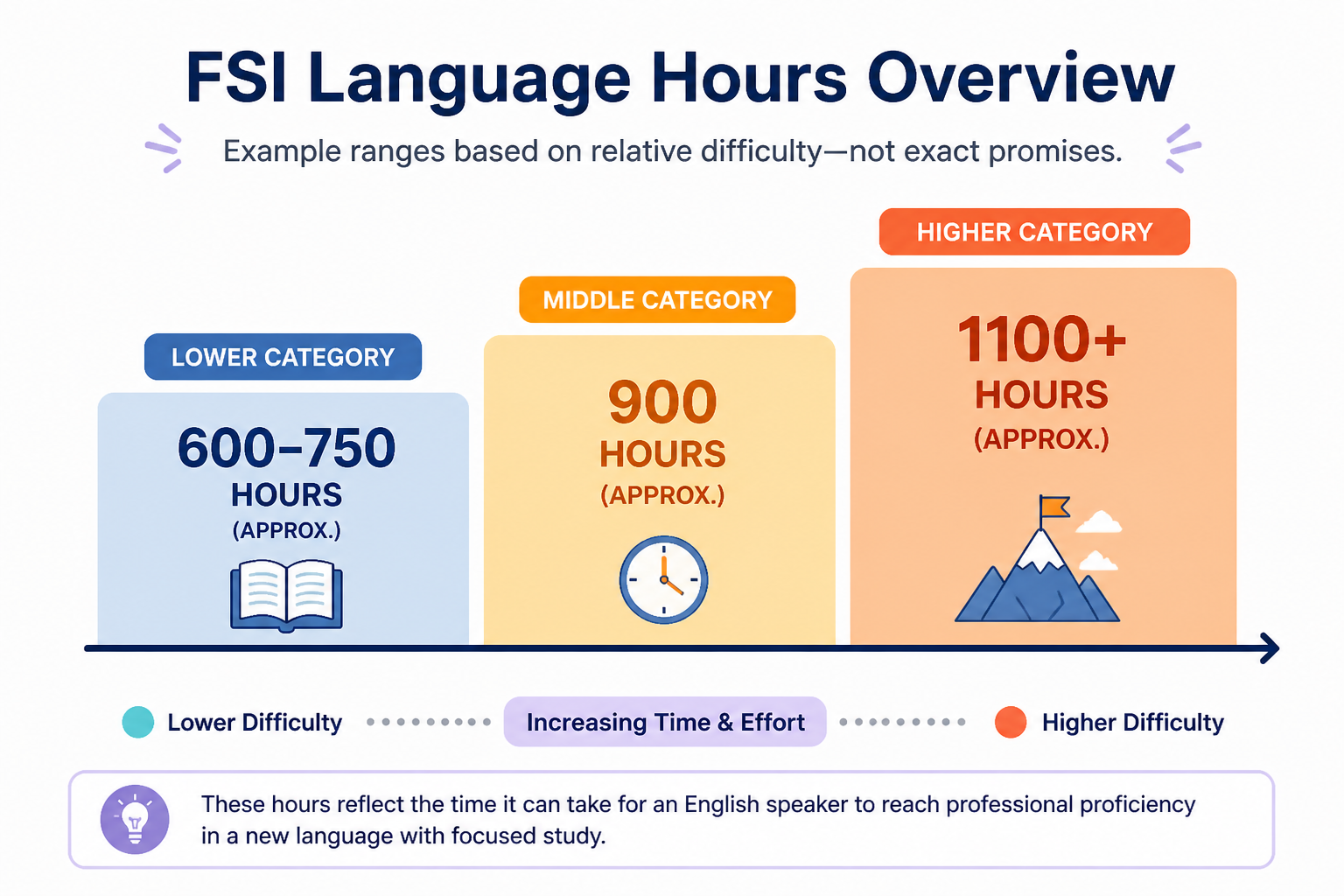
The U.S. Foreign Service Institute groups languages into categories based on how long they usually take for native English speakers to reach professional working proficiency. The more structurally and linguistically distant a language is from English, the more hours are generally required.
Here is the general idea:
| Category | Approximate Hours | General Idea |
|---|---|---|
| Category I | 600–750 hours | Most similar to English |
| Category II | 900 hours | Noticeably harder, but still manageable |
| Category III | 1,100 hours | More complex grammar or structure |
| Category IV | 2,200 hours | Significantly more challenging for English speakers |
These numbers are often quoted as if they apply to everyone equally. They do not. They are averages built around intensive language learning conditions and a specific target outcome. Your actual experience can be faster, slower, or wildly different depending on how you study and what you need to do with the language.
What “Hard” Means in a Language
When people ask how hard a language is, they usually mean one of four things:
- How hard is it to pronounce?
- How hard is it to understand grammar?
- How much memorization does it require?
- How long until I can actually use it?
FSI hours mostly measure the last one: time to reach functional professional proficiency. But “hard” can show up in different places.
A language might have:
- simple grammar but tricky pronunciation
- familiar words but a confusing writing system
- complicated grammar but very predictable spelling
- easy listening practice availability but limited speaking opportunities
So when you see a number, ask: hard in what way? A language that is hard to pronounce is not automatically hard to read. A language with difficult grammar is not automatically impossible to speak at a basic level.
Why FSI Hours Are Useful, But Not Perfect
FSI hours are useful because they reflect a real-world learning environment: serious study, guided practice, and enough time to build competence. That makes them more helpful than vague claims like “this language is easy” or “this language is impossible,” which are usually just people describing their own experience with dramatic flair.
But there are limits.
- They are designed for native English speakers. If you already speak another related language, your experience may be very different.
- They focus on professional proficiency. Many learners do not need that level.
- They assume fairly intensive study. Casual learning takes longer.
- They do not measure motivation, method, or access to practice.
If you want a more personal estimate, FSI hours should be combined with your target level. That is where a guide like CEFR language levels explained becomes very useful. Knowing whether you want A2 conversation skills, B1 travel independence, or C1 professional ability changes the whole picture.
A Simple Way to Read FSI Hours Without Overthinking It
Here is the simplest way to interpret the numbers:
- Lower category: fewer study hours, usually more structural overlap with English
- Middle category: moderate difficulty, with some noticeable hurdles
- Higher category: much more time needed, often because of grammar, vocabulary distance, writing system, or all three
You do not need to memorize the exact hour count for every language. What matters is the pattern. The farther a language is from English in structure, sound, and writing, the more time you should expect to invest.
What Makes a Language Easier or Harder for English Speakers
FSI estimates are based on several kinds of difficulty. Understanding these helps you judge whether a language will feel easy or hard for you.
1. Vocabulary similarity
If a language shares many words with English, you get a head start. Cognates can make reading and memorizing feel much easier. You are not learning every word from scratch.
For example, if you can recognize familiar-looking words quickly, your early progress often feels faster. That said, familiar vocabulary can also be sneaky. Some words look similar but mean something different, which leads to embarrassing and memorable mistakes. The kind your brain saves forever, naturally.
2. Grammar distance
Grammar matters a lot. If the language uses sentence structures, tense systems, or agreement rules that are close to English, learners usually progress faster. If it uses very different patterns, you may need more time to feel comfortable.
Grammar difficulty is not just about how many rules exist. It is also about how many rules you must remember while speaking in real time. A language can seem easy in a workbook and suddenly become much harder during a live conversation. That is normal.
3. Pronunciation and listening
Some languages are readable but not easy to hear. Others are easy to pronounce once learned, but difficult to distinguish by ear at first. If sounds do not exist in English, your mouth and ears need training.
This is one reason a language can feel harder than its vocabulary suggests. You may know the words on paper and still struggle to recognize them in speech.
4. Writing system
If the writing system is familiar, your first steps are easier. If it is new, you need extra time for reading, typing, and visual recognition. This does not mean the language itself is “harder” in every way, but it does add another layer of learning.
5. Practice environment
A language that you can hear, read, and use often will usually feel easier than one you only study for 20 minutes a day without any real exposure. Frequency matters. So does consistency. So does having a reason to care beyond “because the app told me to.”
FSI Hours and CEFR: How the Two Systems Fit Together
FSI hours and CEFR levels measure different things, but they can work together nicely.
FSI hours answer: How much study does this language usually take?
CEFR answers: What can I do with the language at each stage?
That distinction is incredibly useful. A learner may want “conversational fluency,” but that phrase is vague. CEFR gives clearer checkpoints, while FSI gives a broad estimate of effort.
| System | Focus | Best Use |
|---|---|---|
| FSI hours | Estimated study time | Comparing difficulty and planning effort |
| CEFR levels | Ability and performance | Setting milestones and tracking progress |
If you want to choose a realistic target, pair this article with CEFR language levels explained. That gives you both the destination and the rough travel time.
How to Think About FSI Hours in the Real World
Here is where many learners get tripped up: they think the FSI number is the amount of time they must study before they “can speak.” That is not how language ability works.
In reality, language learning has layers:
- Survival stage: greetings, simple questions, basic needs
- Functional stage: everyday conversations, routine tasks, common listening
- Independent stage: longer conversations, reading with support, more natural speech
- Professional stage: comfortable use in formal or work settings
FSI hours are mostly aimed at the higher end of that range. But many learners do not need professional proficiency. If your goal is travel, personal interest, or casual conversation, you may need far fewer hours to feel successful.
That is why it is smart to define success before you count hours. Otherwise you end up studying toward a moving target, which is a wonderful way to feel tired and confused.
What an FSI Hour Estimate Can Tell You About Difficulty
Use the number as a signal, not a prophecy.
Here is a practical interpretation:
- 600–750 hours: The language may be relatively approachable for English speakers, especially if you study regularly.
- 900–1,100 hours: Expect real work. Progress is still very achievable, but you will need a plan.
- 2,200 hours: Expect a long-term project. This does not mean “too hard,” only that the path is longer and more demanding.
If a language is in a higher category, it does not mean you should avoid it. It just means you should stop expecting quick results from casual effort. The language is not being mean. It is just expensive in time.
The Biggest Mistakes Learners Make With FSI Hours
FSI numbers are helpful, but they are also easy to misuse. Here are the most common mistakes.
Mistake 1: Treating the number like fate
People see 2,200 hours and panic. Or they see 600 hours and assume the language will basically teach itself while they watch one video and half-read a menu.
Fix: Treat the number as a planning tool. Ask what kind of learning habits would make that estimate smaller or larger in your own life.
Mistake 2: Ignoring your own language background
FSI estimates are based on native English speakers. If you already speak a related language, you may have advantages the chart does not capture. If you are a beginner with no prior language-learning habits, the chart may still underestimate how hard the process feels at first.
Mistake 3: Confusing recognition with ability
Recognizing words in a lesson is not the same as using them in real life. Many learners feel “I know this language” because they understand a passage with support, then freeze when asked to speak.
Fix: Test yourself in the four core skills: listening, speaking, reading, and writing. Difficulty often shows up unevenly.
Mistake 4: Studying inconsistently
FSI hours assume sustained effort. Long gaps between study sessions slow down memory and make review heavier.
Fix: Build a realistic habit first. A smaller daily routine often beats occasional heroic study marathons.
Mistake 5: Chasing fluency before building a base
Many learners want conversation immediately but skip the part where the language stops feeling like mysterious noise and starts feeling familiar.
Fix: Focus on building a strong foundation in high-frequency words, core grammar patterns, and simple listening practice.
A Better Way to Use FSI Hours for Your Own Learning Plan
Instead of asking, “How hard is this language?” ask these three questions:
- What level do I actually need?
- How much time can I realistically study each week?
- What kind of difficulty will matter most for me?
Once you answer those, FSI hours become much more helpful.
For example, if your target is casual travel conversation, you probably do not need the same time investment as someone aiming for a professional presentation role. If your goal is reading novels, your study focus will be different from someone who mainly needs speaking practice.
This is why comparing estimated hours without defining your goal can be misleading. “Hard” changes depending on what you want to do.
A Simple Decision Tree for Interpreting Difficulty
Use this quick mental check when you are evaluating a language.
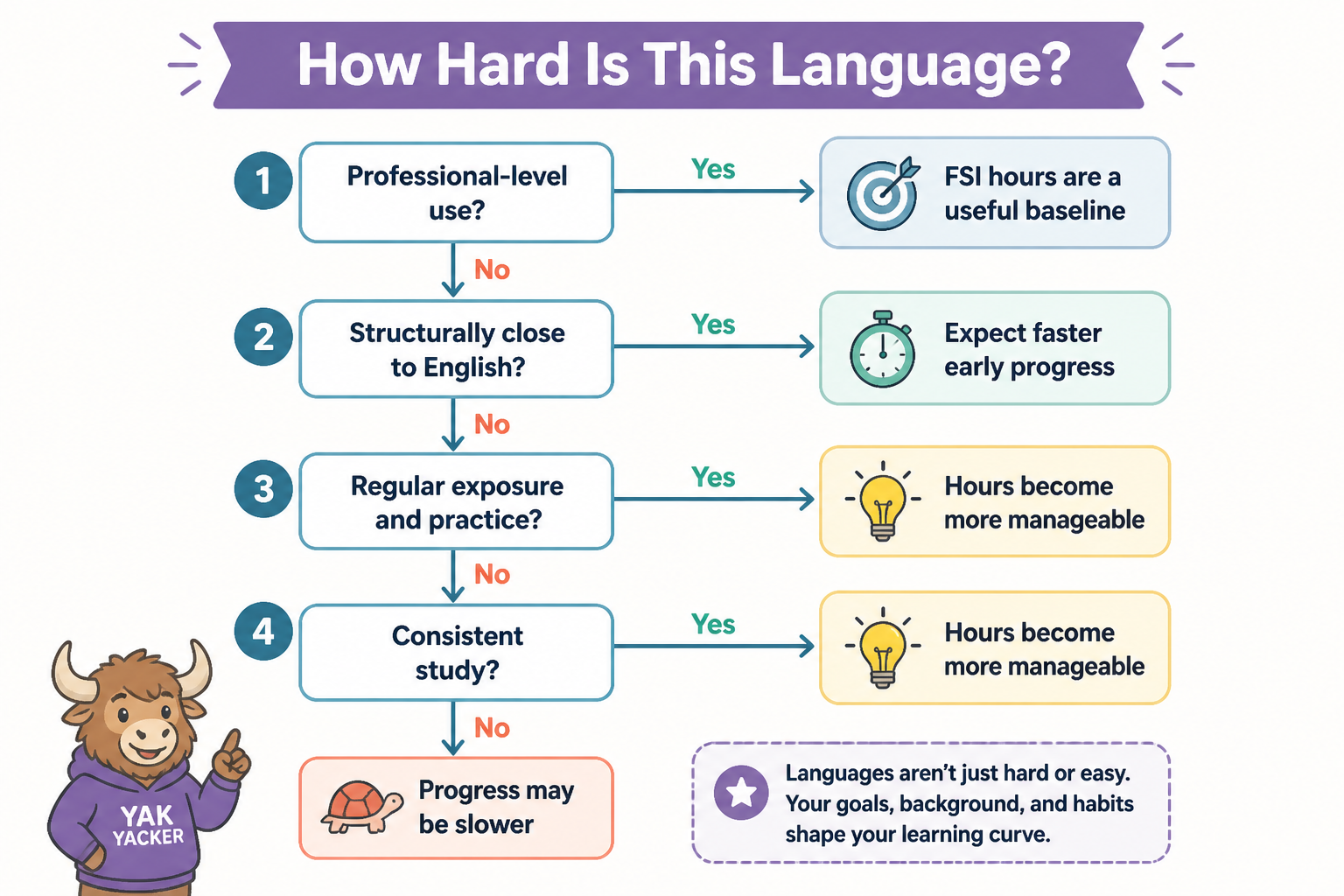
- Do you need professional-level use?
- If yes, FSI hours are a useful planning baseline.
- If no, your real target may be much lower.
- Is the language structurally close to English?
- If yes, expect faster early progress.
- If no, expect more time for basic comfort.
- Do you have regular exposure and practice?
- If yes, the language may feel easier than the FSI number suggests.
- If no, progress will likely be slower.
- Are you studying consistently?
- If yes, the hours become more manageable.
- If no, the estimate becomes less useful.
How Much of the FSI Estimate Is About You, Not the Language?
A lot, actually.
Two people can study the same language and have very different experiences. One learner may have:
- strong memory for vocabulary
- good listening patience
- lots of daily exposure
- a good study system
Another learner may have:
- very limited time
- anxiety about speaking
- few opportunities to hear the language
- inconsistent study habits
Same language. Very different difficulty. That is why the most honest answer to “How hard is this language?” is usually: It depends on the learner, the goal, and the method.
If you want to improve the method side of the equation, the best way to learn a language is a useful companion guide.
What FSI Hours Do Not Tell You
FSI hours do a decent job of comparing broad difficulty, but they leave out a lot.
- They do not tell you whether the language is fun for you.
- They do not tell you how useful it will feel in your daily life.
- They do not tell you whether speaking opportunities are easy to find.
- They do not tell you which skill will be hardest for you personally.
- They do not tell you how to study efficiently.
That last one matters a lot. A language may be “hard,” but the wrong study method can make it feel much harder than it really is. On the other hand, a good method can make a challenging language far more manageable.
How to Make a Hard Language Feel Easier
If the FSI estimate is high, do not panic. High hours do not mean hopeless. They just mean you need to be smarter about your process.
1. Start with the highest-value words and phrases
Focus on the most common, most useful language first. That gives you a faster return on your effort and helps you understand more real content sooner.
2. Practice little and often
Short, frequent sessions often beat long, rare ones. Memory likes repetition, not dramatic one-day efforts followed by disappearance.
3. Mix input and output
Listening and reading build recognition. Speaking and writing build active control. You need both if you want the language to feel usable.
4. Use repetition wisely
Words and structures stick when you meet them again and again in different contexts. Repetition is not boring when it is working. It is just the brain quietly doing its job.
5. Make the language part of your routine
The easiest language to learn is often the one you see every day. A language that fits naturally into your habits becomes less intimidating over time.
For a more practical approach to speed and consistency, how to learn a language fast offers methods that pair well with the hour estimates in this guide.
A Practical Example: Turning FSI Hours Into a Study Plan
Let us say you are looking at a language that falls into a higher difficulty range. That sounds intimidating until you break it into manageable pieces.
Instead of thinking:
“2,200 hours is enormous. I will never do that.”
Try this:
- Step 1: Decide what level you need.
- Step 2: Estimate your weekly study time.
- Step 3: Identify the biggest challenge: sounds, grammar, reading, or conversation.
- Step 4: Choose one main method for input and one for output.
- Step 5: Review progress every few weeks and adjust.
This approach turns a huge number into a sequence of small decisions. That is how difficult languages stop feeling mysterious and start feeling trainable.
Common Reactions People Have to FSI Hours
When learners first see the numbers, they often fall into one of these reactions:
- “Great, so I know exactly how long it will take.”
- “Nope, impossible.”
- “I must be bad at languages.”
- “I should only study the easiest languages.”
All four reactions miss the point.
The real takeaway is simpler: some languages require more time than others, and smarter study habits matter a lot. A high-hour language is not a personal failure. It is just a bigger project.
How to Know Whether a Language Is Worth It for You
Difficulty should not be your only filter. A language can be hard and still be the perfect choice for you.
Ask yourself:
- Do I actually care about this language?
- Will I have reasons to use it regularly?
- Can I imagine staying motivated for months, not just days?
- Does learning it support my travel, work, family, or personal interests?
Motivation does not erase difficulty, but it helps you survive it. And that is often the difference between “I studied for two weeks” and “I actually learned something.”
Quick Reference: How to Read the FSI Number
Here is the short version you can keep in your head:
| If the number is… | What it usually means | What to do with that information |
|---|---|---|
| Lower | Fewer hours to reach professional proficiency | Still build good habits; do not assume it will be effortless |
| Middle | Moderate challenge and moderate time investment | Use a clear study plan and regular review |
| Higher | More time, more repetition, more patience required | Break the language into smaller goals and stay consistent |
What to Do Next If You Are Choosing a Language
If you are using FSI hours to choose a language, do not stop at the number. Use the number as one input among several.
- Check the expected time commitment.
- Compare that with your weekly availability.
- Think about your real target level.
- Consider whether you enjoy the sound, structure, or practical use of the language.
- Choose the language you can stick with, not just the one that looks easiest on paper.
If you are still deciding how to structure your path, it helps to revisit the basics of planning on the main how to learn a language guide. That gives you a bigger-picture framework for turning difficulty into a workable plan.
Final Takeaway: FSI Hours Are Useful, Not Judgemental
FSI language hours are a helpful way to estimate how much work a language may take for an English speaker. They are not a measure of your intelligence, your talent, or your future success. They are simply a rough guide to the amount of effort usually involved in reaching a high level of proficiency.
So if you are asking, “How hard is this language?” the best answer is:
- Use FSI hours to gauge the general difficulty.
- Use CEFR levels to define your target.
- Use a realistic study method to control the actual experience.
- Use consistency to make the hours work in your favor.
That is the real secret. The language may be difficult, but the path becomes much easier when the estimate is honest, the goal is clear, and the study plan is built for real life rather than fantasy.