
Short answer: it depends. Less helpful answer: a lot. More useful answer: it depends on what you mean by learn, which language you’re learning, how much time you can study, and how consistent you are.
That sounds annoyingly vague at first, but it’s actually good news. Language learning is not a mysterious talent contest. It’s a skill with very real inputs: time, quality of practice, and clear goals. Once you understand those pieces, the “how long” question gets much easier to answer.
This guide will help you estimate your timeline in a realistic way, understand the common benchmarks people use, and avoid the biggest time-wasting mistakes. You’ll also see how to turn a vague goal like “I want to speak French” into a practical plan you can actually follow.
First, what does “learn a language” actually mean?
This is the question hiding inside the question. People often ask how long it takes to learn a language when they really mean one of these:
- How long until I can have basic conversations?
- How long until I can travel and handle everyday situations?
- How long until I can work in the language?
- How long until I sound fluent?
- How long until I can read books or watch shows without much effort?
Those are very different targets. If you don’t define the finish line, every estimate will feel either too optimistic or too depressing.
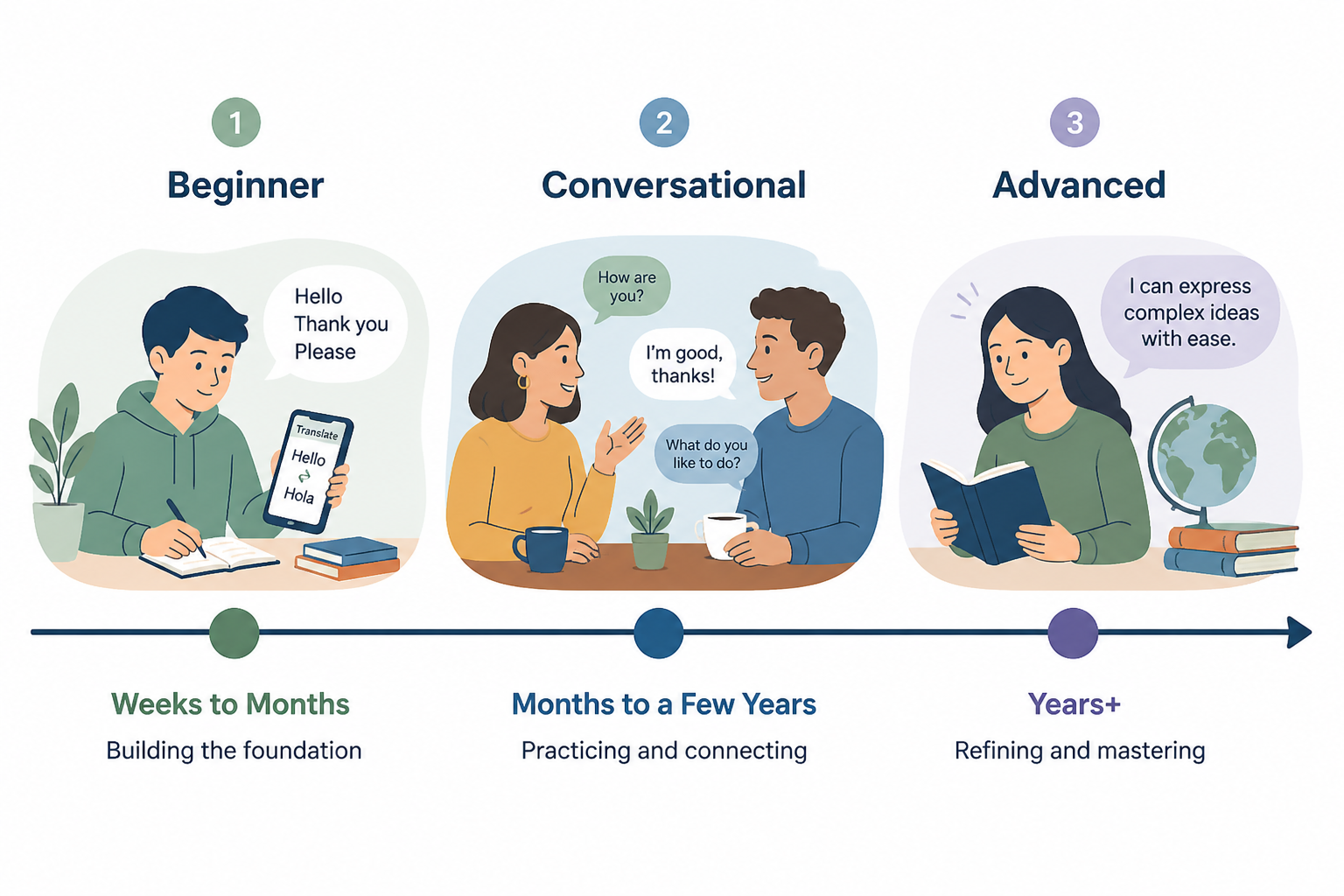
A better way to think about it is to separate survival communication, comfortable conversation, and professional or near-native use.
| Goal | What it usually looks like | Rough timeline for many learners |
|---|---|---|
| Basic survival | Greetings, simple questions, ordering food, asking for help | A few weeks to a few months |
| Everyday conversation | Talking about routine topics, asking follow-up questions, handling common situations | Several months to 1–2 years |
| Confident intermediate use | Longer conversations, opinions, stories, work-related basics | 1–3 years |
| Advanced or near-fluent use | Complex discussions, nuance, professional tasks, reading with ease | Several years |
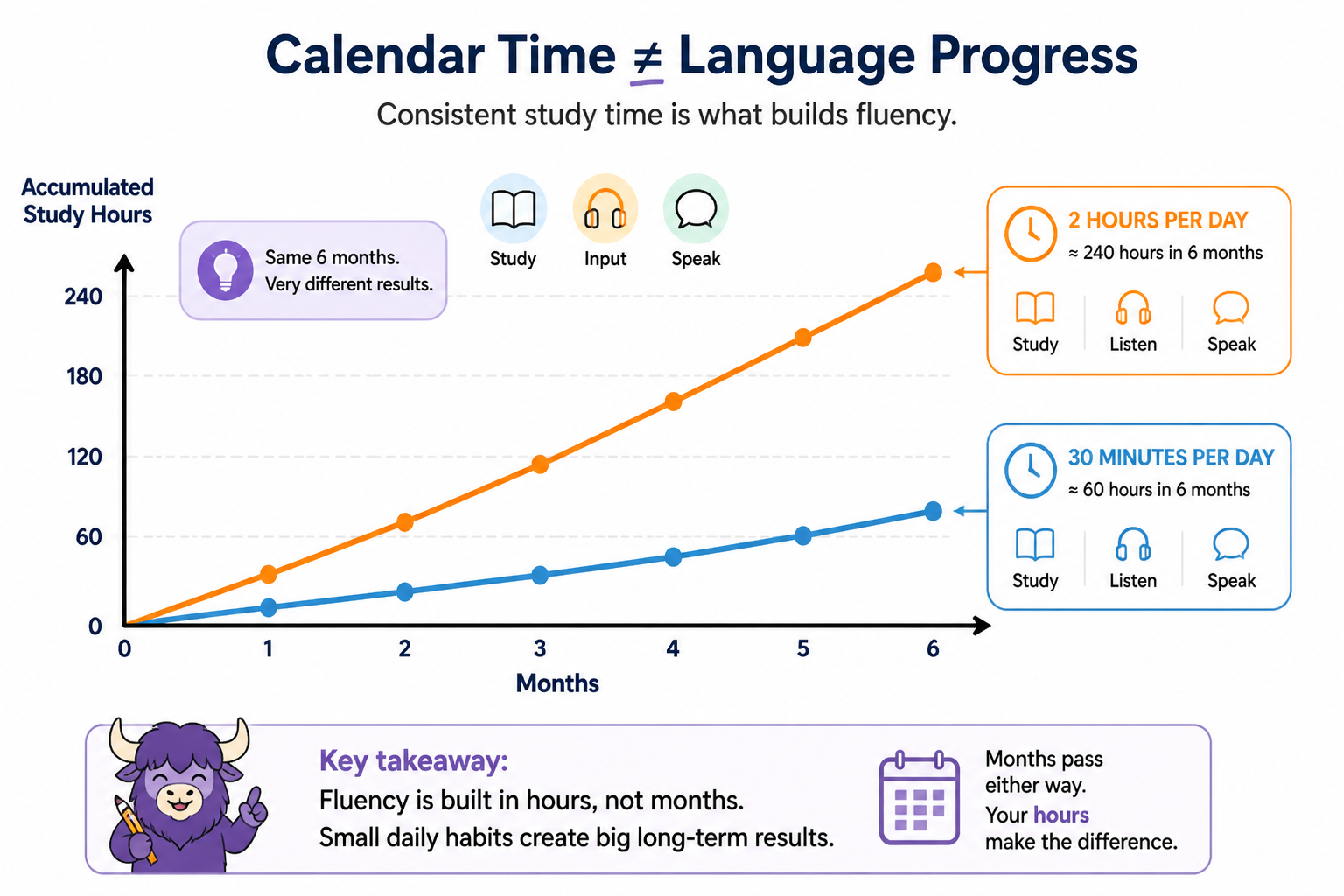
These are not promises. They’re rough reality checks. A learner studying 30 minutes a day will move very differently from someone studying two hours a day, speaking with native speakers, and getting lots of input.
The biggest factor: how many hours you actually put in
The cleanest way to estimate language-learning time is by hours. Not because hours are everything, but because they’re measurable. Motivation is nice. Hours are better.
One hour of focused study usually beats three hours of distracted “I had the app open while checking my phone” time. Consistency matters too. Thirty minutes a day for a year often produces better results than cramming on weekends and disappearing for two weeks.
That’s why people often talk about estimated study hours instead of calendar time. Two learners can both say, “I started in January,” but one has logged 50 hours and the other has logged 500. They will not be at the same level, and that’s completely normal.
A simple formula you can use
If you want a rough estimate, use this:
Time to goal = total hours needed ÷ hours studied per week
For example, if your target level seems to need about 400 hours and you study 5 hours per week, the math says:
400 ÷ 5 = 80 weeks, or about 1.5 years.
That’s not a guarantee, but it gives you a much more realistic picture than “I’ll be fluent by summer.” Summer, unfortunately, remains unbothered by our dreams.
Why some languages take longer than others
Not all languages are equally difficult for every learner. Your native language matters. So does the writing system, pronunciation, and how much exposure you get outside of study time.
For English speakers, some languages are usually faster to reach a basic conversational level because they share vocabulary or structure with English. Others take longer because they are more distant in grammar, sounds, or script.
The point is not to label languages as “easy” or “hard” in some absolute sense. It’s to recognize that your starting point changes the timeline.
| Factor | Why it changes the timeline |
|---|---|
| Similarity to English | Shared words and familiar grammar can speed up early progress |
| Writing system | Learning a new script adds time at the beginning |
| Pronunciation | New sounds take practice and can slow speaking confidence |
| Grammar distance | More unfamiliar structures usually mean more study time |
| Exposure | More listening, reading, and speaking practice accelerates growth |
| Consistency | Regular contact with the language beats irregular bursts |
So when people ask, “How long does it take to learn a language?” the honest response is often, “Which language, for whom, and for what goal?”
What realistic timelines look like
Most learners don’t need perfect fluency. They need useful ability. That means it helps to think in stages.
Stage 1: Survival basics
This is the point where you can handle simple, high-frequency situations. You know how to greet people, ask for repetition, say where you’re from, order basic food, and understand a few common phrases.
Many learners can reach this stage in weeks or a few months with steady practice. It’s a great early win because it makes the language feel real instead of imaginary.
Typical signs you’re here:
- You recognize common words and phrases automatically
- You can introduce yourself and answer simple questions
- You can ask for help when you get stuck
- You understand some routine speech if it’s slow and clear
Stage 2: Everyday conversation
This is where the language starts becoming genuinely useful. You can talk about daily routines, plans, opinions, hobbies, and simple experiences. You still make mistakes, but the conversation keeps moving.
For many learners, this stage takes months to a couple of years. The timeline depends heavily on how much speaking and listening practice you get, because comprehension and conversation require more automaticity than memorized phrases.
Typical signs you’re here:
- You can keep a conversation going beyond one or two lines
- You can understand the main point of slower natural speech
- You can describe what you want, what you did, and what you think
- You can recover when you don’t know a word
Stage 3: Confident intermediate use
At this stage, the language starts feeling like a tool rather than a subject. You can discuss familiar topics with more detail, follow longer conversations, and use the language for real tasks like studying, travel planning, or work basics.
This is often the stage where learners feel both proud and frustrated. Proud because they’re doing real things. Frustrated because they can now see how much they still don’t know. That’s not failure. That’s just what progress looks like when the training wheels come off.
Stage 4: Advanced or near-fluent use
This stage takes much longer because the gains become smaller and more refined. You’re no longer just learning to communicate. You’re learning to communicate with precision, nuance, speed, and flexibility.
That means advanced progress is often slower than beginner progress, even though it’s still progress. A learner may go from zero to surviving a trip in months, but the jump from “pretty good” to “very polished” may take years.
Why people think language learning takes forever
Language learning feels slow for a few very normal reasons.
1. The early wins are small. You don’t become “fluent” after learning your first 50 words, even though that’s a meaningful start.
2. Progress is uneven. You may understand much more than you can produce. Then one day, speaking improves suddenly. Then listening catches up later.
3. There are too many skills at once. Vocabulary, grammar, pronunciation, listening, reading, speaking, and memory all develop on different schedules.
4. People compare themselves to impossible examples. Social media is full of “I learned in 3 months” stories that leave out the details. Sometimes those people already knew a related language. Sometimes they studied full-time. Sometimes they meant “I can introduce myself and order coffee.”
5. The brain needs repetition. Language sticks through repeated exposure, not one heroic study session. That can feel painfully unglamorous. Learning is rarely a movie montage.
How long different study schedules usually take
Instead of guessing, use your weekly time budget. Here’s a practical way to think about it.
| Weekly study time | What it usually means | What you can expect |
|---|---|---|
| 3–5 hours | Slow, steady hobby pace | Progress, but likely gradual and long-term |
| 5–10 hours | Serious part-time learning | Good results if you stay consistent |
| 10–15 hours | Strong part-time commitment | Noticeable progress in months, not years, for basic goals |
| 20+ hours | Very intensive study | Much faster growth, especially if speaking and input are included |
A few important notes:
- Hours need to be reasonably focused.
- Passive exposure helps, but active practice usually matters more for speaking and writing.
- “Study time” should include listening, speaking, reading, review, and practical use—not just flashcards.
If you want a realistic answer for yourself, don’t ask, “How long does it take to learn a language?” Ask, “How many hours per week can I truly keep up for the next six months?” That question is much more useful.
What an efficient learning path looks like
Time matters, but how you spend it matters just as much. Two learners can both study 300 hours and get very different results. One is doing random app exercises and the other is following a structured plan with speaking, listening, and review.
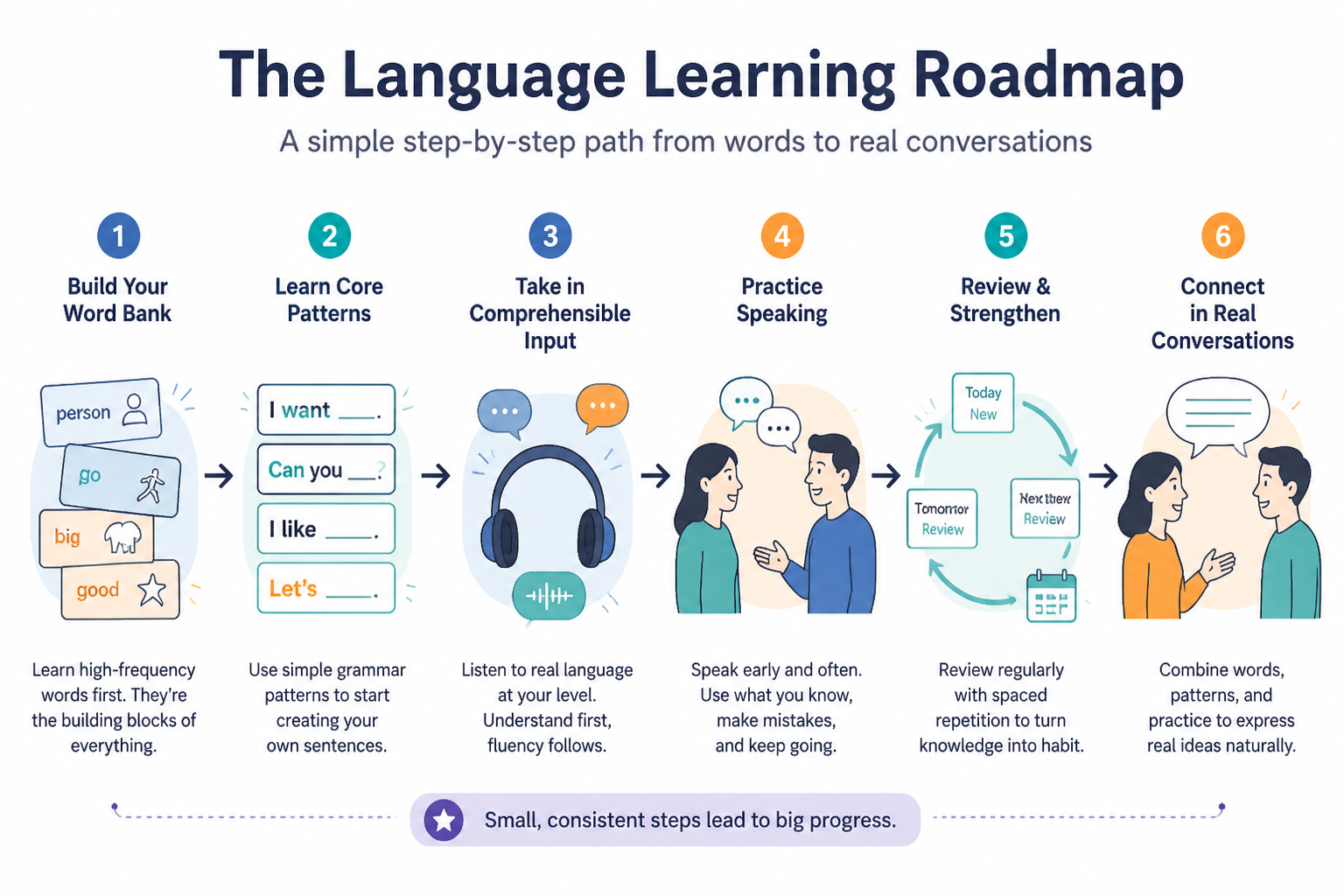
Here’s the basic shape of an efficient path:
- Learn the most useful high-frequency words first
- Master a small set of core grammar patterns
- Listen to lots of understandable language
- Practice speaking before you feel fully ready
- Review regularly so old material doesn’t evaporate
- Build from simple sentences to longer connected speech
If you want a more detailed framework, a language study plan is the best place to start. A plan turns vague effort into repeatable progress.
The role of CEFR levels in estimating time
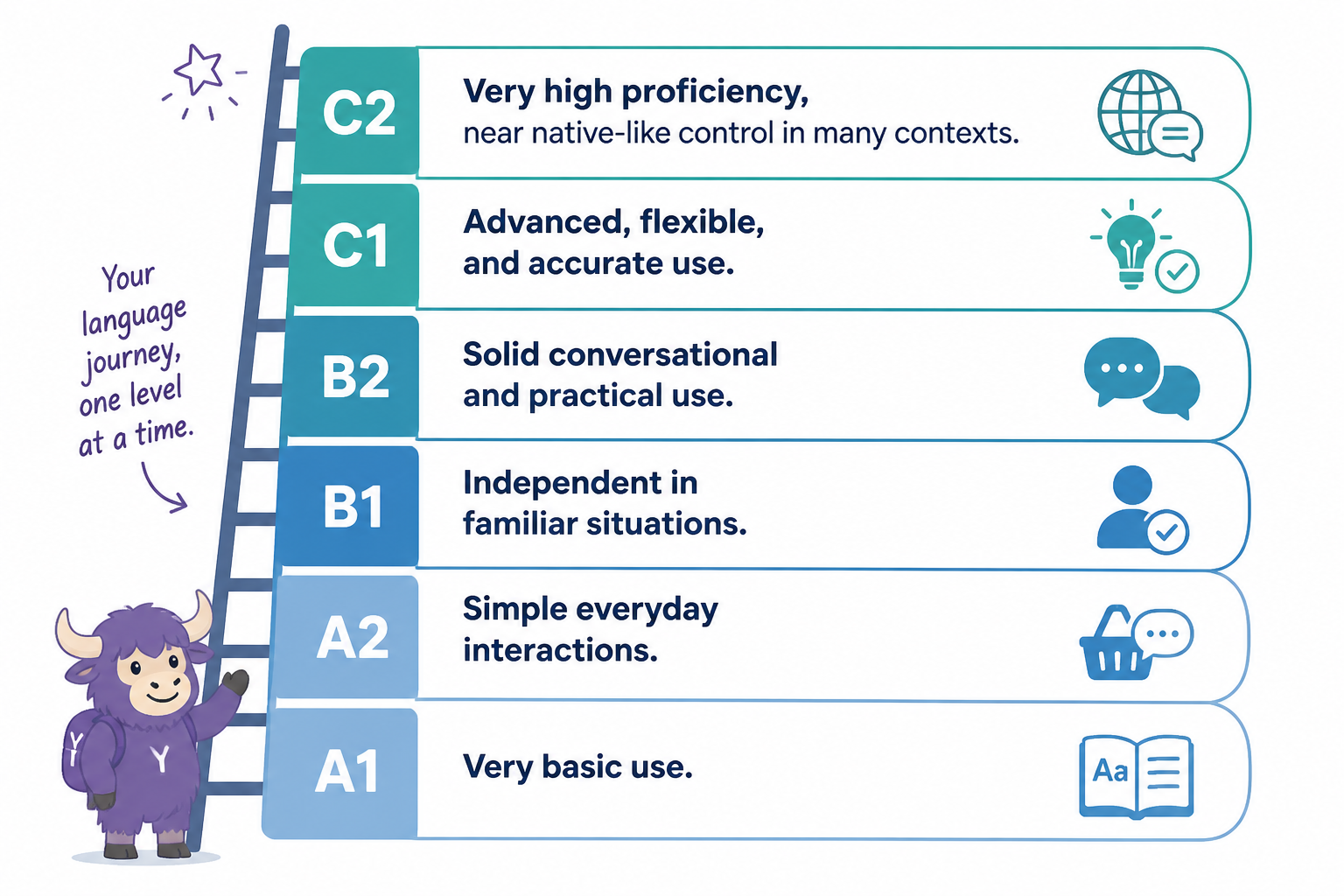
One of the most useful ways to understand language progress is through CEFR levels: A1, A2, B1, B2, C1, and C2. These levels describe what you can do with the language, not just how much you “know.”
That matters because people often say “I’m intermediate” when they actually mean “I can order lunch and survive a hotel check-in.” CEFR gives a clearer picture.
At a high level:
- A1: very basic use
- A2: simple everyday interactions
- B1: independent in many familiar situations
- B2: solid conversational and practical use
- C1: advanced, flexible, and accurate use
- C2: very high proficiency, close to educated native-like control in many contexts
If you want a clearer breakdown of what those levels mean, the guide to CEFR language levels is a helpful companion.
Using CEFR levels makes timeline estimates more honest. For example, “I want B1” is far more measurable than “I want to be good at the language.”
What the FSI estimates do and do not mean
You may have heard of the famous FSI language hour estimates. These numbers are often used to answer how long it takes to learn a language, but they can be misunderstood very easily.
The FSI estimates are best thought of as a rough benchmark for reaching professional working proficiency in certain languages, under specific conditions, usually for English-speaking learners studying intensively.
That is very different from casual learning, travel readiness, or “I can chat with friends.”
Why people like the FSI estimates:
- They give a concrete hour range
- They remind learners that time requirements differ by language
- They set expectations for ambitious goals
Why people misuse them:
- They assume the estimate applies to every learner
- They treat the number like a deadline instead of a rough guide
- They confuse professional proficiency with everyday conversational ability
If you want to understand those numbers in context, the page on FSI language hours is useful background.
The key takeaway is simple: estimates are informative, not fate.
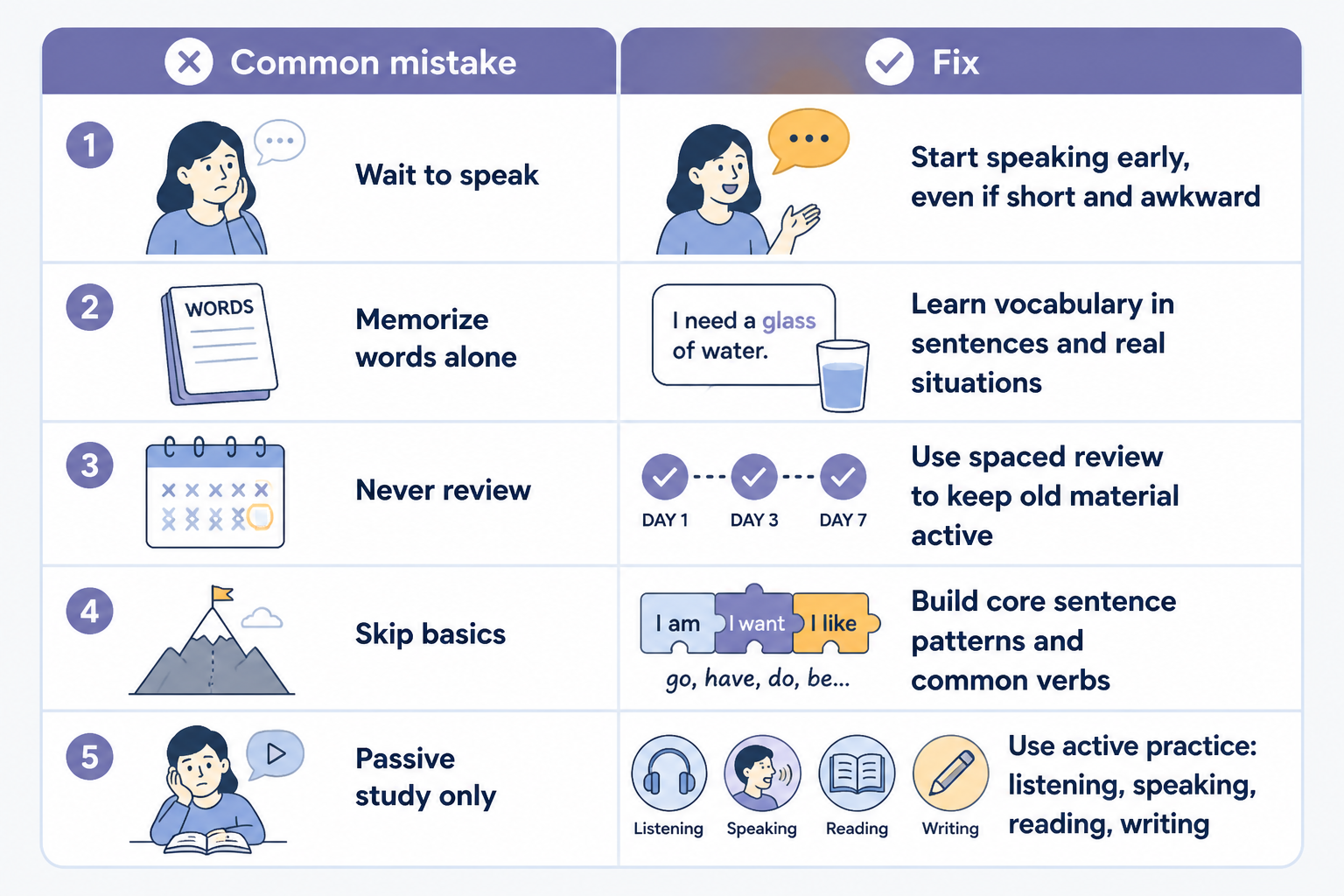
Common mistakes that make language learning take much longer
Some learners think they are “bad at languages” when the real issue is a bad method. That’s fixable.
1. Studying only when you feel motivated
Motivation is unreliable. It comes and goes like a squirrel with a calendar. Consistency wins.
Fix: build a schedule that is small enough to keep. Even 20 minutes a day is useful if you actually do it.
2. Focusing on too many resources
If you’re using five apps, three YouTube channels, two textbooks, and a spreadsheet, you may be organizing more than learning.
Fix: pick a small core system and stick with it long enough to see results.
3. Waiting too long to speak
Many learners try to become “ready” before speaking. The problem is that speaking is what makes you ready.
Fix: start with simple speaking early, even if it’s short and awkward.
4. Learning words without context
Vocabulary lists are not useless, but words are much easier to remember when they appear in sentences and real situations.
Fix: study words in context and practice using them.
5. Ignoring review
Forgetting is normal. If you never review, you’ll keep re-learning the same material.
Fix: schedule review sessions so old content stays alive.
6. Avoiding “boring” basics
Some learners skip simple patterns because they want exciting progress. But the basics are the scaffolding that holds everything else up.
Fix: spend enough time on core sentence patterns, common verbs, and everyday topics.
How to make your learning time go farther
Not all hours are equal. A focused hour of active practice can produce more progress than a distracted afternoon of passive exposure. To make your time count, prioritize the activities that force your brain to work with the language.
High-value activities
- Listening to understandable speech
- Speaking out loud, even if you make mistakes
- Reading simple material you mostly understand
- Reviewing vocabulary and phrases in spaced intervals
- Writing short messages, diary entries, or summaries
- Practicing with real-life tasks and prompts
Lower-value activities when used alone
- Watching or listening without understanding anything
- Collecting resources instead of using them
- Passive re-reading without recall
- Doing endless app drills without real application
That doesn’t mean passive exposure is worthless. It means it works best when it supports active use. Listening can train your ear. Reading can build vocabulary. But if you want faster progress, you need some activities that force output and recall.
A realistic timeline for different goals
Let’s make this practical. If your goal is X, what does the time look like?
| Your goal | What it takes | Typical timeline |
|---|---|---|
| Basic travel phrases | Useful vocabulary, simple listening, survival expressions | Weeks to a few months |
| Casual conversations | Common grammar, frequent words, lots of speaking practice | Several months to 2 years |
| Workable independence | Comfort with routine tasks, decent comprehension, flexible speech | 1–3 years |
| Professional use | Specialized vocabulary, accuracy, speed, and confidence | Several years |
| Advanced fluency | Nuance, idioms, subtle listening, broad reading ability | Long-term development |
These timelines assume ordinary adult learning with regular practice. A full-time immersive environment can speed things up. So can a language closely related to one you already know. On the other hand, irregular study or very limited exposure can stretch the process out significantly.
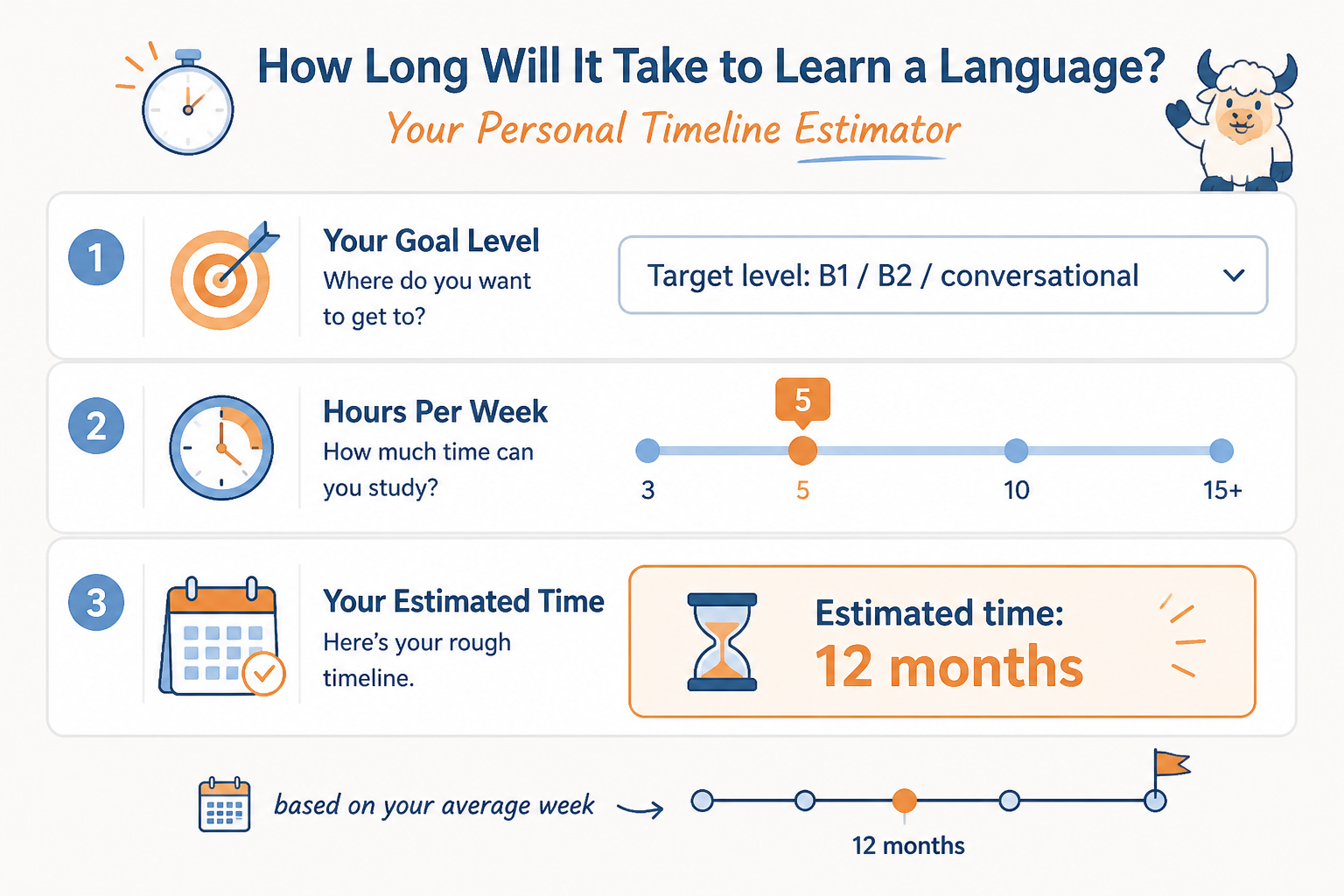
How to estimate your own timeline honestly
If you want a personal estimate, use this simple process.
Step 1: Define the goal
Write one sentence that says what you want to be able to do. For example:
- I want to hold simple conversations while traveling.
- I want to reach B1 so I can talk about everyday life.
- I want to work in the language in my field.
Step 2: Pick a level, not a fantasy
If you don’t know the exact level, choose the closest practical stage. Often the answer is not “fluent.” It’s more like “comfortable at B1” or “solid at B2.”
Step 3: Estimate weekly hours
Be honest. Not your best week. Your average week.
- Can you do 3 hours?
- 5 hours?
- 10 hours?
- 15 hours or more?
Step 4: Multiply out the months
Once you know the rough hours needed for your goal, divide by your weekly study time. Then turn that into months or years. That estimate will already be much more reliable than a vague “someday.”
Step 5: Adjust for your reality
Think about whether you’ll have speaking practice, whether you’ll hear the language outside study, and whether your schedule is likely to stay stable. If not, increase the estimate a bit. Reality likes to have a say.
A sample realistic learning journey
Here’s what a steady learner’s progress might look like over time.
| Time spent | Possible progress |
|---|---|
| First 20–50 hours | Basic phrases, pronunciation familiarity, survival expressions, first simple conversations |
| 50–150 hours | Common vocabulary, basic grammar patterns, more listening comprehension, short conversations |
| 150–400 hours | Routine communication, simple stories, everyday interaction, growing confidence |
| 400–800 hours | Much stronger conversation ability, broader topics, better listening, fewer basic gaps |
| 800+ hours | Deeper comprehension, more complex discussion, improved speed and accuracy |
Again, these are not exact. But they help show why “learning a language” is not one single moment. It’s a series of stages. And each stage gets you something useful.
What to focus on first if you want faster results
If you’re short on time, prioritize in this order:
- High-frequency words and phrases — the stuff that appears everywhere
- Core grammar — the patterns that let you build sentences
- Listening — so the language becomes familiar and understandable
- Speaking — so you can use what you know under real conditions
- Review — so your progress stays in your head
This order is not the only possible order, but it works well for many learners because it balances usefulness and momentum. You want early wins, but you also want habits that keep paying off.
When to expect plateaus
Every learner hits a point where progress feels slower. Usually, nothing is wrong. You’ve just moved past the beginner boost.
Plateaus often happen when:
- the easy vocabulary is already learned
- the grammar gets more complex
- you can understand the general meaning but not the details
- you realize you need more listening and speaking practice than before
The fix is usually not “try harder” in a vague way. It’s usually one of these:
- change your input level so it’s more understandable
- add more speaking practice
- review weak vocabulary in context
- practice the exact skill that feels stuck
Plateaus are not proof that you’ve stopped learning. They’re usually a sign that the next stage needs different work.
How to stay realistic without getting discouraged
It’s easy to swing between two bad extremes. One extreme is magical thinking: “I’ll be fluent in no time.” The other is defeatism: “This will take forever, so why start?”
The healthier middle ground is this: language learning takes time, but the early stages are much more rewarding than people expect. You do not need years before anything useful happens. With a smart approach, you can make real progress quickly.
Try to measure progress by abilities gained, not only by the final destination.
- Can you understand more than last month?
- Can you say more than last month?
- Can you handle a real-life situation you couldn’t before?
- Do your study sessions feel less confusing than they used to?
Those are signs that your time is working.
A simple framework for setting your expectation
Here’s a useful mental model:
Days help you build habits.
Months help you build basic ability.
Years help you build depth and confidence.
If your goal is to travel, “months” might be enough. If your goal is to work professionally, think in “years,” not weeks. If your goal is just to enjoy the process, you have a lot more flexibility than you might think.
That’s why the same language can feel “fast” for one learner and “slow” for another. They are often aiming at different destinations.
The honest answer in one sentence
How long does it take to learn a language? Long enough that you should plan for it seriously, but not so long that you should wait to start.
What to do next
If you want a better estimate for your own situation, do these three things today:
- Choose a concrete goal, like basic conversation, B1, or work use
- Estimate your weekly study time honestly
- Build a plan around the hours you can actually sustain
If you want help making that plan, the guide on how to build a language study plan will help you turn your timeline into a routine.
If you want a clearer understanding of what different milestones mean, check out CEFR language levels explained.
And if you’re curious about the famous hour estimates people quote online, the article on FSI language hours gives that topic the context it deserves.
The important thing is not to wait for the perfect estimate. Start with a realistic one, then learn from what actually happens. Languages reward steady effort far more than dramatic optimism.