What “immersion at home” really means
Immersion at home is the art of surrounding yourself with the language so often, and in such useful ways, that your brain starts treating it as part of normal life. You do not need to move abroad, spend hours on grammar drills, or turn your living room into a pretend classroom. You need repeated exposure, clear input, and enough meaning that your brain can connect words to real situations.
For the broader learning path, visit our parent guide.
In plain English: you are making the language show up in your day before you are “ready” for it. That matters because languages are not learned only by studying them. They are learned by hearing, seeing, noticing, guessing, repeating, and slowly building familiarity. When the language is around you in everyday routines, it stops feeling like a school subject and starts feeling usable.
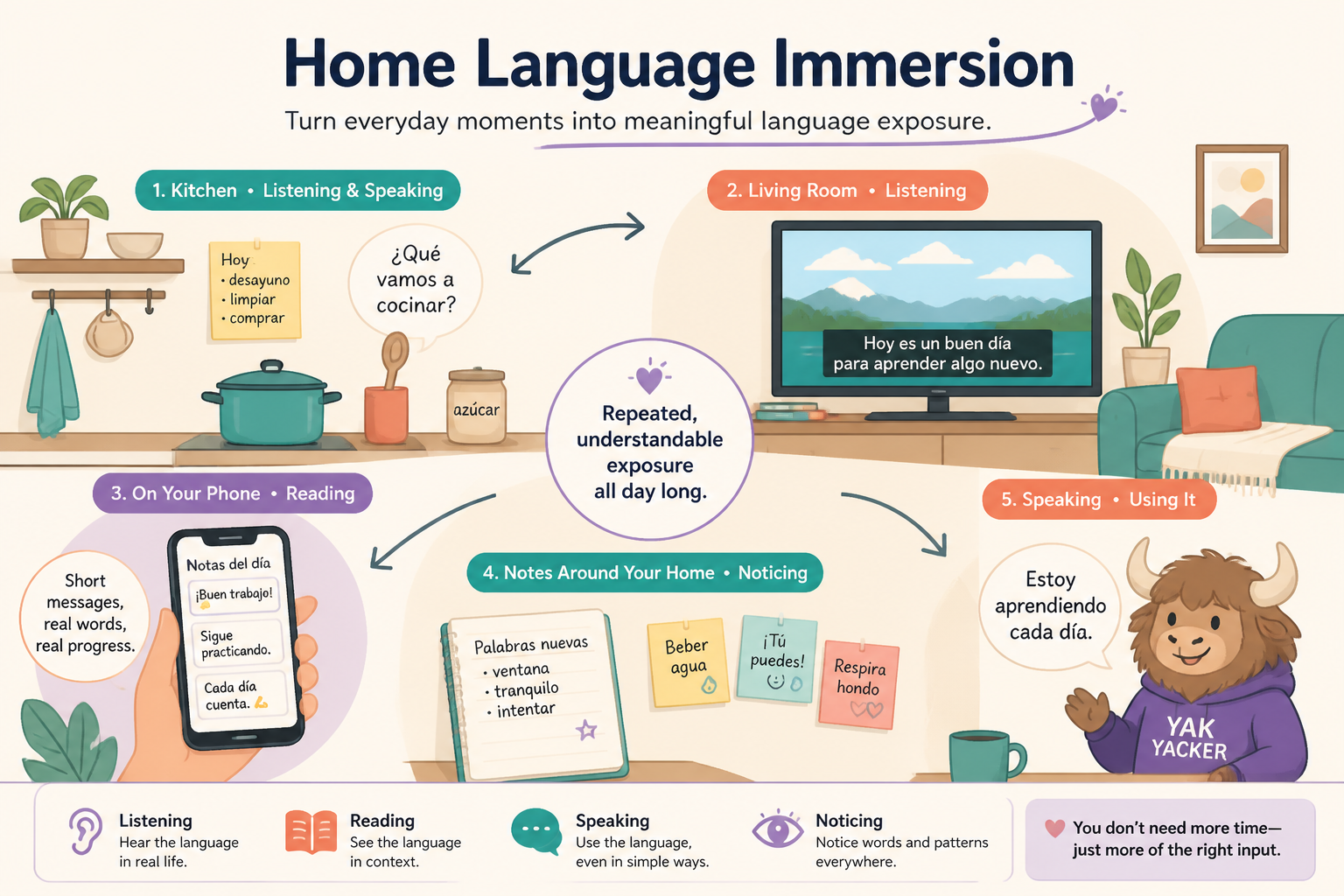
At home, immersion does not mean 100% of your life must be in the target language. That is not realistic for most people, and honestly, it is not necessary. What matters is creating enough high-quality contact that your brain gets frequent, understandable input and a reason to keep paying attention.
Why home immersion works
Home immersion helps because it turns language learning into a habit, not an event. Instead of trying to “study Spanish” for one intense hour and then forgetting about it, you build a language environment that keeps nudging you all day.
That repeated contact does a few important things:
- It makes words feel familiar before you can actively use them.
- It helps you notice patterns without memorizing every rule first.
- It reduces the shock of hearing natural speech.
- It gives you more chances to connect words with actions, objects, and emotions.
- It makes your study time more efficient because the language is already familiar.
For many learners, the biggest obstacle is not effort. It is inconsistency. Home immersion solves that by making the language easy to encounter often, even on busy days.
The big idea: make the language part of normal life
The best home immersion setup is not a perfect one. It is a practical one. You want the language to appear in the places where you already spend time: your phone, your morning routine, your commute, your cooking, your cleaning, your downtime, and your entertainment.
Think of immersion at home as a set of layers:
| Layer | What it does | Examples |
|---|---|---|
| Passive exposure | Gives your brain repeated contact | Labels, music, background listening, wallpapers |
| Guided understanding | Helps you follow meaning | Podcasts for learners, subtitles, graded content |
| Active use | Forces retrieval and production | Speaking aloud, journaling, shadowing, self-talk |
| Routine integration | Makes it stick | Morning app check, evening listening, cooking vocabulary |
You do not need every layer to be intense. You just need enough of each layer to keep the language present and understandable.
Start with your current level, not your dream level
A common mistake is trying to immerse yourself in content that is far above your level. If every sentence feels like a riddle, your brain gets tired and checks out. Real immersion is not about drowning in the language. It is about staying afloat while the language slowly becomes familiar.
Here is the simplest way to think about it:
- Beginner: use short, highly understandable content with lots of support.
- Intermediate: mix learner-friendly content with real content you can mostly follow.
- Upper beginner to lower intermediate: start stretching into natural content, but keep support tools like subtitles, transcripts, or slower audio.
If you want the core principle behind this approach, it helps to understand comprehensible input. The short version is simple: you learn best from language you can understand enough to follow, but that still stretches you a little.
Build your immersion environment room by room
You do not have to redesign your whole home in one afternoon. The easiest approach is to choose a few places where the language will appear naturally and consistently.
1. Make your phone and digital life partly target-language
Your phone is probably the most used language-learning surface in your life, which makes it incredibly useful. You do not need to change every setting at once. Start small.
- Change your phone language only if you can still function comfortably.
- Switch one app at a time.
- Use target-language keyboard shortcuts if helpful.
- Set daily reminders in the language.
- Change your wallpaper to a phrase or image with key vocabulary.
This works because you see the language repeatedly in low-pressure moments. You are not “studying.” You are just living your life with more exposure.
2. Label high-frequency objects
Sticky notes can be surprisingly effective if you use them wisely. The goal is not to label your house like a middle-school classroom project. The goal is to attach useful words to objects you touch every day.
- fridge
- door
- mirror
- chair
- sink
- keys
- charger
Better yet, label things with short phrases, not just single nouns, when that helps memory. For example: “open the fridge,” “wash hands,” “turn off lights.” Action phrases are often more useful than isolated words because they connect language to behavior.
3. Put the language where your habits already are
Do you make coffee every morning? Listen to a short audio clip while you do it. Do you fold laundry? Put on a learner podcast. Do you walk the dog? Use that time for listening practice. If you cook, keep a list of target-language cooking words nearby.
The trick is to attach language to an existing routine instead of trying to create a brand-new habit from scratch. New habits are fragile. Existing habits are sturdy.
Choose the right mix of input
Immersion at home works best when you combine different types of input. Each type teaches something slightly different.
| Input type | Best use | Why it helps |
|---|---|---|
| Podcasts | Listening during routines, walks, chores | Trains your ear and exposes you to natural rhythm |
| Movies and TV | Context-rich understanding | Pairs speech with visual clues and emotion |
| Reading | Vocabulary growth and recognition | Slows language down so patterns become visible |
| Music | Memorable phrases and pronunciation | Repetition makes chunks stick |
| Self-talk and journaling | Active recall and output | Forces you to produce language, not just recognize it |
Use podcasts as your “background immersion”
Podcasts are one of the easiest ways to keep the language in your day without needing a screen. They work especially well during tasks that do not require much attention. If you want a deeper framework, see how to learn a language with podcasts.
Good podcast habits for home immersion:
- Pick short episodes first.
- Repeat episodes instead of always chasing new ones.
- Use transcripts if available.
- Listen once for general meaning, then again for details.
- Keep a note of a few phrases you hear often.
Use movies and subtitles as your “rich context” practice
Movies and shows are powerful because the meaning is not only in the words. You can also read faces, gestures, actions, and setting. That makes them a strong bridge between beginner-friendly material and real speech. For a practical method, the guide on learning with movies and subtitles is especially useful.
The key is not to watch passively forever. Use subtitles strategically. Sometimes you want them on. Sometimes you want to test yourself. Sometimes you want to replay one scene until it makes sense. That is immersion with a purpose, not just background noise.
Design your day around small immersion windows
You do not need a four-hour study block. In fact, most people do better with a few smaller immersion windows that fit naturally into the day.
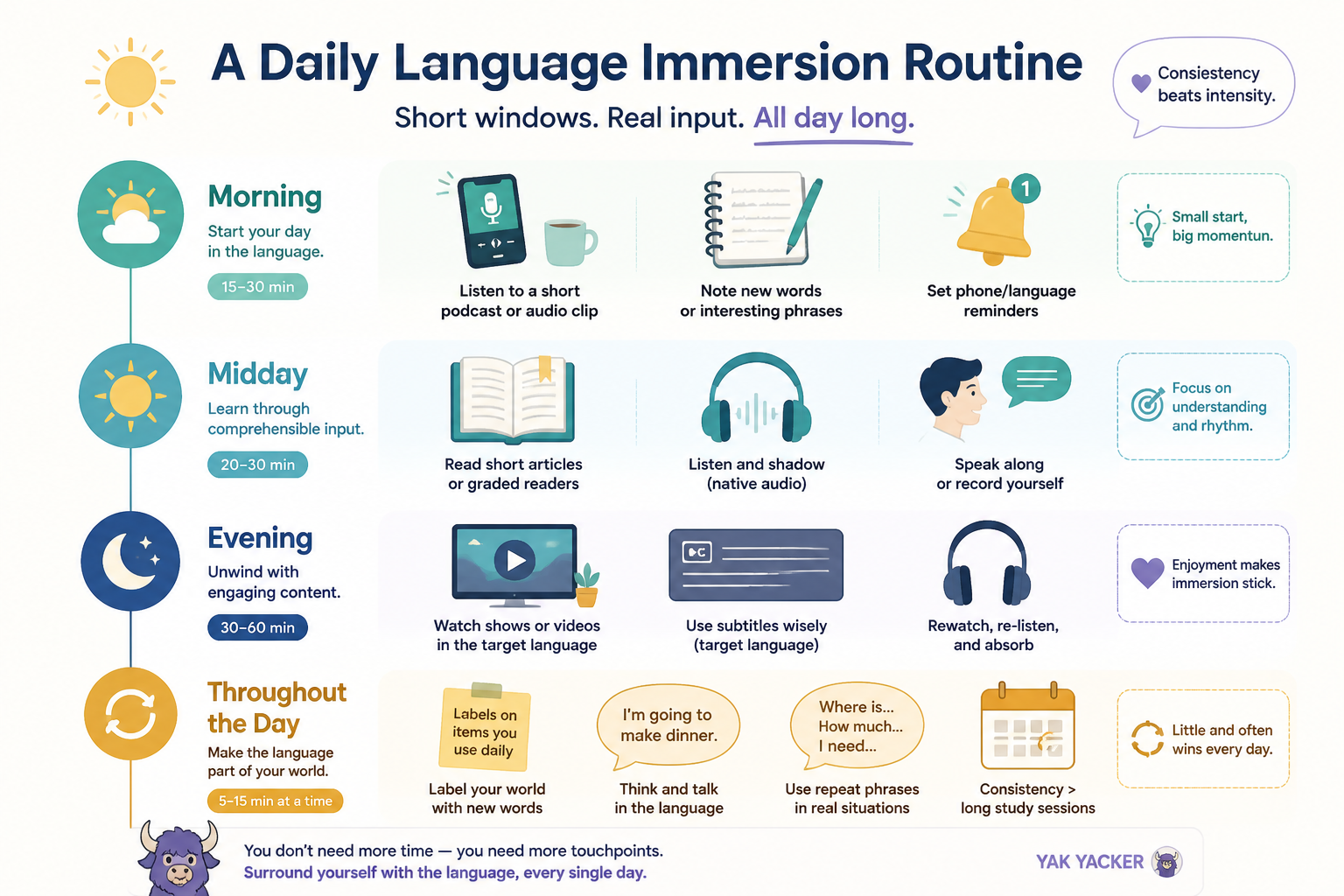
A simple daily structure
- Morning: 5 to 10 minutes of easy exposure, such as a short podcast clip, app notifications, or reviewing a labeled list.
- Midday: 10 to 20 minutes of reading, listening, or shadowing.
- Evening: 20 to 45 minutes of a show, a movie scene, a podcast, or a mixed-input session with notes.
- Throughout the day: small moments of self-talk, labels, and repeated phrases.
This structure works because it spreads input across the day. Your brain sees the language more often, which helps memory and recognition.
A weekend structure
On weekends, you can create longer immersion blocks:
- watch one episode in the target language
- listen to the same podcast episode again
- cook using a target-language recipe or ingredient list
- write a short journal entry about your day
- review the phrases you noticed during the week
The goal is not to turn weekends into language boot camp. The goal is to create longer stretches where the language feels normal and useful.
Use the “understand, then stretch” rule
One of the easiest ways to waste time is to jump straight into content that is too hard. The better approach is to balance comfortable understanding with small challenges.
Here is the rule:
Choose content you can understand enough to enjoy, then add a small stretch that forces attention.
That stretch might be:
- a slower re-listen without subtitles
- looking up only the most important unknown words
- repeating a short segment aloud
- summarizing the content in simple target-language words
- noticing one grammar pattern across several examples
When you stretch just a little, you learn. When you stretch too far, you get frustrated. The sweet spot is where the material feels manageable but not boring.
Turn everyday tasks into language practice
This is where home immersion becomes truly practical. You can attach the language to real-life tasks so it stops being “study time” and becomes part of life.
Cooking
- Read recipe steps in the target language.
- Say ingredient names aloud.
- Use command phrases like “mix,” “cut,” “add,” and “heat.”
- Describe what you are doing while you cook.
Cleaning
- Use task phrases: “sweep the floor,” “wipe the table,” “take out the trash.”
- Listen to an audio lesson while cleaning.
- Label cleaning supplies with useful words.
Getting ready in the morning
- Describe your routine aloud.
- Use a few fixed phrases every day.
- Practice body-related vocabulary while brushing teeth, washing face, or dressing.
Exercising
- Count reps aloud.
- Use simple action verbs.
- Listen to a familiar episode while walking or stretching.
These may seem small, but they are powerful because they repeat often. Repetition in real contexts is what makes immersion stick.
Make output part of the environment too
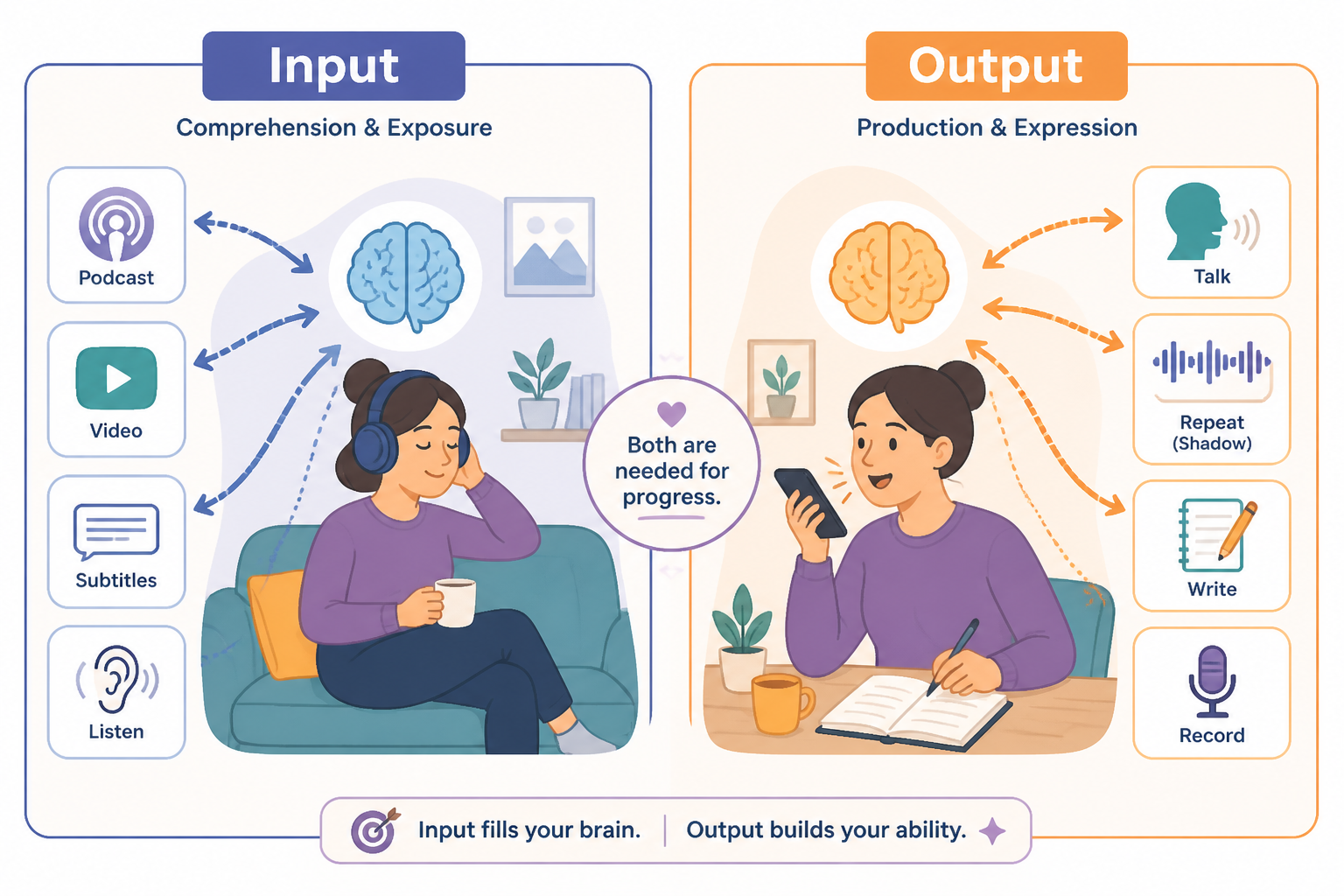
Immersion is often described as input-heavy, and input is indeed essential. But if you only listen and never try to use the language, your progress can plateau. You need some output, even if it is tiny.
Easy ways to produce language at home
- Self-talk: narrate what you are doing in simple sentences.
- Shadowing: repeat audio right after hearing it.
- Mini journaling: write 2 to 5 sentences about your day.
- Voice notes: record yourself summarizing what you watched or heard.
- Flashcard recall: say answers out loud instead of reading silently.
Output helps because it shows you what you can actually produce, not just recognize. That gap is normal. In fact, noticing it is useful.
How to make content understandable without making it boring
The best immersion content is not the easiest content. It is the content that you can mostly follow with support. That support can come from subtitles, transcripts, repetition, context, or previous familiarity.
Support tools that help
- Subtitles: useful when paired with listening, not as a crutch forever
- Transcripts: excellent for reviewing a podcast or video
- Repetition: hearing the same material again improves recognition
- Short segments: easier to understand and review
- Visual context: people, actions, objects, and setting make meaning clearer
What to avoid
- switching to something harder every day just because it is “real”
- reading every subtitle word by word forever
- stopping an audio clip every three seconds for dictionary lookup
- choosing content you hate just because it is in the language
The point is to stay engaged long enough for exposure to work. If the material is too painful, you will avoid it. That is a sign to adjust, not to quit.
A practical home immersion recipe for beginners
If you are not sure where to begin, use this simple setup for the first two weeks.
Your beginner immersion checklist
- Pick one main listening source: a learner podcast or a very easy video series.
- Pick one entertainment source: a show, movie, or short clips with subtitles.
- Choose 10 to 20 useful household words or phrases.
- Label 5 to 10 objects you see every day.
- Set one daily listening routine, even if it is only 10 minutes.
- Choose one tiny output habit, like self-talk or a 2-sentence journal.
- Repeat the same materials often instead of constantly changing them.
This setup is boring in the best possible way. It gives your brain enough repetition to build familiarity without overwhelming you with options.
A sample beginner day
- Morning: listen to 5 minutes of easy audio while making coffee.
- Lunch: read a short dialogue or watch a short clip with subtitles.
- Evening: listen to the same audio again, then repeat 3 phrases aloud.
- Before bed: write one sentence about what you did today.
A practical home immersion recipe for intermediate learners
At the intermediate level, the challenge changes. You probably understand more, but you may still feel stuck between “learner content” and “real content.” Home immersion can bridge that gap nicely.
Your intermediate immersion checklist
- Mix learner-friendly content with native content.
- Use subtitles or transcripts strategically, not constantly.
- Choose one podcast series or show to repeat.
- Build topic-based vocabulary around your interests and routines.
- Do at least one active output task daily.
- Track phrases you hear often and reuse them.
A sample intermediate day
- Morning: 10 minutes of podcast listening while getting ready.
- Afternoon: 15 minutes of reading or transcript review.
- Evening: one scene from a show with subtitles, then once without.
- Night: a short voice note summarizing the scene or podcast.
At this stage, repetition matters even more than novelty. Reusing the same sources helps you notice more each time, which is where real progress hides.
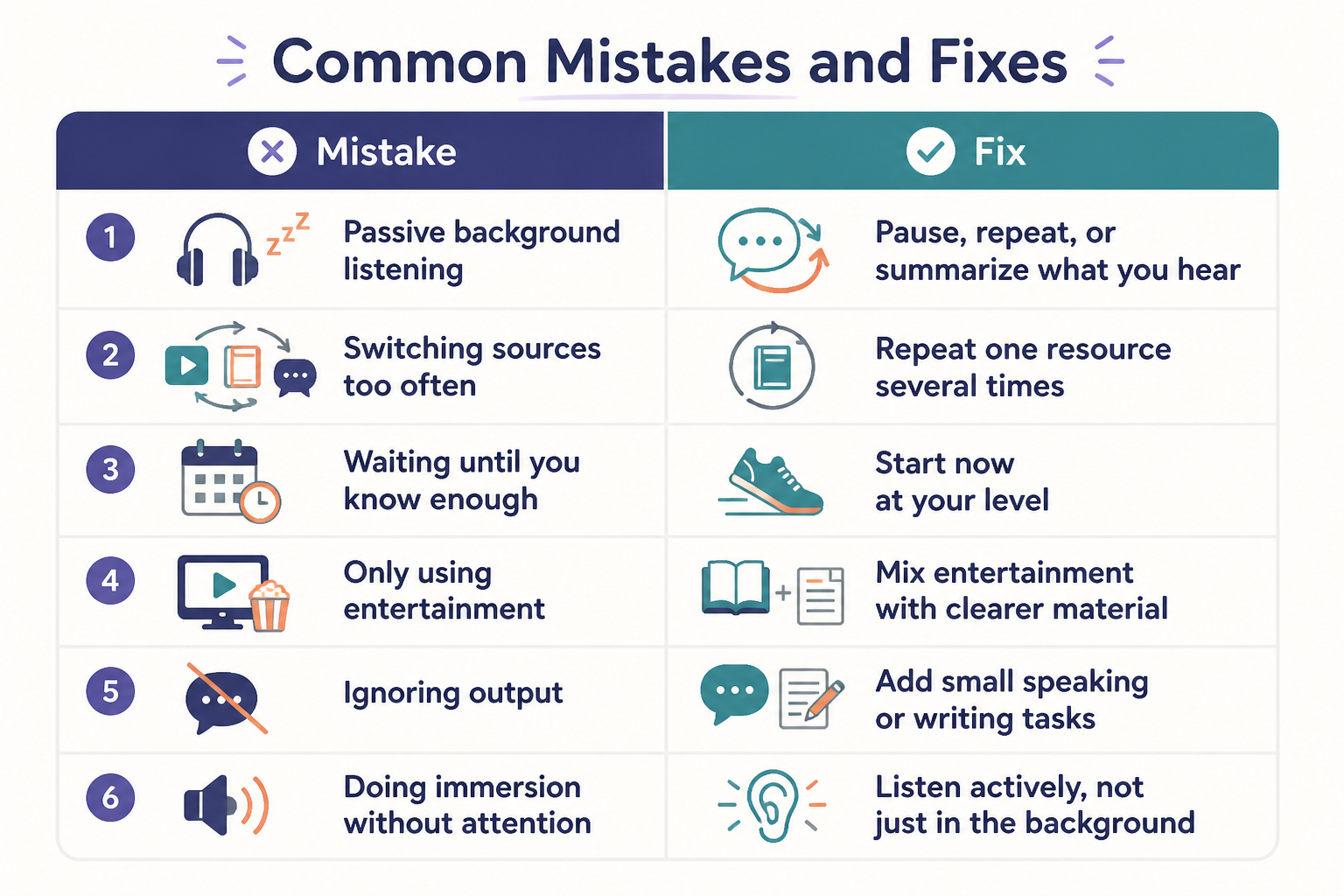
Common mistakes that make immersion feel like it is not working
Most immersion problems are not really motivation problems. They are setup problems. Here are the big ones.
1. Making the language too hard
If you choose content that is far beyond your level, you may feel busy without learning much. The fix is to reduce difficulty, add support, or shorten the content.
2. Consuming without processing
Passive exposure helps, but only if some of it becomes noticeable. If you always have the language on in the background but never pay attention, your brain may treat it as noise.
Fix: pause to repeat a phrase, write down a phrase, or summarize what you heard.
3. Switching sources too often
Constant novelty can feel productive, but repetition is what reveals patterns. One good podcast episode repeated three times often teaches more than three random episodes heard once.
4. Waiting until you “know enough”
Immersion is not the reward for being ready. It is one of the ways you get ready. Start now, but make it appropriate to your level.
5. Only using entertainment
Movies and music are great, but if they are your only input, your progress can be uneven. Mix in clearer, more deliberate material too.
6. Ignoring output
If you never try to speak or write, you may understand more than you can actually use. Small output tasks keep your learning balanced.
How to know whether your immersion is working
Sometimes immersion feels subtle, so it helps to know what progress looks like. You are not looking for sudden magic. You are looking for small signs that the language is becoming more familiar.
Good signs
- You recognize words before you translate them mentally.
- You follow more of a podcast than you used to.
- You notice repeated phrases in shows or audio.
- You need subtitles less often, or use them more strategically.
- You can say simple things without freezing completely.
- You feel less tired after listening.
Warning signs
- You cannot understand anything for long stretches.
- You feel annoyed every time you open a resource.
- You keep switching tools instead of using any one of them consistently.
- You are doing a lot of “immersion” but almost no attention or review.
If the warning signs show up, adjust the difficulty before you judge the method. Home immersion is only effective when the material is just understandable enough.
How to keep it sustainable
The best immersion system is one you can keep using when life gets busy, boring, or messy. Sustainability matters more than intensity.
Make it easy to start
- Keep one podcast bookmarked.
- Keep one show ready to play.
- Have a short list of phrases to review.
- Leave your notebook or app open to the right place.
Lower the number of decisions
Decision fatigue is real. If you have to decide what to study, how to study it, and when to do it every day, you will eventually do nothing. A better system has defaults.
- Default morning audio
- Default evening show
- Default 5-minute review
- Default output task
Keep the language tied to something enjoyable
If every contact with the language feels like homework, you will resist it. Pair the language with things you already enjoy: coffee, walks, cooking, cozy evenings, or a favorite series. Pleasure is not a bonus. It is part of consistency.
A simple 30-day home immersion plan
If you want structure, here is a realistic month-long plan. It is not dramatic. It is practical.
Week 1: Set up your environment
- Choose one listening resource.
- Choose one video or movie resource.
- Label 5 to 10 objects.
- Set one daily listening time.
- Pick one tiny output habit.
Week 2: Repeat and notice
- Reuse the same audio or video at least twice.
- Write down repeated words or phrases.
- Try to understand content with less pausing.
- Do one short self-talk session each day.
Week 3: Add one stretch
- Watch one scene without subtitles after first viewing.
- Listen to a slightly harder podcast segment.
- Summarize what you heard in 2 to 4 sentences.
- Use 3 to 5 new words in a speaking or writing task.
Week 4: Refine your system
- Keep what works.
- Drop what you avoid.
- Replace hard content with better-fitting content.
- Make your routine smaller if needed, not bigger.
By the end of 30 days, your goal is not fluency. Your goal is a home environment where the language shows up naturally and consistently.
When to use subtitles, transcripts, or no support at all
Support tools are useful, but they should have a job. Here is a simple way to choose.
| Support level | Best for | When to use it |
|---|---|---|
| Subtitles on | First exposure, difficult scenes, detailed understanding | When content is still too hard to follow comfortably |
| Subtitles off | Checking comprehension, training listening skills | After you already know the general meaning |
| Transcript only | Podcast review, focused vocabulary study | When you want to inspect the language carefully |
| No support | Comfort testing, natural listening practice | When the material is familiar enough to be useful |
A useful pattern is: supported first, less supported second, unsupported last. That sequence turns one piece of content into several learning experiences.
How to stay motivated when progress feels slow
Immersion progress is often quiet. You may not notice much this week, but then one day a phrase lands, a scene makes sense, or a podcast sounds less like noise and more like speech. That slow shift is normal.
To stay motivated, focus on evidence of familiarity, not perfection:
- Can you understand one more sentence than last month?
- Do you recognize words before looking them up?
- Are common phrases feeling less strange?
- Can you enjoy a clip without translating every second?
Those small changes are the real milestones. They are easy to miss if you expect dramatic breakthroughs.
Putting it all together: your home immersion blueprint
If you want the shortest possible version of this whole article, here it is:
- Choose understandable content.
- Repeat it often.
- Mix listening, watching, reading, and speaking.
- Connect the language to real routines.
- Use subtitles, transcripts, and labels strategically.
- Keep output small but regular.
- Adjust difficulty before you quit.
That is the core of How To Immerse In a Language At Home. Not perfection. Not massive time blocks. Just steady contact, useful input, and a home setup that makes the language impossible to ignore in a good way.
What to do next
Pick one thing from this guide and set it up today. Not five things. One.
- Bookmark one podcast episode.
- Choose one show or movie scene to watch with subtitles.
- Label five objects in your room.
- Set a 10-minute daily listening time.
- Write one short self-introduction or daily summary.
If you want to strengthen the foundations behind immersion, review comprehensible input again and pair it with a few consistent sessions. If you want more ideas for your listening routine, check how to learn a language with podcasts. If you want to build a stronger entertainment-based routine, use movies and subtitles as your next step.
The goal is not to create a perfect language bubble. The goal is to make home feel a little more like the language, every day.