



What comprehensible input means
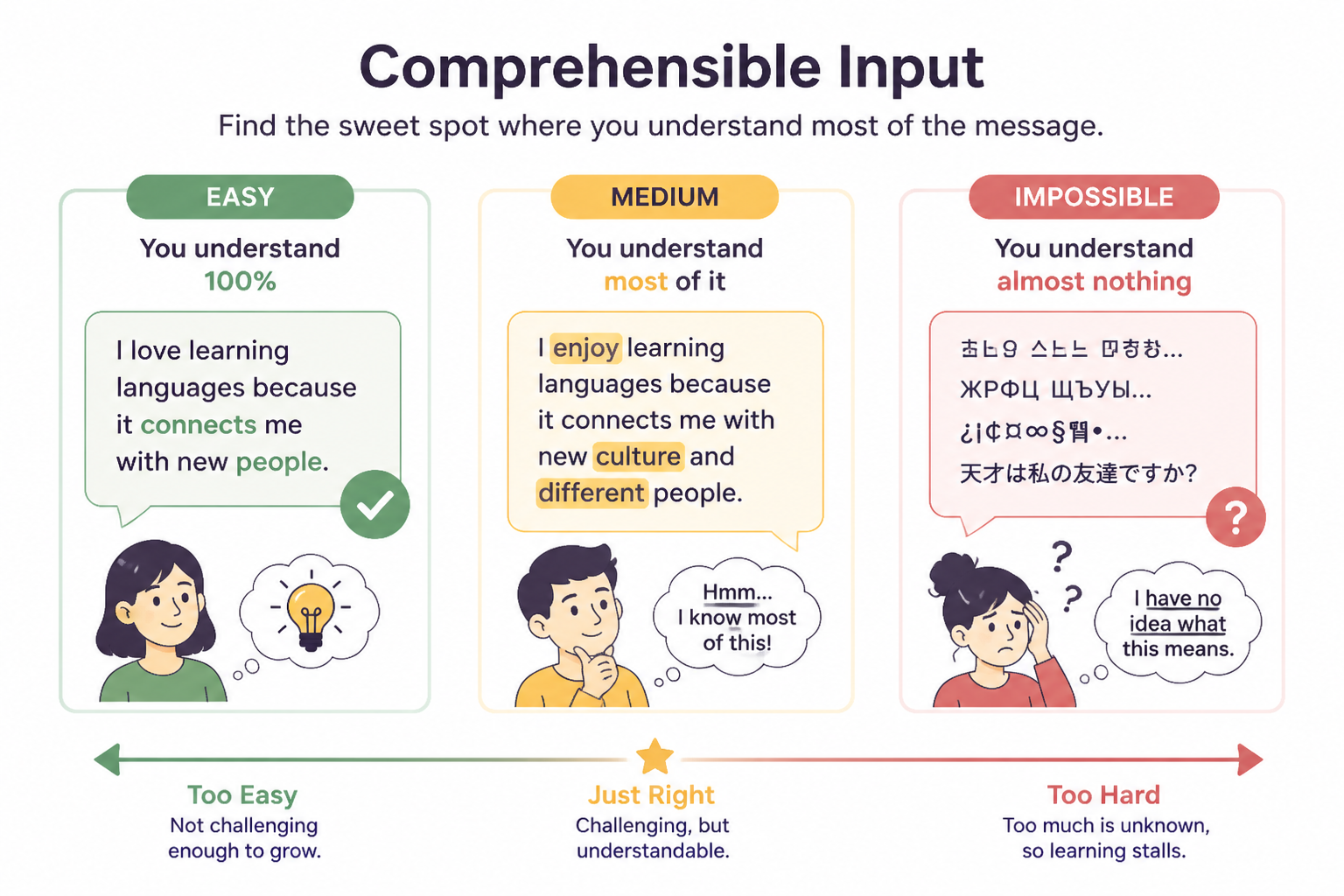
Comprehensible input is language you can mostly understand, even if you do not understand every single word. It is the sweet spot between “I understand nothing” and “this is so easy it is boring.” In language learning, that sweet spot matters a lot.
The basic idea is simple: your brain learns better from language that is just a little above your current level, but still understandable because of context, familiar words, pictures, gestures, tone, or repeated patterns. When input is comprehensible, you are not guessing wildly. You are actually following meaning.
This matters because languages are not learned by magic. You need lots of exposure to real language, but exposure only helps if your brain can connect what it hears or reads to meaning. That is why comprehensible input is one of the most useful ideas in language learning.
Think of it like reading a map. If the map is written in a code you cannot decode, it is useless. If the map uses symbols you already know plus a few new ones, you can figure things out and gradually learn the new symbols. Comprehensible input works the same way.
Why comprehensible input matters so much
If you have ever sat through a listening exercise and felt like every sentence flew past without landing, you already know the problem. When input is too hard, your brain spends all its energy trying to survive the experience. There is little left for learning.
Comprehensible input solves that by making language understandable enough for learning to happen. Here is why it is powerful:
- It helps you notice patterns. When you understand the overall meaning, you can start noticing repeated words, chunks, sentence structures, and grammar patterns.
- It builds vocabulary naturally. Words make more sense when you meet them in a meaningful context instead of isolated flashcard land.
- It improves listening and reading stamina. The more you can understand, the longer you can stay engaged without mentally face-planting.
- It reduces frustration. You are less likely to quit when the material feels challenging but manageable.
- It supports long-term progress. Repeated exposure to understandable language creates a foundation for speaking and writing later.
That does not mean you should avoid challenge. It means you should choose the right kind of challenge. If the content is completely opaque, your brain cannot do much with it. If it is completely easy, you may not grow. The goal is to find the middle ground where learning is active and comfortable enough to keep going.
The simple formula: understand most of it, learn a little from the rest
A useful way to think about comprehensible input is this: you understand most of the message, and the new parts are learnable because the rest gives them meaning.
For example, imagine you read a short story and you know 90% of the words. The remaining 10% are unfamiliar, but the story is clear enough that you can guess some of them from context. You might not learn every unknown word immediately, but you are building stronger mental connections than you would from a word list alone.
This is why beginner-friendly content, graded readers, simple podcasts, picture-supported videos, and carefully chosen conversations can work so well. They make meaning easier to access, which makes the language itself easier to absorb.
| Type of input | What it feels like | Learning value |
|---|---|---|
| Too difficult | Mostly confusion, lots of guessing | Low, because meaning is not clear |
| Comprehensible | Mostly clear, with a few new parts | High, because you can connect form to meaning |
| Too easy | Comfortable but not very challenging | Moderate, especially for review and fluency |
Comprehensible input is not the same as “just passively absorb everything”
This is where people sometimes get confused. Comprehensible input does not mean you sit back, stare at language, and hope your brain downloads it overnight like a suspicious app update. It means you engage with language that makes sense to you.
The “comprehensible” part is doing the heavy lifting. If something is understandable, your brain can compare what it already knows with what is new. That comparison is where learning happens.
So yes, input can be somewhat passive in the sense that you are not always producing language. But it is not mindless. Good input usually involves some combination of:
- focused attention
- repeated exposure
- guessing meaning from context
- noticing familiar words or structures
- checking your understanding occasionally
In other words, comprehensible input is not “do nothing and hope.” It is “make the language understandable enough that your brain can work with it.”
How to tell if input is comprehensible
A lot of learners ask: “How do I know if this is the right level?” Good question. You do not need a perfect formula, but you do need a practical test.
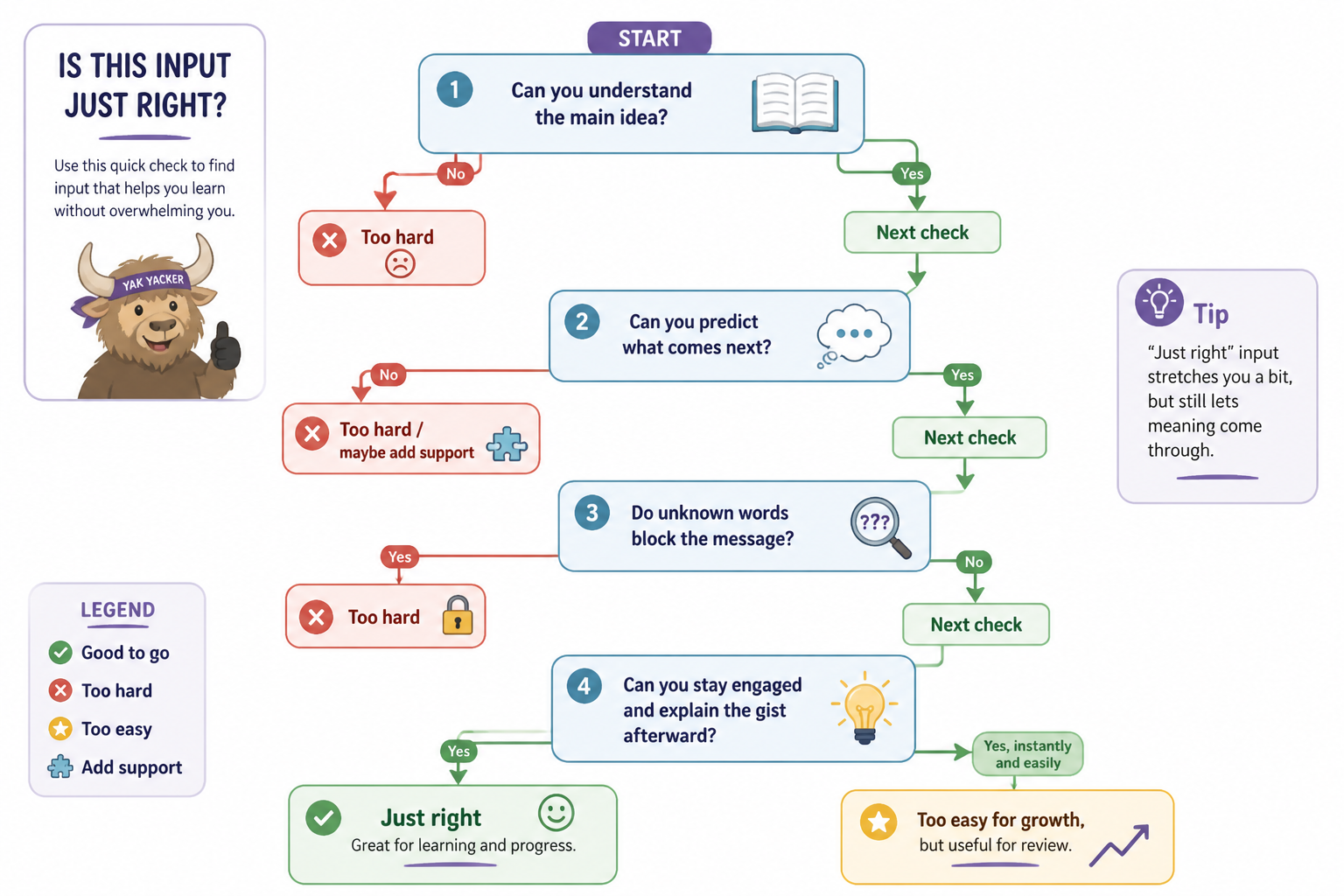
Use this quick check:
- You can follow the main idea without translating every sentence.
- You understand enough to predict what might come next.
- Unknown words do not block the whole message.
- You can stay engaged for several minutes without feeling completely lost.
- After finishing, you can roughly explain what you heard or read.
If you fail all of those, the input is probably too hard. If you pass all of them instantly, it may be too easy for growth, though it can still be useful for reinforcement.
A nice rule of thumb is that you should understand the overall meaning most of the time, even if you do not know every detail. You want enough clarity that the new language is learning-friendly, not mystery-box level confusing.
Examples of comprehensible input in real life
Comprehensible input can come from many sources. The best examples are often simple, concrete, and full of context.
1. A slow, clear conversation
Imagine someone says, “I went to the store because I needed milk, but it was closed.” If you understand “went,” “store,” “needed,” “milk,” and “closed,” the meaning is easy to follow, even if one or two words are new.
The listener gets support from the situation, the familiar vocabulary, and the predictable structure. That makes the input comprehensible.
2. A short article with pictures
A short article about making tea, cooking pasta, or describing a house is often easier to understand because the topic is familiar and the images help anchor meaning. You do not need to decode every word to understand the gist.
3. A graded reader
Graded readers are books written with controlled vocabulary and grammar. They are designed to be understandable at a specific level. This makes them a classic example of comprehensible input for reading.
4. A beginner-friendly video or podcast
A video with visuals, gestures, and repeated language can make meaning much clearer than audio alone. The same goes for slow podcasts with simple topics, especially when the speaker uses examples and paraphrases.
5. Repeated exposure to a familiar story
Hearing the same story several times can make it increasingly comprehensible. On the first listen, you catch the broad outline. On the second or third, more details start to pop out. Repetition is not boring when it is doing actual work.
What makes input comprehensible?
Input becomes comprehensible when the learner gets enough support to understand the message. That support can come from several places.
| Support type | How it helps | Example |
|---|---|---|
| Context | Shows what is being talked about | A restaurant scene makes “the menu,” “order,” and “bill” easier to understand |
| Visuals | Connect words to real-world meaning | Pictures of food or a map while listening |
| Familiar vocabulary | Gives your brain anchor points | Words you already know in a new sentence |
| Repetition | Lets meaning become clearer over time | The same phrase appears several times in one story |
| Slower speech or simpler text | Reduces processing load | A learner podcast or a graded reader |
| Paraphrase | Restates meaning in easier words | “He was furious” followed by “He was very, very angry” |
The big idea is that comprehensible input is not just about simplified language. It is about supported meaning. You can simplify with easier words, but you can also make input understandable through context, visuals, or repetition.
That is good news, because it means you do not need perfect materials. You need the right materials, used the right way.
How comprehensible input helps you learn
Comprehensible input helps learning in a few important ways. Understanding these can keep you from treating it like some vague “trust the process” slogan.
It creates meaning first
Language is easier to remember when it means something. If you hear a phrase in a meaningful situation, your brain stores more than the sound or spelling. It stores the situation, the emotion, the topic, and the likely use.
It helps you notice patterns naturally
Once you understand the message, you can start noticing how it is built. You begin to recognize repeated sentence patterns, common chunks, and useful combinations. This is much easier than trying to memorize every rule in isolation.
It lowers cognitive overload
When input is too difficult, your working memory gets overloaded. You spend all your energy on decoding instead of learning. Comprehensible input keeps the task challenging enough to be useful but not so hard that your brain throws up its hands and walks away.
It builds a base for speaking and writing
Speaking and writing need input behind them. The more understandable language you have absorbed, the more material your brain has to draw from when you want to produce language yourself.
If you want a practical example, think of listening to many examples of how people ask for help, express opinions, or tell short stories. Later, when you try to speak, those structures feel less foreign because you have already seen them in action.
Comprehensible input and language level
Your current level matters a lot. What counts as comprehensible for one learner may be completely inaccessible for another. That is why it helps to think in terms of levels rather than a one-size-fits-all rule.
If you want a more structured way to think about level, it can help to compare your ability with common frameworks like the CEFR language levels explained guide. That kind of level reference can help you choose material that is challenging but not overwhelming.
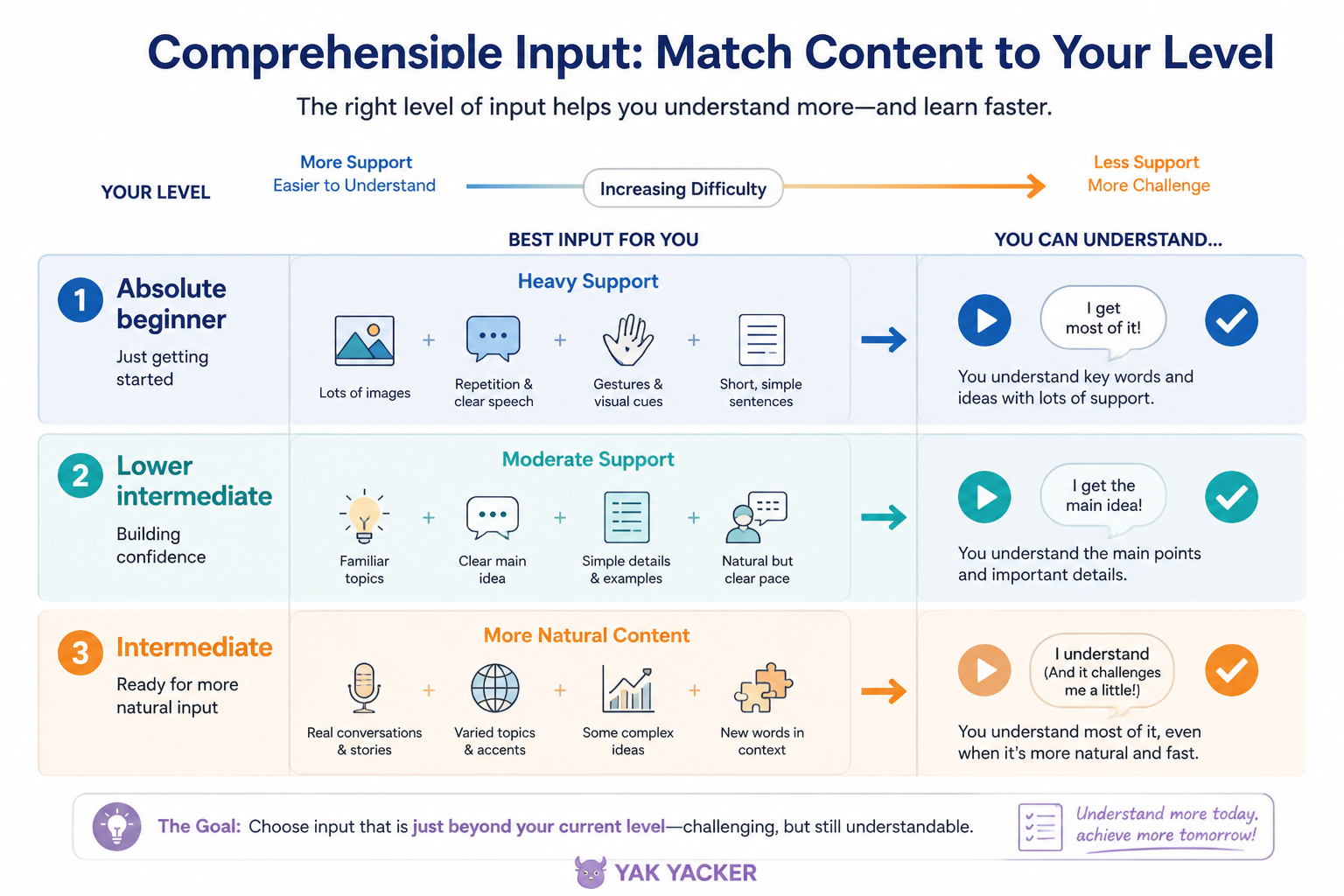
As a general principle:
- Absolute beginners need very heavy support: images, gestures, repetition, short sentences, and highly predictable language.
- Lower intermediates can handle longer material if the topic is familiar and the main idea is clear.
- Intermediate learners can stretch into more natural content as long as they still understand enough to stay oriented.
This is why level-appropriate content matters. A learner who understands the gist of a conversation can benefit from it. A learner who understands only random words is probably not getting enough useful input yet.
Comprehensible input for listening
Listening is one of the most common places where learners get stuck. Real spoken language can feel fast, messy, and strangely determined to run away from you. That is normal. The solution is not to panic, but to choose listening input that is actually learnable.
Strong listening input often includes:
- clear pronunciation
- natural but not frantic speed
- repetition of key ideas
- visual support
- familiar topic or context
If you want to build this skill more systematically, a focused guide on how to practice listening in a language can help you choose the right kind of audio and turn listening into actual progress instead of background noise.
Here is a simple listening progression:
- Start with very clear, short audio.
- Use visual context when possible.
- Listen once for the main idea.
- Listen again for details you missed.
- Notice repeated words or phrases.
- Move to slightly harder material when the current one feels comfortable.
The key is that you should not need to decode every word to benefit. Good listening input gives you enough support to keep meaning in view.
Comprehensible input for reading
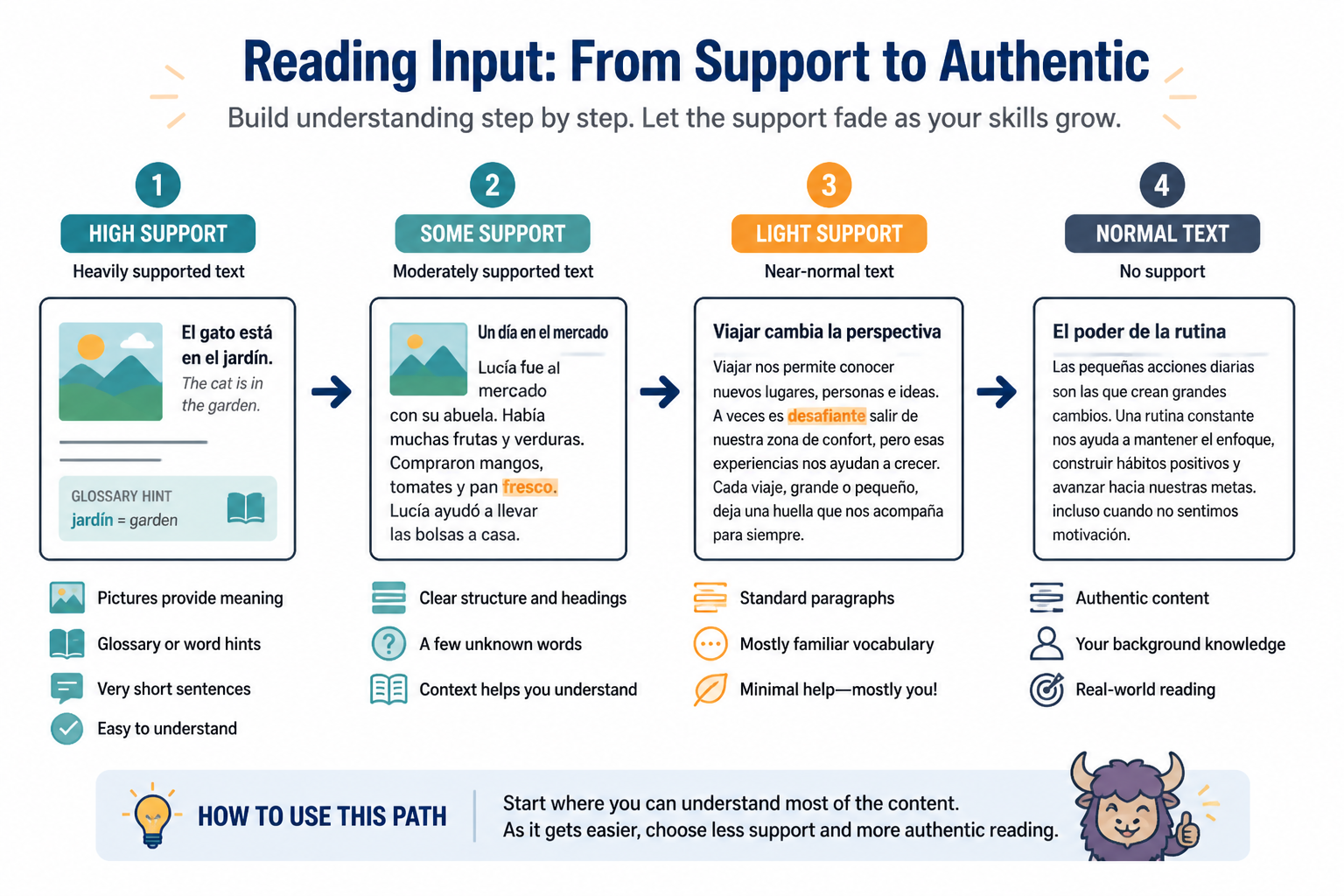
Reading is often easier than listening because you can slow down, reread, and study the sentence structure more carefully. But the same principle still applies: the text needs to be understandable enough to teach you something.
Good reading input may include:
- short sentences
- familiar topics
- controlled vocabulary
- clear paragraph structure
- supporting images or headings
If reading is your main input source, you will probably benefit from practical advice on how to practice reading in a new language. Reading becomes much more effective when you know how to pick material, handle unknown words, and avoid overcomplicating the process.
A useful rule for reading is this: if you are stopping every few words to look things up, the material may be too hard for efficient learning. A better text lets you keep moving while still encountering enough new language to stretch you.
How to choose comprehensible input materials
Choosing the right materials is one of the most practical skills in language learning. The wrong material can make you feel like you are “bad at languages” when the real problem is simply bad input selection.
Use this checklist when choosing content:
- Can I understand the topic quickly?
- Do I know enough of the words to follow the main idea?
- Is there context that supports meaning?
- Can I stay engaged without constant frustration?
- Will I hear or see repeated language patterns?
- Does this feel slightly challenging but not miserable?
Good material is often:
- about everyday topics
- used in short chunks
- supported by visuals or examples
- reused multiple times
- matched to your current level
Bad material is often:
- too dense
- full of rare vocabulary
- unfamiliar in topic and structure at the same time
- too long without support
- so easy that you are not paying attention
You do not need perfect content. You need content you can work with. Small adjustments in difficulty can make a huge difference in how much you learn.
Common mistakes with comprehensible input
Like any good idea, comprehensible input can be misunderstood. Here are the most common mistakes and how to fix them.
1. Choosing material that is far too hard
This is the biggest mistake. Many learners think more difficult content must be better because it is “real.” But if you understand almost nothing, the material is not helping much.
Fix: choose simpler content and gradually raise the difficulty. You are not avoiding real language. You are building the ability to understand it.
2. Making everything look easy by translating constantly
If you translate every line, you may understand the sentence mechanically, but you lose momentum and context. That can turn input into a tedious word puzzle instead of meaningful exposure.
Fix: try understanding the main idea first. Look up only the words that matter most or keep appearing.
3. Staying at the same easy level forever
Easy input has value, especially for review and confidence. But if you never raise the challenge, your progress can stall.
Fix: once a type of content feels comfortable, step slightly up in difficulty. Change one variable at a time: speed, length, vocabulary, or topic complexity.
4. Expecting immediate speaking ability
Input helps speaking, but it does not instantly create it. You still need practice producing language. The point is that good input gives speaking a stronger base.
Fix: treat input as foundation-building, then add output practice when you are ready.
5. Using “comprehensible input” as an excuse to avoid all effort
Some learners hear the phrase and assume they can just consume content casually forever. But thoughtful practice still matters. You need selection, repetition, reflection, and gradual challenge.
Fix: make input intentional. Choose material on purpose, with a reason, and notice what you are learning from it.
A practical way to use comprehensible input every day
You do not need a complicated system. A simple routine is usually enough if it is consistent.
Here is a beginner-to-intermediate routine you can actually stick with:
- Pick one input source. Choose reading, listening, or a mix.
- Choose material you can mostly understand. Keep it just challenging enough.
- Spend 10 to 30 minutes focused on meaning. Do not multitask if you can help it.
- Notice repeated words or phrases. These are often the most useful parts.
- Review briefly. Summarize the main idea in your own words, even if simply.
- Repeat the next day. Consistency matters more than heroic marathon sessions.
If you want a bigger picture of where this fits in the overall learning journey, the parent guide on how to learn a language can help you connect input practice with other skills like speaking, vocabulary, and study planning.
Here is a helpful mini-plan for one week:
| Day | Task | Goal |
|---|---|---|
| 1 | Choose a short, understandable article or audio clip | Find your baseline level |
| 2 | Study the same material again | Increase comprehension through repetition |
| 3 | Try a similar but slightly harder piece | Stretch just a little |
| 4 | Read or listen for the main idea only | Train overall understanding |
| 5 | Review unknown words that kept appearing | Capture useful vocabulary |
| 6 | Use a different but related topic | Build flexibility |
| 7 | Summarize what you understood from the week | Check progress and confidence |
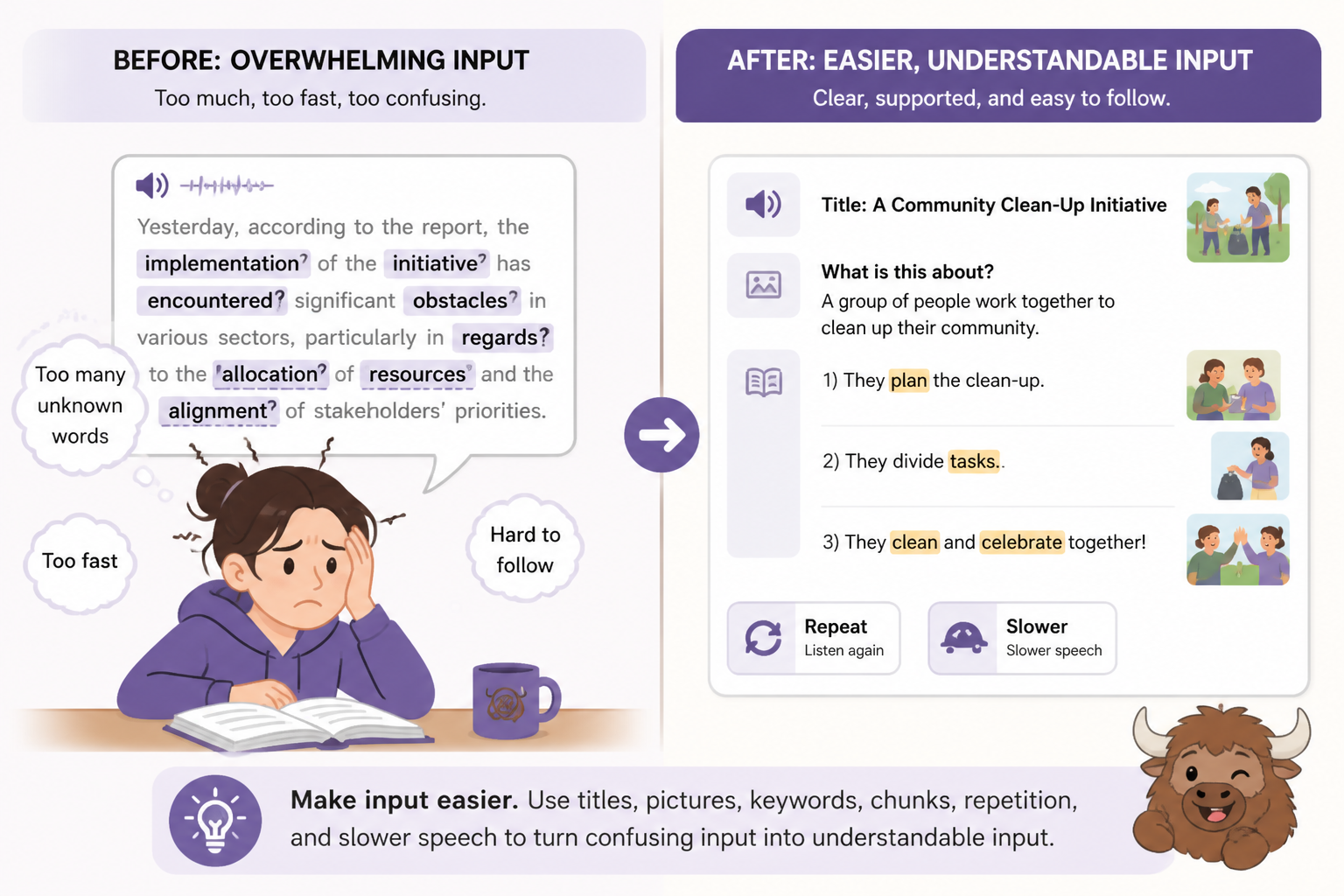
How to make input more comprehensible when it feels hard
Sometimes the content is close to your level, but not quite. That is normal. Before you give up on it, try to add support.
Ways to make input easier:
- Read the title, headings, or summary first.
- Use pictures, gestures, or topic clues.
- Listen or read in shorter chunks.
- Repeat the same material more than once.
- Look up only the most important unknown words.
- Choose a slower speaker or a simpler text version if available.
Sometimes the issue is not the language itself, but the format. A topic that feels impossible in fast audio may feel manageable in written form. Or a dense article may become understandable if you break it into sections.
That is why smart learners do not just ask, “Is this good content?” They ask, “How can I make this content understandable enough to learn from?”
When input feels too easy
Too easy is not a disaster. It can still be useful for confidence, fluency, and reinforcement. But if all your input feels too easy, you may be stuck in comfort mode.
Signs the material may be too easy:
- You can understand everything instantly.
- You are not noticing any new language.
- Your attention drifts because the material offers no stretch.
- You finish content without feeling mentally engaged.
What to do: increase one difficulty factor at a time. You can choose a faster speaker, longer text, richer vocabulary, or a less predictable topic. The goal is not to make life harder for sport. It is to keep learning alive.
How comprehensible input and output work together
Input and output are not enemies. They are partners. Input gives you the raw material: words, phrases, sentence patterns, and a feel for how the language works. Output helps you test and strengthen that material.
A useful way to think about it:
- Input shows you how language is used.
- Output helps you practice using it yourself.
If you try to output without enough input, you may feel like you are building sentences out of spare parts and optimism. If you only do input forever, you may understand a lot but struggle to say anything quickly. The two together are much stronger than either alone.
So if your learning plan includes speaking, writing, drills, or conversation practice, that is a good thing. Comprehensible input is the foundation, not the whole house.
A simple decision guide for learners
If you are not sure what to do next, use this decision guide.
| If this is true… | Then do this… |
|---|---|
| I understand almost nothing | Choose easier material with more support |
| I understand the gist but miss details | Stay with the material and repeat it |
| I understand everything instantly | Increase difficulty slightly |
| I get bored quickly | Change topic, format, or challenge level |
| I feel stuck despite effort | Check whether the input is too hard or too unstructured |
This is one of the best things about comprehensible input: it gives you a practical way to choose study material instead of relying on guesswork or motivation alone.
What “good progress” looks like
When comprehensible input is working, progress is often gradual and a little sneaky. You may not notice it day to day, but over time you will see signs like these:
- you understand more without translating
- you recognize common phrases faster
- you can follow slightly faster speech
- you read longer passages without getting lost
- you need fewer pauses to catch the meaning
- you feel less stressed by unfamiliar language
That kind of progress can feel less dramatic than cramming a list of 100 words, but it is often much more durable. The language starts to feel familiar, not just memorized.
If you want a sanity check, ask yourself this: “Is this becoming easier to understand than it was two weeks ago?” If the answer is yes, your input is probably doing its job.
Common questions learners ask
Do I need to understand 100%?
No. In fact, you usually will not. The point is to understand enough that the new language can be learned from context. Missing a few words is normal.
Should I look up every unknown word?
Usually not. That slows you down and can reduce your focus on meaning. Look up words that are important, repeated, or blocking comprehension.
Is comprehensible input only for beginners?
No. Intermediate learners also benefit from it, and often in a big way. The difference is that their input can be more natural and less simplified than a beginner’s material.
Can I learn just from input?
Input is essential, but most learners benefit from combining it with speaking, writing, review, or focused practice. Input is the foundation; other activities help turn that foundation into usable skill.
Putting it all together
Comprehensible input is language you can understand well enough to learn from. That sounds simple, but it is one of the most important ideas in language learning because it explains why some materials help and others just waste your energy.
When you choose input that is understandable, interesting, and slightly challenging, you give your brain the conditions it needs to notice patterns, absorb vocabulary, and build confidence. When the input is too hard, learning stalls. When it is too easy, progress can slow. The art is finding the middle ground and adjusting as you improve.
If you remember only one thing, remember this: your goal is not to collect language like souvenirs. Your goal is to understand language in context often enough that it starts to feel familiar, usable, and alive.
That is what comprehensible input is really about: turning language from noise into meaning, one understandable chunk at a time.