Learning a Language Through Podcasts: A Practical Guide
If you want a language-learning method that fits into real life, podcasts are hard to beat. You can listen while walking, commuting, cooking, cleaning, or lying on the couch pretending you are “studying.” More importantly, podcasts can help you build listening skills, vocabulary, rhythm, and confidence without needing a textbook open in front of you every second.
But there is a catch: simply pressing play is not the same as learning. A podcast can be a powerful language tool, but only if you use it with a bit of strategy. Otherwise, it becomes background noise with a foreign accent. Useful? Sure. Enough on its own? Usually not.
This guide shows you how to learn a language with podcasts in a practical way: how to choose the right ones, how to listen so you actually improve, how to avoid common mistakes, and how to turn casual listening into steady progress.
For a bigger-picture look at making listening work as a skill, you may also find how to practice listening in a language helpful. And if you keep hearing people talk about “input” and wondering what that means in plain English, comprehensible input explained is a good companion read.
Why podcasts are so useful for language learning
Podcasts work because they give you repeated exposure to real language in a format that is easy to access. You do not need to schedule a special lesson time, and you do not need to be at a desk. That convenience matters more than people think. A method you can actually repeat tends to beat a perfect method you never use.
Here is what podcasts help with:
- Listening comprehension — your ear gets used to native speech, pacing, and pronunciation.
- Vocabulary recognition — words you have seen in reading become easier to notice in real speech.
- Pronunciation and intonation — you start hearing how the language actually sounds in natural flow.
- Speed and rhythm — you get used to the music of the language, not just isolated words.
- Consistency — podcasts are easy to build into a daily routine.
That said, podcasts are best viewed as one strong part of a language-learning system, not the whole system. They help you absorb the language. They do not, by themselves, force you to speak, write, or deeply practice grammar. Think of them as a high-value bridge between classroom language and real-world language.
Podcasts are most effective when you listen with a purpose, not just with your ears.
What kind of learner benefits most from podcasts?
Almost anyone can use podcasts, but they are especially good for beginners with support, intermediate learners, and anyone who wants more listening exposure without extra scheduling pain.
Podcasts are a great fit if you:
- already know some basics and want more exposure
- struggle to find time for formal study
- like learning while walking, commuting, or doing chores
- want more natural speech than app exercises provide
- need more listening practice but do not want to stare at a screen forever
They are less ideal if you are a complete beginner with no support at all. In that case, random native podcasts can feel like being dropped into a lake and told to “enjoy the immersion.” You can still use podcasts as a beginner, but you need the right type of content and a gentler method.
The podcast learning ladder: choose the right difficulty
The biggest mistake people make is choosing podcasts that are too hard. If every sentence sounds like a blur, you are not learning efficiently. A good podcast should stretch you, not crush you.
Use this simple ladder to match the podcast to your level.
| Level | What it sounds like | Best podcast type | Main goal |
|---|---|---|---|
| Beginner | You catch a few words, not full meaning | Slow, learner-friendly podcasts, bilingual shows, short episodes | Build familiarity and basic listening confidence |
| Lower intermediate | You understand the topic but miss details | Clear native or semi-native podcasts with transcripts | Train your ear and expand vocabulary |
| Intermediate | You follow most ideas but not every sentence | Natural podcasts on familiar topics | Increase speed, accuracy, and endurance |
| Upper intermediate | You can follow many episodes with effort | Native podcasts across multiple topics | Polish comprehension and learn real-world nuance |
A useful rule: if you understand roughly 70 to 90 percent of a podcast with support, it is probably in the sweet spot. If you understand almost nothing, it is too hard for active study. If you understand everything instantly, it may be too easy for growth, though still fine for relaxation and review.
How to choose a podcast that actually helps you learn
The best podcast is not always the most popular one. It is the one you can understand enough to keep going, and that keeps you interested enough to return tomorrow.
When choosing a podcast, look for these features:
- Clear audio — muddy sound makes listening harder than necessary.
- Appropriate speed — slower or clearly enunciated speech is often better at first.
- Useful topic content — choose topics you can actually care about.
- Episode length that fits your life — 5 to 15 minutes can be perfect for beginners; 20 to 40 minutes may work better later.
- Transcripts or notes — not required, but very useful for active study.
- Consistency — a steady series helps you build habits and familiarity.
Do not overthink the perfect choice. A “good enough” podcast you actually listen to is better than a “better” podcast you forget about after two episodes.
What to avoid in the beginning
At the start, avoid podcasts that are:
- too fast to follow at all
- full of jokes, interruptions, and overlapping voices
- heavily specialized in a topic you know nothing about
- recorded with poor audio or lots of background noise
- so advanced they become a guessing game instead of a learning tool
Complex content is not automatically bad. It just needs to arrive at the right time. First you need enough understanding to make listening productive.
A simple method for learning with podcasts
There are many ways to use podcasts, but the most effective approach is usually a mix of passive exposure and active listening. Passive exposure gives you volume. Active listening gives you progress. You need both.
Here is a practical workflow you can use for almost any episode:
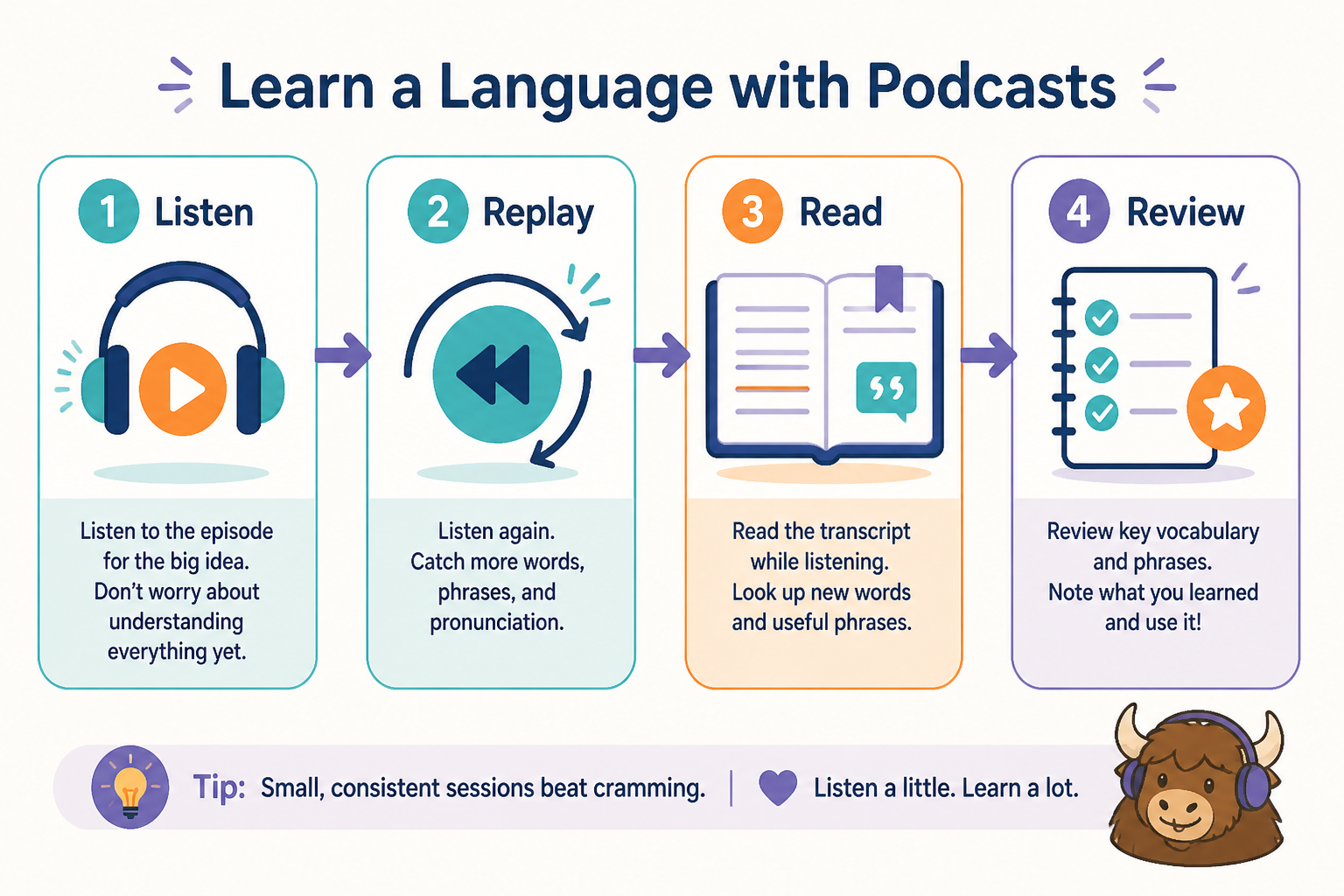
- Step 1: Preview — read the title, episode summary, or transcript notes if available.
- Step 2: First listen — listen without stopping to get the general idea.
- Step 3: Second listen — replay and catch words, phrases, and details.
- Step 4: Read support materials — if there is a transcript, use it now.
- Step 5: Listen again — hear the episode one more time with better understanding.
- Step 6: Review useful language — note expressions, vocabulary, or pronunciation details.
You do not need to do every step every time. Some episodes should be deep-work episodes. Others can be lighter “keep the habit alive” episodes. That balance matters.
The three listening modes: passive, focused, and intensive
One reason podcasts are so effective is that they can be used in different modes depending on your energy and your goal. Not every listen needs to be intense. In fact, trying to make every listen intense can burn you out.
| Mode | What you do | Best for | Example use |
|---|---|---|---|
| Passive listening | Listen while doing something else | Exposure, rhythm, familiarity | Walking, commuting, chores |
| Focused listening | Pay attention and follow the main ideas | Understanding and retention | Sitting with one episode and no multitasking |
| Intensive listening | Replay sections, check transcript, study words | Detailed comprehension and language analysis | Short episode or chosen clip for deep study |
The smartest learners rotate between these modes. Passive listening keeps the language in your life. Focused listening improves comprehension. Intensive listening turns raw exposure into actual learning.
How to use podcasts as a beginner
If you are new to the language, podcasts should feel manageable. The goal is not to understand everything. The goal is to start recognizing sound patterns, frequent words, and simple phrases without panic.
A beginner-friendly approach looks like this:
- Use short episodes.
- Prefer slower or clearly spoken content.
- Listen to the same episode more than once.
- Use transcripts or notes when possible.
- Focus on very common words and phrases.
- Do not stop every two seconds to translate everything.
You want early success. That success keeps you coming back, and repetition is where the magic happens. Your brain needs repeated contact with the same sounds before they start feeling normal.
A good beginner routine could be:
- Listen once without pressure.
- Listen again while reading a transcript, if available.
- Write down 3 useful words or phrases.
- Replay one short section and shadow it quietly.
Shadowing means speaking along with the audio just behind the speaker. It can help with rhythm, pronunciation, and confidence, but keep it light at first. This is practice, not a courtroom performance.
Beginner mistake: trying to translate everything
When every unknown word sends you into dictionary mode, the episode stops being a listening exercise and turns into a scavenger hunt. That is exhausting and often inefficient.
Better approach: only look up words that seem central, repeated, or very useful. If a word appears once and does not matter to the main idea, it can wait.
How to use podcasts at intermediate level
Intermediate learners often get the most out of podcasts because they understand enough to stay engaged, but still have plenty of room to improve. At this stage, the challenge is not just “Can I understand the podcast?” It is “Can I understand more than I did last month?”
Your focus should shift toward:
- faster comprehension
- recognizing natural speech patterns
- noticing filler words and linking
- expanding topic-specific vocabulary
- learning chunks and expressions, not just single words
At this stage, podcasts become a rich source of language chunks. A chunk is a phrase that native speakers use as a unit. For example, you may not need to understand every grammar detail right away if you can recognize the whole phrase and know when to use it.
Try this workflow for intermediate listening:
- Choose one episode on a topic you care about.
- Listen once without pausing.
- Note the general topic and any repeated phrases.
- Replay short parts that felt important or hard.
- Write down expressions you could realistically use or recognize again.
- Review those expressions later in the week.
This is where podcasts can become more than exposure. They can become a source of reusable language.
How to turn one podcast episode into real learning
Here is a practical method you can use whenever you want more than casual listening. It works especially well with shorter episodes or short sections of longer episodes.
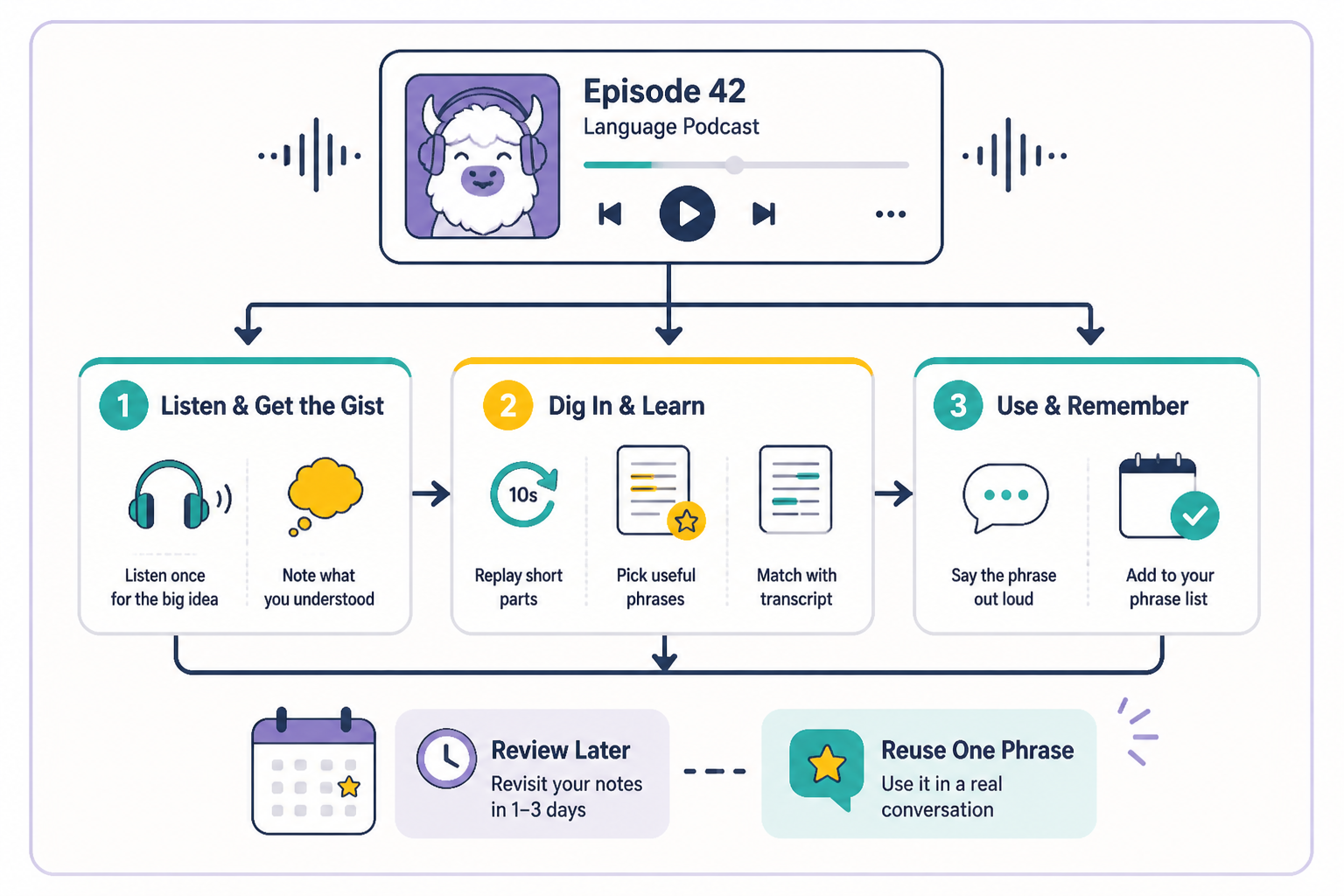
- 1. Listen for the gist. Ask: What is this episode about?
- 2. Find the useful parts. Pick 3 to 5 words, phrases, or sentences worth keeping.
- 3. Replay strategically. Focus on sections you almost understood.
- 4. Use the transcript if available. Match sound to text.
- 5. Repeat later. Re-listen after a day or two to see what sticks.
- 6. Use one phrase in your own speaking or writing. Even one reuse helps lock it in.
The last step matters a lot. If you never use what you hear, the knowledge stays passive. Using it once in a sentence, message, or journal entry gives your brain a reason to keep it.
How many podcasts should you listen to?
More is not always better. Too many podcasts can make your learning feel scattered. It is usually smarter to follow a small number of podcasts consistently than to sample twenty shows and remember none of them.
A good setup is:
- 1 main podcast for regular listening
- 1 backup podcast for variety or difficult days
- 1 easy podcast for low-energy listening
This gives you enough variety to stay interested, without creating decision fatigue. If you spend more time choosing what to listen to than actually listening, the system needs simplifying.
How podcasts fit with other language-learning habits
Podcasts are strongest when they sit inside a broader habit, not when they are isolated. A steady language routine might include reading, speaking, writing, and vocabulary review alongside podcast listening.
If you want the learning to stick, podcasts should connect to something else. For example:
- Listen to a podcast and review a few words in flashcards.
- Listen to a podcast and summarize it out loud in simple language.
- Listen to a podcast and notice one grammar pattern in context.
- Listen to a podcast and write one short reflection about it.
That connection matters because language is not just information. It is a skill. Exposure helps, but practice locks the pieces into place.
If you are trying to make this sustainable, it also helps to build the habit around an existing routine. Our guide on how to build a language learning habit can help you turn listening into something you actually keep doing after the first burst of enthusiasm wears off.
A realistic weekly podcast routine
You do not need to treat podcast learning like a part-time job. A simple routine often works better than an ambitious plan that collapses by Thursday.
Here is a sample weekly structure:
| Day | Activity | Time |
|---|---|---|
| Monday | Listen to one episode passively during a walk | 15–30 minutes |
| Tuesday | Replay the same episode with attention | 10–20 minutes |
| Wednesday | Review a few phrases or notes | 5–10 minutes |
| Thursday | Listen to a new episode or continue the same show | 15–30 minutes |
| Friday | Focused re-listen to one hard section | 10–15 minutes |
| Weekend | Easy listening for enjoyment or a full episode review | 20–40 minutes |
This is only a model. The main idea is to spread repetition across the week. One listen is good. Two or three listens to the same material are often much better.
How to make podcasts easier to understand
If a podcast feels too hard, do not give up immediately. Make it easier first. Many learners quit because they choose the right general method but the wrong level of difficulty.
Here are the best ways to reduce difficulty:
- use slower or clearer shows
- listen to topics you already know in your first language
- read a transcript before or after listening
- start with short episodes
- repeat the same episode several times
- adjust playback speed only if it genuinely helps, not just because it feels productive
One especially useful idea is to choose content that is understandable because of the topic, not just the language. If you already know a lot about the subject, you can often follow the podcast more easily even when the vocabulary is new.
This is closely related to the idea of comprehensible input: language learning is easier when you understand enough from context to keep moving forward. Podcasts are excellent for this when you pick the right level.
Common mistakes when learning with podcasts
Most podcast problems are not really podcast problems. They are method problems. Here are the big ones to watch for.
| Mistake | Why it hurts | Better fix |
|---|---|---|
| Listening to episodes that are far too hard | You get frustration instead of progress | Choose easier content and use transcripts |
| Only listening passively | You hear the language but do not process it deeply | Mix passive listening with focused review |
| Trying to understand every word | You lose the main idea and burn out | Focus on gist first, details second |
| Switching podcasts constantly | No repetition means less retention | Stick with a few shows long enough to improve |
| Never reviewing anything | Useful language disappears quickly | Write down a few phrases and revisit them |
| Using podcasts only and ignoring other skills | Listening grows, but speaking and active use lag behind | Pair podcast listening with speaking, reading, or writing |
If you recognize yourself in one of these mistakes, good news: the fix is usually simple. Podcasts are forgiving once you stop expecting them to do everything.
Podcast mistake: treating every episode like a test
Some learners feel they must understand 100 percent or the episode “did not count.” That mindset makes listening miserable. It also misses the point. A podcast episode can count even if you only understood 60 percent, as long as you learned something real and came back to it.
Progress in listening is often gradual. One day you realize you are catching words you used to miss. That is not an accident. That is accumulated exposure doing its job.
How to review vocabulary from podcasts without making a huge mess
Vocabulary from podcasts is best reviewed in small doses. The goal is not to collect every unknown word like rare trading cards. The goal is to keep the most useful language alive long enough to recognize and use it again.
When choosing what to review, prioritize:
- high-frequency words
- phrases that appeared more than once
- expressions you could imagine using
- words that were essential to understanding the episode
For each useful item, capture enough context to remember it. A single word alone is often too vague. A short phrase is usually better.
Example:
- Less useful: one isolated word with no context
- More useful: a short phrase from the podcast in a full sentence
That context helps you remember meaning, tone, and usage. It also reduces the chance of memorizing a word you can recognize but never actually use correctly.
How to practice speaking using podcasts
Even though podcasts are mainly a listening tool, they can support speaking too. You can use what you hear as a model for pronunciation, rhythm, and sentence structure.
Practical ways to turn podcast input into speaking practice:
- Shadowing — repeat short sections just after the speaker.
- Retelling — summarize the episode out loud in simple terms.
- Imitating phrases — copy pronunciation and sentence melody.
- Answering questions — pause and respond as if you were discussing the episode.
Retelling is especially powerful because it forces you to retrieve words, not just recognize them. Recognition is useful. Production is stronger. A podcast can feed both.
How to know if podcasts are working for you
Podcast learning can feel slow because it often improves comprehension in ways that are easy to miss day by day. So how do you know it is actually helping?
Look for these signs:
- You catch more words without trying harder.
- You can follow the same podcast more easily than before.
- You recognize phrases you heard in older episodes.
- Native speech feels less like noise and more like language.
- You need fewer pauses or replays to understand the main idea.
- You start noticing expressions in other contexts too.
These are better signs than “I understood everything instantly.” Real improvement often shows up as reduced strain, not dramatic perfection.
What to do when you feel stuck
If podcasts start feeling flat, boring, or impossible, the fix is usually to adjust one part of the system instead of abandoning the method entirely.
Use this troubleshooting checklist:
- If it is too hard: choose easier episodes, slower speech, or transcripts.
- If it is too easy: move to more natural speech or new topics.
- If you are bored: pick a topic you genuinely care about.
- If you forget everything: re-listen more often and review fewer items.
- If you cannot stay consistent: shorten the episodes and attach listening to a daily routine.
Sometimes the issue is not the podcast itself, but your energy. On tired days, a lighter listening session is still useful. A short, easy listen is better than none at all. Perfection is not required; repetition is.
A simple decision tree for podcast learning
If you are unsure how to use podcasts right now, this quick decision guide can help.
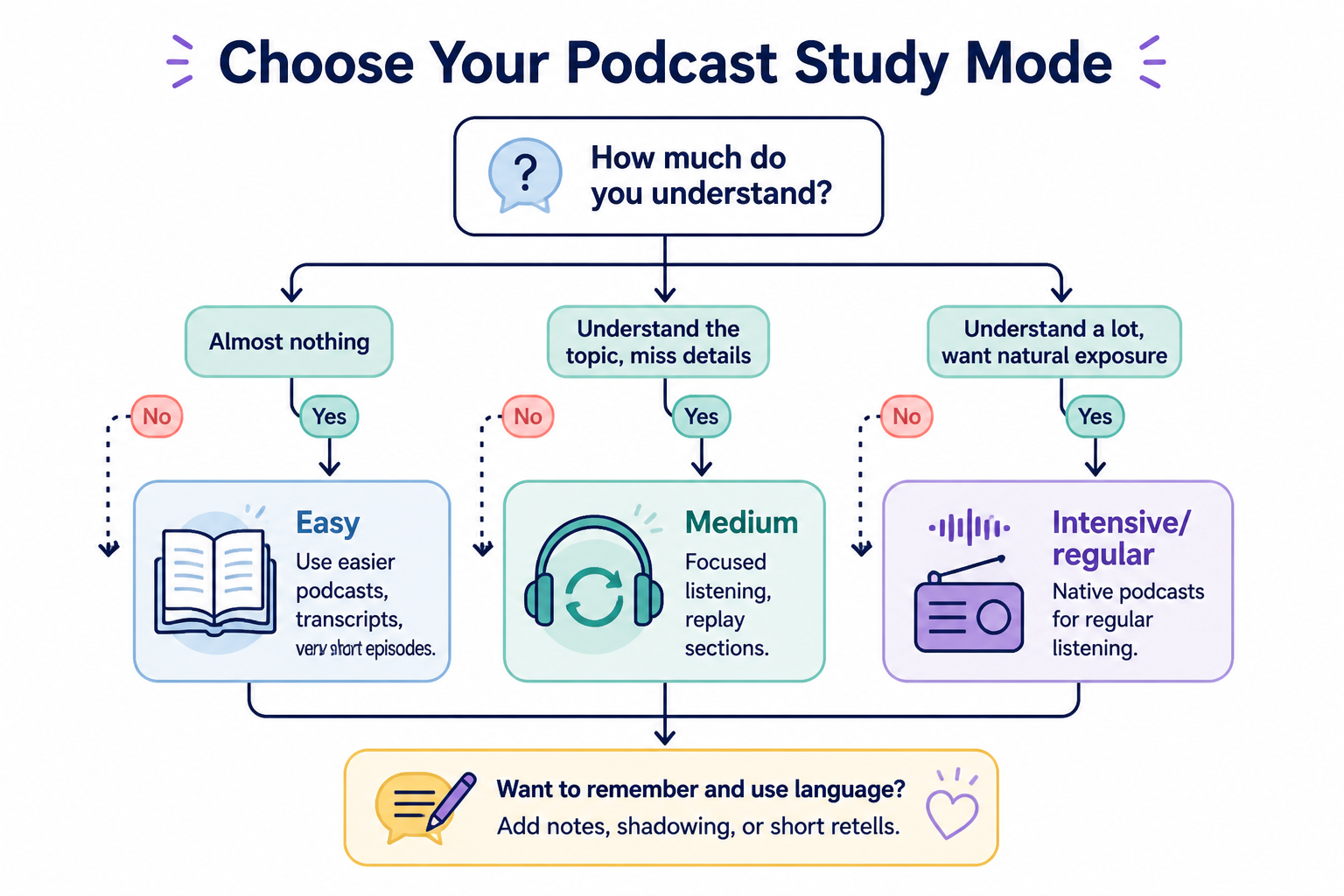
- Do you understand almost nothing? Use easier podcasts, transcripts, and very short episodes.
- Do you understand the topic but miss details? Use focused listening and replay sections.
- Do you understand a lot but want more natural exposure? Use native podcasts for regular listening.
- Do you want to remember and use language? Add notes, shadowing, or short retells.
That is the whole game, really: match the podcast to the task. Not every listen needs to do everything.
Example: what a real podcast session can look like
Here is a realistic example of how a learner might use one 12-minute episode.
- First, they read the episode title and realize it is about daily routines.
- Then they listen once during a walk, catching the general topic.
- After that, they listen again with the transcript and notice repeated phrases about time, habits, and frequency.
- They write down four useful expressions.
- Later, they replay one short segment and shadow it twice.
- Two days later, they listen again and notice that the episode feels much easier.
Nothing about that routine is flashy. That is the point. Language progress is often built from small, repeatable actions that do not look dramatic in the moment.
How podcasts compare with other listening resources
Podcasts are not the only listening tool, but they have some unique strengths.
| Resource | Strength | Limitation | Best use |
|---|---|---|---|
| Podcasts | Portable, flexible, repeatable | No visual support unless transcript is available | Daily listening practice and routine building |
| Videos | Visual context helps comprehension | Less convenient for multitasking | When you need visual clues |
| Textbooks | Structured explanation | Less natural language exposure | Grammar and organized study |
| Conversation | Interactive and responsive | Harder to control difficulty | Speaking fluency and real-life communication |
Podcasts shine because they are easy to repeat in real life. If you can pair them with other resources, even better. But if you only have limited time, podcast listening is one of the most efficient ways to keep the language around you.
How to stay motivated long enough to see results
Motivation comes and goes. A podcast system needs to survive ordinary Tuesdays, not just the energetic first week when everything feels exciting and possible.
A few things help:
- Choose topics you enjoy, not just topics you think are “good for learning.”
- Keep episodes short enough to finish.
- Use one main show for familiarity.
- Track small wins, like understanding more of an episode than last time.
- Link listening to a habit you already have.
That last part is especially important. If podcast listening only happens when you feel inspired, it will happen far less often than you want. If it happens automatically after coffee, during a commute, or while washing dishes, it has a much better chance of sticking.
For help making that automatic, see how to build a language learning habit. It pairs nicely with podcast-based learning.
What a strong long-term podcast strategy looks like
Over time, your podcast strategy should evolve. You are not trying to stay at the same level of difficulty forever. As your comprehension grows, your listening material should grow too.
A healthy progression might look like this:
- Phase 1: beginner-friendly episodes, lots of repetition, transcript support
- Phase 2: semi-natural podcasts on familiar topics
- Phase 3: native podcasts with selective replay and note-taking
- Phase 4: regular native listening for comprehension, enjoyment, and maintenance
This progression keeps the challenge alive without making the language feel permanently out of reach. The goal is not to stay in training wheels forever. The goal is to keep moving until the wheels are no longer necessary.
Podcast learning checklist
If you want a quick way to keep yourself on track, use this checklist before or after a listening session.
- Did I choose a podcast at the right difficulty?
- Did I listen once without constant pausing?
- Did I replay any useful or difficult sections?
- Did I notice any repeated words or phrases?
- Did I write down only the most useful items?
- Did I do at least one form of review or reuse?
- Did I make it easy to come back tomorrow?
If you can answer yes to most of those, your podcast routine is probably doing good work.
Final takeaways
Learning a language through podcasts works best when you treat podcasts as a tool, not a magic trick. Choose content that is understandable enough to learn from, listen more than once, mix passive and active modes, and connect podcast time to the rest of your language routine.
The biggest wins usually come from simple habits done consistently: one good episode, replayed with purpose, used again later. Not glamorous. Very effective.
If you want to keep improving, the next best step is to build a listening routine you can repeat. Start small, keep it easy enough to sustain, and let the repetition do its job.
And if you want to zoom out and connect podcast listening with a broader learning plan, the main language learning guide is a useful place to continue.