If you’ve ever seen language levels like A1, B2, or C1 and thought, “Cool… but what does that actually mean?” you are not alone.
CEFR levels are one of the most common ways to describe language ability, but the labels can feel mysterious at first. They show up on course descriptions, textbooks, test results, apps, and study plans. Knowing what they mean can help you choose the right materials, set realistic goals, and stop guessing whether you are “good enough” to move on.
This guide breaks down CEFR Language Levels Explained in simple English. You’ll learn what each level means, how the scale works, what real-life tasks learners can usually do at each stage, where people often misjudge themselves, and how to use CEFR levels to track your progress without turning your language journey into a spreadsheet nightmare.
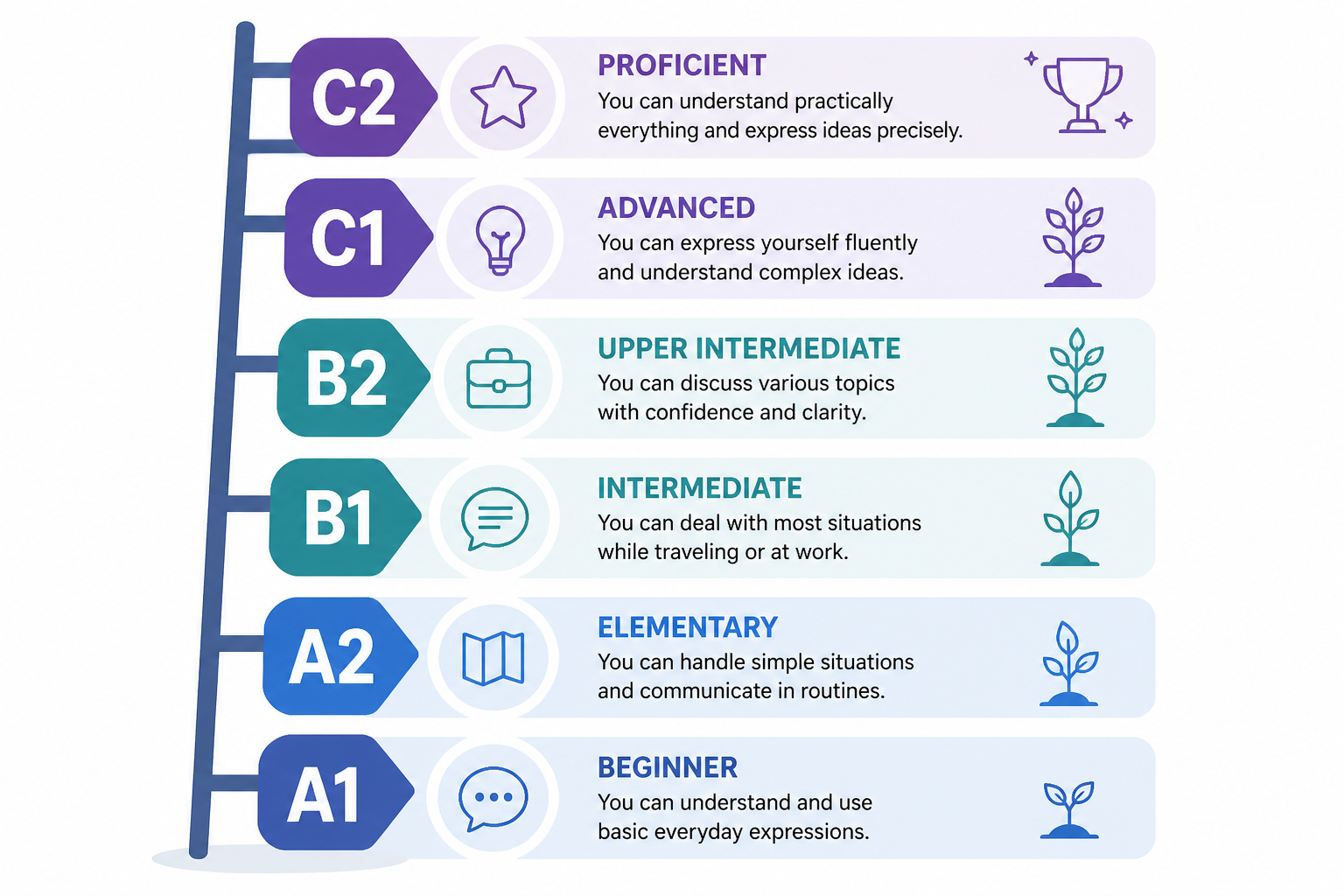
What is CEFR?
CEFR stands for Common European Framework of Reference for Languages. That is a long name for a practical idea: a shared system for describing how well someone can use a language.
Instead of saying “I know some Spanish” or “I’m fluent in French,” CEFR gives a more precise way to describe ability. It focuses on what you can do with the language in real situations.
That matters because language ability is not just one thing. You might be great at reading but struggle to speak. You might understand podcasts but freeze during a conversation. CEFR tries to capture those practical differences with a scale that runs from beginner to highly proficient.
The main levels are:
- A1 — Beginner
- A2 — Elementary
- B1 — Intermediate
- B2 — Upper-intermediate
- C1 — Advanced
- C2 — Proficient / near-native-like in many contexts
Some systems also use “plus” levels like B1+ or B2+, but the six main levels are the core framework most learners see.
Why CEFR levels matter for learners
CEFR is useful because it turns vague progress into something easier to understand. If you know your level, you can make smarter decisions about what to study next.
Here’s why that helps:
- You can pick the right materials. A B1 learner and a C1 learner should not use the same textbook.
- You can set realistic goals. “Reach B2 speaking” is clearer than “get better at English.”
- You can measure progress. Even if you are not perfect, you can notice improvement.
- You can understand test results. Many language exams map scores to CEFR levels.
- You can avoid wasting time. If you are already B1 in reading, you probably do not need beginner reading drills forever.
In other words, CEFR is not just a label. It is a planning tool.
If you want a broader picture of how level systems fit into language study, the main overview on how to learn a language can help connect the dots.
The CEFR levels at a glance
Before getting into each level, here is the big picture. Think of CEFR as a ladder. Each rung means you can do more, but not everything gets better at exactly the same speed.
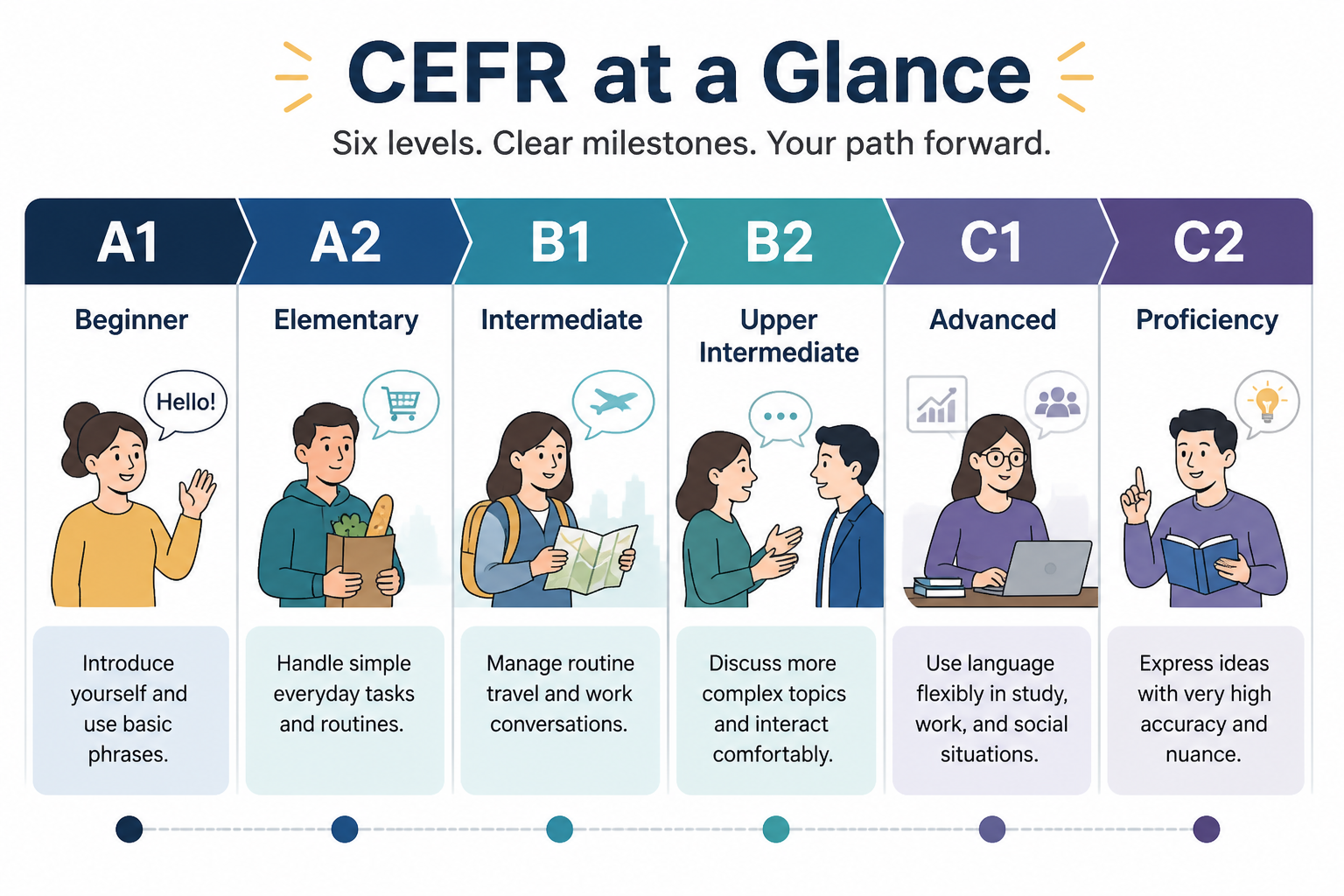
| Level | What it usually means | Typical real-life ability |
|---|---|---|
| A1 | Basic beginner | Can introduce yourself and handle very simple interactions |
| A2 | Basic user | Can manage simple everyday tasks and familiar topics |
| B1 | Independent user | Can handle routine travel, work, and personal topics with some confidence |
| B2 | Independent user, stronger | Can discuss more complex topics and interact with native speakers more comfortably |
| C1 | Advanced user | Can use the language flexibly in study, work, and social situations |
| C2 | Highly proficient user | Can understand and use the language with very high accuracy and nuance |
That table is helpful, but the real meaning comes from seeing what each level looks like in practice.
A1: absolute beginner, but not hopeless
A1 is the starting point. At this level, you can use the language for very basic needs, especially with support. You are not expected to have long conversations. You are expected to recognize and produce simple, memorized language.
At A1, a learner can usually:
- introduce themselves
- ask and answer basic personal questions
- understand very simple instructions
- recognize familiar words and phrases
- use basic greetings and polite expressions
- fill in forms with personal details
Example A1 tasks might include saying your name, asking where the bathroom is, or understanding “Please wait here.” That is not flashy, but it is real language use.
Common A1 mistake: expecting conversation fluency too soon. A1 is about survival-level communication, not smooth discussion. If you can ask for directions and understand the answer only when it is slow and clear, that is normal.
What helps at A1: short phrases, high-frequency vocabulary, listening to very slow speech, and lots of repetition. This is the level where “boring” is often useful. Repetition builds the base.
A2: simple everyday language starts to work
A2 means you can handle more everyday situations, especially predictable ones. You are still a beginner, but now you can move beyond introductions and memorized phrases.
At A2, a learner can usually:
- talk about daily routines
- describe simple needs and preferences
- ask for and give basic information
- understand short, clear messages
- manage simple shopping, travel, or service situations
- write short notes or messages
Example A2 tasks might include saying what time you get up, ordering food, or asking someone to repeat a sentence. You can communicate, but you still need simple language and patient listeners.
Common A2 mistake: confusing familiarity with fluency. You may know many words in common topics, but that does not mean you can talk freely about them. A2 learners often understand more than they can produce.
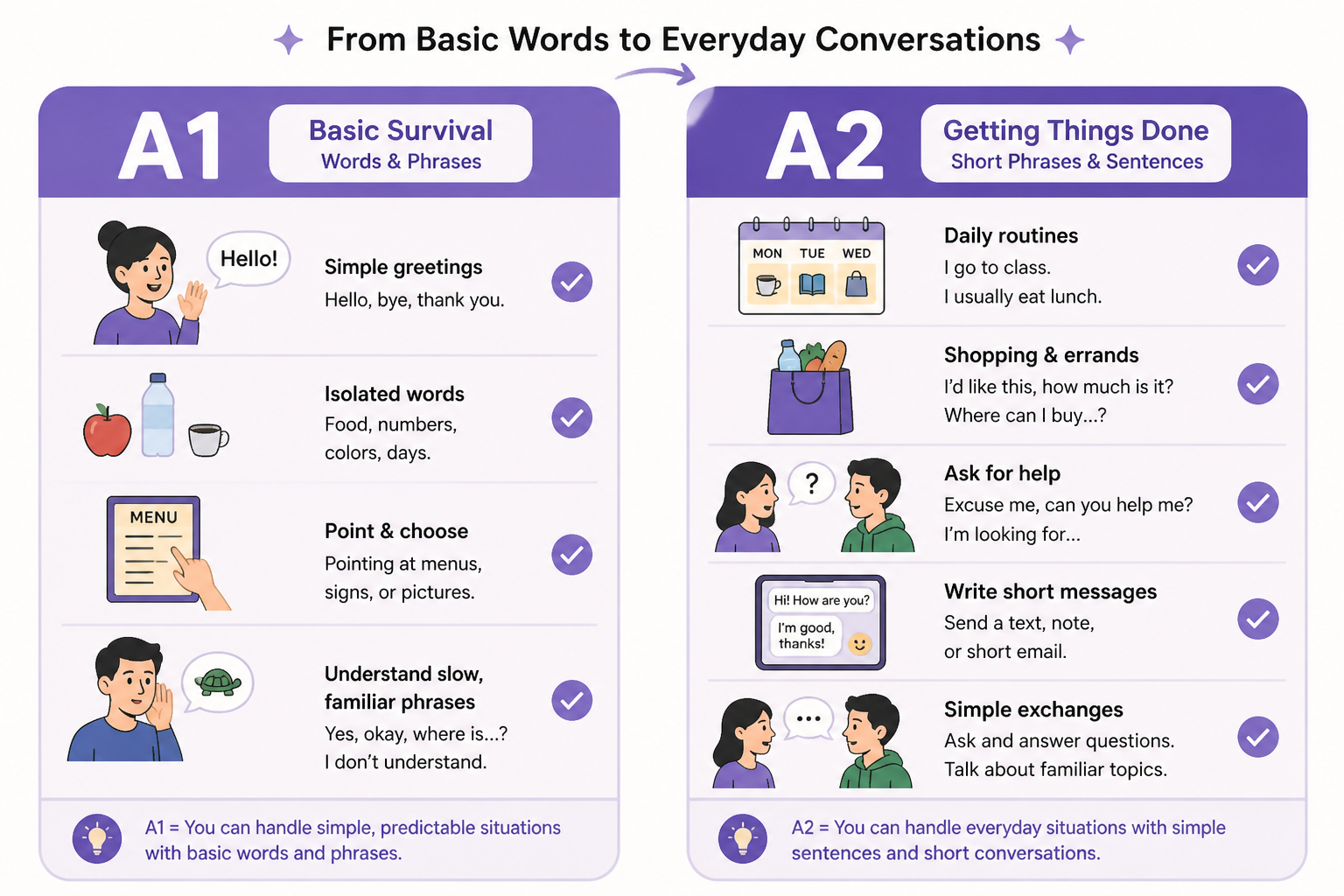
What helps at A2: themed vocabulary, sentence patterns, short listening practice, and controlled speaking. You want enough structure to use the language without drowning in it.
B1: the “I can handle this” level
B1 is a big milestone. This is often the level where learners start to feel like the language is becoming usable in everyday life, not just in class.
At B1, a learner can usually:
- deal with many common situations while traveling
- talk about work, school, hobbies, and personal experiences
- understand the main points of clear standard speech
- write simple connected text on familiar topics
- describe events, plans, and opinions in basic detail
At this stage, you are no longer limited to short fragments. You can string ideas together. Your speech may still be slow, imperfect, and occasionally awkward, but it is becoming useful.
Example B1 tasks might include explaining your job, telling a short story about a weekend trip, or giving your opinion on a simple topic like “Why I like learning languages.”
Common B1 mistake: assuming “I can say a lot” means “I can say it well.” B1 speech often sounds like a good attempt, not a polished performance. That is fine. The goal at this level is communication, not elegance.
What helps at B1: lots of speaking practice, easy reading, listening with support, and guided writing. B1 is where confidence matters, but confidence needs evidence, so practice should be frequent and manageable.
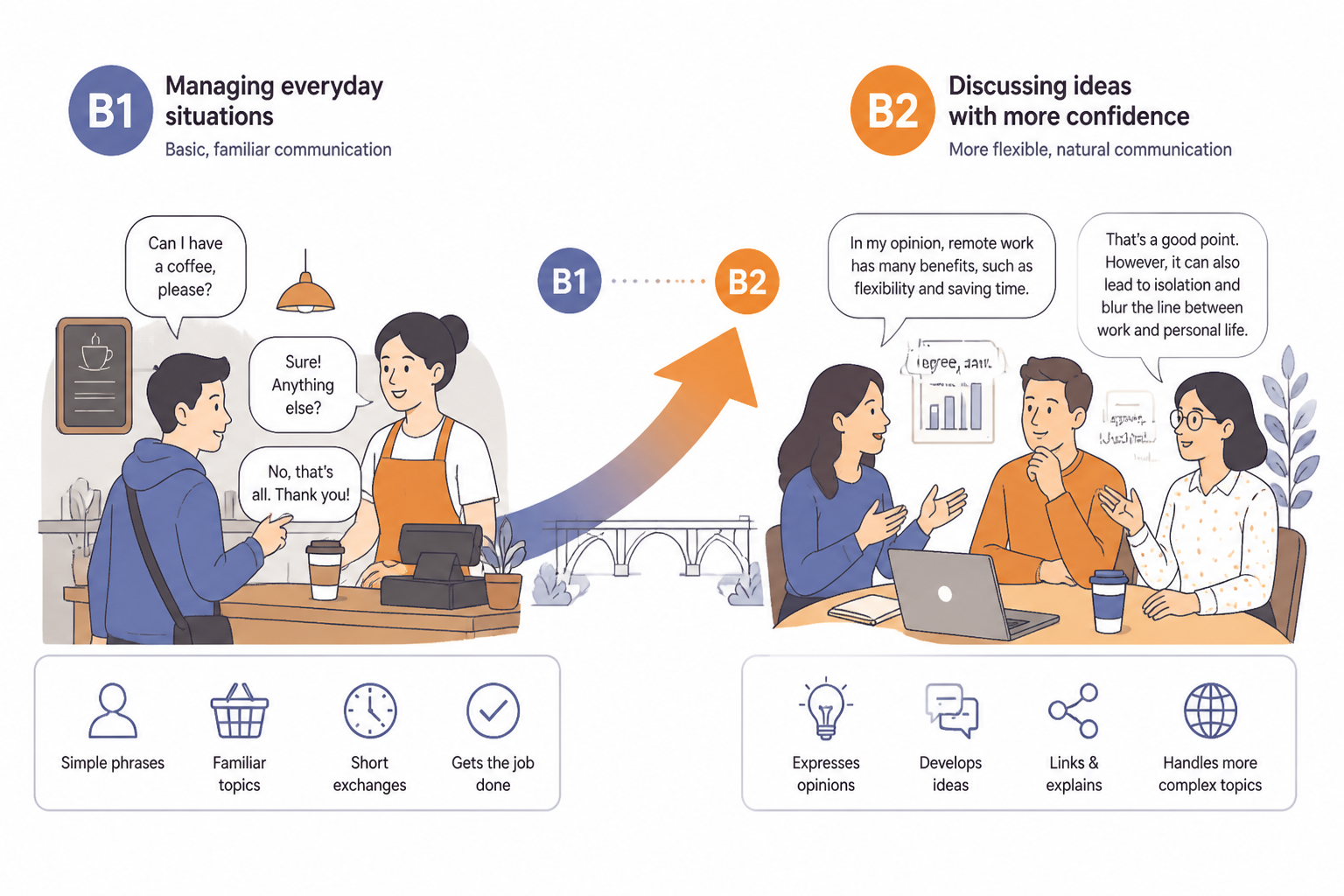
B2: the level where real conversation starts opening up
B2 is often the level people mean when they say they want to “be good at a language.” It is not perfection, but it is a strong, practical command of the language in many everyday and professional contexts.
At B2, a learner can usually:
- understand the main ideas of complex texts
- interact with native speakers with less strain
- take part in discussions on familiar and some abstract topics
- write clear, detailed text on a wide range of subjects
- explain viewpoints and give pros and cons
In plain English: B2 is the point where the language starts behaving like a tool you can actually use, not just a puzzle you are trying to solve.
Example B2 tasks might include discussing your opinion on remote work, following most of a TV interview, or writing a detailed email at work.
Common B2 mistake: thinking every missing word means you are not really B2. Nope. B2 learners still have gaps. The difference is that those gaps do not stop communication as often.
What helps at B2: authentic content, conversation practice, targeted grammar cleanup, and writing with feedback. B2 is where accuracy and flexibility both start to matter more.
C1: advanced use with real flexibility
C1 means you can use the language effectively in demanding situations. You are usually comfortable with complex texts, nuanced discussions, and work or academic tasks in the language.
At C1, a learner can usually:
- understand longer, more demanding texts
- express ideas fluently without searching too hard for words
- use the language flexibly for social, academic, and professional purposes
- write clear, well-structured text on complex topics
- pick up on implied meaning, tone, and nuance more often
Example C1 tasks might include participating in a workplace meeting, writing a structured argument, or following a serious podcast episode with relatively little strain.
Common C1 mistake: thinking that advanced means effortless. Even strong C1 learners may pause, hesitate, or make occasional mistakes. The difference is that they can keep going without falling apart every five seconds.
What helps at C1: exposure to rich content, precision work on weak spots, and practice in real-world tasks like presentations, essays, debates, or detailed conversations.
C2: highly proficient, but not magical
C2 is the top of the CEFR scale. It describes a user who can understand and use the language at a very high level across a wide range of situations.
At C2, a learner can usually:
- understand almost everything heard or read with little effort
- summarize information from many sources
- express themselves very precisely and naturally
- handle subtle distinctions in meaning
- adapt language style to different audiences and purposes
C2 does not necessarily mean “sound exactly like a native speaker in every situation.” It means extremely high competence. Native speakers themselves vary in vocabulary, style, education, and confidence, so “native-like” is not a perfect standard anyway.
Common C2 mistake: treating C2 as a finish line where nothing can improve. In real life, C2 learners still expand vocabulary, refine style, and learn specialized language. Mastery is not a static trophy.
What helps at C2: immersion in advanced content, specialized reading, editing, style work, and deep exposure to how the language behaves across contexts.
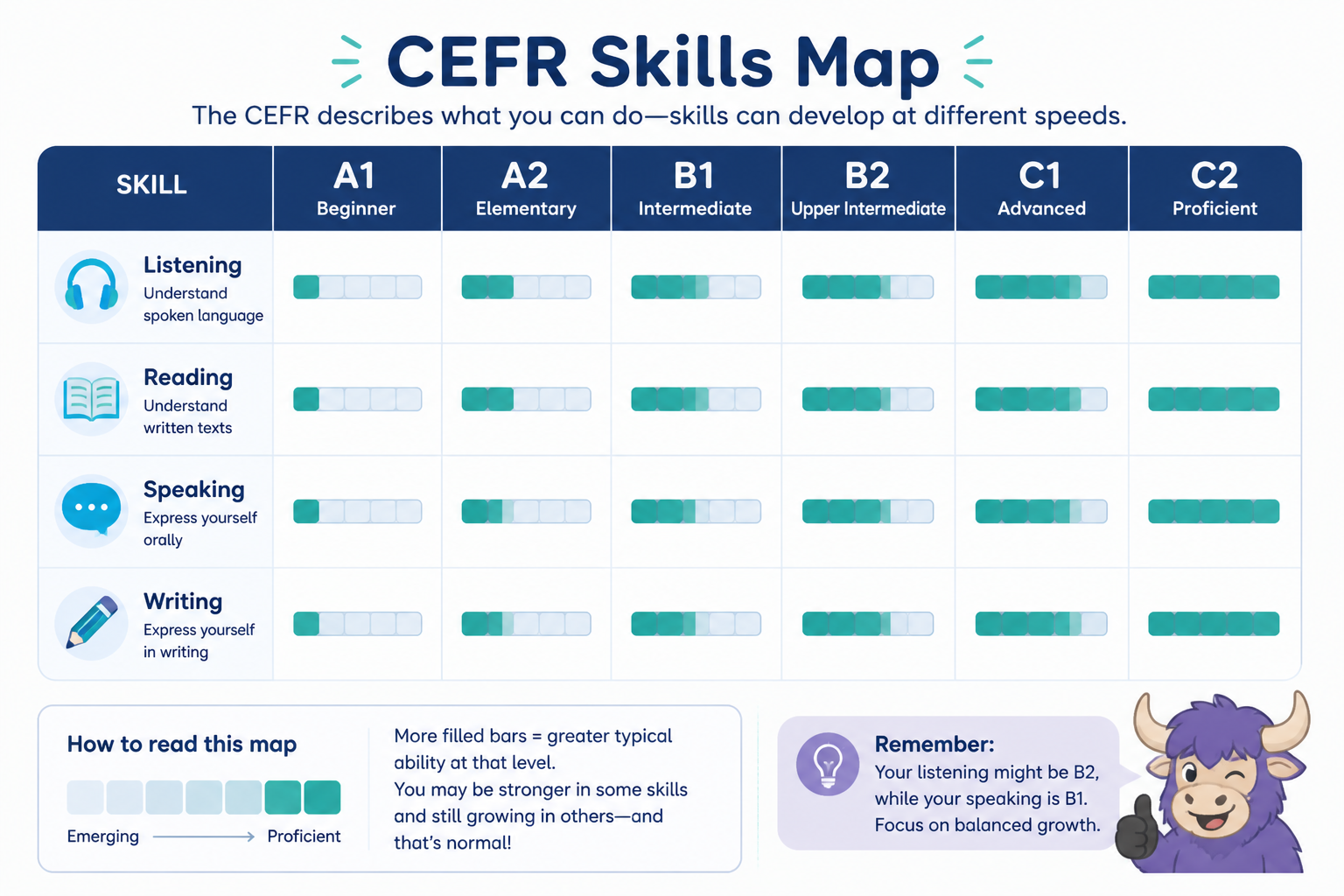
What CEFR is really measuring
CEFR is about communicative ability. That sounds fancy, but it just means: how well can you use the language in real life?
It usually looks at four broad skills:
- Listening — understanding spoken language
- Reading — understanding written language
- Speaking — producing spoken language
- Writing — producing written language
But here is the important part: CEFR levels are not always even across all skills. You might be B2 in reading and B1 in speaking. That is very normal.
This is why “What level am I?” is sometimes the wrong question. A better question is: What can I do in each skill?
| Skill | What to look for |
|---|---|
| Listening | Can you follow the main idea, details, or nuance? |
| Reading | Can you understand simple text, articles, or complex arguments? |
| Speaking | Can you ask, answer, explain, and keep a conversation going? |
| Writing | Can you write notes, emails, opinions, or structured text? |
How to tell your CEFR level without guessing wildly
Many learners estimate their level based on feelings. The problem is that feelings can be misleading. When you understand a lot of content, you may think you are stronger than you are. When you struggle in conversation, you may think you are worse than you are.
A better approach is to test your ability across real tasks.
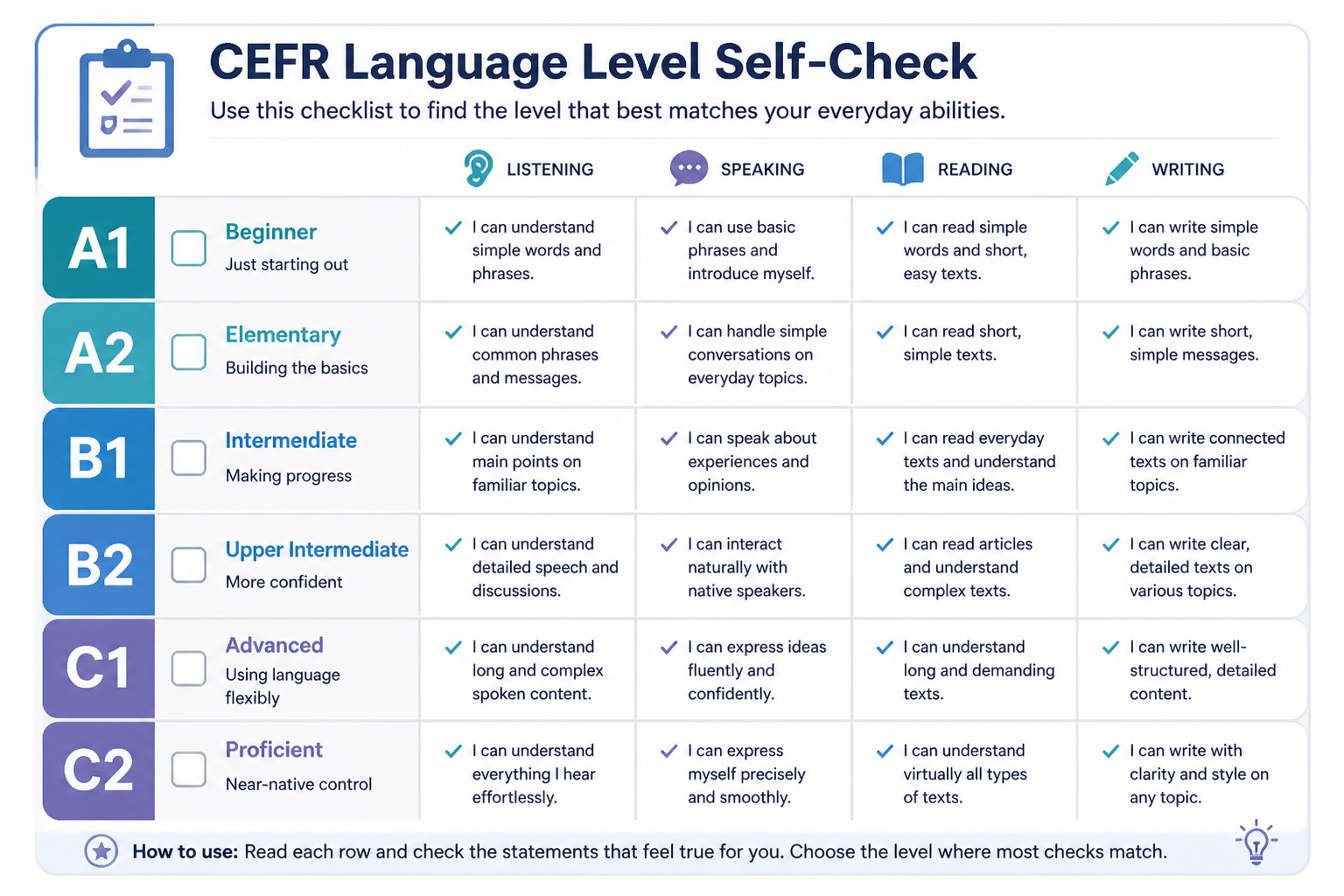
A simple self-check method
- Can I handle only memorized phrases? You are probably A1.
- Can I manage simple everyday needs? You may be A2.
- Can I discuss familiar topics in connected sentences? You may be B1.
- Can I join conversations on wider topics and explain my opinion? You may be B2.
- Can I use the language flexibly in work or study settings? You may be C1.
- Can I understand and use the language at a very high level across most contexts? You may be C2.
That is only a rough guide, but it is more useful than a vague hunch.
A better self-check: think in tasks, not labels
Ask yourself questions like these:
- Can I order food without rehearsing every line?
- Can I explain what I did yesterday?
- Can I ask follow-up questions in a conversation?
- Can I understand a news article on a topic I know?
- Can I write a decent email without translating every sentence in my head?
- Can I discuss an abstract topic like change, risk, or responsibility?
If you can answer yes to more demanding tasks, your level is rising. Progress is often easier to see in what you can do than in a label alone.
Why CEFR levels are helpful for study planning
CEFR is especially useful when you want to avoid two common traps: studying things that are too hard, and staying stuck with things that are too easy.
Here is how levels help with planning:
- If material is too hard, you may become frustrated and learn slowly.
- If material is too easy, you may feel comfortable but stop growing.
- If material fits your level, you can stretch without breaking.
That “stretch without breaking” zone is where progress tends to happen fastest.
If you want to connect level-setting with time estimates, you may also find FSI language hours useful for understanding the rough amount of time people often associate with different kinds of language progress.
And if you are wondering how long the full journey might take in general, how long to learn a language is a helpful companion read.
Common mistakes learners make with CEFR levels
CEFR is helpful, but only if you use it correctly. Here are the biggest mistakes people make.
1. Thinking the levels are perfect boxes
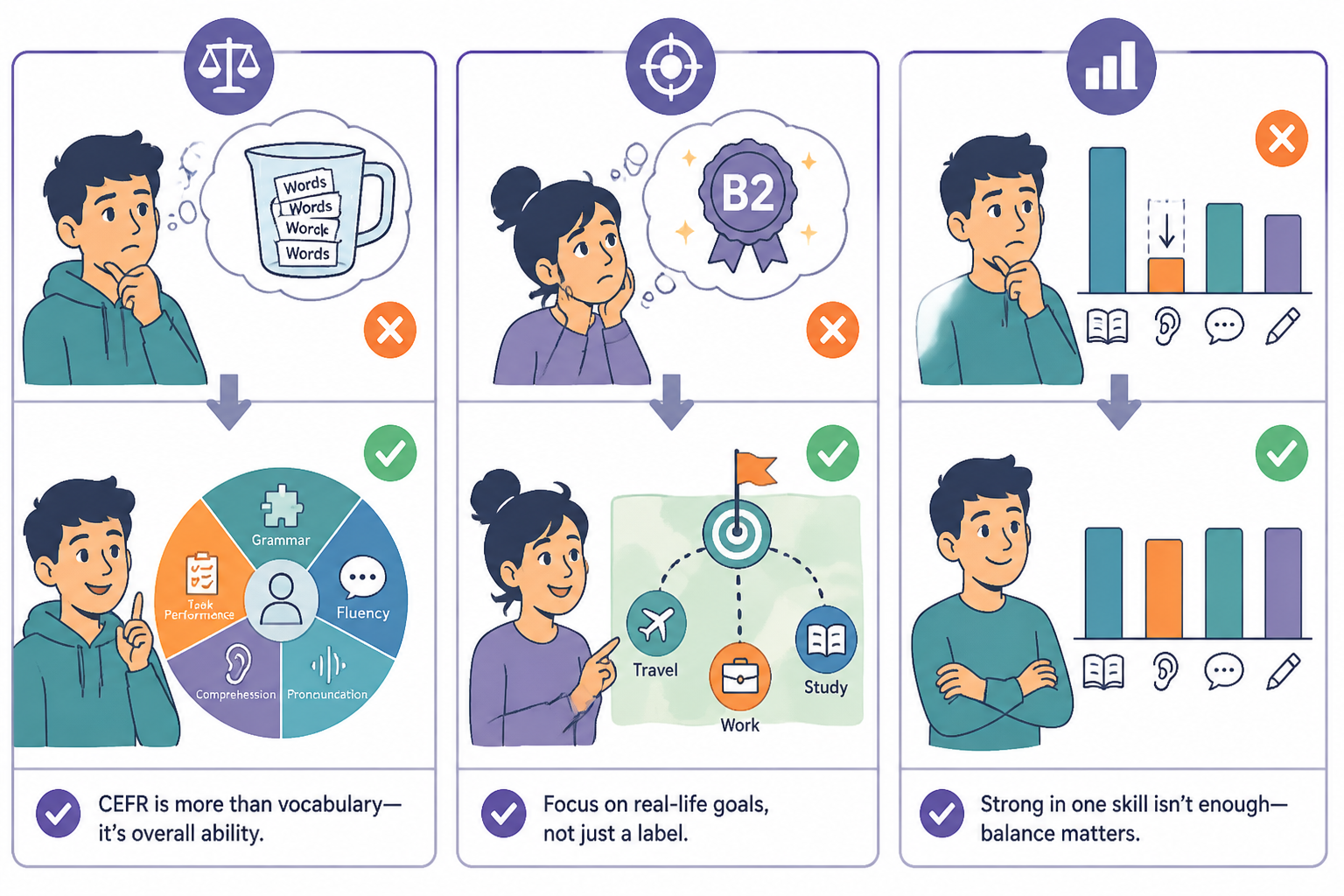
Real learners do not fit neatly into boxes. You might be B1 overall with A2 speaking and B2 reading. That is not a failure. It is normal human learning.
2. Confusing “understanding” with “being able to use”
Many learners can understand much more than they can produce. Passive knowledge is important, but production skills often lag behind. That gap is part of the process.
3. Measuring level by vocabulary alone
Vocabulary matters, but CEFR is not just a vocabulary count. Grammar control, fluency, pronunciation, accuracy, comprehension, and task performance all matter too.
4. Chasing the label instead of the skill
Some learners become obsessed with “getting to B2” and forget why they wanted the language in the first place. The label should support your goals, not replace them.
5. Overrating your level because one skill is strong
If you read beautifully but cannot follow normal speech, your overall ability is not the same as your reading level. Be honest about skill imbalance. It saves time later.
How CEFR levels compare to real-world ability
People often want a simple translation like “B1 means fluent.” Unfortunately, language does not work that neatly. But CEFR can still give a useful picture if you think in practical terms.
| Level | Practical picture | What it does not mean |
|---|---|---|
| A1 | Very basic survival communication | Real conversation confidence |
| A2 | Simple everyday exchange | Comfort with complex topics |
| B1 | Independent handling of common situations | Natural, effortless speech |
| B2 | Strong communication in many settings | Perfect accuracy or no hesitation |
| C1 | Flexible, effective use in demanding contexts | Flawless native-like performance |
| C2 | Very high proficiency and nuance | Unlimited knowledge of every word or style |
A lot of confusion disappears when you stop asking, “Am I fluent?” and start asking, “What can I actually do?”
How to use CEFR levels to choose study materials
Once you know your level, the next step is choosing material that matches it. Too easy and you coast. Too hard and you panic. The goal is a manageable challenge.
Here is a practical way to choose:
- A1–A2: beginner courses, slow audio, picture-based vocabulary, short dialogues, simple graded readers
- B1: intermediate lessons, short articles, slower podcasts, guided conversations, basic native content with support
- B2: native content on familiar topics, mixed difficulty reading, unscripted listening, conversation practice, writing feedback
- C1–C2: specialized reading, advanced talks, dense articles, debates, academic or professional content, style refinement
A useful rule: if you understand almost everything instantly, the material may be too easy. If you understand almost nothing, it is probably too hard. Aim for “challenging but not impossible.”
CEFR and language tests: why the levels show up everywhere
CEFR levels are used because they give schools, employers, test makers, and learners a common reference point. That makes it easier to compare results across different systems.
You might see CEFR in:
- placement tests
- course descriptions
- textbook series
- exam score reports
- job language requirements
- study abroad requirements
This is helpful, but it can also create pressure. A level is a snapshot, not a verdict on your worth as a learner. It tells you where you are now, not whether you are “smart” or “bad at languages.”
A practical CEFR checklist for learners
If you want a quick way to think about your own level, use this checklist. Not every item has to be true, but the more boxes you tick, the clearer your level becomes.
Beginner signs:
- I rely on memorized phrases.
- I need slow speech and lots of repetition.
- I can handle only very simple tasks.
- I often need translation support.
Intermediate signs:
- I can talk about familiar topics in full sentences.
- I can understand the main idea of clear speech or text.
- I can handle many everyday situations.
- I still make errors, but communication works.
Advanced signs:
- I can discuss abstract or complex topics.
- I can understand a range of authentic content.
- I can adjust my language for different situations.
- I can communicate with relatively little strain.
What to do if your skills are uneven
This is one of the most common CEFR problems. A learner will say, “I’m B1,” but then reading is B2, listening is A2, and speaking is somewhere in the emotional wilderness.
That does not mean the scale is useless. It means your profile is uneven. Most learners are uneven in some way.
Here is how to handle it:
- Identify your strongest skill. This gives you confidence and a base.
- Identify your weakest skill. This shows where targeted practice is needed.
- Set skill-specific goals. For example: “Move speaking from A2 to B1.”
- Use the strong skill to support the weak one. Reading can reinforce vocabulary that later helps listening and speaking.
A balanced profile is nice, but useful language ability often grows unevenly first and evens out later.
How CEFR fits into a smart learning routine
CEFR should support your routine, not replace it. A good routine uses your level as a guide for what kind of practice to do, how hard it should be, and what success should look like.
For example:
- A1–A2: build core vocabulary, simple structures, and repeated exposure
- B1: practice combining skills and expressing more personal meaning
- B2: increase input quality, accuracy, and conversation depth
- C1–C2: refine nuance, style, and specialized use
The level tells you what kind of practice makes sense next. That is much more useful than chasing random study tips that may not fit your stage.
A simple way to turn CEFR into a study plan
If you want to use CEFR practically, try this simple three-step method.
Step 1: choose your target level
Pick the level that best matches your goal, not your ego. If you need the language for travel, maybe B1 is enough. If you need it for work or study, maybe B2 or C1 is the target.
Step 2: compare your current ability to that level
Look at the real tasks listed for that level. What can you already do? What still feels hard? That gap is your study target.
Step 3: practice the tasks that close the gap
Do not just “study grammar.” Study the exact things you need for the next level: speaking longer, understanding faster speech, reading more complex texts, or writing more clearly.
That is how CEFR becomes a tool instead of a label collection.
Frequently misunderstood CEFR ideas
Before wrapping up, it helps to clear up a few myths that trip learners up.
“B2 means fluent.”
Sometimes people use “fluent” loosely to mean “I can communicate pretty well.” In that casual sense, B2 might feel fluent. But if you mean effortless, highly nuanced, and near-native use in most contexts, that is closer to C1 or C2.
“C2 means native speaker.”
Not exactly. C2 is a proficiency level, not a nationality or identity. It describes extremely strong command, but real native speakers still vary widely.
“If I understand everything, I must be high-level.”
Understanding familiar or slow content does not automatically mean advanced ability. Level depends on the range and difficulty of what you can handle, plus how well you can produce language yourself.
The short version: what CEFR levels mean
If you want the simplest possible summary, here it is:
- A1–A2: you can handle basic, everyday communication
- B1–B2: you can function independently and discuss more than just survival topics
- C1–C2: you can use the language with high flexibility, precision, and control
But the better summary is this: CEFR levels describe what you can do in the language, not who you are as a learner.
What to do next
If you now have a clearer idea of where CEFR levels fit into your learning, the next smartest move is to identify your current skill level in each area and choose study materials that match it. That way, you can spend less time guessing and more time improving.
If you want to keep building that picture, it can help to compare CEFR with progress tracking methods and time estimates. These guides work well together:
- how to track language progress with CEFR and ACTFL
- FSI language hours
- how long it takes to learn a language
The main thing to remember is simple: CEFR is a map, not a medal. Use it to choose your route, check your progress, and keep moving forward without having to wonder whether you are “good enough” yet.