
How to Use Shadowing to Improve Your Language Skills
If you want to sound more natural, speak more smoothly, and stop freezing every time someone talks at normal speed, shadowing can help. The shadowing method is simple on paper: you listen to a speaker and repeat what they say almost immediately, trying to match their rhythm, pronunciation, and intonation.
Simple does not mean easy. Shadowing asks your brain to do several things at once: listen, process meaning, remember the sound pattern, and speak out loud. That is exactly why it is useful. It trains the parts of language use that many learners neglect when they only study vocabulary lists or grammar rules.
This guide will show you what shadowing is, why it works, how to do it step by step, what materials to use, how to avoid common mistakes, and how to build it into a real learning routine. If you want the method explained more narrowly, you can also read The Shadowing Method For Language Learning, but this article will give you the full practical picture.
What shadowing actually is
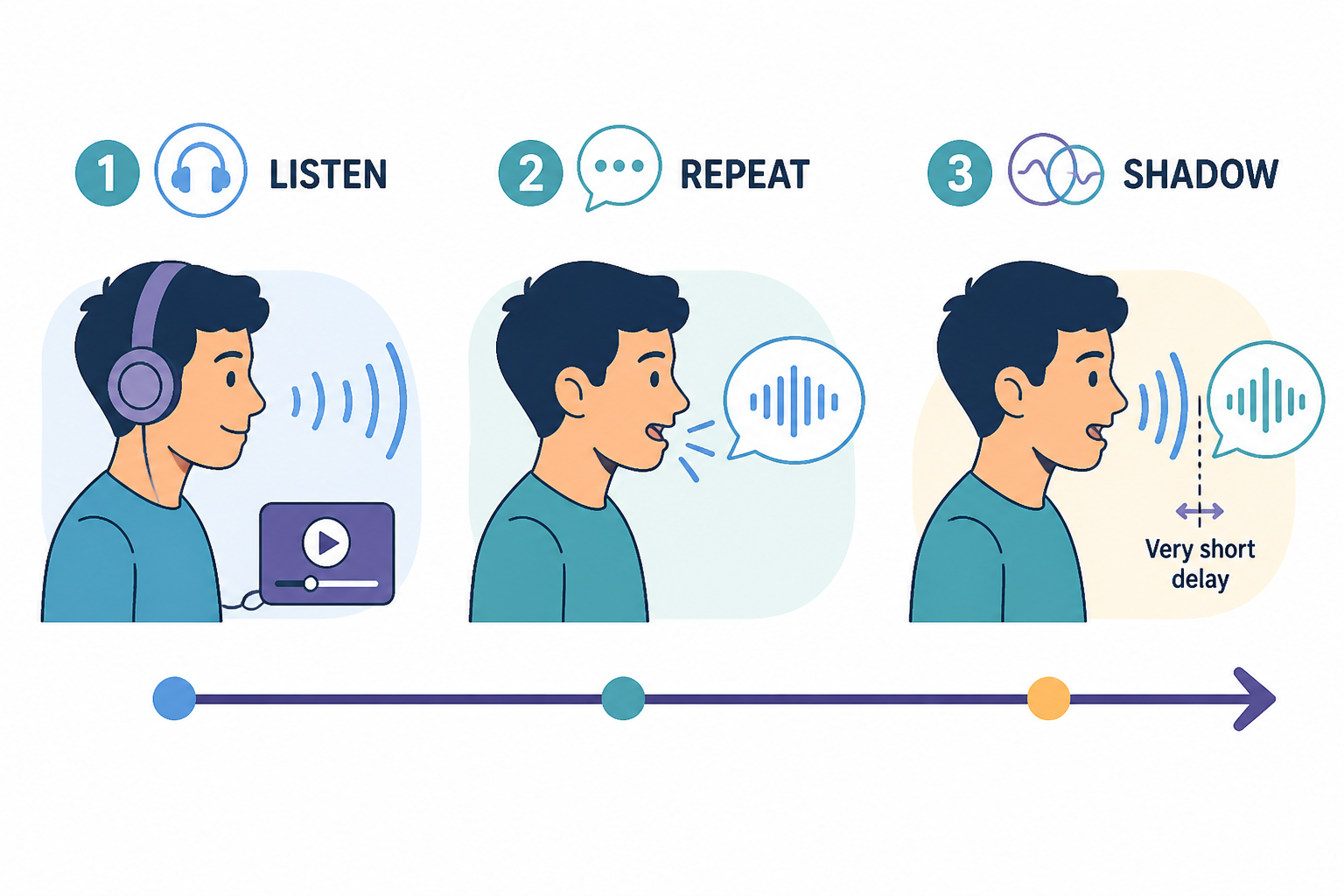
Shadowing means speaking along with audio, usually with a very small delay. You are not mainly trying to memorize the text. You are trying to imitate the speaker in real time, as closely as possible.
Think of it like being the speaker’s shadow: they move, and you follow. Your goal is to copy:
- pronunciation
- stress and rhythm
- sentence melody, also called intonation
- speed and flow
- pausing and linking between words
Shadowing is not the same as simple repetition. In repetition, you listen to a phrase and then repeat after it ends. In shadowing, you try to overlap with the speaker. That small timing difference makes the exercise much more demanding and much more powerful.
Why shadowing helps language learners
Many learners spend a lot of time understanding language on the page, but real conversations happen at speed. Shadowing narrows that gap. It helps you move from “I know this word” to “I can actually say this smoothly.”
1. It improves listening and speaking at the same time
Shadowing forces your ears and mouth to work together. You cannot just sit back and understand passively. You must process sound quickly and produce sound immediately. That combination builds stronger automaticity, which is a fancy way of saying your responses become less slow and clunky.
2. It helps you notice how real speech sounds
Textbook audio often sounds neat and tidy. Real speech usually sounds connected, reduced, and fast. Shadowing helps you hear how words blend together, where stress falls, and how native speakers shape a sentence in motion. Over time, your ear gets less surprised by normal speech.
3. It can improve pronunciation and fluency
Because you are copying a live model, shadowing gives you a clear target. You are not guessing how a phrase should sound. You are trying to match a real example. That can improve your accent, your timing, and your confidence speaking without long pauses.
4. It builds speaking confidence without needing a partner
Not every learner has access to conversation partners every day. Shadowing lets you practice speaking alone, which makes it easy to fit into short sessions. You still need real conversations eventually, but shadowing is a very useful bridge between study and speaking.
If your biggest challenge is listening rather than speaking, you may want to pair shadowing with more focused listening work. This guide on how to practice listening in a language is a good companion, because shadowing works best when your listening base is improving too.
What shadowing is not
Shadowing is useful, but it is not magic. It does not replace every other part of language learning. It is one tool, not the whole toolbox.
| Shadowing helps with… | Shadowing does not fully replace… |
|---|---|
| pronunciation | vocabulary building |
| intonation and rhythm | grammar study |
| listening speed | reading practice |
| speaking flow | real conversation practice |
| confidence with sound patterns | writing practice |
That table matters because learners sometimes overuse shadowing and expect it to solve everything. It will not teach you words you do not know. It will not explain grammar rules. It will not make you fluent if you never use the language for meaning. It is strongest when it supports other study methods.
Who shadowing is best for
Shadowing can help many learners, but it is especially useful if you are in one of these situations:
- You understand written language better than spoken language.
- You feel slow when speaking, even with easy topics.
- You want to improve pronunciation and rhythm.
- You know some vocabulary, but it does not come out smoothly in conversation.
- You need a daily speaking practice you can do alone.
It is less helpful if you choose audio that is far above your current level and spend the whole session confused. The method works best when the material is challenging but still understandable enough that you can follow it.
That idea connects closely to comprehensible input explained. If the audio is too hard, shadowing becomes noise-copying. If it is understandable, shadowing becomes a real learning exercise.
The basic shadowing process
Here is the simplest version of the method:
- Choose short audio with a transcript if possible.
- Listen once or twice to understand the overall meaning.
- Play a short segment.
- Start speaking slightly behind the speaker.
- Try to match the sound, rhythm, and pace.
- Repeat the segment until it feels smoother.
That is the core. But in practice, there are different ways to do shadowing, and some work better than others depending on your level.
Three useful ways to shadow
Not all shadowing looks exactly the same. You can adjust the method so it matches your current ability.
1. Full shadowing
This is the classic version. You speak along with the audio almost immediately, trying to keep up with the speaker.
Best for: intermediate learners or beginners with very short, simple audio.
2. Delayed shadowing
In delayed shadowing, you wait a brief moment before speaking. This gives your brain a tiny buffer, which can make the exercise easier while still training fast speech processing.
Best for: beginners, or learners working with dense material.
3. Transcript-supported shadowing
Here you read along with the transcript while shadowing. This reduces confusion and helps you connect sound with spelling and meaning.
Best for: learners who need support with listening accuracy or vocabulary recognition.
| Type | Best for | Main benefit | Main risk |
|---|---|---|---|
| Full shadowing | intermediate learners | fast speaking and listening coordination | can feel overwhelming |
| Delayed shadowing | beginners and cautious learners | more control and less panic | slightly less speed training |
| Transcript-supported shadowing | learners who need clarity | better comprehension and accuracy | can become too dependent on the text |
How to do shadowing step by step
Here is a practical routine you can actually follow. You do not need a fancy setup. A phone, headphones, and a short audio clip are enough.
Step 1: Pick the right audio
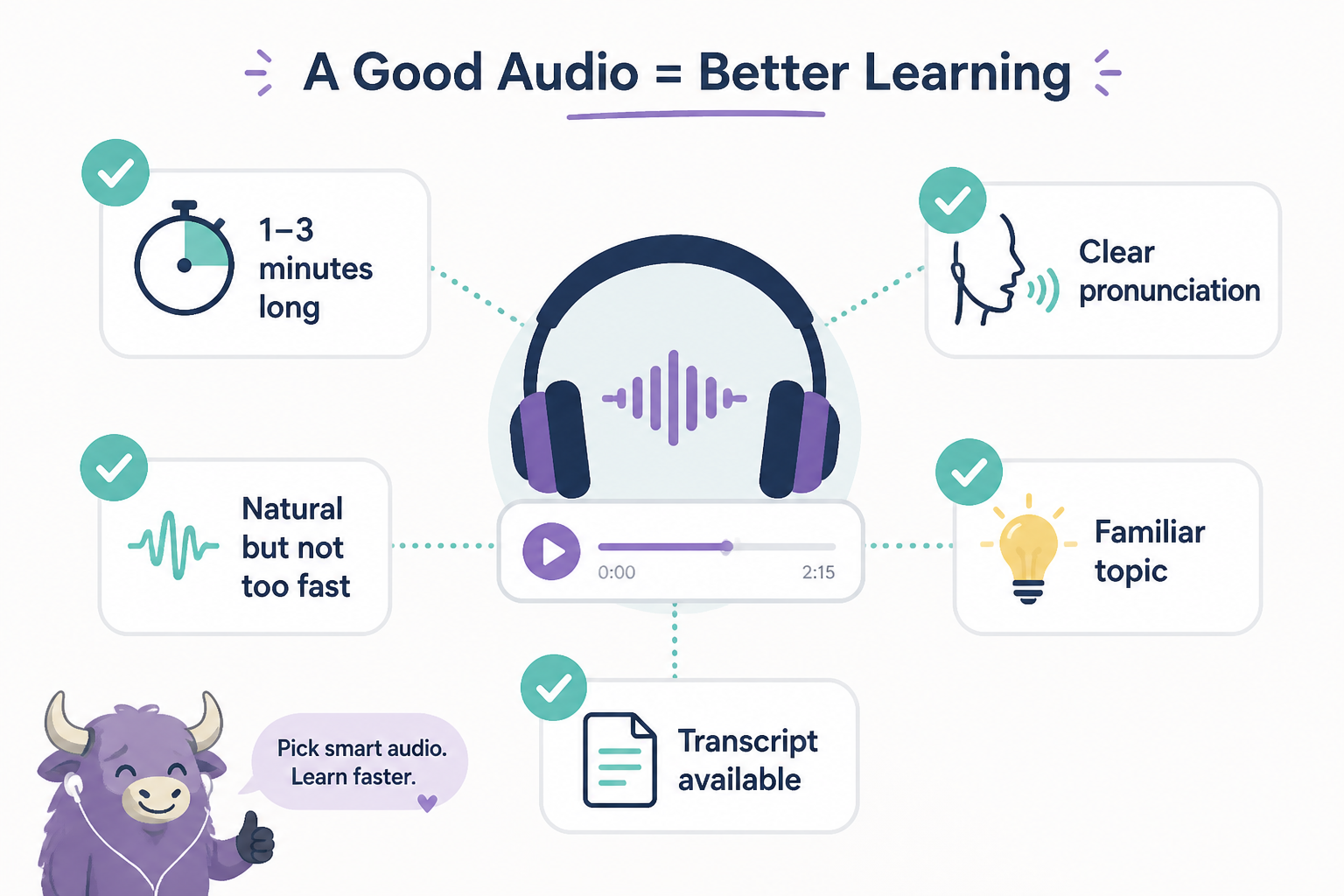
Start with something short, clear, and not too fast. The best audio for shadowing usually has these qualities:
- 1 to 3 minutes long for practice segments
- clear pronunciation
- natural but not chaotic speed
- topic you can understand at least broadly
- transcript available if you need support
Good audio sources for shadowing are often dialogues, narrated stories, short explanations, or learner-friendly content. Very noisy recordings or rapid overlapping conversations can be frustrating at first.
Step 2: Understand the meaning first
Before you copy the sound, make sure you know what the audio is about. Listen once without speaking. If there is a transcript, read it. Look up only the words that block understanding. You do not need to understand every tiny detail, but you should know the general meaning.
This step matters because shadowing works better when your brain is processing meaning, not just parroting sounds. Sound plus meaning is stronger than sound alone.
Step 3: Break the audio into small chunks
Do not try to shadow a full five-minute monologue in one go. Use short chunks, such as a sentence or two at a time. If the audio is dense, break it even smaller.
Chunking helps because your memory is limited. Smaller pieces give you a better chance to stay accurate without getting lost halfway through the sentence.
Step 4: Listen and imitate the sound pattern
Play the first chunk and focus on the melody of the sentence. Before worrying about every single sound, notice the overall rhythm, stress, and movement. Then speak along with the audio and try to match what you hear.
Do not just copy the words. Copy the shape of the sentence. Is the speaker rising at the end? Are some words compressed? Are some syllables longer or stronger? Shadowing trains these details.
Step 5: Repeat the same chunk several times
One pass is rarely enough. Repeat the same small section until it starts to feel familiar. On the first attempt, you may sound awkward. On the third or fourth, your mouth begins to catch the pattern.
That repetition is not boring busywork. It is the point. You are building a physical habit of speaking the language more automatically.
Step 6: Record yourself
If possible, record your shadowing attempt. Then compare it to the original. This is one of the fastest ways to notice gaps between what you think you sound like and what you actually sound like. A lot of learners discover, with mild embarrassment and great usefulness, that they are rushing, flattening the melody, or skipping sounds.
Step 7: Review and refine
After you shadow a chunk, go back and work on the parts that felt weak. Maybe you missed a linking sound. Maybe a particular phrase was too fast. Maybe your timing drifted. Focus on one issue at a time.
The goal is not perfection. The goal is better control each time you practice.
A simple shadowing session template
If you want a routine you can reuse, try this structure:
| Phase | Time | What you do |
|---|---|---|
| Warm-up | 2 minutes | listen once without speaking, relax your mouth, review the topic |
| First pass | 3 to 5 minutes | shadow one short segment with transcript support if needed |
| Repeat pass | 5 to 10 minutes | shadow the same section several times |
| Record and compare | 3 minutes | listen to your recording and notice mismatches |
| Final pass | 3 to 5 minutes | shadow once more with improved timing and pronunciation |
This kind of session can be short and still effective. You do not need an hour to benefit. A focused 15- to 25-minute practice block is often more useful than a long unfocused one.
That is also why shadowing fits nicely with how to build a language learning habit. Small, repeatable sessions are much easier to keep doing than heroic one-time study marathons that collapse after a week.
How to choose the right material
The material you choose can make shadowing feel smooth and useful, or frustrating and messy. Good material is one of the biggest success factors.
Good material is understandable, not effortless
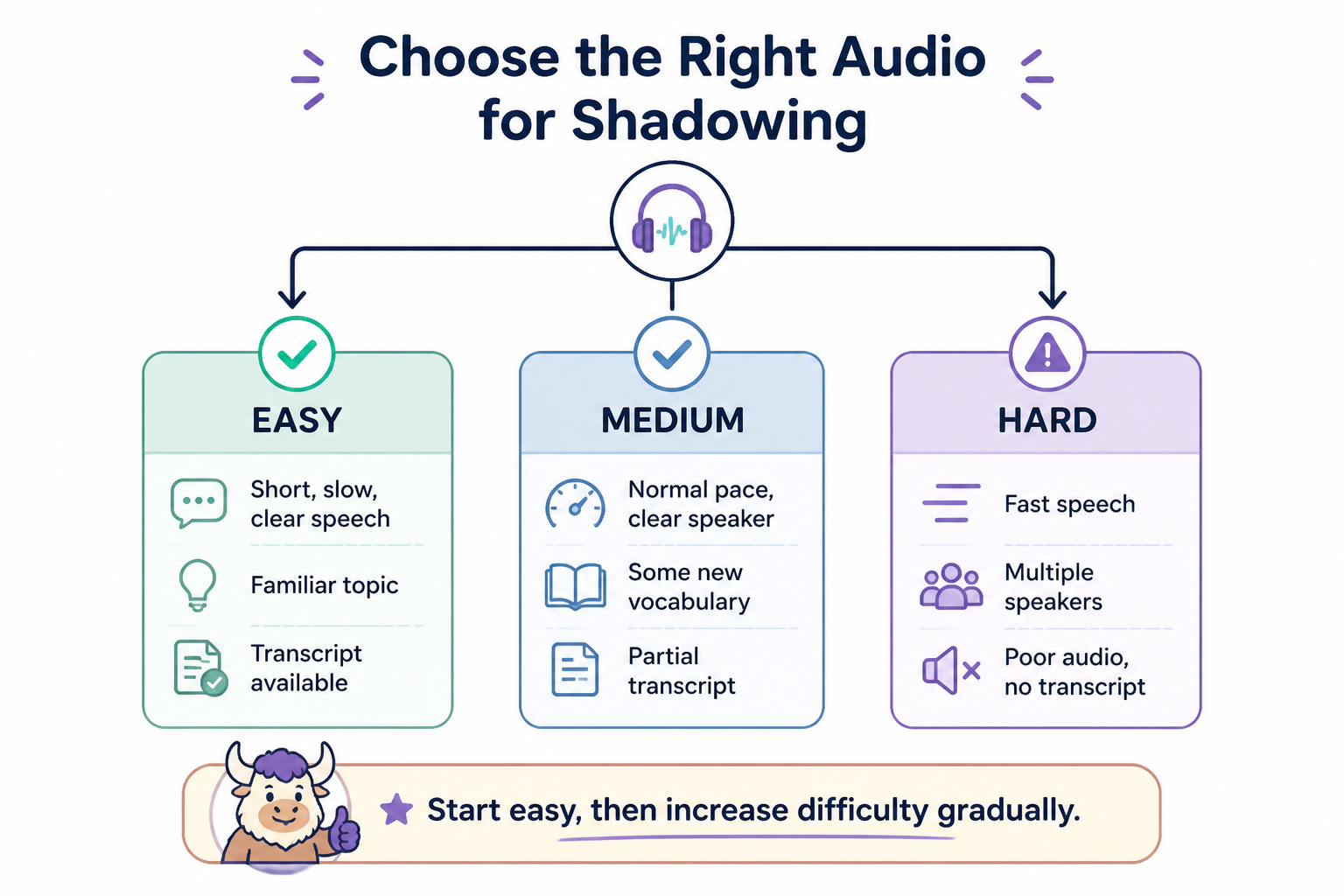
If the audio is too easy, you may not learn much. If it is too hard, you will spend all your energy trying to decode basic meaning. Aim for the middle: understandable enough to follow, but challenging enough to stretch you.
Use short passages before long ones
Short passages are easier to control. They let you repeat the same language enough times to notice patterns. Long passages are better later, when you already have some comfort with the method.
Choose speakers you can actually follow
Some voices are naturally harder to shadow than others. If the speaker mumbles, speaks extremely fast, or has a recording with poor audio quality, the exercise becomes more about deciphering than practicing. Pick a voice that is clear enough for learning, even if it is not perfectly polished.
Use transcripts wisely
Transcripts are helpful, but do not cling to them forever. Use them to support comprehension, then gradually reduce your dependence so your ears do more of the work.
Common mistakes learners make with shadowing
Shadowing is straightforward, but there are a few traps that can quietly reduce its usefulness. If your practice feels frustrating or strangely ineffective, one of these is probably the reason.
Mistake 1: Choosing audio that is too difficult
If you cannot follow the meaning at all, your brain will spend its time panicking instead of learning. Use easier material and build up gradually.
Fix
Switch to shorter clips, slower speech, or a transcript-supported exercise. The material should stretch you, not drown you.
Mistake 2: Focusing only on words, not sound
Some learners try to mentally translate each word while shadowing. That slows everything down. Shadowing works best when you pay attention to the sound pattern, not just the dictionary meaning of each word.
Fix
Start by copying rhythm, stress, and intonation. Let the words ride on top of that pattern.
Mistake 3: Speaking too softly or half-heartedly
If you barely move your mouth, you are not giving your muscles enough practice. Shadowing works better when you actually speak aloud with energy.
Fix
Speak clearly. Even if your timing is imperfect, active speaking gives you more benefit than mumbling in self-defense.
Mistake 4: Trying to be perfect on the first try
Perfectionism is a sneaky productivity thief. If you stop every two seconds to obsess over one sound, your flow disappears and the practice loses momentum.
Fix
Accept rough first passes. Then come back and improve one or two details on the next round.
Mistake 5: Shadowing without understanding
If you copy sound alone, you may improve imitation but miss the connection to meaning. That makes the exercise much less useful for real communication.
Fix: Make sure you know what the audio is saying before you shadow it. Even a rough sense of the message helps.
What to do if shadowing feels impossible
A lot of learners try shadowing once, struggle, and assume they are doing it wrong forever. Usually the issue is not the learner. It is the setup.
If you cannot keep up
The audio may be too fast or the chunks too long. Make the passage shorter. Lower the difficulty. Use delayed shadowing instead of immediate shadowing.
If you cannot hear the words clearly
Use cleaner audio, a transcript, or a slower speaker. You cannot shadow what you cannot hear. That is not a motivation problem; that is a signal problem.
If your pronunciation still sounds rough
That is normal. Pronunciation improves gradually. Focus on one or two features at a time, such as sentence rhythm or final sounds, instead of trying to fix everything at once.
If you get bored quickly
Use shorter sessions and rotate materials. Shadowing works best when it is regular. It does not need to be dramatic to be effective.
A beginner-friendly shadowing plan
If you are new to the method, do not start with full-speed, full-length audio. Start gently and increase the challenge over time.
| Week | Practice focus | Goal |
|---|---|---|
| Week 1 | short, clear audio with transcript | get comfortable speaking along with audio |
| Week 2 | repeat the same clips more times | improve timing and reduce hesitation |
| Week 3 | slightly longer clips or less transcript support | increase listening independence |
| Week 4 | new audio with similar difficulty | test whether your shadowing control is improving |
This kind of progression keeps the method challenging without turning it into a stress test. The key is gradual improvement, not instant mastery.
How to combine shadowing with other study methods
Shadowing works best when it sits inside a wider learning routine. Here is a simple way to combine it with other activities.
Before shadowing: learn the meaning
Use reading or listening to understand the topic first. This makes shadowing more meaningful and less confusing.
During shadowing: focus on sound and flow
Let your mouth and ears do the work. Do not stop every second to translate mentally.
After shadowing: review difficult phrases, extract useful vocabulary, and check what you still cannot hear clearly.
Optional follow-up: use the phrases in speaking
After shadowing a sentence several times, try saying it again without the audio. Then use the same structure in a new sentence of your own. That helps move the phrase from imitation into active use.
For many learners, this combination is powerful:
- comprehend the message
- shadow the sound
- repeat from memory
- reuse the pattern in real speech
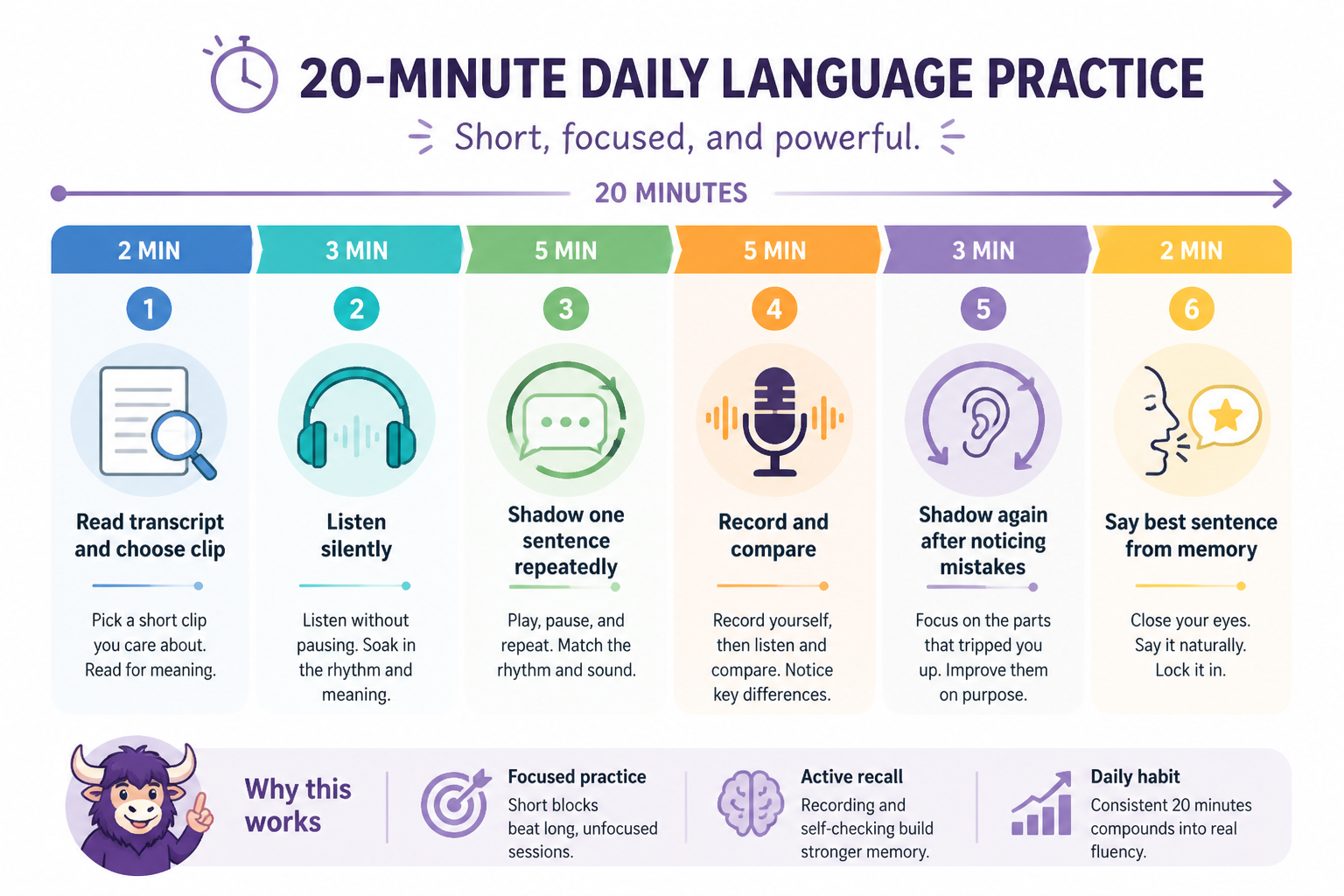
A sample 20-minute shadowing routine
Here is a realistic session you could do on a busy day.
- 2 minutes: choose a short clip and read the transcript once
- 3 minutes: listen without speaking
- 5 minutes: shadow one sentence or short section several times
- 5 minutes: record yourself and compare
- 3 minutes: shadow again after noticing mistakes
- 2 minutes: say the best sentence from memory
That is enough to create a strong practice session. You do not need a perfect environment. You need consistency, attention, and audio that is workable.
How to know if shadowing is working
Progress with shadowing is often subtle at first. You may not suddenly wake up sounding like a movie star. Thankfully, that is not the benchmark. Look for practical signs of improvement.
- You can keep up with slightly faster speech.
- You hesitate less when repeating new phrases.
- You notice rhythm and stress more easily.
- You can hear where words connect in a sentence.
- You feel less intimidated by normal-speed audio.
- Your own speech sounds smoother in recording.
If those things are changing, shadowing is helping. If nothing changes, check the material difficulty, session length, and whether you are really speaking out loud with full attention.
Frequently useful shadowing habits
These habits make the method more effective and less annoying.
- Keep the clips short enough to repeat.
- Use the same passage more than once.
- Speak clearly, not shyly.
- Record yourself sometimes, even if it feels awkward.
- Focus on one improvement per session.
- Return to the same difficult clip a few days later.
- Stop before fatigue turns practice into noise.
Quick checklist for a good shadowing session
Before you start, check these boxes:
- I understand the general meaning of the audio.
- The clip is short enough to repeat.
- I can hear the speaker clearly.
- I am ready to speak out loud, not just listen.
- I know whether I will use a transcript or not.
- I have a specific focus, such as rhythm, speed, or pronunciation.
If all six are true, you are in a strong position to learn something useful from the session.
Final thoughts: what shadowing is really for
The shadowing method is not about becoming a perfect echo machine. It is about training your ear, mouth, and timing to work together under real-world pressure. That is why it helps learners move from passive understanding to active speaking.
Used well, shadowing can sharpen your pronunciation, improve your listening, and make speaking feel less like a cliff edge and more like a staircase. The trick is to keep it small, focused, and regular. Choose audio you can actually work with, repeat it enough times to notice patterns, and combine it with meaning-based learning instead of treating it like a stand-alone miracle.
If you want to keep building a practical learning system around it, revisit the basics of how to learn a language, then pair shadowing with listening practice and a habit you can sustain. That combination is far more powerful than any single technique by itself.