How to Overcome a Language Learning Plateau
A language plateau is the annoying stage where you feel like you are studying, but your progress seems to have hit a wall. You still understand more than before. You can say more than before. But the jump you expected just does not show up. It can feel like your brain has quietly switched to “background loading,” and nothing is happening.
The good news: plateaus are normal. They do not mean you are bad at languages, and they definitely do not mean you have “stopped being a language learner.” In many cases, a plateau is a sign that your old study methods have done their job, and now you need a new kind of challenge.
This guide will show you how to break through a language plateau with practical, realistic steps. You will learn how to diagnose what kind of plateau you are in, how to change your study plan, how to get unstuck with input and output, and how to know whether you are actually improving even when it does not feel like it.
If you want a broader foundation first, it can help to understand where this plateau sits in the bigger picture of learning. You may also find our guide to CEFR language levels explained useful for spotting what progress really looks like at different stages.
What a Language Plateau Actually Is
A plateau is a period where visible progress slows down, even though learning is still happening underneath the surface. In other words, your brain has not quit. Your results are just less dramatic than they were at the beginning.
Early progress in language learning is often easy to notice. You learn greetings, common phrases, basic grammar, and simple vocabulary. That feels exciting because every small piece gives you a big return. Later, progress becomes less obvious. You may need weeks of work to notice one smaller gain, like understanding faster speech a little better or speaking with fewer pauses.
That shift is frustrating, but it is also natural. The better you get, the more effort it takes to improve. The early “wow, I learned so much this week” phase eventually turns into “I think I am better than last month, but only after a lot of squinting.”
A plateau does not mean you are failing. It usually means your progress is becoming more subtle, and your learning method needs adjustment.
That is why the key question is not “How do I feel more motivated?” It is “What kind of learning change will create the next breakthrough?”
Why Plateaus Happen
Most plateaus happen for one or more of these reasons:
- Your study routine has become too repetitive.
- Your input is too easy, too hard, or too familiar.
- You are avoiding the skills that expose weak spots.
- You are not practicing enough retrieval, output, or recall.
- You are focusing on comfort instead of challenge.
- You are improving, but not tracking progress in a way you can notice.
Notice that none of these reasons mean “you are not talented enough.” Plateaus are usually a systems problem, not a personality problem.
That matters, because if you think the problem is your talent, you will respond by feeling discouraged. If you think the problem is your system, you can fix it.
First, Figure Out What Kind of Plateau You Have
Before changing everything, it helps to identify the main bottleneck. Different plateaus need different solutions. Some learners need more listening exposure. Others need speaking practice. Others need better review habits or a clearer study plan.
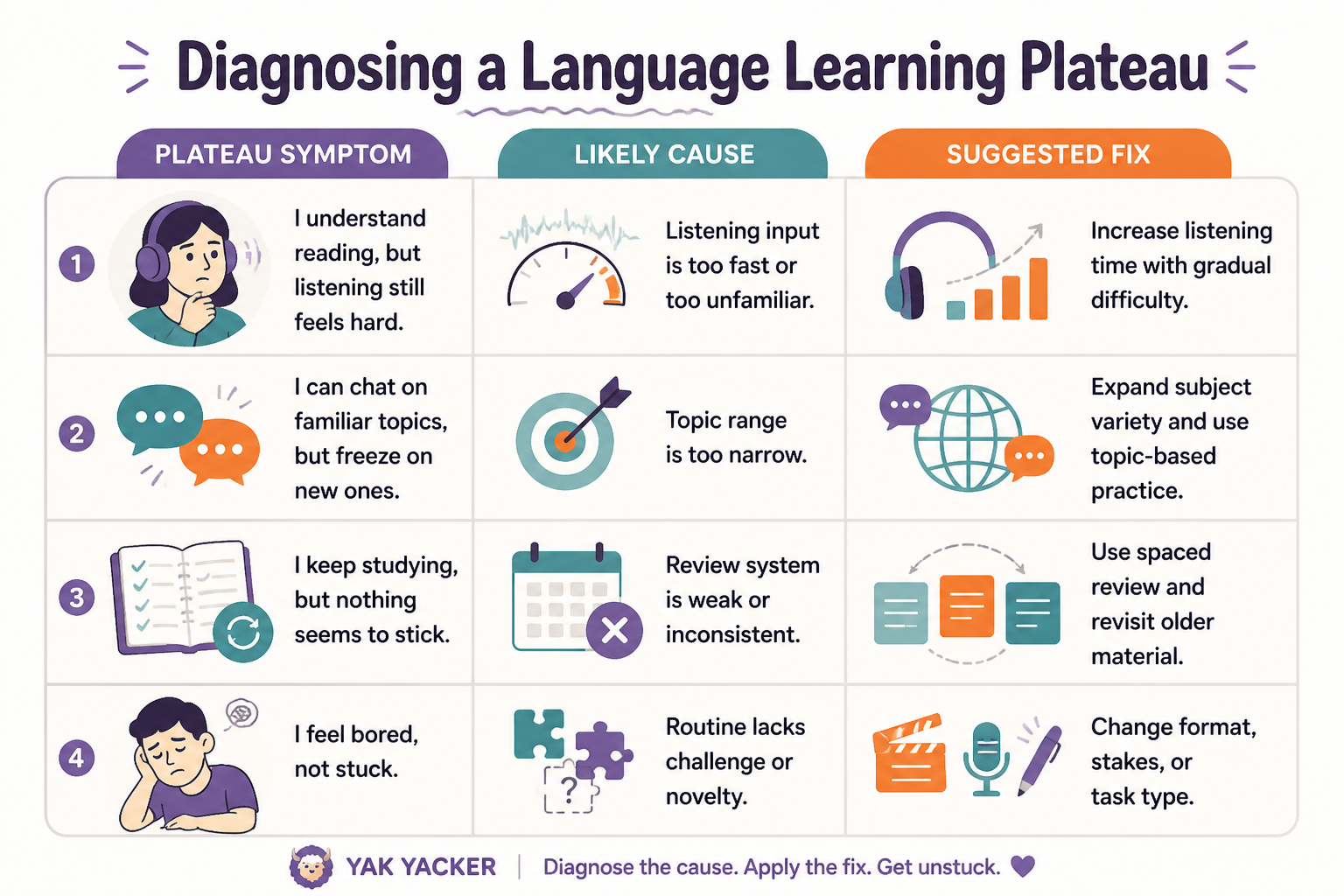
Use this quick diagnostic to get oriented.
| What feels stuck? | Likely cause | Best fix |
|---|---|---|
| You understand lessons, but real content still feels hard | Your input is not varied enough | Use more comprehensible input with slightly higher challenge |
| You know words, but forget them when speaking | Not enough retrieval and output practice | Practice speaking and active recall |
| You can read well, but listening is lagging | Not enough listening variety or speed exposure | Increase listening time with gradual difficulty |
| You can chat in familiar topics, but freeze on new ones | Topic range is too narrow | Expand subject variety and use topic-based practice |
| You keep studying, but nothing seems to stick | Your review system is weak or inconsistent | Fix spaced review and revisit older material |
| You feel bored, not stuck | Your routine lacks challenge or novelty | Change the format, stakes, or task type |
If you want a deeper explanation of one of the most useful ideas in this table, see comprehensible input explained. Understanding the right kind of input is often the fastest way to get unstuck.
The Biggest Mistake: Doing More of the Same
When learners hit a plateau, the usual reaction is to simply do more. More flashcards. More grammar drills. More random videos. More apps. More “I should really study harder.”
Sometimes effort helps. But if the method is the problem, repeating it just gives you a larger pile of the same result.
Here is the key idea: plateaus usually need a change in kind, not only a change in amount.
- If you only recognize words, add retrieval and production.
- If your reading is strong but listening is weak, change the input mode.
- If you can speak only in safe memorized phrases, increase spontaneous practice.
- If you are always studying the same material, increase variety and challenge.
Effort matters, but effort has to hit the right target.
How to Break Through a Language Plateau: The Core Strategy
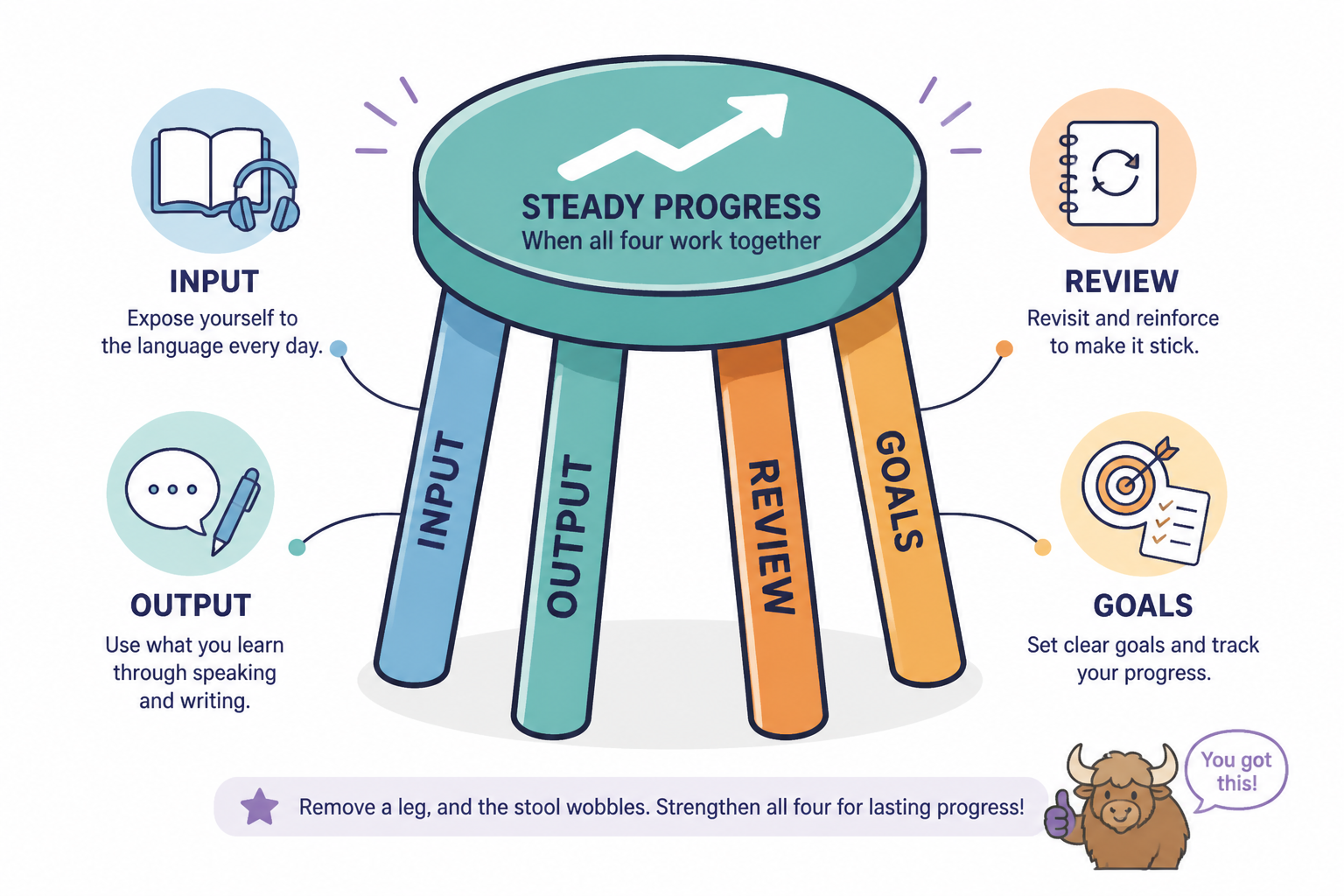
The most reliable way to break through a plateau is to combine four things:
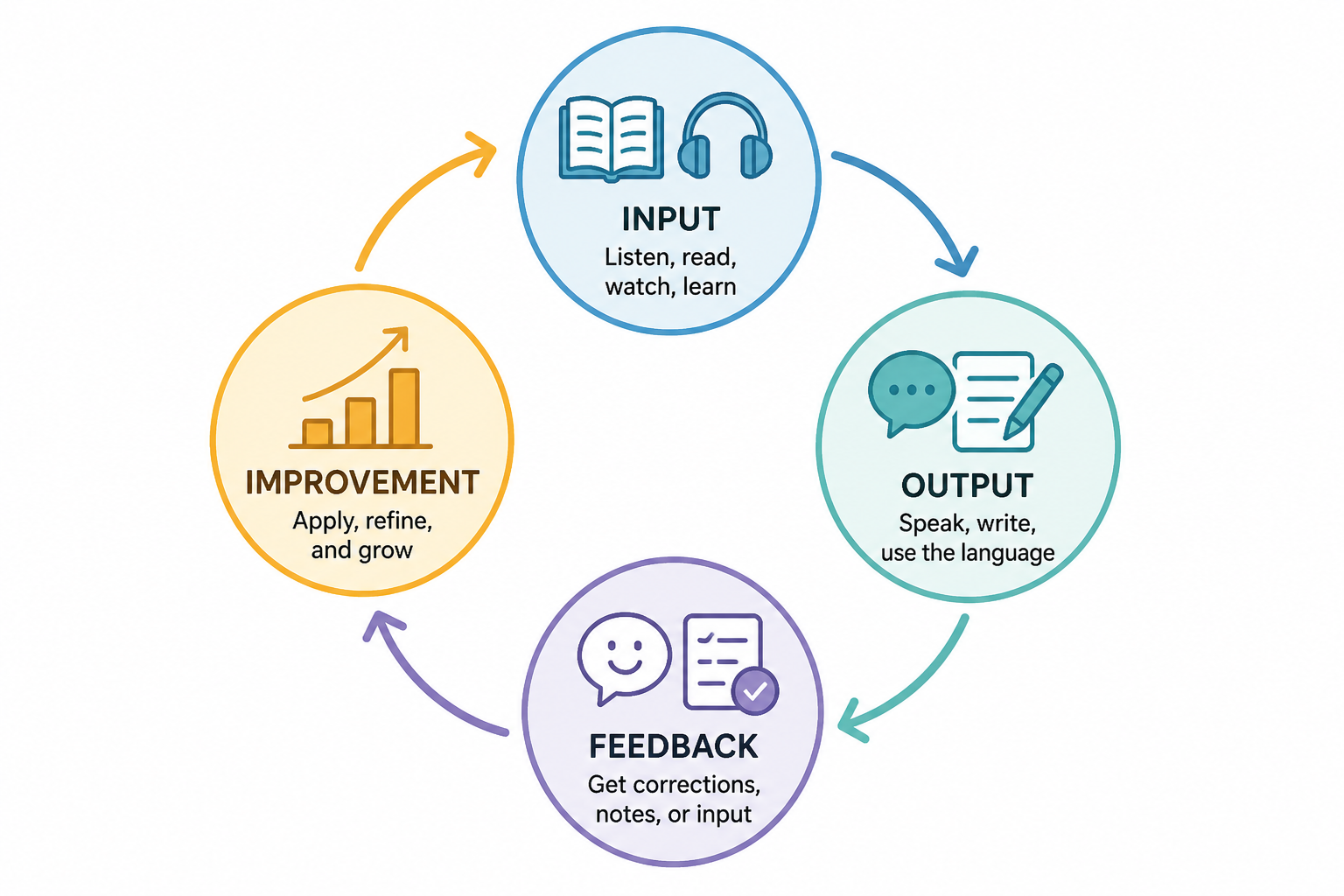
- Better input — material that is understandable but not too easy
- Focused output — speaking or writing that reveals gaps
- Targeted review — revisiting weak vocabulary and structures
- Clear goals — a plan that tells you what to work on next
Think of it like a four-legged stool. Remove one leg and the whole thing wobbles. Keep all four in place and your learning becomes much more stable.
Step 1: Make Your Input Slightly Harder, Not Much Harder
One reason plateaus happen is that your input has become too comfortable. If everything you read or listen to feels easy, your brain is not being stretched enough. But if everything is too hard, you get tired and discouraged.
The sweet spot is material that you mostly understand, but which still includes some new words, unknown phrases, or unfamiliar speed. That is where growth happens.
A useful rule: if you understand almost everything with no effort, move up slightly. If you understand almost nothing, move down slightly. You want challenge, not chaos.
What “slightly harder” looks like in practice
- Read content with a few new words per paragraph, not dozens.
- Listen to speech that is a little faster than your comfort zone.
- Use videos, podcasts, or texts on familiar topics, then expand into new ones.
- Study content where you can infer meaning from context instead of translating every line.
If you need a quick check on whether your material is in the right zone, ask yourself: “Do I understand enough to stay engaged, and enough that new things stand out?” If the answer is yes, you are probably in a useful range.
This is also where a good study plan matters. If your learning has become random, it is hard to control the level of challenge. A structured plan gives you a way to increase difficulty gradually instead of just hoping for the best. If you want help with that, see how to build a language study plan.
Step 2: Add Output That Exposes What You Cannot Yet Do
Input helps you absorb language. Output helps you find the gaps. If you never speak or write enough to notice what you cannot produce, a plateau can quietly continue for months.
Output does not have to be dramatic. You do not need to give a perfect speech or write an essay worthy of a prize. You just need tasks that force your brain to retrieve language on demand.
Good output tasks for plateau-busting
- Summarize a short podcast in 3–5 sentences.
- Retell a story you heard, without reading the transcript.
- Answer the same question in three different ways.
- Write a short opinion paragraph and then revise it.
- Record yourself explaining a topic you know well.
- Have a conversation where you must keep going even when you do not know the exact word.
The point of these tasks is not to sound flawless. The point is to make missing pieces visible. That visibility is valuable. It tells you exactly what needs work.
If you only do receptive study, you may feel productive without being able to use much language. Output breaks that illusion in the nicest possible way.
Step 3: Review the Right Things, Not Just the New Things
Many plateaued learners keep chasing new material while leaving old weak points untouched. That creates a familiar problem: you keep adding bricks, but the wall still has holes.
Review matters because language knowledge builds on itself. Words, phrases, grammar patterns, and listening habits all need repetition over time. But review should be targeted, not mindless.
Instead of reviewing everything equally, focus on:
- Words you recognize but cannot recall quickly
- Phrases you understand but never use
- Grammar points that keep causing the same error
- Listening patterns you miss repeatedly
- Topic vocabulary needed for your goals
Smart review questions
- What do I keep forgetting?
- What do I recognize but not produce?
- What mistake do I make over and over?
- What type of language do I need more often in real use?
If your review is too broad, it becomes vague and slow. If it is too narrow, it misses the bigger problem. Aim for the middle: review the items that most affect your actual communication.
Step 4: Change the Shape of Practice
Sometimes a plateau is not about difficulty level at all. It is about practice format. If you always study alone, always use the same app, always read the same kind of text, or always do tidy exercises with no pressure, your brain gets very good at that one narrow task.
That is not the same as becoming better at the language.
To break a plateau, change the shape of practice. This means adding variety in a deliberate way, not by collecting random activities like language-learning stickers.
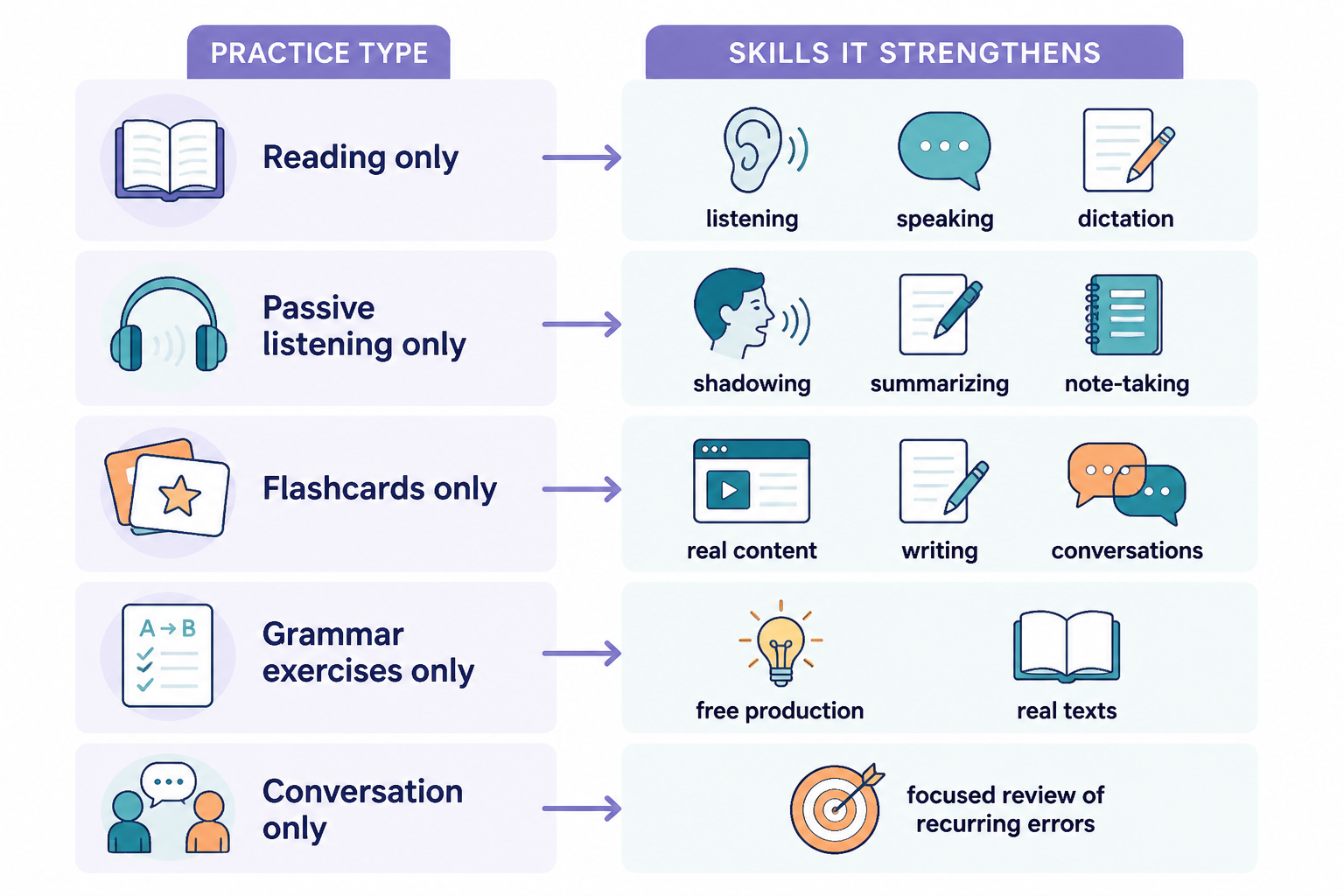
| If your practice is mostly… | Try adding… |
|---|---|
| Reading only | Listening, speaking, and dictation |
| Passive listening only | Shadowing, summarizing, and note-taking |
| Flashcards only | Real content, writing, and conversations |
| Grammar exercises only | Free production and real texts |
| Conversation only | Focused review of recurring errors |
The goal is balance. Not every skill needs equal time every day, but weak skills should not be ignored forever.
Step 5: Make Progress Visible Again
A plateau can feel worse than it is because progress becomes harder to notice. Early progress is obvious. Later progress is sneaky. It hides in small wins: faster understanding, fewer hesitations, better pronunciation, quicker recall, more natural phrasing, less mental translation.
If you are not tracking progress in a way that matches your stage, you may think nothing is happening when improvement is actually real.
Ways to make progress visible
- Record yourself once a week on the same topic.
- Save a reading or listening sample and revisit it later.
- Keep a mistake log for recurring errors.
- Track how much you understand without pausing.
- Note how long you can speak before freezing.
- Write down phrases you used successfully in real life.
These records turn vague feelings into evidence. That matters because confidence often follows evidence, not the other way around.
Even a simple progress log can be powerful:
- This week I understood more of a podcast without subtitles.
- I used three new phrases in conversation.
- I made the same past-tense mistake twice, not ten times.
- I could speak for longer before translating in my head.
Common Plateau Traps and How to Fix Them
There are a few classic traps that keep learners stuck. If you recognize one of these, you are not alone. Most plateau problems are surprisingly ordinary.
Trap 1: The comfort zone treadmill
You keep doing easy material because it feels productive and safe. You finish lessons, tick boxes, and still do not get much better.
Fix: Raise the difficulty slightly. Choose material that contains a meaningful number of unknowns. If nothing is unfamiliar, it is probably too easy.
Trap 2: The perfection trap
You wait until you can speak or write perfectly, so you do not practice enough. Then your progress slows because you are avoiding the very skill that needs training.
Fix: Allow messy output. Make errors on purpose if needed. Errors are not the enemy; they are information.
Trap 3: The random walk
You study “whatever feels useful” day to day. That can work for a while, but eventually it becomes hard to build momentum.
Fix: Use a study plan with a purpose. You need enough structure to guide your focus, not so much freedom that every session starts from zero.
Trap 4: The input-only routine
You listen and read a lot, but you rarely force yourself to use the language. You may understand more than you can produce, and that gap keeps growing.
Fix: Add speaking and writing tasks that are short, specific, and repeatable.
Trap 5: The “I need more motivation first” trap
You wait to feel inspired before changing your routine. But plateaus are often solved by better systems, not better vibes.
Fix: Make one concrete change this week, even if your motivation is low. Small behavioral changes create fresh momentum.
A Practical Plateau-Breaking Routine
If you want something concrete, here is a simple weekly structure you can adapt. It is designed to restore challenge, balance, and progress visibility.
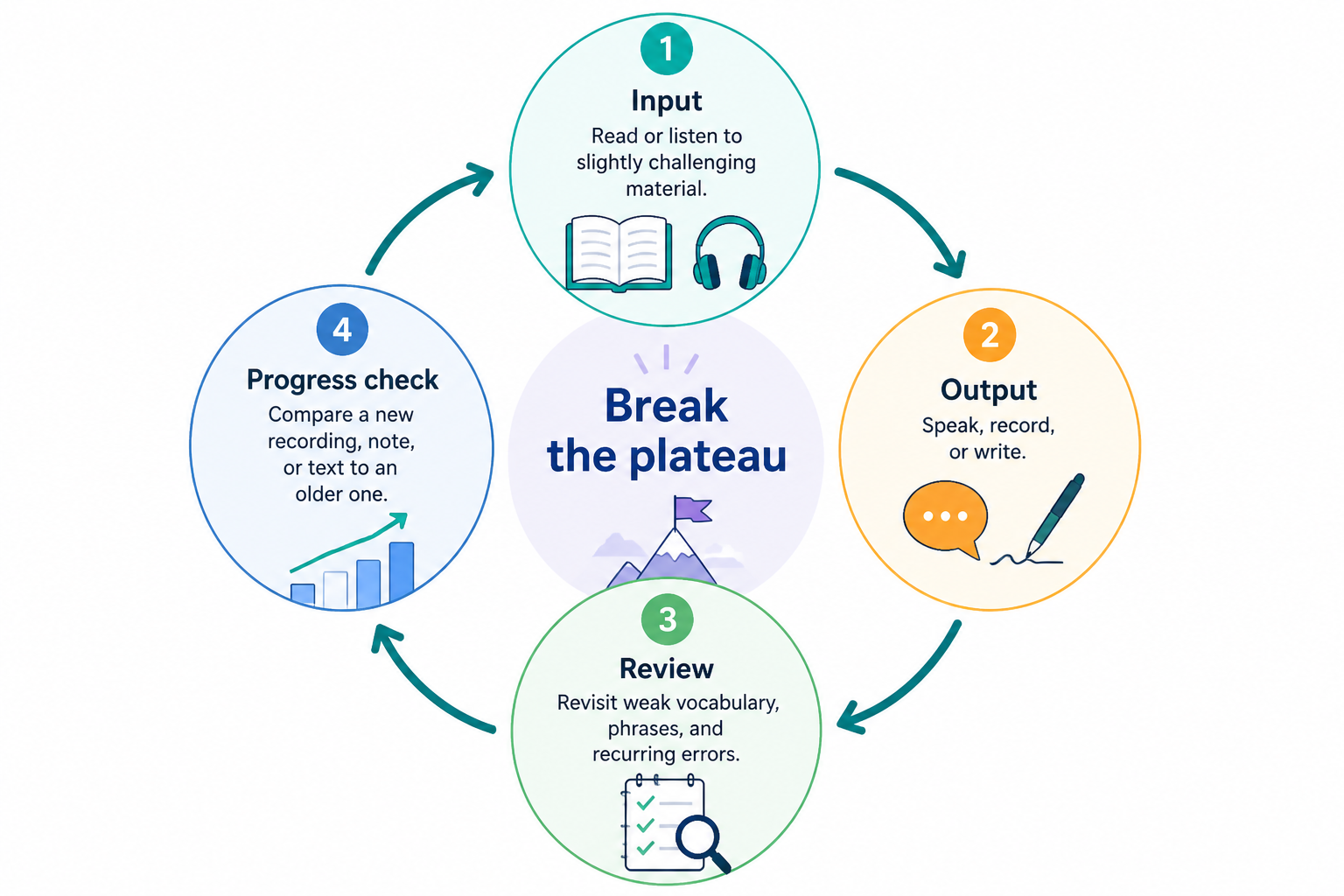
Weekly framework
- 2–3 input sessions: read or listen to slightly challenging material
- 2 output sessions: speak, record yourself, or write short responses
- 2 review sessions: revisit weak vocabulary, phrases, and recurring errors
- 1 progress check: compare a recording, note, or text from this week to an older one
This does not have to be perfect. The point is to create a loop where input feeds output, output exposes gaps, and review fills them.
Example: a 30-minute plateau-breaking study session
- 10 minutes: listen or read a slightly challenging text
- 10 minutes: summarize it out loud or in writing
- 5 minutes: check unknown words or phrases
- 5 minutes: note one recurring mistake and one useful new phrase
This is much more useful than 30 minutes of passive exposure with no follow-up. You want the language to come back out of your brain, not just sit there like furniture.
How to Use Comprehensible Input Without Getting Stuck in It
Comprehensible input is one of the strongest tools for moving beyond a plateau, but only if it is used well. If you rely on input that is always too easy, you will stay comfortable. If you use input that is too hard, you will get overwhelmed.
The goal is a careful balance: material you can mostly understand, with enough new language to stretch you. This is why input should be chosen intentionally rather than randomly.
For a deeper explanation of this idea, see comprehensible input explained.
Three ways to make input more effective
- Choose the right difficulty: not too easy, not too hard
- Reuse the same content in different ways: read, listen, summarize, retell
- Focus on noticing: pay attention to repeated phrases, patterns, and useful chunks
This last point matters a lot. When you notice patterns instead of just words, you start learning language as a system, not as a pile of individual items.
How to Practice Speaking When You Feel “Not Ready”
Many plateaus are caused by silent fear: “I know I should speak more, but I am not ready yet.” That feeling is understandable. Speaking exposes weak spots. It can be awkward. Sometimes it is deeply unglamorous.
But waiting until you feel ready is usually the slowest path forward.
Instead, make speaking easier to start and harder to avoid.
- Prepare 3–5 talking points before a conversation.
- Practice with recurring prompts, such as your routine, opinions, or past experiences.
- Accept pauses as normal.
- Use simpler language when needed.
- Repeat the same topic several times until it becomes easier.
Speaking improves faster when you repeat familiar topics with increasing freedom. That repetition gives your brain the chance to retrieve language more quickly.
A good sign of progress is not “I never make mistakes.” It is “I can keep going even when I am not perfect.”
How to Practice Writing Without Making It a Homework Disaster
Writing is often one of the most efficient plateau-breakers because it gives you time to think, but still forces output. The key is to keep it small, practical, and repeatable.
Instead of writing giant essays, try these:
- Write a short journal entry.
- Summarize what you read or listened to.
- Answer one question in several sentences.
- Write a message you might actually send to someone.
- Rewrite the same text with improved vocabulary or grammar.
Then revise your writing for one or two specific goals only. For example: “Today I will focus on verb tense consistency” or “Today I will try to use two new linking words.” Too many goals at once can turn writing into a swamp.
How to Know Whether You Are Really Stuck
Sometimes learners think they are plateaued when they are actually just improving slowly. Before making dramatic changes, check whether your progress is simply harder to see now.
Ask yourself:
- Do I understand content that used to feel impossible?
- Can I now use some phrases automatically that used to require effort?
- Am I making fewer repeated mistakes?
- Can I speak or write for longer than before?
- Do I recover from misunderstandings more quickly?
If the answer to some of these is yes, you may not be stuck. You may just be in the part of learning where gains are subtle and slow. That still counts.
This is also where understanding level systems can help. If you know what development tends to look like at different stages, you will stop expecting beginner-style leaps from intermediate learning. That is why the CEFR language levels explained guide can be useful as a reality check.
A Simple 2-Week Plateau Recovery Plan
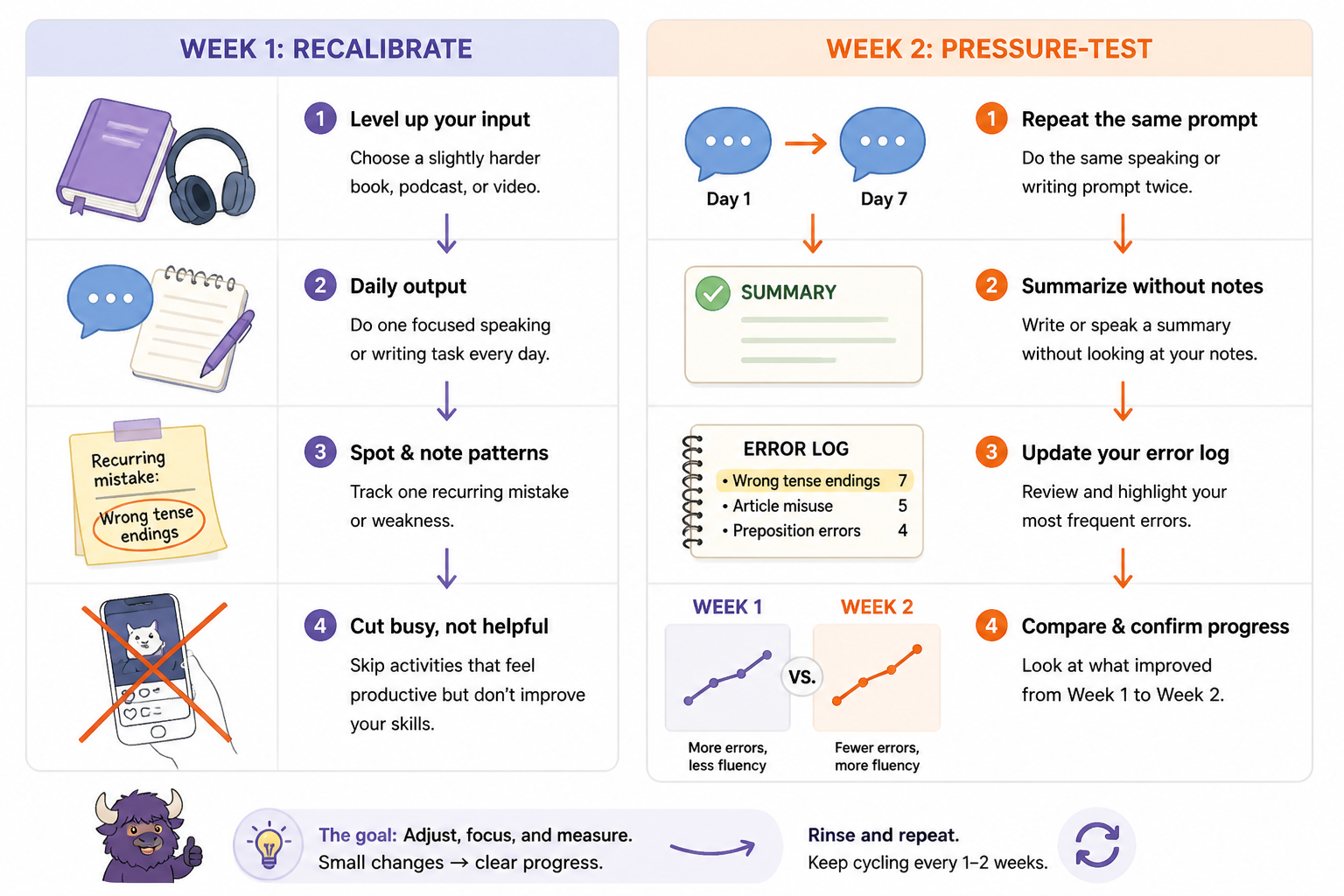
If you want a short, practical reset, try this two-week plan. It is not magic. It is just a clean way to change the pattern.
Week 1: Recalibrate
- Choose one slightly harder input source.
- Do one short output task every day.
- Track one recurring mistake.
- Stop using at least one activity that feels busy but unhelpful.
Week 2: Pressure-test
- Repeat the same speaking prompt twice.
- Summarize one input source without notes.
- Review only your most frequent errors.
- Compare your work to week one and note what changed.
The goal is to create contrast. When you repeat tasks, you can see improvement more clearly. When you compare versions, progress stops hiding.
What Not to Do When You Hit a Plateau
Plateaus can tempt you into panic changes. Try to avoid these common overreactions:
- Changing everything at once — makes it impossible to tell what helped
- Adding too many resources — creates confusion, not clarity
- Only doing easy content — feels good, but rarely breaks the plateau
- Only doing hard content — can crush motivation and comprehension
- Ignoring speaking and writing — keeps gaps hidden
- Measuring progress only by feeling — feelings are useful, but not enough
A better response is calm experimentation. Make one change, observe the effect, then adjust again.
Troubleshooting: If You Tried Everything and Still Feel Stuck
If you have already increased input, added output, and reviewed weak points, but still feel stuck, the issue may be one of these.
Your goals are too vague
If your goal is simply “get better,” it is hard to make useful decisions. Try a specific goal instead, such as:
- understand podcasts on familiar topics without pausing as often
- speak for two minutes without switching to English
- use five new phrases in conversation this week
- reduce one recurring grammar error
Your material is mismatched to your level
If content is too easy, you are coasting. If it is too hard, you are spinning your wheels. Adjust until the challenge feels productive rather than punishing.
You are not getting enough repetition
Sometimes learners move on too quickly. Repetition helps language become automatic. Reuse the same phrases, the same themes, and even the same short texts until they start to feel natural.
You are not sleeping, resting, or spacing your study well
Brains are not machines. If you are overloaded, improvement can stall. A good study plan includes rest, spacing, and realistic pacing. Learning hard things while exhausted is a classic way to feel busy and make little progress.
How to Stay Motivated During a Plateau
Motivation usually improves after you see evidence of progress, not before. So instead of waiting to feel inspired, create small wins you can actually notice.
- Set short weekly goals.
- Keep a visible checklist.
- Record and compare your speaking.
- Celebrate reduced confusion, not just perfect performance.
- Remember that slow progress is still progress.
It also helps to reframe the plateau itself. A plateau is not a dead end. It is a signal. It is your learning system saying, “We have outgrown the current routine.” That is annoying, yes. But it is also useful.
When you respond to that signal with a smarter plan, you usually get moving again.
Quick Checklist: Plateau-Breaking Essentials
Use this as a quick self-check if you want to reset your approach.
- I know what kind of plateau I am in.
- My input is understandable but still challenging.
- I am doing some output, not only passive study.
- I review the things I most often forget or misuse.
- I track progress in a way I can actually see.
- I have a study plan instead of random sessions.
- I changed at least one part of my routine recently.
If you cannot check several of these boxes, you have a useful place to start. No drama required.
Final Takeaway
To break through a language plateau, you usually do not need to study harder in the same old way. You need to change the balance of your learning: slightly harder input, more meaningful output, targeted review, and a clearer plan.
That combination helps you move from “I am busy” to “I am improving.” And that shift is the whole game.
If you want to keep building a strong learning system, revisit your overall plan with how to build a language study plan, and use the main Yak Yacker learning guide at How to Learn a Language as your starting point for broader strategy.