
How to Measure Your Language Skills With CEFR and ACTFL
If you’ve ever thought, “I know I’m improving, but how do I prove it?” this guide is for you. Language learning can feel slippery. Some weeks you understand more. Some days speaking feels easier. Then you try to measure progress and suddenly your brain goes, “Well… I can order coffee in three countries, so that must mean something?”
For the broader learning path, visit our parent guide.
That “something” becomes much clearer when you use two widely recognized systems: CEFR and ACTFL. These frameworks help you describe what you can actually do in a language, not just how many app lessons you finished or how good you feel on a random Tuesday.
In this guide, you’ll learn how CEFR and ACTFL work, how they differ, how to use them to track progress, and how to make your own language milestones easier to see. You’ll also get a practical method for assessing yourself without turning it into an exam marathon.
For a broader view of the learning journey, you may also find it useful to compare your progress with how long it takes to learn a language and the estimated effort in FSI language hours.
Why track language progress at all?
Tracking progress is not just for tests, certificates, or bragging rights. It helps you learn smarter.
When you can measure progress, you can:
- see what is improving and what is stuck
- set realistic goals instead of vague wishes
- choose materials that match your current level
- notice when you’re ready to move up a stage
- stay motivated because progress becomes visible
Without a framework, learners often confuse “I did a lot” with “I improved a lot.” Those are not always the same thing. You can spend ten hours on flashcards and still be unable to hold a basic conversation. Or you can have one frustrating conversation that teaches you more than a week of passive review.
CEFR and ACTFL solve that problem by describing skills in practical terms.
What CEFR and ACTFL are, in plain English
Both CEFR and ACTFL are ways to describe language ability. They are not teaching methods. They are not apps. They are not “levels” in the game sense. They are frameworks for saying what a learner can do with the language.
Think of them like two different measuring tapes. They do a similar job, but the markings are organized a little differently.
CEFR: the Common European Framework of Reference
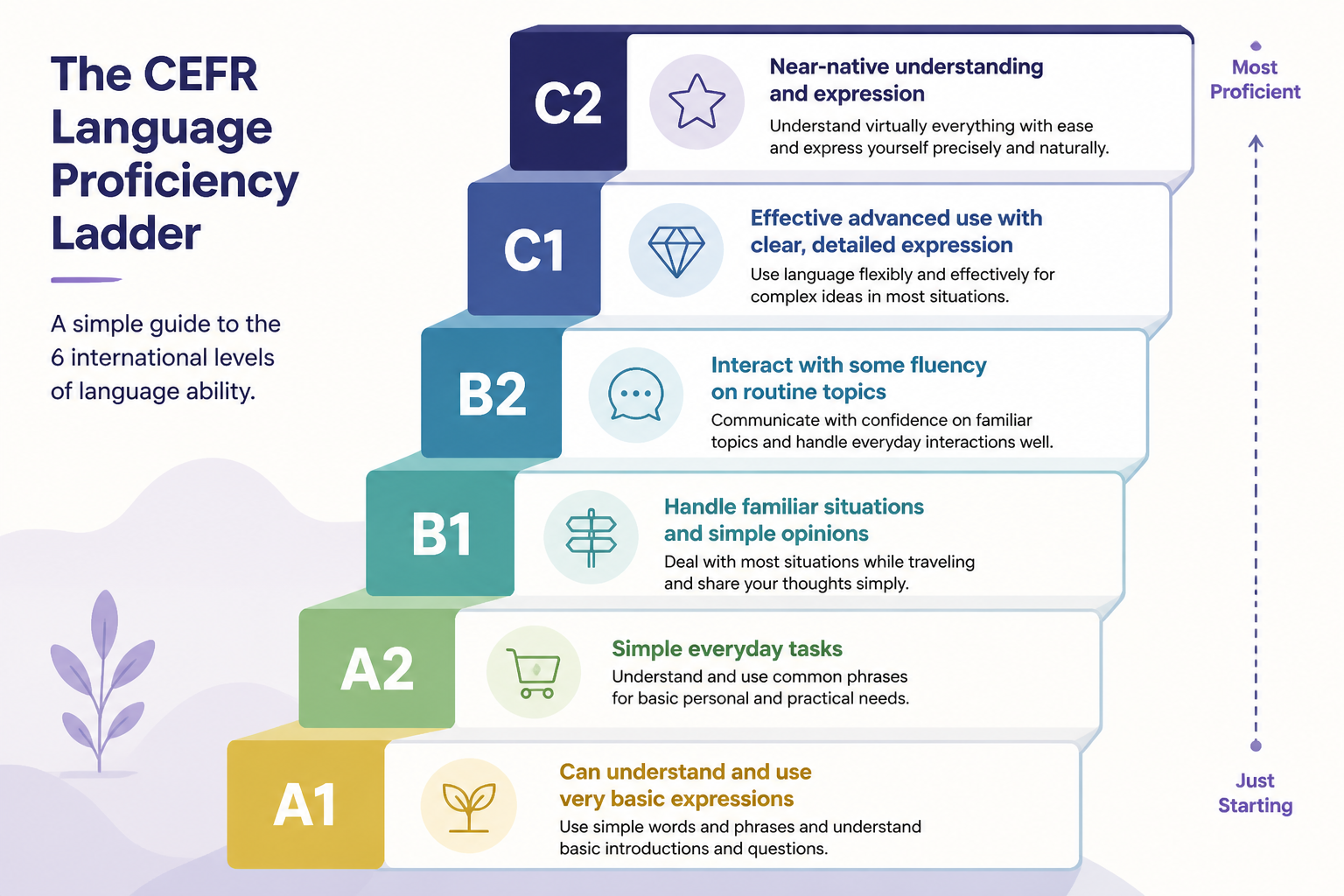
CEFR is a scale used widely around the world, especially in Europe and in many language schools, textbooks, and exam systems. It describes proficiency from beginner to advanced using six main levels:
- A1
- A2
- B1
- B2
- C1
- C2
These levels are often grouped like this:
- A = Basic user
- B = Independent user
- C = Proficient user
CEFR is useful because it gives you a clear ladder. You can usually tell whether you are dealing with survival basics, everyday communication, or advanced fluency.
ACTFL: the American Council on the Teaching of Foreign Languages scale
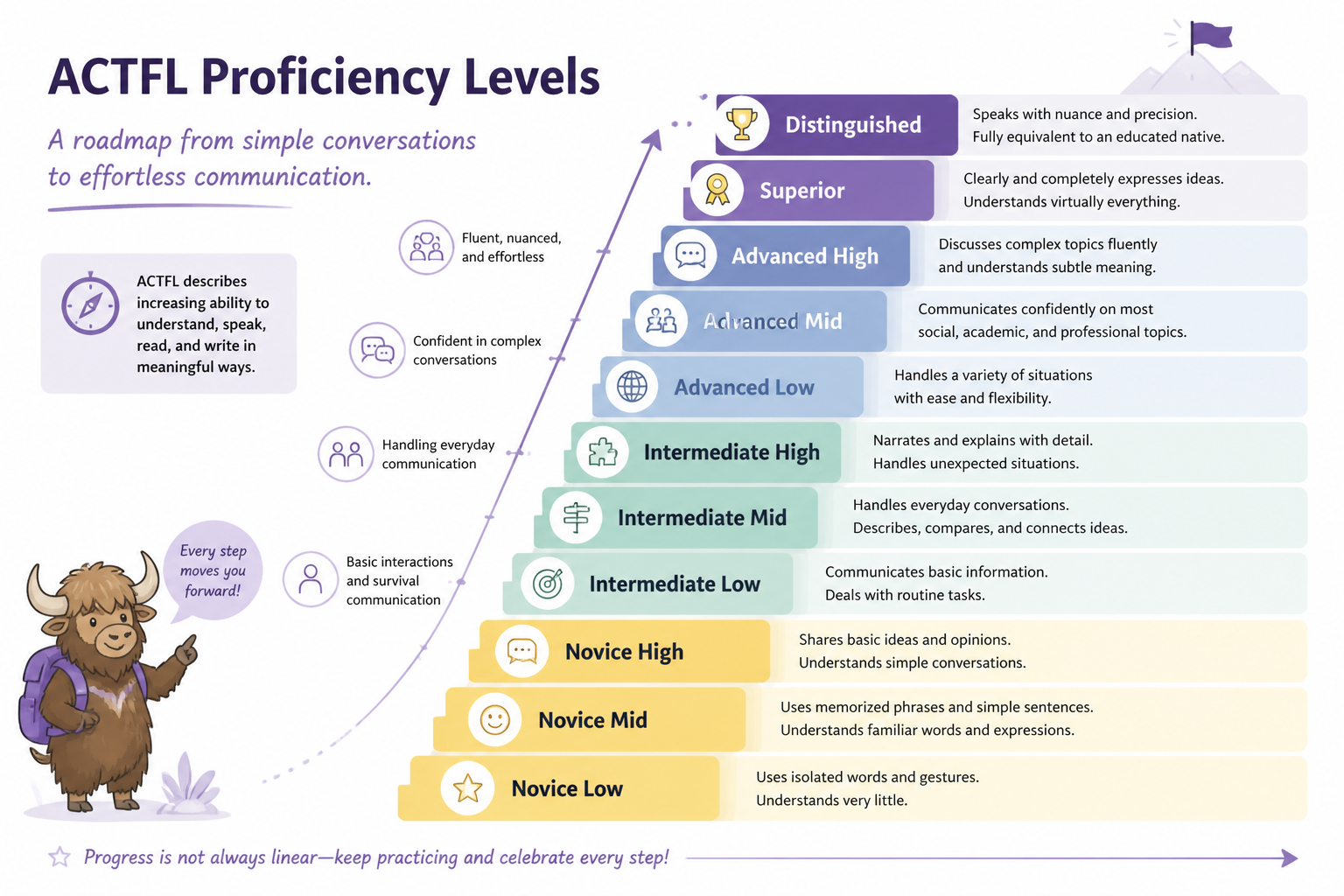
ACTFL is especially common in the United States. It uses descriptors such as:
- Novice Low, Mid, High
- Intermediate Low, Mid, High
- Advanced Low, Mid, High
- Superior
- Distinguished
ACTFL is more detailed at the lower and middle levels than CEFR, which can make it feel more precise for learners who are still building everyday communication skills.
If CEFR is a neat staircase, ACTFL is more like a staircase with extra steps where beginners and intermediates usually need them most.
CEFR vs ACTFL: how they compare
These systems overlap a lot, but they are not identical. One useful way to think about them is this:
CEFR gives you a broad international reference point. ACTFL gives you a more detailed profile, especially for early and mid-stage learners.
| Aspect | CEFR | ACTFL |
|---|---|---|
| Main use | Common in Europe and international materials | Common in U.S. education and assessments |
| Level count | 6 main levels | Multiple sublevels across broad bands |
| Beginner detail | Less granular | More granular |
| Best for | Simple benchmarking and broad tracking | Detailed self-assessment and school-style reporting |
| Communication focus | Strong | Very strong |
You do not need to choose one forever. In fact, many learners benefit from understanding both. If your school, test, or textbook uses one system, great. If a job posting or course uses the other, knowing the rough equivalent saves a lot of guesswork.
The goal is not to memorize every label. The goal is to understand what the label means in real-life language use.
What “progress” actually means in language learning
Before you can track progress, it helps to know what counts as progress. Language learning is not one single skill. It is a bundle of skills that improve at different speeds.
- Listening
- Reading
- Speaking
- Writing
- Vocabulary depth
- Grammar control
- Pronunciation and clarity
- Speed and confidence
You might move from A2 to B1 in reading before your speaking catches up. That is normal. You might understand podcasts better long before you can reply smoothly. Also normal. Your progress is not broken just because it is uneven.
That’s why the best progress tracker does not just ask, “What level am I?” It asks, “What can I do in each skill, and under what conditions?”
How CEFR describes what you can do
CEFR is task-based. It asks whether you can complete real-world communication tasks, not whether you have “studied enough.”
Here’s a simplified view of the levels.
| CEFR level | What it often looks like |
|---|---|
| A1 | Understand and use very basic phrases; introduce yourself; ask simple questions |
| A2 | Handle everyday tasks; talk about familiar topics; understand short, simple texts |
| B1 | Deal with most travel and everyday situations; describe experiences; give simple opinions |
| B2 | Handle more complex conversation; explain ideas clearly; understand main points of detailed texts |
| C1 | Use the language flexibly and effectively in social, academic, or professional settings |
| C2 | Understand and communicate with near-native precision in complex situations |
These descriptions are intentionally broad. A person at B1 in speaking may still be B2 in reading, or the other way around. That does not mean the framework failed. It means the framework is doing its job by showing you where your strengths and gaps are.
For a fuller breakdown of the levels themselves, you can pair this guide with our CEFR language levels explanation.
How ACTFL describes what you can do
ACTFL is also task-based, but its scale often gives more nuance in the early and middle stages. That helps when you want to know whether your ability is “survival level,” “can handle simple conversations,” or “can keep going without falling apart after the third sentence.”
Here is a simplified version of the broad ACTFL bands:
| ACTFL band | What it often looks like |
|---|---|
| Novice | Can use memorized words, phrases, and very short exchanges |
| Intermediate | Can create with language in simple, sentence-level communication |
| Advanced | Can handle connected discourse and narrate or explain in more detail |
| Superior | Can discuss abstract topics and support opinions with detail |
| Distinguished | Can communicate with a high degree of sophistication across complex contexts |
ACTFL is especially helpful if you want to notice small but meaningful growth. For example, moving from Novice High to Intermediate Low may not sound dramatic, but it can mean you’ve gone from mostly memorized chunks to actual sentence creation. That is a big leap in real life.
Which system should you use?
The best system is the one you will actually use consistently. Here’s the simplest way to decide.
| If you want… | Use this |
|---|---|
| A broad international benchmark | CEFR |
| More detail at beginner and intermediate stages | ACTFL |
| To match many textbooks and online language resources | CEFR |
| To align with U.S. school-style assessment | ACTFL |
| A simple way to explain progress to others | CEFR |
| A more fine-grained self-evaluation system | ACTFL |
If you’re new to progress tracking, CEFR is usually easier to start with. If you already know you’re somewhere in the beginner-to-intermediate range and want a more precise view, ACTFL can be very useful.
Either way, consistency matters more than perfection. Pick one scale, measure yourself the same way over time, and you’ll start seeing patterns.
How to measure your language skills step by step
Now for the useful part: how to actually track your progress without turning it into a stressful self-interrogation session.
1. Choose the skill area you want to measure
Start by separating your language ability into skill areas. Do not try to score your “whole language level” in one go. That usually produces vague, fuzzy answers.
- Listening
- Reading
- Speaking
- Writing
- Overall communication
If you want, add sub-skills such as pronunciation, grammar accuracy, or vocabulary range. But do not make the tracker so detailed that you need a spreadsheet degree to use it.
2. Read the descriptors, not just the labels
Labels like B1 or Intermediate Mid only help if you know what they mean. The real value is in the descriptors. Read the statements about what you can do and compare them honestly with your actual ability.
Ask yourself:
- Can I do this reliably?
- Can I do it with help or only alone?
- Can I do it in familiar topics only, or across a wider range?
- Do I do it slowly and carefully, or naturally and flexibly?
A common mistake is overrating yourself based on one lucky performance. You understood a full podcast once? Great. But if you need a silent room, subtitles, and a prayer candle every other time, that is not yet stable progress.
3. Test the skill in real tasks
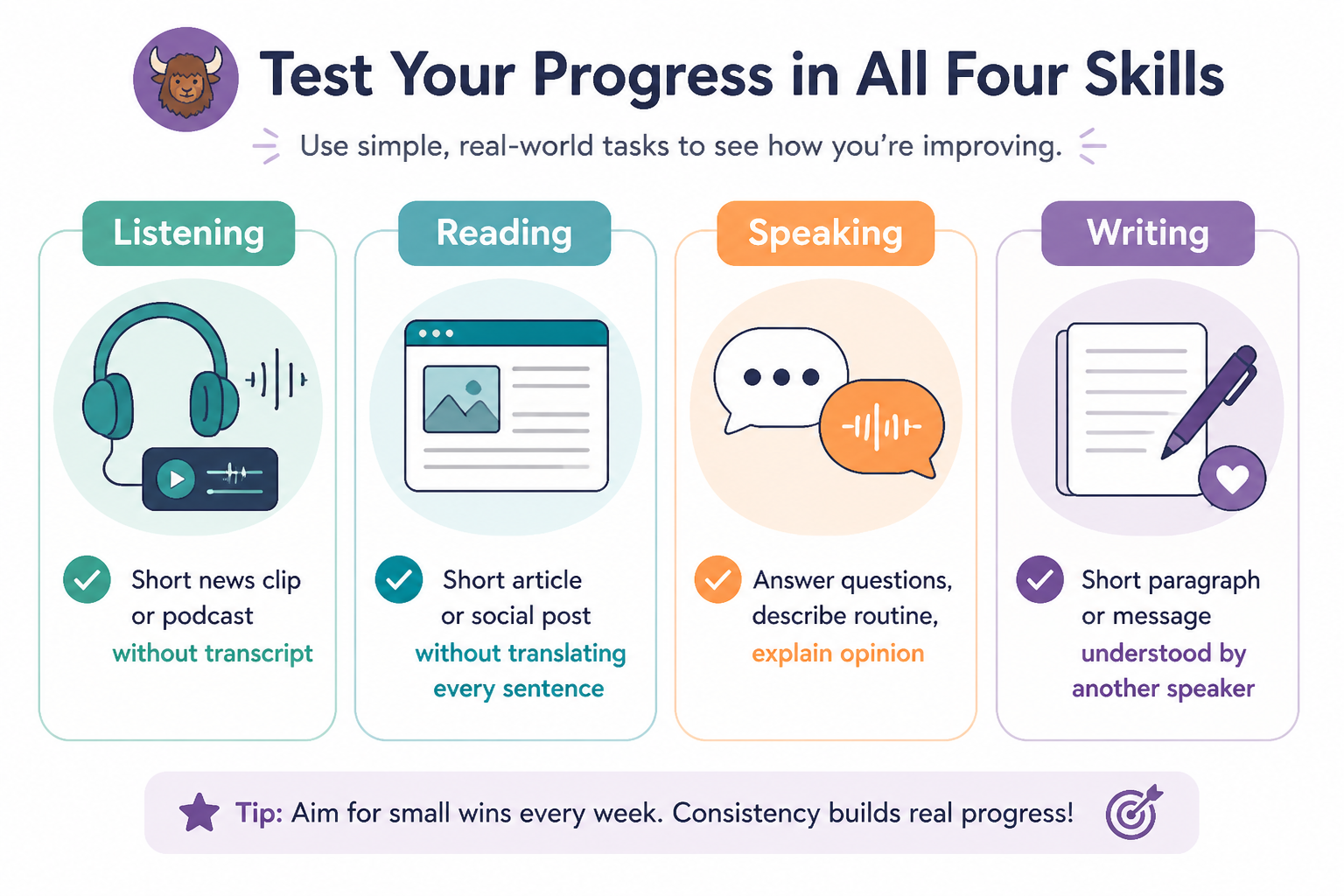
Frameworks are about what you can do, so use real tasks to check your level. Here are some examples.
- Listening: Can you follow a short news clip, a podcast segment, or a conversation without reading a transcript?
- Reading: Can you understand a short article, social media post, or story without translating every sentence?
- Speaking: Can you answer questions about yourself, describe your routine, or explain your opinion without freezing?
- Writing: Can you write a paragraph, a message, or a short explanation with enough clarity that another speaker understands you?
Use tasks that match your goals. If you care most about travel, test travel-related tasks. If you need the language for work, test workplace communication.
4. Compare your performance to the level descriptors
This is where you connect your real-life performance to CEFR or ACTFL. Don’t ask, “Did I do this perfectly?” Ask, “Which description fits me most often?”
For example, if you can usually understand slow, clear speech on familiar topics but struggle with normal-speed conversation, you may be between A2 and B1 in listening. If you can ask basic questions but need lots of time to form full sentences, you may be in the novice or low-intermediate range depending on the scale.
Think “most of the time,” not “on my best day.” That keeps your estimate honest.
5. Record evidence, not just a label
One of the smartest ways to track progress is to save examples of what you can do. A label is useful, but evidence is more useful.
- audio recordings of speaking practice
- writing samples from the same type of task over time
- notes on what you understood in a listening task
- reading logs with the type of text and the percentage you understood
- self-ratings with a short explanation
This turns progress from a feeling into a record. And records are much harder for your inner critic to argue with.
A simple self-assessment template you can reuse
You do not need a complicated system. You need a repeatable one. Here is a simple template you can use monthly or every few weeks.
| Skill | Task | My result | Best-fit CEFR/ACTFL level | Evidence note |
|---|---|---|---|---|
| Listening | 3-minute podcast on familiar topic | Understood main idea, missed details | A2 / Intermediate Low | Could answer 3 out of 5 comprehension questions |
| Reading | Short article | Understood most paragraphs with occasional dictionary use | B1 / Intermediate Mid | Only 6 unknown words |
| Speaking | 2-minute self-introduction | Smooth on familiar topics, pauses for grammar | A2-B1 / Intermediate Low | Recorded and noticed fewer long pauses than last month |
| Writing | Short message or paragraph | Clear but simple, a few errors | A2-B1 / Intermediate Low | Needed less correction than previous draft |
You can keep this in a notebook, spreadsheet, notes app, or even a paper folder. The format matters less than the habit.
How to tell whether you are moving up a level
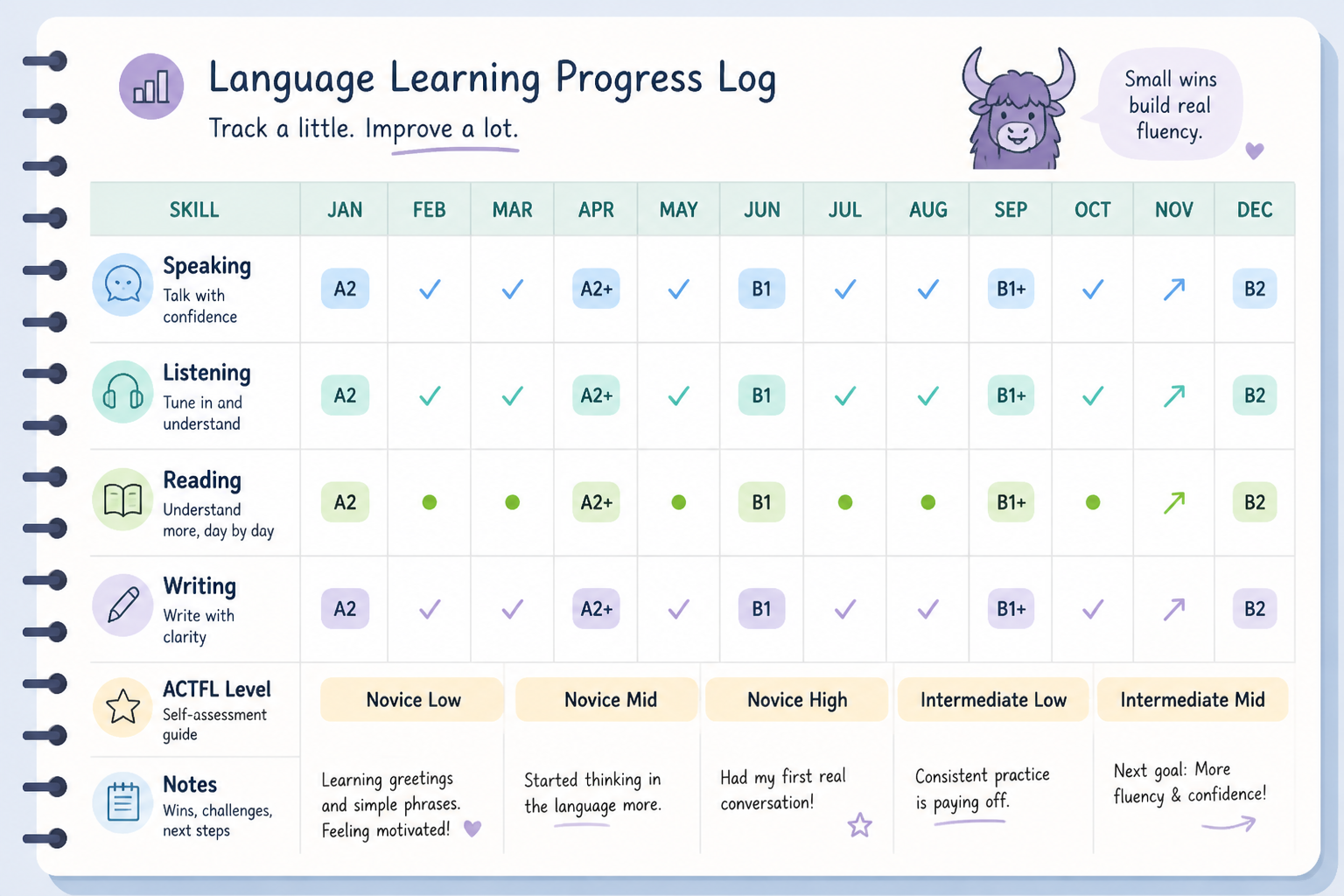
Language progress is often gradual, but level changes usually show up in patterns. You are probably moving up when tasks that once felt hard start feeling manageable, then normal.
Signs you may be ready to move up:
- You understand the main idea without needing constant support
- You can handle a wider range of topics
- You make fewer repeated mistakes in familiar situations
- You can speak or write for longer without running out of tools immediately
- You need less translation or memorization
- You can recover from misunderstandings more easily
Signs you may still be in your current level:
- You can do the task only with heavy preparation
- You rely on memorized chunks almost all the time
- You understand only when the speaker is unusually slow or clear
- You can perform a skill in one narrow topic but not more broadly
- Your performance drops sharply outside a familiar script
Progress is not just “I got one thing right.” It’s “I can now do this across enough situations that it counts as ability.”
Common mistakes when tracking progress
Most learners make a few predictable mistakes. Luckily, they are easy to fix once you know what to look for.
Mistake 1: judging level by vocabulary size alone
Knowing many words helps, but vocabulary alone does not equal proficiency. A learner may know fancy words and still struggle to form a simple sentence in real time.
Fix: Track actual tasks. Can you understand, respond, explain, and maintain a conversation?
Mistake 2: overrating performance after one good day
Sometimes everything clicks. You feel brilliant. You speak smoothly. You understand the whole thing. Wonderful. But a level estimate should reflect consistent ability, not peak performance.
Fix: Base your estimate on several attempts over time.
Mistake 3: underrating yourself because of nervousness
Many learners sound worse when they are anxious, in a recording, or speaking with a stranger. That does not automatically mean their real level is lower.
Fix: Separate skill from performance conditions. Note when nerves affected you.
Mistake 4: comparing yourself to native speakers
That comparison is usually unhelpful unless your goal is professional-level nuance. Most learners are not trying to become indistinguishable from a native speaker. They are trying to communicate effectively.
Fix: Compare yourself to the level descriptors, not to people who grew up with the language.
Mistake 5: ignoring receptive skills
Reading and listening often improve faster than speaking and writing. That’s still real progress. Don’t dismiss it.
Fix: Track each skill separately and celebrate uneven improvement.
How to make your self-ratings more accurate
Self-assessment can be surprisingly useful if you do it carefully. The trick is to make your judgments specific instead of vague.
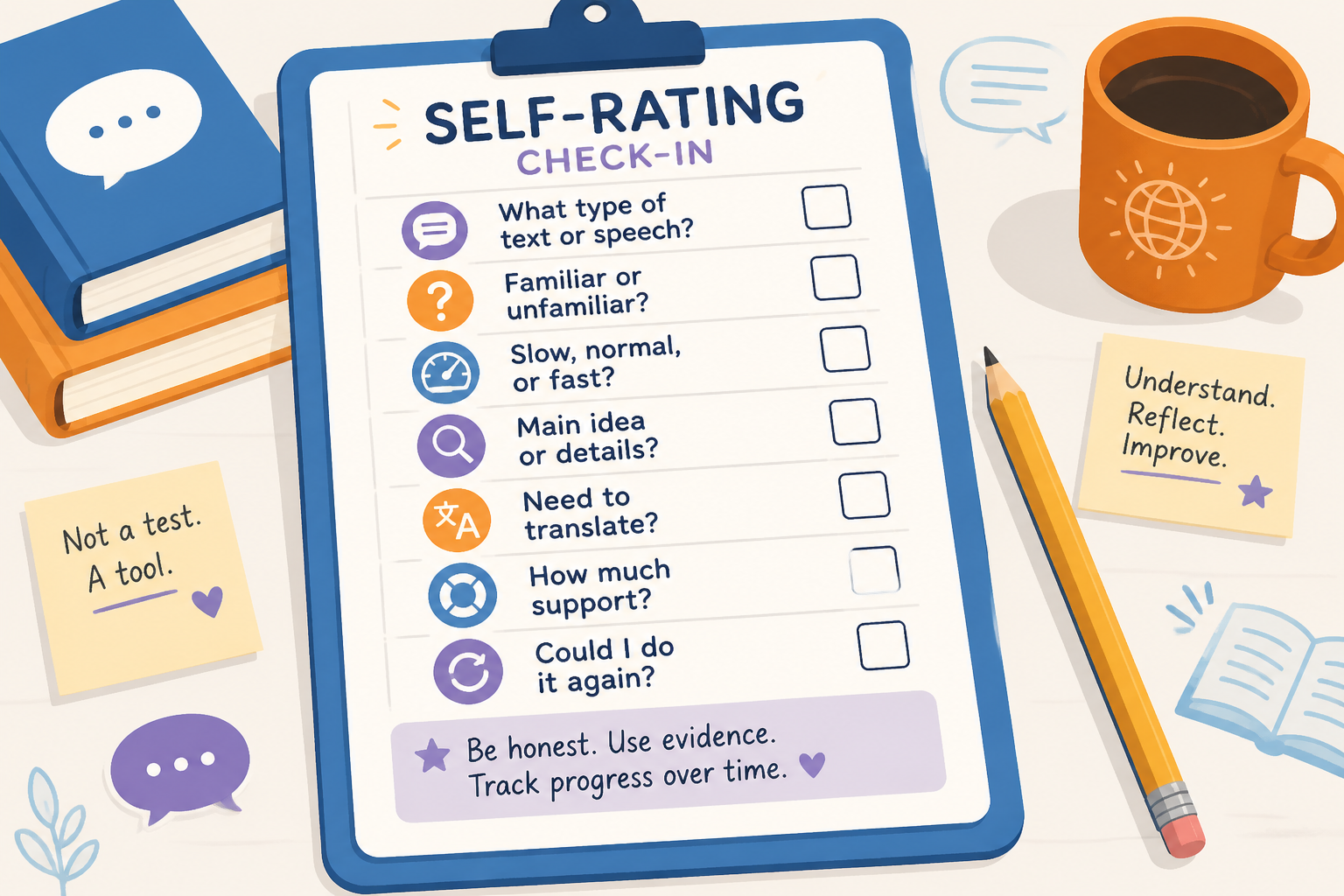
Use these questions:
- What type of text or speech was it?
- Was the topic familiar or unfamiliar?
- Was it slow, normal, or fast?
- Did I understand the main idea only, or also details?
- Could I respond without translating first?
- How much support did I need?
- Could I do this again tomorrow, or only in this exact situation?
The more specific your notes, the more useful your self-rating becomes. “I spoke badly” is not useful. “I could explain my weekend but paused often when I needed past tense verbs” is useful.
How to combine CEFR and ACTFL in one tracking system
You do not have to choose between them forever. In fact, using both can give you a better picture.
Here’s a practical way to combine them:
- Use CEFR as your broad benchmark
- Use ACTFL for more detailed self-notes
- Track individual skills rather than only one overall label
- Write short evidence notes for each assessment
- Review the same tasks regularly so you can compare results
For example, you might say: “My reading is around B1, which feels like Intermediate Mid. My speaking is still closer to A2 / Intermediate Low because I can answer simple questions but not yet sustain longer conversations.”
That kind of combined statement is much more informative than “I’m somewhere in the middle.” The middle of what? Between pancakes? Between levels? We need details.
A practical monthly tracking routine
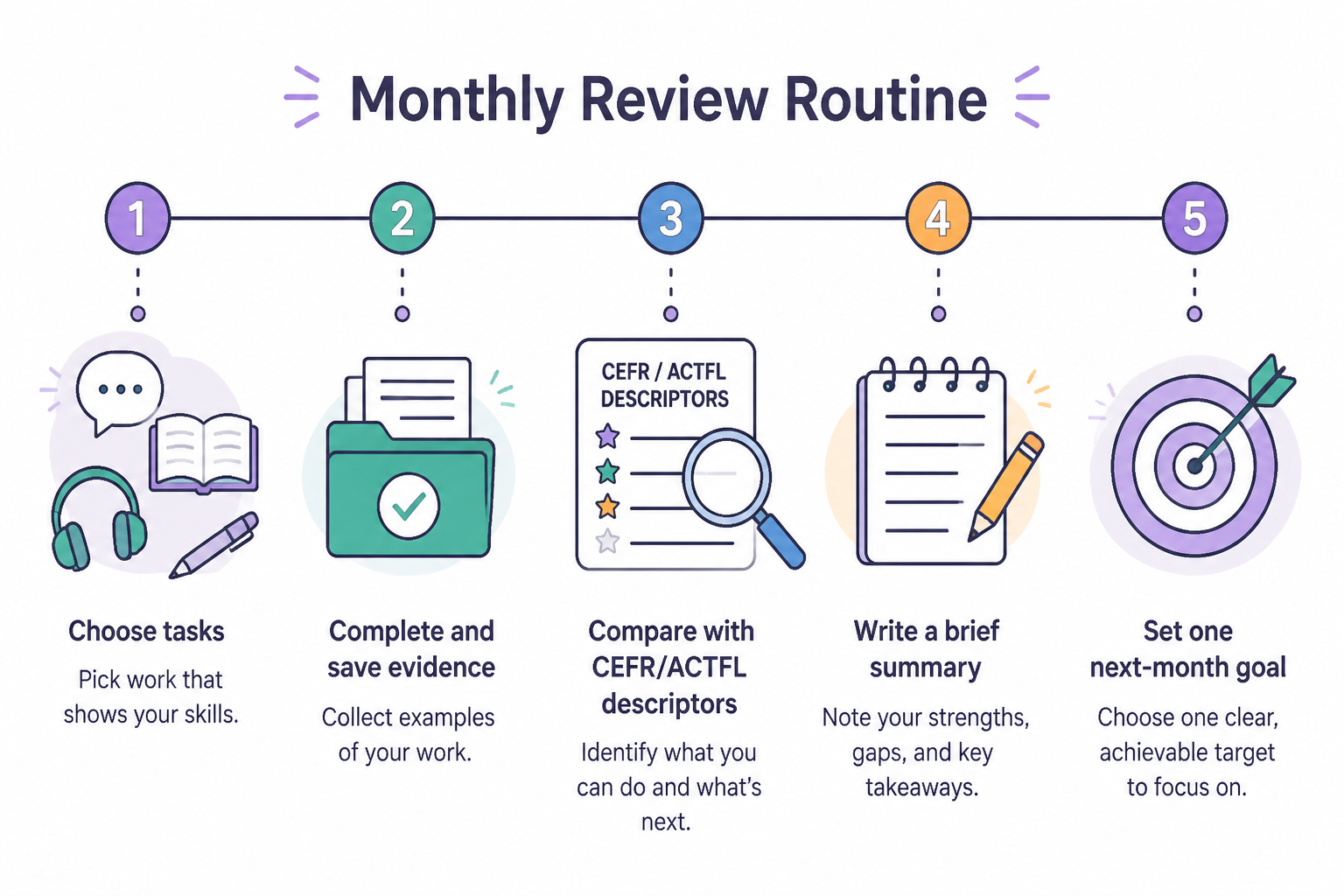
If you want this to become a habit, keep it simple. Here is a realistic monthly routine you can repeat.
- Day 1: choose one listening task, one reading task, one speaking task, and one writing task
- Day 2: complete the tasks and save evidence
- Day 3: compare your performance with CEFR or ACTFL descriptors
- Day 4: write a short summary of what improved and what still feels hard
- Day 5: set one goal for the next month
This does not need to take hours. Even 20 to 30 minutes per month can give you a much clearer picture than vague self-impression.
How to set goals based on your level
Tracking progress is only useful if it affects what you do next. Once you know your level, your goals should match it.
Good goals are specific, level-appropriate, and skill-based.
| Current stage | Better goal | Less useful goal |
|---|---|---|
| A1 / Novice | Order food, introduce yourself, understand very common phrases | Become fluent |
| A2 / Intermediate Low | Handle short daily conversations and write simple messages | Speak perfectly |
| B1 / Intermediate Mid | Tell a short story and explain your opinion on familiar topics | Know all grammar |
| B2 / Advanced Low-Mid | Follow detailed content and speak with more flexibility | Sound native-like |
A good goal sounds like something you can observe. “Understand 80% of a familiar podcast episode without subtitles” is better than “get better at listening.” The first one can be tested. The second one just floats around being inspirational and unhelpful.
What to do if your level seems stuck
Plateaus are normal. Sometimes your ability is improving behind the scenes, but your tasks are not challenging enough to show it. Other times you really are stuck because your study routine is too comfortable.
If your progress seems frozen, try this troubleshooting checklist.
- Are you testing the same easy tasks every time?
- Are you only studying one skill and ignoring the others?
- Are you reviewing a lot but producing very little?
- Are your materials too easy or too hard?
- Are you getting enough repeated practice on the same kinds of tasks?
- Are you measuring progress too frequently to see change?
Often the fix is not “study more” but “change the type of practice.”
Examples:
- If reading is improving but speaking is stuck, do more short speaking tasks with prepared prompts
- If listening is flat, use slightly easier material and repeat it several times
- If writing is stuck, write the same type of message weekly and compare versions
- If everything feels hard, step back one level and rebuild confidence with more manageable input
Progress is often easier to see when tasks are tuned to the right difficulty. Too easy, and nothing changes. Too hard, and everything feels like punishment in a foreign accent.
Examples of progress at different stages
Sometimes the clearest way to understand a framework is to see it in action. Here are a few simplified examples.
Example 1: Listening
Early stage: You can catch familiar words in a slow, clear conversation.
Later stage: You can follow the main idea of a normal-speed conversation about everyday topics, even if you miss some details.
That jump is more than “I hear more words.” It is a shift in comprehension ability. Depending on the exact performance, that could mean moving from A1/A2 into B1 or from Novice into Intermediate territory.
Example 2: Speaking
Early stage: You can answer with memorized phrases and short sentences.
Later stage: You can link sentences together, explain a simple opinion, and keep a basic conversation going even when you need to pause.
That is meaningful growth because you are moving from survival language to created language.
Example 3: Writing
Early stage: You can write a short message with simple vocabulary and a few errors.
Later stage: You can write a connected paragraph, explain a point, and revise your own mistakes more effectively.
That change might not feel dramatic day-to-day, but it is exactly the kind of shift CEFR and ACTFL are designed to capture.
How to use progress tracking to stay motivated
Motivation tends to disappear when progress is invisible. A good tracking system makes improvement visible again.
Here are a few ways to use your tracking results well:
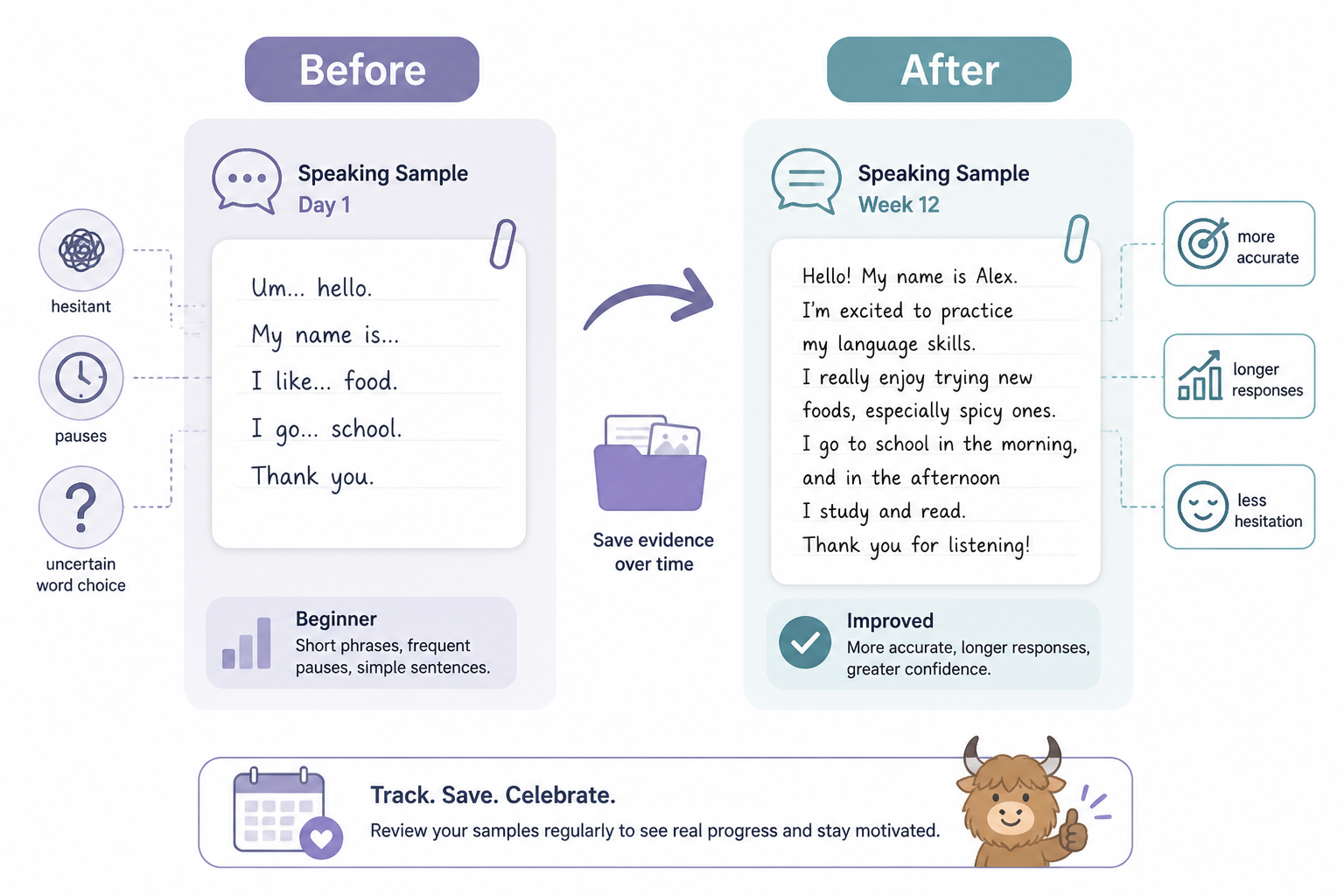
- save a “before” and “after” sample every few months
- write down the tasks that used to feel impossible and now feel normal
- notice skills that improved even if they are not your main focus
- celebrate level movement, but also celebrate stability
- use the data to choose better study materials, not to criticize yourself
Seeing yourself move from “I can barely answer” to “I can handle a short exchange” is very encouraging. That kind of change is easier to notice when you’ve recorded evidence along the way.
A quick guide to honest self-scoring
If you only remember one thing from this article, remember this: score your level based on what you can usually do, not what you hope to do someday.
- Use “usually,” not “once.”
- Use tasks, not vibes.
- Use evidence, not memory alone.
- Use one framework consistently.
- Track each skill separately.
If you do that, your tracking will become much more useful and much less random.
Putting it all together
CEFR and ACTFL give you a smarter way to answer a question every language learner eventually asks: “How good am I, really?”
CEFR gives you a broad, internationally understood ladder from basic to proficient. ACTFL gives you extra detail, especially for beginner and intermediate learners. Together, they help you move from fuzzy self-esteem math to actual progress tracking.
The best way to use them is simple:
- pick the skill you want to measure
- test it with a real task
- compare it to the level descriptors
- write down evidence
- repeat monthly or at steady intervals
- adjust your study plan based on what you find
If you want a deeper refresher on what the CEFR levels mean, review the CEFR levels guide. If you’re curious about the bigger picture of how much effort language learning takes, the pages on FSI language hours and how long it takes to learn a language can help you set realistic expectations.
Progress feels better when you can see it. And once you can see it, you can steer it.