Why learning a language as an adult feels hard
If you’re trying to figure out How To Learn a Language As An Adult, you are not imagining things: it does feel different from learning as a kid. Adults usually have more responsibilities, less free time, and a much louder inner critic. You also know enough to notice every mistake, which is both a blessing and a curse.
For the broader learning path, visit our parent guide.
The good news is that adults also have real advantages. You can set a goal on purpose. You can choose methods that fit your life. You can understand how habits work. You can use logic, planning, and self-awareness in a way children simply cannot. In other words: you may not have endless free afternoons, but you do have a brain that can organize a strategy.
This guide is for people who want a practical, realistic path. Not magic. Not guilt. Not “be fluent in 30 days” nonsense. Just a clear way to make progress as an adult without turning your life upside down.

What adult language learning really requires
Before you choose apps, books, tutors, or a study schedule, it helps to understand the actual job in front of you. Learning a language is not one skill. It is several skills working together:
- Listening — understanding sounds, words, and meaning in real time
- Speaking — producing language quickly enough to have a conversation
- Reading — recognizing words and patterns on the page
- Writing — organizing words into clear sentences
- Vocabulary — remembering useful words and phrases
- Grammar — noticing how words change and fit together
- Pronunciation — training your mouth and ears to match the language
Adults often try to improve all of these at once and then feel overwhelmed. A better approach is to treat them like a team. Some skills should get more attention early on, and others can grow more slowly in the background.
The adult advantage: learning with intention
Adults are usually better at three things that matter a lot:
- Prioritizing — deciding what matters most right now
- Pattern recognition — noticing grammar and structure faster than you might expect
- Consistency — building routines that are realistic instead of idealized
This means adult learners do best when they stop trying to “study everything” and start learning with a plan. That plan does not need to be fancy. It needs to be repeatable.
Start with a goal that is actually useful
The fastest way to waste time is to set a vague goal like “I want to be fluent.” Nice dream. Not very helpful. Fluency means different things to different people, and “someday” is not a study plan.
Instead, choose a goal that connects to your real life. Ask:
- Why do I want to learn this language?
- What will I use it for?
- How much time can I really give it each week?
- What does success look like in 3 months, 6 months, and 1 year?
Good adult goals look like this
- I want to handle basic travel conversations without freezing.
- I want to read simple articles in the language for fun.
- I want to hold a 10-minute conversation with a tutor.
- I want to understand the main idea of beginner podcasts.
- I want to learn enough to talk with family members or coworkers.
Weak goals look like this
- I want to become fluent fast.
- I want to “just learn” the language somehow.
- I want to study more when life calms down.
- I want to memorize all the words.
Specific goals help you choose the right methods. They also keep you from comparing your progress to someone else’s completely different situation.
Choose the right approach for your life, not your fantasy schedule
Many adult learners fail because they build a plan for their best week of the year instead of their normal week. If your real schedule has work, family, errands, and the occasional collapse into the sofa, your language plan needs to respect that.
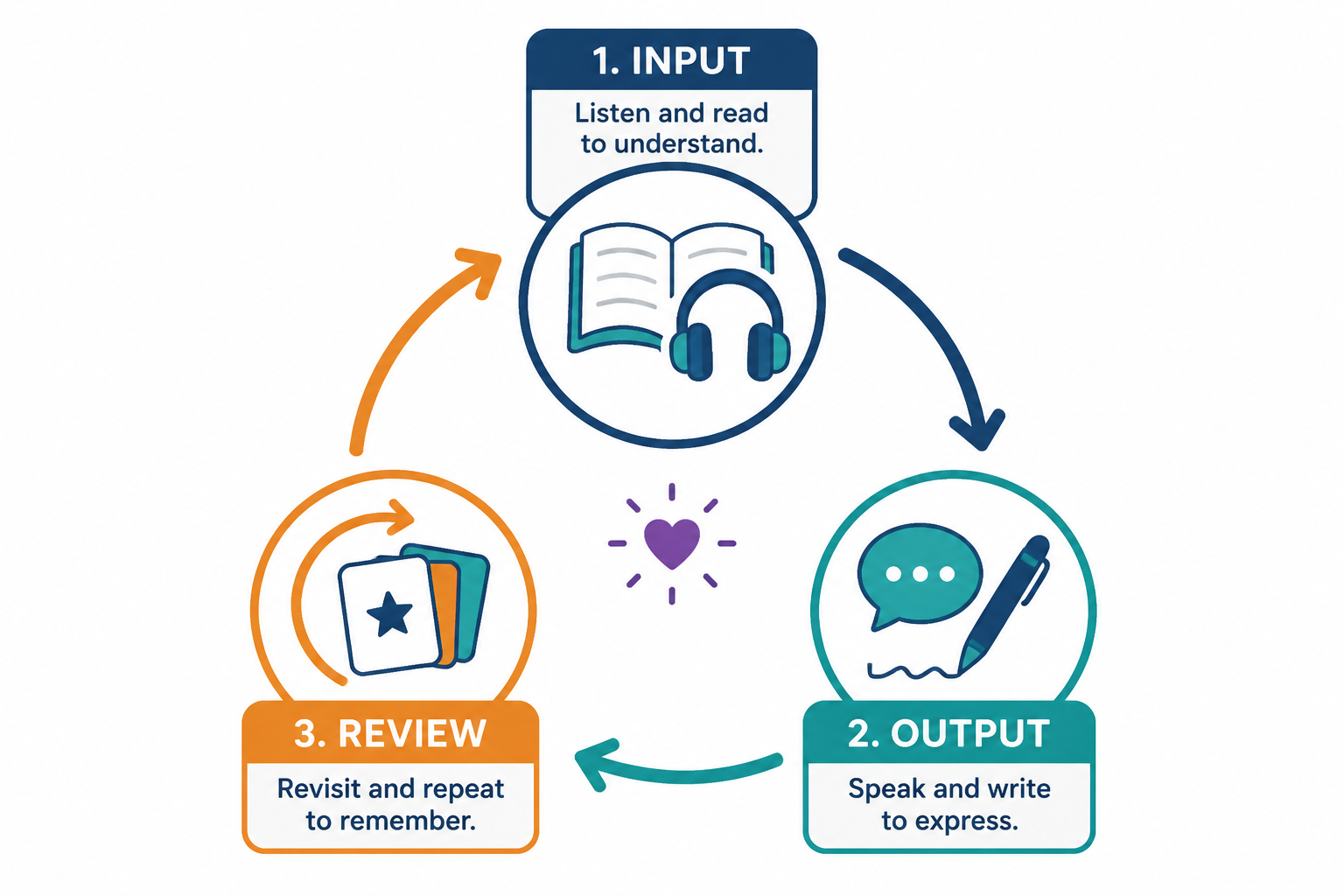
A practical approach usually blends three elements:
- Input — listening and reading to absorb the language
- Output — speaking and writing to practice using it
- Review — revisiting vocabulary and patterns so they stick
What to prioritize first
For most adults, the best starting point is:
- Core phrases and high-frequency vocabulary
- Listening practice with simple material
- Basic speaking practice, even if it feels awkward
- Reading and writing support
- Grammar only as needed to understand patterns
This order works because it gets you using the language early. Adults often wait too long to speak because they want more preparation. But language is a performance skill. You improve by using it, not just by planning to use it.
Pick methods that are worth your time
There are many ways to learn a language, but not every method is equally useful for an adult with limited time. The best method is the one that helps you keep going and gives you real progress.
If you want a broader comparison of approaches, this guide may help: best way to learn a language.
A simple method mix that works for many adults
- Beginner course or app for structure and first vocabulary
- Spaced repetition for memorizing useful words and phrases
- Listening practice with slow, clear material
- Tutor or conversation partner for speaking
- Light reading for reinforcement
- Short writing exercises for recall and grammar
What to avoid
- Using too many tools at once
- Collecting resources instead of studying
- Waiting until you “feel ready” to speak
- Studying only grammar and never practicing real language
- Jumping to advanced material too soon
A useful rule: if a method does not help you understand, remember, or use the language, it may be interesting but not essential.
Build your learning system before you build your ambition
Adults usually do better with a system than with bursts of motivation. Motivation comes and goes. Systems stay standing when your energy is low and your day is messy.
A learning system has four parts:
- When you study
- What you study
- How long you study
- How you track progress
A realistic study structure
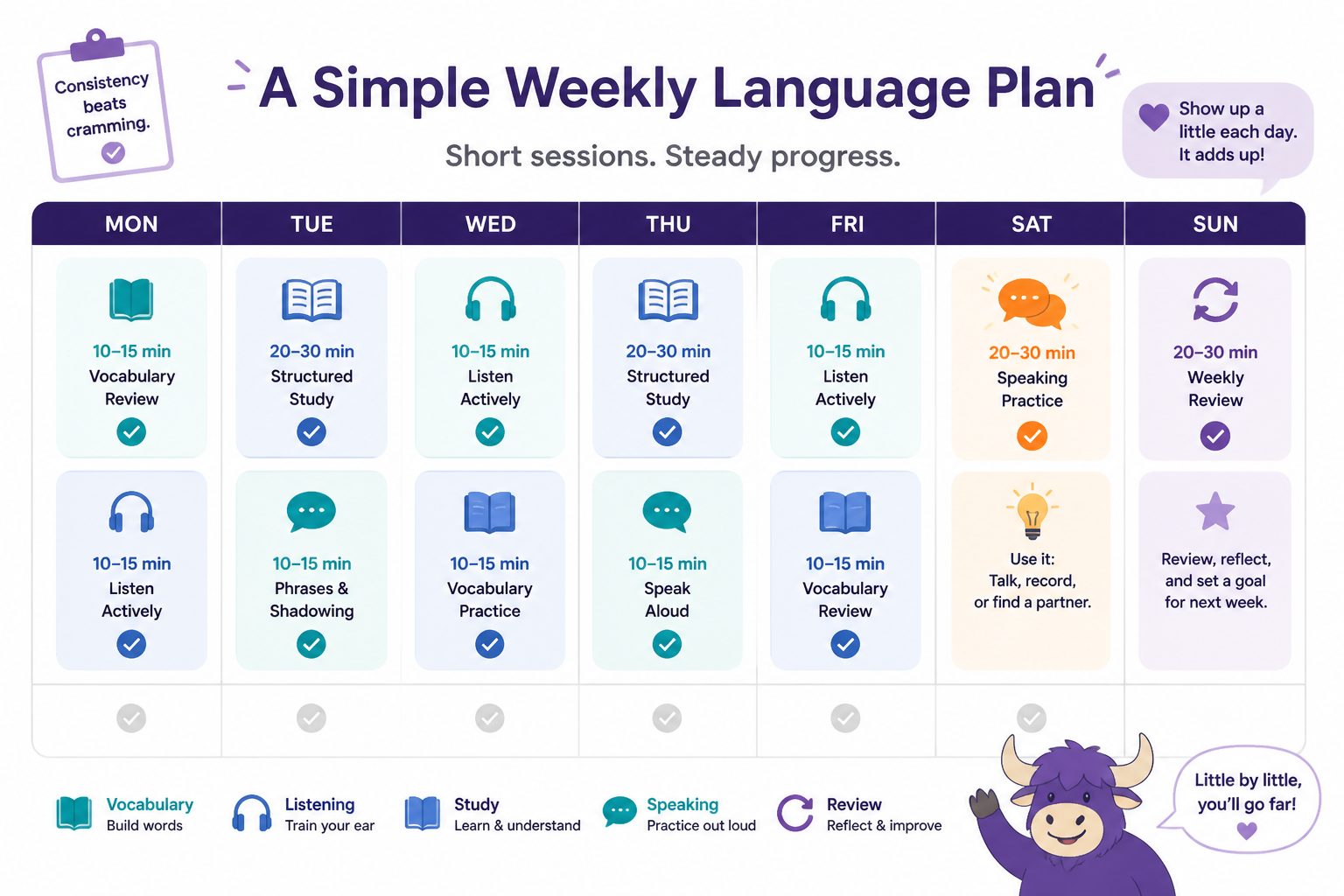
Here is a simple example for an adult with limited time:
- Daily: 10–20 minutes of vocabulary review or listening
- 3 times a week: 20–30 minutes of structured study
- 1–2 times a week: speaking practice
- Weekly: a short review of what is working and what is not
Why short sessions work
Short sessions are easier to repeat. And repetition is what creates progress. A 20-minute study habit that happens four times a week is more powerful than a 3-hour plan that dies after two weeks because real life happened, as it tends to do.
How to study when you are busy
Being busy is not the problem. Being unrealistic is the problem. A language habit has to fit into the cracks of your life, not demand a separate life of its own.
Use “minimum viable study”
Have a tiny version of your routine for difficult days. For example:
- 5 minutes of vocabulary review
- 1 short listening clip
- 3 sentences spoken out loud
- 1 quick note in the language
This keeps the habit alive even when you are tired, traveling, or drowning in work emails. Protecting the habit matters more than making every session perfect.
Attach language study to something you already do
- Review flashcards while drinking coffee
- Listen while walking or commuting
- Read a short text after lunch
- Practice speaking right after your evening cleanup
Pairing language study with existing routines reduces friction. Less friction means less negotiating with yourself, which is always nice.
Focus on high-value vocabulary first
Adults often waste time memorizing random words because they seem fun or impressive. But the most useful words are usually the most common ones. You do not need fancy vocabulary to get started. You need words that let you survive real situations and understand simple content.
What to learn first
- Greetings and basic social phrases
- Numbers, days, time, and dates
- Common verbs
- Basic nouns for everyday life
- Question words
- Essential connectors like “and,” “but,” “because,” and “then”
Learn phrases, not just single words
Adults learn better when vocabulary comes in chunks. For example, instead of memorizing a word alone, learn:
- how to ask for help
- how to say what you want
- how to explain you do not understand
- how to make a polite request
- how to respond in simple conversation
Phrases are useful because they give you a ready-made structure. They are also easier to use under pressure than isolated words are.
Use grammar as a tool, not a prison
Many adults believe grammar is the “serious” part of language learning, so they spend too long on it. Grammar matters, but not in the way school memory might suggest. The goal is not to memorize every rule before speaking. The goal is to understand enough grammar to make sense of patterns and avoid confusion.
A better way to learn grammar
- Learn the pattern briefly
- See it in real examples
- Use it in your own sentences
- Notice it again in reading or listening
- Review only when it causes problems
This is much more effective than reading a giant rule list and hoping your brain absorbs it through sheer determination.
Grammar questions to ask yourself
- What does this pattern help me express?
- What changes when I use it?
- What do I keep confusing?
- Can I make 5 simple example sentences with it?
If a grammar point does not help you speak, understand, or write something useful, it can usually wait.
Train your ear early
Adults often want to start speaking first, but listening is what makes speaking possible. If you cannot hear the language clearly, it is hard to reproduce it well. You do not need perfect comprehension at the start. You need familiar sounds.
How to improve listening without panicking
- Start with very short, simple audio
- Listen more than once
- Read along if possible
- Catch words you recognize instead of every unknown word
- Repeat short audio to notice rhythm and pronunciation
A useful listening progression
- Understand a few common words and phrases
- Recognize them in slow speech
- Notice them in natural speech
- Catch the general meaning of short audio
- Gradually handle longer and less controlled content
Listening grows over time. The biggest mistake is assuming that if you do not understand much now, listening is “not working.” It is working. It is just working quietly.
Start speaking before you feel ready
Speaking is the part that scares many adult learners most. You might worry about sounding foolish, making mistakes, forgetting words, or being too slow. Those fears are normal. They are also part of the process.
The solution is not to wait for confidence. The solution is to build a low-pressure speaking routine.
Simple ways to practice speaking
- Read sentences aloud
- Shadow short audio by repeating it
- Describe what you are doing in simple language
- Answer basic questions out loud
- Practice with a tutor or conversation partner
What speaking practice should feel like
At first, speaking should feel a bit awkward but manageable. If you are making some mistakes, that is fine. If you are completely frozen every time, the task is probably too hard. Reduce the difficulty until you can speak in short wins.
Think of it this way: speaking is not a final exam. It is exercise. A clumsy rep still counts.
Make review automatic
If you do not review, you will keep relearning the same material. That is frustrating and slow. Adults need a review system because memory is busy, distracted, and sometimes a little dramatic.
What to review
- High-frequency vocabulary
- Useful phrases
- Problem grammar patterns
- Words you keep forgetting
- Sentences you want to be able to use quickly
A simple review loop
- Learn something new
- Use it in a sentence
- Review it the next day
- Review it again later in the week
- Use it in a real conversation or writing task
This loop helps move language from “I saw it once” to “I can actually use it.” That transition is where adult learning becomes rewarding.
How to stay consistent when motivation disappears
Most adult learners do not fail because they are incapable. They fail because they stop. Consistency matters more than talent, and consistency depends on reducing resistance.
If you want help building a habit that survives normal life, this guide may be useful: how to build a language-learning habit.
Make the habit easier than skipping it
- Keep materials visible
- Study at the same time each day when possible
- Use short sessions when energy is low
- Have a fallback task for busy days
- Track streaks or sessions if that motivates you
Expect motivation to vary
Some days you will feel ready to conquer the language. Other days you will not want to think in any language at all. That is normal. The goal is not to feel inspired every day. The goal is to keep your routine alive through boring weather, because boring weather is most of life.
Design a study plan that matches your level
Adults do best with a plan that matches their current level, not their hopes. A beginner needs different work from someone who already knows a few hundred words and can read simple texts.
If you want a practical framework for organizing study, this guide can help: how to build a language-study plan.
If you are a complete beginner
- Learn essential phrases
- Practice pronunciation early
- Get comfortable with basic sounds
- Build a tiny core vocabulary
- Use very simple listening and reading material
If you are beyond beginner
- Increase listening time
- Read more graded or simplified content
- Do regular speaking practice
- Study grammar when it blocks understanding
- Practice writing short texts and correcting them
A monthly planning question set
- What do I want to improve this month?
- What am I currently avoiding?
- Which activity gives me the best return on time?
- What should I stop doing because it is not helping?
Planning is not about making a perfect schedule. It is about making sure your effort keeps moving in a useful direction.
Common mistakes adult learners make
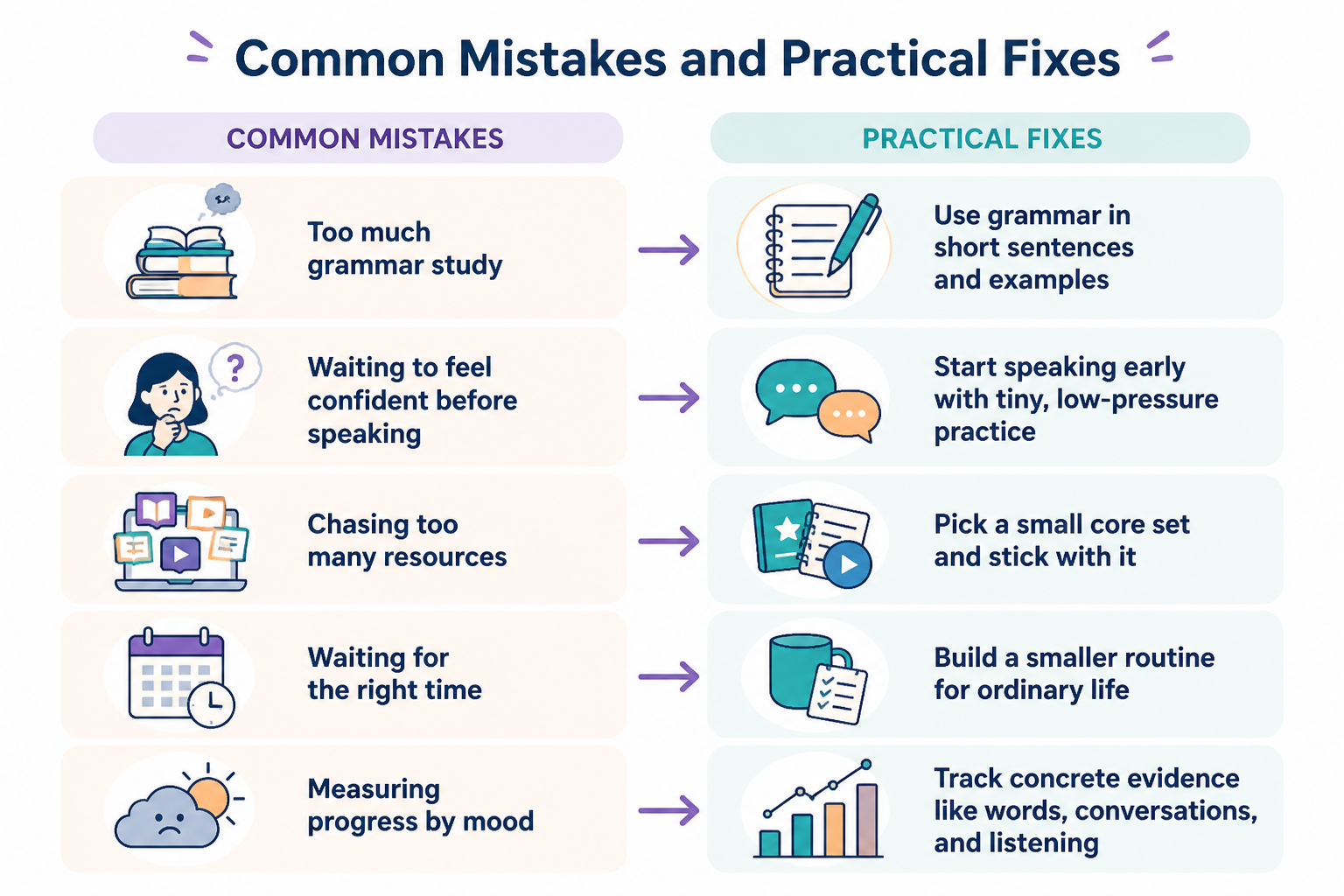
Most adult learners repeat a handful of predictable mistakes. The good news is that once you know them, they are easier to avoid.
1. Trying to learn everything at once
Why it happens: You want to be well-rounded.
What goes wrong: Your brain gets overloaded and nothing sticks well.
Fix: Focus on a small set of priorities for a few weeks at a time.
2. Studying without speaking
Why it happens: Speaking feels scary.
What goes wrong: You understand more than you can produce.
Fix: Add short speaking practice early, even if it is just reading aloud and simple answers.
3. Chasing too many resources
Why it happens: Good resources are tempting.
What goes wrong: You spend more time choosing than learning.
Fix: Pick a small core set and stick with it long enough to see results.
4. Waiting for the “right time”
Why it happens: Life is busy, and you want a cleaner schedule.
What goes wrong: The ideal time never arrives.
Fix: Build a smaller routine that works in ordinary life.
5. Measuring progress by mood instead of evidence
Why it happens: It is hard to notice slow improvement.
What goes wrong: You think nothing is happening when it actually is.
Fix: Track concrete signs like words learned, conversations had, or audio understood.
How to know if your method is working
Adults often underestimate progress because growth can feel invisible day to day. So it helps to look for signs that your method is working even before you feel “fluent.”
Good signs
- You remember more words without looking them up
- You recognize phrases faster in listening
- You can answer simple questions more quickly
- You make fewer repeated mistakes
- You need less mental effort for basic tasks
Signs your plan needs adjustment
- You are constantly bored or exhausted by study
- You never use what you learn
- You keep forgetting the same material with no improvement
- You avoid speaking because everything feels too hard
- Your routine is too complicated to maintain
If the plan is not working, do not assume you are failing. Usually the plan needs simplifying, narrowing, or making more practical.
A sample adult learning routine
Here is a simple example of what a balanced adult routine might look like. Adjust it to your schedule, goals, and level.
| Day | Task | Time | Purpose |
|---|---|---|---|
| Monday | Vocabulary review + short listening | 15–20 min | Memory and exposure |
| Tuesday | Grammar pattern + 5 example sentences | 20 min | Clarity and reuse |
| Wednesday | Speaking practice or tutor session | 20–30 min | Output and confidence |
| Thursday | Reading a short text + note new phrases | 15–20 min | Recognition and vocabulary |
| Friday | Vocabulary review + listening | 15–20 min | Retention |
| Weekend | Longer conversation, review, or relaxed media | 30–45 min | Integration |
This is only a template. The point is to balance input, output, and review without expecting yourself to become a full-time student.
How to keep going when progress feels slow
Almost every adult language learner hits a stage where improvement feels invisible. This is normal, and it usually means you are building skill beneath the surface.
What to do when you feel stuck
- Reduce the difficulty of your materials
- Review older words and phrases
- Add one more speaking session per week
- Pick a narrower goal for the next month
- Look back at what you could not do three months ago
Use the “proof of progress” habit
Once a month, write down:
- What I can understand now that I could not before
- What I can say now that I could not before
- What still feels difficult
- What I will focus on next
This helps you see progress in a more honest way than mood alone. Some months are not flashy, but they are still useful.
How to make the language part of your life
The best long-term results come when the language stops feeling like a school subject and starts feeling like a normal part of your week. You do not need to surround yourself with the language every waking moment. You just need steady contact.
Easy ways to add more exposure
- Listen during routine chores
- Read short articles or graded texts
- Keep a note of useful phrases
- Set one device or app to the language if that helps
- Speak a few sentences to yourself during the day
Small exposure adds up. Adults often do better with repeated small touchpoints than with exhausting marathons.
What to do if you only have 10 minutes a day
Ten minutes is not ideal, but it is enough to build momentum if you use it well. The key is not perfection. The key is focus.
A 10-minute routine
- 3 minutes: review a few words or phrases
- 4 minutes: listen to a short audio clip
- 3 minutes: say or write 3 simple sentences
If that is all you can do on busy days, do that. Consistency with a tiny routine is far better than guilt plus zero action.
What to do next
If you want to learn a language as an adult, your next step is not to find the perfect app, book, or trick. Your next step is to make a plan you can actually repeat.
Start here:
- Choose one clear goal
- Pick one or two core methods
- Set a realistic weekly routine
- Decide what your minimum study day looks like
- Begin with high-value words and phrases
- Add speaking early, even in small amounts
- Review regularly so progress sticks
If you want a more complete structure for turning that plan into something sustainable, these guides connect well with what you have just read: how to build a language-study plan and how to build a language-learning habit.
The main thing to remember is this: adult language learning works best when it is realistic, repeated, and useful. You do not need a perfect memory, unlimited time, or a heroic personality. You need a plan that fits your life and enough consistency to let the language slowly become familiar.
Adults do not need to learn like children. They need to learn like adults: with purpose, patience, and a system that survives ordinary life.