Why 10 Minutes a Day Can Actually Work
If you only have 10 minutes a day, you are not doomed to “barely learning.” You are actually in a very workable spot. The problem is not usually the small amount of time. The problem is trying to do too many things in those 10 minutes, or using them in a way that feels productive but doesn’t build real skill.
For the broader learning path, visit our parent guide.
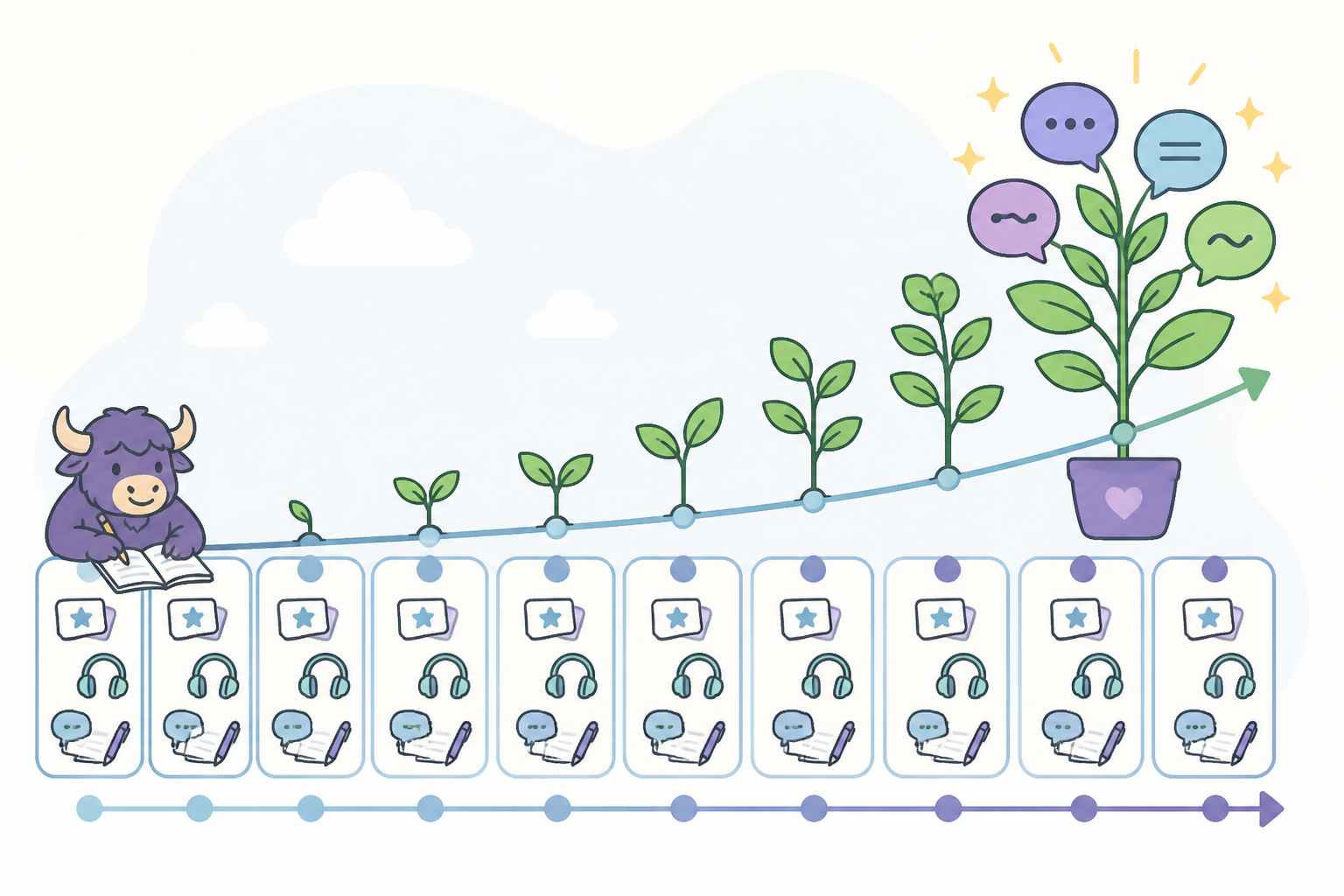
Learning a language in 10 minutes a day works best when you treat those 10 minutes like a tiny training session: focused, consistent, and easy to repeat. Ten minutes will not make you fluent by next Tuesday. But it can absolutely build vocabulary, listening familiarity, speaking confidence, and a real habit that grows over time.
The people who make progress with small daily sessions usually do three things well:
- They choose one small goal per session.
- They repeat the same core activities often enough to get comfortable.
- They make the habit so easy that skipping it feels more annoying than doing it.
That is the whole trick, really. Not magic. Not “study harder.” Just a system that fits real life.
What You Can Realistically Achieve in 10 Minutes a Day
Before we build the plan, it helps to set realistic expectations. Ten minutes a day is enough for steady progress, but only if you understand what kind of progress is likely.
| Possible with 10 minutes a day | Not realistic with 10 minutes a day |
|---|---|
| Learning and reviewing useful words and phrases | Fast fluency |
| Improving listening recognition slowly | Understanding movies with zero effort |
| Practicing pronunciation in short bursts | Perfect accent |
| Building a daily habit | Mastering complex grammar quickly |
| Getting comfortable with common structures | Having deep conversations right away |
This table is not here to lower your hopes. It is here to save you from disappointment. If you expect the wrong result, you’ll quit too early. If you expect the right result, 10 minutes can feel surprisingly powerful.
A better way to think about it is this: 10 minutes a day is not a crash course. It is a compound-interest plan. Small deposits, made consistently, become something useful.
The Best Way to Use a 10-Minute Language Session
The biggest mistake people make is trying to cram everything into one tiny session. They read a little, listen a little, review cards, watch a video, and maybe try speaking. By the end, they’ve touched five things and improved none of them very much.
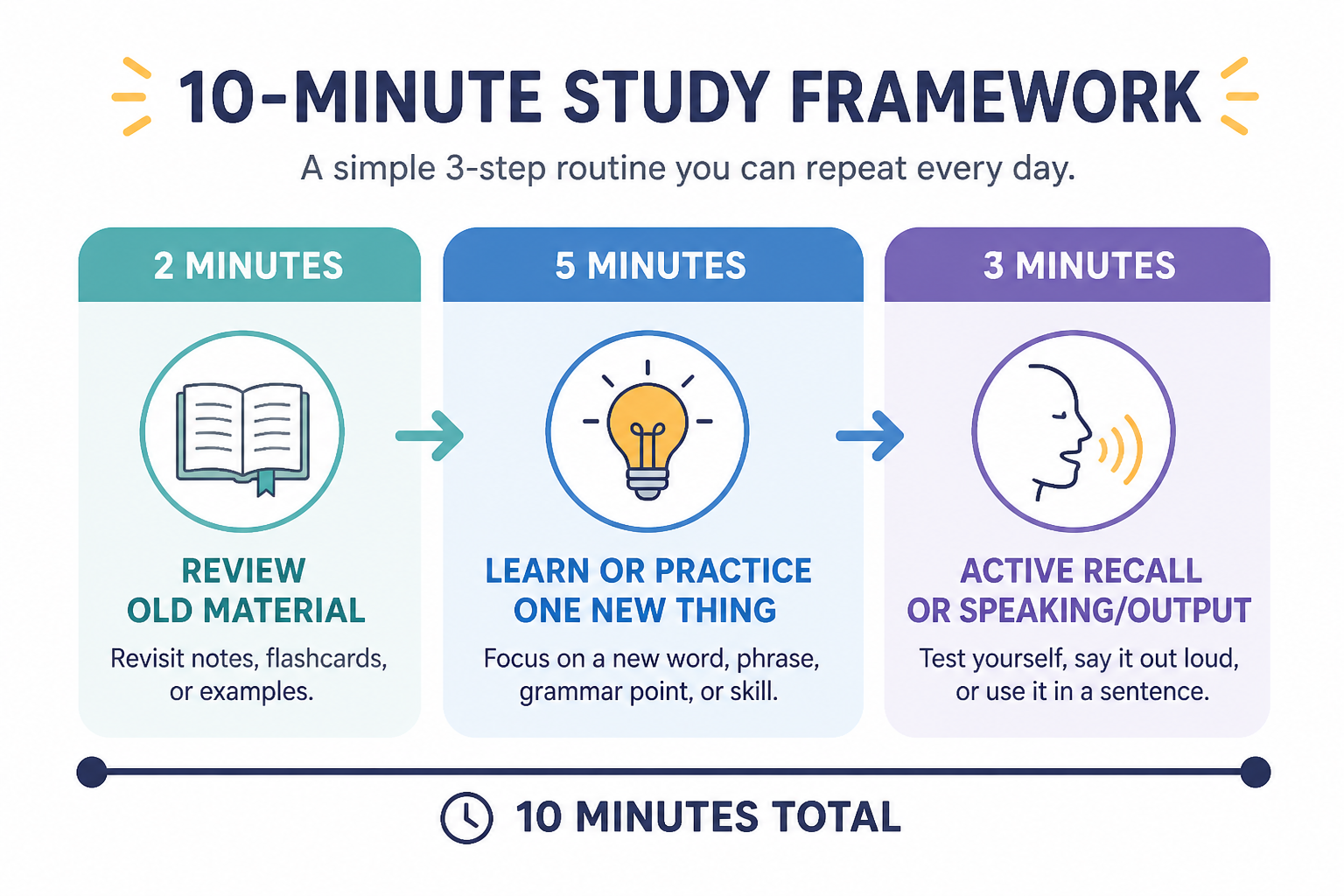
A better approach is to use each 10-minute session for one main job. Here’s a simple structure that works well for beginners and intermediate learners:
- 2 minutes: review old material
- 5 minutes: learn or practice one new thing
- 3 minutes: active recall or output
That may sound almost too simple, but simple is what makes it repeatable. And repeatable is what makes it effective.
Your 10-Minute Daily Language Plan
To make this practical, here is a ready-to-use daily plan. You can follow it exactly, or adapt it based on your goals and current level.
Option 1: Beginner-Friendly 10-Minute Session
- Minute 1-2: Review yesterday’s words or phrases
- Minute 3-5: Learn 3 to 5 new words, phrases, or a mini-dialogue
- Minute 6-7: Say the new material out loud
- Minute 8-9: Try to recall it without looking
- Minute 10: Write one sentence or one tiny note using the new material
Option 2: Intermediate-Friendly 10-Minute Session
- Minute 1-2: Quick review of old vocabulary or notes
- Minute 3-5: Listen to a short clip or read a short text
- Minute 6-7: Shadow or repeat one sentence at a time
- Minute 8-9: Summarize what you heard or read in simple terms
- Minute 10: Make one useful sentence of your own
The important part is not the exact activity. The important part is the shape of the session: review, new input, active use. That combo gives your brain a much better chance to remember what you studied.
What to Study in Those 10 Minutes
If time is short, your choice of content matters a lot. You want material that is useful, repeatable, and easy to revisit. In other words: high-value language.
Good things to study in 10-minute sessions include:
- Common greetings and basic conversation phrases
- High-frequency nouns and verbs
- Core sentence patterns
- Useful questions and answers
- Pronunciation of tricky sounds
- Short audio clips with transcripts
- Mini-dialogues you can reuse in real life
Not-so-great things to study in tiny sessions include:
- Rare vocabulary you may never use
- Long grammar explanations with no practice
- Random words from different topics every day
- Huge reading passages when you’re still struggling with basics
- Anything that takes 10 minutes just to set up
A useful rule: if it cannot be reviewed easily tomorrow, it may be too bulky for a 10-minute routine.
A Simple Formula for Choosing the Right Material
When you only have a few minutes, use this filter:
- Useful: Will I actually need this?
- Repeatable: Can I revisit it often?
- Small: Can I finish it in a short session?
- Clear: Can I understand the goal right away?
If the answer is “yes” to all four, it’s probably a good fit. If not, save it for a longer study session or skip it entirely.
| Best use of 10 minutes | Why it works |
|---|---|
| 10 flashcards with spoken review | Short, focused, easy to repeat |
| One mini-dialogue | Teaches vocabulary and structure together |
| One short listening clip | Builds recognition without overload |
| Three example sentences | Shows grammar in context |
| One writing prompt | Creates active recall and production |
How to Make 10 Minutes Stick: The Habit Side of the Equation
Time is only half the story. The other half is consistency. A perfect plan that happens twice a month is less useful than a simple plan you actually do every day.
If you want your 10-minute sessions to become automatic, your habit design matters almost as much as your study method. For a deeper look at habit-building, the guide on how to build a language learning habit is a helpful companion.
Here’s the basic habit formula:
- Anchor it: Attach the session to something you already do daily
- Reduce friction: Keep materials easy to access
- Make it obvious: Put the reminder where you’ll see it
- Make it tiny: Keep the starting step ridiculously small
Examples of good anchors:
- Right after coffee
- During your commute
- Before lunch
- After brushing your teeth at night
- While waiting for dinner to cook
The goal is not to “find motivation.” The goal is to remove the decision. If the habit starts at the same time and in the same place, it becomes much easier to keep.
A 10-Minute Plan for Beginners
If you are new to language learning, your biggest win is not cramming lots of information. Your biggest win is getting comfortable with the language’s sound, rhythm, and most common building blocks.
Here is a beginner-friendly weekly pattern you can repeat:
| Day | Focus | 10-minute task |
|---|---|---|
| Monday | Basic vocabulary | Learn and say 5 useful words |
| Tuesday | Listening | Listen to a short clip 3 times |
| Wednesday | Phrases | Practice a mini-dialogue out loud |
| Thursday | Review | Recall Monday to Wednesday without notes |
| Friday | Pronunciation | Repeat tricky sounds or words |
| Saturday | Writing | Write 3 simple sentences |
| Sunday | Light review | Choose your easiest review activity |
That structure keeps the work varied without becoming chaotic. Beginners usually need a lot of repetition, but they also need a little variety so the sessions stay usable and not painfully boring.
A 10-Minute Plan for Intermediate Learners
If you already know some basics, your 10 minutes should start pushing you toward real-world comprehension and production. That means less isolated memorization and more meaning-based practice.
A simple intermediate routine might look like this:
- 2 minutes: review old vocabulary with quick recall
- 3 minutes: read or listen to a short piece of real content
- 2 minutes: identify one new phrase or pattern
- 2 minutes: make your own sentence using it
- 1 minute: say the sentence aloud twice
This helps you move from “I know this word” to “I can actually use this word.” That’s where progress starts to feel real.
The Best Types of Activities for Short Study Sessions
Not all language activities fit a 10-minute schedule equally well. Some are compact and powerful. Others are better saved for a longer session. Here’s a practical breakdown.
1. Spaced Review
Reviewing words or phrases you’ve already seen is one of the best uses of short sessions. It keeps vocabulary from slipping away and makes recall stronger over time.
Good review tasks include:
- Looking at a word and saying the meaning aloud
- Covering the answer and testing yourself
- Using a phrase in a new sentence
2. Mini-Listening Practice
A short audio clip can be a very strong 10-minute activity if you listen actively instead of just letting it play in the background.
- Listen once for the general idea
- Listen again and catch familiar words
- Repeat one or two sentences aloud
That simple process trains your ear much better than passive listening alone.
3. Shadowing
Shadowing means repeating what you hear right after you hear it. It can improve rhythm, pronunciation, and automaticity. For short sessions, use only a few sentences so you do not rush through the exercise.
4. Tiny Writing Practice
Writing one or two sentences forces you to retrieve vocabulary and structure from memory. That makes it much more effective than simply rereading examples.
5. Speaking Out Loud
Speaking does not have to mean long conversations. In a 10-minute routine, it can be as simple as answering one prompt, retelling one sentence, or describing your day with very basic language.
If you can say it before you can say it perfectly, you are already making progress.
How to Keep 10 Minutes from Turning into 30
Ironically, one of the biggest challenges of short daily learning is that it can expand. You sit down for 10 minutes and suddenly an hour disappears. That sounds productive, but it can actually make your routine harder to keep.
There’s nothing wrong with longer sessions when you have time. But if your plan is built around 10 minutes, protect that boundary. Otherwise your brain starts thinking the habit is “too big,” and you begin skipping it on busy days.
- Use a timer
- Know your exact task before you begin
- Stop when the timer ends
- Save extra study for days when you truly have more time
This is one reason small routines work: they reduce the chance of all-or-nothing thinking. A 10-minute habit is easier to start, easier to finish, and easier to keep alive when life gets messy.
Common Mistakes People Make with a 10-Minute Language Routine
Short study time can be incredibly effective, but only if you avoid a few traps. Here are the most common ones.
Mistake 1: Doing Something Different Every Day
Variety is nice. Randomness is not. If your session changes completely every day, your brain spends too much time figuring out what to do instead of learning.
Fix: Keep the overall structure the same, and only change the content.
Mistake 2: Studying Too Much New Material
Ten minutes is not the time to shovel in a giant pile of new words. You will forget most of them, then blame yourself unfairly.
Fix: Learn a small amount, then review it repeatedly.
Mistake 3: Only Watching or Reading, Never Producing
Input is important, but if you never speak or write, you can end up recognizing more than you can use.
Fix: End every session with a small output task: one sentence, one answer, one spoken line.
Mistake 4: Making the Session Too Hard
If your 10 minutes are filled with difficult content, the habit can start to feel like a chore. That’s bad news for consistency.
Fix: Keep the difficulty just challenging enough to be useful, but not so hard that you avoid it.
Mistake 5: Measuring Success by “How Much I Finished”
Short sessions are not about finishing a giant lesson. They are about repeating a useful action. If you judge yourself only by how much content you “covered,” you’ll miss the real progress.
Fix: Measure consistency, recall, and comfort instead.
What to Do When You Miss a Day
You will miss a day sometimes. That is normal. The goal is not perfect attendance; the goal is a routine that survives normal life.
When you miss a session, do not try to “make up” for it with a giant catch-up marathon that burns you out. Just restart with the next 10-minute window.
- Do not punish yourself
- Do not restart with an impossible plan
- Do not treat one missed day like failure
- Do make the next day as easy as possible to begin
If your routine keeps breaking, the problem usually is not laziness. The problem is friction. The session may be too complicated, too long, or too disconnected from your daily life.
That’s why habit design matters. If you want help making your routine more resilient, the guide on building a language learning habit fits perfectly with this approach.
How to Track Progress Without Getting Bogged Down
Tracking can be motivating, but only if it stays simple. You do not need a giant spreadsheet to know whether your 10-minute plan is working.
A very basic tracking system is enough:
- Did I do my 10 minutes today?
- What did I study?
- Can I remember or use one thing from yesterday?
You can track this on paper, in a notes app, or in a calendar. The format matters less than the consistency.
Signs your routine is working:
- You recognize more words without translating every time
- You need less effort to start your session
- You can recall phrases more quickly
- You feel less awkward saying simple things out loud
- You can spend 10 minutes without feeling mentally fried
Progress in a small routine often feels subtle at first. Then one day you realize you understand a phrase faster, or remember a word without searching for it, and suddenly the whole thing seems worth it. Which it is.
Choosing Resources That Fit a 10-Minute Routine
Your resources should match your time budget. If a tool or method needs too much setup, too much attention, or too much context, it will fight against your routine instead of supporting it.
The guide to best language learning resources by goal can help you choose materials that fit what you actually want to practice.
For a 10-minute system, look for resources that are:
- Easy to open and use quickly
- Short enough to finish in one session
- Focused on one skill at a time
- Simple to review later
- Flexible enough to repeat often
Good examples include:
- Short audio clips with text
- Small vocabulary lists with examples
- Mini-dialogues
- Simple flashcard decks
- Short reading passages
- Prompt-based writing exercises
Less ideal examples include oversized textbook chapters, long grammar lectures, and resources that require lots of setup before the useful part even begins.
How to Turn 10 Minutes into Real Long-Term Progress
The real power of a 10-minute routine is not the individual session. It’s the streak of sessions that stack up over weeks and months.
To get long-term value, your sessions should cycle through three functions:
- Learn: Pick up something new
- Review: Bring old material back into memory
- Use: Say, write, or recognize the language actively
If you keep those three functions alive, your study time becomes balanced. You are not just collecting vocabulary. You are building memory, familiarity, and usable skill.
That balance matters because language learning usually stalls when people over-focus on one area. Too much input with no output. Too much memorization with no context. Too much grammar with no real use. The 10-minute framework helps keep things honest.
A Sample 14-Day 10-Minute Routine
If you want a ready-made structure, here is a simple two-week starter routine. Think of it as a practical ramp-up, not a strict rulebook.
| Day | Task |
|---|---|
| 1 | Choose your anchor time and set up your materials |
| 2 | Learn 5 essential words or phrases |
| 3 | Review yesterday and say the words aloud |
| 4 | Listen to a short clip or dialogue |
| 5 | Repeat one sentence 5 times |
| 6 | Write 3 simple sentences |
| 7 | Review the week’s material |
| 8 | Learn 5 more high-use words or phrases |
| 9 | Use the words in a new sentence |
| 10 | Listen and pick out familiar words |
| 11 | Shadow a short clip |
| 12 | Do quick recall from memory |
| 13 | Write or speak a tiny self-introduction or update |
| 14 | Review, reflect, and choose the next focus |
If you want a more detailed day-by-day framework for a short burst of learning, the 14-day language learning routine is a useful next step after this guide.
Troubleshooting: Why Your 10-Minute Routine Is Not Working Yet
If your routine feels ineffective, do not assume the idea is broken. Usually, one part of the system needs adjusting. Here are the most common issues and what to do about them.
Problem: “I can’t stay focused for even 10 minutes.”
Likely cause: The activity is too complicated or too boring.
Fix: Simplify the task. Use one clear activity per session, and make sure the material is just interesting enough to hold attention.
Problem: “I do well for a few days, then stop.”
Likely cause: The routine depends too much on motivation.
Fix: Tie the session to a specific time and place, and lower the starting effort. The easier it is to begin, the easier it is to continue.
Problem: “I’m learning things, but I still can’t say anything.”
Likely cause: Too much passive study and not enough output.
Fix: End every session with spoken or written production, even if it is tiny.
Problem: “10 minutes feels too small to matter.”
Likely cause: You are judging the session by intensity instead of consistency.
Fix: Track streaks and recall, not just effort. Small daily wins are often invisible until they stack up.
A Quick Decision Guide: What Should You Do in Your 10 Minutes Today?
If you sit down and freeze, use this simple decision guide.
| If you feel… | Do this |
|---|---|
| Foggy or tired | Review old phrases and say them aloud |
| Fresh and focused | Learn one new mini-topic |
| Disorganized | Do a short listening clip and summary |
| Confident | Write or speak from memory |
| Burned out | Do very light review only |
This kind of flexibility keeps your habit alive. On good days, you stretch. On rough days, you keep the chain going. Both count.
Your 10-Minute Success Checklist
Use this checklist to make sure your routine is set up for success:
- I have a clear daily time for my session
- I know exactly what I will do in those 10 minutes
- I am studying small, useful material
- I review old content regularly
- I end with some kind of active recall, speaking, or writing
- I keep the routine easy enough to repeat tomorrow
- I measure progress by consistency and recall, not perfection
If you can check most of those boxes, you’re in a strong position. If not, adjust the routine before you try harder. “Try harder” is often a bad plan when the system is the real issue.
What to Do Next
If your goal is to make real progress with just 10 minutes a day, the next move is simple: choose one anchor time, pick one type of study material, and repeat the same short structure for at least two weeks.
Start small. Keep it stupidly manageable. Protect the habit. Then let the consistency do the heavy lifting.
If you want to keep building from here, these guides pair naturally with this one:
- How to build a language learning habit
- 14-day language learning routine
- Best language learning resources by goal
- Main how-to-learn-a-language guide
Ten minutes a day will not make language learning effortless. But it can make it real, repeatable, and sustainable. And for most learners, that is the difference between “someday” and actual progress.