If you want to learn a language fast, the good news is this: “fast” does not mean “magic.” It means using the right methods in the right order, spending your time on the things that actually move the needle, and not getting stuck in the language-learning version of rearranging your desk for productivity.
For the broader learning path, visit our parent guide.
This guide will show you how to learn a language faster in a practical, beginner-friendly way. You’ll learn what matters most, what to ignore, how to build momentum, and how to avoid the common traps that make people feel busy without actually improving.
If you want the big picture first, this article focuses on speed, but speed works best when it sits inside a solid plan. If you also want a broader framework, the guide on the best way to learn a language pairs well with this one. And if planning is your weak spot, the article on how to build a language study plan will help you turn this advice into a schedule you can actually follow.
What “learning a language fast” really means
When most people say they want to learn a language fast, they usually mean one of three things:
- They want to speak sooner.
- They want to understand everyday content faster.
- They want visible progress without wasting time.
That’s a great goal. But it helps to be specific. Fast progress in language learning is not about doing everything at once. It is about getting useful results in the shortest amount of time.
Here’s the key idea:
Fast language learning comes from high-frequency input, focused practice, and consistent review.
In plain English, that means:
- Learn the words and patterns you’ll actually use.
- Practice speaking and understanding early, not “someday.”
- Repeat in a smart way so your memory sticks.
- Stay consistent enough that your brain stops forgetting everything overnight.
That last part matters more than people expect. A language does not reward random bursts of motivation. It rewards repeated contact.
The fastest path: the 4-part system
If you want the shortest route to real progress, build your learning around four parts:
- Core vocabulary — the most useful words and phrases
- Core grammar patterns — enough structure to make meaning
- Listening and reading input — so your brain gets used to the language
- Speaking and writing output — so you can use what you know
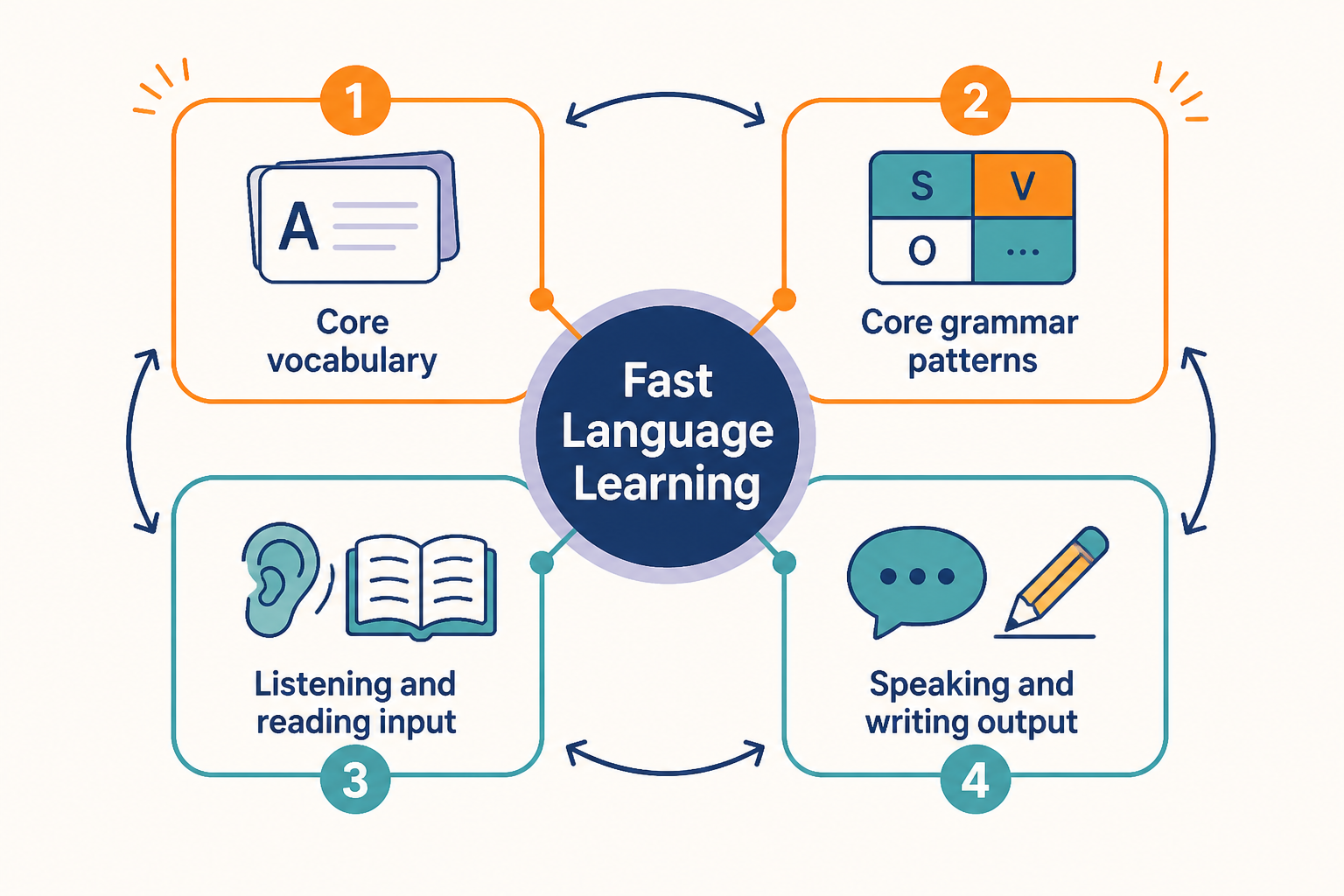
The trick is not to treat these as equal in the beginning. If your goal is speed, some activities deserve more of your time than others.
| Activity | Why it helps | Priority for fast learning |
|---|---|---|
| Useful vocabulary | Lets you understand and say real things quickly | Very high |
| Grammar patterns | Helps you build correct sentences faster | High |
| Listening | Trains your ear and builds recognition | Very high |
| Speaking | Turns passive knowledge into active skill | Very high |
| Reading | Reinforces vocabulary and structure | High |
| Writing | Helps you notice gaps and practice accuracy | Medium to high |
If you’re short on time, your goal is not “do all the things.” Your goal is “do the most effective things first.”
Step 1: Set a clear target before you start
Fast progress starts with knowing what “success” looks like. Otherwise, you’ll study a little of everything and improve a little in nothing.
Ask yourself these questions:
- Why am I learning this language?
- What do I need it for first: travel, work, study, conversation, or daily life?
- How soon do I want to use it?
- What level of fluency is actually useful for me right now?
A person preparing for a trip needs different language skills than someone trying to chat with coworkers or understand a show. “Fast” should match the goal.
Example goal: “In 8 weeks, I want to handle basic conversations about myself, food, directions, and daily routines.”
That is much better than “I want to become fluent fast,” because it gives you something measurable and realistic.
One more thing: your goal should be narrow enough to guide your study choices. The narrower your target, the faster your progress will usually feel.
Step 2: Focus on high-value language first
The biggest speed mistake is trying to learn “the whole language” from day one. That sounds ambitious, but it slows you down. Fast learners focus on the parts that appear constantly.
Start with:
- greetings and introductions
- numbers, time, dates, and days
- common verbs
- basic questions
- routine activities
- food, places, directions, and daily life topics
- simple opinion phrases like “I like,” “I need,” “I want,” and “I think”
These words and patterns show up everywhere. They help you understand more, say more, and get unstuck faster.
Think of it like learning the most useful keys on a keyboard before worrying about the fancy shortcuts.
What to ignore at the start
To learn faster, you also need to ignore some things, at least temporarily:
- rare vocabulary you will not use soon
- advanced grammar exceptions
- perfect pronunciation on every sound
- long grammar explanations that do not help you speak
- random word lists without context
This does not mean these things are unimportant forever. It just means they are low priority when speed matters.
Step 3: Build a strong vocabulary core
Vocabulary is one of the fastest ways to improve your language ability because words give you access to meaning immediately. The more of the language you recognize, the less everything feels like soup.
But there’s a catch: not all vocabulary study is equal.
If you want to learn faster, don’t memorize isolated word lists for hours with no context. Instead, focus on useful words in phrases and sentences.
A smarter way to learn words
Learn vocabulary in this order:
- High-frequency words — the most common words that show up constantly
- Useful chunks — short expressions and sentence patterns
- Topic vocabulary — words related to your needs
- Personal vocabulary — words tied to your real life
For example, instead of learning the word for “restaurant” by itself and moving on, you might learn:
- I’d like…
- How much is…?
- Can I have…?
- Where is the bathroom?
- The bill, please
These are more useful because they help you do something, not just recognize a word.
If you want a deeper strategy for this part of the process, the guide on how to learn vocabulary fast goes into more detail on efficient word learning.
How many words do you need?
You do not need thousands of words before you can begin speaking. You need enough vocabulary to handle your current goal.
A practical way to think about it:
- First stage: enough words to introduce yourself, ask basic questions, and understand simple content
- Second stage: enough words to talk about routines, preferences, needs, and common situations
- Third stage: enough words to handle broader topics and more natural conversation
Speed comes from building the smallest useful vocabulary set first, then expanding from there.
Vocabulary learning mistake to avoid
Mistake: Studying 50 new words once and never seeing them again.
Fix: Review words repeatedly in spaced intervals and use them in short sentences.
Memory likes repetition. It is annoyingly old-fashioned that way.
Step 4: Learn sentence patterns, not just grammar rules
Grammar matters, but if you spend too much time memorizing rules before using them, progress slows down. A faster approach is to learn the most common sentence patterns and practice them until they feel natural.
Instead of asking, “What is every rule?” ask:
- How do I say this idea simply?
- What pattern do native speakers use often?
- What do I need to express right now?
For example, learn patterns such as:
- I am ___
- I have ___
- I want ___
- I need ___
- Can you ___?
- How do I ___?
- Where is ___?
These tiny patterns are powerful because they let you build many sentences quickly.
A practical grammar rule
For fast learning, grammar should answer one question: Does this help me say more useful things sooner?
If yes, learn it. If not, save it for later.
That does not mean grammar is bad. It means grammar should serve communication, not replace it.
Mini example
Suppose you want to say you are hungry, want water, and need help.
- I am hungry.
- I want water.
- I need help.
These are simple, but they are immediately useful. Learning to build small, correct sentences quickly is better than learning one complicated rule and still not being able to talk.
Step 5: Start listening early, even if you understand very little
Many learners wait too long to listen because they think they need more vocabulary first. That delays progress.
Listening early helps your brain get used to the rhythm, sounds, and patterns of the language. You do not need to understand everything. In fact, at the beginning, you probably won’t. That is normal.
Think of listening as training your ear, not passing a test.
How to listen for fast improvement
Use short, repeated listening rather than long, exhausting sessions.
- Choose short audio you can revisit many times.
- Listen once for the general meaning.
- Listen again and catch a few words.
- Read or check the text if available.
- Listen again without stopping every two seconds to panic.
That last step is important. If you stop after every unfamiliar word, you break the flow and make listening feel harder than it needs to be.
Fast learners usually get comfortable with not understanding everything right away. That comfort matters.
What to listen to first
Begin with material that matches your level:
- short dialogues
- slow, clear beginner audio
- simple stories
- content on familiar everyday topics
Once you can follow some of it, increase the challenge little by little.
Step 6: Read content you can mostly understand
Reading is a fast way to reinforce vocabulary and grammar because it gives you repeated exposure in context. The key is to read the right level of material.
If the text is too hard, you will spend your time surviving instead of learning. If it is too easy, you may not gain much. The sweet spot is material you can understand mostly, with some new words sprinkled in.
Good reading habits for speed
- Read short texts first.
- Choose familiar topics.
- Don’t translate every word.
- Look for recurring words and patterns.
- Reread the same text if it is useful.
Rereading is underrated. The first read helps you understand the general message. The second and third reads help you notice language details without feeling overwhelmed.
For beginners, the goal is not to “read like a native.” The goal is to create repeated contact with the language in a way your brain can handle.
Step 7: Speak from the beginning, even if it is tiny
People often think they need to wait until they know more before speaking. That is one of the slowest strategies possible.
Speaking early helps you notice what you can’t say yet. That’s useful feedback. It tells you exactly what to study next.
You do not need full conversations right away. Start with small output:
- repeat words and phrases aloud
- read short sentences out loud
- answer basic self-introduction questions
- describe your day in a few simple sentences
- use language exchange or guided conversation when ready
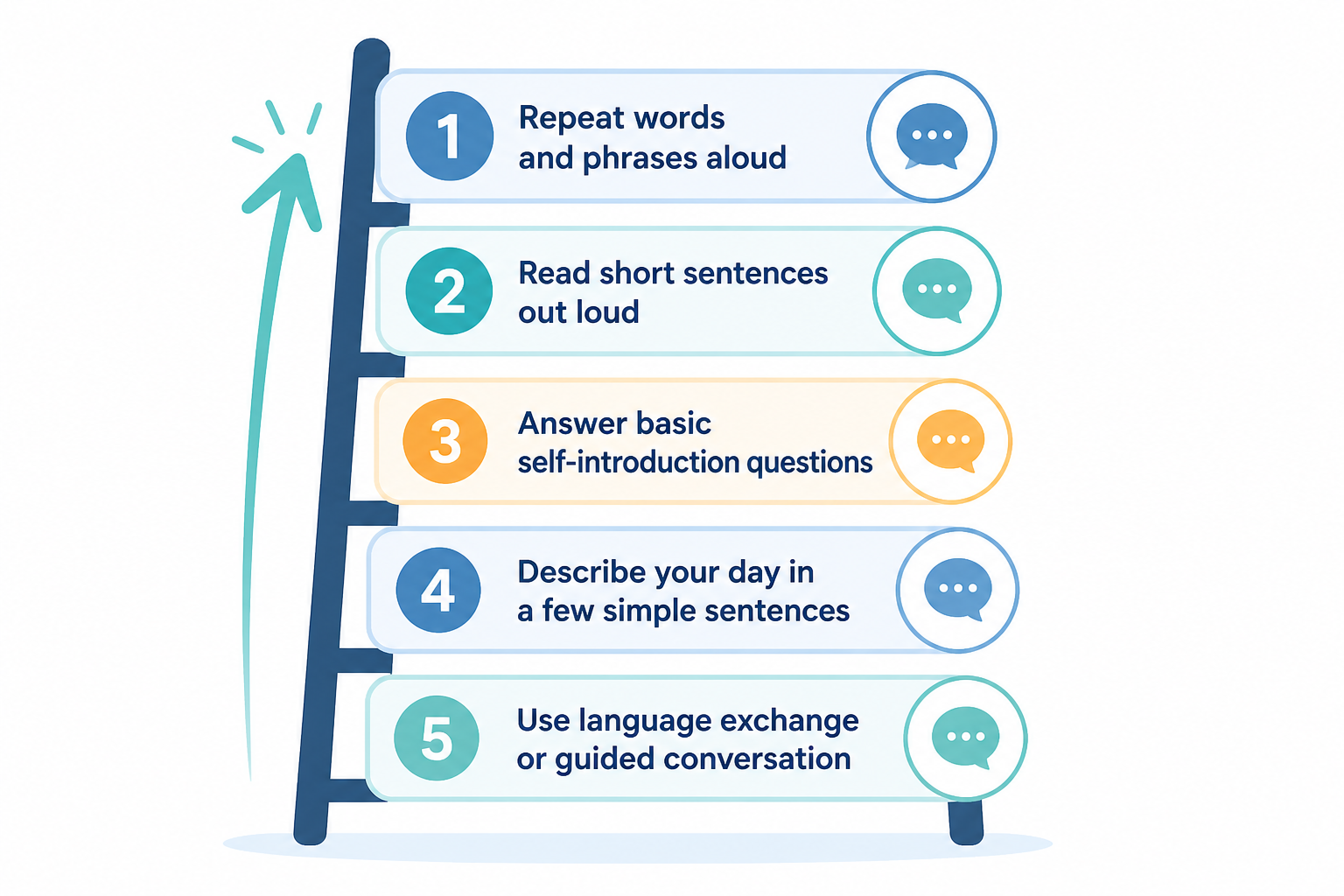
Even if your sentences are basic, speaking creates a different kind of memory than silent study. It connects knowledge to action.
What to do if you feel embarrassed
That feeling is normal. Almost everyone feels awkward at first. The fix is not to wait until the embarrassment disappears. The fix is to make the speaking task small enough that you can do it anyway.
Try this:
- prepare 5 simple sentences in advance
- practice them aloud
- record yourself once
- do a very short conversation
Small speaking reps add up faster than rare “perfect” conversations.
Step 8: Use spaced repetition, but keep it realistic
Spaced repetition is one of the best tools for learning faster because it helps information stick over time. But the method only works if you actually use it consistently.
The goal is simple: review material before you forget it completely.
How to use it well
- Review new words and phrases regularly.
- Keep the review sessions short.
- Focus on items you are likely to forget.
- Do not overload yourself with too many new cards or notes.
Fast learners usually make their review system sustainable. A giant deck that you ignore for a week is not a clever system. It is a guilt machine.
Smart review habits
| Good habit | Why it helps |
|---|---|
| Review in short daily sessions | Keeps memory active without burnout |
| Use full phrases | Helps you remember how words work together |
| Say answers aloud when possible | Improves recall and pronunciation |
| Remove low-value items | Keeps your review set focused |
Step 9: Build a daily routine you can actually repeat
Fast learning does not come from one heroic study day. It comes from repeatable habits that you can keep doing without resentment.
Your routine should fit your life, not replace it.
A strong daily routine for fast progress often includes:
- 10 to 20 minutes of vocabulary review
- 15 to 30 minutes of listening
- 10 to 20 minutes of reading or sentence practice
- 5 to 15 minutes of speaking or writing
That may not sound dramatic, but consistency beats intensity when the intensity burns out after three days.
A sample beginner routine
- Morning: review 10–15 vocabulary items
- Lunch break: listen to a short audio clip
- Evening: practice 5 sentences out loud and write 3 new ones
This is enough to make meaningful progress if you do it often.
If you need help turning this into a schedule, the guide on how to build a language study plan can help you create a weekly structure around these habits.
Step 10: Make the language personal
One of the fastest ways to improve memory is to connect the language to your real life. Your brain remembers things that matter to you better than random textbook content.
Personalize your learning by using:
- your own name, hobbies, job, and routines
- places you go often
- things you eat or buy regularly
- questions you actually want to ask
- sentences about your day
For example, if you like coffee, learn how to say:
- I like coffee.
- Where can I get coffee?
- Can I have a coffee, please?
- I drink coffee every morning.
That kind of learning sticks because it matters to you.
Personalization checklist
- Do I use this word or phrase in real life?
- Will I hear it often?
- Can I say something true about myself with it?
- Will it help me in a real situation this month?
If the answer is yes to most of these, it is probably worth learning now.
What fast learners do differently
Fast learners are not usually more gifted. They are usually more focused.
They tend to:
- spend more time on useful material
- start speaking earlier
- review consistently
- learn vocabulary in context
- avoid perfectionism
- measure progress by usefulness, not just by hours studied
They also accept a simple truth: progress is a mix of effort and smart choices. You need both.
Common myth: “More study time always means faster learning”
Not necessarily. Two hours of unfocused study can be less effective than 30 minutes of deliberate practice. Fast learning is not only about time spent. It is about what happens during that time.
Ask yourself after each session: Did I do something that improved my ability to understand or use the language?
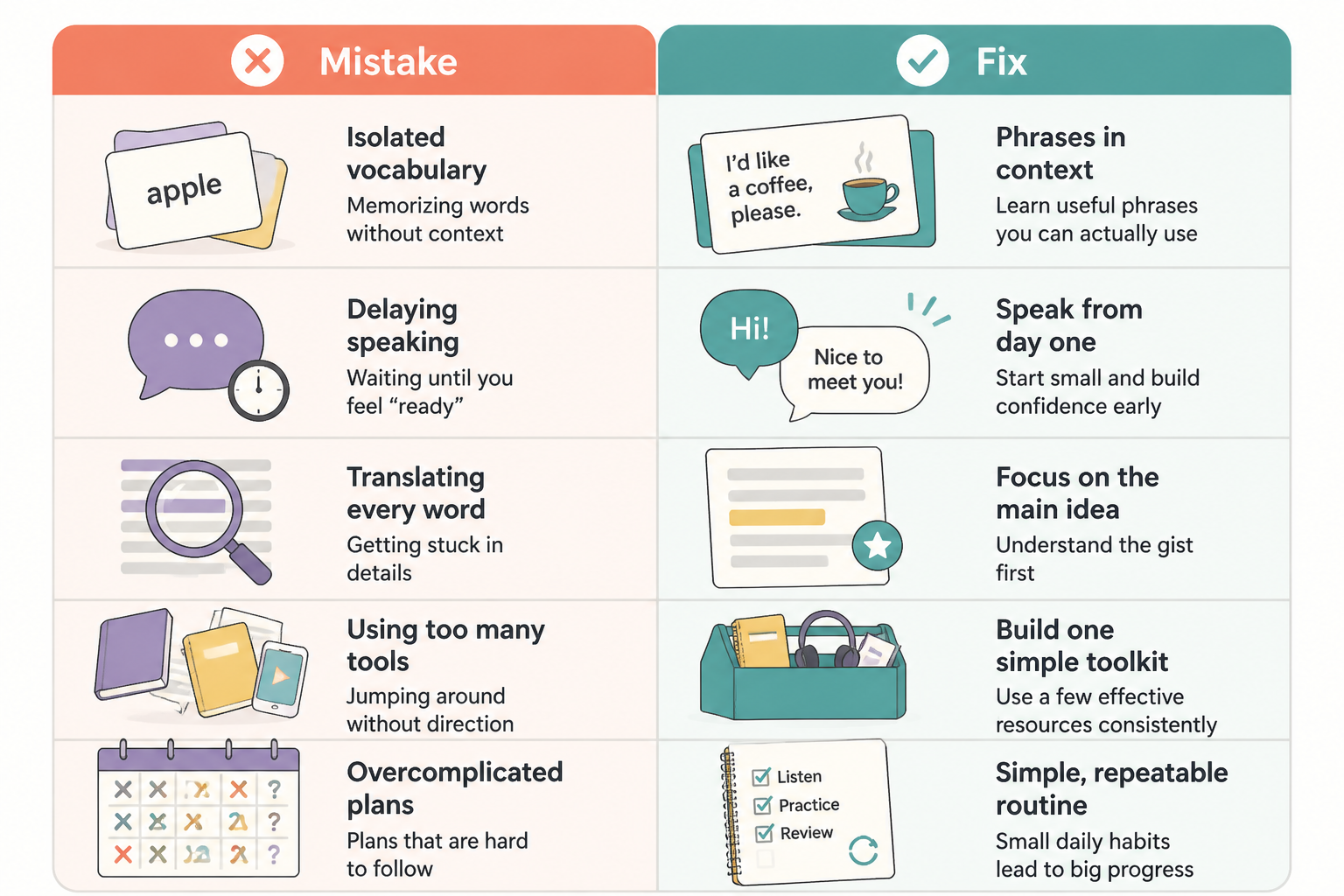
Common mistakes that slow you down
Let’s clear out the usual speed traps. Avoiding these will save you a lot of frustration.
1. Studying only grammar
Problem: You understand rules but can’t actually use the language.
Fix: Pair grammar with sentences, listening, and speaking.
2. Memorizing random words with no context
Problem: You forget words quickly or can’t use them naturally.
Fix: Learn words in phrases and personal sentences.
3. Waiting too long to speak
Problem: You build passive knowledge but freeze in real conversations.
Fix: Start with short, simple speaking practice early.
4. Trying to understand everything
Problem: You waste energy on every unknown word and lose the main message.
Fix: Focus on the general meaning first.
5. Doing too many resources at once
Problem: You bounce around and never build momentum.
Fix: Pick a small set of tools and stick with them long enough to benefit.
6. Making the plan too hard to maintain
Problem: You burn out and stop.
Fix: Create a routine you can repeat even on busy days.
How to know if you are actually improving
Fast progress is easier to maintain when you can see it. But progress is not always dramatic. Sometimes it looks like tiny wins.
Look for signs like these:
- You recognize more words in listening.
- You understand the main idea of short texts more easily.
- You can answer simple questions without translating every word.
- You recover from mistakes faster.
- You need less time to remember common phrases.
These are real signs of progress, even if you are not “fluent” yet.
Simple progress check
Once a week, ask:
- What can I do now that I could not do last week?
- What still feels hard?
- What should I focus on next?
This keeps your learning honest and efficient.
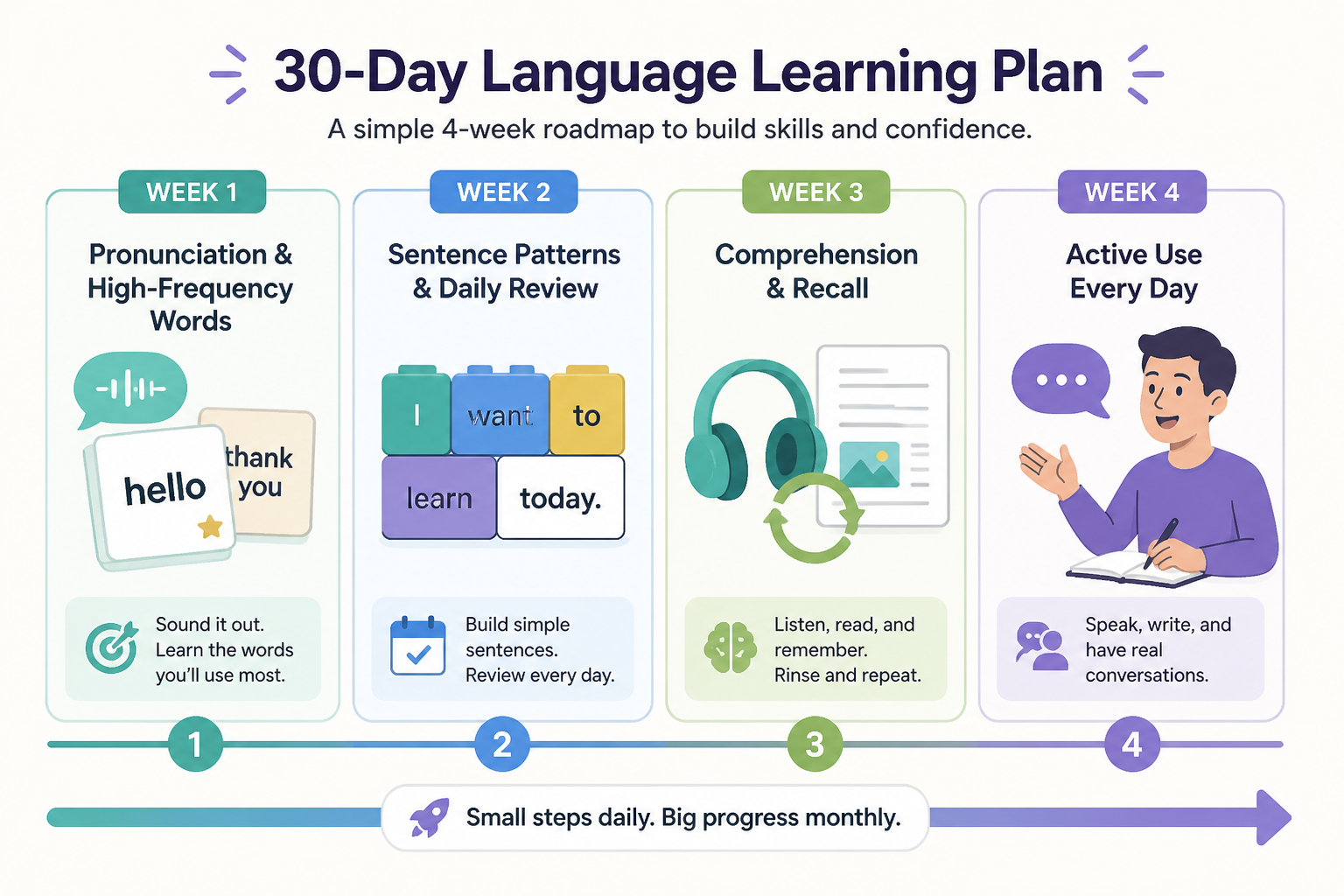
A practical 30-day fast-learning plan
If you want a concrete way to start, here is a simple one-month plan. It is designed to build momentum without overwhelming you.
Week 1: Build the base
- Learn core greetings and basic survival phrases.
- Study common verbs and question words.
- Listen to very short beginner audio every day.
- Say basic sentences out loud.
Goal: get comfortable with the sound and shape of the language.
Week 2: Add useful sentence patterns
- Learn 10 to 20 high-value sentence patterns.
- Review vocabulary daily.
- Read very short texts on familiar topics.
- Write or say a few true sentences about yourself.
Goal: start making your own simple messages.
Week 3: Increase comprehension and recall
- Repeat listening material.
- Read short content more than once.
- Practice speaking with prepared prompts.
- Review and trim weak vocabulary items.
Goal: improve recognition and reduce panic.
Week 4: Use the language more actively
- Do short guided conversations or self-talk.
- Describe your day in 5 to 8 sentences.
- Notice recurring grammar patterns.
- Refine your study system based on what worked.
Goal: make the language feel more usable and less mysterious.
How to choose what to study next
Once you’ve started, the next challenge is deciding what deserves your attention. Use this simple decision rule:
- If you need it for real-life communication soon, study it now.
- If you keep seeing it, study it now.
- If it helps you understand or say more useful things, study it now.
- If it is rare, complicated, and not useful yet, save it for later.
This keeps your learning aligned with speed.
Fast-learning decision tree
| Question | If yes | If no |
|---|---|---|
| Will I use this soon? | Learn it now | Maybe later |
| Does it appear often? | Prioritize it | Lower priority |
| Does it help me communicate? | Keep it | Skip for now |
Troubleshooting: when fast progress stalls
Sometimes you’re doing a lot, but progress feels slow. That happens. Here’s how to diagnose the problem.
Problem: “I keep forgetting everything”
Likely cause: Too much new material, not enough review, or weak context.
Fix: Reduce new items, increase review, and learn words in phrases.
Problem: “I understand lessons, but not real speech”
Likely cause: Your study input is too clean and too slow.
Fix: Add more natural listening and simple real-world texts.
Problem: “I can’t speak without translating”
Likely cause: Not enough speaking practice and not enough automatic sentence patterns.
Fix: Practice common patterns aloud until they become familiar.
Problem: “I’m busy and can’t stay consistent”
Likely cause: Your routine is too large.
Fix: Shrink it until you can do it on bad days, not just good ones.
Problem: “I’m bored”
Likely cause: The material is too repetitive or too disconnected from your life.
Fix: Use topics you care about and mix up input with speaking and reading.
A simple fast-learning checklist
Use this as a quick reality check when you plan your study week.
- Have I chosen a clear goal?
- Am I studying useful vocabulary first?
- Am I learning sentence patterns, not just rules?
- Am I listening every day, even a little?
- Am I reading material I can mostly understand?
- Am I speaking before I feel “ready”?
- Am I reviewing what I learn?
- Is my plan realistic enough to repeat?
If you can say yes to most of these, you are probably on the faster path.
The big takeaway
To learn a language fast, you do not need to do everything. You need to do the right things in a focused, repeatable way.
Here is the short version:
- Set a clear goal.
- Learn high-value vocabulary and sentence patterns.
- Listen and read early.
- Speak in small ways from the beginning.
- Review consistently.
- Keep your routine realistic.
Fast progress comes from momentum. Momentum comes from a system you can stick with. And the best system is usually simpler than people expect.
If you want to keep building from here, the most useful next steps are a stronger overall framework in the best way to learn a language, a more focused review of how to learn vocabulary fast, and a weekly structure from how to build a language study plan.