

Realistic yak teacher pointing to pattern notes under “How to Learn Grammar Efficiently”.

How To Learn Grammar Efficiently

Five-step grammar study session checklist with time blocks

Table of Contents

Use comprehensible input to make grammar easier

Grammar rules become much easier when they sit inside language you can actually understand. That is one reason comprehensible input is so powerful: it gives you repeated, meaningful exposure to grammar in context.

If input is too hard, grammar looks like noise. If input is too easy, you may not notice the pattern. The sweet spot is language you can mostly follow, with just enough new material to stretch you.

That is why grammar study and input should work together. Study gives you a lens. Input gives you evidence. Together, they make the pattern clearer and easier to remember. If you want a fuller explanation of this approach, see comprehensible input explained.

Grammar and reading: why they work so well together

Reading is one of the best places to reinforce grammar because you can slow down, reread, and notice how structures are used in real sentences. You are not trying to produce the grammar yet. You are learning to recognize it accurately and repeatedly.

Here is a simple reading workflow for grammar practice:

  • Read a short passage that is mostly understandable.
  • Highlight or note one grammar point you already studied.
  • Look at three to five examples of that grammar point.
  • Ask what changes in meaning when the grammar changes.
  • Try to reuse the same structure in a new sentence of your own.

Reading this way is not about studying every word. It is about using text to reinforce the patterns you are building. That is efficient because it combines comprehension, review, and exposure in one activity.

Grammar and writing: why output helps more than passive review

Writing is where grammar becomes visible. In your head, a sentence may feel right. On the page, mistakes become much easier to spot. That makes writing a powerful feedback tool.

Writing helps grammar in three ways:

  • It forces you to choose forms instead of recognizing them passively.
  • It exposes weak spots where you are guessing rather than knowing.
  • It gives you something concrete to review and improve later.

A useful method is to write a short paragraph using one target structure several times. Keep the topic simple. The goal is not literary brilliance. The goal is repeated, accurate use.

If you want more structured output practice, use the linked guide on practicing writing in a foreign language alongside your grammar work.

A comparison of grammar study methods

Not all grammar practice is equal. Some methods are good for noticing, some for accuracy, and some for fluency. The smart move is to use them for the job they do best.

MethodBest forWeaknessBest use
Rule memorizationQuick referenceEasy to forget, often passiveShort-term clarification
Drills and exercisesAccuracyCan feel artificialEarly practice and review
Reading with attentionNoticing and reinforcementLess practice in productionSeeing grammar in context
WritingRecall and self-editingSlower, requires correctionApplying grammar deliberately
SpeakingSpeed and automatic useHarder to self-correctBuilding fluency after basic practice

The takeaway is simple: no single method does everything. Efficient grammar learning uses a combination of methods in a sequence that matches your goal.

Common grammar mistakes that slow learners down

Most grammar struggles are not caused by laziness. They are caused by bad workflow. Here are the biggest time-wasters.

1. Studying grammar without context

Rules are easier to forget when you never see them in real use. A grammar point should always be tied to examples, sentences, or text.

2. Trying to learn too many rules at once

If your notes look like a legal document, your study load is probably too big. Limit yourself to one main grammar focus at a time.

3. Doing exercises but never using the grammar

Recognition is not the same as production. You need some output, even if it is short and imperfect.

4. Obsessing over exceptions too early

Exceptions matter, but they should not crowd out the main pattern. Learn the common rule first, then add exceptions when they become relevant.

5. Correcting every mistake immediately

Not every error needs a full investigation. Some mistakes are one-off slips. Others are pattern problems. Focus your energy on the mistakes that repeat.

How to fix repeated grammar mistakes

If you keep making the same mistake, treat it like a signal. It means the pattern is not solid yet. The fix is not more random practice. The fix is targeted repetition.

Use this troubleshooting loop:

  • Find the exact error. What is wrong, specifically?
  • Identify the pattern. Is it a form, a word order issue, or a meaning problem?
  • Compare correct examples. Look at several good sentences side by side.
  • Make your own versions. Write or say three to five new examples.
  • Review again later. Return after a break to see if it sticks.

If you want to be even more effective, keep a “mistake notebook” with just a few high-value corrections. Do not collect every tiny error like rare stamps. Focus on the ones that show up often.

Flowchart showing how to fix a grammar mistake and turn it into mastery

How to make grammar stick faster

Memory improves when grammar is attached to meaning, use, and retrieval. Here are the habits that make that happen.

  • Use examples, not just rules. Examples are easier to remember than abstract explanations.
  • Say the sentence aloud. Speaking helps lock in rhythm and form.
  • Write your own examples. Personal sentences stick better than textbook ones.
  • Return to the same pattern later. Spaced review beats one long session.
  • Notice the grammar in input. Recognition supports recall.

A very strong technique is to build mini sets of example sentences around one grammar point. Put them in a simple note, read them a few times, then try to create new versions. This makes the pattern feel less like a rule and more like a habit.

A practical weekly grammar plan

If you want to learn grammar efficiently, you need a rhythm you can actually repeat. Here is a simple weekly structure that works for many learners.

DayFocusTask
Day 1Notice and understandStudy one new grammar point with examples
Day 2Controlled practiceDo exercises and make 3–5 original sentences
Day 3InputRead or listen for the same grammar in context
Day 4OutputWrite a short paragraph or speak for 1–2 minutes
Day 5ReviewRevisit mistakes and examples
Day 6Mixed useUse the grammar while reading or writing freely
Day 7Rest or light reviewQuick look back at notes, no heavy study

This kind of plan is efficient because it spaces the learning out instead of cramming everything into one session. It also keeps grammar connected to real language use, which is where it becomes useful.

What to do when a grammar rule still feels confusing

Some grammar points are genuinely hard. That does not mean you are bad at languages. It often means the explanation you found is too abstract, too advanced, or too early for your current level.

When a grammar point feels confusing, try this:

  • Find a simpler explanation.
  • Look at more examples, not more theory.
  • Compare correct and incorrect sentences.
  • Ask what meaning changes, not just what form changes.
  • Use the structure in a tiny, controlled way before trying to speak freely with it.

If you still do not fully “get it,” that is okay. Some grammar becomes clearer after more exposure. You do not need perfect understanding before you start using it. Often, the act of using it helps the understanding grow.

How to study grammar without losing motivation

Grammar can feel draining if it is all rules and no payoff. Motivation improves when you can see progress.

To keep momentum:

  • Study one useful grammar point at a time.
  • Keep your sessions short and focused.
  • Track patterns you now recognize in reading or listening.
  • Celebrate when you use a structure correctly in writing or speech.
  • Mix grammar study with actual language use so it does not feel endless.

Progress in grammar is often quiet. You may not notice it day to day, but one week later you suddenly realize that a structure you used to avoid is now showing up naturally. That is a real win.

A simple self-check for efficient grammar learning

If you want to know whether your grammar study is actually efficient, ask yourself these questions:

  • Do I understand why this grammar is used?
  • Can I recognize it in real sentences?
  • Can I produce it in a controlled exercise?
  • Can I use it in my own speaking or writing?
  • Have I reviewed it after some time passed?

If the answer is “yes” to most of these, you are on the right track. If not, adjust your method instead of just studying more hours.

A minimal grammar toolkit that actually works

You do not need a huge stack of resources to learn grammar well. A simple toolkit is often better because it is easier to use consistently.

  • a grammar reference or course you trust
  • a notebook or digital note for example sentences
  • a short review system for repeated mistakes
  • reading material that is mostly understandable
  • a writing habit, even if it is only a few sentences at a time

That combination is enough for most learners to build strong grammar skills without turning study into a full-time project.

Bringing it all together

If you want to learn grammar efficiently, the key is not more intensity. It is better sequence. Notice the pattern, understand it in plain language, practice it in a controlled way, apply it in real use, and review it over time. That is the smart path.

Grammar gets easier when it stops being isolated. Put it next to reading, writing, speaking, and input. Use examples instead of endless theory. Focus on high-value patterns first. And when you make mistakes, treat them as useful data, not proof that grammar is impossible.

If you keep your study small, consistent, and connected to real language, grammar will start feeling less like a hurdle and more like a tool you can actually use. Which, honestly, is what it should have been all along.

For a broader foundation in language learning, you can also return to the main guide at how to learn a language, and keep building from there.

A ladder showing grammar practice moving from guided drills to free use

Step 4: Apply grammar in real communication

This is where grammar starts paying rent.

If you only do exercises, you may recognize the grammar but fail to use it naturally. Application means using the structure in reading, writing, speaking, or listening tasks that matter to you.

Good application tasks include:

  • writing a short paragraph using the target structure
  • making a voice note and trying to use the grammar three times
  • reading for the structure in authentic text
  • spotting the same grammar point in a conversation or article
  • editing your own sentences for accuracy

If you want to build reading skill alongside grammar, that is a strong move. Reading gives you repeated exposure to grammar in context, which helps the pattern become familiar. For more on that, you can also use how to practice reading in a new language as a companion approach.

Writing is especially helpful because it forces you to slow down and make choices. If you want a structured way to use grammar in output, the guide on how to practice writing in a foreign language pairs very well with grammar study.

Step 5: Review over time, not all at once

Grammar sticks when you revisit it after some time has passed. A single lesson rarely creates long-term memory. Repeated exposure does.

Review works best when it is spaced out. You might revisit a grammar point:

  • later the same day
  • the next day
  • after a few days
  • after one week
  • later in a reading, listening, or writing session

You do not need a complicated system. A simple notebook, flashcards, or a running list of example sentences is enough if you actually use it.

How to choose which grammar to study first

One of the fastest ways to waste time is to study grammar in a random order. Efficient learners choose grammar based on usefulness, frequency, and personal need.

Start with grammar that helps you say or understand the things you actually need most. That usually means:

  • basic sentence structure
  • questions and negation
  • common verb forms
  • time and sequence markers
  • high-frequency function words and patterns
  • structures that appear constantly in your reading or listening

If you are using a textbook or course, do not feel obligated to complete every chapter in order if some topics are much more useful to your current goals. You can prioritize grammar that helps you communicate now.

A simple decision rule:

  • Need it now? Study it first.
  • See it often? Study it next.
  • Rare and specialized? Leave it for later.

What a good grammar study session looks like

Grammar study becomes more efficient when each session has a clear purpose. A random “I’ll just review grammar” session often becomes unfocused and forgettable.

Here is a practical structure you can use:

  • 5 minutes: review an old pattern or example set
  • 10 minutes: study one new grammar point
  • 10 minutes: do focused practice
  • 5 minutes: make your own examples
  • 2 minutes: plan where you will see or use it next

This may look short, but it is much more effective than staring at a page for an hour while your brain slowly escapes through a window.

Five-step grammar study session checklist with time blocks

Use comprehensible input to make grammar easier

Grammar rules become much easier when they sit inside language you can actually understand. That is one reason comprehensible input is so powerful: it gives you repeated, meaningful exposure to grammar in context.

If input is too hard, grammar looks like noise. If input is too easy, you may not notice the pattern. The sweet spot is language you can mostly follow, with just enough new material to stretch you.

That is why grammar study and input should work together. Study gives you a lens. Input gives you evidence. Together, they make the pattern clearer and easier to remember. If you want a fuller explanation of this approach, see comprehensible input explained.

Grammar and reading: why they work so well together

Reading is one of the best places to reinforce grammar because you can slow down, reread, and notice how structures are used in real sentences. You are not trying to produce the grammar yet. You are learning to recognize it accurately and repeatedly.

Here is a simple reading workflow for grammar practice:

  • Read a short passage that is mostly understandable.
  • Highlight or note one grammar point you already studied.
  • Look at three to five examples of that grammar point.
  • Ask what changes in meaning when the grammar changes.
  • Try to reuse the same structure in a new sentence of your own.

Reading this way is not about studying every word. It is about using text to reinforce the patterns you are building. That is efficient because it combines comprehension, review, and exposure in one activity.

Grammar and writing: why output helps more than passive review

Writing is where grammar becomes visible. In your head, a sentence may feel right. On the page, mistakes become much easier to spot. That makes writing a powerful feedback tool.

Writing helps grammar in three ways:

  • It forces you to choose forms instead of recognizing them passively.
  • It exposes weak spots where you are guessing rather than knowing.
  • It gives you something concrete to review and improve later.

A useful method is to write a short paragraph using one target structure several times. Keep the topic simple. The goal is not literary brilliance. The goal is repeated, accurate use.

If you want more structured output practice, use the linked guide on practicing writing in a foreign language alongside your grammar work.

A comparison of grammar study methods

Not all grammar practice is equal. Some methods are good for noticing, some for accuracy, and some for fluency. The smart move is to use them for the job they do best.

MethodBest forWeaknessBest use
Rule memorizationQuick referenceEasy to forget, often passiveShort-term clarification
Drills and exercisesAccuracyCan feel artificialEarly practice and review
Reading with attentionNoticing and reinforcementLess practice in productionSeeing grammar in context
WritingRecall and self-editingSlower, requires correctionApplying grammar deliberately
SpeakingSpeed and automatic useHarder to self-correctBuilding fluency after basic practice

The takeaway is simple: no single method does everything. Efficient grammar learning uses a combination of methods in a sequence that matches your goal.

Common grammar mistakes that slow learners down

Most grammar struggles are not caused by laziness. They are caused by bad workflow. Here are the biggest time-wasters.

1. Studying grammar without context

Rules are easier to forget when you never see them in real use. A grammar point should always be tied to examples, sentences, or text.

2. Trying to learn too many rules at once

If your notes look like a legal document, your study load is probably too big. Limit yourself to one main grammar focus at a time.

3. Doing exercises but never using the grammar

Recognition is not the same as production. You need some output, even if it is short and imperfect.

4. Obsessing over exceptions too early

Exceptions matter, but they should not crowd out the main pattern. Learn the common rule first, then add exceptions when they become relevant.

5. Correcting every mistake immediately

Not every error needs a full investigation. Some mistakes are one-off slips. Others are pattern problems. Focus your energy on the mistakes that repeat.

How to fix repeated grammar mistakes

If you keep making the same mistake, treat it like a signal. It means the pattern is not solid yet. The fix is not more random practice. The fix is targeted repetition.

Use this troubleshooting loop:

  • Find the exact error. What is wrong, specifically?
  • Identify the pattern. Is it a form, a word order issue, or a meaning problem?
  • Compare correct examples. Look at several good sentences side by side.
  • Make your own versions. Write or say three to five new examples.
  • Review again later. Return after a break to see if it sticks.

If you want to be even more effective, keep a “mistake notebook” with just a few high-value corrections. Do not collect every tiny error like rare stamps. Focus on the ones that show up often.

Flowchart showing how to fix a grammar mistake and turn it into mastery

How to make grammar stick faster

Memory improves when grammar is attached to meaning, use, and retrieval. Here are the habits that make that happen.

  • Use examples, not just rules. Examples are easier to remember than abstract explanations.
  • Say the sentence aloud. Speaking helps lock in rhythm and form.
  • Write your own examples. Personal sentences stick better than textbook ones.
  • Return to the same pattern later. Spaced review beats one long session.
  • Notice the grammar in input. Recognition supports recall.

A very strong technique is to build mini sets of example sentences around one grammar point. Put them in a simple note, read them a few times, then try to create new versions. This makes the pattern feel less like a rule and more like a habit.

A practical weekly grammar plan

If you want to learn grammar efficiently, you need a rhythm you can actually repeat. Here is a simple weekly structure that works for many learners.

DayFocusTask
Day 1Notice and understandStudy one new grammar point with examples
Day 2Controlled practiceDo exercises and make 3–5 original sentences
Day 3InputRead or listen for the same grammar in context
Day 4OutputWrite a short paragraph or speak for 1–2 minutes
Day 5ReviewRevisit mistakes and examples
Day 6Mixed useUse the grammar while reading or writing freely
Day 7Rest or light reviewQuick look back at notes, no heavy study

This kind of plan is efficient because it spaces the learning out instead of cramming everything into one session. It also keeps grammar connected to real language use, which is where it becomes useful.

What to do when a grammar rule still feels confusing

Some grammar points are genuinely hard. That does not mean you are bad at languages. It often means the explanation you found is too abstract, too advanced, or too early for your current level.

When a grammar point feels confusing, try this:

  • Find a simpler explanation.
  • Look at more examples, not more theory.
  • Compare correct and incorrect sentences.
  • Ask what meaning changes, not just what form changes.
  • Use the structure in a tiny, controlled way before trying to speak freely with it.

If you still do not fully “get it,” that is okay. Some grammar becomes clearer after more exposure. You do not need perfect understanding before you start using it. Often, the act of using it helps the understanding grow.

How to study grammar without losing motivation

Grammar can feel draining if it is all rules and no payoff. Motivation improves when you can see progress.

To keep momentum:

  • Study one useful grammar point at a time.
  • Keep your sessions short and focused.
  • Track patterns you now recognize in reading or listening.
  • Celebrate when you use a structure correctly in writing or speech.
  • Mix grammar study with actual language use so it does not feel endless.

Progress in grammar is often quiet. You may not notice it day to day, but one week later you suddenly realize that a structure you used to avoid is now showing up naturally. That is a real win.

A simple self-check for efficient grammar learning

If you want to know whether your grammar study is actually efficient, ask yourself these questions:

  • Do I understand why this grammar is used?
  • Can I recognize it in real sentences?
  • Can I produce it in a controlled exercise?
  • Can I use it in my own speaking or writing?
  • Have I reviewed it after some time passed?

If the answer is “yes” to most of these, you are on the right track. If not, adjust your method instead of just studying more hours.

A minimal grammar toolkit that actually works

You do not need a huge stack of resources to learn grammar well. A simple toolkit is often better because it is easier to use consistently.

  • a grammar reference or course you trust
  • a notebook or digital note for example sentences
  • a short review system for repeated mistakes
  • reading material that is mostly understandable
  • a writing habit, even if it is only a few sentences at a time

That combination is enough for most learners to build strong grammar skills without turning study into a full-time project.

Bringing it all together

If you want to learn grammar efficiently, the key is not more intensity. It is better sequence. Notice the pattern, understand it in plain language, practice it in a controlled way, apply it in real use, and review it over time. That is the smart path.

Grammar gets easier when it stops being isolated. Put it next to reading, writing, speaking, and input. Use examples instead of endless theory. Focus on high-value patterns first. And when you make mistakes, treat them as useful data, not proof that grammar is impossible.

If you keep your study small, consistent, and connected to real language, grammar will start feeling less like a hurdle and more like a tool you can actually use. Which, honestly, is what it should have been all along.

For a broader foundation in language learning, you can also return to the main guide at how to learn a language, and keep building from there.

Efficient grammar learning fixes those problems by making study time more active and more connected to real reading, writing, listening, and speaking. Grammar starts to feel less like a school subject and more like a tool you use to do things.

The smart way to learn grammar in 5 steps
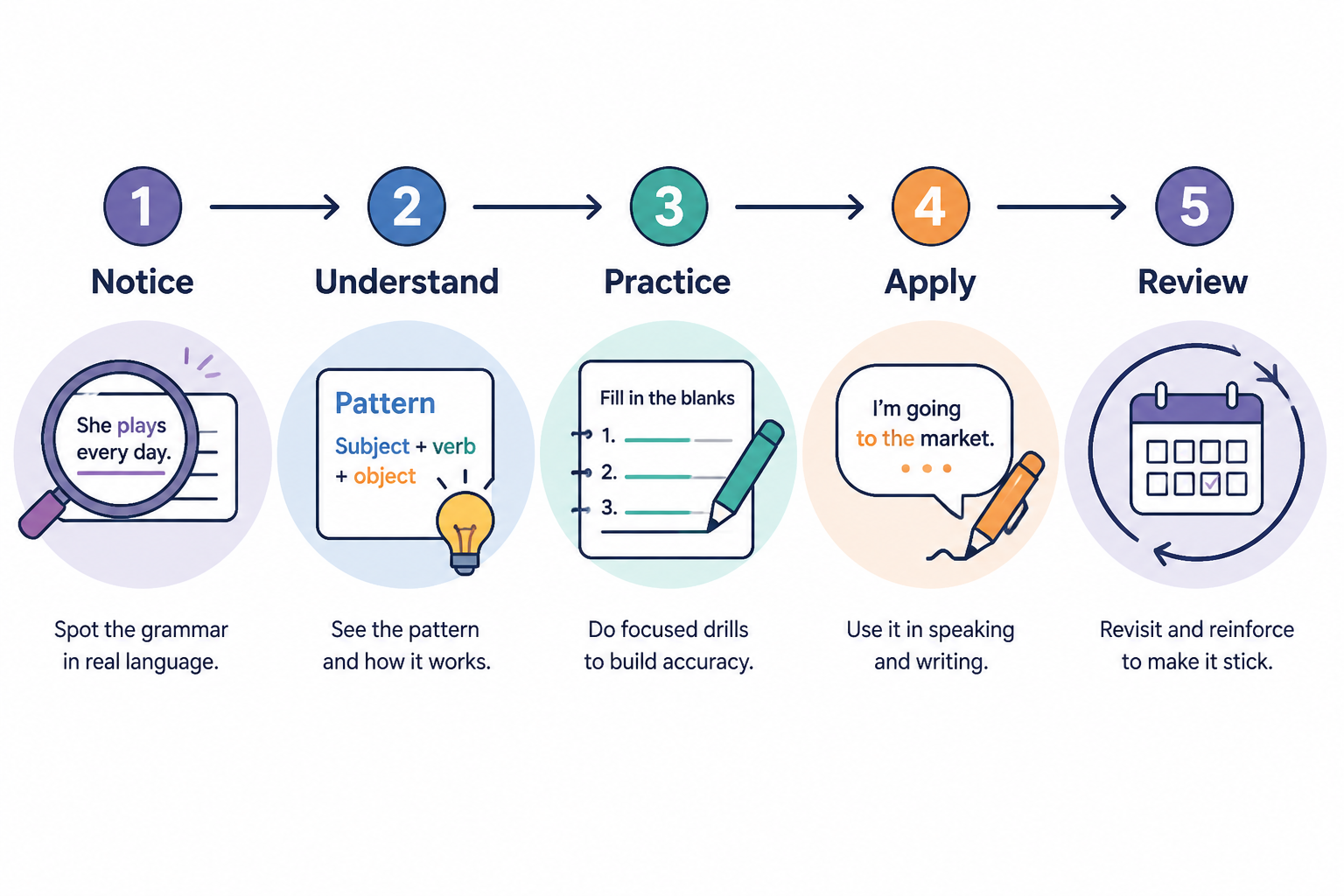
The most efficient grammar process is simple enough to remember and flexible enough to use with almost any language.

Five-step grammar learning flow from noticing to review

StepWhat you doWhy it works
1. NoticeSpot a grammar pattern in real languageConnects grammar to meaning and context
2. UnderstandLearn what the pattern doesHelps the rule make sense
3. PracticeUse the pattern in controlled exercisesBuilds confidence and accuracy
4. ApplyUse it in reading, writing, or speakingMoves grammar into real communication
5. ReviewReturn to it over timeMakes it stick in memory

This is the core of how to learn grammar efficiently. The goal is not to “cover” grammar. The goal is to get grammar into use.

Step 1: Notice grammar in real language

Grammar becomes easier when you stop treating it as a list of rules and start noticing it in context. This is where reading and listening help a lot. When you see a structure used by real speakers and writers, it stops being abstract.

For example, if you keep seeing a pattern in sentences, ask:

  • What changes in the sentence?
  • What stays the same?
  • What meaning does this structure add?
  • Do I see this pattern in lots of different sentences?

You do not need to analyze every sentence like a detective with a lamp. Just look for repeated patterns. Repetition is your clue that a grammar point matters.

A very efficient habit is to collect a few example sentences when you notice a structure. Then compare them side by side. The pattern usually reveals itself faster than reading a rule first.

Step 2: Understand the grammar point in plain language

After noticing a pattern, learn what it does in simple terms. Avoid drowning in terminology unless it actually helps. If a term is useful, learn it. If it is just a label, keep moving.

When studying a grammar point, focus on these questions:

  • What idea does this structure express?
  • When is it used?
  • When is it not used?
  • What is the form?
  • What are the most common mistakes?

A good grammar explanation should make the structure feel smaller, not bigger. If a rule creates more confusion than clarity, simplify it. You usually need the core pattern first, not the entire exception list.

Good grammar study is not about collecting every rule. It is about understanding the few things you need to use most often, well enough to use them correctly under pressure.

Step 3: Practice grammar with controlled exercises
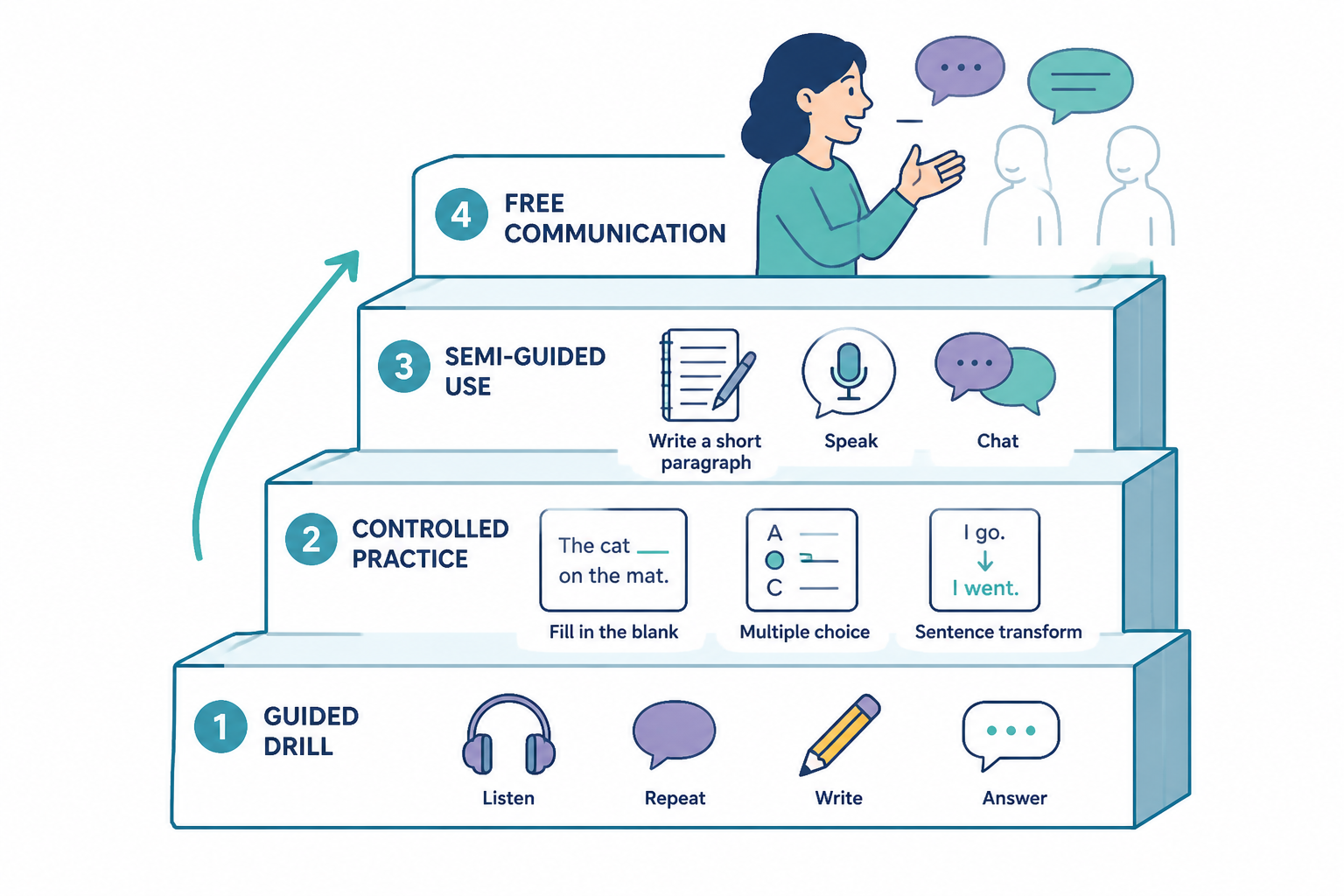
Once you understand a structure, practice it in a way that is focused and manageable. Controlled practice means the task limits the number of moving parts, so you can concentrate on the grammar itself.

Examples of controlled practice include:

  • filling in missing words
  • choosing between two or three forms
  • rewriting simple sentences
  • transforming statements into questions or negatives
  • matching sentences to meanings

This kind of practice is useful because it helps your brain build the pattern before you have to produce it freely. But controlled practice should not be the final step. It is the bridge, not the destination.

A ladder showing grammar practice moving from guided drills to free use

Step 4: Apply grammar in real communication

This is where grammar starts paying rent.

If you only do exercises, you may recognize the grammar but fail to use it naturally. Application means using the structure in reading, writing, speaking, or listening tasks that matter to you.

Good application tasks include:

  • writing a short paragraph using the target structure
  • making a voice note and trying to use the grammar three times
  • reading for the structure in authentic text
  • spotting the same grammar point in a conversation or article
  • editing your own sentences for accuracy

If you want to build reading skill alongside grammar, that is a strong move. Reading gives you repeated exposure to grammar in context, which helps the pattern become familiar. For more on that, you can also use how to practice reading in a new language as a companion approach.

Writing is especially helpful because it forces you to slow down and make choices. If you want a structured way to use grammar in output, the guide on how to practice writing in a foreign language pairs very well with grammar study.

Step 5: Review over time, not all at once

Grammar sticks when you revisit it after some time has passed. A single lesson rarely creates long-term memory. Repeated exposure does.

Review works best when it is spaced out. You might revisit a grammar point:

  • later the same day
  • the next day
  • after a few days
  • after one week
  • later in a reading, listening, or writing session

You do not need a complicated system. A simple notebook, flashcards, or a running list of example sentences is enough if you actually use it.

How to choose which grammar to study first

One of the fastest ways to waste time is to study grammar in a random order. Efficient learners choose grammar based on usefulness, frequency, and personal need.

Start with grammar that helps you say or understand the things you actually need most. That usually means:

  • basic sentence structure
  • questions and negation
  • common verb forms
  • time and sequence markers
  • high-frequency function words and patterns
  • structures that appear constantly in your reading or listening

If you are using a textbook or course, do not feel obligated to complete every chapter in order if some topics are much more useful to your current goals. You can prioritize grammar that helps you communicate now.

A simple decision rule:

  • Need it now? Study it first.
  • See it often? Study it next.
  • Rare and specialized? Leave it for later.

What a good grammar study session looks like
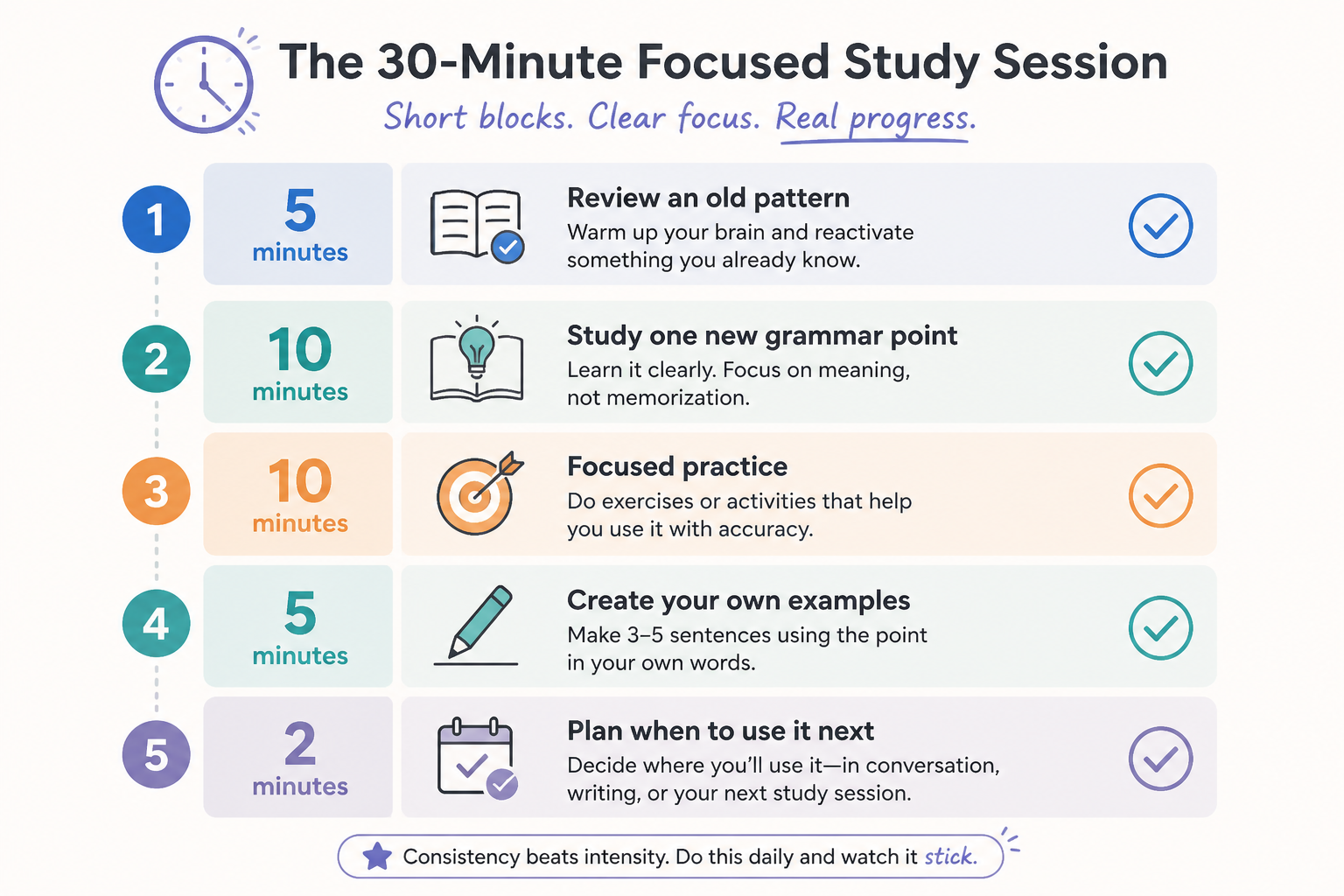
Grammar study becomes more efficient when each session has a clear purpose. A random “I’ll just review grammar” session often becomes unfocused and forgettable.

Here is a practical structure you can use:

  • 5 minutes: review an old pattern or example set
  • 10 minutes: study one new grammar point
  • 10 minutes: do focused practice
  • 5 minutes: make your own examples
  • 2 minutes: plan where you will see or use it next

This may look short, but it is much more effective than staring at a page for an hour while your brain slowly escapes through a window.

Five-step grammar study session checklist with time blocks

Use comprehensible input to make grammar easier

Grammar rules become much easier when they sit inside language you can actually understand. That is one reason comprehensible input is so powerful: it gives you repeated, meaningful exposure to grammar in context.

If input is too hard, grammar looks like noise. If input is too easy, you may not notice the pattern. The sweet spot is language you can mostly follow, with just enough new material to stretch you.

That is why grammar study and input should work together. Study gives you a lens. Input gives you evidence. Together, they make the pattern clearer and easier to remember. If you want a fuller explanation of this approach, see comprehensible input explained.

Grammar and reading: why they work so well together

Reading is one of the best places to reinforce grammar because you can slow down, reread, and notice how structures are used in real sentences. You are not trying to produce the grammar yet. You are learning to recognize it accurately and repeatedly.

Here is a simple reading workflow for grammar practice:

  • Read a short passage that is mostly understandable.
  • Highlight or note one grammar point you already studied.
  • Look at three to five examples of that grammar point.
  • Ask what changes in meaning when the grammar changes.
  • Try to reuse the same structure in a new sentence of your own.

Reading this way is not about studying every word. It is about using text to reinforce the patterns you are building. That is efficient because it combines comprehension, review, and exposure in one activity.

Grammar and writing: why output helps more than passive review

Writing is where grammar becomes visible. In your head, a sentence may feel right. On the page, mistakes become much easier to spot. That makes writing a powerful feedback tool.

Writing helps grammar in three ways:

  • It forces you to choose forms instead of recognizing them passively.
  • It exposes weak spots where you are guessing rather than knowing.
  • It gives you something concrete to review and improve later.

A useful method is to write a short paragraph using one target structure several times. Keep the topic simple. The goal is not literary brilliance. The goal is repeated, accurate use.

If you want more structured output practice, use the linked guide on practicing writing in a foreign language alongside your grammar work.

A comparison of grammar study methods

Not all grammar practice is equal. Some methods are good for noticing, some for accuracy, and some for fluency. The smart move is to use them for the job they do best.

MethodBest forWeaknessBest use
Rule memorizationQuick referenceEasy to forget, often passiveShort-term clarification
Drills and exercisesAccuracyCan feel artificialEarly practice and review
Reading with attentionNoticing and reinforcementLess practice in productionSeeing grammar in context
WritingRecall and self-editingSlower, requires correctionApplying grammar deliberately
SpeakingSpeed and automatic useHarder to self-correctBuilding fluency after basic practice

The takeaway is simple: no single method does everything. Efficient grammar learning uses a combination of methods in a sequence that matches your goal.

Common grammar mistakes that slow learners down

Most grammar struggles are not caused by laziness. They are caused by bad workflow. Here are the biggest time-wasters.

1. Studying grammar without context

Rules are easier to forget when you never see them in real use. A grammar point should always be tied to examples, sentences, or text.

2. Trying to learn too many rules at once

If your notes look like a legal document, your study load is probably too big. Limit yourself to one main grammar focus at a time.

3. Doing exercises but never using the grammar

Recognition is not the same as production. You need some output, even if it is short and imperfect.

4. Obsessing over exceptions too early

Exceptions matter, but they should not crowd out the main pattern. Learn the common rule first, then add exceptions when they become relevant.

5. Correcting every mistake immediately

Not every error needs a full investigation. Some mistakes are one-off slips. Others are pattern problems. Focus your energy on the mistakes that repeat.

How to fix repeated grammar mistakes
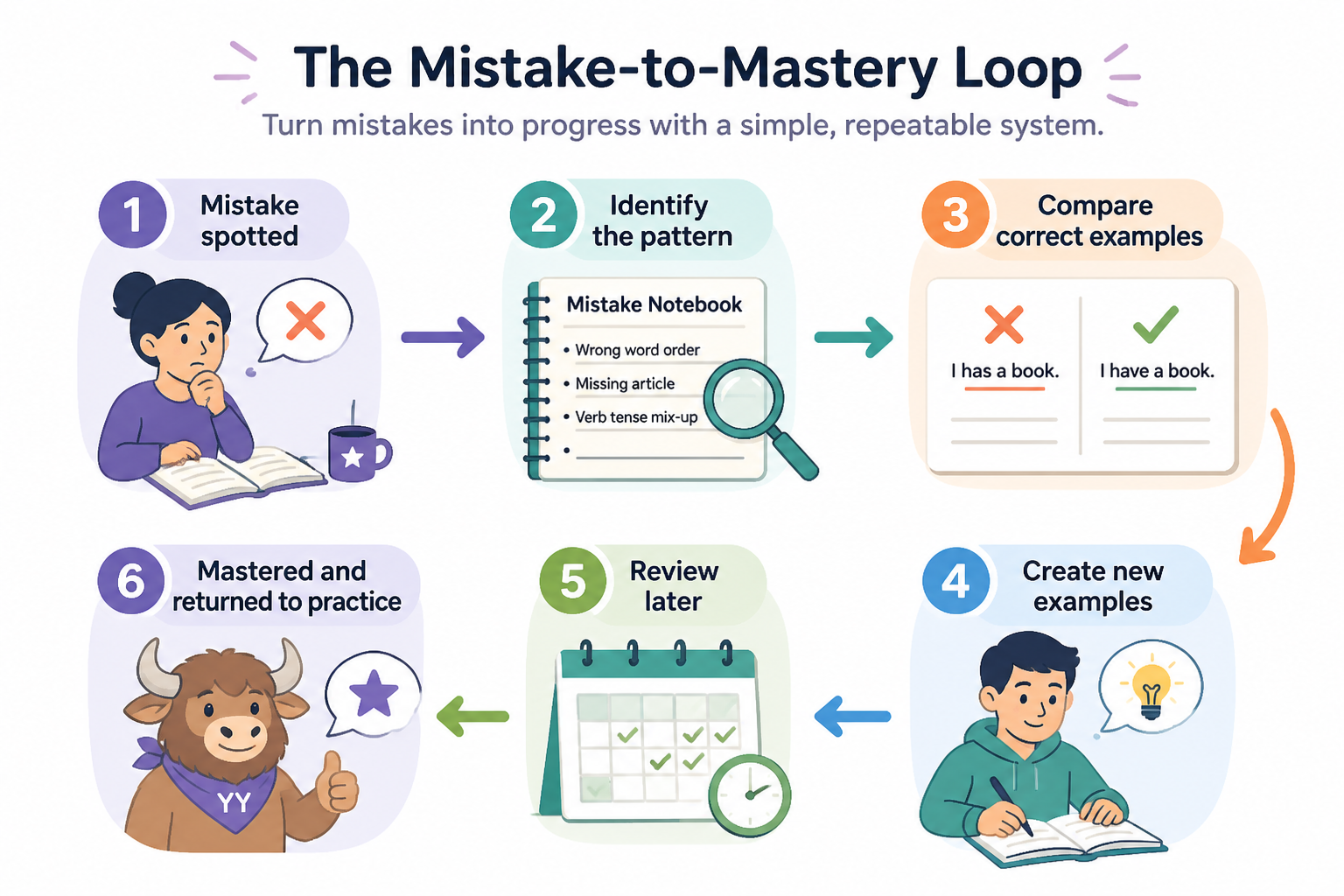
If you keep making the same mistake, treat it like a signal. It means the pattern is not solid yet. The fix is not more random practice. The fix is targeted repetition.

Use this troubleshooting loop:

  • Find the exact error. What is wrong, specifically?
  • Identify the pattern. Is it a form, a word order issue, or a meaning problem?
  • Compare correct examples. Look at several good sentences side by side.
  • Make your own versions. Write or say three to five new examples.
  • Review again later. Return after a break to see if it sticks.

If you want to be even more effective, keep a “mistake notebook” with just a few high-value corrections. Do not collect every tiny error like rare stamps. Focus on the ones that show up often.

Flowchart showing how to fix a grammar mistake and turn it into mastery

How to make grammar stick faster

Memory improves when grammar is attached to meaning, use, and retrieval. Here are the habits that make that happen.

  • Use examples, not just rules. Examples are easier to remember than abstract explanations.
  • Say the sentence aloud. Speaking helps lock in rhythm and form.
  • Write your own examples. Personal sentences stick better than textbook ones.
  • Return to the same pattern later. Spaced review beats one long session.
  • Notice the grammar in input. Recognition supports recall.

A very strong technique is to build mini sets of example sentences around one grammar point. Put them in a simple note, read them a few times, then try to create new versions. This makes the pattern feel less like a rule and more like a habit.

A practical weekly grammar plan

If you want to learn grammar efficiently, you need a rhythm you can actually repeat. Here is a simple weekly structure that works for many learners.

DayFocusTask
Day 1Notice and understandStudy one new grammar point with examples
Day 2Controlled practiceDo exercises and make 3–5 original sentences
Day 3InputRead or listen for the same grammar in context
Day 4OutputWrite a short paragraph or speak for 1–2 minutes
Day 5ReviewRevisit mistakes and examples
Day 6Mixed useUse the grammar while reading or writing freely
Day 7Rest or light reviewQuick look back at notes, no heavy study

This kind of plan is efficient because it spaces the learning out instead of cramming everything into one session. It also keeps grammar connected to real language use, which is where it becomes useful.

What to do when a grammar rule still feels confusing

Some grammar points are genuinely hard. That does not mean you are bad at languages. It often means the explanation you found is too abstract, too advanced, or too early for your current level.

When a grammar point feels confusing, try this:

  • Find a simpler explanation.
  • Look at more examples, not more theory.
  • Compare correct and incorrect sentences.
  • Ask what meaning changes, not just what form changes.
  • Use the structure in a tiny, controlled way before trying to speak freely with it.

If you still do not fully “get it,” that is okay. Some grammar becomes clearer after more exposure. You do not need perfect understanding before you start using it. Often, the act of using it helps the understanding grow.

How to study grammar without losing motivation

Grammar can feel draining if it is all rules and no payoff. Motivation improves when you can see progress.

To keep momentum:

  • Study one useful grammar point at a time.
  • Keep your sessions short and focused.
  • Track patterns you now recognize in reading or listening.
  • Celebrate when you use a structure correctly in writing or speech.
  • Mix grammar study with actual language use so it does not feel endless.

Progress in grammar is often quiet. You may not notice it day to day, but one week later you suddenly realize that a structure you used to avoid is now showing up naturally. That is a real win.

A simple self-check for efficient grammar learning

If you want to know whether your grammar study is actually efficient, ask yourself these questions:

  • Do I understand why this grammar is used?
  • Can I recognize it in real sentences?
  • Can I produce it in a controlled exercise?
  • Can I use it in my own speaking or writing?
  • Have I reviewed it after some time passed?

If the answer is “yes” to most of these, you are on the right track. If not, adjust your method instead of just studying more hours.

A minimal grammar toolkit that actually works

You do not need a huge stack of resources to learn grammar well. A simple toolkit is often better because it is easier to use consistently.

  • a grammar reference or course you trust
  • a notebook or digital note for example sentences
  • a short review system for repeated mistakes
  • reading material that is mostly understandable
  • a writing habit, even if it is only a few sentences at a time

That combination is enough for most learners to build strong grammar skills without turning study into a full-time project.

Bringing it all together

If you want to learn grammar efficiently, the key is not more intensity. It is better sequence. Notice the pattern, understand it in plain language, practice it in a controlled way, apply it in real use, and review it over time. That is the smart path.

Grammar gets easier when it stops being isolated. Put it next to reading, writing, speaking, and input. Use examples instead of endless theory. Focus on high-value patterns first. And when you make mistakes, treat them as useful data, not proof that grammar is impossible.

If you keep your study small, consistent, and connected to real language, grammar will start feeling less like a hurdle and more like a tool you can actually use. Which, honestly, is what it should have been all along.

For a broader foundation in language learning, you can also return to the main guide at how to learn a language, and keep building from there.

Efficient grammar learning fixes those problems by making study time more active and more connected to real reading, writing, listening, and speaking. Grammar starts to feel less like a school subject and more like a tool you use to do things.

The smart way to learn grammar in 5 steps

The most efficient grammar process is simple enough to remember and flexible enough to use with almost any language.

Five-step grammar learning flow from noticing to review

StepWhat you doWhy it works
1. NoticeSpot a grammar pattern in real languageConnects grammar to meaning and context
2. UnderstandLearn what the pattern doesHelps the rule make sense
3. PracticeUse the pattern in controlled exercisesBuilds confidence and accuracy
4. ApplyUse it in reading, writing, or speakingMoves grammar into real communication
5. ReviewReturn to it over timeMakes it stick in memory

This is the core of how to learn grammar efficiently. The goal is not to “cover” grammar. The goal is to get grammar into use.

Step 1: Notice grammar in real language

Grammar becomes easier when you stop treating it as a list of rules and start noticing it in context. This is where reading and listening help a lot. When you see a structure used by real speakers and writers, it stops being abstract.

For example, if you keep seeing a pattern in sentences, ask:

  • What changes in the sentence?
  • What stays the same?
  • What meaning does this structure add?
  • Do I see this pattern in lots of different sentences?

You do not need to analyze every sentence like a detective with a lamp. Just look for repeated patterns. Repetition is your clue that a grammar point matters.

A very efficient habit is to collect a few example sentences when you notice a structure. Then compare them side by side. The pattern usually reveals itself faster than reading a rule first.

Step 2: Understand the grammar point in plain language

After noticing a pattern, learn what it does in simple terms. Avoid drowning in terminology unless it actually helps. If a term is useful, learn it. If it is just a label, keep moving.

When studying a grammar point, focus on these questions:

  • What idea does this structure express?
  • When is it used?
  • When is it not used?
  • What is the form?
  • What are the most common mistakes?

A good grammar explanation should make the structure feel smaller, not bigger. If a rule creates more confusion than clarity, simplify it. You usually need the core pattern first, not the entire exception list.

Good grammar study is not about collecting every rule. It is about understanding the few things you need to use most often, well enough to use them correctly under pressure.

Step 3: Practice grammar with controlled exercises

Once you understand a structure, practice it in a way that is focused and manageable. Controlled practice means the task limits the number of moving parts, so you can concentrate on the grammar itself.

Examples of controlled practice include:

  • filling in missing words
  • choosing between two or three forms
  • rewriting simple sentences
  • transforming statements into questions or negatives
  • matching sentences to meanings

This kind of practice is useful because it helps your brain build the pattern before you have to produce it freely. But controlled practice should not be the final step. It is the bridge, not the destination.

A ladder showing grammar practice moving from guided drills to free use

Step 4: Apply grammar in real communication

This is where grammar starts paying rent.

If you only do exercises, you may recognize the grammar but fail to use it naturally. Application means using the structure in reading, writing, speaking, or listening tasks that matter to you.

Good application tasks include:

  • writing a short paragraph using the target structure
  • making a voice note and trying to use the grammar three times
  • reading for the structure in authentic text
  • spotting the same grammar point in a conversation or article
  • editing your own sentences for accuracy

If you want to build reading skill alongside grammar, that is a strong move. Reading gives you repeated exposure to grammar in context, which helps the pattern become familiar. For more on that, you can also use how to practice reading in a new language as a companion approach.

Writing is especially helpful because it forces you to slow down and make choices. If you want a structured way to use grammar in output, the guide on how to practice writing in a foreign language pairs very well with grammar study.

Step 5: Review over time, not all at once

Grammar sticks when you revisit it after some time has passed. A single lesson rarely creates long-term memory. Repeated exposure does.

Review works best when it is spaced out. You might revisit a grammar point:

  • later the same day
  • the next day
  • after a few days
  • after one week
  • later in a reading, listening, or writing session

You do not need a complicated system. A simple notebook, flashcards, or a running list of example sentences is enough if you actually use it.

How to choose which grammar to study first

One of the fastest ways to waste time is to study grammar in a random order. Efficient learners choose grammar based on usefulness, frequency, and personal need.

Start with grammar that helps you say or understand the things you actually need most. That usually means:

  • basic sentence structure
  • questions and negation
  • common verb forms
  • time and sequence markers
  • high-frequency function words and patterns
  • structures that appear constantly in your reading or listening

If you are using a textbook or course, do not feel obligated to complete every chapter in order if some topics are much more useful to your current goals. You can prioritize grammar that helps you communicate now.

A simple decision rule:

  • Need it now? Study it first.
  • See it often? Study it next.
  • Rare and specialized? Leave it for later.

What a good grammar study session looks like

Grammar study becomes more efficient when each session has a clear purpose. A random “I’ll just review grammar” session often becomes unfocused and forgettable.

Here is a practical structure you can use:

  • 5 minutes: review an old pattern or example set
  • 10 minutes: study one new grammar point
  • 10 minutes: do focused practice
  • 5 minutes: make your own examples
  • 2 minutes: plan where you will see or use it next

This may look short, but it is much more effective than staring at a page for an hour while your brain slowly escapes through a window.

Five-step grammar study session checklist with time blocks

Use comprehensible input to make grammar easier

Grammar rules become much easier when they sit inside language you can actually understand. That is one reason comprehensible input is so powerful: it gives you repeated, meaningful exposure to grammar in context.

If input is too hard, grammar looks like noise. If input is too easy, you may not notice the pattern. The sweet spot is language you can mostly follow, with just enough new material to stretch you.

That is why grammar study and input should work together. Study gives you a lens. Input gives you evidence. Together, they make the pattern clearer and easier to remember. If you want a fuller explanation of this approach, see comprehensible input explained.

Grammar and reading: why they work so well together

Reading is one of the best places to reinforce grammar because you can slow down, reread, and notice how structures are used in real sentences. You are not trying to produce the grammar yet. You are learning to recognize it accurately and repeatedly.

Here is a simple reading workflow for grammar practice:

  • Read a short passage that is mostly understandable.
  • Highlight or note one grammar point you already studied.
  • Look at three to five examples of that grammar point.
  • Ask what changes in meaning when the grammar changes.
  • Try to reuse the same structure in a new sentence of your own.

Reading this way is not about studying every word. It is about using text to reinforce the patterns you are building. That is efficient because it combines comprehension, review, and exposure in one activity.

Grammar and writing: why output helps more than passive review

Writing is where grammar becomes visible. In your head, a sentence may feel right. On the page, mistakes become much easier to spot. That makes writing a powerful feedback tool.

Writing helps grammar in three ways:

  • It forces you to choose forms instead of recognizing them passively.
  • It exposes weak spots where you are guessing rather than knowing.
  • It gives you something concrete to review and improve later.

A useful method is to write a short paragraph using one target structure several times. Keep the topic simple. The goal is not literary brilliance. The goal is repeated, accurate use.

If you want more structured output practice, use the linked guide on practicing writing in a foreign language alongside your grammar work.

A comparison of grammar study methods

Not all grammar practice is equal. Some methods are good for noticing, some for accuracy, and some for fluency. The smart move is to use them for the job they do best.

MethodBest forWeaknessBest use
Rule memorizationQuick referenceEasy to forget, often passiveShort-term clarification
Drills and exercisesAccuracyCan feel artificialEarly practice and review
Reading with attentionNoticing and reinforcementLess practice in productionSeeing grammar in context
WritingRecall and self-editingSlower, requires correctionApplying grammar deliberately
SpeakingSpeed and automatic useHarder to self-correctBuilding fluency after basic practice

The takeaway is simple: no single method does everything. Efficient grammar learning uses a combination of methods in a sequence that matches your goal.

Common grammar mistakes that slow learners down

Most grammar struggles are not caused by laziness. They are caused by bad workflow. Here are the biggest time-wasters.

1. Studying grammar without context

Rules are easier to forget when you never see them in real use. A grammar point should always be tied to examples, sentences, or text.

2. Trying to learn too many rules at once

If your notes look like a legal document, your study load is probably too big. Limit yourself to one main grammar focus at a time.

3. Doing exercises but never using the grammar

Recognition is not the same as production. You need some output, even if it is short and imperfect.

4. Obsessing over exceptions too early

Exceptions matter, but they should not crowd out the main pattern. Learn the common rule first, then add exceptions when they become relevant.

5. Correcting every mistake immediately

Not every error needs a full investigation. Some mistakes are one-off slips. Others are pattern problems. Focus your energy on the mistakes that repeat.

How to fix repeated grammar mistakes

If you keep making the same mistake, treat it like a signal. It means the pattern is not solid yet. The fix is not more random practice. The fix is targeted repetition.

Use this troubleshooting loop:

  • Find the exact error. What is wrong, specifically?
  • Identify the pattern. Is it a form, a word order issue, or a meaning problem?
  • Compare correct examples. Look at several good sentences side by side.
  • Make your own versions. Write or say three to five new examples.
  • Review again later. Return after a break to see if it sticks.

If you want to be even more effective, keep a “mistake notebook” with just a few high-value corrections. Do not collect every tiny error like rare stamps. Focus on the ones that show up often.

Flowchart showing how to fix a grammar mistake and turn it into mastery

How to make grammar stick faster

Memory improves when grammar is attached to meaning, use, and retrieval. Here are the habits that make that happen.

  • Use examples, not just rules. Examples are easier to remember than abstract explanations.
  • Say the sentence aloud. Speaking helps lock in rhythm and form.
  • Write your own examples. Personal sentences stick better than textbook ones.
  • Return to the same pattern later. Spaced review beats one long session.
  • Notice the grammar in input. Recognition supports recall.

A very strong technique is to build mini sets of example sentences around one grammar point. Put them in a simple note, read them a few times, then try to create new versions. This makes the pattern feel less like a rule and more like a habit.

A practical weekly grammar plan

If you want to learn grammar efficiently, you need a rhythm you can actually repeat. Here is a simple weekly structure that works for many learners.

DayFocusTask
Day 1Notice and understandStudy one new grammar point with examples
Day 2Controlled practiceDo exercises and make 3–5 original sentences
Day 3InputRead or listen for the same grammar in context
Day 4OutputWrite a short paragraph or speak for 1–2 minutes
Day 5ReviewRevisit mistakes and examples
Day 6Mixed useUse the grammar while reading or writing freely
Day 7Rest or light reviewQuick look back at notes, no heavy study

This kind of plan is efficient because it spaces the learning out instead of cramming everything into one session. It also keeps grammar connected to real language use, which is where it becomes useful.

What to do when a grammar rule still feels confusing

Some grammar points are genuinely hard. That does not mean you are bad at languages. It often means the explanation you found is too abstract, too advanced, or too early for your current level.

When a grammar point feels confusing, try this:

  • Find a simpler explanation.
  • Look at more examples, not more theory.
  • Compare correct and incorrect sentences.
  • Ask what meaning changes, not just what form changes.
  • Use the structure in a tiny, controlled way before trying to speak freely with it.

If you still do not fully “get it,” that is okay. Some grammar becomes clearer after more exposure. You do not need perfect understanding before you start using it. Often, the act of using it helps the understanding grow.

How to study grammar without losing motivation

Grammar can feel draining if it is all rules and no payoff. Motivation improves when you can see progress.

To keep momentum:

  • Study one useful grammar point at a time.
  • Keep your sessions short and focused.
  • Track patterns you now recognize in reading or listening.
  • Celebrate when you use a structure correctly in writing or speech.
  • Mix grammar study with actual language use so it does not feel endless.

Progress in grammar is often quiet. You may not notice it day to day, but one week later you suddenly realize that a structure you used to avoid is now showing up naturally. That is a real win.

A simple self-check for efficient grammar learning

If you want to know whether your grammar study is actually efficient, ask yourself these questions:

  • Do I understand why this grammar is used?
  • Can I recognize it in real sentences?
  • Can I produce it in a controlled exercise?
  • Can I use it in my own speaking or writing?
  • Have I reviewed it after some time passed?

If the answer is “yes” to most of these, you are on the right track. If not, adjust your method instead of just studying more hours.

A minimal grammar toolkit that actually works

You do not need a huge stack of resources to learn grammar well. A simple toolkit is often better because it is easier to use consistently.

  • a grammar reference or course you trust
  • a notebook or digital note for example sentences
  • a short review system for repeated mistakes
  • reading material that is mostly understandable
  • a writing habit, even if it is only a few sentences at a time

That combination is enough for most learners to build strong grammar skills without turning study into a full-time project.

Bringing it all together

If you want to learn grammar efficiently, the key is not more intensity. It is better sequence. Notice the pattern, understand it in plain language, practice it in a controlled way, apply it in real use, and review it over time. That is the smart path.

Grammar gets easier when it stops being isolated. Put it next to reading, writing, speaking, and input. Use examples instead of endless theory. Focus on high-value patterns first. And when you make mistakes, treat them as useful data, not proof that grammar is impossible.

If you keep your study small, consistent, and connected to real language, grammar will start feeling less like a hurdle and more like a tool you can actually use. Which, honestly, is what it should have been all along.

For a broader foundation in language learning, you can also return to the main guide at how to learn a language, and keep building from there.

How to Build Grammar Skills the Smart Way

If grammar has ever felt like a giant pile of rules, exceptions, and “why is it like this?” moments, you are not alone. A lot of language learners try to memorize grammar the way they would cram for a school test, then wonder why it disappears from memory the moment they try to speak or write. The smarter approach is different: learn grammar in a way that helps you notice patterns, understand meaning, and actually use what you learn.

This guide shows you how to learn grammar efficiently without turning your study time into a grammar museum. You will learn what grammar skills really are, how to study them in a way that sticks, how to practice them in reading, writing, and speaking, and how to avoid the most common mistakes that waste time.

Think of grammar as the operating system of a language. You do not need to memorize every line of code at once. You need enough understanding to make the language work, then enough practice to make it feel natural.

What grammar skills actually are

When people say “I need to learn grammar,” they often mean one of three different things:

  • Understanding: recognizing how a sentence is built and what it means.
  • Recall: being able to choose the right form when you speak or write.
  • Automatic use: using grammar correctly without stopping to think about every rule.

These are not the same skill. You might understand a grammar point in a textbook but still hesitate when using it. That is normal. Efficient grammar learning works because it trains all three layers in the right order: notice, understand, use, repeat.

Here is the important part: grammar is not just rules. It is a set of patterns that help you express time, emphasis, relationships, conditions, questions, and nuance. Once you start seeing grammar as meaning, it becomes easier to remember.

Why most grammar study feels slow

A lot of learners spend hours on grammar with very little to show for it. Usually this happens for one or more of these reasons:

  • They study rules in isolation, without seeing them in real language.
  • They focus on memorizing terms instead of understanding patterns.
  • They move on before they have practiced the grammar in context.
  • They review too much and use too little.
  • They try to learn every rule at once instead of the most useful ones first.

Efficient grammar learning fixes those problems by making study time more active and more connected to real reading, writing, listening, and speaking. Grammar starts to feel less like a school subject and more like a tool you use to do things.

The smart way to learn grammar in 5 steps

The most efficient grammar process is simple enough to remember and flexible enough to use with almost any language.

Five-step grammar learning flow from noticing to review

StepWhat you doWhy it works
1. NoticeSpot a grammar pattern in real languageConnects grammar to meaning and context
2. UnderstandLearn what the pattern doesHelps the rule make sense
3. PracticeUse the pattern in controlled exercisesBuilds confidence and accuracy
4. ApplyUse it in reading, writing, or speakingMoves grammar into real communication
5. ReviewReturn to it over timeMakes it stick in memory

This is the core of how to learn grammar efficiently. The goal is not to “cover” grammar. The goal is to get grammar into use.

Step 1: Notice grammar in real language

Grammar becomes easier when you stop treating it as a list of rules and start noticing it in context. This is where reading and listening help a lot. When you see a structure used by real speakers and writers, it stops being abstract.

For example, if you keep seeing a pattern in sentences, ask:

  • What changes in the sentence?
  • What stays the same?
  • What meaning does this structure add?
  • Do I see this pattern in lots of different sentences?

You do not need to analyze every sentence like a detective with a lamp. Just look for repeated patterns. Repetition is your clue that a grammar point matters.

A very efficient habit is to collect a few example sentences when you notice a structure. Then compare them side by side. The pattern usually reveals itself faster than reading a rule first.

Step 2: Understand the grammar point in plain language

After noticing a pattern, learn what it does in simple terms. Avoid drowning in terminology unless it actually helps. If a term is useful, learn it. If it is just a label, keep moving.

When studying a grammar point, focus on these questions:

  • What idea does this structure express?
  • When is it used?
  • When is it not used?
  • What is the form?
  • What are the most common mistakes?

A good grammar explanation should make the structure feel smaller, not bigger. If a rule creates more confusion than clarity, simplify it. You usually need the core pattern first, not the entire exception list.

Good grammar study is not about collecting every rule. It is about understanding the few things you need to use most often, well enough to use them correctly under pressure.

Step 3: Practice grammar with controlled exercises

Once you understand a structure, practice it in a way that is focused and manageable. Controlled practice means the task limits the number of moving parts, so you can concentrate on the grammar itself.

Examples of controlled practice include:

  • filling in missing words
  • choosing between two or three forms
  • rewriting simple sentences
  • transforming statements into questions or negatives
  • matching sentences to meanings

This kind of practice is useful because it helps your brain build the pattern before you have to produce it freely. But controlled practice should not be the final step. It is the bridge, not the destination.

A ladder showing grammar practice moving from guided drills to free use

Step 4: Apply grammar in real communication

This is where grammar starts paying rent.

If you only do exercises, you may recognize the grammar but fail to use it naturally. Application means using the structure in reading, writing, speaking, or listening tasks that matter to you.

Good application tasks include:

  • writing a short paragraph using the target structure
  • making a voice note and trying to use the grammar three times
  • reading for the structure in authentic text
  • spotting the same grammar point in a conversation or article
  • editing your own sentences for accuracy

If you want to build reading skill alongside grammar, that is a strong move. Reading gives you repeated exposure to grammar in context, which helps the pattern become familiar. For more on that, you can also use how to practice reading in a new language as a companion approach.

Writing is especially helpful because it forces you to slow down and make choices. If you want a structured way to use grammar in output, the guide on how to practice writing in a foreign language pairs very well with grammar study.

Step 5: Review over time, not all at once

Grammar sticks when you revisit it after some time has passed. A single lesson rarely creates long-term memory. Repeated exposure does.

Review works best when it is spaced out. You might revisit a grammar point:

  • later the same day
  • the next day
  • after a few days
  • after one week
  • later in a reading, listening, or writing session

You do not need a complicated system. A simple notebook, flashcards, or a running list of example sentences is enough if you actually use it.

How to choose which grammar to study first

One of the fastest ways to waste time is to study grammar in a random order. Efficient learners choose grammar based on usefulness, frequency, and personal need.

Start with grammar that helps you say or understand the things you actually need most. That usually means:

  • basic sentence structure
  • questions and negation
  • common verb forms
  • time and sequence markers
  • high-frequency function words and patterns
  • structures that appear constantly in your reading or listening

If you are using a textbook or course, do not feel obligated to complete every chapter in order if some topics are much more useful to your current goals. You can prioritize grammar that helps you communicate now.

A simple decision rule:

  • Need it now? Study it first.
  • See it often? Study it next.
  • Rare and specialized? Leave it for later.

What a good grammar study session looks like

Grammar study becomes more efficient when each session has a clear purpose. A random “I’ll just review grammar” session often becomes unfocused and forgettable.

Here is a practical structure you can use:

  • 5 minutes: review an old pattern or example set
  • 10 minutes: study one new grammar point
  • 10 minutes: do focused practice
  • 5 minutes: make your own examples
  • 2 minutes: plan where you will see or use it next

This may look short, but it is much more effective than staring at a page for an hour while your brain slowly escapes through a window.

Five-step grammar study session checklist with time blocks

Use comprehensible input to make grammar easier

Grammar rules become much easier when they sit inside language you can actually understand. That is one reason comprehensible input is so powerful: it gives you repeated, meaningful exposure to grammar in context.

If input is too hard, grammar looks like noise. If input is too easy, you may not notice the pattern. The sweet spot is language you can mostly follow, with just enough new material to stretch you.

That is why grammar study and input should work together. Study gives you a lens. Input gives you evidence. Together, they make the pattern clearer and easier to remember. If you want a fuller explanation of this approach, see comprehensible input explained.

Grammar and reading: why they work so well together

Reading is one of the best places to reinforce grammar because you can slow down, reread, and notice how structures are used in real sentences. You are not trying to produce the grammar yet. You are learning to recognize it accurately and repeatedly.

Here is a simple reading workflow for grammar practice:

  • Read a short passage that is mostly understandable.
  • Highlight or note one grammar point you already studied.
  • Look at three to five examples of that grammar point.
  • Ask what changes in meaning when the grammar changes.
  • Try to reuse the same structure in a new sentence of your own.

Reading this way is not about studying every word. It is about using text to reinforce the patterns you are building. That is efficient because it combines comprehension, review, and exposure in one activity.

Grammar and writing: why output helps more than passive review

Writing is where grammar becomes visible. In your head, a sentence may feel right. On the page, mistakes become much easier to spot. That makes writing a powerful feedback tool.

Writing helps grammar in three ways:

  • It forces you to choose forms instead of recognizing them passively.
  • It exposes weak spots where you are guessing rather than knowing.
  • It gives you something concrete to review and improve later.

A useful method is to write a short paragraph using one target structure several times. Keep the topic simple. The goal is not literary brilliance. The goal is repeated, accurate use.

If you want more structured output practice, use the linked guide on practicing writing in a foreign language alongside your grammar work.

A comparison of grammar study methods

Not all grammar practice is equal. Some methods are good for noticing, some for accuracy, and some for fluency. The smart move is to use them for the job they do best.

MethodBest forWeaknessBest use
Rule memorizationQuick referenceEasy to forget, often passiveShort-term clarification
Drills and exercisesAccuracyCan feel artificialEarly practice and review
Reading with attentionNoticing and reinforcementLess practice in productionSeeing grammar in context
WritingRecall and self-editingSlower, requires correctionApplying grammar deliberately
SpeakingSpeed and automatic useHarder to self-correctBuilding fluency after basic practice

The takeaway is simple: no single method does everything. Efficient grammar learning uses a combination of methods in a sequence that matches your goal.

Common grammar mistakes that slow learners down

Most grammar struggles are not caused by laziness. They are caused by bad workflow. Here are the biggest time-wasters.

1. Studying grammar without context

Rules are easier to forget when you never see them in real use. A grammar point should always be tied to examples, sentences, or text.

2. Trying to learn too many rules at once

If your notes look like a legal document, your study load is probably too big. Limit yourself to one main grammar focus at a time.

3. Doing exercises but never using the grammar

Recognition is not the same as production. You need some output, even if it is short and imperfect.

4. Obsessing over exceptions too early

Exceptions matter, but they should not crowd out the main pattern. Learn the common rule first, then add exceptions when they become relevant.

5. Correcting every mistake immediately

Not every error needs a full investigation. Some mistakes are one-off slips. Others are pattern problems. Focus your energy on the mistakes that repeat.

How to fix repeated grammar mistakes

If you keep making the same mistake, treat it like a signal. It means the pattern is not solid yet. The fix is not more random practice. The fix is targeted repetition.

Use this troubleshooting loop:

  • Find the exact error. What is wrong, specifically?
  • Identify the pattern. Is it a form, a word order issue, or a meaning problem?
  • Compare correct examples. Look at several good sentences side by side.
  • Make your own versions. Write or say three to five new examples.
  • Review again later. Return after a break to see if it sticks.

If you want to be even more effective, keep a “mistake notebook” with just a few high-value corrections. Do not collect every tiny error like rare stamps. Focus on the ones that show up often.

Flowchart showing how to fix a grammar mistake and turn it into mastery

How to make grammar stick faster

Memory improves when grammar is attached to meaning, use, and retrieval. Here are the habits that make that happen.

  • Use examples, not just rules. Examples are easier to remember than abstract explanations.
  • Say the sentence aloud. Speaking helps lock in rhythm and form.
  • Write your own examples. Personal sentences stick better than textbook ones.
  • Return to the same pattern later. Spaced review beats one long session.
  • Notice the grammar in input. Recognition supports recall.

A very strong technique is to build mini sets of example sentences around one grammar point. Put them in a simple note, read them a few times, then try to create new versions. This makes the pattern feel less like a rule and more like a habit.

A practical weekly grammar plan

If you want to learn grammar efficiently, you need a rhythm you can actually repeat. Here is a simple weekly structure that works for many learners.

DayFocusTask
Day 1Notice and understandStudy one new grammar point with examples
Day 2Controlled practiceDo exercises and make 3–5 original sentences
Day 3InputRead or listen for the same grammar in context
Day 4OutputWrite a short paragraph or speak for 1–2 minutes
Day 5ReviewRevisit mistakes and examples
Day 6Mixed useUse the grammar while reading or writing freely
Day 7Rest or light reviewQuick look back at notes, no heavy study

This kind of plan is efficient because it spaces the learning out instead of cramming everything into one session. It also keeps grammar connected to real language use, which is where it becomes useful.

What to do when a grammar rule still feels confusing

Some grammar points are genuinely hard. That does not mean you are bad at languages. It often means the explanation you found is too abstract, too advanced, or too early for your current level.

When a grammar point feels confusing, try this:

  • Find a simpler explanation.
  • Look at more examples, not more theory.
  • Compare correct and incorrect sentences.
  • Ask what meaning changes, not just what form changes.
  • Use the structure in a tiny, controlled way before trying to speak freely with it.

If you still do not fully “get it,” that is okay. Some grammar becomes clearer after more exposure. You do not need perfect understanding before you start using it. Often, the act of using it helps the understanding grow.

How to study grammar without losing motivation

Grammar can feel draining if it is all rules and no payoff. Motivation improves when you can see progress.

To keep momentum:

  • Study one useful grammar point at a time.
  • Keep your sessions short and focused.
  • Track patterns you now recognize in reading or listening.
  • Celebrate when you use a structure correctly in writing or speech.
  • Mix grammar study with actual language use so it does not feel endless.

Progress in grammar is often quiet. You may not notice it day to day, but one week later you suddenly realize that a structure you used to avoid is now showing up naturally. That is a real win.

A simple self-check for efficient grammar learning

If you want to know whether your grammar study is actually efficient, ask yourself these questions:

  • Do I understand why this grammar is used?
  • Can I recognize it in real sentences?
  • Can I produce it in a controlled exercise?
  • Can I use it in my own speaking or writing?
  • Have I reviewed it after some time passed?

If the answer is “yes” to most of these, you are on the right track. If not, adjust your method instead of just studying more hours.

A minimal grammar toolkit that actually works

You do not need a huge stack of resources to learn grammar well. A simple toolkit is often better because it is easier to use consistently.

  • a grammar reference or course you trust
  • a notebook or digital note for example sentences
  • a short review system for repeated mistakes
  • reading material that is mostly understandable
  • a writing habit, even if it is only a few sentences at a time

That combination is enough for most learners to build strong grammar skills without turning study into a full-time project.

Bringing it all together

If you want to learn grammar efficiently, the key is not more intensity. It is better sequence. Notice the pattern, understand it in plain language, practice it in a controlled way, apply it in real use, and review it over time. That is the smart path.

Grammar gets easier when it stops being isolated. Put it next to reading, writing, speaking, and input. Use examples instead of endless theory. Focus on high-value patterns first. And when you make mistakes, treat them as useful data, not proof that grammar is impossible.

If you keep your study small, consistent, and connected to real language, grammar will start feeling less like a hurdle and more like a tool you can actually use. Which, honestly, is what it should have been all along.

For a broader foundation in language learning, you can also return to the main guide at how to learn a language, and keep building from there.

A ladder showing grammar practice moving from guided drills to free use

Step 4: Apply grammar in real communication

This is where grammar starts paying rent.

If you only do exercises, you may recognize the grammar but fail to use it naturally. Application means using the structure in reading, writing, speaking, or listening tasks that matter to you.

Good application tasks include:

  • writing a short paragraph using the target structure
  • making a voice note and trying to use the grammar three times
  • reading for the structure in authentic text
  • spotting the same grammar point in a conversation or article
  • editing your own sentences for accuracy

If you want to build reading skill alongside grammar, that is a strong move. Reading gives you repeated exposure to grammar in context, which helps the pattern become familiar. For more on that, you can also use how to practice reading in a new language as a companion approach.

Writing is especially helpful because it forces you to slow down and make choices. If you want a structured way to use grammar in output, the guide on how to practice writing in a foreign language pairs very well with grammar study.

Step 5: Review over time, not all at once

Grammar sticks when you revisit it after some time has passed. A single lesson rarely creates long-term memory. Repeated exposure does.

Review works best when it is spaced out. You might revisit a grammar point:

  • later the same day
  • the next day
  • after a few days
  • after one week
  • later in a reading, listening, or writing session

You do not need a complicated system. A simple notebook, flashcards, or a running list of example sentences is enough if you actually use it.

How to choose which grammar to study first

One of the fastest ways to waste time is to study grammar in a random order. Efficient learners choose grammar based on usefulness, frequency, and personal need.

Start with grammar that helps you say or understand the things you actually need most. That usually means:

  • basic sentence structure
  • questions and negation
  • common verb forms
  • time and sequence markers
  • high-frequency function words and patterns
  • structures that appear constantly in your reading or listening

If you are using a textbook or course, do not feel obligated to complete every chapter in order if some topics are much more useful to your current goals. You can prioritize grammar that helps you communicate now.

A simple decision rule:

  • Need it now? Study it first.
  • See it often? Study it next.
  • Rare and specialized? Leave it for later.

What a good grammar study session looks like

Grammar study becomes more efficient when each session has a clear purpose. A random “I’ll just review grammar” session often becomes unfocused and forgettable.

Here is a practical structure you can use:

  • 5 minutes: review an old pattern or example set
  • 10 minutes: study one new grammar point
  • 10 minutes: do focused practice
  • 5 minutes: make your own examples
  • 2 minutes: plan where you will see or use it next

This may look short, but it is much more effective than staring at a page for an hour while your brain slowly escapes through a window.

Five-step grammar study session checklist with time blocks

Use comprehensible input to make grammar easier

Grammar rules become much easier when they sit inside language you can actually understand. That is one reason comprehensible input is so powerful: it gives you repeated, meaningful exposure to grammar in context.

If input is too hard, grammar looks like noise. If input is too easy, you may not notice the pattern. The sweet spot is language you can mostly follow, with just enough new material to stretch you.

That is why grammar study and input should work together. Study gives you a lens. Input gives you evidence. Together, they make the pattern clearer and easier to remember. If you want a fuller explanation of this approach, see comprehensible input explained.

Grammar and reading: why they work so well together

Reading is one of the best places to reinforce grammar because you can slow down, reread, and notice how structures are used in real sentences. You are not trying to produce the grammar yet. You are learning to recognize it accurately and repeatedly.

Here is a simple reading workflow for grammar practice:

  • Read a short passage that is mostly understandable.
  • Highlight or note one grammar point you already studied.
  • Look at three to five examples of that grammar point.
  • Ask what changes in meaning when the grammar changes.
  • Try to reuse the same structure in a new sentence of your own.

Reading this way is not about studying every word. It is about using text to reinforce the patterns you are building. That is efficient because it combines comprehension, review, and exposure in one activity.

Grammar and writing: why output helps more than passive review

Writing is where grammar becomes visible. In your head, a sentence may feel right. On the page, mistakes become much easier to spot. That makes writing a powerful feedback tool.

Writing helps grammar in three ways:

  • It forces you to choose forms instead of recognizing them passively.
  • It exposes weak spots where you are guessing rather than knowing.
  • It gives you something concrete to review and improve later.

A useful method is to write a short paragraph using one target structure several times. Keep the topic simple. The goal is not literary brilliance. The goal is repeated, accurate use.

If you want more structured output practice, use the linked guide on practicing writing in a foreign language alongside your grammar work.

A comparison of grammar study methods

Not all grammar practice is equal. Some methods are good for noticing, some for accuracy, and some for fluency. The smart move is to use them for the job they do best.

MethodBest forWeaknessBest use
Rule memorizationQuick referenceEasy to forget, often passiveShort-term clarification
Drills and exercisesAccuracyCan feel artificialEarly practice and review
Reading with attentionNoticing and reinforcementLess practice in productionSeeing grammar in context
WritingRecall and self-editingSlower, requires correctionApplying grammar deliberately
SpeakingSpeed and automatic useHarder to self-correctBuilding fluency after basic practice

The takeaway is simple: no single method does everything. Efficient grammar learning uses a combination of methods in a sequence that matches your goal.

Common grammar mistakes that slow learners down

Most grammar struggles are not caused by laziness. They are caused by bad workflow. Here are the biggest time-wasters.

1. Studying grammar without context

Rules are easier to forget when you never see them in real use. A grammar point should always be tied to examples, sentences, or text.

2. Trying to learn too many rules at once

If your notes look like a legal document, your study load is probably too big. Limit yourself to one main grammar focus at a time.

3. Doing exercises but never using the grammar

Recognition is not the same as production. You need some output, even if it is short and imperfect.

4. Obsessing over exceptions too early

Exceptions matter, but they should not crowd out the main pattern. Learn the common rule first, then add exceptions when they become relevant.

5. Correcting every mistake immediately

Not every error needs a full investigation. Some mistakes are one-off slips. Others are pattern problems. Focus your energy on the mistakes that repeat.

How to fix repeated grammar mistakes

If you keep making the same mistake, treat it like a signal. It means the pattern is not solid yet. The fix is not more random practice. The fix is targeted repetition.

Use this troubleshooting loop:

  • Find the exact error. What is wrong, specifically?
  • Identify the pattern. Is it a form, a word order issue, or a meaning problem?
  • Compare correct examples. Look at several good sentences side by side.
  • Make your own versions. Write or say three to five new examples.
  • Review again later. Return after a break to see if it sticks.

If you want to be even more effective, keep a “mistake notebook” with just a few high-value corrections. Do not collect every tiny error like rare stamps. Focus on the ones that show up often.

Flowchart showing how to fix a grammar mistake and turn it into mastery

How to make grammar stick faster

Memory improves when grammar is attached to meaning, use, and retrieval. Here are the habits that make that happen.

  • Use examples, not just rules. Examples are easier to remember than abstract explanations.
  • Say the sentence aloud. Speaking helps lock in rhythm and form.
  • Write your own examples. Personal sentences stick better than textbook ones.
  • Return to the same pattern later. Spaced review beats one long session.
  • Notice the grammar in input. Recognition supports recall.

A very strong technique is to build mini sets of example sentences around one grammar point. Put them in a simple note, read them a few times, then try to create new versions. This makes the pattern feel less like a rule and more like a habit.

A practical weekly grammar plan

If you want to learn grammar efficiently, you need a rhythm you can actually repeat. Here is a simple weekly structure that works for many learners.

DayFocusTask
Day 1Notice and understandStudy one new grammar point with examples
Day 2Controlled practiceDo exercises and make 3–5 original sentences
Day 3InputRead or listen for the same grammar in context
Day 4OutputWrite a short paragraph or speak for 1–2 minutes
Day 5ReviewRevisit mistakes and examples
Day 6Mixed useUse the grammar while reading or writing freely
Day 7Rest or light reviewQuick look back at notes, no heavy study

This kind of plan is efficient because it spaces the learning out instead of cramming everything into one session. It also keeps grammar connected to real language use, which is where it becomes useful.

What to do when a grammar rule still feels confusing

Some grammar points are genuinely hard. That does not mean you are bad at languages. It often means the explanation you found is too abstract, too advanced, or too early for your current level.

When a grammar point feels confusing, try this:

  • Find a simpler explanation.
  • Look at more examples, not more theory.
  • Compare correct and incorrect sentences.
  • Ask what meaning changes, not just what form changes.
  • Use the structure in a tiny, controlled way before trying to speak freely with it.

If you still do not fully “get it,” that is okay. Some grammar becomes clearer after more exposure. You do not need perfect understanding before you start using it. Often, the act of using it helps the understanding grow.

How to study grammar without losing motivation

Grammar can feel draining if it is all rules and no payoff. Motivation improves when you can see progress.

To keep momentum:

  • Study one useful grammar point at a time.
  • Keep your sessions short and focused.
  • Track patterns you now recognize in reading or listening.
  • Celebrate when you use a structure correctly in writing or speech.
  • Mix grammar study with actual language use so it does not feel endless.

Progress in grammar is often quiet. You may not notice it day to day, but one week later you suddenly realize that a structure you used to avoid is now showing up naturally. That is a real win.

A simple self-check for efficient grammar learning

If you want to know whether your grammar study is actually efficient, ask yourself these questions:

  • Do I understand why this grammar is used?
  • Can I recognize it in real sentences?
  • Can I produce it in a controlled exercise?
  • Can I use it in my own speaking or writing?
  • Have I reviewed it after some time passed?

If the answer is “yes” to most of these, you are on the right track. If not, adjust your method instead of just studying more hours.

A minimal grammar toolkit that actually works

You do not need a huge stack of resources to learn grammar well. A simple toolkit is often better because it is easier to use consistently.

  • a grammar reference or course you trust
  • a notebook or digital note for example sentences
  • a short review system for repeated mistakes
  • reading material that is mostly understandable
  • a writing habit, even if it is only a few sentences at a time

That combination is enough for most learners to build strong grammar skills without turning study into a full-time project.

Bringing it all together

If you want to learn grammar efficiently, the key is not more intensity. It is better sequence. Notice the pattern, understand it in plain language, practice it in a controlled way, apply it in real use, and review it over time. That is the smart path.

Grammar gets easier when it stops being isolated. Put it next to reading, writing, speaking, and input. Use examples instead of endless theory. Focus on high-value patterns first. And when you make mistakes, treat them as useful data, not proof that grammar is impossible.

If you keep your study small, consistent, and connected to real language, grammar will start feeling less like a hurdle and more like a tool you can actually use. Which, honestly, is what it should have been all along.

For a broader foundation in language learning, you can also return to the main guide at how to learn a language, and keep building from there.

How to Build Grammar Skills the Smart Way

If grammar has ever felt like a giant pile of rules, exceptions, and “why is it like this?” moments, you are not alone. A lot of language learners try to memorize grammar the way they would cram for a school test, then wonder why it disappears from memory the moment they try to speak or write. The smarter approach is different: learn grammar in a way that helps you notice patterns, understand meaning, and actually use what you learn.

This guide shows you how to learn grammar efficiently without turning your study time into a grammar museum. You will learn what grammar skills really are, how to study them in a way that sticks, how to practice them in reading, writing, and speaking, and how to avoid the most common mistakes that waste time.

Think of grammar as the operating system of a language. You do not need to memorize every line of code at once. You need enough understanding to make the language work, then enough practice to make it feel natural.

What grammar skills actually are

When people say “I need to learn grammar,” they often mean one of three different things:

  • Understanding: recognizing how a sentence is built and what it means.
  • Recall: being able to choose the right form when you speak or write.
  • Automatic use: using grammar correctly without stopping to think about every rule.

These are not the same skill. You might understand a grammar point in a textbook but still hesitate when using it. That is normal. Efficient grammar learning works because it trains all three layers in the right order: notice, understand, use, repeat.

Here is the important part: grammar is not just rules. It is a set of patterns that help you express time, emphasis, relationships, conditions, questions, and nuance. Once you start seeing grammar as meaning, it becomes easier to remember.

Why most grammar study feels slow

A lot of learners spend hours on grammar with very little to show for it. Usually this happens for one or more of these reasons:

  • They study rules in isolation, without seeing them in real language.
  • They focus on memorizing terms instead of understanding patterns.
  • They move on before they have practiced the grammar in context.
  • They review too much and use too little.
  • They try to learn every rule at once instead of the most useful ones first.

Efficient grammar learning fixes those problems by making study time more active and more connected to real reading, writing, listening, and speaking. Grammar starts to feel less like a school subject and more like a tool you use to do things.

The smart way to learn grammar in 5 steps

The most efficient grammar process is simple enough to remember and flexible enough to use with almost any language.

Five-step grammar learning flow from noticing to review

StepWhat you doWhy it works
1. NoticeSpot a grammar pattern in real languageConnects grammar to meaning and context
2. UnderstandLearn what the pattern doesHelps the rule make sense
3. PracticeUse the pattern in controlled exercisesBuilds confidence and accuracy
4. ApplyUse it in reading, writing, or speakingMoves grammar into real communication
5. ReviewReturn to it over timeMakes it stick in memory

This is the core of how to learn grammar efficiently. The goal is not to “cover” grammar. The goal is to get grammar into use.

Step 1: Notice grammar in real language

Grammar becomes easier when you stop treating it as a list of rules and start noticing it in context. This is where reading and listening help a lot. When you see a structure used by real speakers and writers, it stops being abstract.

For example, if you keep seeing a pattern in sentences, ask:

  • What changes in the sentence?
  • What stays the same?
  • What meaning does this structure add?
  • Do I see this pattern in lots of different sentences?

You do not need to analyze every sentence like a detective with a lamp. Just look for repeated patterns. Repetition is your clue that a grammar point matters.

A very efficient habit is to collect a few example sentences when you notice a structure. Then compare them side by side. The pattern usually reveals itself faster than reading a rule first.

Step 2: Understand the grammar point in plain language

After noticing a pattern, learn what it does in simple terms. Avoid drowning in terminology unless it actually helps. If a term is useful, learn it. If it is just a label, keep moving.

When studying a grammar point, focus on these questions:

  • What idea does this structure express?
  • When is it used?
  • When is it not used?
  • What is the form?
  • What are the most common mistakes?

A good grammar explanation should make the structure feel smaller, not bigger. If a rule creates more confusion than clarity, simplify it. You usually need the core pattern first, not the entire exception list.

Good grammar study is not about collecting every rule. It is about understanding the few things you need to use most often, well enough to use them correctly under pressure.

Step 3: Practice grammar with controlled exercises

Once you understand a structure, practice it in a way that is focused and manageable. Controlled practice means the task limits the number of moving parts, so you can concentrate on the grammar itself.

Examples of controlled practice include:

  • filling in missing words
  • choosing between two or three forms
  • rewriting simple sentences
  • transforming statements into questions or negatives
  • matching sentences to meanings

This kind of practice is useful because it helps your brain build the pattern before you have to produce it freely. But controlled practice should not be the final step. It is the bridge, not the destination.

A ladder showing grammar practice moving from guided drills to free use

Step 4: Apply grammar in real communication

This is where grammar starts paying rent.

If you only do exercises, you may recognize the grammar but fail to use it naturally. Application means using the structure in reading, writing, speaking, or listening tasks that matter to you.

Good application tasks include:

  • writing a short paragraph using the target structure
  • making a voice note and trying to use the grammar three times
  • reading for the structure in authentic text
  • spotting the same grammar point in a conversation or article
  • editing your own sentences for accuracy

If you want to build reading skill alongside grammar, that is a strong move. Reading gives you repeated exposure to grammar in context, which helps the pattern become familiar. For more on that, you can also use how to practice reading in a new language as a companion approach.

Writing is especially helpful because it forces you to slow down and make choices. If you want a structured way to use grammar in output, the guide on how to practice writing in a foreign language pairs very well with grammar study.

Step 5: Review over time, not all at once

Grammar sticks when you revisit it after some time has passed. A single lesson rarely creates long-term memory. Repeated exposure does.

Review works best when it is spaced out. You might revisit a grammar point:

  • later the same day
  • the next day
  • after a few days
  • after one week
  • later in a reading, listening, or writing session

You do not need a complicated system. A simple notebook, flashcards, or a running list of example sentences is enough if you actually use it.

How to choose which grammar to study first

One of the fastest ways to waste time is to study grammar in a random order. Efficient learners choose grammar based on usefulness, frequency, and personal need.

Start with grammar that helps you say or understand the things you actually need most. That usually means:

  • basic sentence structure
  • questions and negation
  • common verb forms
  • time and sequence markers
  • high-frequency function words and patterns
  • structures that appear constantly in your reading or listening

If you are using a textbook or course, do not feel obligated to complete every chapter in order if some topics are much more useful to your current goals. You can prioritize grammar that helps you communicate now.

A simple decision rule:

  • Need it now? Study it first.
  • See it often? Study it next.
  • Rare and specialized? Leave it for later.

What a good grammar study session looks like

Grammar study becomes more efficient when each session has a clear purpose. A random “I’ll just review grammar” session often becomes unfocused and forgettable.

Here is a practical structure you can use:

  • 5 minutes: review an old pattern or example set
  • 10 minutes: study one new grammar point
  • 10 minutes: do focused practice
  • 5 minutes: make your own examples
  • 2 minutes: plan where you will see or use it next

This may look short, but it is much more effective than staring at a page for an hour while your brain slowly escapes through a window.

Five-step grammar study session checklist with time blocks

Use comprehensible input to make grammar easier

Grammar rules become much easier when they sit inside language you can actually understand. That is one reason comprehensible input is so powerful: it gives you repeated, meaningful exposure to grammar in context.

If input is too hard, grammar looks like noise. If input is too easy, you may not notice the pattern. The sweet spot is language you can mostly follow, with just enough new material to stretch you.

That is why grammar study and input should work together. Study gives you a lens. Input gives you evidence. Together, they make the pattern clearer and easier to remember. If you want a fuller explanation of this approach, see comprehensible input explained.

Grammar and reading: why they work so well together

Reading is one of the best places to reinforce grammar because you can slow down, reread, and notice how structures are used in real sentences. You are not trying to produce the grammar yet. You are learning to recognize it accurately and repeatedly.

Here is a simple reading workflow for grammar practice:

  • Read a short passage that is mostly understandable.
  • Highlight or note one grammar point you already studied.
  • Look at three to five examples of that grammar point.
  • Ask what changes in meaning when the grammar changes.
  • Try to reuse the same structure in a new sentence of your own.

Reading this way is not about studying every word. It is about using text to reinforce the patterns you are building. That is efficient because it combines comprehension, review, and exposure in one activity.

Grammar and writing: why output helps more than passive review

Writing is where grammar becomes visible. In your head, a sentence may feel right. On the page, mistakes become much easier to spot. That makes writing a powerful feedback tool.

Writing helps grammar in three ways:

  • It forces you to choose forms instead of recognizing them passively.
  • It exposes weak spots where you are guessing rather than knowing.
  • It gives you something concrete to review and improve later.

A useful method is to write a short paragraph using one target structure several times. Keep the topic simple. The goal is not literary brilliance. The goal is repeated, accurate use.

If you want more structured output practice, use the linked guide on practicing writing in a foreign language alongside your grammar work.

A comparison of grammar study methods

Not all grammar practice is equal. Some methods are good for noticing, some for accuracy, and some for fluency. The smart move is to use them for the job they do best.

MethodBest forWeaknessBest use
Rule memorizationQuick referenceEasy to forget, often passiveShort-term clarification
Drills and exercisesAccuracyCan feel artificialEarly practice and review
Reading with attentionNoticing and reinforcementLess practice in productionSeeing grammar in context
WritingRecall and self-editingSlower, requires correctionApplying grammar deliberately
SpeakingSpeed and automatic useHarder to self-correctBuilding fluency after basic practice

The takeaway is simple: no single method does everything. Efficient grammar learning uses a combination of methods in a sequence that matches your goal.

Common grammar mistakes that slow learners down

Most grammar struggles are not caused by laziness. They are caused by bad workflow. Here are the biggest time-wasters.

1. Studying grammar without context

Rules are easier to forget when you never see them in real use. A grammar point should always be tied to examples, sentences, or text.

2. Trying to learn too many rules at once

If your notes look like a legal document, your study load is probably too big. Limit yourself to one main grammar focus at a time.

3. Doing exercises but never using the grammar

Recognition is not the same as production. You need some output, even if it is short and imperfect.

4. Obsessing over exceptions too early

Exceptions matter, but they should not crowd out the main pattern. Learn the common rule first, then add exceptions when they become relevant.

5. Correcting every mistake immediately

Not every error needs a full investigation. Some mistakes are one-off slips. Others are pattern problems. Focus your energy on the mistakes that repeat.

How to fix repeated grammar mistakes

If you keep making the same mistake, treat it like a signal. It means the pattern is not solid yet. The fix is not more random practice. The fix is targeted repetition.

Use this troubleshooting loop:

  • Find the exact error. What is wrong, specifically?
  • Identify the pattern. Is it a form, a word order issue, or a meaning problem?
  • Compare correct examples. Look at several good sentences side by side.
  • Make your own versions. Write or say three to five new examples.
  • Review again later. Return after a break to see if it sticks.

If you want to be even more effective, keep a “mistake notebook” with just a few high-value corrections. Do not collect every tiny error like rare stamps. Focus on the ones that show up often.

Flowchart showing how to fix a grammar mistake and turn it into mastery

How to make grammar stick faster

Memory improves when grammar is attached to meaning, use, and retrieval. Here are the habits that make that happen.

  • Use examples, not just rules. Examples are easier to remember than abstract explanations.
  • Say the sentence aloud. Speaking helps lock in rhythm and form.
  • Write your own examples. Personal sentences stick better than textbook ones.
  • Return to the same pattern later. Spaced review beats one long session.
  • Notice the grammar in input. Recognition supports recall.

A very strong technique is to build mini sets of example sentences around one grammar point. Put them in a simple note, read them a few times, then try to create new versions. This makes the pattern feel less like a rule and more like a habit.

A practical weekly grammar plan

If you want to learn grammar efficiently, you need a rhythm you can actually repeat. Here is a simple weekly structure that works for many learners.

DayFocusTask
Day 1Notice and understandStudy one new grammar point with examples
Day 2Controlled practiceDo exercises and make 3–5 original sentences
Day 3InputRead or listen for the same grammar in context
Day 4OutputWrite a short paragraph or speak for 1–2 minutes
Day 5ReviewRevisit mistakes and examples
Day 6Mixed useUse the grammar while reading or writing freely
Day 7Rest or light reviewQuick look back at notes, no heavy study

This kind of plan is efficient because it spaces the learning out instead of cramming everything into one session. It also keeps grammar connected to real language use, which is where it becomes useful.

What to do when a grammar rule still feels confusing

Some grammar points are genuinely hard. That does not mean you are bad at languages. It often means the explanation you found is too abstract, too advanced, or too early for your current level.

When a grammar point feels confusing, try this:

  • Find a simpler explanation.
  • Look at more examples, not more theory.
  • Compare correct and incorrect sentences.
  • Ask what meaning changes, not just what form changes.
  • Use the structure in a tiny, controlled way before trying to speak freely with it.

If you still do not fully “get it,” that is okay. Some grammar becomes clearer after more exposure. You do not need perfect understanding before you start using it. Often, the act of using it helps the understanding grow.

How to study grammar without losing motivation

Grammar can feel draining if it is all rules and no payoff. Motivation improves when you can see progress.

To keep momentum:

  • Study one useful grammar point at a time.
  • Keep your sessions short and focused.
  • Track patterns you now recognize in reading or listening.
  • Celebrate when you use a structure correctly in writing or speech.
  • Mix grammar study with actual language use so it does not feel endless.

Progress in grammar is often quiet. You may not notice it day to day, but one week later you suddenly realize that a structure you used to avoid is now showing up naturally. That is a real win.

A simple self-check for efficient grammar learning

If you want to know whether your grammar study is actually efficient, ask yourself these questions:

  • Do I understand why this grammar is used?
  • Can I recognize it in real sentences?
  • Can I produce it in a controlled exercise?
  • Can I use it in my own speaking or writing?
  • Have I reviewed it after some time passed?

If the answer is “yes” to most of these, you are on the right track. If not, adjust your method instead of just studying more hours.

A minimal grammar toolkit that actually works

You do not need a huge stack of resources to learn grammar well. A simple toolkit is often better because it is easier to use consistently.

  • a grammar reference or course you trust
  • a notebook or digital note for example sentences
  • a short review system for repeated mistakes
  • reading material that is mostly understandable
  • a writing habit, even if it is only a few sentences at a time

That combination is enough for most learners to build strong grammar skills without turning study into a full-time project.

Bringing it all together

If you want to learn grammar efficiently, the key is not more intensity. It is better sequence. Notice the pattern, understand it in plain language, practice it in a controlled way, apply it in real use, and review it over time. That is the smart path.

Grammar gets easier when it stops being isolated. Put it next to reading, writing, speaking, and input. Use examples instead of endless theory. Focus on high-value patterns first. And when you make mistakes, treat them as useful data, not proof that grammar is impossible.

If you keep your study small, consistent, and connected to real language, grammar will start feeling less like a hurdle and more like a tool you can actually use. Which, honestly, is what it should have been all along.

For a broader foundation in language learning, you can also return to the main guide at how to learn a language, and keep building from there.

Efficient grammar learning fixes those problems by making study time more active and more connected to real reading, writing, listening, and speaking. Grammar starts to feel less like a school subject and more like a tool you use to do things.

The smart way to learn grammar in 5 steps

The most efficient grammar process is simple enough to remember and flexible enough to use with almost any language.

Five-step grammar learning flow from noticing to review

StepWhat you doWhy it works
1. NoticeSpot a grammar pattern in real languageConnects grammar to meaning and context
2. UnderstandLearn what the pattern doesHelps the rule make sense
3. PracticeUse the pattern in controlled exercisesBuilds confidence and accuracy
4. ApplyUse it in reading, writing, or speakingMoves grammar into real communication
5. ReviewReturn to it over timeMakes it stick in memory

This is the core of how to learn grammar efficiently. The goal is not to “cover” grammar. The goal is to get grammar into use.

Step 1: Notice grammar in real language

Grammar becomes easier when you stop treating it as a list of rules and start noticing it in context. This is where reading and listening help a lot. When you see a structure used by real speakers and writers, it stops being abstract.

For example, if you keep seeing a pattern in sentences, ask:

  • What changes in the sentence?
  • What stays the same?
  • What meaning does this structure add?
  • Do I see this pattern in lots of different sentences?

You do not need to analyze every sentence like a detective with a lamp. Just look for repeated patterns. Repetition is your clue that a grammar point matters.

A very efficient habit is to collect a few example sentences when you notice a structure. Then compare them side by side. The pattern usually reveals itself faster than reading a rule first.

Step 2: Understand the grammar point in plain language

After noticing a pattern, learn what it does in simple terms. Avoid drowning in terminology unless it actually helps. If a term is useful, learn it. If it is just a label, keep moving.

When studying a grammar point, focus on these questions:

  • What idea does this structure express?
  • When is it used?
  • When is it not used?
  • What is the form?
  • What are the most common mistakes?

A good grammar explanation should make the structure feel smaller, not bigger. If a rule creates more confusion than clarity, simplify it. You usually need the core pattern first, not the entire exception list.

Good grammar study is not about collecting every rule. It is about understanding the few things you need to use most often, well enough to use them correctly under pressure.

Step 3: Practice grammar with controlled exercises

Once you understand a structure, practice it in a way that is focused and manageable. Controlled practice means the task limits the number of moving parts, so you can concentrate on the grammar itself.

Examples of controlled practice include:

  • filling in missing words
  • choosing between two or three forms
  • rewriting simple sentences
  • transforming statements into questions or negatives
  • matching sentences to meanings

This kind of practice is useful because it helps your brain build the pattern before you have to produce it freely. But controlled practice should not be the final step. It is the bridge, not the destination.

A ladder showing grammar practice moving from guided drills to free use

Step 4: Apply grammar in real communication

This is where grammar starts paying rent.

If you only do exercises, you may recognize the grammar but fail to use it naturally. Application means using the structure in reading, writing, speaking, or listening tasks that matter to you.

Good application tasks include:

  • writing a short paragraph using the target structure
  • making a voice note and trying to use the grammar three times
  • reading for the structure in authentic text
  • spotting the same grammar point in a conversation or article
  • editing your own sentences for accuracy

If you want to build reading skill alongside grammar, that is a strong move. Reading gives you repeated exposure to grammar in context, which helps the pattern become familiar. For more on that, you can also use how to practice reading in a new language as a companion approach.

Writing is especially helpful because it forces you to slow down and make choices. If you want a structured way to use grammar in output, the guide on how to practice writing in a foreign language pairs very well with grammar study.

Step 5: Review over time, not all at once

Grammar sticks when you revisit it after some time has passed. A single lesson rarely creates long-term memory. Repeated exposure does.

Review works best when it is spaced out. You might revisit a grammar point:

  • later the same day
  • the next day
  • after a few days
  • after one week
  • later in a reading, listening, or writing session

You do not need a complicated system. A simple notebook, flashcards, or a running list of example sentences is enough if you actually use it.

How to choose which grammar to study first

One of the fastest ways to waste time is to study grammar in a random order. Efficient learners choose grammar based on usefulness, frequency, and personal need.

Start with grammar that helps you say or understand the things you actually need most. That usually means:

  • basic sentence structure
  • questions and negation
  • common verb forms
  • time and sequence markers
  • high-frequency function words and patterns
  • structures that appear constantly in your reading or listening

If you are using a textbook or course, do not feel obligated to complete every chapter in order if some topics are much more useful to your current goals. You can prioritize grammar that helps you communicate now.

A simple decision rule:

  • Need it now? Study it first.
  • See it often? Study it next.
  • Rare and specialized? Leave it for later.

What a good grammar study session looks like

Grammar study becomes more efficient when each session has a clear purpose. A random “I’ll just review grammar” session often becomes unfocused and forgettable.

Here is a practical structure you can use:

  • 5 minutes: review an old pattern or example set
  • 10 minutes: study one new grammar point
  • 10 minutes: do focused practice
  • 5 minutes: make your own examples
  • 2 minutes: plan where you will see or use it next

This may look short, but it is much more effective than staring at a page for an hour while your brain slowly escapes through a window.

Five-step grammar study session checklist with time blocks

Use comprehensible input to make grammar easier

Grammar rules become much easier when they sit inside language you can actually understand. That is one reason comprehensible input is so powerful: it gives you repeated, meaningful exposure to grammar in context.

If input is too hard, grammar looks like noise. If input is too easy, you may not notice the pattern. The sweet spot is language you can mostly follow, with just enough new material to stretch you.

That is why grammar study and input should work together. Study gives you a lens. Input gives you evidence. Together, they make the pattern clearer and easier to remember. If you want a fuller explanation of this approach, see comprehensible input explained.

Grammar and reading: why they work so well together

Reading is one of the best places to reinforce grammar because you can slow down, reread, and notice how structures are used in real sentences. You are not trying to produce the grammar yet. You are learning to recognize it accurately and repeatedly.

Here is a simple reading workflow for grammar practice:

  • Read a short passage that is mostly understandable.
  • Highlight or note one grammar point you already studied.
  • Look at three to five examples of that grammar point.
  • Ask what changes in meaning when the grammar changes.
  • Try to reuse the same structure in a new sentence of your own.

Reading this way is not about studying every word. It is about using text to reinforce the patterns you are building. That is efficient because it combines comprehension, review, and exposure in one activity.

Grammar and writing: why output helps more than passive review

Writing is where grammar becomes visible. In your head, a sentence may feel right. On the page, mistakes become much easier to spot. That makes writing a powerful feedback tool.

Writing helps grammar in three ways:

  • It forces you to choose forms instead of recognizing them passively.
  • It exposes weak spots where you are guessing rather than knowing.
  • It gives you something concrete to review and improve later.

A useful method is to write a short paragraph using one target structure several times. Keep the topic simple. The goal is not literary brilliance. The goal is repeated, accurate use.

If you want more structured output practice, use the linked guide on practicing writing in a foreign language alongside your grammar work.

A comparison of grammar study methods

Not all grammar practice is equal. Some methods are good for noticing, some for accuracy, and some for fluency. The smart move is to use them for the job they do best.

MethodBest forWeaknessBest use
Rule memorizationQuick referenceEasy to forget, often passiveShort-term clarification
Drills and exercisesAccuracyCan feel artificialEarly practice and review
Reading with attentionNoticing and reinforcementLess practice in productionSeeing grammar in context
WritingRecall and self-editingSlower, requires correctionApplying grammar deliberately
SpeakingSpeed and automatic useHarder to self-correctBuilding fluency after basic practice

The takeaway is simple: no single method does everything. Efficient grammar learning uses a combination of methods in a sequence that matches your goal.

Common grammar mistakes that slow learners down

Most grammar struggles are not caused by laziness. They are caused by bad workflow. Here are the biggest time-wasters.

1. Studying grammar without context

Rules are easier to forget when you never see them in real use. A grammar point should always be tied to examples, sentences, or text.

2. Trying to learn too many rules at once

If your notes look like a legal document, your study load is probably too big. Limit yourself to one main grammar focus at a time.

3. Doing exercises but never using the grammar

Recognition is not the same as production. You need some output, even if it is short and imperfect.

4. Obsessing over exceptions too early

Exceptions matter, but they should not crowd out the main pattern. Learn the common rule first, then add exceptions when they become relevant.

5. Correcting every mistake immediately

Not every error needs a full investigation. Some mistakes are one-off slips. Others are pattern problems. Focus your energy on the mistakes that repeat.

How to fix repeated grammar mistakes

If you keep making the same mistake, treat it like a signal. It means the pattern is not solid yet. The fix is not more random practice. The fix is targeted repetition.

Use this troubleshooting loop:

  • Find the exact error. What is wrong, specifically?
  • Identify the pattern. Is it a form, a word order issue, or a meaning problem?
  • Compare correct examples. Look at several good sentences side by side.
  • Make your own versions. Write or say three to five new examples.
  • Review again later. Return after a break to see if it sticks.

If you want to be even more effective, keep a “mistake notebook” with just a few high-value corrections. Do not collect every tiny error like rare stamps. Focus on the ones that show up often.

Flowchart showing how to fix a grammar mistake and turn it into mastery

How to make grammar stick faster

Memory improves when grammar is attached to meaning, use, and retrieval. Here are the habits that make that happen.

  • Use examples, not just rules. Examples are easier to remember than abstract explanations.
  • Say the sentence aloud. Speaking helps lock in rhythm and form.
  • Write your own examples. Personal sentences stick better than textbook ones.
  • Return to the same pattern later. Spaced review beats one long session.
  • Notice the grammar in input. Recognition supports recall.

A very strong technique is to build mini sets of example sentences around one grammar point. Put them in a simple note, read them a few times, then try to create new versions. This makes the pattern feel less like a rule and more like a habit.

A practical weekly grammar plan

If you want to learn grammar efficiently, you need a rhythm you can actually repeat. Here is a simple weekly structure that works for many learners.

DayFocusTask
Day 1Notice and understandStudy one new grammar point with examples
Day 2Controlled practiceDo exercises and make 3–5 original sentences
Day 3InputRead or listen for the same grammar in context
Day 4OutputWrite a short paragraph or speak for 1–2 minutes
Day 5ReviewRevisit mistakes and examples
Day 6Mixed useUse the grammar while reading or writing freely
Day 7Rest or light reviewQuick look back at notes, no heavy study

This kind of plan is efficient because it spaces the learning out instead of cramming everything into one session. It also keeps grammar connected to real language use, which is where it becomes useful.

What to do when a grammar rule still feels confusing

Some grammar points are genuinely hard. That does not mean you are bad at languages. It often means the explanation you found is too abstract, too advanced, or too early for your current level.

When a grammar point feels confusing, try this:

  • Find a simpler explanation.
  • Look at more examples, not more theory.
  • Compare correct and incorrect sentences.
  • Ask what meaning changes, not just what form changes.
  • Use the structure in a tiny, controlled way before trying to speak freely with it.

If you still do not fully “get it,” that is okay. Some grammar becomes clearer after more exposure. You do not need perfect understanding before you start using it. Often, the act of using it helps the understanding grow.

How to study grammar without losing motivation

Grammar can feel draining if it is all rules and no payoff. Motivation improves when you can see progress.

To keep momentum:

  • Study one useful grammar point at a time.
  • Keep your sessions short and focused.
  • Track patterns you now recognize in reading or listening.
  • Celebrate when you use a structure correctly in writing or speech.
  • Mix grammar study with actual language use so it does not feel endless.

Progress in grammar is often quiet. You may not notice it day to day, but one week later you suddenly realize that a structure you used to avoid is now showing up naturally. That is a real win.

A simple self-check for efficient grammar learning

If you want to know whether your grammar study is actually efficient, ask yourself these questions:

  • Do I understand why this grammar is used?
  • Can I recognize it in real sentences?
  • Can I produce it in a controlled exercise?
  • Can I use it in my own speaking or writing?
  • Have I reviewed it after some time passed?

If the answer is “yes” to most of these, you are on the right track. If not, adjust your method instead of just studying more hours.

A minimal grammar toolkit that actually works

You do not need a huge stack of resources to learn grammar well. A simple toolkit is often better because it is easier to use consistently.

  • a grammar reference or course you trust
  • a notebook or digital note for example sentences
  • a short review system for repeated mistakes
  • reading material that is mostly understandable
  • a writing habit, even if it is only a few sentences at a time

That combination is enough for most learners to build strong grammar skills without turning study into a full-time project.

Bringing it all together

If you want to learn grammar efficiently, the key is not more intensity. It is better sequence. Notice the pattern, understand it in plain language, practice it in a controlled way, apply it in real use, and review it over time. That is the smart path.

Grammar gets easier when it stops being isolated. Put it next to reading, writing, speaking, and input. Use examples instead of endless theory. Focus on high-value patterns first. And when you make mistakes, treat them as useful data, not proof that grammar is impossible.

If you keep your study small, consistent, and connected to real language, grammar will start feeling less like a hurdle and more like a tool you can actually use. Which, honestly, is what it should have been all along.

For a broader foundation in language learning, you can also return to the main guide at how to learn a language, and keep building from there.

How to Build Grammar Skills the Smart Way

If grammar has ever felt like a giant pile of rules, exceptions, and “why is it like this?” moments, you are not alone. A lot of language learners try to memorize grammar the way they would cram for a school test, then wonder why it disappears from memory the moment they try to speak or write. The smarter approach is different: learn grammar in a way that helps you notice patterns, understand meaning, and actually use what you learn.

This guide shows you how to learn grammar efficiently without turning your study time into a grammar museum. You will learn what grammar skills really are, how to study them in a way that sticks, how to practice them in reading, writing, and speaking, and how to avoid the most common mistakes that waste time.

Think of grammar as the operating system of a language. You do not need to memorize every line of code at once. You need enough understanding to make the language work, then enough practice to make it feel natural.

What grammar skills actually are

When people say “I need to learn grammar,” they often mean one of three different things:

  • Understanding: recognizing how a sentence is built and what it means.
  • Recall: being able to choose the right form when you speak or write.
  • Automatic use: using grammar correctly without stopping to think about every rule.

These are not the same skill. You might understand a grammar point in a textbook but still hesitate when using it. That is normal. Efficient grammar learning works because it trains all three layers in the right order: notice, understand, use, repeat.

Here is the important part: grammar is not just rules. It is a set of patterns that help you express time, emphasis, relationships, conditions, questions, and nuance. Once you start seeing grammar as meaning, it becomes easier to remember.

Why most grammar study feels slow

A lot of learners spend hours on grammar with very little to show for it. Usually this happens for one or more of these reasons:

  • They study rules in isolation, without seeing them in real language.
  • They focus on memorizing terms instead of understanding patterns.
  • They move on before they have practiced the grammar in context.
  • They review too much and use too little.
  • They try to learn every rule at once instead of the most useful ones first.

Efficient grammar learning fixes those problems by making study time more active and more connected to real reading, writing, listening, and speaking. Grammar starts to feel less like a school subject and more like a tool you use to do things.

The smart way to learn grammar in 5 steps

The most efficient grammar process is simple enough to remember and flexible enough to use with almost any language.

Five-step grammar learning flow from noticing to review

StepWhat you doWhy it works
1. NoticeSpot a grammar pattern in real languageConnects grammar to meaning and context
2. UnderstandLearn what the pattern doesHelps the rule make sense
3. PracticeUse the pattern in controlled exercisesBuilds confidence and accuracy
4. ApplyUse it in reading, writing, or speakingMoves grammar into real communication
5. ReviewReturn to it over timeMakes it stick in memory

This is the core of how to learn grammar efficiently. The goal is not to “cover” grammar. The goal is to get grammar into use.

Step 1: Notice grammar in real language

Grammar becomes easier when you stop treating it as a list of rules and start noticing it in context. This is where reading and listening help a lot. When you see a structure used by real speakers and writers, it stops being abstract.

For example, if you keep seeing a pattern in sentences, ask:

  • What changes in the sentence?
  • What stays the same?
  • What meaning does this structure add?
  • Do I see this pattern in lots of different sentences?

You do not need to analyze every sentence like a detective with a lamp. Just look for repeated patterns. Repetition is your clue that a grammar point matters.

A very efficient habit is to collect a few example sentences when you notice a structure. Then compare them side by side. The pattern usually reveals itself faster than reading a rule first.

Step 2: Understand the grammar point in plain language

After noticing a pattern, learn what it does in simple terms. Avoid drowning in terminology unless it actually helps. If a term is useful, learn it. If it is just a label, keep moving.

When studying a grammar point, focus on these questions:

  • What idea does this structure express?
  • When is it used?
  • When is it not used?
  • What is the form?
  • What are the most common mistakes?

A good grammar explanation should make the structure feel smaller, not bigger. If a rule creates more confusion than clarity, simplify it. You usually need the core pattern first, not the entire exception list.

Good grammar study is not about collecting every rule. It is about understanding the few things you need to use most often, well enough to use them correctly under pressure.

Step 3: Practice grammar with controlled exercises

Once you understand a structure, practice it in a way that is focused and manageable. Controlled practice means the task limits the number of moving parts, so you can concentrate on the grammar itself.

Examples of controlled practice include:

  • filling in missing words
  • choosing between two or three forms
  • rewriting simple sentences
  • transforming statements into questions or negatives
  • matching sentences to meanings

This kind of practice is useful because it helps your brain build the pattern before you have to produce it freely. But controlled practice should not be the final step. It is the bridge, not the destination.

A ladder showing grammar practice moving from guided drills to free use

Step 4: Apply grammar in real communication

This is where grammar starts paying rent.

If you only do exercises, you may recognize the grammar but fail to use it naturally. Application means using the structure in reading, writing, speaking, or listening tasks that matter to you.

Good application tasks include:

  • writing a short paragraph using the target structure
  • making a voice note and trying to use the grammar three times
  • reading for the structure in authentic text
  • spotting the same grammar point in a conversation or article
  • editing your own sentences for accuracy

If you want to build reading skill alongside grammar, that is a strong move. Reading gives you repeated exposure to grammar in context, which helps the pattern become familiar. For more on that, you can also use how to practice reading in a new language as a companion approach.

Writing is especially helpful because it forces you to slow down and make choices. If you want a structured way to use grammar in output, the guide on how to practice writing in a foreign language pairs very well with grammar study.

Step 5: Review over time, not all at once

Grammar sticks when you revisit it after some time has passed. A single lesson rarely creates long-term memory. Repeated exposure does.

Review works best when it is spaced out. You might revisit a grammar point:

  • later the same day
  • the next day
  • after a few days
  • after one week
  • later in a reading, listening, or writing session

You do not need a complicated system. A simple notebook, flashcards, or a running list of example sentences is enough if you actually use it.

How to choose which grammar to study first

One of the fastest ways to waste time is to study grammar in a random order. Efficient learners choose grammar based on usefulness, frequency, and personal need.

Start with grammar that helps you say or understand the things you actually need most. That usually means:

  • basic sentence structure
  • questions and negation
  • common verb forms
  • time and sequence markers
  • high-frequency function words and patterns
  • structures that appear constantly in your reading or listening

If you are using a textbook or course, do not feel obligated to complete every chapter in order if some topics are much more useful to your current goals. You can prioritize grammar that helps you communicate now.

A simple decision rule:

  • Need it now? Study it first.
  • See it often? Study it next.
  • Rare and specialized? Leave it for later.

What a good grammar study session looks like

Grammar study becomes more efficient when each session has a clear purpose. A random “I’ll just review grammar” session often becomes unfocused and forgettable.

Here is a practical structure you can use:

  • 5 minutes: review an old pattern or example set
  • 10 minutes: study one new grammar point
  • 10 minutes: do focused practice
  • 5 minutes: make your own examples
  • 2 minutes: plan where you will see or use it next

This may look short, but it is much more effective than staring at a page for an hour while your brain slowly escapes through a window.

Five-step grammar study session checklist with time blocks

Use comprehensible input to make grammar easier

Grammar rules become much easier when they sit inside language you can actually understand. That is one reason comprehensible input is so powerful: it gives you repeated, meaningful exposure to grammar in context.

If input is too hard, grammar looks like noise. If input is too easy, you may not notice the pattern. The sweet spot is language you can mostly follow, with just enough new material to stretch you.

That is why grammar study and input should work together. Study gives you a lens. Input gives you evidence. Together, they make the pattern clearer and easier to remember. If you want a fuller explanation of this approach, see comprehensible input explained.

Grammar and reading: why they work so well together

Reading is one of the best places to reinforce grammar because you can slow down, reread, and notice how structures are used in real sentences. You are not trying to produce the grammar yet. You are learning to recognize it accurately and repeatedly.

Here is a simple reading workflow for grammar practice:

  • Read a short passage that is mostly understandable.
  • Highlight or note one grammar point you already studied.
  • Look at three to five examples of that grammar point.
  • Ask what changes in meaning when the grammar changes.
  • Try to reuse the same structure in a new sentence of your own.

Reading this way is not about studying every word. It is about using text to reinforce the patterns you are building. That is efficient because it combines comprehension, review, and exposure in one activity.

Grammar and writing: why output helps more than passive review

Writing is where grammar becomes visible. In your head, a sentence may feel right. On the page, mistakes become much easier to spot. That makes writing a powerful feedback tool.

Writing helps grammar in three ways:

  • It forces you to choose forms instead of recognizing them passively.
  • It exposes weak spots where you are guessing rather than knowing.
  • It gives you something concrete to review and improve later.

A useful method is to write a short paragraph using one target structure several times. Keep the topic simple. The goal is not literary brilliance. The goal is repeated, accurate use.

If you want more structured output practice, use the linked guide on practicing writing in a foreign language alongside your grammar work.

A comparison of grammar study methods

Not all grammar practice is equal. Some methods are good for noticing, some for accuracy, and some for fluency. The smart move is to use them for the job they do best.

MethodBest forWeaknessBest use
Rule memorizationQuick referenceEasy to forget, often passiveShort-term clarification
Drills and exercisesAccuracyCan feel artificialEarly practice and review
Reading with attentionNoticing and reinforcementLess practice in productionSeeing grammar in context
WritingRecall and self-editingSlower, requires correctionApplying grammar deliberately
SpeakingSpeed and automatic useHarder to self-correctBuilding fluency after basic practice

The takeaway is simple: no single method does everything. Efficient grammar learning uses a combination of methods in a sequence that matches your goal.

Common grammar mistakes that slow learners down

Most grammar struggles are not caused by laziness. They are caused by bad workflow. Here are the biggest time-wasters.

1. Studying grammar without context

Rules are easier to forget when you never see them in real use. A grammar point should always be tied to examples, sentences, or text.

2. Trying to learn too many rules at once

If your notes look like a legal document, your study load is probably too big. Limit yourself to one main grammar focus at a time.

3. Doing exercises but never using the grammar

Recognition is not the same as production. You need some output, even if it is short and imperfect.

4. Obsessing over exceptions too early

Exceptions matter, but they should not crowd out the main pattern. Learn the common rule first, then add exceptions when they become relevant.

5. Correcting every mistake immediately

Not every error needs a full investigation. Some mistakes are one-off slips. Others are pattern problems. Focus your energy on the mistakes that repeat.

How to fix repeated grammar mistakes

If you keep making the same mistake, treat it like a signal. It means the pattern is not solid yet. The fix is not more random practice. The fix is targeted repetition.

Use this troubleshooting loop:

  • Find the exact error. What is wrong, specifically?
  • Identify the pattern. Is it a form, a word order issue, or a meaning problem?
  • Compare correct examples. Look at several good sentences side by side.
  • Make your own versions. Write or say three to five new examples.
  • Review again later. Return after a break to see if it sticks.

If you want to be even more effective, keep a “mistake notebook” with just a few high-value corrections. Do not collect every tiny error like rare stamps. Focus on the ones that show up often.

Flowchart showing how to fix a grammar mistake and turn it into mastery

How to make grammar stick faster

Memory improves when grammar is attached to meaning, use, and retrieval. Here are the habits that make that happen.

  • Use examples, not just rules. Examples are easier to remember than abstract explanations.
  • Say the sentence aloud. Speaking helps lock in rhythm and form.
  • Write your own examples. Personal sentences stick better than textbook ones.
  • Return to the same pattern later. Spaced review beats one long session.
  • Notice the grammar in input. Recognition supports recall.

A very strong technique is to build mini sets of example sentences around one grammar point. Put them in a simple note, read them a few times, then try to create new versions. This makes the pattern feel less like a rule and more like a habit.

A practical weekly grammar plan

If you want to learn grammar efficiently, you need a rhythm you can actually repeat. Here is a simple weekly structure that works for many learners.

DayFocusTask
Day 1Notice and understandStudy one new grammar point with examples
Day 2Controlled practiceDo exercises and make 3–5 original sentences
Day 3InputRead or listen for the same grammar in context
Day 4OutputWrite a short paragraph or speak for 1–2 minutes
Day 5ReviewRevisit mistakes and examples
Day 6Mixed useUse the grammar while reading or writing freely
Day 7Rest or light reviewQuick look back at notes, no heavy study

This kind of plan is efficient because it spaces the learning out instead of cramming everything into one session. It also keeps grammar connected to real language use, which is where it becomes useful.

What to do when a grammar rule still feels confusing

Some grammar points are genuinely hard. That does not mean you are bad at languages. It often means the explanation you found is too abstract, too advanced, or too early for your current level.

When a grammar point feels confusing, try this:

  • Find a simpler explanation.
  • Look at more examples, not more theory.
  • Compare correct and incorrect sentences.
  • Ask what meaning changes, not just what form changes.
  • Use the structure in a tiny, controlled way before trying to speak freely with it.

If you still do not fully “get it,” that is okay. Some grammar becomes clearer after more exposure. You do not need perfect understanding before you start using it. Often, the act of using it helps the understanding grow.

How to study grammar without losing motivation

Grammar can feel draining if it is all rules and no payoff. Motivation improves when you can see progress.

To keep momentum:

  • Study one useful grammar point at a time.
  • Keep your sessions short and focused.
  • Track patterns you now recognize in reading or listening.
  • Celebrate when you use a structure correctly in writing or speech.
  • Mix grammar study with actual language use so it does not feel endless.

Progress in grammar is often quiet. You may not notice it day to day, but one week later you suddenly realize that a structure you used to avoid is now showing up naturally. That is a real win.

A simple self-check for efficient grammar learning

If you want to know whether your grammar study is actually efficient, ask yourself these questions:

  • Do I understand why this grammar is used?
  • Can I recognize it in real sentences?
  • Can I produce it in a controlled exercise?
  • Can I use it in my own speaking or writing?
  • Have I reviewed it after some time passed?

If the answer is “yes” to most of these, you are on the right track. If not, adjust your method instead of just studying more hours.

A minimal grammar toolkit that actually works

You do not need a huge stack of resources to learn grammar well. A simple toolkit is often better because it is easier to use consistently.

  • a grammar reference or course you trust
  • a notebook or digital note for example sentences
  • a short review system for repeated mistakes
  • reading material that is mostly understandable
  • a writing habit, even if it is only a few sentences at a time

That combination is enough for most learners to build strong grammar skills without turning study into a full-time project.

Bringing it all together

If you want to learn grammar efficiently, the key is not more intensity. It is better sequence. Notice the pattern, understand it in plain language, practice it in a controlled way, apply it in real use, and review it over time. That is the smart path.

Grammar gets easier when it stops being isolated. Put it next to reading, writing, speaking, and input. Use examples instead of endless theory. Focus on high-value patterns first. And when you make mistakes, treat them as useful data, not proof that grammar is impossible.

If you keep your study small, consistent, and connected to real language, grammar will start feeling less like a hurdle and more like a tool you can actually use. Which, honestly, is what it should have been all along.

For a broader foundation in language learning, you can also return to the main guide at how to learn a language, and keep building from there.

Efficient grammar learning fixes those problems by making study time more active and more connected to real reading, writing, listening, and speaking. Grammar starts to feel less like a school subject and more like a tool you use to do things.

The smart way to learn grammar in 5 steps

The most efficient grammar process is simple enough to remember and flexible enough to use with almost any language.

Five-step grammar learning flow from noticing to review

StepWhat you doWhy it works
1. NoticeSpot a grammar pattern in real languageConnects grammar to meaning and context
2. UnderstandLearn what the pattern doesHelps the rule make sense
3. PracticeUse the pattern in controlled exercisesBuilds confidence and accuracy
4. ApplyUse it in reading, writing, or speakingMoves grammar into real communication
5. ReviewReturn to it over timeMakes it stick in memory

This is the core of how to learn grammar efficiently. The goal is not to “cover” grammar. The goal is to get grammar into use.

Step 1: Notice grammar in real language

Grammar becomes easier when you stop treating it as a list of rules and start noticing it in context. This is where reading and listening help a lot. When you see a structure used by real speakers and writers, it stops being abstract.

For example, if you keep seeing a pattern in sentences, ask:

  • What changes in the sentence?
  • What stays the same?
  • What meaning does this structure add?
  • Do I see this pattern in lots of different sentences?

You do not need to analyze every sentence like a detective with a lamp. Just look for repeated patterns. Repetition is your clue that a grammar point matters.

A very efficient habit is to collect a few example sentences when you notice a structure. Then compare them side by side. The pattern usually reveals itself faster than reading a rule first.

Step 2: Understand the grammar point in plain language

After noticing a pattern, learn what it does in simple terms. Avoid drowning in terminology unless it actually helps. If a term is useful, learn it. If it is just a label, keep moving.

When studying a grammar point, focus on these questions:

  • What idea does this structure express?
  • When is it used?
  • When is it not used?
  • What is the form?
  • What are the most common mistakes?

A good grammar explanation should make the structure feel smaller, not bigger. If a rule creates more confusion than clarity, simplify it. You usually need the core pattern first, not the entire exception list.

Good grammar study is not about collecting every rule. It is about understanding the few things you need to use most often, well enough to use them correctly under pressure.

Step 3: Practice grammar with controlled exercises

Once you understand a structure, practice it in a way that is focused and manageable. Controlled practice means the task limits the number of moving parts, so you can concentrate on the grammar itself.

Examples of controlled practice include:

  • filling in missing words
  • choosing between two or three forms
  • rewriting simple sentences
  • transforming statements into questions or negatives
  • matching sentences to meanings

This kind of practice is useful because it helps your brain build the pattern before you have to produce it freely. But controlled practice should not be the final step. It is the bridge, not the destination.

A ladder showing grammar practice moving from guided drills to free use

Step 4: Apply grammar in real communication

This is where grammar starts paying rent.

If you only do exercises, you may recognize the grammar but fail to use it naturally. Application means using the structure in reading, writing, speaking, or listening tasks that matter to you.

Good application tasks include:

  • writing a short paragraph using the target structure
  • making a voice note and trying to use the grammar three times
  • reading for the structure in authentic text
  • spotting the same grammar point in a conversation or article
  • editing your own sentences for accuracy

If you want to build reading skill alongside grammar, that is a strong move. Reading gives you repeated exposure to grammar in context, which helps the pattern become familiar. For more on that, you can also use how to practice reading in a new language as a companion approach.

Writing is especially helpful because it forces you to slow down and make choices. If you want a structured way to use grammar in output, the guide on how to practice writing in a foreign language pairs very well with grammar study.

Step 5: Review over time, not all at once

Grammar sticks when you revisit it after some time has passed. A single lesson rarely creates long-term memory. Repeated exposure does.

Review works best when it is spaced out. You might revisit a grammar point:

  • later the same day
  • the next day
  • after a few days
  • after one week
  • later in a reading, listening, or writing session

You do not need a complicated system. A simple notebook, flashcards, or a running list of example sentences is enough if you actually use it.

How to choose which grammar to study first

One of the fastest ways to waste time is to study grammar in a random order. Efficient learners choose grammar based on usefulness, frequency, and personal need.

Start with grammar that helps you say or understand the things you actually need most. That usually means:

  • basic sentence structure
  • questions and negation
  • common verb forms
  • time and sequence markers
  • high-frequency function words and patterns
  • structures that appear constantly in your reading or listening

If you are using a textbook or course, do not feel obligated to complete every chapter in order if some topics are much more useful to your current goals. You can prioritize grammar that helps you communicate now.

A simple decision rule:

  • Need it now? Study it first.
  • See it often? Study it next.
  • Rare and specialized? Leave it for later.

What a good grammar study session looks like

Grammar study becomes more efficient when each session has a clear purpose. A random “I’ll just review grammar” session often becomes unfocused and forgettable.

Here is a practical structure you can use:

  • 5 minutes: review an old pattern or example set
  • 10 minutes: study one new grammar point
  • 10 minutes: do focused practice
  • 5 minutes: make your own examples
  • 2 minutes: plan where you will see or use it next

This may look short, but it is much more effective than staring at a page for an hour while your brain slowly escapes through a window.

Five-step grammar study session checklist with time blocks

Use comprehensible input to make grammar easier

Grammar rules become much easier when they sit inside language you can actually understand. That is one reason comprehensible input is so powerful: it gives you repeated, meaningful exposure to grammar in context.

If input is too hard, grammar looks like noise. If input is too easy, you may not notice the pattern. The sweet spot is language you can mostly follow, with just enough new material to stretch you.

That is why grammar study and input should work together. Study gives you a lens. Input gives you evidence. Together, they make the pattern clearer and easier to remember. If you want a fuller explanation of this approach, see comprehensible input explained.

Grammar and reading: why they work so well together

Reading is one of the best places to reinforce grammar because you can slow down, reread, and notice how structures are used in real sentences. You are not trying to produce the grammar yet. You are learning to recognize it accurately and repeatedly.

Here is a simple reading workflow for grammar practice:

  • Read a short passage that is mostly understandable.
  • Highlight or note one grammar point you already studied.
  • Look at three to five examples of that grammar point.
  • Ask what changes in meaning when the grammar changes.
  • Try to reuse the same structure in a new sentence of your own.

Reading this way is not about studying every word. It is about using text to reinforce the patterns you are building. That is efficient because it combines comprehension, review, and exposure in one activity.

Grammar and writing: why output helps more than passive review

Writing is where grammar becomes visible. In your head, a sentence may feel right. On the page, mistakes become much easier to spot. That makes writing a powerful feedback tool.

Writing helps grammar in three ways:

  • It forces you to choose forms instead of recognizing them passively.
  • It exposes weak spots where you are guessing rather than knowing.
  • It gives you something concrete to review and improve later.

A useful method is to write a short paragraph using one target structure several times. Keep the topic simple. The goal is not literary brilliance. The goal is repeated, accurate use.

If you want more structured output practice, use the linked guide on practicing writing in a foreign language alongside your grammar work.

A comparison of grammar study methods

Not all grammar practice is equal. Some methods are good for noticing, some for accuracy, and some for fluency. The smart move is to use them for the job they do best.

MethodBest forWeaknessBest use
Rule memorizationQuick referenceEasy to forget, often passiveShort-term clarification
Drills and exercisesAccuracyCan feel artificialEarly practice and review
Reading with attentionNoticing and reinforcementLess practice in productionSeeing grammar in context
WritingRecall and self-editingSlower, requires correctionApplying grammar deliberately
SpeakingSpeed and automatic useHarder to self-correctBuilding fluency after basic practice

The takeaway is simple: no single method does everything. Efficient grammar learning uses a combination of methods in a sequence that matches your goal.

Common grammar mistakes that slow learners down

Most grammar struggles are not caused by laziness. They are caused by bad workflow. Here are the biggest time-wasters.

1. Studying grammar without context

Rules are easier to forget when you never see them in real use. A grammar point should always be tied to examples, sentences, or text.

2. Trying to learn too many rules at once

If your notes look like a legal document, your study load is probably too big. Limit yourself to one main grammar focus at a time.

3. Doing exercises but never using the grammar

Recognition is not the same as production. You need some output, even if it is short and imperfect.

4. Obsessing over exceptions too early

Exceptions matter, but they should not crowd out the main pattern. Learn the common rule first, then add exceptions when they become relevant.

5. Correcting every mistake immediately

Not every error needs a full investigation. Some mistakes are one-off slips. Others are pattern problems. Focus your energy on the mistakes that repeat.

How to fix repeated grammar mistakes

If you keep making the same mistake, treat it like a signal. It means the pattern is not solid yet. The fix is not more random practice. The fix is targeted repetition.

Use this troubleshooting loop:

  • Find the exact error. What is wrong, specifically?
  • Identify the pattern. Is it a form, a word order issue, or a meaning problem?
  • Compare correct examples. Look at several good sentences side by side.
  • Make your own versions. Write or say three to five new examples.
  • Review again later. Return after a break to see if it sticks.

If you want to be even more effective, keep a “mistake notebook” with just a few high-value corrections. Do not collect every tiny error like rare stamps. Focus on the ones that show up often.

Flowchart showing how to fix a grammar mistake and turn it into mastery

How to make grammar stick faster

Memory improves when grammar is attached to meaning, use, and retrieval. Here are the habits that make that happen.

  • Use examples, not just rules. Examples are easier to remember than abstract explanations.
  • Say the sentence aloud. Speaking helps lock in rhythm and form.
  • Write your own examples. Personal sentences stick better than textbook ones.
  • Return to the same pattern later. Spaced review beats one long session.
  • Notice the grammar in input. Recognition supports recall.

A very strong technique is to build mini sets of example sentences around one grammar point. Put them in a simple note, read them a few times, then try to create new versions. This makes the pattern feel less like a rule and more like a habit.

A practical weekly grammar plan

If you want to learn grammar efficiently, you need a rhythm you can actually repeat. Here is a simple weekly structure that works for many learners.

DayFocusTask
Day 1Notice and understandStudy one new grammar point with examples
Day 2Controlled practiceDo exercises and make 3–5 original sentences
Day 3InputRead or listen for the same grammar in context
Day 4OutputWrite a short paragraph or speak for 1–2 minutes
Day 5ReviewRevisit mistakes and examples
Day 6Mixed useUse the grammar while reading or writing freely
Day 7Rest or light reviewQuick look back at notes, no heavy study

This kind of plan is efficient because it spaces the learning out instead of cramming everything into one session. It also keeps grammar connected to real language use, which is where it becomes useful.

What to do when a grammar rule still feels confusing

Some grammar points are genuinely hard. That does not mean you are bad at languages. It often means the explanation you found is too abstract, too advanced, or too early for your current level.

When a grammar point feels confusing, try this:

  • Find a simpler explanation.
  • Look at more examples, not more theory.
  • Compare correct and incorrect sentences.
  • Ask what meaning changes, not just what form changes.
  • Use the structure in a tiny, controlled way before trying to speak freely with it.

If you still do not fully “get it,” that is okay. Some grammar becomes clearer after more exposure. You do not need perfect understanding before you start using it. Often, the act of using it helps the understanding grow.

How to study grammar without losing motivation

Grammar can feel draining if it is all rules and no payoff. Motivation improves when you can see progress.

To keep momentum:

  • Study one useful grammar point at a time.
  • Keep your sessions short and focused.
  • Track patterns you now recognize in reading or listening.
  • Celebrate when you use a structure correctly in writing or speech.
  • Mix grammar study with actual language use so it does not feel endless.

Progress in grammar is often quiet. You may not notice it day to day, but one week later you suddenly realize that a structure you used to avoid is now showing up naturally. That is a real win.

A simple self-check for efficient grammar learning

If you want to know whether your grammar study is actually efficient, ask yourself these questions:

  • Do I understand why this grammar is used?
  • Can I recognize it in real sentences?
  • Can I produce it in a controlled exercise?
  • Can I use it in my own speaking or writing?
  • Have I reviewed it after some time passed?

If the answer is “yes” to most of these, you are on the right track. If not, adjust your method instead of just studying more hours.

A minimal grammar toolkit that actually works

You do not need a huge stack of resources to learn grammar well. A simple toolkit is often better because it is easier to use consistently.

  • a grammar reference or course you trust
  • a notebook or digital note for example sentences
  • a short review system for repeated mistakes
  • reading material that is mostly understandable
  • a writing habit, even if it is only a few sentences at a time

That combination is enough for most learners to build strong grammar skills without turning study into a full-time project.

Bringing it all together

If you want to learn grammar efficiently, the key is not more intensity. It is better sequence. Notice the pattern, understand it in plain language, practice it in a controlled way, apply it in real use, and review it over time. That is the smart path.

Grammar gets easier when it stops being isolated. Put it next to reading, writing, speaking, and input. Use examples instead of endless theory. Focus on high-value patterns first. And when you make mistakes, treat them as useful data, not proof that grammar is impossible.

If you keep your study small, consistent, and connected to real language, grammar will start feeling less like a hurdle and more like a tool you can actually use. Which, honestly, is what it should have been all along.

For a broader foundation in language learning, you can also return to the main guide at how to learn a language, and keep building from there.

How to Build Grammar Skills the Smart Way

If grammar has ever felt like a giant pile of rules, exceptions, and “why is it like this?” moments, you are not alone. A lot of language learners try to memorize grammar the way they would cram for a school test, then wonder why it disappears from memory the moment they try to speak or write. The smarter approach is different: learn grammar in a way that helps you notice patterns, understand meaning, and actually use what you learn.

This guide shows you how to learn grammar efficiently without turning your study time into a grammar museum. You will learn what grammar skills really are, how to study them in a way that sticks, how to practice them in reading, writing, and speaking, and how to avoid the most common mistakes that waste time.

Think of grammar as the operating system of a language. You do not need to memorize every line of code at once. You need enough understanding to make the language work, then enough practice to make it feel natural.

What grammar skills actually are

When people say “I need to learn grammar,” they often mean one of three different things:

  • Understanding: recognizing how a sentence is built and what it means.
  • Recall: being able to choose the right form when you speak or write.
  • Automatic use: using grammar correctly without stopping to think about every rule.

These are not the same skill. You might understand a grammar point in a textbook but still hesitate when using it. That is normal. Efficient grammar learning works because it trains all three layers in the right order: notice, understand, use, repeat.

Here is the important part: grammar is not just rules. It is a set of patterns that help you express time, emphasis, relationships, conditions, questions, and nuance. Once you start seeing grammar as meaning, it becomes easier to remember.

Why most grammar study feels slow

A lot of learners spend hours on grammar with very little to show for it. Usually this happens for one or more of these reasons:

  • They study rules in isolation, without seeing them in real language.
  • They focus on memorizing terms instead of understanding patterns.
  • They move on before they have practiced the grammar in context.
  • They review too much and use too little.
  • They try to learn every rule at once instead of the most useful ones first.

Efficient grammar learning fixes those problems by making study time more active and more connected to real reading, writing, listening, and speaking. Grammar starts to feel less like a school subject and more like a tool you use to do things.

The smart way to learn grammar in 5 steps

The most efficient grammar process is simple enough to remember and flexible enough to use with almost any language.

Five-step grammar learning flow from noticing to review

StepWhat you doWhy it works
1. NoticeSpot a grammar pattern in real languageConnects grammar to meaning and context
2. UnderstandLearn what the pattern doesHelps the rule make sense
3. PracticeUse the pattern in controlled exercisesBuilds confidence and accuracy
4. ApplyUse it in reading, writing, or speakingMoves grammar into real communication
5. ReviewReturn to it over timeMakes it stick in memory

This is the core of how to learn grammar efficiently. The goal is not to “cover” grammar. The goal is to get grammar into use.

Step 1: Notice grammar in real language

Grammar becomes easier when you stop treating it as a list of rules and start noticing it in context. This is where reading and listening help a lot. When you see a structure used by real speakers and writers, it stops being abstract.

For example, if you keep seeing a pattern in sentences, ask:

  • What changes in the sentence?
  • What stays the same?
  • What meaning does this structure add?
  • Do I see this pattern in lots of different sentences?

You do not need to analyze every sentence like a detective with a lamp. Just look for repeated patterns. Repetition is your clue that a grammar point matters.

A very efficient habit is to collect a few example sentences when you notice a structure. Then compare them side by side. The pattern usually reveals itself faster than reading a rule first.

Step 2: Understand the grammar point in plain language

After noticing a pattern, learn what it does in simple terms. Avoid drowning in terminology unless it actually helps. If a term is useful, learn it. If it is just a label, keep moving.

When studying a grammar point, focus on these questions:

  • What idea does this structure express?
  • When is it used?
  • When is it not used?
  • What is the form?
  • What are the most common mistakes?

A good grammar explanation should make the structure feel smaller, not bigger. If a rule creates more confusion than clarity, simplify it. You usually need the core pattern first, not the entire exception list.

Good grammar study is not about collecting every rule. It is about understanding the few things you need to use most often, well enough to use them correctly under pressure.

Step 3: Practice grammar with controlled exercises

Once you understand a structure, practice it in a way that is focused and manageable. Controlled practice means the task limits the number of moving parts, so you can concentrate on the grammar itself.

Examples of controlled practice include:

  • filling in missing words
  • choosing between two or three forms
  • rewriting simple sentences
  • transforming statements into questions or negatives
  • matching sentences to meanings

This kind of practice is useful because it helps your brain build the pattern before you have to produce it freely. But controlled practice should not be the final step. It is the bridge, not the destination.

A ladder showing grammar practice moving from guided drills to free use

Step 4: Apply grammar in real communication

This is where grammar starts paying rent.

If you only do exercises, you may recognize the grammar but fail to use it naturally. Application means using the structure in reading, writing, speaking, or listening tasks that matter to you.

Good application tasks include:

  • writing a short paragraph using the target structure
  • making a voice note and trying to use the grammar three times
  • reading for the structure in authentic text
  • spotting the same grammar point in a conversation or article
  • editing your own sentences for accuracy

If you want to build reading skill alongside grammar, that is a strong move. Reading gives you repeated exposure to grammar in context, which helps the pattern become familiar. For more on that, you can also use how to practice reading in a new language as a companion approach.

Writing is especially helpful because it forces you to slow down and make choices. If you want a structured way to use grammar in output, the guide on how to practice writing in a foreign language pairs very well with grammar study.

Step 5: Review over time, not all at once

Grammar sticks when you revisit it after some time has passed. A single lesson rarely creates long-term memory. Repeated exposure does.

Review works best when it is spaced out. You might revisit a grammar point:

  • later the same day
  • the next day
  • after a few days
  • after one week
  • later in a reading, listening, or writing session

You do not need a complicated system. A simple notebook, flashcards, or a running list of example sentences is enough if you actually use it.

How to choose which grammar to study first

One of the fastest ways to waste time is to study grammar in a random order. Efficient learners choose grammar based on usefulness, frequency, and personal need.

Start with grammar that helps you say or understand the things you actually need most. That usually means:

  • basic sentence structure
  • questions and negation
  • common verb forms
  • time and sequence markers
  • high-frequency function words and patterns
  • structures that appear constantly in your reading or listening

If you are using a textbook or course, do not feel obligated to complete every chapter in order if some topics are much more useful to your current goals. You can prioritize grammar that helps you communicate now.

A simple decision rule:

  • Need it now? Study it first.
  • See it often? Study it next.
  • Rare and specialized? Leave it for later.

What a good grammar study session looks like

Grammar study becomes more efficient when each session has a clear purpose. A random “I’ll just review grammar” session often becomes unfocused and forgettable.

Here is a practical structure you can use:

  • 5 minutes: review an old pattern or example set
  • 10 minutes: study one new grammar point
  • 10 minutes: do focused practice
  • 5 minutes: make your own examples
  • 2 minutes: plan where you will see or use it next

This may look short, but it is much more effective than staring at a page for an hour while your brain slowly escapes through a window.

Five-step grammar study session checklist with time blocks

Use comprehensible input to make grammar easier

Grammar rules become much easier when they sit inside language you can actually understand. That is one reason comprehensible input is so powerful: it gives you repeated, meaningful exposure to grammar in context.

If input is too hard, grammar looks like noise. If input is too easy, you may not notice the pattern. The sweet spot is language you can mostly follow, with just enough new material to stretch you.

That is why grammar study and input should work together. Study gives you a lens. Input gives you evidence. Together, they make the pattern clearer and easier to remember. If you want a fuller explanation of this approach, see comprehensible input explained.

Grammar and reading: why they work so well together

Reading is one of the best places to reinforce grammar because you can slow down, reread, and notice how structures are used in real sentences. You are not trying to produce the grammar yet. You are learning to recognize it accurately and repeatedly.

Here is a simple reading workflow for grammar practice:

  • Read a short passage that is mostly understandable.
  • Highlight or note one grammar point you already studied.
  • Look at three to five examples of that grammar point.
  • Ask what changes in meaning when the grammar changes.
  • Try to reuse the same structure in a new sentence of your own.

Reading this way is not about studying every word. It is about using text to reinforce the patterns you are building. That is efficient because it combines comprehension, review, and exposure in one activity.

Grammar and writing: why output helps more than passive review

Writing is where grammar becomes visible. In your head, a sentence may feel right. On the page, mistakes become much easier to spot. That makes writing a powerful feedback tool.

Writing helps grammar in three ways:

  • It forces you to choose forms instead of recognizing them passively.
  • It exposes weak spots where you are guessing rather than knowing.
  • It gives you something concrete to review and improve later.

A useful method is to write a short paragraph using one target structure several times. Keep the topic simple. The goal is not literary brilliance. The goal is repeated, accurate use.

If you want more structured output practice, use the linked guide on practicing writing in a foreign language alongside your grammar work.

A comparison of grammar study methods

Not all grammar practice is equal. Some methods are good for noticing, some for accuracy, and some for fluency. The smart move is to use them for the job they do best.

MethodBest forWeaknessBest use
Rule memorizationQuick referenceEasy to forget, often passiveShort-term clarification
Drills and exercisesAccuracyCan feel artificialEarly practice and review
Reading with attentionNoticing and reinforcementLess practice in productionSeeing grammar in context
WritingRecall and self-editingSlower, requires correctionApplying grammar deliberately
SpeakingSpeed and automatic useHarder to self-correctBuilding fluency after basic practice

The takeaway is simple: no single method does everything. Efficient grammar learning uses a combination of methods in a sequence that matches your goal.

Common grammar mistakes that slow learners down

Most grammar struggles are not caused by laziness. They are caused by bad workflow. Here are the biggest time-wasters.

1. Studying grammar without context

Rules are easier to forget when you never see them in real use. A grammar point should always be tied to examples, sentences, or text.

2. Trying to learn too many rules at once

If your notes look like a legal document, your study load is probably too big. Limit yourself to one main grammar focus at a time.

3. Doing exercises but never using the grammar

Recognition is not the same as production. You need some output, even if it is short and imperfect.

4. Obsessing over exceptions too early

Exceptions matter, but they should not crowd out the main pattern. Learn the common rule first, then add exceptions when they become relevant.

5. Correcting every mistake immediately

Not every error needs a full investigation. Some mistakes are one-off slips. Others are pattern problems. Focus your energy on the mistakes that repeat.

How to fix repeated grammar mistakes

If you keep making the same mistake, treat it like a signal. It means the pattern is not solid yet. The fix is not more random practice. The fix is targeted repetition.

Use this troubleshooting loop:

  • Find the exact error. What is wrong, specifically?
  • Identify the pattern. Is it a form, a word order issue, or a meaning problem?
  • Compare correct examples. Look at several good sentences side by side.
  • Make your own versions. Write or say three to five new examples.
  • Review again later. Return after a break to see if it sticks.

If you want to be even more effective, keep a “mistake notebook” with just a few high-value corrections. Do not collect every tiny error like rare stamps. Focus on the ones that show up often.

Flowchart showing how to fix a grammar mistake and turn it into mastery

How to make grammar stick faster

Memory improves when grammar is attached to meaning, use, and retrieval. Here are the habits that make that happen.

  • Use examples, not just rules. Examples are easier to remember than abstract explanations.
  • Say the sentence aloud. Speaking helps lock in rhythm and form.
  • Write your own examples. Personal sentences stick better than textbook ones.
  • Return to the same pattern later. Spaced review beats one long session.
  • Notice the grammar in input. Recognition supports recall.

A very strong technique is to build mini sets of example sentences around one grammar point. Put them in a simple note, read them a few times, then try to create new versions. This makes the pattern feel less like a rule and more like a habit.

A practical weekly grammar plan

If you want to learn grammar efficiently, you need a rhythm you can actually repeat. Here is a simple weekly structure that works for many learners.

DayFocusTask
Day 1Notice and understandStudy one new grammar point with examples
Day 2Controlled practiceDo exercises and make 3–5 original sentences
Day 3InputRead or listen for the same grammar in context
Day 4OutputWrite a short paragraph or speak for 1–2 minutes
Day 5ReviewRevisit mistakes and examples
Day 6Mixed useUse the grammar while reading or writing freely
Day 7Rest or light reviewQuick look back at notes, no heavy study

This kind of plan is efficient because it spaces the learning out instead of cramming everything into one session. It also keeps grammar connected to real language use, which is where it becomes useful.

What to do when a grammar rule still feels confusing

Some grammar points are genuinely hard. That does not mean you are bad at languages. It often means the explanation you found is too abstract, too advanced, or too early for your current level.

When a grammar point feels confusing, try this:

  • Find a simpler explanation.
  • Look at more examples, not more theory.
  • Compare correct and incorrect sentences.
  • Ask what meaning changes, not just what form changes.
  • Use the structure in a tiny, controlled way before trying to speak freely with it.

If you still do not fully “get it,” that is okay. Some grammar becomes clearer after more exposure. You do not need perfect understanding before you start using it. Often, the act of using it helps the understanding grow.

How to study grammar without losing motivation

Grammar can feel draining if it is all rules and no payoff. Motivation improves when you can see progress.

To keep momentum:

  • Study one useful grammar point at a time.
  • Keep your sessions short and focused.
  • Track patterns you now recognize in reading or listening.
  • Celebrate when you use a structure correctly in writing or speech.
  • Mix grammar study with actual language use so it does not feel endless.

Progress in grammar is often quiet. You may not notice it day to day, but one week later you suddenly realize that a structure you used to avoid is now showing up naturally. That is a real win.

A simple self-check for efficient grammar learning

If you want to know whether your grammar study is actually efficient, ask yourself these questions:

  • Do I understand why this grammar is used?
  • Can I recognize it in real sentences?
  • Can I produce it in a controlled exercise?
  • Can I use it in my own speaking or writing?
  • Have I reviewed it after some time passed?

If the answer is “yes” to most of these, you are on the right track. If not, adjust your method instead of just studying more hours.

A minimal grammar toolkit that actually works

You do not need a huge stack of resources to learn grammar well. A simple toolkit is often better because it is easier to use consistently.

  • a grammar reference or course you trust
  • a notebook or digital note for example sentences
  • a short review system for repeated mistakes
  • reading material that is mostly understandable
  • a writing habit, even if it is only a few sentences at a time

That combination is enough for most learners to build strong grammar skills without turning study into a full-time project.

Bringing it all together

If you want to learn grammar efficiently, the key is not more intensity. It is better sequence. Notice the pattern, understand it in plain language, practice it in a controlled way, apply it in real use, and review it over time. That is the smart path.

Grammar gets easier when it stops being isolated. Put it next to reading, writing, speaking, and input. Use examples instead of endless theory. Focus on high-value patterns first. And when you make mistakes, treat them as useful data, not proof that grammar is impossible.

If you keep your study small, consistent, and connected to real language, grammar will start feeling less like a hurdle and more like a tool you can actually use. Which, honestly, is what it should have been all along.

For a broader foundation in language learning, you can also return to the main guide at how to learn a language, and keep building from there.

A ladder showing grammar practice moving from guided drills to free use

Step 4: Apply grammar in real communication

This is where grammar starts paying rent.

If you only do exercises, you may recognize the grammar but fail to use it naturally. Application means using the structure in reading, writing, speaking, or listening tasks that matter to you.

Good application tasks include:

  • writing a short paragraph using the target structure
  • making a voice note and trying to use the grammar three times
  • reading for the structure in authentic text
  • spotting the same grammar point in a conversation or article
  • editing your own sentences for accuracy

If you want to build reading skill alongside grammar, that is a strong move. Reading gives you repeated exposure to grammar in context, which helps the pattern become familiar. For more on that, you can also use how to practice reading in a new language as a companion approach.

Writing is especially helpful because it forces you to slow down and make choices. If you want a structured way to use grammar in output, the guide on how to practice writing in a foreign language pairs very well with grammar study.

Step 5: Review over time, not all at once

Grammar sticks when you revisit it after some time has passed. A single lesson rarely creates long-term memory. Repeated exposure does.

Review works best when it is spaced out. You might revisit a grammar point:

  • later the same day
  • the next day
  • after a few days
  • after one week
  • later in a reading, listening, or writing session

You do not need a complicated system. A simple notebook, flashcards, or a running list of example sentences is enough if you actually use it.

How to choose which grammar to study first

One of the fastest ways to waste time is to study grammar in a random order. Efficient learners choose grammar based on usefulness, frequency, and personal need.

Start with grammar that helps you say or understand the things you actually need most. That usually means:

  • basic sentence structure
  • questions and negation
  • common verb forms
  • time and sequence markers
  • high-frequency function words and patterns
  • structures that appear constantly in your reading or listening

If you are using a textbook or course, do not feel obligated to complete every chapter in order if some topics are much more useful to your current goals. You can prioritize grammar that helps you communicate now.

A simple decision rule:

  • Need it now? Study it first.
  • See it often? Study it next.
  • Rare and specialized? Leave it for later.

What a good grammar study session looks like

Grammar study becomes more efficient when each session has a clear purpose. A random “I’ll just review grammar” session often becomes unfocused and forgettable.

Here is a practical structure you can use:

  • 5 minutes: review an old pattern or example set
  • 10 minutes: study one new grammar point
  • 10 minutes: do focused practice
  • 5 minutes: make your own examples
  • 2 minutes: plan where you will see or use it next

This may look short, but it is much more effective than staring at a page for an hour while your brain slowly escapes through a window.

Five-step grammar study session checklist with time blocks

Use comprehensible input to make grammar easier

Grammar rules become much easier when they sit inside language you can actually understand. That is one reason comprehensible input is so powerful: it gives you repeated, meaningful exposure to grammar in context.

If input is too hard, grammar looks like noise. If input is too easy, you may not notice the pattern. The sweet spot is language you can mostly follow, with just enough new material to stretch you.

That is why grammar study and input should work together. Study gives you a lens. Input gives you evidence. Together, they make the pattern clearer and easier to remember. If you want a fuller explanation of this approach, see comprehensible input explained.

Grammar and reading: why they work so well together

Reading is one of the best places to reinforce grammar because you can slow down, reread, and notice how structures are used in real sentences. You are not trying to produce the grammar yet. You are learning to recognize it accurately and repeatedly.

Here is a simple reading workflow for grammar practice:

  • Read a short passage that is mostly understandable.
  • Highlight or note one grammar point you already studied.
  • Look at three to five examples of that grammar point.
  • Ask what changes in meaning when the grammar changes.
  • Try to reuse the same structure in a new sentence of your own.

Reading this way is not about studying every word. It is about using text to reinforce the patterns you are building. That is efficient because it combines comprehension, review, and exposure in one activity.

Grammar and writing: why output helps more than passive review

Writing is where grammar becomes visible. In your head, a sentence may feel right. On the page, mistakes become much easier to spot. That makes writing a powerful feedback tool.

Writing helps grammar in three ways:

  • It forces you to choose forms instead of recognizing them passively.
  • It exposes weak spots where you are guessing rather than knowing.
  • It gives you something concrete to review and improve later.

A useful method is to write a short paragraph using one target structure several times. Keep the topic simple. The goal is not literary brilliance. The goal is repeated, accurate use.

If you want more structured output practice, use the linked guide on practicing writing in a foreign language alongside your grammar work.

A comparison of grammar study methods

Not all grammar practice is equal. Some methods are good for noticing, some for accuracy, and some for fluency. The smart move is to use them for the job they do best.

MethodBest forWeaknessBest use
Rule memorizationQuick referenceEasy to forget, often passiveShort-term clarification
Drills and exercisesAccuracyCan feel artificialEarly practice and review
Reading with attentionNoticing and reinforcementLess practice in productionSeeing grammar in context
WritingRecall and self-editingSlower, requires correctionApplying grammar deliberately
SpeakingSpeed and automatic useHarder to self-correctBuilding fluency after basic practice

The takeaway is simple: no single method does everything. Efficient grammar learning uses a combination of methods in a sequence that matches your goal.

Common grammar mistakes that slow learners down

Most grammar struggles are not caused by laziness. They are caused by bad workflow. Here are the biggest time-wasters.

1. Studying grammar without context

Rules are easier to forget when you never see them in real use. A grammar point should always be tied to examples, sentences, or text.

2. Trying to learn too many rules at once

If your notes look like a legal document, your study load is probably too big. Limit yourself to one main grammar focus at a time.

3. Doing exercises but never using the grammar

Recognition is not the same as production. You need some output, even if it is short and imperfect.

4. Obsessing over exceptions too early

Exceptions matter, but they should not crowd out the main pattern. Learn the common rule first, then add exceptions when they become relevant.

5. Correcting every mistake immediately

Not every error needs a full investigation. Some mistakes are one-off slips. Others are pattern problems. Focus your energy on the mistakes that repeat.

How to fix repeated grammar mistakes

If you keep making the same mistake, treat it like a signal. It means the pattern is not solid yet. The fix is not more random practice. The fix is targeted repetition.

Use this troubleshooting loop:

  • Find the exact error. What is wrong, specifically?
  • Identify the pattern. Is it a form, a word order issue, or a meaning problem?
  • Compare correct examples. Look at several good sentences side by side.
  • Make your own versions. Write or say three to five new examples.
  • Review again later. Return after a break to see if it sticks.

If you want to be even more effective, keep a “mistake notebook” with just a few high-value corrections. Do not collect every tiny error like rare stamps. Focus on the ones that show up often.

Flowchart showing how to fix a grammar mistake and turn it into mastery

How to make grammar stick faster

Memory improves when grammar is attached to meaning, use, and retrieval. Here are the habits that make that happen.

  • Use examples, not just rules. Examples are easier to remember than abstract explanations.
  • Say the sentence aloud. Speaking helps lock in rhythm and form.
  • Write your own examples. Personal sentences stick better than textbook ones.
  • Return to the same pattern later. Spaced review beats one long session.
  • Notice the grammar in input. Recognition supports recall.

A very strong technique is to build mini sets of example sentences around one grammar point. Put them in a simple note, read them a few times, then try to create new versions. This makes the pattern feel less like a rule and more like a habit.

A practical weekly grammar plan

If you want to learn grammar efficiently, you need a rhythm you can actually repeat. Here is a simple weekly structure that works for many learners.

DayFocusTask
Day 1Notice and understandStudy one new grammar point with examples
Day 2Controlled practiceDo exercises and make 3–5 original sentences
Day 3InputRead or listen for the same grammar in context
Day 4OutputWrite a short paragraph or speak for 1–2 minutes
Day 5ReviewRevisit mistakes and examples
Day 6Mixed useUse the grammar while reading or writing freely
Day 7Rest or light reviewQuick look back at notes, no heavy study

This kind of plan is efficient because it spaces the learning out instead of cramming everything into one session. It also keeps grammar connected to real language use, which is where it becomes useful.

What to do when a grammar rule still feels confusing

Some grammar points are genuinely hard. That does not mean you are bad at languages. It often means the explanation you found is too abstract, too advanced, or too early for your current level.

When a grammar point feels confusing, try this:

  • Find a simpler explanation.
  • Look at more examples, not more theory.
  • Compare correct and incorrect sentences.
  • Ask what meaning changes, not just what form changes.
  • Use the structure in a tiny, controlled way before trying to speak freely with it.

If you still do not fully “get it,” that is okay. Some grammar becomes clearer after more exposure. You do not need perfect understanding before you start using it. Often, the act of using it helps the understanding grow.

How to study grammar without losing motivation

Grammar can feel draining if it is all rules and no payoff. Motivation improves when you can see progress.

To keep momentum:

  • Study one useful grammar point at a time.
  • Keep your sessions short and focused.
  • Track patterns you now recognize in reading or listening.
  • Celebrate when you use a structure correctly in writing or speech.
  • Mix grammar study with actual language use so it does not feel endless.

Progress in grammar is often quiet. You may not notice it day to day, but one week later you suddenly realize that a structure you used to avoid is now showing up naturally. That is a real win.

A simple self-check for efficient grammar learning

If you want to know whether your grammar study is actually efficient, ask yourself these questions:

  • Do I understand why this grammar is used?
  • Can I recognize it in real sentences?
  • Can I produce it in a controlled exercise?
  • Can I use it in my own speaking or writing?
  • Have I reviewed it after some time passed?

If the answer is “yes” to most of these, you are on the right track. If not, adjust your method instead of just studying more hours.

A minimal grammar toolkit that actually works

You do not need a huge stack of resources to learn grammar well. A simple toolkit is often better because it is easier to use consistently.

  • a grammar reference or course you trust
  • a notebook or digital note for example sentences
  • a short review system for repeated mistakes
  • reading material that is mostly understandable
  • a writing habit, even if it is only a few sentences at a time

That combination is enough for most learners to build strong grammar skills without turning study into a full-time project.

Bringing it all together

If you want to learn grammar efficiently, the key is not more intensity. It is better sequence. Notice the pattern, understand it in plain language, practice it in a controlled way, apply it in real use, and review it over time. That is the smart path.

Grammar gets easier when it stops being isolated. Put it next to reading, writing, speaking, and input. Use examples instead of endless theory. Focus on high-value patterns first. And when you make mistakes, treat them as useful data, not proof that grammar is impossible.

If you keep your study small, consistent, and connected to real language, grammar will start feeling less like a hurdle and more like a tool you can actually use. Which, honestly, is what it should have been all along.

For a broader foundation in language learning, you can also return to the main guide at how to learn a language, and keep building from there.

Efficient grammar learning fixes those problems by making study time more active and more connected to real reading, writing, listening, and speaking. Grammar starts to feel less like a school subject and more like a tool you use to do things.

The smart way to learn grammar in 5 steps

The most efficient grammar process is simple enough to remember and flexible enough to use with almost any language.

Five-step grammar learning flow from noticing to review

StepWhat you doWhy it works
1. NoticeSpot a grammar pattern in real languageConnects grammar to meaning and context
2. UnderstandLearn what the pattern doesHelps the rule make sense
3. PracticeUse the pattern in controlled exercisesBuilds confidence and accuracy
4. ApplyUse it in reading, writing, or speakingMoves grammar into real communication
5. ReviewReturn to it over timeMakes it stick in memory

This is the core of how to learn grammar efficiently. The goal is not to “cover” grammar. The goal is to get grammar into use.

Step 1: Notice grammar in real language

Grammar becomes easier when you stop treating it as a list of rules and start noticing it in context. This is where reading and listening help a lot. When you see a structure used by real speakers and writers, it stops being abstract.

For example, if you keep seeing a pattern in sentences, ask:

  • What changes in the sentence?
  • What stays the same?
  • What meaning does this structure add?
  • Do I see this pattern in lots of different sentences?

You do not need to analyze every sentence like a detective with a lamp. Just look for repeated patterns. Repetition is your clue that a grammar point matters.

A very efficient habit is to collect a few example sentences when you notice a structure. Then compare them side by side. The pattern usually reveals itself faster than reading a rule first.

Step 2: Understand the grammar point in plain language

After noticing a pattern, learn what it does in simple terms. Avoid drowning in terminology unless it actually helps. If a term is useful, learn it. If it is just a label, keep moving.

When studying a grammar point, focus on these questions:

  • What idea does this structure express?
  • When is it used?
  • When is it not used?
  • What is the form?
  • What are the most common mistakes?

A good grammar explanation should make the structure feel smaller, not bigger. If a rule creates more confusion than clarity, simplify it. You usually need the core pattern first, not the entire exception list.

Good grammar study is not about collecting every rule. It is about understanding the few things you need to use most often, well enough to use them correctly under pressure.

Step 3: Practice grammar with controlled exercises

Once you understand a structure, practice it in a way that is focused and manageable. Controlled practice means the task limits the number of moving parts, so you can concentrate on the grammar itself.

Examples of controlled practice include:

  • filling in missing words
  • choosing between two or three forms
  • rewriting simple sentences
  • transforming statements into questions or negatives
  • matching sentences to meanings

This kind of practice is useful because it helps your brain build the pattern before you have to produce it freely. But controlled practice should not be the final step. It is the bridge, not the destination.

A ladder showing grammar practice moving from guided drills to free use

Step 4: Apply grammar in real communication

This is where grammar starts paying rent.

If you only do exercises, you may recognize the grammar but fail to use it naturally. Application means using the structure in reading, writing, speaking, or listening tasks that matter to you.

Good application tasks include:

  • writing a short paragraph using the target structure
  • making a voice note and trying to use the grammar three times
  • reading for the structure in authentic text
  • spotting the same grammar point in a conversation or article
  • editing your own sentences for accuracy

If you want to build reading skill alongside grammar, that is a strong move. Reading gives you repeated exposure to grammar in context, which helps the pattern become familiar. For more on that, you can also use how to practice reading in a new language as a companion approach.

Writing is especially helpful because it forces you to slow down and make choices. If you want a structured way to use grammar in output, the guide on how to practice writing in a foreign language pairs very well with grammar study.

Step 5: Review over time, not all at once

Grammar sticks when you revisit it after some time has passed. A single lesson rarely creates long-term memory. Repeated exposure does.

Review works best when it is spaced out. You might revisit a grammar point:

  • later the same day
  • the next day
  • after a few days
  • after one week
  • later in a reading, listening, or writing session

You do not need a complicated system. A simple notebook, flashcards, or a running list of example sentences is enough if you actually use it.

How to choose which grammar to study first

One of the fastest ways to waste time is to study grammar in a random order. Efficient learners choose grammar based on usefulness, frequency, and personal need.

Start with grammar that helps you say or understand the things you actually need most. That usually means:

  • basic sentence structure
  • questions and negation
  • common verb forms
  • time and sequence markers
  • high-frequency function words and patterns
  • structures that appear constantly in your reading or listening

If you are using a textbook or course, do not feel obligated to complete every chapter in order if some topics are much more useful to your current goals. You can prioritize grammar that helps you communicate now.

A simple decision rule:

  • Need it now? Study it first.
  • See it often? Study it next.
  • Rare and specialized? Leave it for later.

What a good grammar study session looks like

Grammar study becomes more efficient when each session has a clear purpose. A random “I’ll just review grammar” session often becomes unfocused and forgettable.

Here is a practical structure you can use:

  • 5 minutes: review an old pattern or example set
  • 10 minutes: study one new grammar point
  • 10 minutes: do focused practice
  • 5 minutes: make your own examples
  • 2 minutes: plan where you will see or use it next

This may look short, but it is much more effective than staring at a page for an hour while your brain slowly escapes through a window.

Five-step grammar study session checklist with time blocks

Use comprehensible input to make grammar easier

Grammar rules become much easier when they sit inside language you can actually understand. That is one reason comprehensible input is so powerful: it gives you repeated, meaningful exposure to grammar in context.

If input is too hard, grammar looks like noise. If input is too easy, you may not notice the pattern. The sweet spot is language you can mostly follow, with just enough new material to stretch you.

That is why grammar study and input should work together. Study gives you a lens. Input gives you evidence. Together, they make the pattern clearer and easier to remember. If you want a fuller explanation of this approach, see comprehensible input explained.

Grammar and reading: why they work so well together

Reading is one of the best places to reinforce grammar because you can slow down, reread, and notice how structures are used in real sentences. You are not trying to produce the grammar yet. You are learning to recognize it accurately and repeatedly.

Here is a simple reading workflow for grammar practice:

  • Read a short passage that is mostly understandable.
  • Highlight or note one grammar point you already studied.
  • Look at three to five examples of that grammar point.
  • Ask what changes in meaning when the grammar changes.
  • Try to reuse the same structure in a new sentence of your own.

Reading this way is not about studying every word. It is about using text to reinforce the patterns you are building. That is efficient because it combines comprehension, review, and exposure in one activity.

Grammar and writing: why output helps more than passive review

Writing is where grammar becomes visible. In your head, a sentence may feel right. On the page, mistakes become much easier to spot. That makes writing a powerful feedback tool.

Writing helps grammar in three ways:

  • It forces you to choose forms instead of recognizing them passively.
  • It exposes weak spots where you are guessing rather than knowing.
  • It gives you something concrete to review and improve later.

A useful method is to write a short paragraph using one target structure several times. Keep the topic simple. The goal is not literary brilliance. The goal is repeated, accurate use.

If you want more structured output practice, use the linked guide on practicing writing in a foreign language alongside your grammar work.

A comparison of grammar study methods

Not all grammar practice is equal. Some methods are good for noticing, some for accuracy, and some for fluency. The smart move is to use them for the job they do best.

MethodBest forWeaknessBest use
Rule memorizationQuick referenceEasy to forget, often passiveShort-term clarification
Drills and exercisesAccuracyCan feel artificialEarly practice and review
Reading with attentionNoticing and reinforcementLess practice in productionSeeing grammar in context
WritingRecall and self-editingSlower, requires correctionApplying grammar deliberately
SpeakingSpeed and automatic useHarder to self-correctBuilding fluency after basic practice

The takeaway is simple: no single method does everything. Efficient grammar learning uses a combination of methods in a sequence that matches your goal.

Common grammar mistakes that slow learners down

Most grammar struggles are not caused by laziness. They are caused by bad workflow. Here are the biggest time-wasters.

1. Studying grammar without context

Rules are easier to forget when you never see them in real use. A grammar point should always be tied to examples, sentences, or text.

2. Trying to learn too many rules at once

If your notes look like a legal document, your study load is probably too big. Limit yourself to one main grammar focus at a time.

3. Doing exercises but never using the grammar

Recognition is not the same as production. You need some output, even if it is short and imperfect.

4. Obsessing over exceptions too early

Exceptions matter, but they should not crowd out the main pattern. Learn the common rule first, then add exceptions when they become relevant.

5. Correcting every mistake immediately

Not every error needs a full investigation. Some mistakes are one-off slips. Others are pattern problems. Focus your energy on the mistakes that repeat.

How to fix repeated grammar mistakes

If you keep making the same mistake, treat it like a signal. It means the pattern is not solid yet. The fix is not more random practice. The fix is targeted repetition.

Use this troubleshooting loop:

  • Find the exact error. What is wrong, specifically?
  • Identify the pattern. Is it a form, a word order issue, or a meaning problem?
  • Compare correct examples. Look at several good sentences side by side.
  • Make your own versions. Write or say three to five new examples.
  • Review again later. Return after a break to see if it sticks.

If you want to be even more effective, keep a “mistake notebook” with just a few high-value corrections. Do not collect every tiny error like rare stamps. Focus on the ones that show up often.

Flowchart showing how to fix a grammar mistake and turn it into mastery

How to make grammar stick faster

Memory improves when grammar is attached to meaning, use, and retrieval. Here are the habits that make that happen.

  • Use examples, not just rules. Examples are easier to remember than abstract explanations.
  • Say the sentence aloud. Speaking helps lock in rhythm and form.
  • Write your own examples. Personal sentences stick better than textbook ones.
  • Return to the same pattern later. Spaced review beats one long session.
  • Notice the grammar in input. Recognition supports recall.

A very strong technique is to build mini sets of example sentences around one grammar point. Put them in a simple note, read them a few times, then try to create new versions. This makes the pattern feel less like a rule and more like a habit.

A practical weekly grammar plan

If you want to learn grammar efficiently, you need a rhythm you can actually repeat. Here is a simple weekly structure that works for many learners.

DayFocusTask
Day 1Notice and understandStudy one new grammar point with examples
Day 2Controlled practiceDo exercises and make 3–5 original sentences
Day 3InputRead or listen for the same grammar in context
Day 4OutputWrite a short paragraph or speak for 1–2 minutes
Day 5ReviewRevisit mistakes and examples
Day 6Mixed useUse the grammar while reading or writing freely
Day 7Rest or light reviewQuick look back at notes, no heavy study

This kind of plan is efficient because it spaces the learning out instead of cramming everything into one session. It also keeps grammar connected to real language use, which is where it becomes useful.

What to do when a grammar rule still feels confusing

Some grammar points are genuinely hard. That does not mean you are bad at languages. It often means the explanation you found is too abstract, too advanced, or too early for your current level.

When a grammar point feels confusing, try this:

  • Find a simpler explanation.
  • Look at more examples, not more theory.
  • Compare correct and incorrect sentences.
  • Ask what meaning changes, not just what form changes.
  • Use the structure in a tiny, controlled way before trying to speak freely with it.

If you still do not fully “get it,” that is okay. Some grammar becomes clearer after more exposure. You do not need perfect understanding before you start using it. Often, the act of using it helps the understanding grow.

How to study grammar without losing motivation

Grammar can feel draining if it is all rules and no payoff. Motivation improves when you can see progress.

To keep momentum:

  • Study one useful grammar point at a time.
  • Keep your sessions short and focused.
  • Track patterns you now recognize in reading or listening.
  • Celebrate when you use a structure correctly in writing or speech.
  • Mix grammar study with actual language use so it does not feel endless.

Progress in grammar is often quiet. You may not notice it day to day, but one week later you suddenly realize that a structure you used to avoid is now showing up naturally. That is a real win.

A simple self-check for efficient grammar learning

If you want to know whether your grammar study is actually efficient, ask yourself these questions:

  • Do I understand why this grammar is used?
  • Can I recognize it in real sentences?
  • Can I produce it in a controlled exercise?
  • Can I use it in my own speaking or writing?
  • Have I reviewed it after some time passed?

If the answer is “yes” to most of these, you are on the right track. If not, adjust your method instead of just studying more hours.

A minimal grammar toolkit that actually works

You do not need a huge stack of resources to learn grammar well. A simple toolkit is often better because it is easier to use consistently.

  • a grammar reference or course you trust
  • a notebook or digital note for example sentences
  • a short review system for repeated mistakes
  • reading material that is mostly understandable
  • a writing habit, even if it is only a few sentences at a time

That combination is enough for most learners to build strong grammar skills without turning study into a full-time project.

Bringing it all together

If you want to learn grammar efficiently, the key is not more intensity. It is better sequence. Notice the pattern, understand it in plain language, practice it in a controlled way, apply it in real use, and review it over time. That is the smart path.

Grammar gets easier when it stops being isolated. Put it next to reading, writing, speaking, and input. Use examples instead of endless theory. Focus on high-value patterns first. And when you make mistakes, treat them as useful data, not proof that grammar is impossible.

If you keep your study small, consistent, and connected to real language, grammar will start feeling less like a hurdle and more like a tool you can actually use. Which, honestly, is what it should have been all along.

For a broader foundation in language learning, you can also return to the main guide at how to learn a language, and keep building from there.

How to Build Grammar Skills the Smart Way

If grammar has ever felt like a giant pile of rules, exceptions, and “why is it like this?” moments, you are not alone. A lot of language learners try to memorize grammar the way they would cram for a school test, then wonder why it disappears from memory the moment they try to speak or write. The smarter approach is different: learn grammar in a way that helps you notice patterns, understand meaning, and actually use what you learn.

This guide shows you how to learn grammar efficiently without turning your study time into a grammar museum. You will learn what grammar skills really are, how to study them in a way that sticks, how to practice them in reading, writing, and speaking, and how to avoid the most common mistakes that waste time.

Think of grammar as the operating system of a language. You do not need to memorize every line of code at once. You need enough understanding to make the language work, then enough practice to make it feel natural.

What grammar skills actually are

When people say “I need to learn grammar,” they often mean one of three different things:

  • Understanding: recognizing how a sentence is built and what it means.
  • Recall: being able to choose the right form when you speak or write.
  • Automatic use: using grammar correctly without stopping to think about every rule.

These are not the same skill. You might understand a grammar point in a textbook but still hesitate when using it. That is normal. Efficient grammar learning works because it trains all three layers in the right order: notice, understand, use, repeat.

Here is the important part: grammar is not just rules. It is a set of patterns that help you express time, emphasis, relationships, conditions, questions, and nuance. Once you start seeing grammar as meaning, it becomes easier to remember.

Why most grammar study feels slow

A lot of learners spend hours on grammar with very little to show for it. Usually this happens for one or more of these reasons:

  • They study rules in isolation, without seeing them in real language.
  • They focus on memorizing terms instead of understanding patterns.
  • They move on before they have practiced the grammar in context.
  • They review too much and use too little.
  • They try to learn every rule at once instead of the most useful ones first.

Efficient grammar learning fixes those problems by making study time more active and more connected to real reading, writing, listening, and speaking. Grammar starts to feel less like a school subject and more like a tool you use to do things.

The smart way to learn grammar in 5 steps

The most efficient grammar process is simple enough to remember and flexible enough to use with almost any language.

Five-step grammar learning flow from noticing to review

StepWhat you doWhy it works
1. NoticeSpot a grammar pattern in real languageConnects grammar to meaning and context
2. UnderstandLearn what the pattern doesHelps the rule make sense
3. PracticeUse the pattern in controlled exercisesBuilds confidence and accuracy
4. ApplyUse it in reading, writing, or speakingMoves grammar into real communication
5. ReviewReturn to it over timeMakes it stick in memory

This is the core of how to learn grammar efficiently. The goal is not to “cover” grammar. The goal is to get grammar into use.

Step 1: Notice grammar in real language

Grammar becomes easier when you stop treating it as a list of rules and start noticing it in context. This is where reading and listening help a lot. When you see a structure used by real speakers and writers, it stops being abstract.

For example, if you keep seeing a pattern in sentences, ask:

  • What changes in the sentence?
  • What stays the same?
  • What meaning does this structure add?
  • Do I see this pattern in lots of different sentences?

You do not need to analyze every sentence like a detective with a lamp. Just look for repeated patterns. Repetition is your clue that a grammar point matters.

A very efficient habit is to collect a few example sentences when you notice a structure. Then compare them side by side. The pattern usually reveals itself faster than reading a rule first.

Step 2: Understand the grammar point in plain language

After noticing a pattern, learn what it does in simple terms. Avoid drowning in terminology unless it actually helps. If a term is useful, learn it. If it is just a label, keep moving.

When studying a grammar point, focus on these questions:

  • What idea does this structure express?
  • When is it used?
  • When is it not used?
  • What is the form?
  • What are the most common mistakes?

A good grammar explanation should make the structure feel smaller, not bigger. If a rule creates more confusion than clarity, simplify it. You usually need the core pattern first, not the entire exception list.

Good grammar study is not about collecting every rule. It is about understanding the few things you need to use most often, well enough to use them correctly under pressure.

Step 3: Practice grammar with controlled exercises

Once you understand a structure, practice it in a way that is focused and manageable. Controlled practice means the task limits the number of moving parts, so you can concentrate on the grammar itself.

Examples of controlled practice include:

  • filling in missing words
  • choosing between two or three forms
  • rewriting simple sentences
  • transforming statements into questions or negatives
  • matching sentences to meanings

This kind of practice is useful because it helps your brain build the pattern before you have to produce it freely. But controlled practice should not be the final step. It is the bridge, not the destination.

A ladder showing grammar practice moving from guided drills to free use

Step 4: Apply grammar in real communication

This is where grammar starts paying rent.

If you only do exercises, you may recognize the grammar but fail to use it naturally. Application means using the structure in reading, writing, speaking, or listening tasks that matter to you.

Good application tasks include:

  • writing a short paragraph using the target structure
  • making a voice note and trying to use the grammar three times
  • reading for the structure in authentic text
  • spotting the same grammar point in a conversation or article
  • editing your own sentences for accuracy

If you want to build reading skill alongside grammar, that is a strong move. Reading gives you repeated exposure to grammar in context, which helps the pattern become familiar. For more on that, you can also use how to practice reading in a new language as a companion approach.

Writing is especially helpful because it forces you to slow down and make choices. If you want a structured way to use grammar in output, the guide on how to practice writing in a foreign language pairs very well with grammar study.

Step 5: Review over time, not all at once

Grammar sticks when you revisit it after some time has passed. A single lesson rarely creates long-term memory. Repeated exposure does.

Review works best when it is spaced out. You might revisit a grammar point:

  • later the same day
  • the next day
  • after a few days
  • after one week
  • later in a reading, listening, or writing session

You do not need a complicated system. A simple notebook, flashcards, or a running list of example sentences is enough if you actually use it.

How to choose which grammar to study first

One of the fastest ways to waste time is to study grammar in a random order. Efficient learners choose grammar based on usefulness, frequency, and personal need.

Start with grammar that helps you say or understand the things you actually need most. That usually means:

  • basic sentence structure
  • questions and negation
  • common verb forms
  • time and sequence markers
  • high-frequency function words and patterns
  • structures that appear constantly in your reading or listening

If you are using a textbook or course, do not feel obligated to complete every chapter in order if some topics are much more useful to your current goals. You can prioritize grammar that helps you communicate now.

A simple decision rule:

  • Need it now? Study it first.
  • See it often? Study it next.
  • Rare and specialized? Leave it for later.

What a good grammar study session looks like

Grammar study becomes more efficient when each session has a clear purpose. A random “I’ll just review grammar” session often becomes unfocused and forgettable.

Here is a practical structure you can use:

  • 5 minutes: review an old pattern or example set
  • 10 minutes: study one new grammar point
  • 10 minutes: do focused practice
  • 5 minutes: make your own examples
  • 2 minutes: plan where you will see or use it next

This may look short, but it is much more effective than staring at a page for an hour while your brain slowly escapes through a window.

Five-step grammar study session checklist with time blocks

Use comprehensible input to make grammar easier

Grammar rules become much easier when they sit inside language you can actually understand. That is one reason comprehensible input is so powerful: it gives you repeated, meaningful exposure to grammar in context.

If input is too hard, grammar looks like noise. If input is too easy, you may not notice the pattern. The sweet spot is language you can mostly follow, with just enough new material to stretch you.

That is why grammar study and input should work together. Study gives you a lens. Input gives you evidence. Together, they make the pattern clearer and easier to remember. If you want a fuller explanation of this approach, see comprehensible input explained.

Grammar and reading: why they work so well together

Reading is one of the best places to reinforce grammar because you can slow down, reread, and notice how structures are used in real sentences. You are not trying to produce the grammar yet. You are learning to recognize it accurately and repeatedly.

Here is a simple reading workflow for grammar practice:

  • Read a short passage that is mostly understandable.
  • Highlight or note one grammar point you already studied.
  • Look at three to five examples of that grammar point.
  • Ask what changes in meaning when the grammar changes.
  • Try to reuse the same structure in a new sentence of your own.

Reading this way is not about studying every word. It is about using text to reinforce the patterns you are building. That is efficient because it combines comprehension, review, and exposure in one activity.

Grammar and writing: why output helps more than passive review

Writing is where grammar becomes visible. In your head, a sentence may feel right. On the page, mistakes become much easier to spot. That makes writing a powerful feedback tool.

Writing helps grammar in three ways:

  • It forces you to choose forms instead of recognizing them passively.
  • It exposes weak spots where you are guessing rather than knowing.
  • It gives you something concrete to review and improve later.

A useful method is to write a short paragraph using one target structure several times. Keep the topic simple. The goal is not literary brilliance. The goal is repeated, accurate use.

If you want more structured output practice, use the linked guide on practicing writing in a foreign language alongside your grammar work.

A comparison of grammar study methods

Not all grammar practice is equal. Some methods are good for noticing, some for accuracy, and some for fluency. The smart move is to use them for the job they do best.

MethodBest forWeaknessBest use
Rule memorizationQuick referenceEasy to forget, often passiveShort-term clarification
Drills and exercisesAccuracyCan feel artificialEarly practice and review
Reading with attentionNoticing and reinforcementLess practice in productionSeeing grammar in context
WritingRecall and self-editingSlower, requires correctionApplying grammar deliberately
SpeakingSpeed and automatic useHarder to self-correctBuilding fluency after basic practice

The takeaway is simple: no single method does everything. Efficient grammar learning uses a combination of methods in a sequence that matches your goal.

Common grammar mistakes that slow learners down

Most grammar struggles are not caused by laziness. They are caused by bad workflow. Here are the biggest time-wasters.

1. Studying grammar without context

Rules are easier to forget when you never see them in real use. A grammar point should always be tied to examples, sentences, or text.

2. Trying to learn too many rules at once

If your notes look like a legal document, your study load is probably too big. Limit yourself to one main grammar focus at a time.

3. Doing exercises but never using the grammar

Recognition is not the same as production. You need some output, even if it is short and imperfect.

4. Obsessing over exceptions too early

Exceptions matter, but they should not crowd out the main pattern. Learn the common rule first, then add exceptions when they become relevant.

5. Correcting every mistake immediately

Not every error needs a full investigation. Some mistakes are one-off slips. Others are pattern problems. Focus your energy on the mistakes that repeat.

How to fix repeated grammar mistakes

If you keep making the same mistake, treat it like a signal. It means the pattern is not solid yet. The fix is not more random practice. The fix is targeted repetition.

Use this troubleshooting loop:

  • Find the exact error. What is wrong, specifically?
  • Identify the pattern. Is it a form, a word order issue, or a meaning problem?
  • Compare correct examples. Look at several good sentences side by side.
  • Make your own versions. Write or say three to five new examples.
  • Review again later. Return after a break to see if it sticks.

If you want to be even more effective, keep a “mistake notebook” with just a few high-value corrections. Do not collect every tiny error like rare stamps. Focus on the ones that show up often.

Flowchart showing how to fix a grammar mistake and turn it into mastery

How to make grammar stick faster

Memory improves when grammar is attached to meaning, use, and retrieval. Here are the habits that make that happen.

  • Use examples, not just rules. Examples are easier to remember than abstract explanations.
  • Say the sentence aloud. Speaking helps lock in rhythm and form.
  • Write your own examples. Personal sentences stick better than textbook ones.
  • Return to the same pattern later. Spaced review beats one long session.
  • Notice the grammar in input. Recognition supports recall.

A very strong technique is to build mini sets of example sentences around one grammar point. Put them in a simple note, read them a few times, then try to create new versions. This makes the pattern feel less like a rule and more like a habit.

A practical weekly grammar plan

If you want to learn grammar efficiently, you need a rhythm you can actually repeat. Here is a simple weekly structure that works for many learners.

DayFocusTask
Day 1Notice and understandStudy one new grammar point with examples
Day 2Controlled practiceDo exercises and make 3–5 original sentences
Day 3InputRead or listen for the same grammar in context
Day 4OutputWrite a short paragraph or speak for 1–2 minutes
Day 5ReviewRevisit mistakes and examples
Day 6Mixed useUse the grammar while reading or writing freely
Day 7Rest or light reviewQuick look back at notes, no heavy study

This kind of plan is efficient because it spaces the learning out instead of cramming everything into one session. It also keeps grammar connected to real language use, which is where it becomes useful.

What to do when a grammar rule still feels confusing

Some grammar points are genuinely hard. That does not mean you are bad at languages. It often means the explanation you found is too abstract, too advanced, or too early for your current level.

When a grammar point feels confusing, try this:

  • Find a simpler explanation.
  • Look at more examples, not more theory.
  • Compare correct and incorrect sentences.
  • Ask what meaning changes, not just what form changes.
  • Use the structure in a tiny, controlled way before trying to speak freely with it.

If you still do not fully “get it,” that is okay. Some grammar becomes clearer after more exposure. You do not need perfect understanding before you start using it. Often, the act of using it helps the understanding grow.

How to study grammar without losing motivation

Grammar can feel draining if it is all rules and no payoff. Motivation improves when you can see progress.

To keep momentum:

  • Study one useful grammar point at a time.
  • Keep your sessions short and focused.
  • Track patterns you now recognize in reading or listening.
  • Celebrate when you use a structure correctly in writing or speech.
  • Mix grammar study with actual language use so it does not feel endless.

Progress in grammar is often quiet. You may not notice it day to day, but one week later you suddenly realize that a structure you used to avoid is now showing up naturally. That is a real win.

A simple self-check for efficient grammar learning

If you want to know whether your grammar study is actually efficient, ask yourself these questions:

  • Do I understand why this grammar is used?
  • Can I recognize it in real sentences?
  • Can I produce it in a controlled exercise?
  • Can I use it in my own speaking or writing?
  • Have I reviewed it after some time passed?

If the answer is “yes” to most of these, you are on the right track. If not, adjust your method instead of just studying more hours.

A minimal grammar toolkit that actually works

You do not need a huge stack of resources to learn grammar well. A simple toolkit is often better because it is easier to use consistently.

  • a grammar reference or course you trust
  • a notebook or digital note for example sentences
  • a short review system for repeated mistakes
  • reading material that is mostly understandable
  • a writing habit, even if it is only a few sentences at a time

That combination is enough for most learners to build strong grammar skills without turning study into a full-time project.

Bringing it all together

If you want to learn grammar efficiently, the key is not more intensity. It is better sequence. Notice the pattern, understand it in plain language, practice it in a controlled way, apply it in real use, and review it over time. That is the smart path.

Grammar gets easier when it stops being isolated. Put it next to reading, writing, speaking, and input. Use examples instead of endless theory. Focus on high-value patterns first. And when you make mistakes, treat them as useful data, not proof that grammar is impossible.

If you keep your study small, consistent, and connected to real language, grammar will start feeling less like a hurdle and more like a tool you can actually use. Which, honestly, is what it should have been all along.

For a broader foundation in language learning, you can also return to the main guide at how to learn a language, and keep building from there.

Efficient grammar learning fixes those problems by making study time more active and more connected to real reading, writing, listening, and speaking. Grammar starts to feel less like a school subject and more like a tool you use to do things.

The smart way to learn grammar in 5 steps

The most efficient grammar process is simple enough to remember and flexible enough to use with almost any language.

Five-step grammar learning flow from noticing to review

StepWhat you doWhy it works
1. NoticeSpot a grammar pattern in real languageConnects grammar to meaning and context
2. UnderstandLearn what the pattern doesHelps the rule make sense
3. PracticeUse the pattern in controlled exercisesBuilds confidence and accuracy
4. ApplyUse it in reading, writing, or speakingMoves grammar into real communication
5. ReviewReturn to it over timeMakes it stick in memory

This is the core of how to learn grammar efficiently. The goal is not to “cover” grammar. The goal is to get grammar into use.

Step 1: Notice grammar in real language

Grammar becomes easier when you stop treating it as a list of rules and start noticing it in context. This is where reading and listening help a lot. When you see a structure used by real speakers and writers, it stops being abstract.

For example, if you keep seeing a pattern in sentences, ask:

  • What changes in the sentence?
  • What stays the same?
  • What meaning does this structure add?
  • Do I see this pattern in lots of different sentences?

You do not need to analyze every sentence like a detective with a lamp. Just look for repeated patterns. Repetition is your clue that a grammar point matters.

A very efficient habit is to collect a few example sentences when you notice a structure. Then compare them side by side. The pattern usually reveals itself faster than reading a rule first.

Step 2: Understand the grammar point in plain language

After noticing a pattern, learn what it does in simple terms. Avoid drowning in terminology unless it actually helps. If a term is useful, learn it. If it is just a label, keep moving.

When studying a grammar point, focus on these questions:

  • What idea does this structure express?
  • When is it used?
  • When is it not used?
  • What is the form?
  • What are the most common mistakes?

A good grammar explanation should make the structure feel smaller, not bigger. If a rule creates more confusion than clarity, simplify it. You usually need the core pattern first, not the entire exception list.

Good grammar study is not about collecting every rule. It is about understanding the few things you need to use most often, well enough to use them correctly under pressure.

Step 3: Practice grammar with controlled exercises

Once you understand a structure, practice it in a way that is focused and manageable. Controlled practice means the task limits the number of moving parts, so you can concentrate on the grammar itself.

Examples of controlled practice include:

  • filling in missing words
  • choosing between two or three forms
  • rewriting simple sentences
  • transforming statements into questions or negatives
  • matching sentences to meanings

This kind of practice is useful because it helps your brain build the pattern before you have to produce it freely. But controlled practice should not be the final step. It is the bridge, not the destination.

A ladder showing grammar practice moving from guided drills to free use

Step 4: Apply grammar in real communication

This is where grammar starts paying rent.

If you only do exercises, you may recognize the grammar but fail to use it naturally. Application means using the structure in reading, writing, speaking, or listening tasks that matter to you.

Good application tasks include:

  • writing a short paragraph using the target structure
  • making a voice note and trying to use the grammar three times
  • reading for the structure in authentic text
  • spotting the same grammar point in a conversation or article
  • editing your own sentences for accuracy

If you want to build reading skill alongside grammar, that is a strong move. Reading gives you repeated exposure to grammar in context, which helps the pattern become familiar. For more on that, you can also use how to practice reading in a new language as a companion approach.

Writing is especially helpful because it forces you to slow down and make choices. If you want a structured way to use grammar in output, the guide on how to practice writing in a foreign language pairs very well with grammar study.

Step 5: Review over time, not all at once

Grammar sticks when you revisit it after some time has passed. A single lesson rarely creates long-term memory. Repeated exposure does.

Review works best when it is spaced out. You might revisit a grammar point:

  • later the same day
  • the next day
  • after a few days
  • after one week
  • later in a reading, listening, or writing session

You do not need a complicated system. A simple notebook, flashcards, or a running list of example sentences is enough if you actually use it.

How to choose which grammar to study first

One of the fastest ways to waste time is to study grammar in a random order. Efficient learners choose grammar based on usefulness, frequency, and personal need.

Start with grammar that helps you say or understand the things you actually need most. That usually means:

  • basic sentence structure
  • questions and negation
  • common verb forms
  • time and sequence markers
  • high-frequency function words and patterns
  • structures that appear constantly in your reading or listening

If you are using a textbook or course, do not feel obligated to complete every chapter in order if some topics are much more useful to your current goals. You can prioritize grammar that helps you communicate now.

A simple decision rule:

  • Need it now? Study it first.
  • See it often? Study it next.
  • Rare and specialized? Leave it for later.

What a good grammar study session looks like

Grammar study becomes more efficient when each session has a clear purpose. A random “I’ll just review grammar” session often becomes unfocused and forgettable.

Here is a practical structure you can use:

  • 5 minutes: review an old pattern or example set
  • 10 minutes: study one new grammar point
  • 10 minutes: do focused practice
  • 5 minutes: make your own examples
  • 2 minutes: plan where you will see or use it next

This may look short, but it is much more effective than staring at a page for an hour while your brain slowly escapes through a window.

Five-step grammar study session checklist with time blocks

Use comprehensible input to make grammar easier

Grammar rules become much easier when they sit inside language you can actually understand. That is one reason comprehensible input is so powerful: it gives you repeated, meaningful exposure to grammar in context.

If input is too hard, grammar looks like noise. If input is too easy, you may not notice the pattern. The sweet spot is language you can mostly follow, with just enough new material to stretch you.

That is why grammar study and input should work together. Study gives you a lens. Input gives you evidence. Together, they make the pattern clearer and easier to remember. If you want a fuller explanation of this approach, see comprehensible input explained.

Grammar and reading: why they work so well together

Reading is one of the best places to reinforce grammar because you can slow down, reread, and notice how structures are used in real sentences. You are not trying to produce the grammar yet. You are learning to recognize it accurately and repeatedly.

Here is a simple reading workflow for grammar practice:

  • Read a short passage that is mostly understandable.
  • Highlight or note one grammar point you already studied.
  • Look at three to five examples of that grammar point.
  • Ask what changes in meaning when the grammar changes.
  • Try to reuse the same structure in a new sentence of your own.

Reading this way is not about studying every word. It is about using text to reinforce the patterns you are building. That is efficient because it combines comprehension, review, and exposure in one activity.

Grammar and writing: why output helps more than passive review

Writing is where grammar becomes visible. In your head, a sentence may feel right. On the page, mistakes become much easier to spot. That makes writing a powerful feedback tool.

Writing helps grammar in three ways:

  • It forces you to choose forms instead of recognizing them passively.
  • It exposes weak spots where you are guessing rather than knowing.
  • It gives you something concrete to review and improve later.

A useful method is to write a short paragraph using one target structure several times. Keep the topic simple. The goal is not literary brilliance. The goal is repeated, accurate use.

If you want more structured output practice, use the linked guide on practicing writing in a foreign language alongside your grammar work.

A comparison of grammar study methods

Not all grammar practice is equal. Some methods are good for noticing, some for accuracy, and some for fluency. The smart move is to use them for the job they do best.

MethodBest forWeaknessBest use
Rule memorizationQuick referenceEasy to forget, often passiveShort-term clarification
Drills and exercisesAccuracyCan feel artificialEarly practice and review
Reading with attentionNoticing and reinforcementLess practice in productionSeeing grammar in context
WritingRecall and self-editingSlower, requires correctionApplying grammar deliberately
SpeakingSpeed and automatic useHarder to self-correctBuilding fluency after basic practice

The takeaway is simple: no single method does everything. Efficient grammar learning uses a combination of methods in a sequence that matches your goal.

Common grammar mistakes that slow learners down

Most grammar struggles are not caused by laziness. They are caused by bad workflow. Here are the biggest time-wasters.

1. Studying grammar without context

Rules are easier to forget when you never see them in real use. A grammar point should always be tied to examples, sentences, or text.

2. Trying to learn too many rules at once

If your notes look like a legal document, your study load is probably too big. Limit yourself to one main grammar focus at a time.

3. Doing exercises but never using the grammar

Recognition is not the same as production. You need some output, even if it is short and imperfect.

4. Obsessing over exceptions too early

Exceptions matter, but they should not crowd out the main pattern. Learn the common rule first, then add exceptions when they become relevant.

5. Correcting every mistake immediately

Not every error needs a full investigation. Some mistakes are one-off slips. Others are pattern problems. Focus your energy on the mistakes that repeat.

How to fix repeated grammar mistakes

If you keep making the same mistake, treat it like a signal. It means the pattern is not solid yet. The fix is not more random practice. The fix is targeted repetition.

Use this troubleshooting loop:

  • Find the exact error. What is wrong, specifically?
  • Identify the pattern. Is it a form, a word order issue, or a meaning problem?
  • Compare correct examples. Look at several good sentences side by side.
  • Make your own versions. Write or say three to five new examples.
  • Review again later. Return after a break to see if it sticks.

If you want to be even more effective, keep a “mistake notebook” with just a few high-value corrections. Do not collect every tiny error like rare stamps. Focus on the ones that show up often.

Flowchart showing how to fix a grammar mistake and turn it into mastery

How to make grammar stick faster

Memory improves when grammar is attached to meaning, use, and retrieval. Here are the habits that make that happen.

  • Use examples, not just rules. Examples are easier to remember than abstract explanations.
  • Say the sentence aloud. Speaking helps lock in rhythm and form.
  • Write your own examples. Personal sentences stick better than textbook ones.
  • Return to the same pattern later. Spaced review beats one long session.
  • Notice the grammar in input. Recognition supports recall.

A very strong technique is to build mini sets of example sentences around one grammar point. Put them in a simple note, read them a few times, then try to create new versions. This makes the pattern feel less like a rule and more like a habit.

A practical weekly grammar plan

If you want to learn grammar efficiently, you need a rhythm you can actually repeat. Here is a simple weekly structure that works for many learners.

DayFocusTask
Day 1Notice and understandStudy one new grammar point with examples
Day 2Controlled practiceDo exercises and make 3–5 original sentences
Day 3InputRead or listen for the same grammar in context
Day 4OutputWrite a short paragraph or speak for 1–2 minutes
Day 5ReviewRevisit mistakes and examples
Day 6Mixed useUse the grammar while reading or writing freely
Day 7Rest or light reviewQuick look back at notes, no heavy study

This kind of plan is efficient because it spaces the learning out instead of cramming everything into one session. It also keeps grammar connected to real language use, which is where it becomes useful.

What to do when a grammar rule still feels confusing

Some grammar points are genuinely hard. That does not mean you are bad at languages. It often means the explanation you found is too abstract, too advanced, or too early for your current level.

When a grammar point feels confusing, try this:

  • Find a simpler explanation.
  • Look at more examples, not more theory.
  • Compare correct and incorrect sentences.
  • Ask what meaning changes, not just what form changes.
  • Use the structure in a tiny, controlled way before trying to speak freely with it.

If you still do not fully “get it,” that is okay. Some grammar becomes clearer after more exposure. You do not need perfect understanding before you start using it. Often, the act of using it helps the understanding grow.

How to study grammar without losing motivation

Grammar can feel draining if it is all rules and no payoff. Motivation improves when you can see progress.

To keep momentum:

  • Study one useful grammar point at a time.
  • Keep your sessions short and focused.
  • Track patterns you now recognize in reading or listening.
  • Celebrate when you use a structure correctly in writing or speech.
  • Mix grammar study with actual language use so it does not feel endless.

Progress in grammar is often quiet. You may not notice it day to day, but one week later you suddenly realize that a structure you used to avoid is now showing up naturally. That is a real win.

A simple self-check for efficient grammar learning

If you want to know whether your grammar study is actually efficient, ask yourself these questions:

  • Do I understand why this grammar is used?
  • Can I recognize it in real sentences?
  • Can I produce it in a controlled exercise?
  • Can I use it in my own speaking or writing?
  • Have I reviewed it after some time passed?

If the answer is “yes” to most of these, you are on the right track. If not, adjust your method instead of just studying more hours.

A minimal grammar toolkit that actually works

You do not need a huge stack of resources to learn grammar well. A simple toolkit is often better because it is easier to use consistently.

  • a grammar reference or course you trust
  • a notebook or digital note for example sentences
  • a short review system for repeated mistakes
  • reading material that is mostly understandable
  • a writing habit, even if it is only a few sentences at a time

That combination is enough for most learners to build strong grammar skills without turning study into a full-time project.

Bringing it all together

If you want to learn grammar efficiently, the key is not more intensity. It is better sequence. Notice the pattern, understand it in plain language, practice it in a controlled way, apply it in real use, and review it over time. That is the smart path.

Grammar gets easier when it stops being isolated. Put it next to reading, writing, speaking, and input. Use examples instead of endless theory. Focus on high-value patterns first. And when you make mistakes, treat them as useful data, not proof that grammar is impossible.

If you keep your study small, consistent, and connected to real language, grammar will start feeling less like a hurdle and more like a tool you can actually use. Which, honestly, is what it should have been all along.

For a broader foundation in language learning, you can also return to the main guide at how to learn a language, and keep building from there.

Efficient grammar learning fixes those problems by making study time more active and more connected to real reading, writing, listening, and speaking. Grammar starts to feel less like a school subject and more like a tool you use to do things.

The smart way to learn grammar in 5 steps

The most efficient grammar process is simple enough to remember and flexible enough to use with almost any language.

Five-step grammar learning flow from noticing to review

StepWhat you doWhy it works
1. NoticeSpot a grammar pattern in real languageConnects grammar to meaning and context
2. UnderstandLearn what the pattern doesHelps the rule make sense
3. PracticeUse the pattern in controlled exercisesBuilds confidence and accuracy
4. ApplyUse it in reading, writing, or speakingMoves grammar into real communication
5. ReviewReturn to it over timeMakes it stick in memory

This is the core of how to learn grammar efficiently. The goal is not to “cover” grammar. The goal is to get grammar into use.

Step 1: Notice grammar in real language

Grammar becomes easier when you stop treating it as a list of rules and start noticing it in context. This is where reading and listening help a lot. When you see a structure used by real speakers and writers, it stops being abstract.

For example, if you keep seeing a pattern in sentences, ask:

  • What changes in the sentence?
  • What stays the same?
  • What meaning does this structure add?
  • Do I see this pattern in lots of different sentences?

You do not need to analyze every sentence like a detective with a lamp. Just look for repeated patterns. Repetition is your clue that a grammar point matters.

A very efficient habit is to collect a few example sentences when you notice a structure. Then compare them side by side. The pattern usually reveals itself faster than reading a rule first.

Step 2: Understand the grammar point in plain language

After noticing a pattern, learn what it does in simple terms. Avoid drowning in terminology unless it actually helps. If a term is useful, learn it. If it is just a label, keep moving.

When studying a grammar point, focus on these questions:

  • What idea does this structure express?
  • When is it used?
  • When is it not used?
  • What is the form?
  • What are the most common mistakes?

A good grammar explanation should make the structure feel smaller, not bigger. If a rule creates more confusion than clarity, simplify it. You usually need the core pattern first, not the entire exception list.

Good grammar study is not about collecting every rule. It is about understanding the few things you need to use most often, well enough to use them correctly under pressure.

Step 3: Practice grammar with controlled exercises

Once you understand a structure, practice it in a way that is focused and manageable. Controlled practice means the task limits the number of moving parts, so you can concentrate on the grammar itself.

Examples of controlled practice include:

  • filling in missing words
  • choosing between two or three forms
  • rewriting simple sentences
  • transforming statements into questions or negatives
  • matching sentences to meanings

This kind of practice is useful because it helps your brain build the pattern before you have to produce it freely. But controlled practice should not be the final step. It is the bridge, not the destination.

A ladder showing grammar practice moving from guided drills to free use

Step 4: Apply grammar in real communication

This is where grammar starts paying rent.

If you only do exercises, you may recognize the grammar but fail to use it naturally. Application means using the structure in reading, writing, speaking, or listening tasks that matter to you.

Good application tasks include:

  • writing a short paragraph using the target structure
  • making a voice note and trying to use the grammar three times
  • reading for the structure in authentic text
  • spotting the same grammar point in a conversation or article
  • editing your own sentences for accuracy

If you want to build reading skill alongside grammar, that is a strong move. Reading gives you repeated exposure to grammar in context, which helps the pattern become familiar. For more on that, you can also use how to practice reading in a new language as a companion approach.

Writing is especially helpful because it forces you to slow down and make choices. If you want a structured way to use grammar in output, the guide on how to practice writing in a foreign language pairs very well with grammar study.

Step 5: Review over time, not all at once

Grammar sticks when you revisit it after some time has passed. A single lesson rarely creates long-term memory. Repeated exposure does.

Review works best when it is spaced out. You might revisit a grammar point:

  • later the same day
  • the next day
  • after a few days
  • after one week
  • later in a reading, listening, or writing session

You do not need a complicated system. A simple notebook, flashcards, or a running list of example sentences is enough if you actually use it.

How to choose which grammar to study first

One of the fastest ways to waste time is to study grammar in a random order. Efficient learners choose grammar based on usefulness, frequency, and personal need.

Start with grammar that helps you say or understand the things you actually need most. That usually means:

  • basic sentence structure
  • questions and negation
  • common verb forms
  • time and sequence markers
  • high-frequency function words and patterns
  • structures that appear constantly in your reading or listening

If you are using a textbook or course, do not feel obligated to complete every chapter in order if some topics are much more useful to your current goals. You can prioritize grammar that helps you communicate now.

A simple decision rule:

  • Need it now? Study it first.
  • See it often? Study it next.
  • Rare and specialized? Leave it for later.

What a good grammar study session looks like

Grammar study becomes more efficient when each session has a clear purpose. A random “I’ll just review grammar” session often becomes unfocused and forgettable.

Here is a practical structure you can use:

  • 5 minutes: review an old pattern or example set
  • 10 minutes: study one new grammar point
  • 10 minutes: do focused practice
  • 5 minutes: make your own examples
  • 2 minutes: plan where you will see or use it next

This may look short, but it is much more effective than staring at a page for an hour while your brain slowly escapes through a window.

Five-step grammar study session checklist with time blocks

Use comprehensible input to make grammar easier

Grammar rules become much easier when they sit inside language you can actually understand. That is one reason comprehensible input is so powerful: it gives you repeated, meaningful exposure to grammar in context.

If input is too hard, grammar looks like noise. If input is too easy, you may not notice the pattern. The sweet spot is language you can mostly follow, with just enough new material to stretch you.

That is why grammar study and input should work together. Study gives you a lens. Input gives you evidence. Together, they make the pattern clearer and easier to remember. If you want a fuller explanation of this approach, see comprehensible input explained.

Grammar and reading: why they work so well together

Reading is one of the best places to reinforce grammar because you can slow down, reread, and notice how structures are used in real sentences. You are not trying to produce the grammar yet. You are learning to recognize it accurately and repeatedly.

Here is a simple reading workflow for grammar practice:

  • Read a short passage that is mostly understandable.
  • Highlight or note one grammar point you already studied.
  • Look at three to five examples of that grammar point.
  • Ask what changes in meaning when the grammar changes.
  • Try to reuse the same structure in a new sentence of your own.

Reading this way is not about studying every word. It is about using text to reinforce the patterns you are building. That is efficient because it combines comprehension, review, and exposure in one activity.

Grammar and writing: why output helps more than passive review

Writing is where grammar becomes visible. In your head, a sentence may feel right. On the page, mistakes become much easier to spot. That makes writing a powerful feedback tool.

Writing helps grammar in three ways:

  • It forces you to choose forms instead of recognizing them passively.
  • It exposes weak spots where you are guessing rather than knowing.
  • It gives you something concrete to review and improve later.

A useful method is to write a short paragraph using one target structure several times. Keep the topic simple. The goal is not literary brilliance. The goal is repeated, accurate use.

If you want more structured output practice, use the linked guide on practicing writing in a foreign language alongside your grammar work.

A comparison of grammar study methods

Not all grammar practice is equal. Some methods are good for noticing, some for accuracy, and some for fluency. The smart move is to use them for the job they do best.

MethodBest forWeaknessBest use
Rule memorizationQuick referenceEasy to forget, often passiveShort-term clarification
Drills and exercisesAccuracyCan feel artificialEarly practice and review
Reading with attentionNoticing and reinforcementLess practice in productionSeeing grammar in context
WritingRecall and self-editingSlower, requires correctionApplying grammar deliberately
SpeakingSpeed and automatic useHarder to self-correctBuilding fluency after basic practice

The takeaway is simple: no single method does everything. Efficient grammar learning uses a combination of methods in a sequence that matches your goal.

Common grammar mistakes that slow learners down

Most grammar struggles are not caused by laziness. They are caused by bad workflow. Here are the biggest time-wasters.

1. Studying grammar without context

Rules are easier to forget when you never see them in real use. A grammar point should always be tied to examples, sentences, or text.

2. Trying to learn too many rules at once

If your notes look like a legal document, your study load is probably too big. Limit yourself to one main grammar focus at a time.

3. Doing exercises but never using the grammar

Recognition is not the same as production. You need some output, even if it is short and imperfect.

4. Obsessing over exceptions too early

Exceptions matter, but they should not crowd out the main pattern. Learn the common rule first, then add exceptions when they become relevant.

5. Correcting every mistake immediately

Not every error needs a full investigation. Some mistakes are one-off slips. Others are pattern problems. Focus your energy on the mistakes that repeat.

How to fix repeated grammar mistakes

If you keep making the same mistake, treat it like a signal. It means the pattern is not solid yet. The fix is not more random practice. The fix is targeted repetition.

Use this troubleshooting loop:

  • Find the exact error. What is wrong, specifically?
  • Identify the pattern. Is it a form, a word order issue, or a meaning problem?
  • Compare correct examples. Look at several good sentences side by side.
  • Make your own versions. Write or say three to five new examples.
  • Review again later. Return after a break to see if it sticks.

If you want to be even more effective, keep a “mistake notebook” with just a few high-value corrections. Do not collect every tiny error like rare stamps. Focus on the ones that show up often.

Flowchart showing how to fix a grammar mistake and turn it into mastery

How to make grammar stick faster

Memory improves when grammar is attached to meaning, use, and retrieval. Here are the habits that make that happen.

  • Use examples, not just rules. Examples are easier to remember than abstract explanations.
  • Say the sentence aloud. Speaking helps lock in rhythm and form.
  • Write your own examples. Personal sentences stick better than textbook ones.
  • Return to the same pattern later. Spaced review beats one long session.
  • Notice the grammar in input. Recognition supports recall.

A very strong technique is to build mini sets of example sentences around one grammar point. Put them in a simple note, read them a few times, then try to create new versions. This makes the pattern feel less like a rule and more like a habit.

A practical weekly grammar plan

If you want to learn grammar efficiently, you need a rhythm you can actually repeat. Here is a simple weekly structure that works for many learners.

DayFocusTask
Day 1Notice and understandStudy one new grammar point with examples
Day 2Controlled practiceDo exercises and make 3–5 original sentences
Day 3InputRead or listen for the same grammar in context
Day 4OutputWrite a short paragraph or speak for 1–2 minutes
Day 5ReviewRevisit mistakes and examples
Day 6Mixed useUse the grammar while reading or writing freely
Day 7Rest or light reviewQuick look back at notes, no heavy study

This kind of plan is efficient because it spaces the learning out instead of cramming everything into one session. It also keeps grammar connected to real language use, which is where it becomes useful.

What to do when a grammar rule still feels confusing

Some grammar points are genuinely hard. That does not mean you are bad at languages. It often means the explanation you found is too abstract, too advanced, or too early for your current level.

When a grammar point feels confusing, try this:

  • Find a simpler explanation.
  • Look at more examples, not more theory.
  • Compare correct and incorrect sentences.
  • Ask what meaning changes, not just what form changes.
  • Use the structure in a tiny, controlled way before trying to speak freely with it.

If you still do not fully “get it,” that is okay. Some grammar becomes clearer after more exposure. You do not need perfect understanding before you start using it. Often, the act of using it helps the understanding grow.

How to study grammar without losing motivation

Grammar can feel draining if it is all rules and no payoff. Motivation improves when you can see progress.

To keep momentum:

  • Study one useful grammar point at a time.
  • Keep your sessions short and focused.
  • Track patterns you now recognize in reading or listening.
  • Celebrate when you use a structure correctly in writing or speech.
  • Mix grammar study with actual language use so it does not feel endless.

Progress in grammar is often quiet. You may not notice it day to day, but one week later you suddenly realize that a structure you used to avoid is now showing up naturally. That is a real win.

A simple self-check for efficient grammar learning

If you want to know whether your grammar study is actually efficient, ask yourself these questions:

  • Do I understand why this grammar is used?
  • Can I recognize it in real sentences?
  • Can I produce it in a controlled exercise?
  • Can I use it in my own speaking or writing?
  • Have I reviewed it after some time passed?

If the answer is “yes” to most of these, you are on the right track. If not, adjust your method instead of just studying more hours.

A minimal grammar toolkit that actually works

You do not need a huge stack of resources to learn grammar well. A simple toolkit is often better because it is easier to use consistently.

  • a grammar reference or course you trust
  • a notebook or digital note for example sentences
  • a short review system for repeated mistakes
  • reading material that is mostly understandable
  • a writing habit, even if it is only a few sentences at a time

That combination is enough for most learners to build strong grammar skills without turning study into a full-time project.

Bringing it all together

If you want to learn grammar efficiently, the key is not more intensity. It is better sequence. Notice the pattern, understand it in plain language, practice it in a controlled way, apply it in real use, and review it over time. That is the smart path.

Grammar gets easier when it stops being isolated. Put it next to reading, writing, speaking, and input. Use examples instead of endless theory. Focus on high-value patterns first. And when you make mistakes, treat them as useful data, not proof that grammar is impossible.

If you keep your study small, consistent, and connected to real language, grammar will start feeling less like a hurdle and more like a tool you can actually use. Which, honestly, is what it should have been all along.

For a broader foundation in language learning, you can also return to the main guide at how to learn a language, and keep building from there.

How to Build Grammar Skills the Smart Way

If grammar has ever felt like a giant pile of rules, exceptions, and “why is it like this?” moments, you are not alone. A lot of language learners try to memorize grammar the way they would cram for a school test, then wonder why it disappears from memory the moment they try to speak or write. The smarter approach is different: learn grammar in a way that helps you notice patterns, understand meaning, and actually use what you learn.

This guide shows you how to learn grammar efficiently without turning your study time into a grammar museum. You will learn what grammar skills really are, how to study them in a way that sticks, how to practice them in reading, writing, and speaking, and how to avoid the most common mistakes that waste time.

Think of grammar as the operating system of a language. You do not need to memorize every line of code at once. You need enough understanding to make the language work, then enough practice to make it feel natural.

What grammar skills actually are

When people say “I need to learn grammar,” they often mean one of three different things:

  • Understanding: recognizing how a sentence is built and what it means.
  • Recall: being able to choose the right form when you speak or write.
  • Automatic use: using grammar correctly without stopping to think about every rule.

These are not the same skill. You might understand a grammar point in a textbook but still hesitate when using it. That is normal. Efficient grammar learning works because it trains all three layers in the right order: notice, understand, use, repeat.

Here is the important part: grammar is not just rules. It is a set of patterns that help you express time, emphasis, relationships, conditions, questions, and nuance. Once you start seeing grammar as meaning, it becomes easier to remember.

Why most grammar study feels slow

A lot of learners spend hours on grammar with very little to show for it. Usually this happens for one or more of these reasons:

  • They study rules in isolation, without seeing them in real language.
  • They focus on memorizing terms instead of understanding patterns.
  • They move on before they have practiced the grammar in context.
  • They review too much and use too little.
  • They try to learn every rule at once instead of the most useful ones first.

Efficient grammar learning fixes those problems by making study time more active and more connected to real reading, writing, listening, and speaking. Grammar starts to feel less like a school subject and more like a tool you use to do things.

The smart way to learn grammar in 5 steps

The most efficient grammar process is simple enough to remember and flexible enough to use with almost any language.

Five-step grammar learning flow from noticing to review

StepWhat you doWhy it works
1. NoticeSpot a grammar pattern in real languageConnects grammar to meaning and context
2. UnderstandLearn what the pattern doesHelps the rule make sense
3. PracticeUse the pattern in controlled exercisesBuilds confidence and accuracy
4. ApplyUse it in reading, writing, or speakingMoves grammar into real communication
5. ReviewReturn to it over timeMakes it stick in memory

This is the core of how to learn grammar efficiently. The goal is not to “cover” grammar. The goal is to get grammar into use.

Step 1: Notice grammar in real language

Grammar becomes easier when you stop treating it as a list of rules and start noticing it in context. This is where reading and listening help a lot. When you see a structure used by real speakers and writers, it stops being abstract.

For example, if you keep seeing a pattern in sentences, ask:

  • What changes in the sentence?
  • What stays the same?
  • What meaning does this structure add?
  • Do I see this pattern in lots of different sentences?

You do not need to analyze every sentence like a detective with a lamp. Just look for repeated patterns. Repetition is your clue that a grammar point matters.

A very efficient habit is to collect a few example sentences when you notice a structure. Then compare them side by side. The pattern usually reveals itself faster than reading a rule first.

Step 2: Understand the grammar point in plain language

After noticing a pattern, learn what it does in simple terms. Avoid drowning in terminology unless it actually helps. If a term is useful, learn it. If it is just a label, keep moving.

When studying a grammar point, focus on these questions:

  • What idea does this structure express?
  • When is it used?
  • When is it not used?
  • What is the form?
  • What are the most common mistakes?

A good grammar explanation should make the structure feel smaller, not bigger. If a rule creates more confusion than clarity, simplify it. You usually need the core pattern first, not the entire exception list.

Good grammar study is not about collecting every rule. It is about understanding the few things you need to use most often, well enough to use them correctly under pressure.

Step 3: Practice grammar with controlled exercises

Once you understand a structure, practice it in a way that is focused and manageable. Controlled practice means the task limits the number of moving parts, so you can concentrate on the grammar itself.

Examples of controlled practice include:

  • filling in missing words
  • choosing between two or three forms
  • rewriting simple sentences
  • transforming statements into questions or negatives
  • matching sentences to meanings

This kind of practice is useful because it helps your brain build the pattern before you have to produce it freely. But controlled practice should not be the final step. It is the bridge, not the destination.

A ladder showing grammar practice moving from guided drills to free use

Step 4: Apply grammar in real communication

This is where grammar starts paying rent.

If you only do exercises, you may recognize the grammar but fail to use it naturally. Application means using the structure in reading, writing, speaking, or listening tasks that matter to you.

Good application tasks include:

  • writing a short paragraph using the target structure
  • making a voice note and trying to use the grammar three times
  • reading for the structure in authentic text
  • spotting the same grammar point in a conversation or article
  • editing your own sentences for accuracy

If you want to build reading skill alongside grammar, that is a strong move. Reading gives you repeated exposure to grammar in context, which helps the pattern become familiar. For more on that, you can also use how to practice reading in a new language as a companion approach.

Writing is especially helpful because it forces you to slow down and make choices. If you want a structured way to use grammar in output, the guide on how to practice writing in a foreign language pairs very well with grammar study.

Step 5: Review over time, not all at once

Grammar sticks when you revisit it after some time has passed. A single lesson rarely creates long-term memory. Repeated exposure does.

Review works best when it is spaced out. You might revisit a grammar point:

  • later the same day
  • the next day
  • after a few days
  • after one week
  • later in a reading, listening, or writing session

You do not need a complicated system. A simple notebook, flashcards, or a running list of example sentences is enough if you actually use it.

How to choose which grammar to study first

One of the fastest ways to waste time is to study grammar in a random order. Efficient learners choose grammar based on usefulness, frequency, and personal need.

Start with grammar that helps you say or understand the things you actually need most. That usually means:

  • basic sentence structure
  • questions and negation
  • common verb forms
  • time and sequence markers
  • high-frequency function words and patterns
  • structures that appear constantly in your reading or listening

If you are using a textbook or course, do not feel obligated to complete every chapter in order if some topics are much more useful to your current goals. You can prioritize grammar that helps you communicate now.

A simple decision rule:

  • Need it now? Study it first.
  • See it often? Study it next.
  • Rare and specialized? Leave it for later.

What a good grammar study session looks like

Grammar study becomes more efficient when each session has a clear purpose. A random “I’ll just review grammar” session often becomes unfocused and forgettable.

Here is a practical structure you can use:

  • 5 minutes: review an old pattern or example set
  • 10 minutes: study one new grammar point
  • 10 minutes: do focused practice
  • 5 minutes: make your own examples
  • 2 minutes: plan where you will see or use it next

This may look short, but it is much more effective than staring at a page for an hour while your brain slowly escapes through a window.

Five-step grammar study session checklist with time blocks

Use comprehensible input to make grammar easier

Grammar rules become much easier when they sit inside language you can actually understand. That is one reason comprehensible input is so powerful: it gives you repeated, meaningful exposure to grammar in context.

If input is too hard, grammar looks like noise. If input is too easy, you may not notice the pattern. The sweet spot is language you can mostly follow, with just enough new material to stretch you.

That is why grammar study and input should work together. Study gives you a lens. Input gives you evidence. Together, they make the pattern clearer and easier to remember. If you want a fuller explanation of this approach, see comprehensible input explained.

Grammar and reading: why they work so well together

Reading is one of the best places to reinforce grammar because you can slow down, reread, and notice how structures are used in real sentences. You are not trying to produce the grammar yet. You are learning to recognize it accurately and repeatedly.

Here is a simple reading workflow for grammar practice:

  • Read a short passage that is mostly understandable.
  • Highlight or note one grammar point you already studied.
  • Look at three to five examples of that grammar point.
  • Ask what changes in meaning when the grammar changes.
  • Try to reuse the same structure in a new sentence of your own.

Reading this way is not about studying every word. It is about using text to reinforce the patterns you are building. That is efficient because it combines comprehension, review, and exposure in one activity.

Grammar and writing: why output helps more than passive review

Writing is where grammar becomes visible. In your head, a sentence may feel right. On the page, mistakes become much easier to spot. That makes writing a powerful feedback tool.

Writing helps grammar in three ways:

  • It forces you to choose forms instead of recognizing them passively.
  • It exposes weak spots where you are guessing rather than knowing.
  • It gives you something concrete to review and improve later.

A useful method is to write a short paragraph using one target structure several times. Keep the topic simple. The goal is not literary brilliance. The goal is repeated, accurate use.

If you want more structured output practice, use the linked guide on practicing writing in a foreign language alongside your grammar work.

A comparison of grammar study methods

Not all grammar practice is equal. Some methods are good for noticing, some for accuracy, and some for fluency. The smart move is to use them for the job they do best.

MethodBest forWeaknessBest use
Rule memorizationQuick referenceEasy to forget, often passiveShort-term clarification
Drills and exercisesAccuracyCan feel artificialEarly practice and review
Reading with attentionNoticing and reinforcementLess practice in productionSeeing grammar in context
WritingRecall and self-editingSlower, requires correctionApplying grammar deliberately
SpeakingSpeed and automatic useHarder to self-correctBuilding fluency after basic practice

The takeaway is simple: no single method does everything. Efficient grammar learning uses a combination of methods in a sequence that matches your goal.

Common grammar mistakes that slow learners down

Most grammar struggles are not caused by laziness. They are caused by bad workflow. Here are the biggest time-wasters.

1. Studying grammar without context

Rules are easier to forget when you never see them in real use. A grammar point should always be tied to examples, sentences, or text.

2. Trying to learn too many rules at once

If your notes look like a legal document, your study load is probably too big. Limit yourself to one main grammar focus at a time.

3. Doing exercises but never using the grammar

Recognition is not the same as production. You need some output, even if it is short and imperfect.

4. Obsessing over exceptions too early

Exceptions matter, but they should not crowd out the main pattern. Learn the common rule first, then add exceptions when they become relevant.

5. Correcting every mistake immediately

Not every error needs a full investigation. Some mistakes are one-off slips. Others are pattern problems. Focus your energy on the mistakes that repeat.

How to fix repeated grammar mistakes

If you keep making the same mistake, treat it like a signal. It means the pattern is not solid yet. The fix is not more random practice. The fix is targeted repetition.

Use this troubleshooting loop:

  • Find the exact error. What is wrong, specifically?
  • Identify the pattern. Is it a form, a word order issue, or a meaning problem?
  • Compare correct examples. Look at several good sentences side by side.
  • Make your own versions. Write or say three to five new examples.
  • Review again later. Return after a break to see if it sticks.

If you want to be even more effective, keep a “mistake notebook” with just a few high-value corrections. Do not collect every tiny error like rare stamps. Focus on the ones that show up often.

Flowchart showing how to fix a grammar mistake and turn it into mastery

How to make grammar stick faster

Memory improves when grammar is attached to meaning, use, and retrieval. Here are the habits that make that happen.

  • Use examples, not just rules. Examples are easier to remember than abstract explanations.
  • Say the sentence aloud. Speaking helps lock in rhythm and form.
  • Write your own examples. Personal sentences stick better than textbook ones.
  • Return to the same pattern later. Spaced review beats one long session.
  • Notice the grammar in input. Recognition supports recall.

A very strong technique is to build mini sets of example sentences around one grammar point. Put them in a simple note, read them a few times, then try to create new versions. This makes the pattern feel less like a rule and more like a habit.

A practical weekly grammar plan

If you want to learn grammar efficiently, you need a rhythm you can actually repeat. Here is a simple weekly structure that works for many learners.

DayFocusTask
Day 1Notice and understandStudy one new grammar point with examples
Day 2Controlled practiceDo exercises and make 3–5 original sentences
Day 3InputRead or listen for the same grammar in context
Day 4OutputWrite a short paragraph or speak for 1–2 minutes
Day 5ReviewRevisit mistakes and examples
Day 6Mixed useUse the grammar while reading or writing freely
Day 7Rest or light reviewQuick look back at notes, no heavy study

This kind of plan is efficient because it spaces the learning out instead of cramming everything into one session. It also keeps grammar connected to real language use, which is where it becomes useful.

What to do when a grammar rule still feels confusing

Some grammar points are genuinely hard. That does not mean you are bad at languages. It often means the explanation you found is too abstract, too advanced, or too early for your current level.

When a grammar point feels confusing, try this:

  • Find a simpler explanation.
  • Look at more examples, not more theory.
  • Compare correct and incorrect sentences.
  • Ask what meaning changes, not just what form changes.
  • Use the structure in a tiny, controlled way before trying to speak freely with it.

If you still do not fully “get it,” that is okay. Some grammar becomes clearer after more exposure. You do not need perfect understanding before you start using it. Often, the act of using it helps the understanding grow.

How to study grammar without losing motivation

Grammar can feel draining if it is all rules and no payoff. Motivation improves when you can see progress.

To keep momentum:

  • Study one useful grammar point at a time.
  • Keep your sessions short and focused.
  • Track patterns you now recognize in reading or listening.
  • Celebrate when you use a structure correctly in writing or speech.
  • Mix grammar study with actual language use so it does not feel endless.

Progress in grammar is often quiet. You may not notice it day to day, but one week later you suddenly realize that a structure you used to avoid is now showing up naturally. That is a real win.

A simple self-check for efficient grammar learning

If you want to know whether your grammar study is actually efficient, ask yourself these questions:

  • Do I understand why this grammar is used?
  • Can I recognize it in real sentences?
  • Can I produce it in a controlled exercise?
  • Can I use it in my own speaking or writing?
  • Have I reviewed it after some time passed?

If the answer is “yes” to most of these, you are on the right track. If not, adjust your method instead of just studying more hours.

A minimal grammar toolkit that actually works

You do not need a huge stack of resources to learn grammar well. A simple toolkit is often better because it is easier to use consistently.

  • a grammar reference or course you trust
  • a notebook or digital note for example sentences
  • a short review system for repeated mistakes
  • reading material that is mostly understandable
  • a writing habit, even if it is only a few sentences at a time

That combination is enough for most learners to build strong grammar skills without turning study into a full-time project.

Bringing it all together

If you want to learn grammar efficiently, the key is not more intensity. It is better sequence. Notice the pattern, understand it in plain language, practice it in a controlled way, apply it in real use, and review it over time. That is the smart path.

Grammar gets easier when it stops being isolated. Put it next to reading, writing, speaking, and input. Use examples instead of endless theory. Focus on high-value patterns first. And when you make mistakes, treat them as useful data, not proof that grammar is impossible.

If you keep your study small, consistent, and connected to real language, grammar will start feeling less like a hurdle and more like a tool you can actually use. Which, honestly, is what it should have been all along.

For a broader foundation in language learning, you can also return to the main guide at how to learn a language, and keep building from there.

A ladder showing grammar practice moving from guided drills to free use

Step 4: Apply grammar in real communication

This is where grammar starts paying rent.

If you only do exercises, you may recognize the grammar but fail to use it naturally. Application means using the structure in reading, writing, speaking, or listening tasks that matter to you.

Good application tasks include:

  • writing a short paragraph using the target structure
  • making a voice note and trying to use the grammar three times
  • reading for the structure in authentic text
  • spotting the same grammar point in a conversation or article
  • editing your own sentences for accuracy

If you want to build reading skill alongside grammar, that is a strong move. Reading gives you repeated exposure to grammar in context, which helps the pattern become familiar. For more on that, you can also use how to practice reading in a new language as a companion approach.

Writing is especially helpful because it forces you to slow down and make choices. If you want a structured way to use grammar in output, the guide on how to practice writing in a foreign language pairs very well with grammar study.

Step 5: Review over time, not all at once

Grammar sticks when you revisit it after some time has passed. A single lesson rarely creates long-term memory. Repeated exposure does.

Review works best when it is spaced out. You might revisit a grammar point:

  • later the same day
  • the next day
  • after a few days
  • after one week
  • later in a reading, listening, or writing session

You do not need a complicated system. A simple notebook, flashcards, or a running list of example sentences is enough if you actually use it.

How to choose which grammar to study first

One of the fastest ways to waste time is to study grammar in a random order. Efficient learners choose grammar based on usefulness, frequency, and personal need.

Start with grammar that helps you say or understand the things you actually need most. That usually means:

  • basic sentence structure
  • questions and negation
  • common verb forms
  • time and sequence markers
  • high-frequency function words and patterns
  • structures that appear constantly in your reading or listening

If you are using a textbook or course, do not feel obligated to complete every chapter in order if some topics are much more useful to your current goals. You can prioritize grammar that helps you communicate now.

A simple decision rule:

  • Need it now? Study it first.
  • See it often? Study it next.
  • Rare and specialized? Leave it for later.

What a good grammar study session looks like

Grammar study becomes more efficient when each session has a clear purpose. A random “I’ll just review grammar” session often becomes unfocused and forgettable.

Here is a practical structure you can use:

  • 5 minutes: review an old pattern or example set
  • 10 minutes: study one new grammar point
  • 10 minutes: do focused practice
  • 5 minutes: make your own examples
  • 2 minutes: plan where you will see or use it next

This may look short, but it is much more effective than staring at a page for an hour while your brain slowly escapes through a window.

Five-step grammar study session checklist with time blocks

Use comprehensible input to make grammar easier

Grammar rules become much easier when they sit inside language you can actually understand. That is one reason comprehensible input is so powerful: it gives you repeated, meaningful exposure to grammar in context.

If input is too hard, grammar looks like noise. If input is too easy, you may not notice the pattern. The sweet spot is language you can mostly follow, with just enough new material to stretch you.

That is why grammar study and input should work together. Study gives you a lens. Input gives you evidence. Together, they make the pattern clearer and easier to remember. If you want a fuller explanation of this approach, see comprehensible input explained.

Grammar and reading: why they work so well together

Reading is one of the best places to reinforce grammar because you can slow down, reread, and notice how structures are used in real sentences. You are not trying to produce the grammar yet. You are learning to recognize it accurately and repeatedly.

Here is a simple reading workflow for grammar practice:

  • Read a short passage that is mostly understandable.
  • Highlight or note one grammar point you already studied.
  • Look at three to five examples of that grammar point.
  • Ask what changes in meaning when the grammar changes.
  • Try to reuse the same structure in a new sentence of your own.

Reading this way is not about studying every word. It is about using text to reinforce the patterns you are building. That is efficient because it combines comprehension, review, and exposure in one activity.

Grammar and writing: why output helps more than passive review

Writing is where grammar becomes visible. In your head, a sentence may feel right. On the page, mistakes become much easier to spot. That makes writing a powerful feedback tool.

Writing helps grammar in three ways:

  • It forces you to choose forms instead of recognizing them passively.
  • It exposes weak spots where you are guessing rather than knowing.
  • It gives you something concrete to review and improve later.

A useful method is to write a short paragraph using one target structure several times. Keep the topic simple. The goal is not literary brilliance. The goal is repeated, accurate use.

If you want more structured output practice, use the linked guide on practicing writing in a foreign language alongside your grammar work.

A comparison of grammar study methods

Not all grammar practice is equal. Some methods are good for noticing, some for accuracy, and some for fluency. The smart move is to use them for the job they do best.

MethodBest forWeaknessBest use
Rule memorizationQuick referenceEasy to forget, often passiveShort-term clarification
Drills and exercisesAccuracyCan feel artificialEarly practice and review
Reading with attentionNoticing and reinforcementLess practice in productionSeeing grammar in context
WritingRecall and self-editingSlower, requires correctionApplying grammar deliberately
SpeakingSpeed and automatic useHarder to self-correctBuilding fluency after basic practice

The takeaway is simple: no single method does everything. Efficient grammar learning uses a combination of methods in a sequence that matches your goal.

Common grammar mistakes that slow learners down

Most grammar struggles are not caused by laziness. They are caused by bad workflow. Here are the biggest time-wasters.

1. Studying grammar without context

Rules are easier to forget when you never see them in real use. A grammar point should always be tied to examples, sentences, or text.

2. Trying to learn too many rules at once

If your notes look like a legal document, your study load is probably too big. Limit yourself to one main grammar focus at a time.

3. Doing exercises but never using the grammar

Recognition is not the same as production. You need some output, even if it is short and imperfect.

4. Obsessing over exceptions too early

Exceptions matter, but they should not crowd out the main pattern. Learn the common rule first, then add exceptions when they become relevant.

5. Correcting every mistake immediately

Not every error needs a full investigation. Some mistakes are one-off slips. Others are pattern problems. Focus your energy on the mistakes that repeat.

How to fix repeated grammar mistakes

If you keep making the same mistake, treat it like a signal. It means the pattern is not solid yet. The fix is not more random practice. The fix is targeted repetition.

Use this troubleshooting loop:

  • Find the exact error. What is wrong, specifically?
  • Identify the pattern. Is it a form, a word order issue, or a meaning problem?
  • Compare correct examples. Look at several good sentences side by side.
  • Make your own versions. Write or say three to five new examples.
  • Review again later. Return after a break to see if it sticks.

If you want to be even more effective, keep a “mistake notebook” with just a few high-value corrections. Do not collect every tiny error like rare stamps. Focus on the ones that show up often.

Flowchart showing how to fix a grammar mistake and turn it into mastery

How to make grammar stick faster

Memory improves when grammar is attached to meaning, use, and retrieval. Here are the habits that make that happen.

  • Use examples, not just rules. Examples are easier to remember than abstract explanations.
  • Say the sentence aloud. Speaking helps lock in rhythm and form.
  • Write your own examples. Personal sentences stick better than textbook ones.
  • Return to the same pattern later. Spaced review beats one long session.
  • Notice the grammar in input. Recognition supports recall.

A very strong technique is to build mini sets of example sentences around one grammar point. Put them in a simple note, read them a few times, then try to create new versions. This makes the pattern feel less like a rule and more like a habit.

A practical weekly grammar plan

If you want to learn grammar efficiently, you need a rhythm you can actually repeat. Here is a simple weekly structure that works for many learners.

DayFocusTask
Day 1Notice and understandStudy one new grammar point with examples
Day 2Controlled practiceDo exercises and make 3–5 original sentences
Day 3InputRead or listen for the same grammar in context
Day 4OutputWrite a short paragraph or speak for 1–2 minutes
Day 5ReviewRevisit mistakes and examples
Day 6Mixed useUse the grammar while reading or writing freely
Day 7Rest or light reviewQuick look back at notes, no heavy study

This kind of plan is efficient because it spaces the learning out instead of cramming everything into one session. It also keeps grammar connected to real language use, which is where it becomes useful.

What to do when a grammar rule still feels confusing

Some grammar points are genuinely hard. That does not mean you are bad at languages. It often means the explanation you found is too abstract, too advanced, or too early for your current level.

When a grammar point feels confusing, try this:

  • Find a simpler explanation.
  • Look at more examples, not more theory.
  • Compare correct and incorrect sentences.
  • Ask what meaning changes, not just what form changes.
  • Use the structure in a tiny, controlled way before trying to speak freely with it.

If you still do not fully “get it,” that is okay. Some grammar becomes clearer after more exposure. You do not need perfect understanding before you start using it. Often, the act of using it helps the understanding grow.

How to study grammar without losing motivation

Grammar can feel draining if it is all rules and no payoff. Motivation improves when you can see progress.

To keep momentum:

  • Study one useful grammar point at a time.
  • Keep your sessions short and focused.
  • Track patterns you now recognize in reading or listening.
  • Celebrate when you use a structure correctly in writing or speech.
  • Mix grammar study with actual language use so it does not feel endless.

Progress in grammar is often quiet. You may not notice it day to day, but one week later you suddenly realize that a structure you used to avoid is now showing up naturally. That is a real win.

A simple self-check for efficient grammar learning

If you want to know whether your grammar study is actually efficient, ask yourself these questions:

  • Do I understand why this grammar is used?
  • Can I recognize it in real sentences?
  • Can I produce it in a controlled exercise?
  • Can I use it in my own speaking or writing?
  • Have I reviewed it after some time passed?

If the answer is “yes” to most of these, you are on the right track. If not, adjust your method instead of just studying more hours.

A minimal grammar toolkit that actually works

You do not need a huge stack of resources to learn grammar well. A simple toolkit is often better because it is easier to use consistently.

  • a grammar reference or course you trust
  • a notebook or digital note for example sentences
  • a short review system for repeated mistakes
  • reading material that is mostly understandable
  • a writing habit, even if it is only a few sentences at a time

That combination is enough for most learners to build strong grammar skills without turning study into a full-time project.

Bringing it all together

If you want to learn grammar efficiently, the key is not more intensity. It is better sequence. Notice the pattern, understand it in plain language, practice it in a controlled way, apply it in real use, and review it over time. That is the smart path.

Grammar gets easier when it stops being isolated. Put it next to reading, writing, speaking, and input. Use examples instead of endless theory. Focus on high-value patterns first. And when you make mistakes, treat them as useful data, not proof that grammar is impossible.

If you keep your study small, consistent, and connected to real language, grammar will start feeling less like a hurdle and more like a tool you can actually use. Which, honestly, is what it should have been all along.

For a broader foundation in language learning, you can also return to the main guide at how to learn a language, and keep building from there.

Efficient grammar learning fixes those problems by making study time more active and more connected to real reading, writing, listening, and speaking. Grammar starts to feel less like a school subject and more like a tool you use to do things.

The smart way to learn grammar in 5 steps

The most efficient grammar process is simple enough to remember and flexible enough to use with almost any language.

Five-step grammar learning flow from noticing to review

StepWhat you doWhy it works
1. NoticeSpot a grammar pattern in real languageConnects grammar to meaning and context
2. UnderstandLearn what the pattern doesHelps the rule make sense
3. PracticeUse the pattern in controlled exercisesBuilds confidence and accuracy
4. ApplyUse it in reading, writing, or speakingMoves grammar into real communication
5. ReviewReturn to it over timeMakes it stick in memory

This is the core of how to learn grammar efficiently. The goal is not to “cover” grammar. The goal is to get grammar into use.

Step 1: Notice grammar in real language

Grammar becomes easier when you stop treating it as a list of rules and start noticing it in context. This is where reading and listening help a lot. When you see a structure used by real speakers and writers, it stops being abstract.

For example, if you keep seeing a pattern in sentences, ask:

  • What changes in the sentence?
  • What stays the same?
  • What meaning does this structure add?
  • Do I see this pattern in lots of different sentences?

You do not need to analyze every sentence like a detective with a lamp. Just look for repeated patterns. Repetition is your clue that a grammar point matters.

A very efficient habit is to collect a few example sentences when you notice a structure. Then compare them side by side. The pattern usually reveals itself faster than reading a rule first.

Step 2: Understand the grammar point in plain language

After noticing a pattern, learn what it does in simple terms. Avoid drowning in terminology unless it actually helps. If a term is useful, learn it. If it is just a label, keep moving.

When studying a grammar point, focus on these questions:

  • What idea does this structure express?
  • When is it used?
  • When is it not used?
  • What is the form?
  • What are the most common mistakes?

A good grammar explanation should make the structure feel smaller, not bigger. If a rule creates more confusion than clarity, simplify it. You usually need the core pattern first, not the entire exception list.

Good grammar study is not about collecting every rule. It is about understanding the few things you need to use most often, well enough to use them correctly under pressure.

Step 3: Practice grammar with controlled exercises

Once you understand a structure, practice it in a way that is focused and manageable. Controlled practice means the task limits the number of moving parts, so you can concentrate on the grammar itself.

Examples of controlled practice include:

  • filling in missing words
  • choosing between two or three forms
  • rewriting simple sentences
  • transforming statements into questions or negatives
  • matching sentences to meanings

This kind of practice is useful because it helps your brain build the pattern before you have to produce it freely. But controlled practice should not be the final step. It is the bridge, not the destination.

A ladder showing grammar practice moving from guided drills to free use

Step 4: Apply grammar in real communication

This is where grammar starts paying rent.

If you only do exercises, you may recognize the grammar but fail to use it naturally. Application means using the structure in reading, writing, speaking, or listening tasks that matter to you.

Good application tasks include:

  • writing a short paragraph using the target structure
  • making a voice note and trying to use the grammar three times
  • reading for the structure in authentic text
  • spotting the same grammar point in a conversation or article
  • editing your own sentences for accuracy

If you want to build reading skill alongside grammar, that is a strong move. Reading gives you repeated exposure to grammar in context, which helps the pattern become familiar. For more on that, you can also use how to practice reading in a new language as a companion approach.

Writing is especially helpful because it forces you to slow down and make choices. If you want a structured way to use grammar in output, the guide on how to practice writing in a foreign language pairs very well with grammar study.

Step 5: Review over time, not all at once

Grammar sticks when you revisit it after some time has passed. A single lesson rarely creates long-term memory. Repeated exposure does.

Review works best when it is spaced out. You might revisit a grammar point:

  • later the same day
  • the next day
  • after a few days
  • after one week
  • later in a reading, listening, or writing session

You do not need a complicated system. A simple notebook, flashcards, or a running list of example sentences is enough if you actually use it.

How to choose which grammar to study first

One of the fastest ways to waste time is to study grammar in a random order. Efficient learners choose grammar based on usefulness, frequency, and personal need.

Start with grammar that helps you say or understand the things you actually need most. That usually means:

  • basic sentence structure
  • questions and negation
  • common verb forms
  • time and sequence markers
  • high-frequency function words and patterns
  • structures that appear constantly in your reading or listening

If you are using a textbook or course, do not feel obligated to complete every chapter in order if some topics are much more useful to your current goals. You can prioritize grammar that helps you communicate now.

A simple decision rule:

  • Need it now? Study it first.
  • See it often? Study it next.
  • Rare and specialized? Leave it for later.

What a good grammar study session looks like

Grammar study becomes more efficient when each session has a clear purpose. A random “I’ll just review grammar” session often becomes unfocused and forgettable.

Here is a practical structure you can use:

  • 5 minutes: review an old pattern or example set
  • 10 minutes: study one new grammar point
  • 10 minutes: do focused practice
  • 5 minutes: make your own examples
  • 2 minutes: plan where you will see or use it next

This may look short, but it is much more effective than staring at a page for an hour while your brain slowly escapes through a window.

Five-step grammar study session checklist with time blocks

Use comprehensible input to make grammar easier

Grammar rules become much easier when they sit inside language you can actually understand. That is one reason comprehensible input is so powerful: it gives you repeated, meaningful exposure to grammar in context.

If input is too hard, grammar looks like noise. If input is too easy, you may not notice the pattern. The sweet spot is language you can mostly follow, with just enough new material to stretch you.

That is why grammar study and input should work together. Study gives you a lens. Input gives you evidence. Together, they make the pattern clearer and easier to remember. If you want a fuller explanation of this approach, see comprehensible input explained.

Grammar and reading: why they work so well together

Reading is one of the best places to reinforce grammar because you can slow down, reread, and notice how structures are used in real sentences. You are not trying to produce the grammar yet. You are learning to recognize it accurately and repeatedly.

Here is a simple reading workflow for grammar practice:

  • Read a short passage that is mostly understandable.
  • Highlight or note one grammar point you already studied.
  • Look at three to five examples of that grammar point.
  • Ask what changes in meaning when the grammar changes.
  • Try to reuse the same structure in a new sentence of your own.

Reading this way is not about studying every word. It is about using text to reinforce the patterns you are building. That is efficient because it combines comprehension, review, and exposure in one activity.

Grammar and writing: why output helps more than passive review

Writing is where grammar becomes visible. In your head, a sentence may feel right. On the page, mistakes become much easier to spot. That makes writing a powerful feedback tool.

Writing helps grammar in three ways:

  • It forces you to choose forms instead of recognizing them passively.
  • It exposes weak spots where you are guessing rather than knowing.
  • It gives you something concrete to review and improve later.

A useful method is to write a short paragraph using one target structure several times. Keep the topic simple. The goal is not literary brilliance. The goal is repeated, accurate use.

If you want more structured output practice, use the linked guide on practicing writing in a foreign language alongside your grammar work.

A comparison of grammar study methods

Not all grammar practice is equal. Some methods are good for noticing, some for accuracy, and some for fluency. The smart move is to use them for the job they do best.

MethodBest forWeaknessBest use
Rule memorizationQuick referenceEasy to forget, often passiveShort-term clarification
Drills and exercisesAccuracyCan feel artificialEarly practice and review
Reading with attentionNoticing and reinforcementLess practice in productionSeeing grammar in context
WritingRecall and self-editingSlower, requires correctionApplying grammar deliberately
SpeakingSpeed and automatic useHarder to self-correctBuilding fluency after basic practice

The takeaway is simple: no single method does everything. Efficient grammar learning uses a combination of methods in a sequence that matches your goal.

Common grammar mistakes that slow learners down

Most grammar struggles are not caused by laziness. They are caused by bad workflow. Here are the biggest time-wasters.

1. Studying grammar without context

Rules are easier to forget when you never see them in real use. A grammar point should always be tied to examples, sentences, or text.

2. Trying to learn too many rules at once

If your notes look like a legal document, your study load is probably too big. Limit yourself to one main grammar focus at a time.

3. Doing exercises but never using the grammar

Recognition is not the same as production. You need some output, even if it is short and imperfect.

4. Obsessing over exceptions too early

Exceptions matter, but they should not crowd out the main pattern. Learn the common rule first, then add exceptions when they become relevant.

5. Correcting every mistake immediately

Not every error needs a full investigation. Some mistakes are one-off slips. Others are pattern problems. Focus your energy on the mistakes that repeat.

How to fix repeated grammar mistakes

If you keep making the same mistake, treat it like a signal. It means the pattern is not solid yet. The fix is not more random practice. The fix is targeted repetition.

Use this troubleshooting loop:

  • Find the exact error. What is wrong, specifically?
  • Identify the pattern. Is it a form, a word order issue, or a meaning problem?
  • Compare correct examples. Look at several good sentences side by side.
  • Make your own versions. Write or say three to five new examples.
  • Review again later. Return after a break to see if it sticks.

If you want to be even more effective, keep a “mistake notebook” with just a few high-value corrections. Do not collect every tiny error like rare stamps. Focus on the ones that show up often.

Flowchart showing how to fix a grammar mistake and turn it into mastery

How to make grammar stick faster

Memory improves when grammar is attached to meaning, use, and retrieval. Here are the habits that make that happen.

  • Use examples, not just rules. Examples are easier to remember than abstract explanations.
  • Say the sentence aloud. Speaking helps lock in rhythm and form.
  • Write your own examples. Personal sentences stick better than textbook ones.
  • Return to the same pattern later. Spaced review beats one long session.
  • Notice the grammar in input. Recognition supports recall.

A very strong technique is to build mini sets of example sentences around one grammar point. Put them in a simple note, read them a few times, then try to create new versions. This makes the pattern feel less like a rule and more like a habit.

A practical weekly grammar plan

If you want to learn grammar efficiently, you need a rhythm you can actually repeat. Here is a simple weekly structure that works for many learners.

DayFocusTask
Day 1Notice and understandStudy one new grammar point with examples
Day 2Controlled practiceDo exercises and make 3–5 original sentences
Day 3InputRead or listen for the same grammar in context
Day 4OutputWrite a short paragraph or speak for 1–2 minutes
Day 5ReviewRevisit mistakes and examples
Day 6Mixed useUse the grammar while reading or writing freely
Day 7Rest or light reviewQuick look back at notes, no heavy study

This kind of plan is efficient because it spaces the learning out instead of cramming everything into one session. It also keeps grammar connected to real language use, which is where it becomes useful.

What to do when a grammar rule still feels confusing

Some grammar points are genuinely hard. That does not mean you are bad at languages. It often means the explanation you found is too abstract, too advanced, or too early for your current level.

When a grammar point feels confusing, try this:

  • Find a simpler explanation.
  • Look at more examples, not more theory.
  • Compare correct and incorrect sentences.
  • Ask what meaning changes, not just what form changes.
  • Use the structure in a tiny, controlled way before trying to speak freely with it.

If you still do not fully “get it,” that is okay. Some grammar becomes clearer after more exposure. You do not need perfect understanding before you start using it. Often, the act of using it helps the understanding grow.

How to study grammar without losing motivation

Grammar can feel draining if it is all rules and no payoff. Motivation improves when you can see progress.

To keep momentum:

  • Study one useful grammar point at a time.
  • Keep your sessions short and focused.
  • Track patterns you now recognize in reading or listening.
  • Celebrate when you use a structure correctly in writing or speech.
  • Mix grammar study with actual language use so it does not feel endless.

Progress in grammar is often quiet. You may not notice it day to day, but one week later you suddenly realize that a structure you used to avoid is now showing up naturally. That is a real win.

A simple self-check for efficient grammar learning

If you want to know whether your grammar study is actually efficient, ask yourself these questions:

  • Do I understand why this grammar is used?
  • Can I recognize it in real sentences?
  • Can I produce it in a controlled exercise?
  • Can I use it in my own speaking or writing?
  • Have I reviewed it after some time passed?

If the answer is “yes” to most of these, you are on the right track. If not, adjust your method instead of just studying more hours.

A minimal grammar toolkit that actually works

You do not need a huge stack of resources to learn grammar well. A simple toolkit is often better because it is easier to use consistently.

  • a grammar reference or course you trust
  • a notebook or digital note for example sentences
  • a short review system for repeated mistakes
  • reading material that is mostly understandable
  • a writing habit, even if it is only a few sentences at a time

That combination is enough for most learners to build strong grammar skills without turning study into a full-time project.

Bringing it all together

If you want to learn grammar efficiently, the key is not more intensity. It is better sequence. Notice the pattern, understand it in plain language, practice it in a controlled way, apply it in real use, and review it over time. That is the smart path.

Grammar gets easier when it stops being isolated. Put it next to reading, writing, speaking, and input. Use examples instead of endless theory. Focus on high-value patterns first. And when you make mistakes, treat them as useful data, not proof that grammar is impossible.

If you keep your study small, consistent, and connected to real language, grammar will start feeling less like a hurdle and more like a tool you can actually use. Which, honestly, is what it should have been all along.

For a broader foundation in language learning, you can also return to the main guide at how to learn a language, and keep building from there.

Efficient grammar learning fixes those problems by making study time more active and more connected to real reading, writing, listening, and speaking. Grammar starts to feel less like a school subject and more like a tool you use to do things.

The smart way to learn grammar in 5 steps

The most efficient grammar process is simple enough to remember and flexible enough to use with almost any language.

Five-step grammar learning flow from noticing to review

StepWhat you doWhy it works
1. NoticeSpot a grammar pattern in real languageConnects grammar to meaning and context
2. UnderstandLearn what the pattern doesHelps the rule make sense
3. PracticeUse the pattern in controlled exercisesBuilds confidence and accuracy
4. ApplyUse it in reading, writing, or speakingMoves grammar into real communication
5. ReviewReturn to it over timeMakes it stick in memory

This is the core of how to learn grammar efficiently. The goal is not to “cover” grammar. The goal is to get grammar into use.

Step 1: Notice grammar in real language

Grammar becomes easier when you stop treating it as a list of rules and start noticing it in context. This is where reading and listening help a lot. When you see a structure used by real speakers and writers, it stops being abstract.

For example, if you keep seeing a pattern in sentences, ask:

  • What changes in the sentence?
  • What stays the same?
  • What meaning does this structure add?
  • Do I see this pattern in lots of different sentences?

You do not need to analyze every sentence like a detective with a lamp. Just look for repeated patterns. Repetition is your clue that a grammar point matters.

A very efficient habit is to collect a few example sentences when you notice a structure. Then compare them side by side. The pattern usually reveals itself faster than reading a rule first.

Step 2: Understand the grammar point in plain language

After noticing a pattern, learn what it does in simple terms. Avoid drowning in terminology unless it actually helps. If a term is useful, learn it. If it is just a label, keep moving.

When studying a grammar point, focus on these questions:

  • What idea does this structure express?
  • When is it used?
  • When is it not used?
  • What is the form?
  • What are the most common mistakes?

A good grammar explanation should make the structure feel smaller, not bigger. If a rule creates more confusion than clarity, simplify it. You usually need the core pattern first, not the entire exception list.

Good grammar study is not about collecting every rule. It is about understanding the few things you need to use most often, well enough to use them correctly under pressure.

Step 3: Practice grammar with controlled exercises

Once you understand a structure, practice it in a way that is focused and manageable. Controlled practice means the task limits the number of moving parts, so you can concentrate on the grammar itself.

Examples of controlled practice include:

  • filling in missing words
  • choosing between two or three forms
  • rewriting simple sentences
  • transforming statements into questions or negatives
  • matching sentences to meanings

This kind of practice is useful because it helps your brain build the pattern before you have to produce it freely. But controlled practice should not be the final step. It is the bridge, not the destination.

A ladder showing grammar practice moving from guided drills to free use

Step 4: Apply grammar in real communication

This is where grammar starts paying rent.

If you only do exercises, you may recognize the grammar but fail to use it naturally. Application means using the structure in reading, writing, speaking, or listening tasks that matter to you.

Good application tasks include:

  • writing a short paragraph using the target structure
  • making a voice note and trying to use the grammar three times
  • reading for the structure in authentic text
  • spotting the same grammar point in a conversation or article
  • editing your own sentences for accuracy

If you want to build reading skill alongside grammar, that is a strong move. Reading gives you repeated exposure to grammar in context, which helps the pattern become familiar. For more on that, you can also use how to practice reading in a new language as a companion approach.

Writing is especially helpful because it forces you to slow down and make choices. If you want a structured way to use grammar in output, the guide on how to practice writing in a foreign language pairs very well with grammar study.

Step 5: Review over time, not all at once

Grammar sticks when you revisit it after some time has passed. A single lesson rarely creates long-term memory. Repeated exposure does.

Review works best when it is spaced out. You might revisit a grammar point:

  • later the same day
  • the next day
  • after a few days
  • after one week
  • later in a reading, listening, or writing session

You do not need a complicated system. A simple notebook, flashcards, or a running list of example sentences is enough if you actually use it.

How to choose which grammar to study first

One of the fastest ways to waste time is to study grammar in a random order. Efficient learners choose grammar based on usefulness, frequency, and personal need.

Start with grammar that helps you say or understand the things you actually need most. That usually means:

  • basic sentence structure
  • questions and negation
  • common verb forms
  • time and sequence markers
  • high-frequency function words and patterns
  • structures that appear constantly in your reading or listening

If you are using a textbook or course, do not feel obligated to complete every chapter in order if some topics are much more useful to your current goals. You can prioritize grammar that helps you communicate now.

A simple decision rule:

  • Need it now? Study it first.
  • See it often? Study it next.
  • Rare and specialized? Leave it for later.

What a good grammar study session looks like

Grammar study becomes more efficient when each session has a clear purpose. A random “I’ll just review grammar” session often becomes unfocused and forgettable.

Here is a practical structure you can use:

  • 5 minutes: review an old pattern or example set
  • 10 minutes: study one new grammar point
  • 10 minutes: do focused practice
  • 5 minutes: make your own examples
  • 2 minutes: plan where you will see or use it next

This may look short, but it is much more effective than staring at a page for an hour while your brain slowly escapes through a window.

Five-step grammar study session checklist with time blocks

Use comprehensible input to make grammar easier

Grammar rules become much easier when they sit inside language you can actually understand. That is one reason comprehensible input is so powerful: it gives you repeated, meaningful exposure to grammar in context.

If input is too hard, grammar looks like noise. If input is too easy, you may not notice the pattern. The sweet spot is language you can mostly follow, with just enough new material to stretch you.

That is why grammar study and input should work together. Study gives you a lens. Input gives you evidence. Together, they make the pattern clearer and easier to remember. If you want a fuller explanation of this approach, see comprehensible input explained.

Grammar and reading: why they work so well together

Reading is one of the best places to reinforce grammar because you can slow down, reread, and notice how structures are used in real sentences. You are not trying to produce the grammar yet. You are learning to recognize it accurately and repeatedly.

Here is a simple reading workflow for grammar practice:

  • Read a short passage that is mostly understandable.
  • Highlight or note one grammar point you already studied.
  • Look at three to five examples of that grammar point.
  • Ask what changes in meaning when the grammar changes.
  • Try to reuse the same structure in a new sentence of your own.

Reading this way is not about studying every word. It is about using text to reinforce the patterns you are building. That is efficient because it combines comprehension, review, and exposure in one activity.

Grammar and writing: why output helps more than passive review

Writing is where grammar becomes visible. In your head, a sentence may feel right. On the page, mistakes become much easier to spot. That makes writing a powerful feedback tool.

Writing helps grammar in three ways:

  • It forces you to choose forms instead of recognizing them passively.
  • It exposes weak spots where you are guessing rather than knowing.
  • It gives you something concrete to review and improve later.

A useful method is to write a short paragraph using one target structure several times. Keep the topic simple. The goal is not literary brilliance. The goal is repeated, accurate use.

If you want more structured output practice, use the linked guide on practicing writing in a foreign language alongside your grammar work.

A comparison of grammar study methods

Not all grammar practice is equal. Some methods are good for noticing, some for accuracy, and some for fluency. The smart move is to use them for the job they do best.

MethodBest forWeaknessBest use
Rule memorizationQuick referenceEasy to forget, often passiveShort-term clarification
Drills and exercisesAccuracyCan feel artificialEarly practice and review
Reading with attentionNoticing and reinforcementLess practice in productionSeeing grammar in context
WritingRecall and self-editingSlower, requires correctionApplying grammar deliberately
SpeakingSpeed and automatic useHarder to self-correctBuilding fluency after basic practice

The takeaway is simple: no single method does everything. Efficient grammar learning uses a combination of methods in a sequence that matches your goal.

Common grammar mistakes that slow learners down

Most grammar struggles are not caused by laziness. They are caused by bad workflow. Here are the biggest time-wasters.

1. Studying grammar without context

Rules are easier to forget when you never see them in real use. A grammar point should always be tied to examples, sentences, or text.

2. Trying to learn too many rules at once

If your notes look like a legal document, your study load is probably too big. Limit yourself to one main grammar focus at a time.

3. Doing exercises but never using the grammar

Recognition is not the same as production. You need some output, even if it is short and imperfect.

4. Obsessing over exceptions too early

Exceptions matter, but they should not crowd out the main pattern. Learn the common rule first, then add exceptions when they become relevant.

5. Correcting every mistake immediately

Not every error needs a full investigation. Some mistakes are one-off slips. Others are pattern problems. Focus your energy on the mistakes that repeat.

How to fix repeated grammar mistakes

If you keep making the same mistake, treat it like a signal. It means the pattern is not solid yet. The fix is not more random practice. The fix is targeted repetition.

Use this troubleshooting loop:

  • Find the exact error. What is wrong, specifically?
  • Identify the pattern. Is it a form, a word order issue, or a meaning problem?
  • Compare correct examples. Look at several good sentences side by side.
  • Make your own versions. Write or say three to five new examples.
  • Review again later. Return after a break to see if it sticks.

If you want to be even more effective, keep a “mistake notebook” with just a few high-value corrections. Do not collect every tiny error like rare stamps. Focus on the ones that show up often.

Flowchart showing how to fix a grammar mistake and turn it into mastery

How to make grammar stick faster

Memory improves when grammar is attached to meaning, use, and retrieval. Here are the habits that make that happen.

  • Use examples, not just rules. Examples are easier to remember than abstract explanations.
  • Say the sentence aloud. Speaking helps lock in rhythm and form.
  • Write your own examples. Personal sentences stick better than textbook ones.
  • Return to the same pattern later. Spaced review beats one long session.
  • Notice the grammar in input. Recognition supports recall.

A very strong technique is to build mini sets of example sentences around one grammar point. Put them in a simple note, read them a few times, then try to create new versions. This makes the pattern feel less like a rule and more like a habit.

A practical weekly grammar plan

If you want to learn grammar efficiently, you need a rhythm you can actually repeat. Here is a simple weekly structure that works for many learners.

DayFocusTask
Day 1Notice and understandStudy one new grammar point with examples
Day 2Controlled practiceDo exercises and make 3–5 original sentences
Day 3InputRead or listen for the same grammar in context
Day 4OutputWrite a short paragraph or speak for 1–2 minutes
Day 5ReviewRevisit mistakes and examples
Day 6Mixed useUse the grammar while reading or writing freely
Day 7Rest or light reviewQuick look back at notes, no heavy study

This kind of plan is efficient because it spaces the learning out instead of cramming everything into one session. It also keeps grammar connected to real language use, which is where it becomes useful.

What to do when a grammar rule still feels confusing

Some grammar points are genuinely hard. That does not mean you are bad at languages. It often means the explanation you found is too abstract, too advanced, or too early for your current level.

When a grammar point feels confusing, try this:

  • Find a simpler explanation.
  • Look at more examples, not more theory.
  • Compare correct and incorrect sentences.
  • Ask what meaning changes, not just what form changes.
  • Use the structure in a tiny, controlled way before trying to speak freely with it.

If you still do not fully “get it,” that is okay. Some grammar becomes clearer after more exposure. You do not need perfect understanding before you start using it. Often, the act of using it helps the understanding grow.

How to study grammar without losing motivation

Grammar can feel draining if it is all rules and no payoff. Motivation improves when you can see progress.

To keep momentum:

  • Study one useful grammar point at a time.
  • Keep your sessions short and focused.
  • Track patterns you now recognize in reading or listening.
  • Celebrate when you use a structure correctly in writing or speech.
  • Mix grammar study with actual language use so it does not feel endless.

Progress in grammar is often quiet. You may not notice it day to day, but one week later you suddenly realize that a structure you used to avoid is now showing up naturally. That is a real win.

A simple self-check for efficient grammar learning

If you want to know whether your grammar study is actually efficient, ask yourself these questions:

  • Do I understand why this grammar is used?
  • Can I recognize it in real sentences?
  • Can I produce it in a controlled exercise?
  • Can I use it in my own speaking or writing?
  • Have I reviewed it after some time passed?

If the answer is “yes” to most of these, you are on the right track. If not, adjust your method instead of just studying more hours.

A minimal grammar toolkit that actually works

You do not need a huge stack of resources to learn grammar well. A simple toolkit is often better because it is easier to use consistently.

  • a grammar reference or course you trust
  • a notebook or digital note for example sentences
  • a short review system for repeated mistakes
  • reading material that is mostly understandable
  • a writing habit, even if it is only a few sentences at a time

That combination is enough for most learners to build strong grammar skills without turning study into a full-time project.

Bringing it all together

If you want to learn grammar efficiently, the key is not more intensity. It is better sequence. Notice the pattern, understand it in plain language, practice it in a controlled way, apply it in real use, and review it over time. That is the smart path.

Grammar gets easier when it stops being isolated. Put it next to reading, writing, speaking, and input. Use examples instead of endless theory. Focus on high-value patterns first. And when you make mistakes, treat them as useful data, not proof that grammar is impossible.

If you keep your study small, consistent, and connected to real language, grammar will start feeling less like a hurdle and more like a tool you can actually use. Which, honestly, is what it should have been all along.

For a broader foundation in language learning, you can also return to the main guide at how to learn a language, and keep building from there.

How to Build Grammar Skills the Smart Way

If grammar has ever felt like a giant pile of rules, exceptions, and “why is it like this?” moments, you are not alone. A lot of language learners try to memorize grammar the way they would cram for a school test, then wonder why it disappears from memory the moment they try to speak or write. The smarter approach is different: learn grammar in a way that helps you notice patterns, understand meaning, and actually use what you learn.

This guide shows you how to learn grammar efficiently without turning your study time into a grammar museum. You will learn what grammar skills really are, how to study them in a way that sticks, how to practice them in reading, writing, and speaking, and how to avoid the most common mistakes that waste time.

Think of grammar as the operating system of a language. You do not need to memorize every line of code at once. You need enough understanding to make the language work, then enough practice to make it feel natural.

What grammar skills actually are

When people say “I need to learn grammar,” they often mean one of three different things:

  • Understanding: recognizing how a sentence is built and what it means.
  • Recall: being able to choose the right form when you speak or write.
  • Automatic use: using grammar correctly without stopping to think about every rule.

These are not the same skill. You might understand a grammar point in a textbook but still hesitate when using it. That is normal. Efficient grammar learning works because it trains all three layers in the right order: notice, understand, use, repeat.

Here is the important part: grammar is not just rules. It is a set of patterns that help you express time, emphasis, relationships, conditions, questions, and nuance. Once you start seeing grammar as meaning, it becomes easier to remember.

Why most grammar study feels slow

A lot of learners spend hours on grammar with very little to show for it. Usually this happens for one or more of these reasons:

  • They study rules in isolation, without seeing them in real language.
  • They focus on memorizing terms instead of understanding patterns.
  • They move on before they have practiced the grammar in context.
  • They review too much and use too little.
  • They try to learn every rule at once instead of the most useful ones first.

Efficient grammar learning fixes those problems by making study time more active and more connected to real reading, writing, listening, and speaking. Grammar starts to feel less like a school subject and more like a tool you use to do things.

The smart way to learn grammar in 5 steps

The most efficient grammar process is simple enough to remember and flexible enough to use with almost any language.

Five-step grammar learning flow from noticing to review

StepWhat you doWhy it works
1. NoticeSpot a grammar pattern in real languageConnects grammar to meaning and context
2. UnderstandLearn what the pattern doesHelps the rule make sense
3. PracticeUse the pattern in controlled exercisesBuilds confidence and accuracy
4. ApplyUse it in reading, writing, or speakingMoves grammar into real communication
5. ReviewReturn to it over timeMakes it stick in memory

This is the core of how to learn grammar efficiently. The goal is not to “cover” grammar. The goal is to get grammar into use.

Step 1: Notice grammar in real language

Grammar becomes easier when you stop treating it as a list of rules and start noticing it in context. This is where reading and listening help a lot. When you see a structure used by real speakers and writers, it stops being abstract.

For example, if you keep seeing a pattern in sentences, ask:

  • What changes in the sentence?
  • What stays the same?
  • What meaning does this structure add?
  • Do I see this pattern in lots of different sentences?

You do not need to analyze every sentence like a detective with a lamp. Just look for repeated patterns. Repetition is your clue that a grammar point matters.

A very efficient habit is to collect a few example sentences when you notice a structure. Then compare them side by side. The pattern usually reveals itself faster than reading a rule first.

Step 2: Understand the grammar point in plain language

After noticing a pattern, learn what it does in simple terms. Avoid drowning in terminology unless it actually helps. If a term is useful, learn it. If it is just a label, keep moving.

When studying a grammar point, focus on these questions:

  • What idea does this structure express?
  • When is it used?
  • When is it not used?
  • What is the form?
  • What are the most common mistakes?

A good grammar explanation should make the structure feel smaller, not bigger. If a rule creates more confusion than clarity, simplify it. You usually need the core pattern first, not the entire exception list.

Good grammar study is not about collecting every rule. It is about understanding the few things you need to use most often, well enough to use them correctly under pressure.

Step 3: Practice grammar with controlled exercises

Once you understand a structure, practice it in a way that is focused and manageable. Controlled practice means the task limits the number of moving parts, so you can concentrate on the grammar itself.

Examples of controlled practice include:

  • filling in missing words
  • choosing between two or three forms
  • rewriting simple sentences
  • transforming statements into questions or negatives
  • matching sentences to meanings

This kind of practice is useful because it helps your brain build the pattern before you have to produce it freely. But controlled practice should not be the final step. It is the bridge, not the destination.

A ladder showing grammar practice moving from guided drills to free use

Step 4: Apply grammar in real communication

This is where grammar starts paying rent.

If you only do exercises, you may recognize the grammar but fail to use it naturally. Application means using the structure in reading, writing, speaking, or listening tasks that matter to you.

Good application tasks include:

  • writing a short paragraph using the target structure
  • making a voice note and trying to use the grammar three times
  • reading for the structure in authentic text
  • spotting the same grammar point in a conversation or article
  • editing your own sentences for accuracy

If you want to build reading skill alongside grammar, that is a strong move. Reading gives you repeated exposure to grammar in context, which helps the pattern become familiar. For more on that, you can also use how to practice reading in a new language as a companion approach.

Writing is especially helpful because it forces you to slow down and make choices. If you want a structured way to use grammar in output, the guide on how to practice writing in a foreign language pairs very well with grammar study.

Step 5: Review over time, not all at once

Grammar sticks when you revisit it after some time has passed. A single lesson rarely creates long-term memory. Repeated exposure does.

Review works best when it is spaced out. You might revisit a grammar point:

  • later the same day
  • the next day
  • after a few days
  • after one week
  • later in a reading, listening, or writing session

You do not need a complicated system. A simple notebook, flashcards, or a running list of example sentences is enough if you actually use it.

How to choose which grammar to study first

One of the fastest ways to waste time is to study grammar in a random order. Efficient learners choose grammar based on usefulness, frequency, and personal need.

Start with grammar that helps you say or understand the things you actually need most. That usually means:

  • basic sentence structure
  • questions and negation
  • common verb forms
  • time and sequence markers
  • high-frequency function words and patterns
  • structures that appear constantly in your reading or listening

If you are using a textbook or course, do not feel obligated to complete every chapter in order if some topics are much more useful to your current goals. You can prioritize grammar that helps you communicate now.

A simple decision rule:

  • Need it now? Study it first.
  • See it often? Study it next.
  • Rare and specialized? Leave it for later.

What a good grammar study session looks like

Grammar study becomes more efficient when each session has a clear purpose. A random “I’ll just review grammar” session often becomes unfocused and forgettable.

Here is a practical structure you can use:

  • 5 minutes: review an old pattern or example set
  • 10 minutes: study one new grammar point
  • 10 minutes: do focused practice
  • 5 minutes: make your own examples
  • 2 minutes: plan where you will see or use it next

This may look short, but it is much more effective than staring at a page for an hour while your brain slowly escapes through a window.

Five-step grammar study session checklist with time blocks

Use comprehensible input to make grammar easier

Grammar rules become much easier when they sit inside language you can actually understand. That is one reason comprehensible input is so powerful: it gives you repeated, meaningful exposure to grammar in context.

If input is too hard, grammar looks like noise. If input is too easy, you may not notice the pattern. The sweet spot is language you can mostly follow, with just enough new material to stretch you.

That is why grammar study and input should work together. Study gives you a lens. Input gives you evidence. Together, they make the pattern clearer and easier to remember. If you want a fuller explanation of this approach, see comprehensible input explained.

Grammar and reading: why they work so well together

Reading is one of the best places to reinforce grammar because you can slow down, reread, and notice how structures are used in real sentences. You are not trying to produce the grammar yet. You are learning to recognize it accurately and repeatedly.

Here is a simple reading workflow for grammar practice:

  • Read a short passage that is mostly understandable.
  • Highlight or note one grammar point you already studied.
  • Look at three to five examples of that grammar point.
  • Ask what changes in meaning when the grammar changes.
  • Try to reuse the same structure in a new sentence of your own.

Reading this way is not about studying every word. It is about using text to reinforce the patterns you are building. That is efficient because it combines comprehension, review, and exposure in one activity.

Grammar and writing: why output helps more than passive review

Writing is where grammar becomes visible. In your head, a sentence may feel right. On the page, mistakes become much easier to spot. That makes writing a powerful feedback tool.

Writing helps grammar in three ways:

  • It forces you to choose forms instead of recognizing them passively.
  • It exposes weak spots where you are guessing rather than knowing.
  • It gives you something concrete to review and improve later.

A useful method is to write a short paragraph using one target structure several times. Keep the topic simple. The goal is not literary brilliance. The goal is repeated, accurate use.

If you want more structured output practice, use the linked guide on practicing writing in a foreign language alongside your grammar work.

A comparison of grammar study methods

Not all grammar practice is equal. Some methods are good for noticing, some for accuracy, and some for fluency. The smart move is to use them for the job they do best.

MethodBest forWeaknessBest use
Rule memorizationQuick referenceEasy to forget, often passiveShort-term clarification
Drills and exercisesAccuracyCan feel artificialEarly practice and review
Reading with attentionNoticing and reinforcementLess practice in productionSeeing grammar in context
WritingRecall and self-editingSlower, requires correctionApplying grammar deliberately
SpeakingSpeed and automatic useHarder to self-correctBuilding fluency after basic practice

The takeaway is simple: no single method does everything. Efficient grammar learning uses a combination of methods in a sequence that matches your goal.

Common grammar mistakes that slow learners down

Most grammar struggles are not caused by laziness. They are caused by bad workflow. Here are the biggest time-wasters.

1. Studying grammar without context

Rules are easier to forget when you never see them in real use. A grammar point should always be tied to examples, sentences, or text.

2. Trying to learn too many rules at once

If your notes look like a legal document, your study load is probably too big. Limit yourself to one main grammar focus at a time.

3. Doing exercises but never using the grammar

Recognition is not the same as production. You need some output, even if it is short and imperfect.

4. Obsessing over exceptions too early

Exceptions matter, but they should not crowd out the main pattern. Learn the common rule first, then add exceptions when they become relevant.

5. Correcting every mistake immediately

Not every error needs a full investigation. Some mistakes are one-off slips. Others are pattern problems. Focus your energy on the mistakes that repeat.

How to fix repeated grammar mistakes

If you keep making the same mistake, treat it like a signal. It means the pattern is not solid yet. The fix is not more random practice. The fix is targeted repetition.

Use this troubleshooting loop:

  • Find the exact error. What is wrong, specifically?
  • Identify the pattern. Is it a form, a word order issue, or a meaning problem?
  • Compare correct examples. Look at several good sentences side by side.
  • Make your own versions. Write or say three to five new examples.
  • Review again later. Return after a break to see if it sticks.

If you want to be even more effective, keep a “mistake notebook” with just a few high-value corrections. Do not collect every tiny error like rare stamps. Focus on the ones that show up often.

Flowchart showing how to fix a grammar mistake and turn it into mastery

How to make grammar stick faster

Memory improves when grammar is attached to meaning, use, and retrieval. Here are the habits that make that happen.

  • Use examples, not just rules. Examples are easier to remember than abstract explanations.
  • Say the sentence aloud. Speaking helps lock in rhythm and form.
  • Write your own examples. Personal sentences stick better than textbook ones.
  • Return to the same pattern later. Spaced review beats one long session.
  • Notice the grammar in input. Recognition supports recall.

A very strong technique is to build mini sets of example sentences around one grammar point. Put them in a simple note, read them a few times, then try to create new versions. This makes the pattern feel less like a rule and more like a habit.

A practical weekly grammar plan

If you want to learn grammar efficiently, you need a rhythm you can actually repeat. Here is a simple weekly structure that works for many learners.

DayFocusTask
Day 1Notice and understandStudy one new grammar point with examples
Day 2Controlled practiceDo exercises and make 3–5 original sentences
Day 3InputRead or listen for the same grammar in context
Day 4OutputWrite a short paragraph or speak for 1–2 minutes
Day 5ReviewRevisit mistakes and examples
Day 6Mixed useUse the grammar while reading or writing freely
Day 7Rest or light reviewQuick look back at notes, no heavy study

This kind of plan is efficient because it spaces the learning out instead of cramming everything into one session. It also keeps grammar connected to real language use, which is where it becomes useful.

What to do when a grammar rule still feels confusing

Some grammar points are genuinely hard. That does not mean you are bad at languages. It often means the explanation you found is too abstract, too advanced, or too early for your current level.

When a grammar point feels confusing, try this:

  • Find a simpler explanation.
  • Look at more examples, not more theory.
  • Compare correct and incorrect sentences.
  • Ask what meaning changes, not just what form changes.
  • Use the structure in a tiny, controlled way before trying to speak freely with it.

If you still do not fully “get it,” that is okay. Some grammar becomes clearer after more exposure. You do not need perfect understanding before you start using it. Often, the act of using it helps the understanding grow.

How to study grammar without losing motivation

Grammar can feel draining if it is all rules and no payoff. Motivation improves when you can see progress.

To keep momentum:

  • Study one useful grammar point at a time.
  • Keep your sessions short and focused.
  • Track patterns you now recognize in reading or listening.
  • Celebrate when you use a structure correctly in writing or speech.
  • Mix grammar study with actual language use so it does not feel endless.

Progress in grammar is often quiet. You may not notice it day to day, but one week later you suddenly realize that a structure you used to avoid is now showing up naturally. That is a real win.

A simple self-check for efficient grammar learning

If you want to know whether your grammar study is actually efficient, ask yourself these questions:

  • Do I understand why this grammar is used?
  • Can I recognize it in real sentences?
  • Can I produce it in a controlled exercise?
  • Can I use it in my own speaking or writing?
  • Have I reviewed it after some time passed?

If the answer is “yes” to most of these, you are on the right track. If not, adjust your method instead of just studying more hours.

A minimal grammar toolkit that actually works

You do not need a huge stack of resources to learn grammar well. A simple toolkit is often better because it is easier to use consistently.

  • a grammar reference or course you trust
  • a notebook or digital note for example sentences
  • a short review system for repeated mistakes
  • reading material that is mostly understandable
  • a writing habit, even if it is only a few sentences at a time

That combination is enough for most learners to build strong grammar skills without turning study into a full-time project.

Bringing it all together

If you want to learn grammar efficiently, the key is not more intensity. It is better sequence. Notice the pattern, understand it in plain language, practice it in a controlled way, apply it in real use, and review it over time. That is the smart path.

Grammar gets easier when it stops being isolated. Put it next to reading, writing, speaking, and input. Use examples instead of endless theory. Focus on high-value patterns first. And when you make mistakes, treat them as useful data, not proof that grammar is impossible.

If you keep your study small, consistent, and connected to real language, grammar will start feeling less like a hurdle and more like a tool you can actually use. Which, honestly, is what it should have been all along.

For a broader foundation in language learning, you can also return to the main guide at how to learn a language, and keep building from there.