

Writing in a foreign language is one of the fastest ways to find out what you actually know. Reading can feel smooth. Listening can feel familiar. Speaking can be forgiving. But writing has a way of showing you the truth: which words you can use on your own, which grammar patterns are still shaky, and which gaps your brain has politely been ignoring.
If you want to get better at writing, the goal is not to sit down once a week and produce a masterpiece. The goal is to build a practice you can repeat every day without it turning into homework from a medieval school. A good daily writing habit should be small enough to survive busy days, but structured enough to actually improve your language skills.
This guide shows you how to build that habit step by step. You’ll learn what to write, how long to write, how to stop staring at a blank page like it owes you money, how to get feedback, and how to improve without getting crushed by mistakes.
Why daily writing works so well
Writing is not just “output.” It is also a powerful learning tool. When you write, you have to make decisions that force your brain to notice details:
- Which verb tense fits here?
- Do I need an article, a preposition, or neither?
- Can I express this with a simpler word I already know?
- Does this sentence sound natural, or just technically correct?
That decision-making is where learning happens. You are not only remembering language; you are using it actively. The more often you do that, the more automatic the language becomes.
Daily writing also gives you something that occasional “big” practice sessions often miss: continuity. When you write every day, you see your recurring mistakes. You start noticing patterns. You stop making the same error in three different ways and calling it progress.
In short: daily writing helps you build fluency, accuracy, and confidence at the same time. Not overnight. Not magically. But reliably.
What daily writing practice should actually look like
A daily writing practice is not a writing marathon. It is a repeatable routine. That means it should have a few things:
- A clear time limit so it doesn’t expand and swallow your day.
- A simple prompt or goal so you do not waste energy deciding what to write.
- A way to review so you improve instead of just producing pages.
- A realistic difficulty level so you stay consistent.
Many learners make the mistake of thinking that “real practice” means writing a lot. In reality, a 5-minute daily habit that you keep for three months is far more valuable than one heroic 90-minute session every two weeks. Consistency beats drama.
Choose your writing goal before you choose your exercise
Different writing goals need different practice. If you skip this step, you may end up doing activities that feel productive but do not match what you need.
| If your goal is… | Focus on… | Best practice style |
|---|---|---|
| Build confidence writing basic sentences | Accuracy and simple structure | Short journal entries, sentence building, substitution drills |
| Write more naturally | Word choice and common patterns | Guided journal prompts, rewrite exercises, model imitation |
| Prepare for school, work, or exams | Clear structure and controlled style | Timed responses, summaries, short paragraphs, formal practice |
| Learn to communicate online | Everyday expression and quick responses | Mini posts, messages, opinions, opinion + explanation paragraphs |
| Improve grammar awareness | Error spotting and correction | Editing your own text, comparing versions, feedback-based revision |
If you are not sure where to start, choose the first one: simple confidence-building writing. Most learners need to make writing feel manageable before they can make it sophisticated.
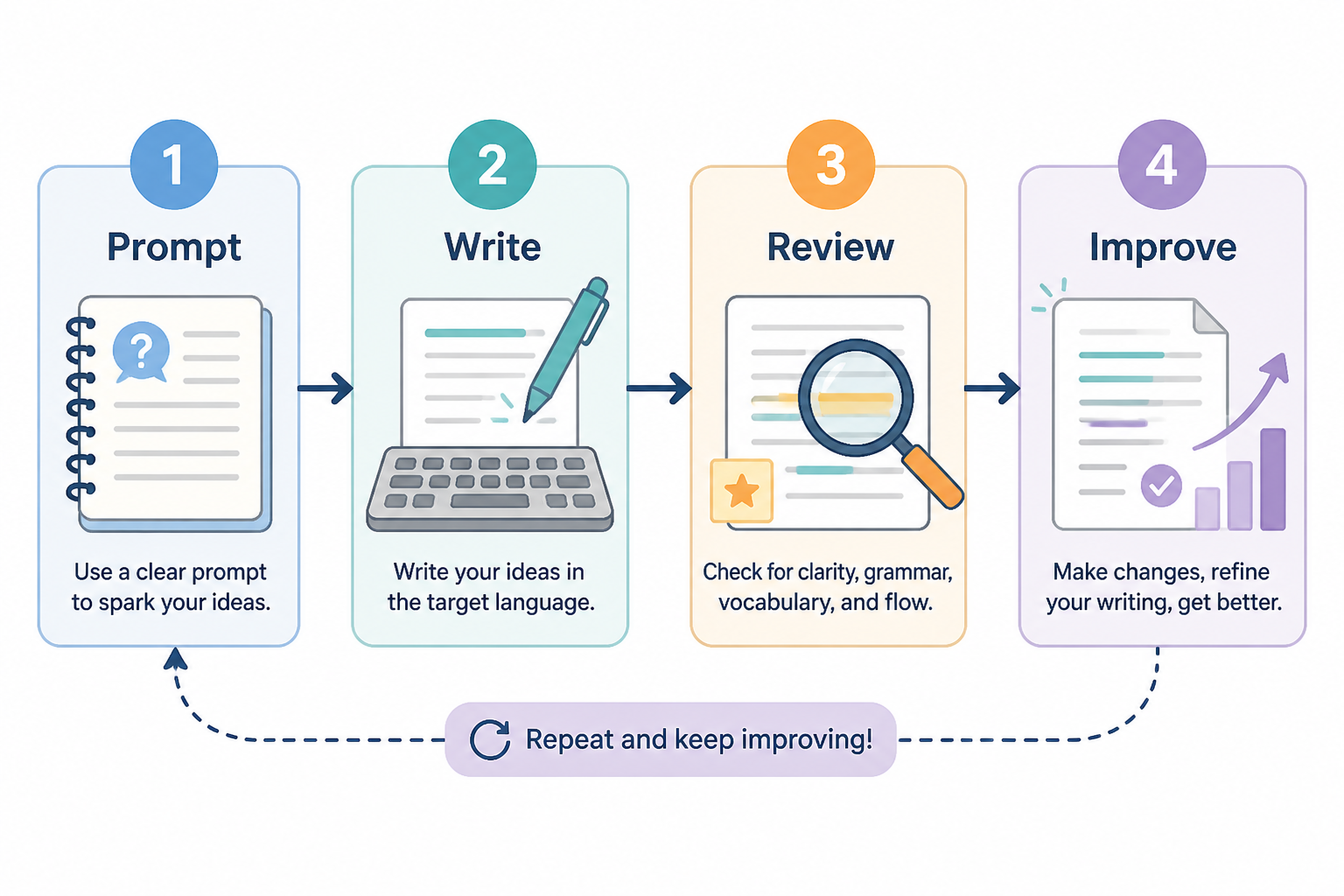
The easiest daily writing system: Prompt, write, check, repeat
The simplest effective routine has four steps:
- Pick a prompt
- Write for a set amount of time
- Check your work
- Save a useful correction
This is the backbone of a strong habit because it is easy to repeat. You do not need a perfect notebook system or a special app. You just need a process that reduces friction.
Here’s what that looks like in practice:
Prompt: “What did I do today?”
Write for 5 minutes without stopping.
Check for one or two things: verb tense and word order.
Rewrite your best sentence correctly.
That may seem small, but it’s enough to build momentum. Small is not weak. Small is sustainable. Sustainable wins.
What to write about when you have no idea what to say
Blank-page paralysis is one of the biggest reasons learners avoid writing. The problem is rarely that you have nothing to say. The problem is that your brain is trying to say everything at once, which is rude of it.
Good daily writing topics are simple, specific, and easy to answer with the language you already have.
- What did you do today?
- What are you planning to do tomorrow?
- What did you eat?
- How do you feel right now?
- What was interesting, difficult, boring, or funny today?
- What do you like or dislike about something?
- What would you change about your day?
- What is something you learned recently?
If you want more prompt ideas, use daily language journaling prompts as a starting point. Prompts are especially useful when you want to write daily but do not want to spend your limited energy inventing topics from scratch.
Another smart approach is to recycle the same prompt types on different days. Repetition helps. Writing about “my day” five times is not boring if your goal is to practice expressing real life in the language.
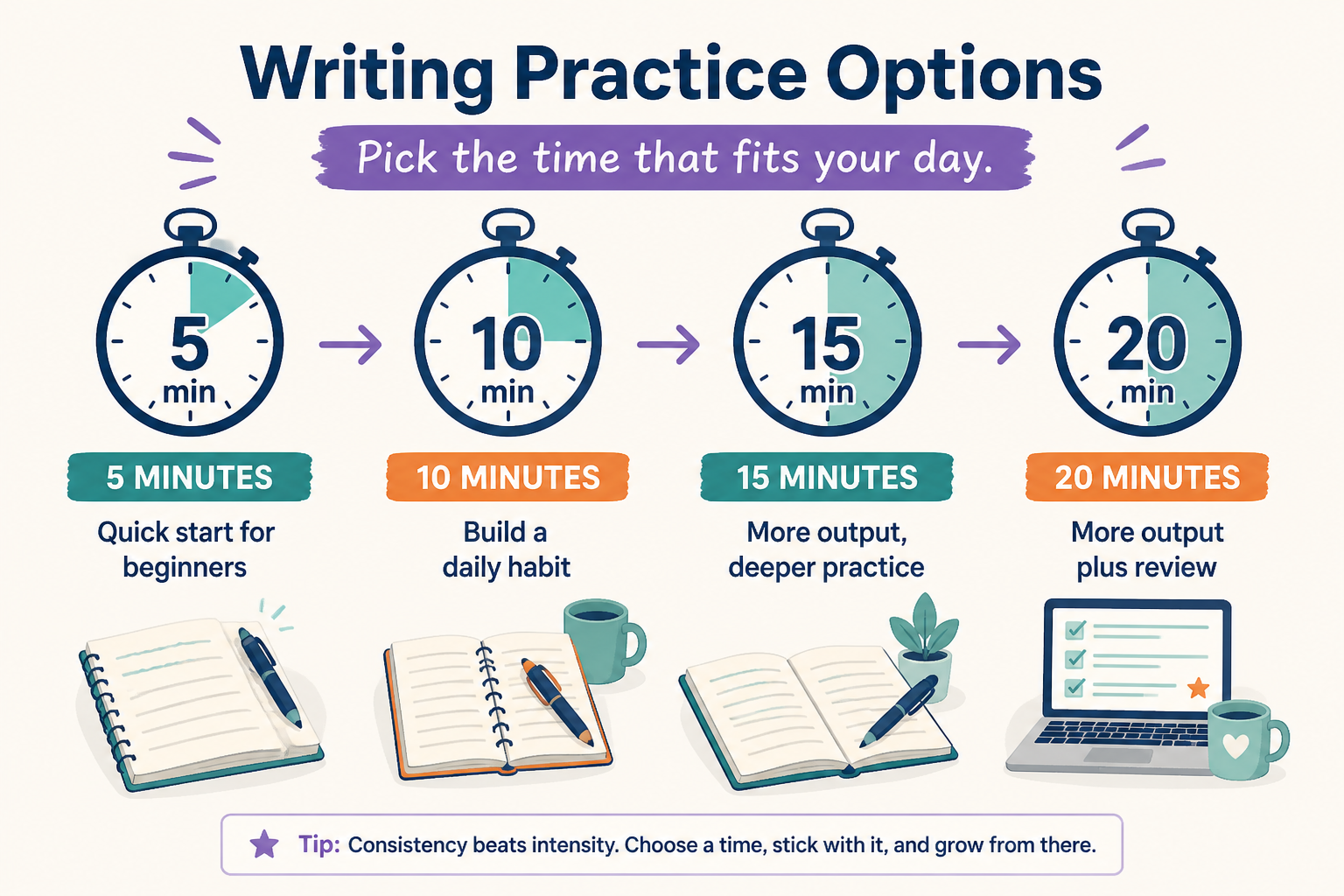
How long should you write each day?
Long enough to warm up your brain, short enough that you can do it tomorrow too.
That usually means one of these:
- 5 minutes for beginners or very busy days
- 10 minutes for a solid everyday habit
- 15–20 minutes if you want more output and review time
If you are starting out, 5 minutes is enough. The real skill is showing up. Once the habit exists, you can grow it.
A useful rule: write until you feel a little resistance, not until you are exhausted. The point is practice, not punishment.
Build a daily writing routine that you can keep
Habits usually fail for boring reasons: they are inconvenient, unclear, or too ambitious. So build your writing routine around your real life, not your ideal life.
Step 1: Pick a fixed trigger
A trigger is something that happens every day and reminds you to write. For example:
- After breakfast
- During lunch
- Before bed
- Right after brushing your teeth
- When your coffee starts working its magic
Keep the trigger simple and attached to an existing routine. That makes the habit easier to remember.
Step 2: Prepare a tiny writing space
This could be a notebook, a notes app, a document, or a dedicated journal. The main thing is that it is easy to open and use. If your system takes five clicks and a prayer to start, you probably won’t use it.
Step 3: Decide what “done” means
Daily writing works better when the finish line is clear. “Write something” is vague. “Write 5 sentences about my day” is doable.
A good daily target might be:
- 3 sentences
- 1 short paragraph
- 5 minutes of free writing
- 1 prompt answer
- 1 corrected rewrite of a previous entry
Step 4: Leave yourself a starter line
One of the best ways to reduce friction is to begin each session with a reusable first sentence:
- Today I…
- This morning I…
- I feel…
- Yesterday I…
- I want to…
Starting is often harder than writing. Make the start easy and the rest follows more naturally.
Three daily writing formats that actually work
You do not need to invent a brand-new exercise every day. In fact, rotating a few reliable formats is often better. It keeps the habit fresh without making it complicated.
1. The mini journal
This is the simplest option. Write a short entry about your day, thoughts, plans, or feelings. Aim for short, clear sentences rather than long, complicated ones.
Example:
Today I worked at home. I answered emails and studied for 20 minutes. I felt tired in the afternoon, but I finished my tasks. Tonight I want to rest and read a little.
This format is great because it feels real. You are writing about your actual life, which makes the language useful and memorable.
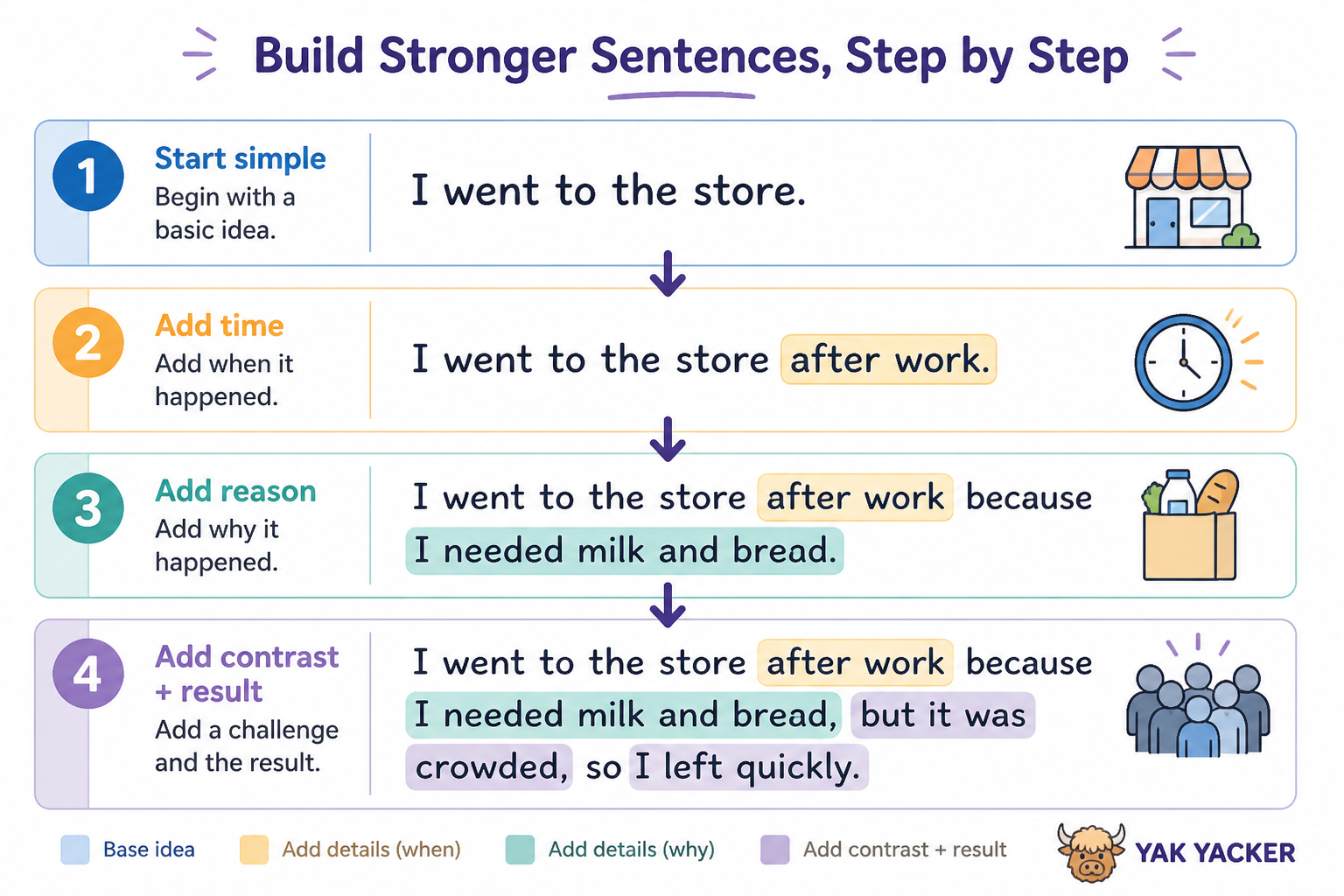
2. The sentence expansion drill
Start with one simple sentence and expand it step by step. This helps you practice grammar, detail, and sentence variety.
Start: I went to the store.
Expand: I went to the store after work.
Expand again: I went to the store after work because I needed milk and bread.
Expand again: I went to the store after work because I needed milk and bread, but it was crowded, so I left quickly.
This exercise is excellent for learners who know basic vocabulary but want to say more with what they already know.
3. The model-and-change method
Pick a simple model sentence or paragraph from something you read, then adapt it to your own life. This gives you a structure to follow instead of starting from zero.
Model: I usually wake up early. I drink coffee and check my messages. Then I start work.
Your version: I usually wake up late on weekends. I eat breakfast and listen to music. Then I study for an hour.
This is powerful because it teaches pattern recognition. You are learning how natural language is built, not just collecting vocabulary like tiny chaotic squirrels.
How to make your writing better without making it harder
Improvement should be part of the routine, but it should not become a giant editing project every time. If perfection becomes your goal, you may stop writing altogether. And then the “practice” part disappears.
A smarter approach is to focus on one or two things per session.
Use a simple review checklist
After writing, check for:
- One grammar point you often miss
- One spelling issue
- One sentence that sounds awkward
- One place where you could say something more simply
That’s enough. You do not need to hunt every mistake in one sitting. The goal is to improve gradually.
Rewrite one sentence, not the whole entry
Choose one sentence and make it better. This keeps review manageable and teaches you how to refine your language.
Original: Yesterday I go to the park and I see my friend.
Revised: Yesterday I went to the park and saw my friend.
One small correction repeated often is more useful than endless editing with no memory attached.
How to handle mistakes without losing confidence
Writing practice will show you mistakes. That is the whole point. If you avoid mistakes completely, you are probably avoiding real practice too.
The key is to treat mistakes as information, not as proof that you are bad at languages. Everyone makes them. Even advanced learners make them. Even native speakers make them while pretending not to.
If mistakes make you freeze, it helps to read more about how to handle mistakes in language learning. The short version: notice the error, learn the correction, and keep going.
Here is a healthier way to think about writing errors:
- Wrong does not mean useless.
- Correction does not mean failure.
- Revision is part of learning, not a punishment.
- Repeated mistakes mean you have found something worth practicing.
If you can change your reaction to mistakes, your writing practice becomes much less stressful and much more effective.
How to get feedback that is actually useful
Writing by yourself is helpful. Writing with feedback is stronger. But not all feedback helps. Some corrections are vague. Some are overwhelming. Some are so detailed they make you feel like your sentence was personally attacked.
Good feedback should tell you:
- What is incorrect
- What sounds unnatural
- What is the better version
- Why the correction matters, if possible
If you want a deeper system for this part of the process, see how to get corrections and feedback when learning a language.
When asking for feedback, be specific. Instead of saying “Can you correct this?”, try:
- Can you correct the grammar and explain the main mistakes?
- Can you tell me if this sounds natural?
- Can you fix only the sentences that are unclear?
- Can you highlight my top 3 recurring mistakes?
That makes it easier for a teacher, tutor, language partner, or correction tool to give you feedback you can actually use.

How to practice writing if you are a beginner
If you are just starting out, do not aim for complex essays. Start with tiny, controlled writing tasks. Your job is to become comfortable putting words together.
Beginner-friendly tasks include:
- Copying and changing model sentences
- Writing 3–5 simple sentences about your day
- Labeling objects in a picture and writing one sentence about each
- Answering one short question with a full sentence
- Making a list of things you like, need, or did
At this stage, accuracy matters more than ambition. It is better to write simple correct sentences than clever broken ones. Clever can wait. Clear comes first.
A beginner’s session might look like this:
- 2 minutes: review a few useful words
- 5 minutes: answer one prompt with short sentences
- 3 minutes: check the text for one grammar pattern
- 1 minute: rewrite one sentence correctly
That’s a complete practice session. No dramatic energy required.
How to practice writing if you are intermediate
Intermediate learners usually need a different challenge. Basic journaling still helps, but it may become too easy unless you add some pressure or variety.
Try these upgrades:
- Write longer paragraphs with a clear topic sentence
- Explain opinions instead of only describing facts
- Compare two things and say which you prefer and why
- Summarize something you read in your own words
- Rewrite a text more naturally after getting feedback
Intermediate writing is often about depth. Instead of saying only what happened, say what you think, why it matters, what caused it, and what might happen next.
Example prompt:
Do you prefer mornings or evenings? Explain your answer with two reasons and one example.
This kind of task pushes you to organize ideas, connect sentences, and express opinions more clearly.
How to keep your writing from becoming copy-paste practice
It is easy to fall into habits that feel productive but do not stretch your skills much. Here are a few traps to avoid:
Trap 1: Writing the same sentence every day
Repetition can help, but only if you are noticing something new. If you are just writing “Today I studied language” every day and calling it progress, your brain may have filed the activity under “familiar.”
Fix: keep the topic familiar, but change the structure. Add a reason, contrast, detail, or opinion.
Trap 2: Looking up every word
If you stop for every unknown word, your writing session turns into a dictionary scavenger hunt. That can be useful sometimes, but it can also kill momentum.
Fix: use what you know first. Leave a blank, write a simpler sentence, or use a placeholder and come back later.
Trap 3: Never reviewing old mistakes
If you only write new entries and never revisit old corrections, you may keep relearning the same lesson in slightly different shoes.
Fix: once or twice a week, review your previous corrections and rewrite one or two sentences correctly.
Trap 4: Making the task too ambitious
Writing five detailed paragraphs every day sounds impressive. It also sounds like a fast way to stop after three days.
Fix: shrink the task until it feels almost too easy. Then build up gradually.
A simple weekly structure for daily writing
Daily writing becomes much easier when each day has a loose role. You do not need a rigid schedule, but a light structure helps you avoid decision fatigue.
| Day | Focus | Example task |
|---|---|---|
| Monday | Free journaling | Write 5 sentences about your day |
| Tuesday | Sentence accuracy | Rewrite 3 sentences from yesterday |
| Wednesday | Opinion practice | Answer a “Why do you think…?” prompt |
| Thursday | Vocabulary recycling | Use 5 new words in 5 simple sentences |
| Friday | Summary practice | Summarize a short article, message, or lesson |
| Saturday | Longer response | Write one paragraph with details and examples |
| Sunday | Review and reflect | Read old entries and notice common mistakes |
This is just one option. The main idea is to give your practice enough variety to stay interesting while still staying familiar enough to repeat.
How to know if your writing practice is working
Improvement in writing is not always dramatic. Often it shows up quietly. You may notice that you:
- Need the dictionary less often
- Can write faster
- Make fewer repeated mistakes
- Can express the same idea in more than one way
- Feel less nervous starting a blank page
- Can revise your own writing more effectively
It helps to keep a few old entries. Every couple of weeks, compare a recent text with an older one. You will often spot improvements that are easy to miss day to day.
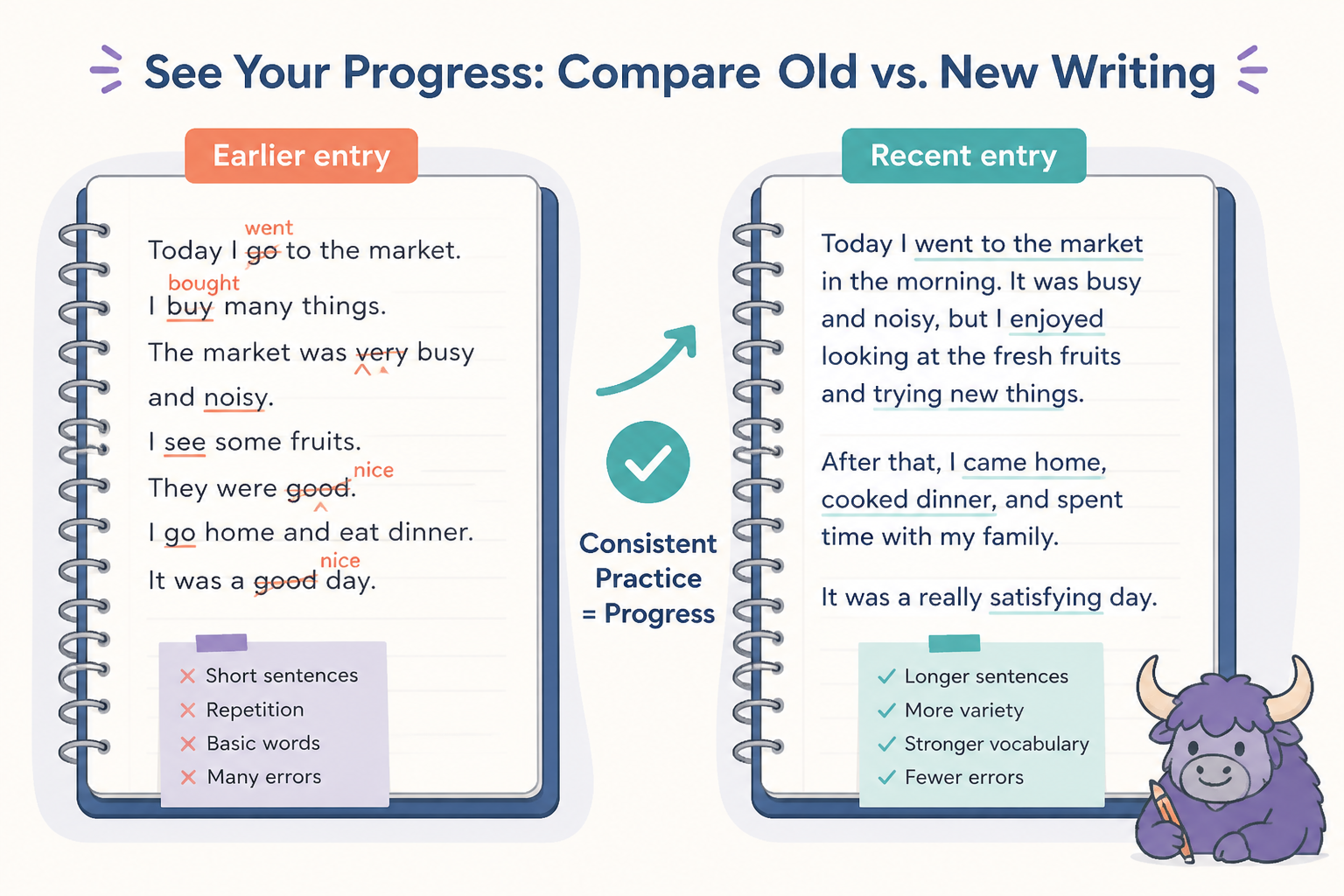
Do not judge progress only by how many mistakes remain. Judge it by how much easier writing feels, how much clearer your thoughts become, and how often you can finish a piece without getting stuck.
Troubleshooting common problems
“I don’t know enough vocabulary to write”
Use simpler ideas. The point of practice is not to prove your vocabulary is enormous. Use short sentences, concrete topics, and basic structures. If needed, write about what you can see, what you did, or what you plan to do.
“I spend too much time correcting”
Limit review time. For example, write for 10 minutes and correct for 5. Or only correct one category per session, such as verb tenses or word order.
“My writing sounds stiff and unnatural”
This usually means you are translating too directly from English or using structures that are technically correct but not very natural. Try reading more model sentences, simplifying your ideas, and asking for feedback on naturalness—not just accuracy.
“I keep forgetting to write”
Make the habit smaller and attach it to an existing routine. Put your notebook somewhere visible. Set a phone reminder. Or pair writing with another habit, like tea, coffee, or bedtime.
“I only write when I feel motivated”
Motivation is nice, but habits survive on systems. Decide in advance what you will do on low-energy days. For example: one prompt, three sentences, done. On good days, you can always do more.
A practical 30-day plan for daily foreign-language writing
If you want a concrete starting point, use this simple 30-day approach. It is intentionally modest. The goal is to make the habit feel easy enough to keep.
Days 1–7: Get the habit started
- Write 3–5 short sentences each day
- Use simple prompts about your day
- Do not worry about perfection
- Correct only one or two obvious mistakes
Days 8–14: Add one improvement focus
- Keep writing daily
- Focus on one grammar point or mistake type
- Rewrite one sentence each day
- Try one new prompt type, like opinion or comparison
Days 15–21: Add more detail
- Write one longer paragraph on 3 days of the week
- Add reasons, examples, or descriptions
- Use feedback if available
- Save corrections in one place
Days 22–30: Review and strengthen
- Read your earlier entries
- Notice recurring mistakes
- Rewrite one old entry more clearly
- Keep the daily habit going without increasing the pressure too much
By the end of 30 days, you should have a real practice, not just a burst of enthusiasm. That is the difference between a challenge and a habit.
A simple checklist for daily writing practice
Use this as a quick before-you-start guide:
- I know when I will write.
- I know where I will write.
- I have a prompt or topic.
- I know how long I will write.
- I know how I will review my text.
- I know what I will do with mistakes.
- I have made the task small enough to repeat tomorrow.
If any of those boxes is blank, fix that first. A clear system makes consistency much easier.
When you need a little inspiration
Sometimes the hardest part is simply beginning. On those days, use one of these writing starters:
- Today I…
- I want to…
- I learned…
- I like…
- I don’t like…
- I remember…
- I think…
- My plan for tomorrow is…
These are intentionally plain. Plain is helpful. You can always make the sentence more interesting later. First, make it exist.
Final advice: make it small, clear, and repeatable
If you want to practice writing in a foreign language every day, do not build a system that depends on feeling brilliant, inspired, or perfectly organized. Build one that works when you are tired, distracted, or slightly annoyed at the concept of verbs.
The best daily writing practice is:
- small enough to do today
- clear enough to start without confusion
- useful enough to improve your language
- flexible enough to survive busy weeks
Start with one prompt. Write a few sentences. Check one or two mistakes. Save one correction. Repeat tomorrow.
That simple pattern can take you a surprisingly long way.
If you want to keep building your overall learning system, the main how to learn a language guide is a useful place to connect writing practice with reading, listening, speaking, and review.