What graded readers are and why they help
If you want to read in a new language without spending half your life in a dictionary, graded readers are one of the friendliest tools you can use. A graded reader is a book written or adapted for language learners at a specific level, so the vocabulary, grammar, and sentence length stay manageable. That means you can actually read for meaning instead of stopping every third word to recover from a small vocabulary crisis.
They work because they give you something essential in language learning: lots of understandable input. When the language is mostly within your reach, you can follow the story, notice patterns, and build reading fluency without constant frustration. That makes graded readers especially useful for beginners and lower-intermediate learners, but they can help almost anyone who wants more reading volume.
How graded readers fit into language learning
Reading is not just about learning words on a page. It trains your brain to recognize patterns automatically: common phrases, grammar structures, and the way ideas connect across sentences. The more you read at the right level, the less every page feels like a puzzle.
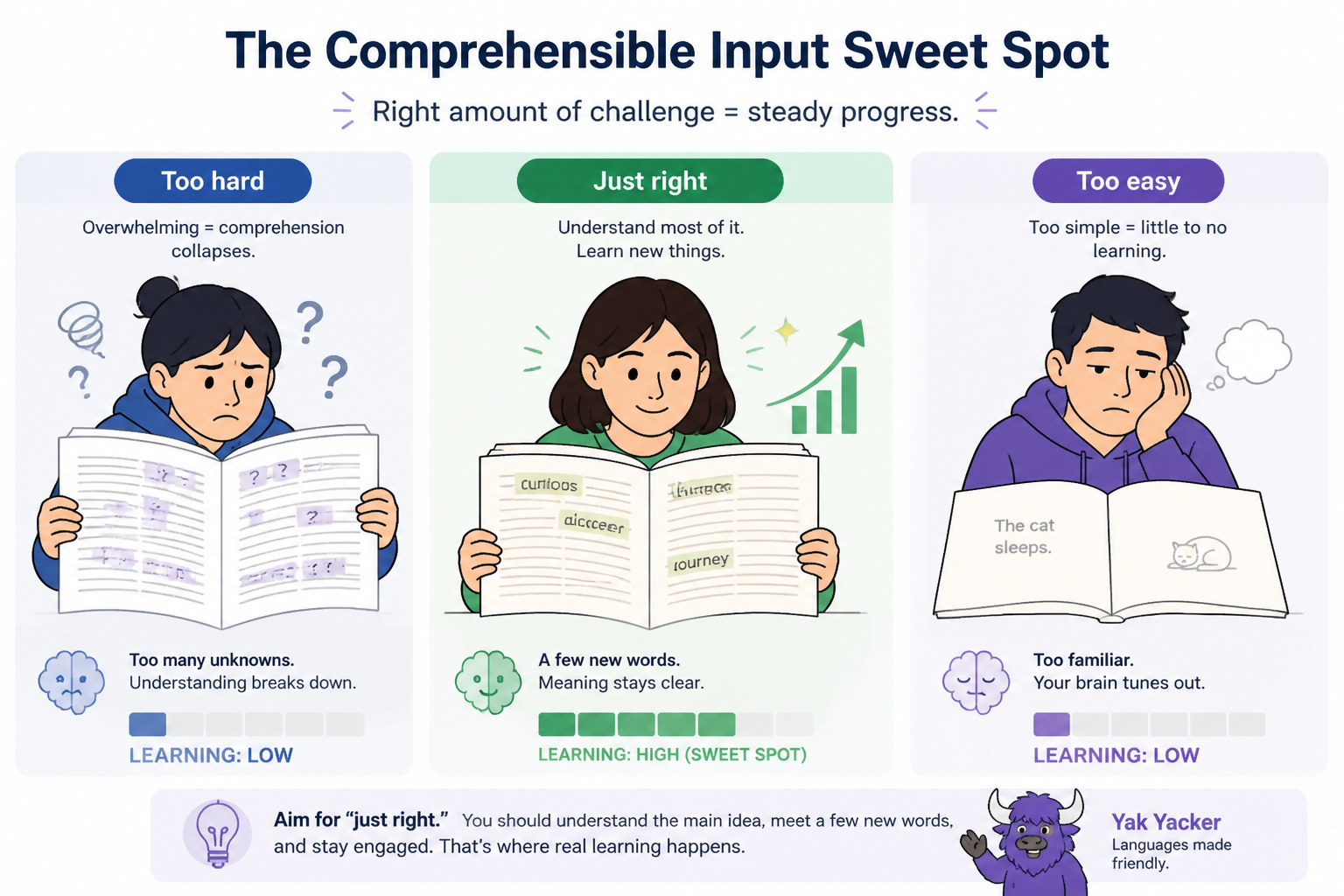
Graded readers are useful because they sit between two unhelpful extremes:
- Too hard: every page is packed with unknown words, so reading becomes slow and exhausting.
- Too easy: you understand everything, but you are not stretching enough to learn much.
The sweet spot is a text you can mostly understand with context, but which still gives you some new material to notice. That balance is the reason graded readers are so effective for building reading confidence and stamina.
Choosing the right level
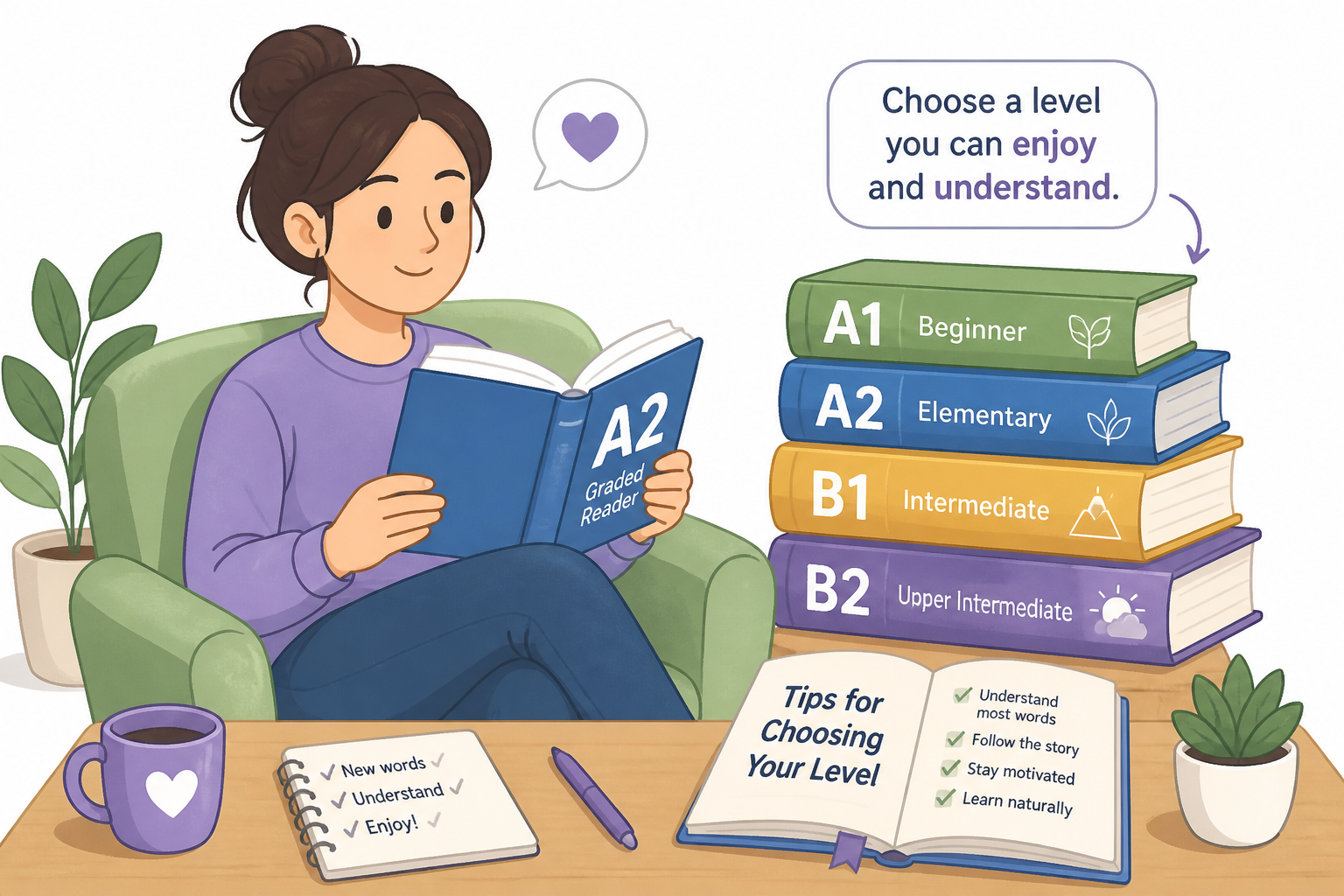
The most important decision is not which book looks interesting on the cover. It is whether the book is at the right level for you. A graded reader that is too advanced can feel like a wall of confusion. One that is too easy may be pleasant, but it will not do much work for your learning.
A practical way to think about level is this: you should understand enough to keep moving without translating every sentence, but not so much that the book feels completely effortless. If you are constantly lost, go down a level. If you can read pages at a time without noticing any challenge, go up a level.
A simple rule for level selection
- Too hard: more than a few unknown words per paragraph, frequent rereading, and a strong urge to quit.
- About right: you can follow the story, guess some unknown words from context, and keep reading.
- Too easy: you understand almost everything immediately and rarely learn anything new.
For many learners, the best graded reader is slightly easier than the kind of book they think they “should” be reading. That is not a sign of weakness. It is how you build momentum.
Connecting graded readers to CEFR levels
Many books are labeled with level systems such as A1, A2, B1, and so on. These labels help you estimate difficulty, but they are not perfect. Different publishers use slightly different criteria, and your own skill profile matters too. You might understand a B1 graded reader in one topic more easily than an A2 reader on a subject you know nothing about.
If you want a clearer sense of those labels, it helps to understand CEFR language levels. That will make it easier to choose books that fit your current stage instead of guessing and hoping for the best.
How to use graded readers effectively
Using graded readers well is not complicated, but a few habits make a huge difference. The goal is not to squeeze every drop of vocabulary from every page. The goal is to read enough, understand enough, and stay relaxed enough that reading becomes a repeatable habit.
Step 1: pick a book you can finish
Choose something that looks genuinely readable. You do not need to love the book before you start, but you should be willing to keep going. Short stories, simplified classics, mystery stories, and light adventure books are often good starting points because they create momentum quickly.
If you are unsure, choose a shorter book first. Finishing a book matters more than choosing the “perfect” one. Success builds confidence, and confidence keeps you reading.
Step 2: read for meaning first
When you open a graded reader, your first job is to understand the story or information. Do not stop at every unknown word unless it blocks the meaning. Often, the surrounding sentence gives you enough clues to keep going.
This is where graded readers are different from a dictionary exercise. You are training your brain to tolerate some ambiguity while still understanding the main message. That skill is gold in real-world reading.
For a deeper explanation of why this matters, see comprehensible input.
Step 3: use the right amount of help
Help is useful, but too much help turns reading into constant interruption. A good approach is to look up only words that:
- keep appearing
- seem important to the plot or idea
- you suspect will be useful again
Ignore the rest for now. Many unknown words are not worth your time on the first pass. If they matter, they will come back.
Step 4: reread when useful
Graded readers are perfect for rereading. On a second reading, the story is more familiar, so your brain can pay attention to vocabulary and sentence patterns instead of just figuring out what is happening.
You do not need to reread every book. But when a book is short, enjoyable, or important to you, a second pass can be surprisingly effective. The first read is for understanding. The second read is often where the learning gets deeper.
Step 5: read regularly, not heroically
Ten or fifteen minutes a day is usually more useful than a long session once a week. Regular reading keeps the language fresh in your memory and makes the habit easier to sustain. Language learning tends to reward consistency more than dramatic bursts of effort.
A practical reading routine you can follow
If you want a routine instead of a vague “read more” plan, here is a simple structure that works well for graded readers.
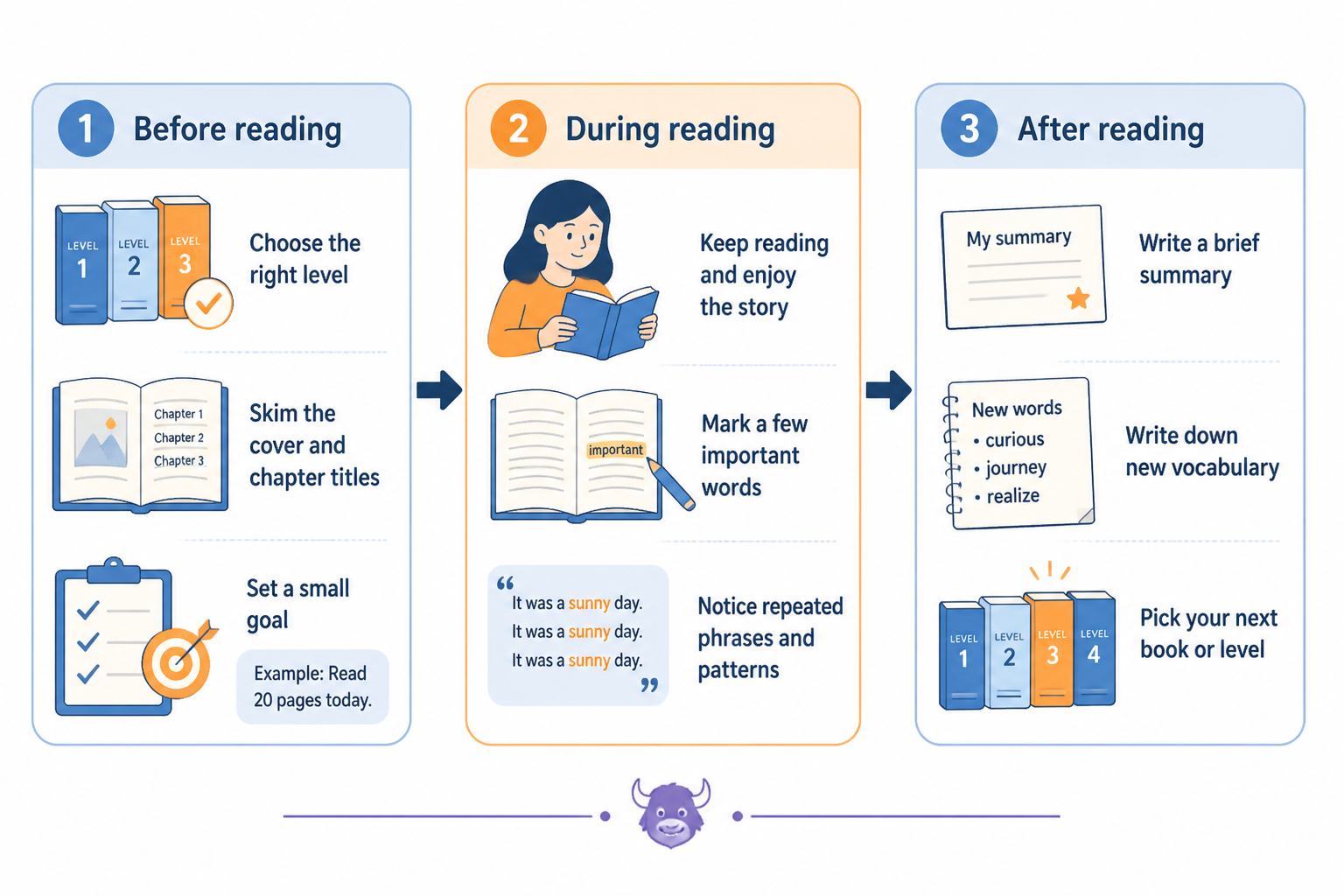
Before reading
- Choose a book at the right level.
- Skim the title, cover, and chapter names if available.
- Set a small goal, such as “read two pages” or “finish one chapter.”
- Decide whether you will use a dictionary lightly or not at all.
During reading
- Keep moving when the meaning is clear enough.
- Mark or note only important recurring words.
- Do not obsess over every sentence being perfect.
- Pay attention to repeated expressions and sentence patterns.
After reading
- Summarize the chapter in one or two simple sentences.
- Write down a few useful words or phrases.
- Notice what felt easier than before.
- Decide whether the next book should be easier, similar, or harder.
How to know if a graded reader is the right fit
Sometimes the level label looks right, but the book still feels off. That can happen because of topic, style, or your personal background knowledge. The following table can help you diagnose the problem quickly.
| What you feel | What it probably means | What to do |
|---|---|---|
| You understand almost nothing | The book is too difficult | Move down a level or choose a simpler topic |
| You understand the words but not the story | The sentences may be manageable, but the content is confusing | Try a clearer genre or something with simpler plot structure |
| You read easily but learn very little | The book is too easy | Move up a level or choose a richer book |
| You keep stopping to look up words | The book is slightly too hard or your lookup habit is too aggressive | Reduce dictionary use or lower the level |
| You get bored immediately | The book is too easy or not interesting enough | Choose a different topic or increase difficulty a little |
A good graded reader should feel comfortably challenging, not punishing. Reading should make you work a little, but not like you are carrying a sofa uphill in the rain.
What to do with unknown words
Unknown words are normal. In fact, they are part of the point. The trick is to decide which words deserve attention and which ones should be left alone. If you stop for every unknown item, your reading flow collapses. If you ignore everything, you may miss useful patterns.
A simple decision rule
- Can I guess it from context? If yes, keep reading.
- Does it seem important or repeated? If yes, check it.
- Is it a one-time detail? If yes, probably ignore it.
This approach helps you stay focused on meaning while still collecting useful vocabulary. Over time, repeated words and phrases start to feel familiar without heavy memorization.
What not to do
- Do not stop for every single unknown word.
- Do not copy huge vocabulary lists from a chapter and never revisit them.
- Do not assume you must understand 100% of the text to learn from it.
Reading is not a courtroom trial where every word needs a legal verdict. It is a process of building familiarity.
How graded readers support comprehensible input
One of the biggest reasons graded readers work is that they make input comprehensible. That means you are hearing or reading language you can mostly understand, with just enough new material to make it useful. This is the sweet spot for learning because your brain can connect known patterns with new ones.
When a text is too difficult, comprehension collapses and learning slows down. When it is understandable, your brain can notice repetition, infer meaning, and gradually absorb vocabulary and grammar without constant translation.
That is why graded readers are often recommended alongside other beginner-friendly activities. They make reading feel possible, and “possible” is where habits begin.
How to build confidence without getting lazy
Some learners worry that graded readers are “too easy” and that they should push themselves with harder books right away. It is a fair concern. But confidence is not laziness. Confidence is what makes reading sustainable.
The best strategy is to use graded readers as a bridge. They help you build enough vocabulary, pattern recognition, and stamina to eventually handle more challenging material. Think of them like training wheels, except useful and not embarrassing. You are not supposed to remain on them forever. You are supposed to use them until your balance improves.
Signs you are progressing
- You need fewer dictionary checks.
- You can read longer stretches without fatigue.
- You recover faster when a sentence is confusing.
- You start noticing repeated words naturally.
- You can summarize chapters more easily.
Common mistakes learners make with graded readers
Many learners use graded readers in a way that is technically “reading” but not very effective. The problem is usually not effort. It is method. Here are the most common mistakes and how to fix them.
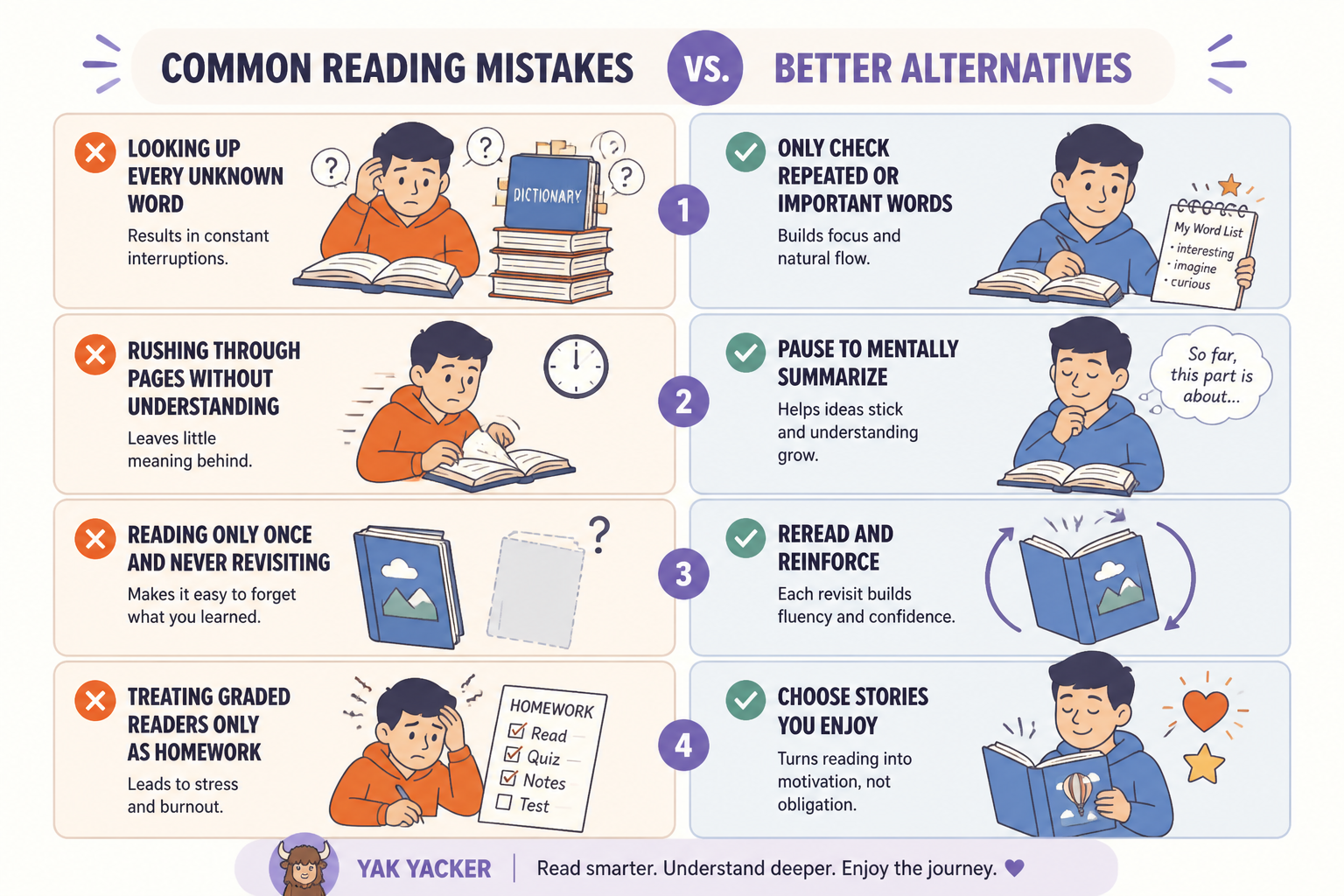
1. Choosing books that are too hard
This is the biggest mistake. A book that is far above your level turns reading into decoding. That can be useful in tiny doses, but it is not a good main strategy.
Fix: choose a lower level than you think you need. If you are hesitating between two levels, try the easier one first.
2. Looking up too many words
Dictionary use can feel productive, but too much of it breaks flow and slows down comprehension.
Fix: only look up words that repeat, seem central, or matter to the story. Let the rest pass.
3. Reading without paying attention
Some learners rush through pages without really processing the meaning. That is not fatal, but it reduces the value of the reading.
Fix: pause occasionally and mentally summarize what just happened.
4. Only reading once and never revisiting
One reading is good. Two readings can be much better, especially for shorter books.
Fix: reread selected books, especially ones you enjoyed or found useful.
5. Using graded readers only as homework
If reading feels like a chore, it becomes harder to sustain.
Fix: choose books with a topic or story style you actually like. Even a simple book becomes easier when you care what happens next.
How to turn graded readers into real language gains
Reading alone is useful, but you can make the gains more durable with a few light follow-up habits. You do not need a full study system. A few minutes after reading is enough.
Try a one-sentence summary
After each chapter, write one sentence about what happened. Keep it simple. If you cannot summarize the chapter, that is a clue that the text may have been too hard or that you were reading too quickly.
Collect only high-value language
Write down a small number of useful words or phrases, especially ones that repeat. The goal is not to collect a mountain of vocabulary. The goal is to gather items you are likely to meet again.
Notice patterns, not just meanings
Graded readers are excellent for noticing how language is actually used. Watch for common sentence starters, connectors, and repeated expressions. These patterns often matter more than isolated vocabulary in the long run.
Pair reading with listening if possible
If your graded reader has audio, or if you later hear similar language elsewhere, that combination can strengthen recognition. Even without audio, reading aloud a few lines can help you notice pronunciation and rhythm.
Sample graded reader study plan for one week
If you want a concrete plan, here is a simple one. Adjust the time, but keep the structure gentle and realistic.
| Day | What to do | Goal |
|---|---|---|
| Day 1 | Choose a graded reader and read the first few pages | Check if the level feels right |
| Day 2 | Read one short session and note recurring words | Build familiarity |
| Day 3 | Read the next chapter or section | Keep the story moving |
| Day 4 | Reread a previous section | Notice what became easier |
| Day 5 | Read a new section with fewer dictionary checks | Strengthen fluency |
| Day 6 | Summarize the story in simple language | Check comprehension |
| Day 7 | Review your notes and decide whether to stay at this level or move up | Make the next choice easier |
This kind of plan works because it mixes new reading with review. That balance helps comprehension grow without making the process feel endless.
What a good reading session actually looks like
It can help to see the process in real life. Imagine you open a graded reader and start a chapter. You understand the main character is late, the weather is bad, and there is some kind of problem at work. You do not know every word, but the scene is clear enough. You keep reading.
Then a word appears three times in two pages. It seems important, so you check it once. Now the rest of the chapter makes more sense. At the end, you can say, in your own simple words, what happened. That is a successful session.
Notice what did not happen: you did not translate every sentence, write down twenty words, or chase perfection. You read for meaning, used help selectively, and moved forward.
How to move from graded readers to harder material
At some point, you may want to read more natural books, articles, or stories. Graded readers can prepare you for that, but the transition works best when you move gradually. Do not jump from very easy texts straight into an unfiltered novel and expect it to feel the same.
Signs you are ready to level up
- You finish graded readers with little effort.
- You can read several pages without losing the thread.
- You recognize common vocabulary automatically.
- You rarely need to stop and decode basic grammar.
How to make the transition smoother
- Choose slightly more difficult graded readers first.
- Try shorter authentic texts before long ones.
- Keep using the same reading habits: meaning first, selective lookup, brief summaries.
- Accept that harder texts will feel slower at first.
Gradual progression keeps reading enjoyable. You want to stretch, not snap.
A quick decision guide
If you are not sure how to use graded readers right now, this mini-guide can help you decide what to do next.
| If this is happening… | Do this… |
|---|---|
| You are a complete beginner | Choose the easiest level you can find and focus on finishing short books |
| You know some basics but struggle with long texts | Use graded readers at a lower level than your comfort guess |
| You understand most pages but still feel slow | Keep reading at the same level and reduce dictionary use |
| You are bored by the current book | Switch genres or move up slightly in level |
| You want to build real fluency | Read regularly, reread good books, and summarize what you read |
Final takeaways
Graded readers are one of the simplest and most effective ways to build reading ability in a new language. They help you read enough, understand enough, and stay motivated enough to keep going. That combination matters more than heroic study sessions or perfect translation.
If you remember only a few things, remember these:
- Choose a level that feels comfortably understandable.
- Read for meaning first, not dictionary perfection.
- Use help selectively.
- Reread when it helps.
- Read regularly and keep the habit easy.
For more context on reading practice in general, you may also find this useful: how to practice reading in a new language. If you want the broader learning framework behind this approach, the main guide at How to Learn a Language is a good place to connect the pieces.
Used well, graded readers do exactly what a good learning tool should do: they make progress feel possible today, not someday after your vocabulary magically fixes itself.