
The best language learning resource is not the fanciest one. It is the one that matches what you are trying to do right now.
For the broader learning path, visit our parent guide.
If your goal is to understand everyday conversation, the resource that helps you listen and repeat will beat a giant grammar handbook. If you want to speak with confidence, a speaking-focused app or tutor will matter more than a stack of flashcards. If you need to pass an exam, test practice will be worth its weight in coffee.
That is the main problem most learners run into: they collect resources before they get clear on the goal. Then they end up with ten apps, five notebooks, and the lingering suspicion that they are “doing language learning wrong.” You are not. You just need a better match between goal and tool.
This guide will help you choose resources based on what you actually want to achieve. Along the way, you will see what each resource does well, where it falls short, and how to combine resources without turning your study life into a chaotic app cemetery.
If you want a bigger picture of the learning process, it can help to pair this guide with the best way to learn a language. If you are ready to turn resource choices into a practical routine, how to build a language study plan and how to build a language learning habit are the natural next steps.
How to choose the right resource for your goal
Before we talk about specific tools, you need a simple way to judge them. A good resource is not “good” in general. It is good for a certain stage, skill, or outcome.
Ask these four questions:
- What skill does this resource train? Listening, speaking, reading, writing, vocabulary, grammar, pronunciation, or test strategy?
- What level is it built for? Total beginner, early learner, intermediate, or advanced?
- How active is it? Does it make you produce language, or only recognize it?
- What is the payoff? Faster comprehension, better speaking, more confidence, exam readiness, or better consistency?
A lot of learners assume “more resources = better progress.” Usually the opposite happens. The right setup is often just a few tools doing different jobs. One for input, one for output, one for review, and one for accountability is often enough.
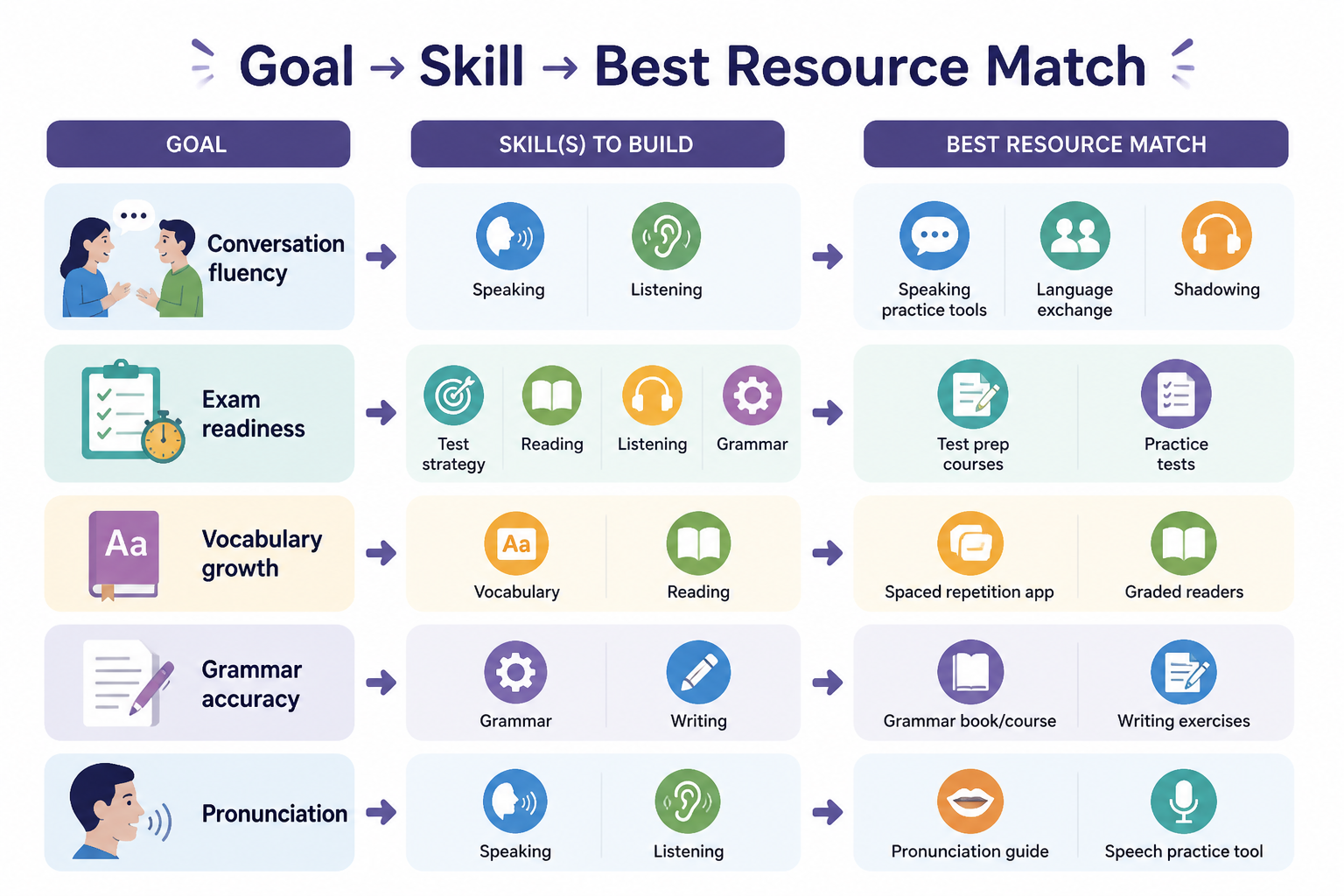
The main types of language learning resources
It helps to understand the tool categories before choosing by goal. Here is the short version.
| Resource type | Best for | Weakness |
|---|---|---|
| Vocabulary apps | Building and reviewing useful words | Can create recognition without real usage |
| Grammar books or courses | Understanding structure clearly | Can become too passive if you only read |
| Listening content | Training your ear and understanding real speech | Can feel hard without support at first |
| Speaking practice tools | Fluency, confidence, pronunciation, quick reactions | Needs regular use and some discomfort |
| Reading material | Vocabulary growth, comprehension, sentence pattern awareness | Can be slow if too difficult |
| Writing tools | Sentence accuracy, grammar, expression, recall | Needs feedback to improve fastest |
| Tutor or exchange partner | Interactive practice and feedback | Quality can vary a lot |
| Test prep resources | Exam score improvement and format familiarity | May not build broad real-world fluency alone |
The important idea is that no single resource does everything well. A “best” resource usually means “best at one job.”
Choose a useful next step
Use the guide below to match your goal, or start with a clear learning path and build from there.
Best resources by goal
Now we get to the useful part. Your goal decides the right mix.
If your goal is to learn useful everyday vocabulary
Choose resources that repeatedly expose you to high-frequency words in context, then force a little recall.
- Vocabulary apps with spaced repetition for steady review.
- Beginner dialogues so you see words in real sentences, not isolated lists.
- Graded readers if you want vocabulary plus simple context.
- Personal word lists made from words you actually need in your life.
What works best here is not random memorization. It is repeated exposure plus meaningful repetition. Learning “airport,” “appointment,” or “receipt” matters much more if those words are likely to show up in your real life.
Best use case: You want to handle basic conversations, travel, shopping, work-related tasks, or everyday small talk.
Avoid: trying to memorize huge themed word lists that you never use. That is how learners end up knowing twenty words for “kitchen appliances” and none for “How much is this?”
Simple combo: one spaced-repetition app, one short reader, and one notebook for personally useful words.
If your goal is to understand native speakers better
Listening resources should be the priority. That means content you can hear often and re-hear easily.
- Slow or learner-friendly audio for early comprehension.
- Dialogues with transcripts so you can check what you missed.
- Short podcasts or video lessons with repeated themes and clear speech.
- Listening comprehension exercises that train you to catch details.
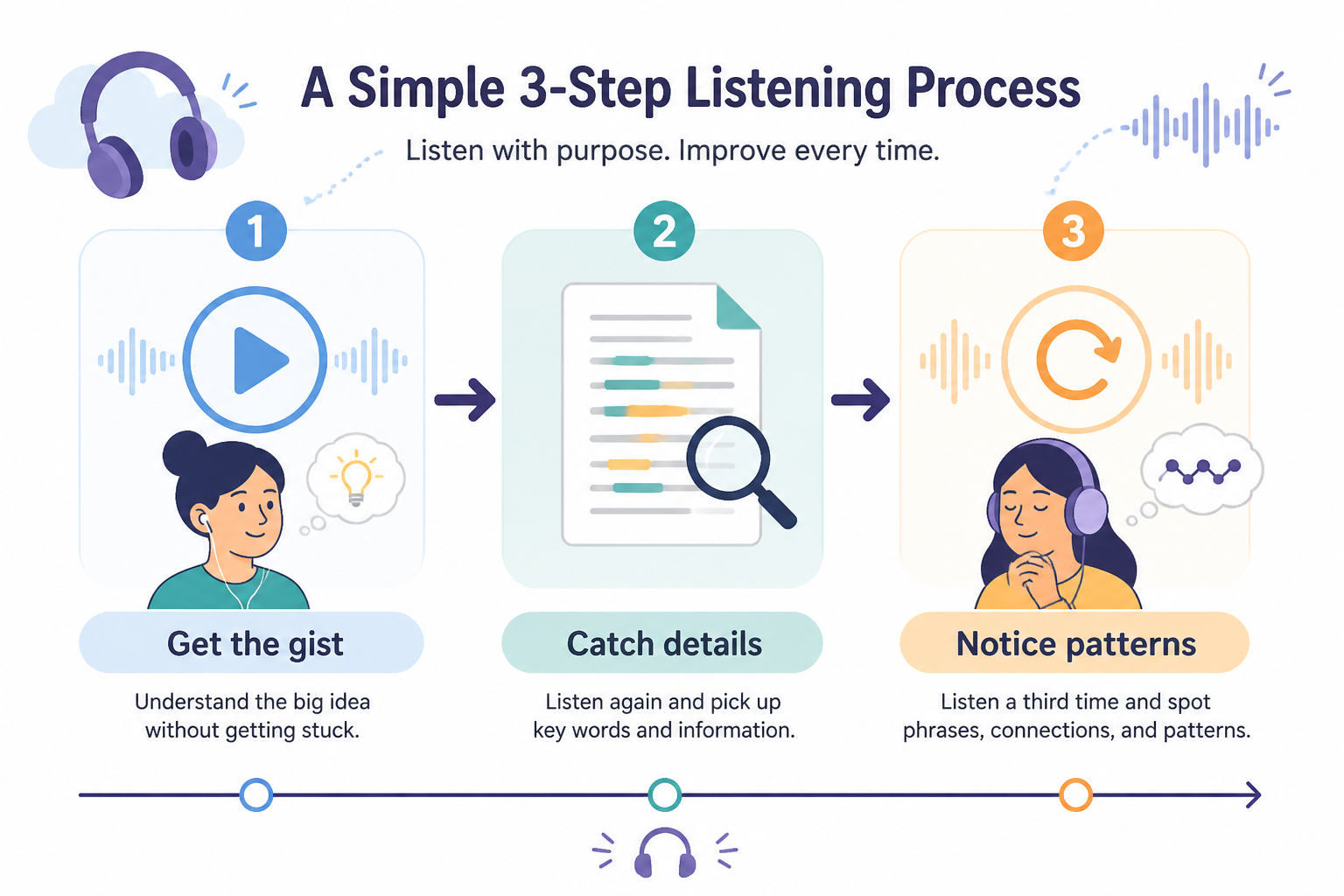
Listening improves fastest when you hear the same material more than once. The first listen is for the general idea. The second is for details. The third is where patterns start to stick.
Best use case: You can read some material but still freeze when people speak naturally.
Avoid: starting with fast, slang-heavy native content and expecting magic. That is like deciding to train by sprinting uphill in flip-flops.
Simple combo: one slow audio source, one transcript, and a short repeat-listening routine.
If your goal is to speak with confidence
Speaking goals need speaking resources. A lot of learners wait too long to say anything because they think they need more input first. Input helps, but confidence comes from actually speaking.
- Tutor sessions for guided speaking and correction.
- Language exchange partners for low-cost conversational practice.
- Speaking prompt decks so you are not staring into the void every day.
- Shadowing audio to improve rhythm, pronunciation, and automatic phrasing.
- Self-recording tools so you can hear your own mistakes clearly.
If your goal is fluency, practice making full sentences before you feel ready. Use simple topics like your day, your plans, your opinions, and your routines. Confidence grows when your brain stops treating speaking like a high-stakes event.
Best use case: You understand more than you can say, and you want to close that gap.
Avoid: only doing passive exercises like multiple-choice quizzes. Those are fine for support, but they will not teach your mouth to move.
Simple combo: one conversation partner or tutor, one shadowing audio source, and one set of speaking prompts.
If your goal is to improve pronunciation
Pronunciation needs clear models and feedback. You are training both your ears and your mouth.
- Shadowing recordings with native or clear model audio.
- Pronunciation guides that break sounds into manageable pieces.
- Minimal pair exercises for sounds that are easy to mix up.
- Recording and playback so you can compare your speech to the model.
- Tutor feedback if you want faster correction.
Pronunciation improves when you focus on a small number of problems at a time. Do not try to fix every sound in one sitting. That leads to overwhelmed brain, which is not a technical term, but it is very real.
Best use case: People understand you, but not always clearly, or you want to sound more natural and less translated.
Avoid: reading aloud without feedback and calling it pronunciation practice. That may help a little, but it is not enough by itself.
Simple combo: one pronunciation model, one recording habit, and one feedback source.
If your goal is to read more comfortably
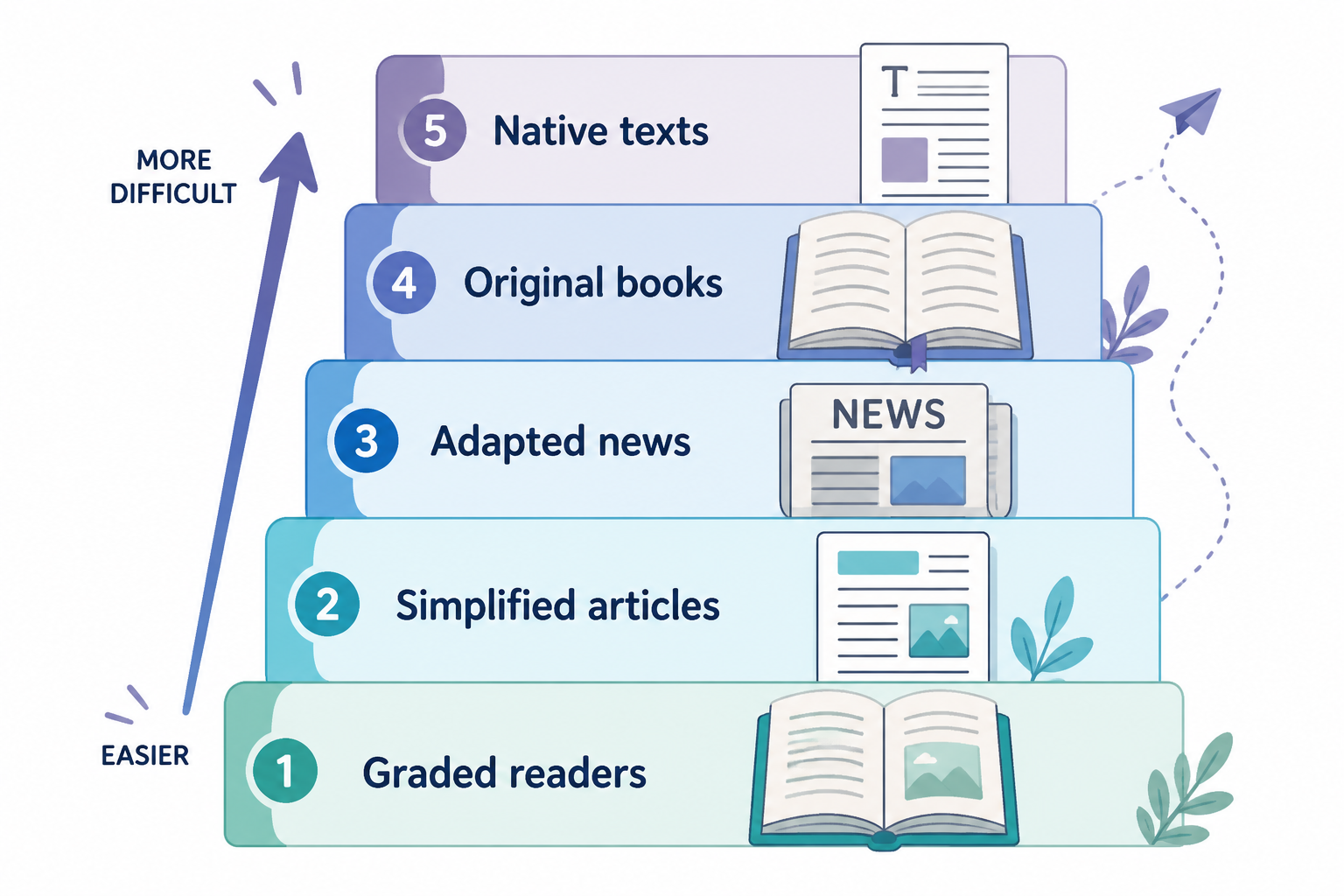
Reading goals need material that is interesting enough to keep you going, but not so hard that every sentence feels like a puzzle with missing pieces.
- Graded readers for learners at early stages.
- Articles or stories with built-in support such as glosses or simple vocabulary help.
- Parallel texts if you want to compare a difficult passage with a known translation.
- Digital readers with dictionary lookup for fast checking.
Reading is one of the best ways to grow vocabulary and notice grammar patterns in context. But the material should be at the right difficulty. If every sentence needs a dictionary, you are reading a tax return, not a learning resource.
Best use case: You want to understand signs, messages, articles, stories, or work-related texts.
Avoid: choosing “real native content” that is far above your level and then rereading the same paragraph twelve times with increasing resentment.
Simple combo: one graded reader, one dictionary tool, and one regular reading routine.
If your goal is to write better
Writing gets better when you get practice producing language and then correcting it. This is the skill where feedback matters a lot.
- Writing prompts for regular practice.
- Journal entries for low-pressure output.
- Correction tools or tutors to spot mistakes.
- Model texts so you can copy useful structures.
- Sentence-building exercises for accuracy and confidence.
Writing is not only about grammar. It is also about organization. Can you say what you mean clearly? Can you choose the right level of formality? Can you make your ideas easy to follow?
Best use case: You need to write messages, essays, posts, emails, or notes in the language.
Avoid: writing a lot without checking mistakes. Repeating the same errors is a fast route to confidence in the wrong answer.
Simple combo: one prompt source, one correction method, and one model text you can imitate.
If your goal is to understand grammar without losing your will to live
Grammar resources are useful when they explain patterns clearly and connect them to real usage. The goal is not to become a grammar robot. The goal is to understand how sentences work so your input and output make more sense.
- Concise grammar books with examples.
- Lessons that compare forms in context instead of listing rules only.
- Practice exercises that make you apply the rule.
- Error review notes based on your own mistakes.
Grammar helps most when it answers a question you already have. If you are reading or speaking and keep running into the same pattern, that is the right time to study it. Random grammar bingeing can feel productive without creating much usable knowledge.
Best use case: You want more accuracy, better sentence control, and fewer “I sort of know this but not really” moments.
Avoid: treating grammar as the whole learning plan. It is a support system, not the entire house.
Simple combo: a grammar reference, real examples, and your own mistake log.
If your goal is to prepare for an exam
Test prep is a special case. You need language ability, but you also need familiarity with the exam format. That means practice tests and strategy matter a lot.
- Official test prep materials if they are available.
- Practice tests to build timing and pattern recognition.
- Targeted skill drills for weak sections.
- Vocabulary and grammar review based on the test’s style.
- Timed writing and speaking practice if the exam includes production.
For exam goals, do not study only broad general language material. You need to train the exact tasks the test will ask you to do. A great speaker can still underperform if they do not know the format.
Best use case: You have a deadline and a score target.
Avoid: practicing only the easy parts. Test prep is where avoiding your weak spot feels comforting and becomes expensive.
Simple combo: official-style practice, targeted review, and a timed schedule.
If your goal is to stay consistent over time
Consistency is its own goal, because even the best resources fail if you never open them. For this goal, the best resource is the one you will actually use when you are tired, busy, or slightly unmotivated.
- Very short daily lessons
- Streak-friendly apps if they motivate you without distracting you
- Light reading or listening content you can finish quickly
- A visible habit tracker if you like checking boxes
Consistency resources should be low-friction. They should make starting easy. Once you start, you may often do more than planned.
Best use case: You keep stopping and starting again, and you want a routine that sticks.
Avoid: designing a perfect study setup that only works on your best day.
Simple combo: one tiny daily resource, one reminder system, and one clear minimum goal.
Which resource type should you prioritize first?
If you are not sure where to start, use this simple priority rule:
- Need to understand people? Prioritize listening.
- Need to talk? Prioritize speaking.
- Need to read? Prioritize reading.
- Need to write? Prioritize writing.
- Need to pass an exam? Prioritize exam practice.
- Need to stay consistent? Prioritize a habit-friendly resource.
Most learners should not try to maximize every skill at once. Pick one main goal and one support goal. For example:
- Main goal: speaking
- Support goal: listening
- Resources: conversation practice plus repeatable audio
- Main goal: reading
- Support goal: vocabulary
- Resources: graded readers plus spaced review
- Main goal: exam success
- Support goal: weak-skill repair
- Resources: practice tests plus focused drills
That simple pairing prevents resource overload and helps your practice feel connected.
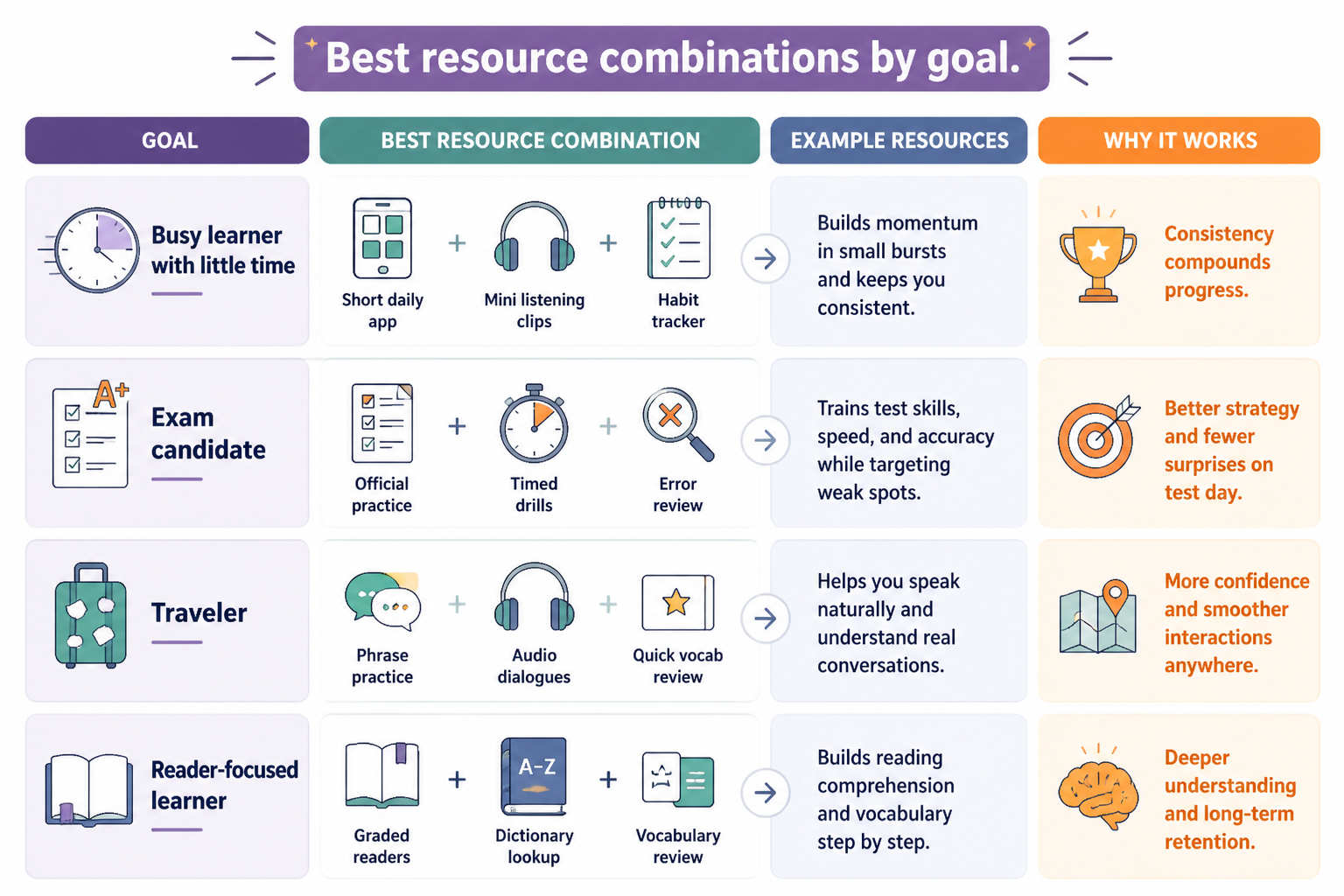
The best resource combinations by learner situation
Sometimes the easiest way to choose is by looking at your situation instead of your abstract goal. Here are a few common ones.
| Your situation | Best resource combination | Why it works |
|---|---|---|
| Total beginner | Beginner course, vocabulary review, simple audio | Gives structure, basics, and repeated exposure |
| Intermediate learner stuck in “I understand a bit” mode | Listening practice, speaking sessions, graded reading | Bridges comprehension and production |
| Busy learner with little time | Short daily app, mini listening clips, habit tracker | Easy to maintain even on rough days |
| Exam candidate | Official practice, timed drills, error review | Targets score-specific performance |
| Traveler | Phrase practice, audio dialogues, quick vocabulary review | Builds practical survival language fast |
| Reader-focused learner | Graded readers, dictionary lookup, vocabulary review | Improves comprehension with manageable difficulty |
If you notice a pattern, it is this: the best combinations include both input and output, or at least one active step after passive exposure. That keeps learning from becoming a spectator sport.
Common mistakes when choosing language learning resources
Resource mistakes are sneaky because they feel like productive effort. Here are the biggest ones.
1. Choosing resources because they are popular
Popular does not mean right for your goal. A flashy app may be great for some learners and useless for others. Ask what it trains before you install it.
2. Using too many resources at once
If you are using six tools, you may be spreading attention so thin that nothing gets enough repetition. Most learners improve faster with fewer resources used more consistently.
3. Picking resources that are too hard
Material that is way above your level can be inspiring for exactly twelve minutes. After that, it becomes a stress generator. Good resources should stretch you without turning every session into a survival exercise.
4. Relying only on passive learning
Watching, listening, and reading are important, but they do not replace producing the language. You need some combination of speaking, writing, or recall practice.
5. Ignoring feedback
If you never check your mistakes, you may keep practicing the same problems. Feedback is what turns practice into improvement.
6. Forgetting the real-world purpose
It is easy to study in a way that feels educational but does not support the life you actually want. If your goal is travel conversation, you probably do not need three weeks of obscure animal vocabulary.
Quick fix: every resource should answer one of these questions: What skill does it train? What goal does it support? What will I do with it this week?
A practical framework for choosing resources
When you are unsure, use this quick decision framework.
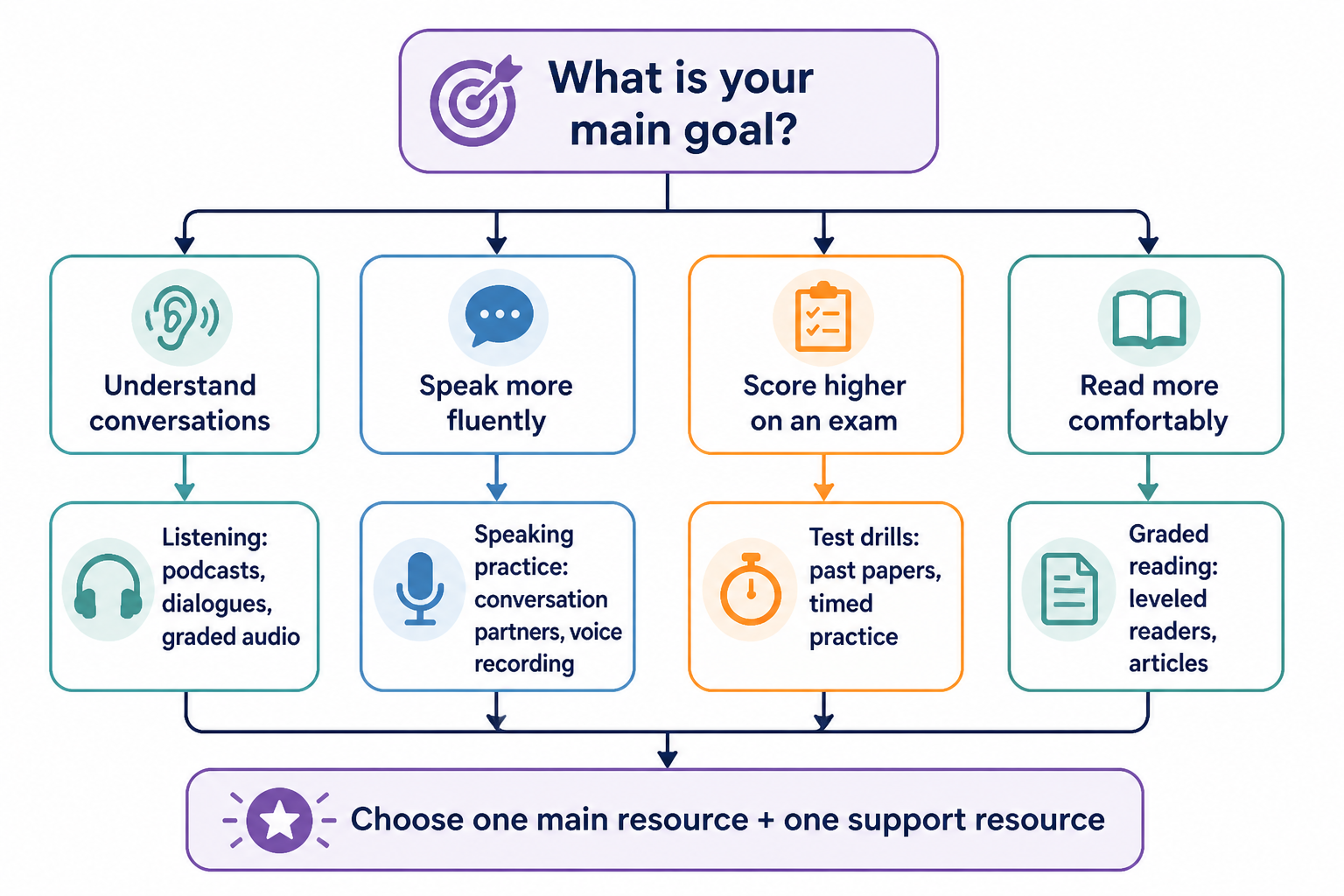
Step 1: Define your main goal in one sentence.
- “I want to understand everyday conversation.”
- “I want to speak more fluently.”
- “I want to pass my exam.”
- “I want to read articles comfortably.”
Step 2: Pick the skill that most directly supports that goal.
- Conversation understanding → listening
- Speaking fluency → speaking practice
- Exam score → test drills
- Reading comfort → graded reading
Step 3: Add one support resource.
- Listening + vocabulary review
- Speaking + shadowing audio
- Reading + dictionary lookup
- Exam prep + error log
Step 4: Limit your setup.
- One main resource
- One support resource
- One review system
Step 5: Use it long enough to learn something useful before switching.
How to tell if a resource is actually working
Sometimes people abandon a resource too quickly. Other times they keep using a resource long after it has stopped helping. Here are signs to watch for.
A resource is working if:
- You can use it regularly without dread.
- You notice repeatable progress over time.
- It supports your actual goal, not just your curiosity.
- It leads to output, recall, or understanding you did not have before.
- You can explain what it is for in one sentence.
A resource is probably not working if:
- You keep avoiding it.
- You finish sessions feeling busy but unchanged.
- You cannot say what skill it trains.
- It is too difficult or too easy to be useful.
- It does not fit the time you realistically have.
If a resource is not working, the answer is not always to quit immediately. Sometimes you need to adjust how you use it. For example, a listening resource may work better with transcripts. A speaking tool may work better if you use prompts instead of freestyle conversation right away.
What a balanced resource setup looks like
You do not need a huge system. In fact, a small balanced setup is often the smartest choice.
| Skill area | Example resource | Frequency |
|---|---|---|
| Input | Listening or reading material | Most days |
| Recall | Flashcards or review notes | Short daily sessions |
| Production | Speaking or writing practice | Several times per week |
| Feedback | Tutor, corrections, or self-review | Weekly or as needed |
| Motivation/consistency | Habit tracker or tiny daily routine | Daily |
This setup works because it covers the learning loop: see language, remember it, use it, fix it, repeat. That is what turns resources into progress.
Sample resource plans for different goals
To make this concrete, here are a few simple plans you can adapt.
Plan A: For the learner who wants better conversation
- 3 days a week: speaking with prompts or a partner
- Most days: short listening practice
- 2 to 3 times a week: vocabulary review from conversation topics
- Weekly: note common mistakes and review them
This plan builds both comprehension and response speed. It is especially helpful if you can understand basic language but struggle to answer quickly.
Plan B: For the learner who wants to read comfortably
- Most days: one short graded reading session
- During reading: look up only important words
- 3 times a week: review useful vocabulary from reading
- Weekly: summarize what you read in a few sentences
This plan keeps reading enjoyable while slowly increasing difficulty. It also prevents you from turning every session into a dictionary marathon.
Plan C: For the learner who wants to pass an exam
- 2 days a week: timed practice sections
- 2 days a week: focused review of weak areas
- 1 day a week: full practice test or a longer test-style set
- Short daily review: vocabulary, grammar, or error notes
This plan combines skill-building with format training, which is exactly what exam prep needs.
Plan D: For the busy learner who just wants to keep going
- 5 to 10 minutes a day: one app or one short lesson
- 2 or 3 times a week: one longer listening or speaking session
- Weekly: small review of what you actually completed
This plan is not flashy, but it is sustainable. And sustainable usually wins.
Common resource questions, answered simply
Should I use one resource or many?
Start with one main resource and one support resource. Add more only if they solve a clear problem.
Should I choose apps, books, or tutors?
Choose based on what you need most right now. Apps are convenient, books can explain clearly, and tutors provide feedback. Many learners benefit from a mix, but not from everything at once.
Can free resources be enough?
Yes, if they match your goal and you use them consistently. Free does not mean weak. It just means you need to be more careful about quality and fit.
How do I know when to switch resources?
Switch when a resource is no longer helping your goal, when it has become too easy or too hard, or when you are avoiding it so often that it is clearly not a fit.
Your next step: build a small, goal-based setup
The smartest way to choose language learning resources is to stop asking, “What is the best resource?” and start asking, “What resource helps me with my goal this month?”
That question leads to better choices, fewer distractions, and more steady progress. It also keeps you from buying the educational equivalent of a gym membership you only think about while sitting down.
If you want to turn this into an actual routine, the best next move is to define your goal, pick one main resource, add one support resource, and put it into a simple weekly plan. From there, build a habit that is easy enough to repeat. The structure behind that approach is explained in how to build a language study plan and how to build a language learning habit.
And if you still want the broader learning framework that ties all of this together, go back to the best way to learn a language. Resource choice is only one piece of the puzzle, but it is a very important piece. Pick well, and everything else gets easier.