

How to Create a Language Learning Plan That Actually Works
A good language study plan does one simple thing: it turns “I should practice more” into something you can actually follow on a normal Tuesday.
That sounds obvious, but it’s where a lot of learners get stuck. They buy a notebook, make a beautiful schedule, feel motivated for two days, and then life happens. Suddenly the plan is too ambitious, too vague, or too awkward to keep up with.
This guide will show you how to build a language study plan that fits real life. Not a perfect plan. A usable one. The kind that helps you improve steadily without needing superhero discipline or a monk-like calendar.
If you want the big-picture learning mindset behind all of this, the parent guide on how to learn a language is a helpful starting point. But here, we’re focusing on the practical part: how to design a study plan that actually gets used.
What a language study plan is really for
A language study plan is not just a calendar of tasks. It’s a decision-making tool.
Its job is to answer questions like:
- What am I learning first?
- How often will I study?
- What will I do in each session?
- How will I know I’m improving?
- What do I do when I miss a day or lose motivation?
Without a plan, language learning usually becomes a pile of random activities: a video here, an app streak there, a podcast in the car, maybe a grammar lesson when guilt strikes. None of that is bad. But random effort is hard to sustain, and even harder to measure.
A strong plan gives your learning direction. It helps you spend less time deciding and more time doing.
A good language plan doesn’t make learning easier every day. It makes continuing easier overall.
That distinction matters. The goal is not to make every session feel magical. The goal is to make progress feel predictable enough that you stay in the game long enough to improve.
Start with the right goal: what do you actually want the language for?
Before you choose resources or make a schedule, get clear on your reason for learning. This is the foundation of the whole plan.
Different goals need different study plans. For example:
| If your goal is… | Your plan should emphasize… |
|---|---|
| Travel basics | Common phrases, listening, survival vocabulary, quick speaking practice |
| Conversation | Speaking, listening, useful sentence patterns, pronunciation practice |
| Reading books or articles | Vocabulary, grammar recognition, reading practice, text comprehension |
| School or exams | Structured grammar, practice tests, targeted skill work, review cycles |
| Work or relocation | Practical vocabulary, workplace situations, speaking confidence, listening under pressure |
If your plan doesn’t match your goal, it will feel “busy” but not useful. That’s a very common problem. People study what looks impressive instead of what moves them forward.
Ask yourself these three questions:
- Why am I learning this language right now?
- What do I want to be able to do in 3 months?
- What would count as success for me, realistically?
Try to make your answer concrete. “I want to improve” is too vague. “I want to hold a 5-minute conversation about myself without freezing” is much better.
Step 1: Choose one main outcome and a few supporting skills
Once your goal is clear, turn it into a plan with one main outcome and a small number of supporting skills. This keeps your study focused instead of scattered.
Here’s the idea:
- Main outcome: the most important thing you want to improve
- Supporting skills: the smaller skills that help that main outcome happen
Example: If your main outcome is “hold a simple conversation,” your supporting skills might be:
- listening to everyday speech
- learning common sentence patterns
- practicing speaking aloud
- building core vocabulary for daily topics
That’s enough. You do not need twelve goals, six apps, a notebook system, and a motivational poster featuring your future fluent self.
The more goals you add, the more your attention gets diluted. A focused plan helps you notice progress faster, which keeps motivation alive.
Step 2: Do a quick reality check on your time, energy, and attention
Many language plans fail because they are built for the person you wish you were, not the person you actually are on an average week.
Be honest about three things:
- Time: how many minutes can you reliably study?
- Energy: when are you most alert?
- Attention: can you focus in long blocks, or do you need shorter sessions?
For many learners, the sweet spot is smaller than they expect. Thirty focused minutes beats a grand plan you abandon after a week.
Use this quick filter:
| Question | If the answer is “not much” | If the answer is “yes, a lot” |
|---|---|---|
| Can I study daily? | Build a small weekly minimum | Use daily habits plus bigger sessions |
| Can I focus for 30–60 minutes? | Use 10–20 minute blocks | Add deeper work sessions |
| Do I have mental energy after work? | Choose lighter tasks at night | Reserve harder tasks for peak energy |
The point is not to limit yourself forever. It’s to design something you can follow consistently enough to build momentum.
Step 3: Pick the core skills your plan must cover
Most language study plans should include four main skill areas:
- listening
- speaking
- reading
- writing
You do not need equal time in all four. In fact, forcing equal time is often a mistake.
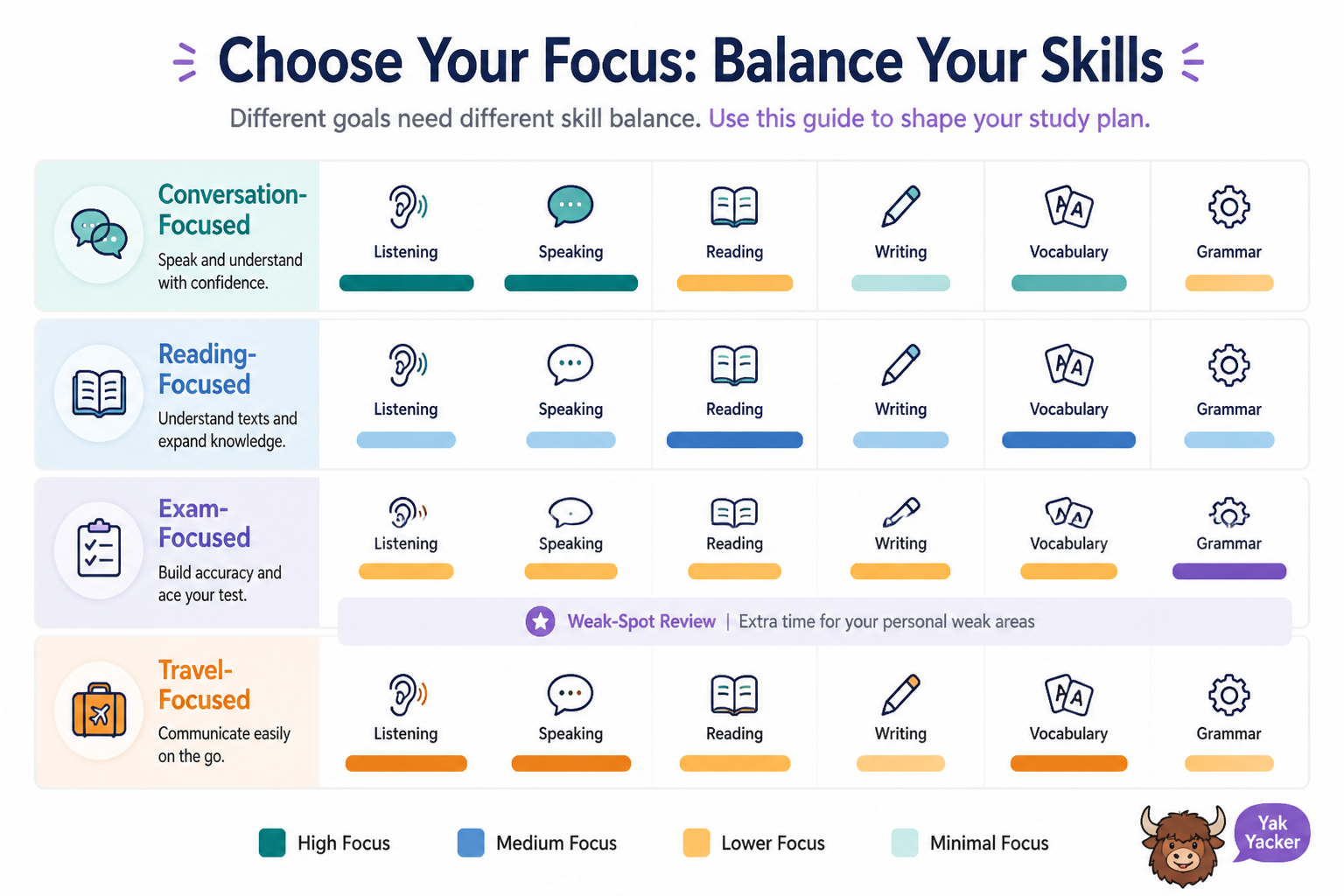
Instead, match the mix to your goal. For example:
- Conversation-focused: more listening and speaking, less writing
- Reading-focused: more reading and vocabulary, some grammar, lighter speaking
- Exam-focused: balanced skills, with extra work on weak spots
- Travel-focused: practical listening, speaking, and useful phrase review
A simple way to think about it: if one skill will be used more often in your real life, it should get more attention in your plan.
Step 4: Build your plan around input, output, and review
A strong study plan usually has three parts:
- Input: hearing or reading the language
- Output: speaking or writing the language
- Review: revisiting what you’ve learned so it sticks
This is where a lot of learners accidentally go wrong. They do lots of input and almost no output. Or they study new material constantly and never review it. That creates the illusion of progress without the memory support to back it up.
Here’s a practical balance:
- Input: builds familiarity and comprehension
- Output: forces active use and reveals gaps
- Review: turns short-term familiarity into long-term memory
Think of input as exposure, output as exercise, and review as storage. If one is missing, the whole system gets weaker.
What input can look like
- listening to short dialogues
- reading graded texts or simple articles
- watching slow, understandable content
- reading with audio support
What output can look like
- speaking aloud to yourself
- answering prompts in full sentences
- writing short journal entries
- practicing dialogues from memory
What review can look like
- spaced repetition cards
- quick recap of old notes
- re-listening to familiar material
- short weekly revision sessions
If your plan includes those three pieces, it is much more likely to produce actual progress, not just a satisfying sense that you were “doing language stuff.”
Step 5: Decide how often to study, and keep the promise small enough to keep
This is where the plan becomes real.
Frequency matters more than heroic sessions. Most learners do better with a smaller plan they can repeat than a larger one they keep renegotiating.
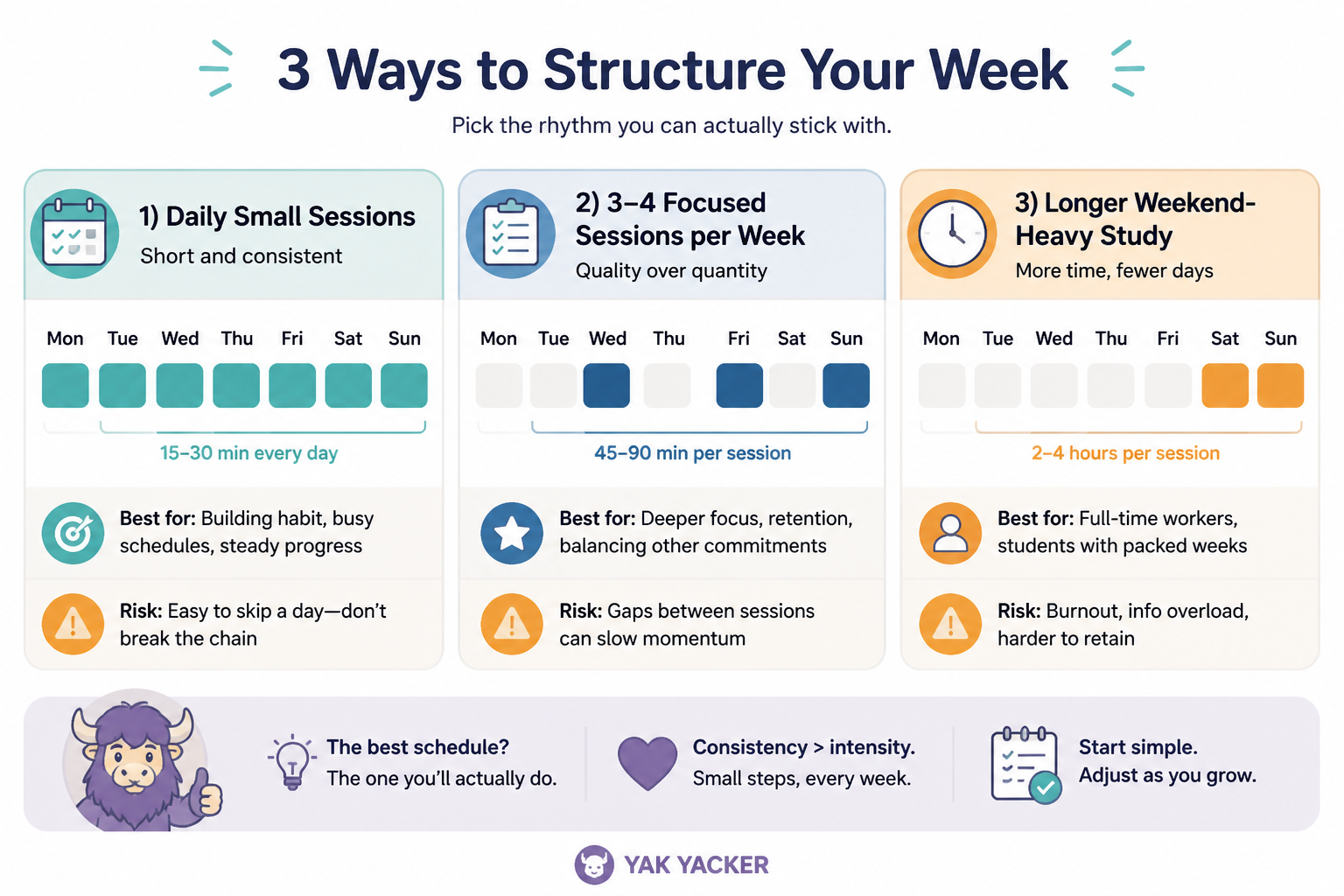
Here are three common study patterns:
| Pattern | Best for | Risk |
|---|---|---|
| Daily small sessions | Busy learners who need momentum | Can become too automatic or too shallow |
| 3–4 focused sessions per week | Learners with unpredictable schedules | Easy to skip if not scheduled carefully |
| Longer weekend-heavy study | People with limited weekday time | Hard to retain material without review |
A good rule: choose the smallest frequency you can truly sustain, then build from there if needed.
If you’re not sure, start smaller than you think. A plan you follow is better than a plan you admire from a distance.
Step 6: Design each study session so you know what to do
One reason study plans fail is that they define the schedule but not the session. You sit down, look at your materials, and waste ten minutes deciding where to begin. That friction adds up fast.
Every session should have a simple structure. Here’s an easy template:
- Warm-up: review something familiar
- Main task: learn or practice one new thing
- Active use: say, write, or apply it
- Quick review: check what stuck
Example of a 30-minute session:
- 5 minutes: review old vocabulary
- 10 minutes: learn a small set of new phrases
- 10 minutes: listen and repeat or answer prompts aloud
- 5 minutes: write down what was hard
That structure is simple, but it prevents aimless wandering. It also makes starting easier because you are not inventing a new workflow every time.
For shorter sessions, shrink the plan instead of skipping it:
- 2-minute review
- 5-minute focused task
- 3-minute active recall
Short sessions still count. In fact, they are often the sessions that keep the whole plan alive.
Step 7: Choose resources that match the job, not just the hype
Resources are useful only if they fit your goal and your current level. A flashy resource that is too hard, too boring, or too vague will slow you down.
When choosing resources, ask:
- Does this help my main goal?
- Is it the right level for me right now?
- Will I actually use it consistently?
- Does it support input, output, or review?
If you want help matching resources to specific goals, the guide to best language learning resources by goal can be useful.
The best resources are usually not the most impressive ones. They are the ones that you can use repeatedly without mental drama.
A useful rule: use fewer resources than you think you need. It’s easier to stay consistent with three good tools than with twelve promising ones and one confused brain.
A simple language study plan template you can copy
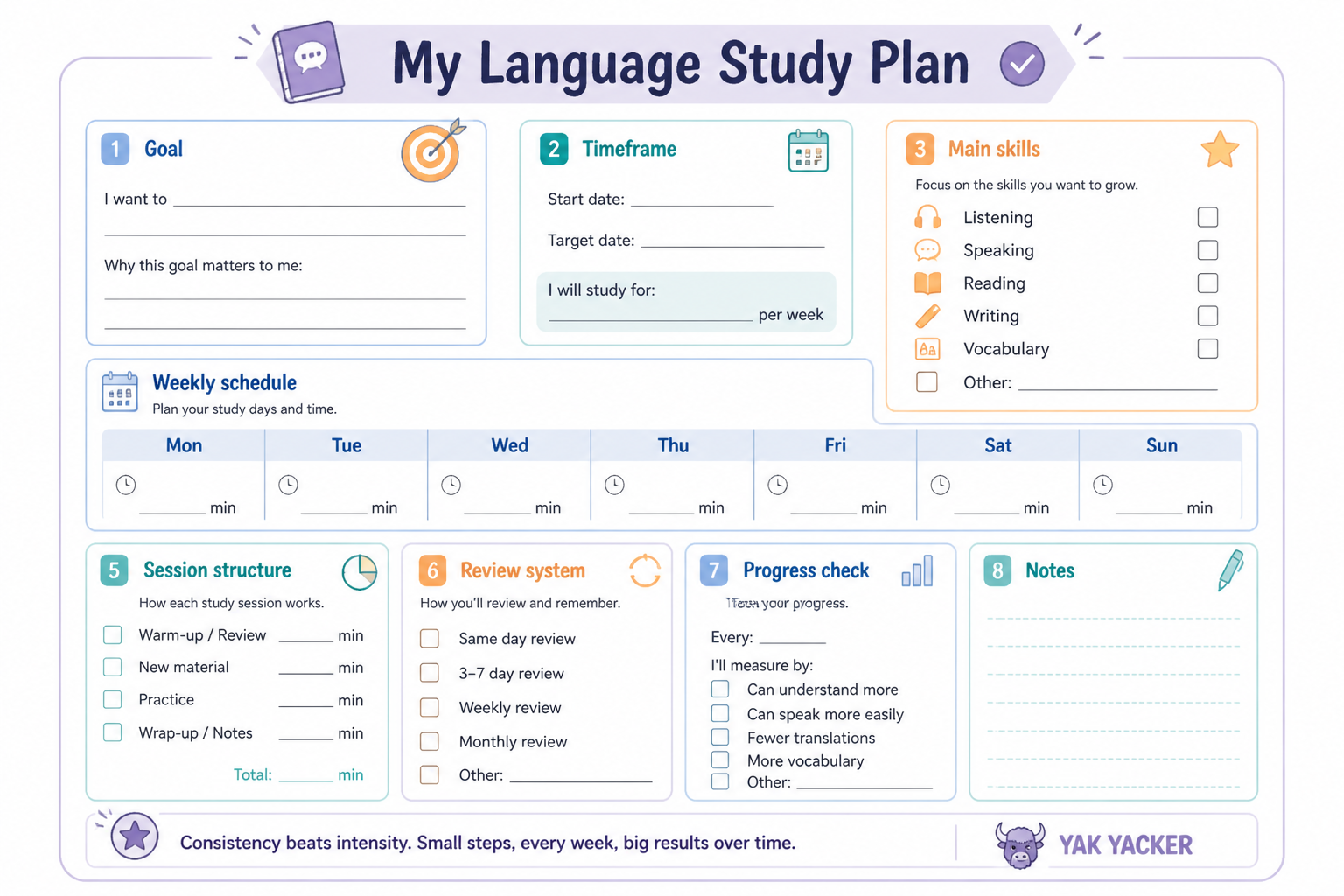
Here’s a practical template you can adapt for almost any language:
| Part | What to decide | Example |
|---|---|---|
| Goal | What you want to do | Hold a basic conversation |
| Timeframe | How long you’re planning for | 12 weeks |
| Main skills | Which skills matter most | Listening, speaking, vocabulary |
| Weekly schedule | How often you study | 5 days a week, 25 minutes each |
| Session structure | What each session looks like | Review, learn, use, check |
| Review system | How you keep old material alive | Sunday recap + spaced repetition |
| Progress check | How you measure improvement | Short speaking test every 2 weeks |
That template is flexible on purpose. The trick is not to copy the example exactly. The trick is to make each part specific enough that you can follow it without guessing.
What a realistic beginner plan might look like
Here’s a sample plan for a beginner who wants basic conversation ability and has about 20–30 minutes a day.
| Day | Main focus | Task |
|---|---|---|
| Monday | Listening + phrases | Short dialogue, repeat key phrases, note 5 useful expressions |
| Tuesday | Vocabulary + review | Review old cards, learn 8–10 new words, use them in sentences |
| Wednesday | Speaking | Say a short self-introduction and answer 3 prompts aloud |
| Thursday | Listening + pronunciation | Listen to one short audio, shadow lines, focus on sounds |
| Friday | Review + writing | Write 4–5 sentences using the week’s material |
| Weekend | Light input or catch-up | Relaxed listening, reading, or missed review |
This plan is not fancy. That’s a feature, not a bug. It has repetition, variety, and enough structure to make the next session obvious.
If you are more advanced, the same structure can still work. You just upgrade the tasks: more complex listening, longer speaking, richer reading, and more detailed writing.
How to build review into your plan so you don’t forget everything
Review is the part many learners skip because it feels less exciting than learning something new. But review is what keeps your efforts from leaking out of your brain like a badly sealed bucket.
A good review system does three things:
- repeats important material at intervals
- keeps older content active
- shows you what you actually remember
Simple review options include:
- daily flashcard review
- weekly recap sessions
- re-listening to old audio
- rewriting key phrases from memory
You do not need a complicated system to benefit from review. You just need a reliable one.
Try this pattern:
- Same day: review new material for 5 minutes
- 2–3 days later: revisit it briefly
- 1 week later: use it in a new context
- 2–4 weeks later: test yourself without notes
That rhythm helps move words and structures from “I saw this once” to “I can probably use this.” Which is a big upgrade.
How to make your plan flexible without making it vague
Flexibility is important. But many learners use “I want flexibility” as code for “I don’t want to decide anything.” That usually leads to inconsistency.
A flexible plan still has rules. It just has a backup version of the rules.
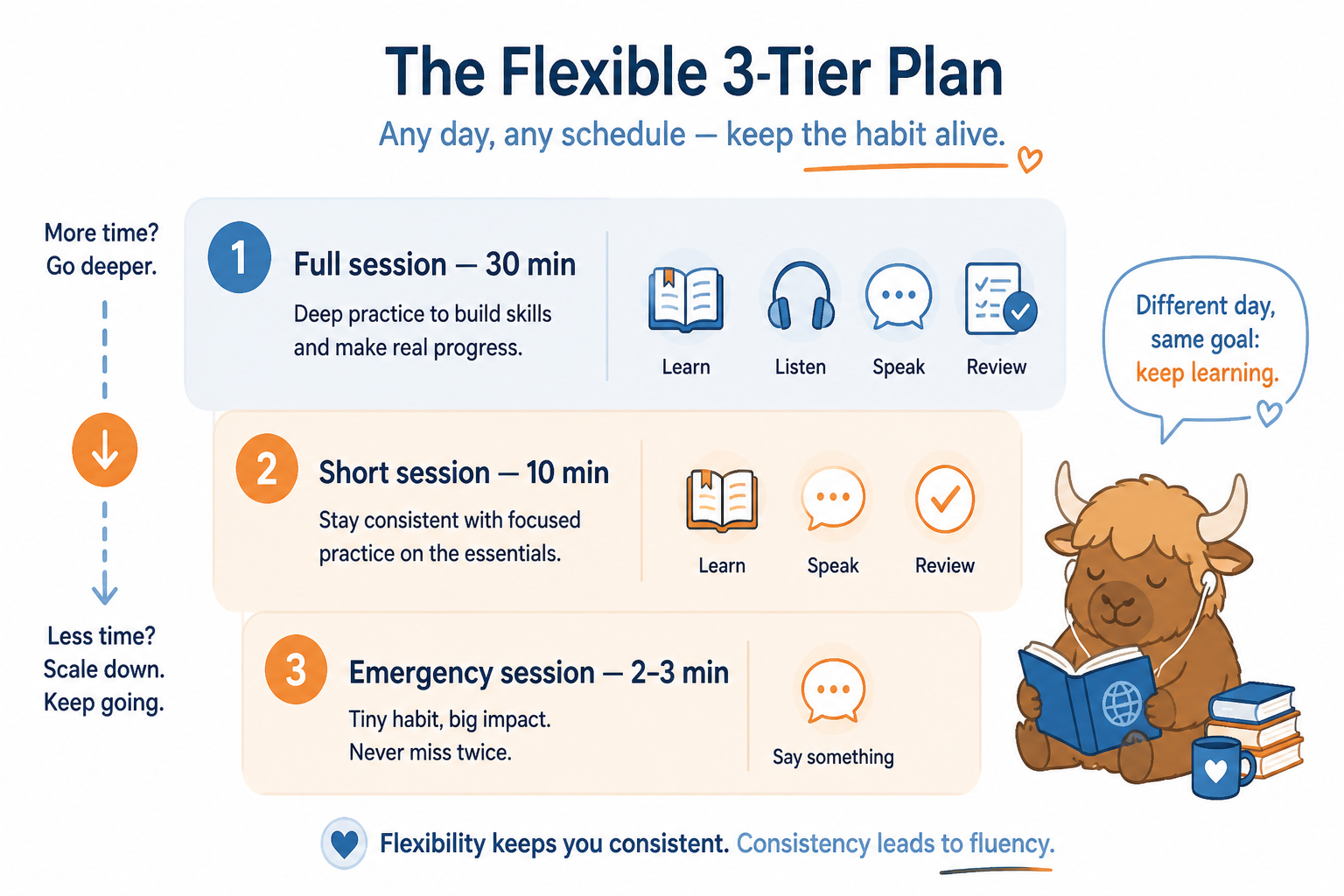
For example:
- Full session: 30 minutes on a normal day
- Short session: 10 minutes on a busy day
- Emergency session: 2–3 minutes to preserve the habit
This way, the plan survives busy weeks. You can scale down without abandoning the system.
A good plan also allows for swapping tasks. If you’re too tired for speaking practice, maybe do listening review instead. If you can’t read a long article, read a short one. The key is to protect the habit and the direction, even when the exact task changes.
Common mistakes people make when building a language study plan
Here are the big ones. If you can avoid these, your plan is already ahead of most.
1. Making the plan too ambitious
People often build a plan for a highly motivated version of themselves who has endless energy and never gets interrupted. Real life disagrees.
Fix: halve the plan. Then see if it still feels good. If it does, that’s probably closer to sustainable.
2. Studying only what feels comfortable
It’s easy to overdo the fun part, like watching content, while avoiding the harder work of speaking or review.
Fix: make sure each week includes at least one output task and one review task.
3. Changing the plan every few days
Constant tweaking can feel productive, but it often hides inconsistency. A plan needs time to show whether it works.
Fix: keep a plan stable for a few weeks before major changes, unless something is obviously broken.
4. Using too many resources
Too many apps and textbooks create decision fatigue. You spend more time choosing than learning.
Fix: choose one main resource per skill, then commit for a while.
5. Not defining progress clearly
If success is vague, the plan feels disappointing even when it is working. You need markers you can actually notice.
Fix: define measurable signs of progress, such as:
- I can understand a longer listening clip
- I can say the same sentence with less hesitation
- I recognize words faster when reading
- I can review old material with fewer errors
How to track progress without turning your life into a spreadsheet museum
You do not need elaborate tracking. In fact, too much tracking can become another procrastination hobby.
Keep it simple. Track a few signals:
- how many sessions you completed this week
- what you practiced
- what felt easier than before
- what still feels hard
You can do this in a notebook, a notes app, or a calendar. The method matters less than the habit of noticing change.
A good weekly check-in might ask:
- Did I follow my plan?
- Which sessions worked best?
- What did I avoid?
- What should I adjust next week?
This keeps the plan alive and responsive without making it a second job.
How to adjust your plan when it stops working
Every language plan eventually needs a tune-up. That does not mean you failed. It means you have new information.
Here’s how to diagnose the problem:
| If you notice… | The issue might be… | Try this |
|---|---|---|
| You keep skipping sessions | The plan is too big or the time is awkward | Shorten sessions or move them to a better time |
| You study but forget a lot | Not enough review | Add spaced review and more active recall |
| You understand input but can’t speak | Too much passive learning | Add more speaking practice, even if it’s short |
| You feel bored | Material may be too easy or too repetitive | Change content level or task type |
| You feel overwhelmed | Too many goals or resources | Cut the plan down to the essentials |
The best adjustment is usually a small one, not a total rebuild. Small changes are easier to test, and they keep you moving.
For example, instead of rewriting your whole study system, you might simply add:
- 5 more minutes of review
- one speaking session per week
- a shorter, easier input resource
- a fixed weekday for your hardest task
How to make your plan easier to follow than to ignore
A study plan works best when it reduces friction. The less you have to think before starting, the more likely you are to begin.
Make your plan easier by doing these things:
- Keep your materials in one place
- Use the same study time when possible
- Write the next task before you stop
- Have a backup session for busy days
- Start with a tiny first step
One underrated trick: end each session by writing down exactly what you’ll do next time. Future you is busy and forgetful. Be kind and specific.
Example:
Next session: review 10 words, listen to the first dialogue again, and practice the three sentences I kept stumbling over.
That note makes restarting much easier.
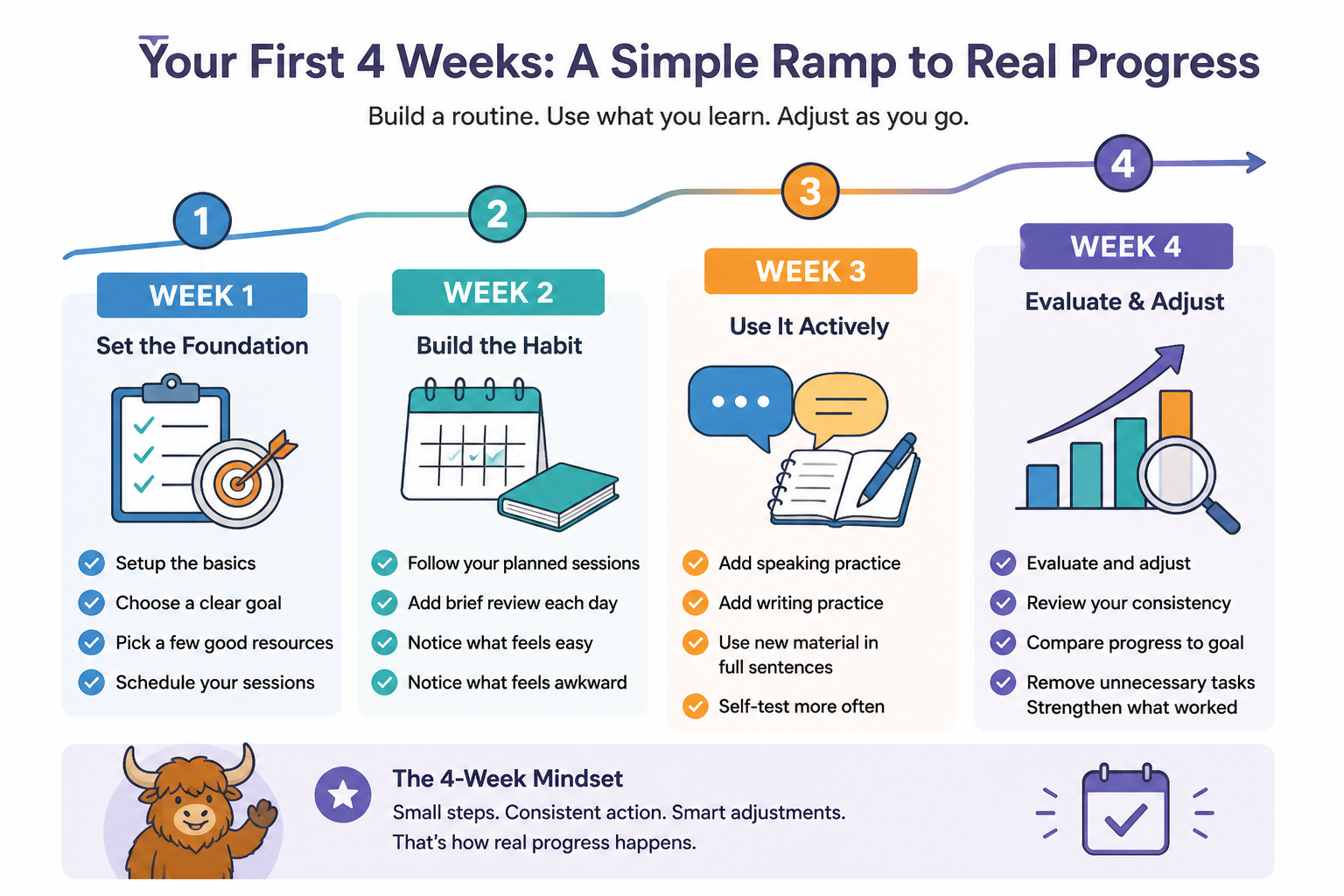
A 4-week starter plan for building momentum
If you want a simple way to begin, use this four-week structure. It’s designed to help you build consistency before complexity.
Week 1: Set up and simplify
- choose your goal
- pick one main resource per skill
- set a realistic schedule
- complete easy sessions only
Week 2: Build the rhythm
- follow your planned sessions
- add a small review routine
- notice which tasks feel smooth and which feel awkward
Week 3: Add active use
- include more speaking or writing
- use new material in full sentences
- test yourself without looking as often
Week 4: Evaluate and adjust
- review your consistency
- check progress against your goal
- remove anything that feels unnecessary
- strengthen the parts that worked
This kind of gradual start is much more effective than an oversized launch plan that burns out by Thursday.
Quick checklist: does your study plan pass the reality test?
Before you commit, check whether your plan can answer “yes” to most of these:
- Is the goal specific?
- Does the plan match my real reason for learning?
- Can I follow it on a busy week?
- Does it include input, output, and review?
- Do I know what each session will look like?
- Am I using a manageable number of resources?
- Can I track progress without overcomplicating it?
- Do I have a backup plan for low-energy days?
If you answered “no” to several of these, the plan probably needs simplifying, not more motivation.
What to do next
If your language study plan still feels fuzzy, start smaller than your pride wants you to. Pick one goal, one schedule, one review method, and one way to measure progress. That is enough to begin.
If you want to improve the habit side of your system, the guide on how to build a language learning habit pairs naturally with this one.
If you’re still deciding what kind of approach fits you best overall, you may also find the best way to learn a language helpful for choosing a broader learning strategy.
And if you want to choose tools more intelligently, the resource guide for language learning resources by goal can help you avoid the “I have six apps and no plan” trap.
The best language study plan is not the prettiest one. It’s the one you can return to tomorrow, and the next day, and the day after that. Build for repeatability first. Fancy can wait.