

If you want the best way to learn a language, here’s the honest answer: there is no magic method, but there are much better ways and much worse ones. The most effective learners usually do a few simple things very well: they focus on the right material, practice consistently, make input understandable, and keep reviewing what matters instead of trying to memorize everything at once.
For the broader learning path, visit our parent guide.
That sounds almost too simple, which is annoying if you were hoping for a secret shortcut. But simple does not mean easy. Learning a language effectively is mostly about building a system you can actually stick to long enough to see progress.
This guide will show you how to do that. You’ll learn what makes language study effective, how to choose the right mix of listening, reading, speaking, and vocabulary work, how to avoid the most common mistakes, and how to build a study routine that keeps working after the initial motivation disappears.
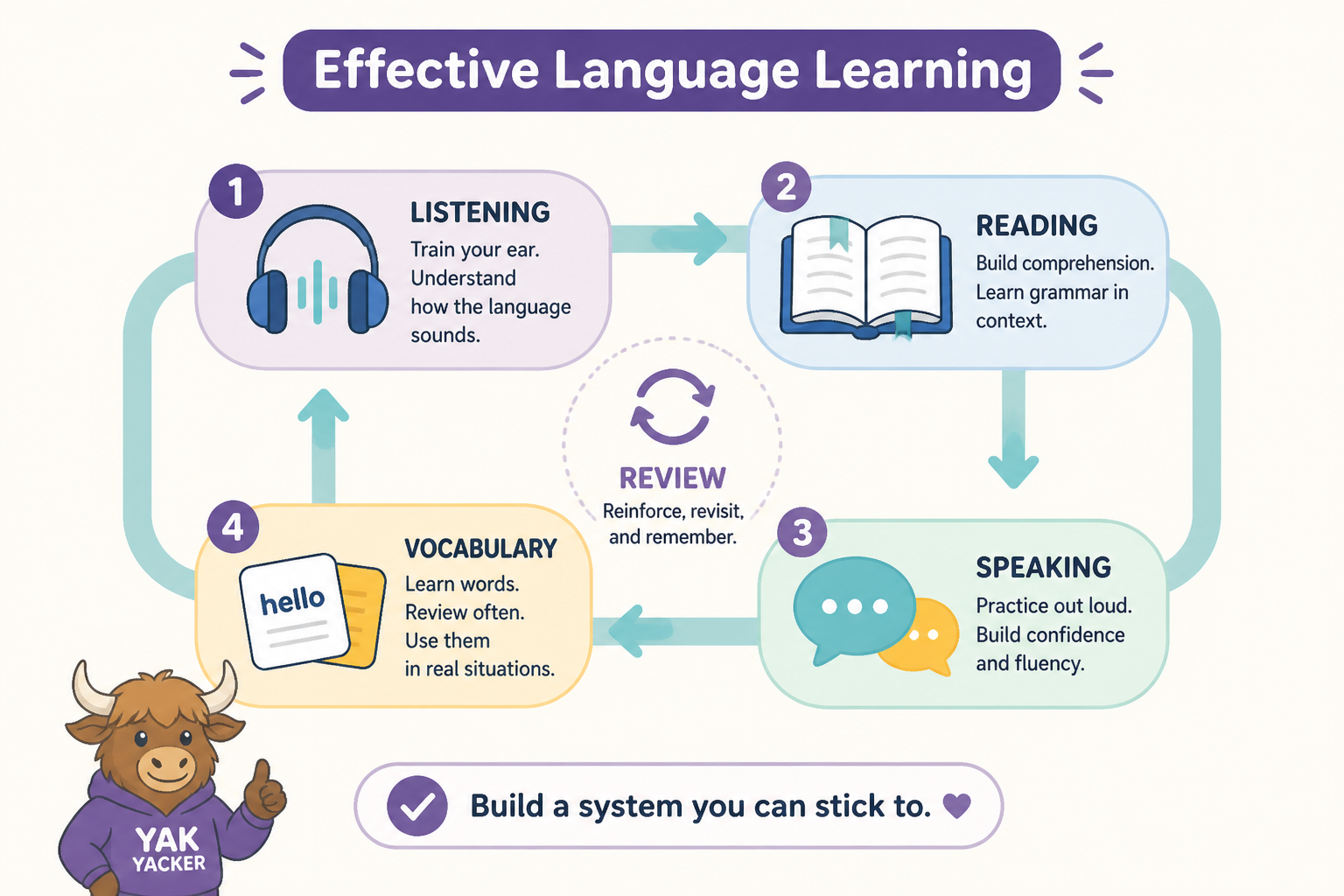
What “learning a language effectively” actually means
Before talking about methods, it helps to define the goal. Learning a language effectively does not mean using the most advanced app, studying for the longest hours, or knowing every grammar term. It means making real progress with the least wasted effort.
In practical terms, an effective language learner does these things:
- understands more of the language over time
- remembers useful words and phrases
- can use the language in real situations, not just on a worksheet
- keeps going long enough to improve steadily
- does not spend half the study time on things that barely help
That last point matters a lot. Many learners are not failing because they are lazy. They are failing because their study method is inefficient. They study what feels productive instead of what actually builds language ability.
For example, spending an hour highlighting grammar notes can feel serious. But spending 20 minutes understanding a short text, then reviewing the useful vocabulary, and then trying to use those words in a sentence is often far more effective.
Effective language learning is not about doing everything. It is about doing the right things often enough to create progress.
The core principle: input plus output plus review
If you want a simple framework to remember, use this:
| Part | What it does | Examples |
|---|---|---|
| Input | Helps you understand the language | listening, reading, watching with support |
| Output | Helps you use the language actively | speaking, writing, shadowing |
| Review | Helps you remember what you learned | spaced repetition, quick review, notes, self-testing |
Most beginner and intermediate learners need all three. If you only do input, you may understand more than you can say. If you only do output, you may get stuck constantly reaching for words you never really absorbed. If you skip review, everything leaks out of your brain like a badly packed suitcase.
The best way to learn a language is not one activity. It is a balanced process with a clear purpose for each part.
Start with a realistic goal, not a vague dream
“I want to learn Spanish” is a nice dream, but it is not yet a study plan. Effective learners define what success means for them.
Ask yourself:
- Do I want to travel and handle basic conversations?
- Do I want to read articles or books?
- Do I need the language for work?
- Do I want to watch shows and understand most of them?
- Do I want to speak comfortably with native speakers?
Your goal affects your method. Someone who wants survival conversation does not need the same study system as someone aiming for professional-level reading.
A useful goal has three parts:
- Target skill: speaking, listening, reading, writing, or a mix
- Target situation: travel, work, school, conversation, media, exams
- Target time frame: what progress you want in 3 months, 6 months, or a year
For example: “In six months, I want to handle short conversations while traveling and understand common phrases in daily situations.” That is specific enough to guide your study choices.
If your goal is vague, you will keep asking, “Am I doing enough?” If your goal is clear, you can make smarter decisions about where to spend your time.
Choose methods that make the language understandable
One of the biggest mistakes learners make is choosing material that is too hard. They assume difficulty means effectiveness. It often means frustration.
Language learning works best when input is just slightly above your current level. You should understand enough to follow the main idea, but still encounter new words and structures that stretch you.
Here’s the practical rule:
- If you understand almost nothing, the material is too hard.
- If you understand everything instantly, it may be too easy for growth.
- If you understand most of it and can infer the rest, it is probably useful.
This matters because comprehensible material makes learning possible. You cannot easily learn from total confusion. Your brain needs context. It needs repetition. It needs meaning.
That is why beginners often learn faster from graded readers, slow audio, simple dialogues, or short learner-friendly texts than from full-speed native podcasts or news broadcasts.
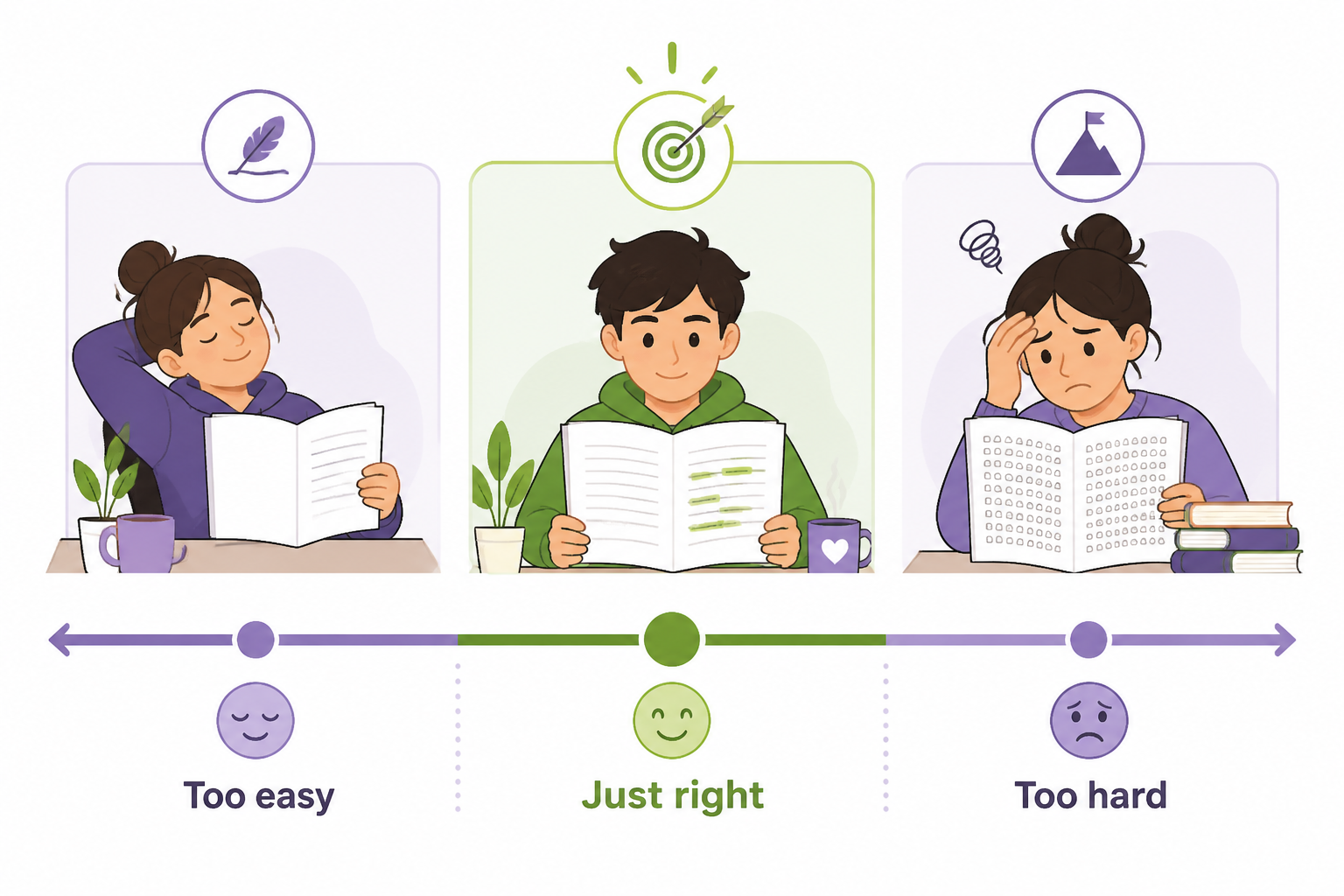
A quick test for choosing material
- Can I understand the topic without translating every sentence?
- Can I guess some unknown words from context?
- Can I stay focused for more than a few minutes?
- Will I learn something new without feeling completely lost?
If the answer is yes to most of these, the material is probably in the right zone.
Use the right balance of listening, reading, speaking, and writing
Many learners try to “study the language” in a general way. The problem is that language ability is not one skill. It is a set of connected skills.
Here is what each skill does for you:
| Skill | What it builds | Best use case |
|---|---|---|
| Listening | sound recognition, natural rhythm, common phrases | understanding real conversations |
| Reading | vocabulary growth, grammar recognition, spelling awareness | learning new words quickly and seeing language in context |
| Speaking | fluency, retrieval speed, confidence | using the language in real life |
| Writing | accuracy, sentence control, active recall | thinking carefully and reinforcing grammar |
If you’re a beginner, input usually matters more at the start, especially listening and reading with support. But output should not wait forever. You do not need perfect knowledge before you begin speaking or writing simple sentences.
The trick is to make each skill serve a job:
- Listening teaches your ear to recognize the language.
- Reading helps you absorb vocabulary and structure.
- Speaking forces quick retrieval and reveals gaps.
- Writing helps you slow down and notice accuracy.
A well-designed study plan uses the strengths of each skill instead of guessing and hoping for the best.
Focus on high-frequency language first
Not all words are equally useful. In every language, a relatively small set of words appears constantly. If you learn these first, you can understand and say much more with less effort.
That does not mean you should obsess over frequency lists for months. It means you should prioritize language that shows up again and again in real life:
- basic greetings and social phrases
- common verbs
- numbers, time, and dates
- question words
- daily actions
- common connectors like “and,” “but,” “because,” and “then”
This gives you early wins. You can understand more quickly, and you can start making useful sentences sooner. That boost in confidence matters more than people admit.
Here is the important caveat: frequency is helpful, but relevance is just as important. If you are learning for travel, words about transportation, food, lodging, and directions may matter more than obscure categories that you will not use soon.
The best way to learn a language is to combine high-frequency language with your personal needs. That gives you both efficiency and usefulness.
Learn vocabulary in context, not as disconnected word lists
One of the fastest ways to waste study time is to memorize long lists of isolated words without seeing how they work in real sentences.
Why? Because words behave differently depending on context. Their meaning can shift slightly. Their grammar can change. Their common partners matter. A word you “know” on paper may disappear from memory when you try to use it.
Better vocabulary methods include:
- learning words inside short sentences
- collecting phrases, not just single words
- reviewing words from texts or audio you actually understood
- writing your own example sentence
- using spaced review to bring words back before you forget them
For example, instead of learning only “to decide,” “decision,” and “decisive” separately, notice how they appear in actual language. Seeing patterns like this makes vocabulary stick better and helps you use it more naturally.
A simple and effective rule: if a word seems important, capture the phrase it appears in, not just the word itself.
That tiny shift can make your vocabulary feel much less slippery.
Use spaced repetition, but don’t let it replace real language use
Spaced repetition is one of the most useful tools in language learning. It helps you review information at the right moment: before you forget it completely, but after enough time has passed for the review to matter.
Used well, it is excellent for:
- vocabulary
- phrases
- useful sentence patterns
- small grammar points that need memorization
Used badly, it becomes a giant deck of random cards you half-ignore while telling yourself you are “studying.” That is not ideal. It can feel productive without building real ability.
To use spaced repetition effectively:
- keep your cards simple
- include context, not just translations
- avoid stuffing in every word you see
- review things you actually need
- test yourself actively instead of just rereading
A good flashcard is usually short, specific, and useful. For example, a card that asks you to recall a phrase from context is often better than a card with a lonely vocabulary word floating in space like a confused balloon.
For more help choosing resources that fit your goal, see best language learning resources by goal.
Build a study plan instead of improvising every day
Random study sessions can keep you busy, but they usually do not keep you moving in the same direction. A study plan solves that problem.
A strong plan answers four questions:
- What do I study?
- How long do I study?
- In what order do I study things?
- How do I know it is working?
You do not need a complicated system. In fact, complicated systems often collapse after a few weeks. A simple plan that you repeat consistently is better than a perfect plan that exists only in your imagination.
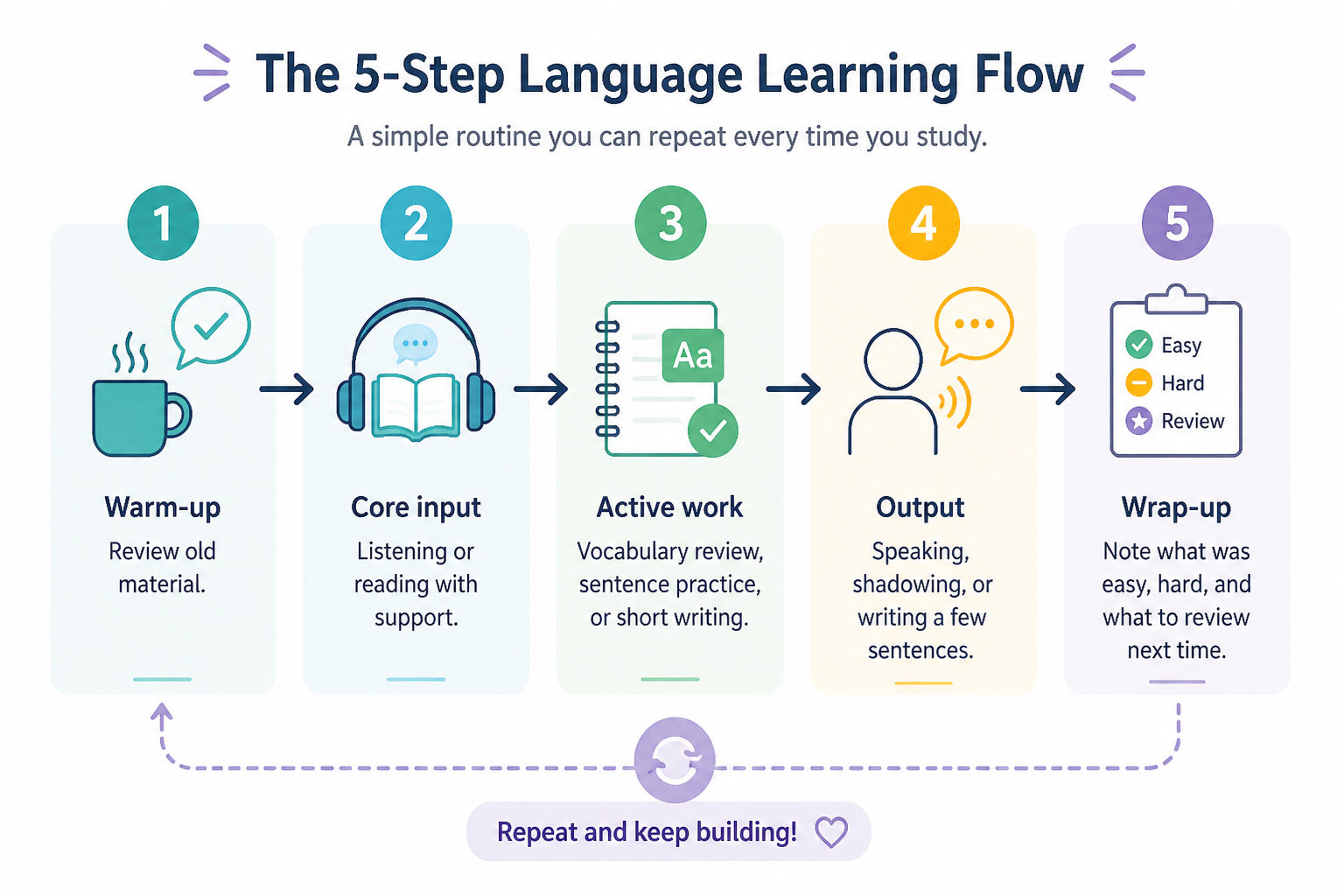
Here is a basic structure many learners can use:
- Warm-up: review old material for 5 to 10 minutes
- Core input: listening or reading with comprehension support
- Active work: vocabulary review, sentence practice, or short writing
- Output: speaking, shadowing, or writing a few sentences
- Wrap-up: note what was easy, hard, and worth reviewing next time
This approach is simple, but it covers the major learning functions. If you want help designing a routine that fits your schedule, use how to build a language study plan.
Sample weekly structure for a busy learner
| Day | Main focus | Example task |
|---|---|---|
| Monday | review + listening | review 15 cards, listen to a short dialogue |
| Tuesday | reading + vocabulary | read a short text and extract useful phrases |
| Wednesday | speaking | say simple sentences aloud or do a short conversation practice |
| Thursday | listening + shadowing | repeat short phrases after audio |
| Friday | writing + review | write 5 to 8 sentences using the week’s vocabulary |
| Weekend | lighter input | watch, read, or review something enjoyable |
This is only one model, not a law. The best plan is the one you can repeat without negotiating with yourself every day like a tiny exhausted manager.
Turn passive exposure into active learning
Passive exposure means hearing or seeing the language. Active learning means doing something with it. Both matter, but passive exposure alone is not enough if you want real progress.
Here is how to turn input into learning:
- pause after a sentence and say it in your own words
- repeat key phrases aloud
- write down one useful phrase from a text
- make a short summary of what you heard or read
- use new vocabulary in your own sentence the same day
This kind of active processing makes language stick. It forces your brain to notice meaning, structure, and usage instead of letting the words slide past like scenery on a train.
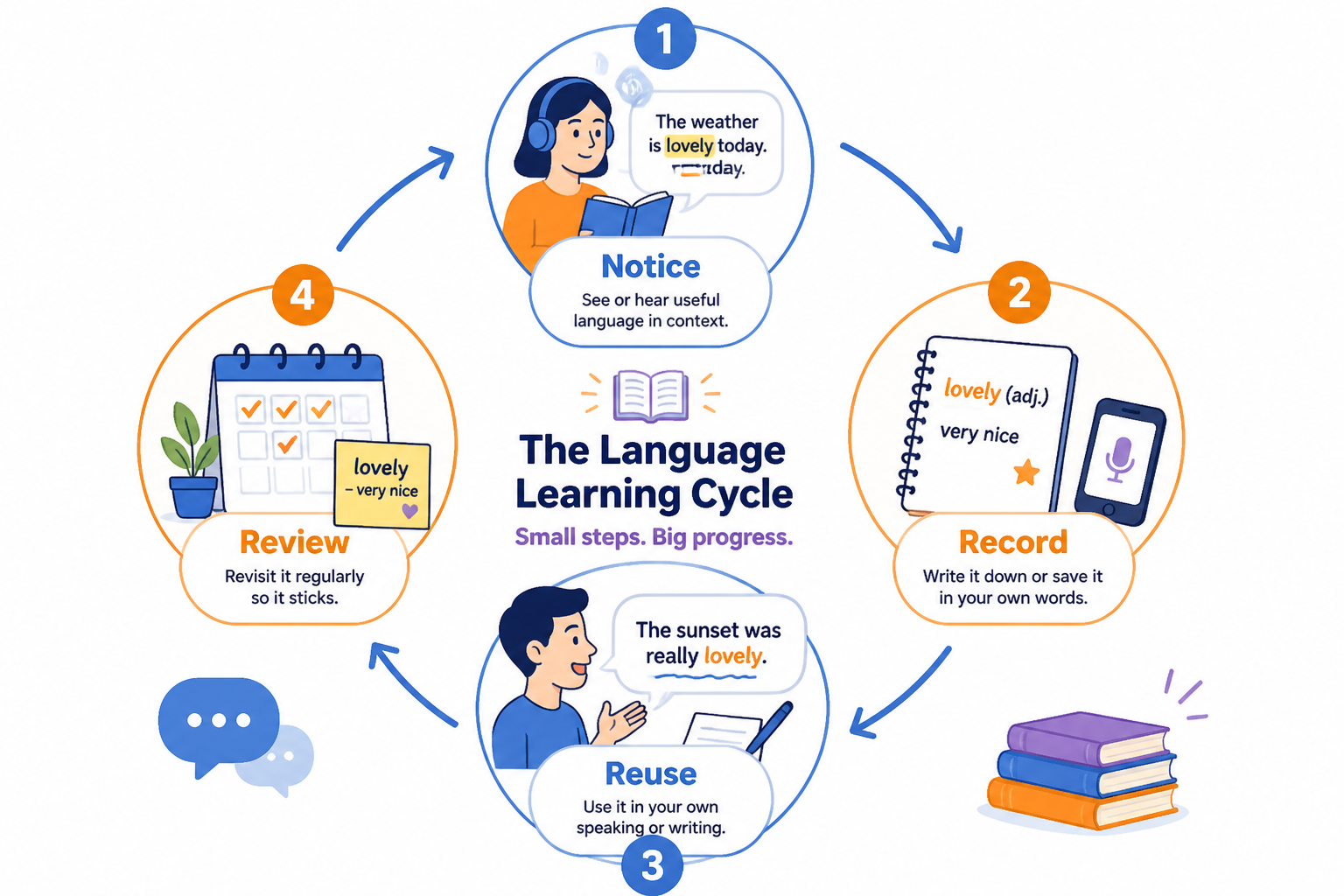
One especially useful method is “notice and reuse.” First, notice a phrase in context. Then, use it in a sentence of your own. That simple cycle is often more effective than collecting fifty random words and hoping they assemble themselves later.
Practice speaking earlier than feels comfortable
Many learners wait too long to speak because they want to avoid mistakes. That is understandable. Nobody enjoys sounding clumsy. But speaking is not the final reward for perfect learning. It is part of learning.
Speaking early helps you:
- notice gaps in your knowledge
- improve recall speed
- build confidence using the language under pressure
- learn what you actually need in conversation
You do not need long fluent conversations on day one. Start with simple actions:
- repeat short phrases aloud
- answer simple prompts
- describe your day in basic sentences
- practice common questions and answers
- read short dialogues and act them out
The goal is not perfection. The goal is retrieval. Can you get the words out when you need them?
A useful mindset shift: mistakes are not proof that speaking is failing. Mistakes are data. They tell you what to work on next.
Use writing to slow down and sharpen your accuracy
Writing is often underrated, especially by learners who mainly want to speak. But writing is powerful because it gives you time to think. That extra time helps you notice grammar, word choice, and sentence order more carefully.
Writing works well for:
- journaling in simple sentences
- rewriting a text using your own words
- answering prompts
- summarizing what you learned
- practicing a specific structure repeatedly
You can keep writing extremely simple. Even five short sentences a day can be useful if you review them and improve them over time.
Try this mini routine:
- Write 3 to 5 sentences about your day.
- Circle any words you had to search for.
- Check whether your sentence makes sense.
- Rewrite it more clearly if needed.
- Save the useful phrases for review.
Writing is especially helpful when your speaking is still shaky. It lets you practice active use without the speed pressure of live conversation.
Make your study time small enough to repeat
One of the most practical secrets of effective language learning is that consistency beats drama. A short session repeated regularly is better than a heroic three-hour session that happens once and never returns.
This does not mean long sessions are bad. It means the size of the session should match your life. If your plan is too big, you will eventually avoid it. If it is small enough, you can keep going.
A good question to ask is: “What is the smallest session I can do even on a bad day?”
- 10 minutes of review
- 10 minutes of listening
- 5 minutes of speaking aloud
- 5 minutes of writing one short paragraph
That may not sound dramatic, but repeated over time, it builds momentum. And momentum is where language learning stops feeling like a repeated restart and starts feeling like progress.
If building a habit is your main challenge, see how to build a language learning habit.
Common mistakes that make language learning less effective
Sometimes the fastest way to improve is to stop doing the things that quietly waste time. Here are the biggest culprits.
1. Studying too many things at once
It is tempting to use five apps, three textbooks, four YouTube channels, and a stack of flashcards. The problem is not variety itself. The problem is fragmentation. You end up feeling busy while never building depth in anything.
Fix: choose a small number of core tools and use them consistently.
2. Choosing material that is far too hard
If every sentence feels like a puzzle, learning becomes exhausting. You may work hard, but the return is small.
Fix: lower the difficulty until you can understand most of the message with support.
3. Memorizing words without using them
A word you never meet again is easy to forget. A word you see, hear, say, and write is much more likely to stick.
Fix: learn vocabulary from real material and reuse it in your own sentences.
4. Waiting too long to produce language
Some learners spend months consuming input but never trying to speak or write. That can create a big gap between recognition and use.
Fix: begin simple output early, even if it is short and imperfect.
5. Mistaking comfort for progress
It feels good to review what you already know. But if your study never gets slightly challenging, progress slows down.
Fix: keep most of your work understandable, but include a small amount of stretch.
6. Not reviewing enough
Language learning is cumulative. If you never revisit old material, you end up relearning the same things over and over.
Fix: schedule quick review into every week.
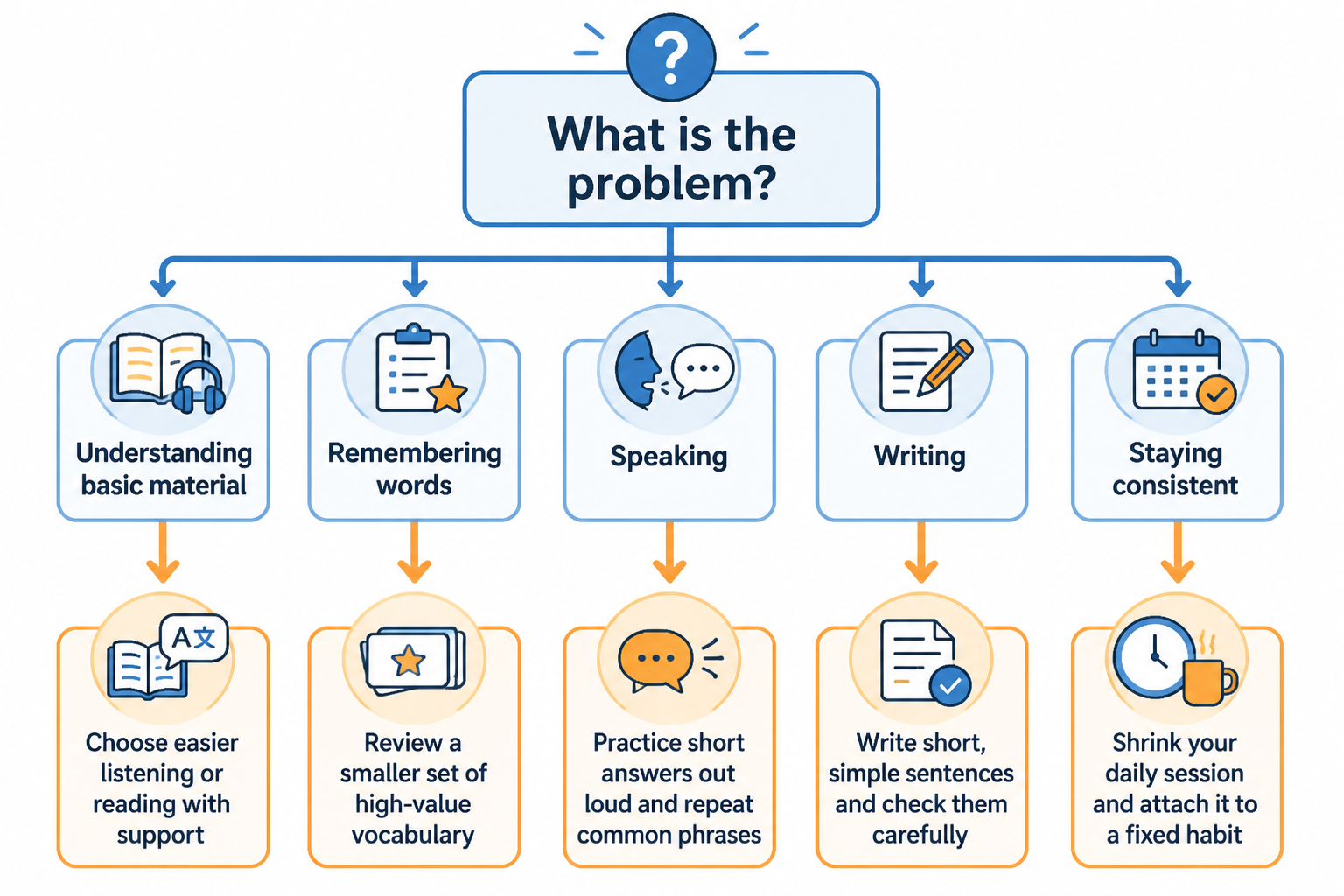
A simple decision guide for what to study next
If you ever feel stuck choosing what to do, use this quick decision guide.
| If you are struggling with… | Do this next |
|---|---|
| understanding basic material | choose easier listening or reading with support |
| remembering words | review a smaller set of high-value vocabulary |
| speaking | practice short answers out loud and repeat common phrases |
| writing | write short, simple sentences and check them carefully |
| staying consistent | shrink your daily session and attach it to a fixed habit |
This kind of troubleshooting keeps you from guessing blindly. You can respond to the actual bottleneck instead of just doing more of everything.
What an effective beginner study session can look like
Here is a practical example of a 30-minute session for a beginner or lower-intermediate learner. This is not the only way to do it, but it shows how the pieces fit together.
- 5 minutes: review yesterday’s words or phrases
- 10 minutes: listen to a short, understandable dialogue or lesson
- 5 minutes: write down 3 useful phrases from the audio
- 5 minutes: say those phrases aloud in your own voice
- 5 minutes: write 2 or 3 original sentences using one of the new phrases
Notice what this session does well. It includes review, input, and output. It does not ask you to do everything. It focuses on a small amount of useful language and makes you interact with it several times.
That repeated contact is where progress lives.
How to tell if your method is working
People often ask, “How do I know if I’m studying effectively?” The answer is not just test scores. Look for real signs of improvement in your daily use of the language.
Good signs include:
- you understand more of the same type of material than before
- you remember common phrases more quickly
- you need fewer translations to follow simple content
- you can speak or write with less hesitation
- words reappear in your memory at the right moment
Bad signs include:
- you keep starting over with new tools
- you study a lot but never reuse what you learn
- you only feel productive during review, not after it
- you avoid slightly difficult material completely
- you cannot point to any real-world improvement over time
If your method is not working, do not panic and reinvent everything. Usually one small adjustment is enough: easier input, more review, smaller sessions, or more speaking practice.
A practical blueprint for learning more effectively
If you want a clean summary, use this blueprint as your default approach:
- Step 1: define a clear goal for your language learning
- Step 2: pick understandable material at the right level
- Step 3: focus on useful, high-frequency words and phrases
- Step 4: combine listening, reading, speaking, and writing
- Step 5: review important material regularly
- Step 6: speak and write earlier than feels perfect
- Step 7: keep your study routine small enough to repeat
- Step 8: adjust when you hit a bottleneck
That is the practical version of the best way to learn a language. Not glamorous, maybe. But effective, definitely.
If you want help choosing the right materials for your goals, use best language learning resources by goal. If you want to turn this advice into a concrete routine, how to build a language study plan will help you organize it. And if consistency is your biggest obstacle, how to build a language learning habit is the next useful step.
Final thoughts: effectiveness comes from fit, repetition, and honest feedback
The best way to learn a language is the way that helps you understand more, use more, and keep going. That usually means working with material you can mostly follow, reviewing the language you really need, speaking and writing before you feel completely ready, and building a routine you can repeat without burnout.
If you remember only one thing, make it this: progress comes from a good loop, not a perfect session. Input helps you notice the language. Output helps you use it. Review helps you keep it. Repeat that loop often enough, and the language starts to become yours.
And fortunately, you do not need to become a productivity wizard to make that happen. Just keep the work clear, useful, and repeatable. Your future self will be annoyingly grateful.