Listening is often the skill that makes language learning feel “real.” You can memorize vocabulary, study grammar, and even write neat little sentences, but then a native speaker talks at normal speed and suddenly it sounds like a blender full of marbles. If that has happened to you, you are very normal.
For the broader learning path, visit our parent guide.
The good news: listening is not a mysterious talent you either have or do not have. It is a trainable skill. And if you practice it the right way, it improves faster than most learners expect. The key is not just hearing more of the language. It is learning how to listen in a way your brain can actually process.
This guide shows you how to practice listening in a language step by step, from absolute basics to more advanced techniques. You will learn what makes listening hard, how to build listening skill without getting overwhelmed, how to choose the right material, how to use transcripts and subtitles wisely, and how to turn “I heard words” into actual understanding.
What listening practice really means
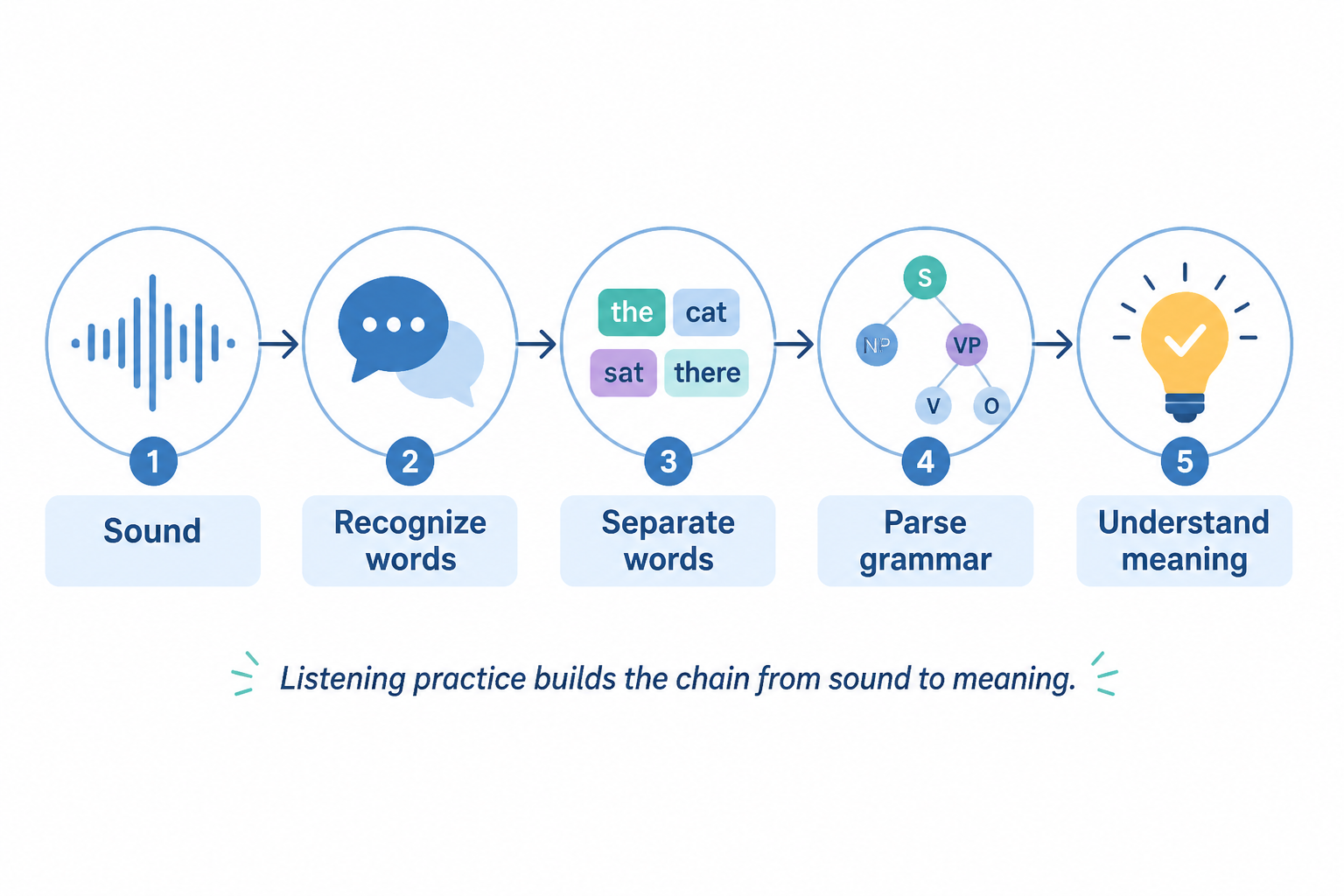
Listening practice is not just background noise. It is active training for your brain’s ability to recognize words, connect them to meaning, and keep up with real speech. That includes several smaller skills working together:
- hearing the sounds clearly
- recognizing words you already know
- separating one word from the next
- understanding grammar in real time
- keeping up with speed, accents, and reductions
- remembering enough of what you heard to make sense of it
When beginners say, “I can read it, but I can’t understand it when I hear it,” that is usually because these listening subskills are undertrained. Reading gives you time to inspect each word. Listening does not wait politely.
The goal is not to understand every single sound perfectly on day one. The goal is to improve the chain from sound to meaning so your comprehension gets faster and more reliable.
Why listening gets difficult so fast
Listening feels harder than reading for a few predictable reasons. Once you know these, the problem becomes less personal and more solvable.
1. Real speech is fast and compressed
People do not speak like textbooks. Sounds blend together, syllables get reduced, and words can be swallowed a little. That is normal speech, not broken speech.
2. You cannot pause your way through real conversations
In reading, you can stop and inspect a sentence. In listening, the next sentence keeps coming. Your brain has to do the work in real time.
3. Vocabulary recognition is slower in listening
Even if you know a word on paper, your brain may not recognize it instantly when someone says it. You need repeated exposure before recognition becomes automatic.
4. One missed word can affect the rest
Listening is a chain. If you miss the subject, you may not know who did what. If you miss a negation, the whole meaning flips. That is why small gaps can feel bigger than they really are.
5. Your brain is doing more than one job
Listening often happens while you are also trying to guess, translate, recall grammar, and stay calm. That is a lot. Good practice lowers the load gradually.
The core principle: make listening understandable, not perfect
The biggest mistake learners make is using listening material that is far too hard. They think struggling means learning. Sometimes it does. But if almost every second is confusion, your brain is mostly surviving, not building skill.
A better rule is this: choose material you can understand fairly well, then stretch it a little. That is where progress happens.
This idea is closely related to comprehensible input: language you can mostly understand, with just enough new material to push you forward. If you want the deeper logic behind that approach, you can read comprehensible input explained.
For listening practice, “comprehensible” does not mean easy or boring. It means enough is known that your brain can connect sounds to meaning instead of treating every sentence like static.
How to choose the right listening material
Your listening practice will improve much faster if the material fits your current level. Here is a simple way to choose.
| Material level | What it feels like | Best use | Good for? |
|---|---|---|---|
| Too hard | You catch a few words, but mostly feel lost | Occasional challenge, not daily core practice | Intermediate and above, only in small doses |
| Just right | You understand the main idea and many details | Core practice for growth | Most learners |
| Too easy | You understand almost everything with no effort | Warm-up, confidence, speed-building | Review and repetition |
A useful target is this: you should understand enough to stay engaged, but not so much that you are bored. If you are completely lost, move down a level. If you understand nearly everything, stretch upward a bit.
What kind of content works best?
- Short dialogues for beginners
- Slow, clear audio with obvious context
- Podcasts made for learners
- Short video clips with subtitles you can control
- Repeated listening to the same material
Podcasts can be especially useful when they are beginner-friendly and consistently spoken. If you want help using them well, see how to learn a language with podcasts.
Movies and shows can also help, especially once you are ready for more natural speech. They are great for rhythm, intonation, everyday vocabulary, and real-world phrasing. For a structured approach, read how to learn with movies and subtitles.
A simple framework for listening practice
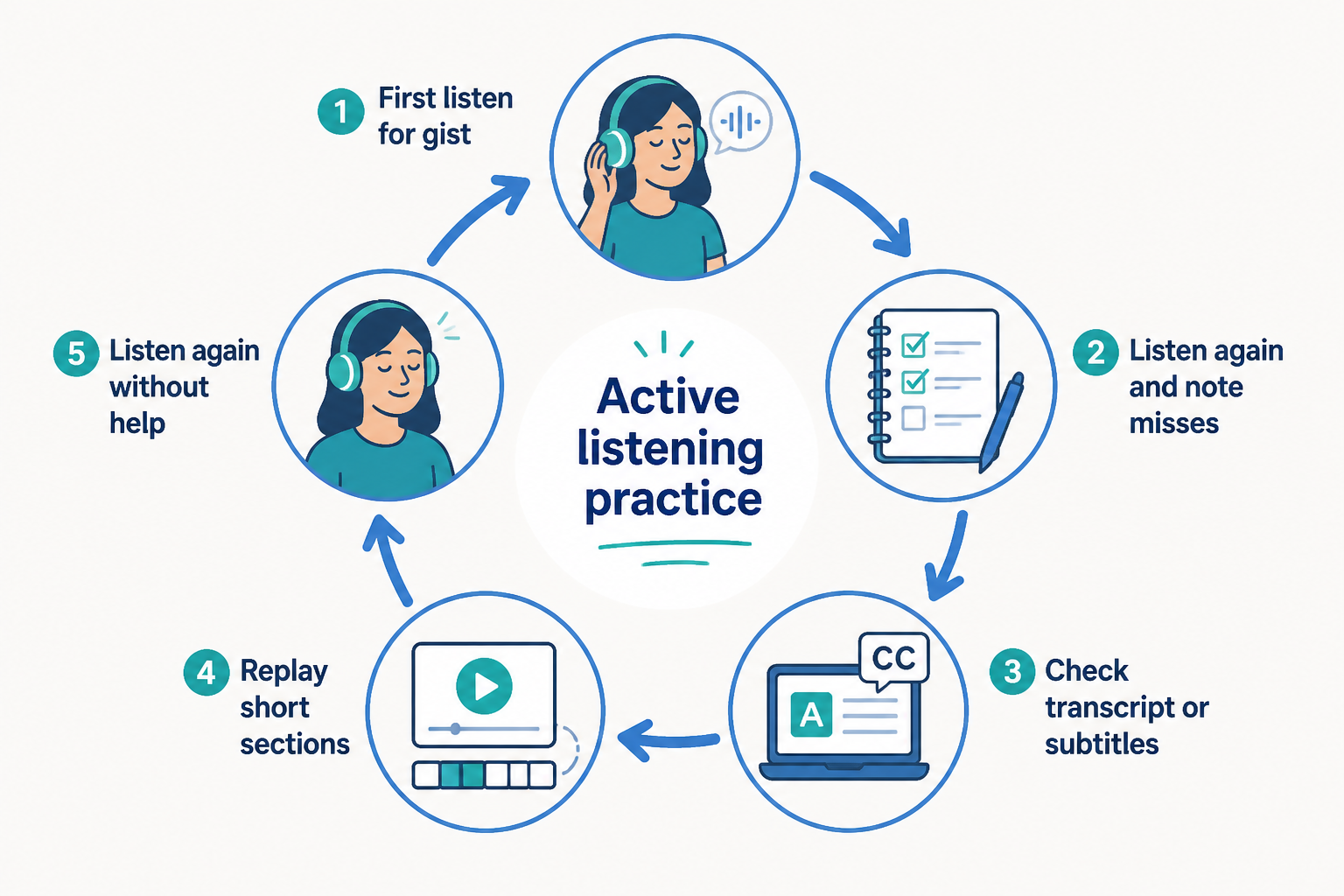
One of the best ways to improve listening is to stop treating it like a random activity. Use a repeatable process. Here is a practical framework:
- Listen once for the general meaning.
- Listen again and note what you missed.
- Check the transcript or subtitles if available.
- Replay short sections and notice new details.
- Listen again without help.
This loop works because it trains both comprehension and recognition. You are not just “getting through” the audio. You are learning why you missed things and then hearing the same language again with better understanding.
What to do on the first listen
Do not stop every two seconds. The first listen is for the broad picture.
Ask yourself:
- Who is speaking?
- What is the topic?
- Is this a question, a story, an explanation, or a conversation?
- What words or phrases do I recognize?
If you get the gist, that is success. You are building context, and context is a huge part of listening.
What to do on the second listen
Now you listen more carefully. Try to notice:
- words you recognized only after hearing them twice
- phrases that kept repeating
- parts where the speaker sounded different from how you expected
- any word boundaries that were hard to hear
This is where real learning happens. The first listen gives you a map. The second listen helps you fill in the streets.
What to do with transcripts
Transcripts are useful, but they should not become a crutch. Use them after you have tried to understand the audio first.
A good transcript workflow looks like this:
- listen once without reading
- try to summarize what you heard
- read the transcript or subtitles
- compare what you missed
- listen again and notice the exact sounds
Do not read and listen at the exact same time forever if it makes you ignore the audio. The point is to build listening skill, not just to feel productive while reading fast subtitles.
Beginner listening strategy: make it small and repeatable
If you are a beginner, your listening practice should be short, controlled, and repeatable. You do not need heroic sessions. You need consistent ones.
A beginner-friendly listening session
Try this structure:
- 2 minutes – warm up with very familiar audio
- 5 minutes – listen to one short clip several times
- 3 minutes – check the transcript or subtitles
- 5 minutes – listen again and shadow or repeat out loud
That is enough for real progress if you do it regularly. Five intense minutes beat twenty distracted minutes almost every time.
Beginner signs you picked the right level
- You can catch the topic without help.
- You recognize some repeated words.
- You are challenged, but not panicked.
- You can improve after one or two replays.
If everything sounds like a blur, the material is too hard. That is not a failure; it is just bad matching. Adjust the level and try again.
Intermediate listening strategy: stretch your range
Intermediate learners usually need a different kind of practice. At this stage, the challenge is not just understanding simple audio. It is handling faster speech, less predictable vocabulary, and more natural conversations.
You want to move from “I can understand language-learning audio” to “I can understand more of the real thing.” That transition takes exposure to multiple voices, styles, and speeds.
Good intermediate practice includes
- dialogues with natural pacing
- short podcasts on familiar topics
- clips from shows with subtitles used strategically
- repeat listening to the same episode or scene
- listening for specific information, not every word
At this stage, it helps to stop expecting total comprehension. Real listening often means understanding 70 to 90 percent and using context for the rest. That is not cheating. That is what fluent listeners do too.
Intermediate listening task examples
- Summarize the main idea in one sentence.
- Write down three phrases you hear several times.
- Identify the speaker’s opinion or attitude.
- Listen for numbers, places, times, or names.
- Notice how one person agrees, hesitates, corrects, or changes topic.
These tasks make listening active. Instead of passively hoping comprehension happens, you give your brain a mission.
How to use repetition without getting bored
Repetition is one of the most powerful listening tools, but only if you use it well. Repeating the same audio is not failure. It is how your brain starts to recognize sounds automatically.
Think of it like this: the first listen is for discovery, the second for pattern recognition, and the third for speed. After that, you are no longer hearing “new audio.” You are building familiarity.
A practical repetition method
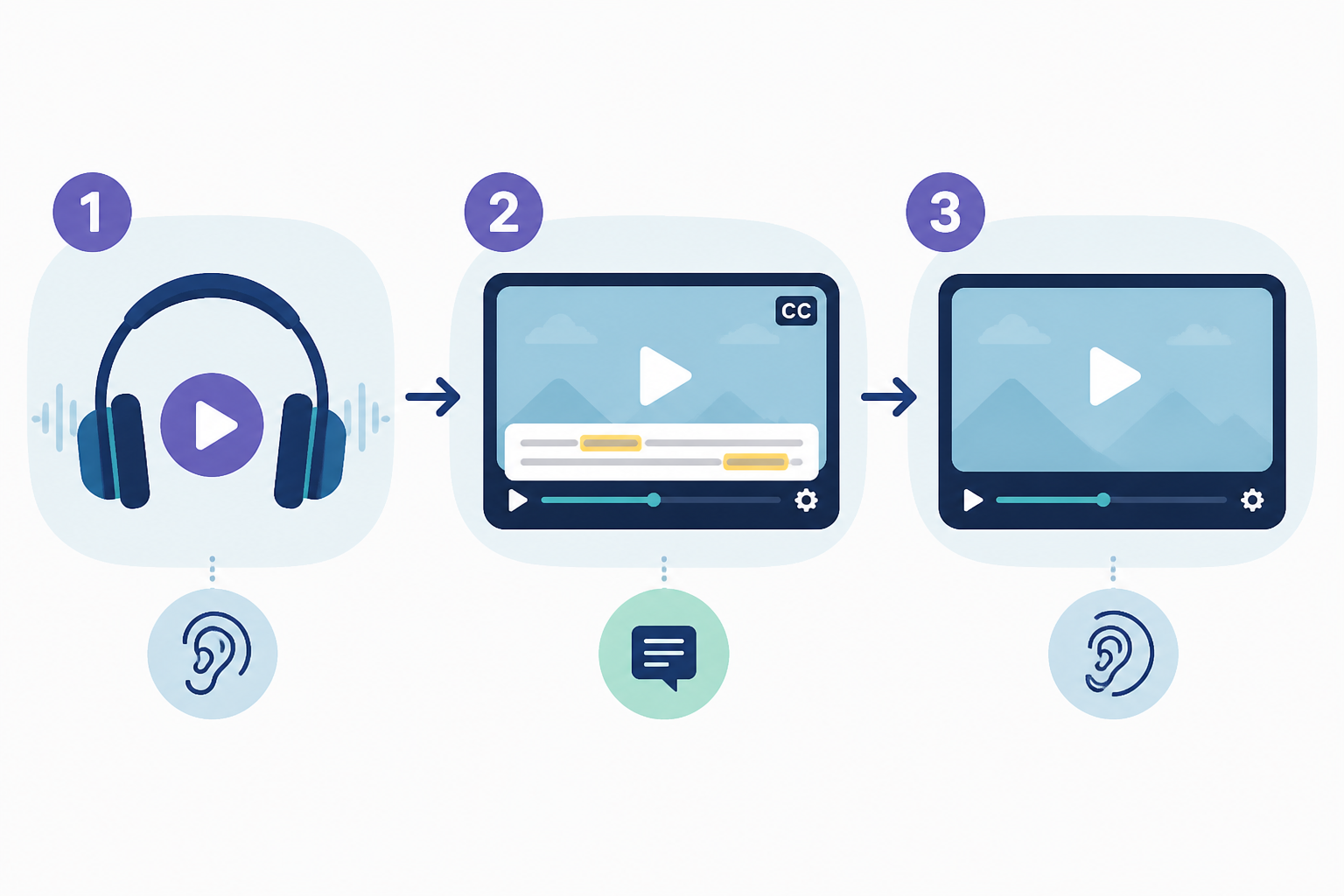
- Listen to a short segment once without help.
- Listen again with subtitles or a transcript.
- Replay one sentence or phrase until it becomes clear.
- Pause and say the phrase aloud.
- Listen one more time without reading.
This method works especially well with clips under two minutes. Shorter is often better because you can pay attention more deeply instead of drifting away halfway through a ten-minute fog bank.
What repetition actually trains
- word recognition speed
- sound pattern familiarity
- listening confidence
- memory for common phrases
- stress, rhythm, and intonation awareness
Repeated exposure is one reason podcasts and short scenes are so effective. You can revisit them without needing endless new material every day.
How subtitles can help, and how they can hurt
Subtitles are useful, but they are not magic. They can either support listening or quietly replace it if you are not careful.
Use subtitles when they help you notice the sound
Subtitles are most useful when you:
- need help identifying words you already almost know
- want to connect spelling to sound
- are checking whether you heard a phrase correctly
- need support with fast or unclear sections
Subtitles become a problem when you
- read ahead and stop listening
- depend on them immediately every time
- never re-listen without text
- use them to avoid the challenge entirely
The smart approach is flexible use. Start with audio only, then use subtitles as support, then remove them again.
Listening exercises that actually work
If you want practical exercises, here are several that are simple but effective. You do not need all of them at once. Pick one or two and use them consistently.
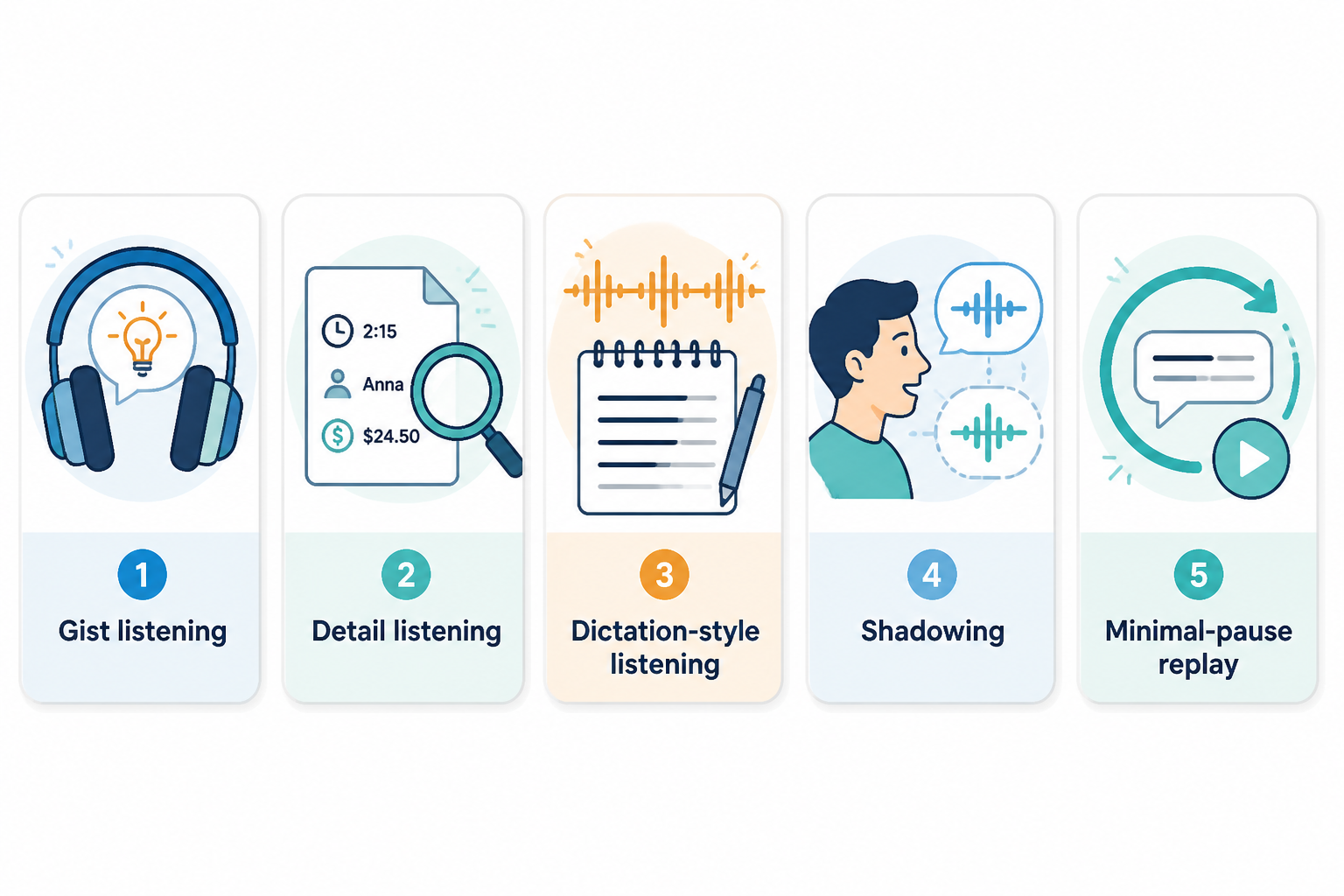
1. Gist listening
Listen for the general meaning only. Ask: “What is this about?”
This trains your ability to understand the big picture even when you miss details.
2. Detail listening
Listen for one specific thing: a time, a name, an opinion, a location, or a price.
This helps you focus on targeted information instead of trying to catch every word.
3. Dictation-style listening
Pause the audio after short sections and write what you hear. Then check against the transcript.
This is very useful for identifying sounds you tend to miss.
4. Shadowing
Listen and repeat at the same time or just behind the speaker.
Shadowing is great for rhythm, pronunciation awareness, and fast recognition. It is more advanced than simple listening, but it can supercharge listening ability when used with understandable audio.
5. Minimal-pause replay
Replay one sentence or phrase several times with tiny pauses in between.
This helps your brain catch details that vanished on the first pass.
A weekly listening plan you can actually follow
Consistency matters more than intensity. A simple plan beats a perfect plan that you never do.
Sample weekly plan for beginners
| Day | Task | Time |
|---|---|---|
| Monday | One short clip, audio only, two listens | 10 minutes |
| Tuesday | Same clip with transcript or subtitles | 10 minutes |
| Wednesday | New short clip, gist listening | 10 minutes |
| Thursday | Replay one clip and shadow selected lines | 10 minutes |
| Friday | Listen for specific details in a short clip | 10 minutes |
| Weekend | Choose a fun audio/video piece and enjoy it twice | 15–20 minutes |
Sample weekly plan for intermediate learners
| Day | Task | Time |
|---|---|---|
| Monday | Podcast episode or short conversation, no transcript first | 15 minutes |
| Tuesday | Repeat the same audio with transcript, note unknown phrases | 15 minutes |
| Wednesday | Movie or show clip with subtitles, then without | 20 minutes |
| Thursday | Shadowing or repeating selected sections | 10–15 minutes |
| Friday | New audio on a familiar topic, focus on main ideas | 15 minutes |
| Weekend | Longer relaxed listening for enjoyment | 20–30 minutes |
You do not need to follow a timetable exactly. The point is to make listening a regular habit with a clear purpose.
Common mistakes that slow listening progress
Most listening problems are fixable once you spot them. Here are the big ones.
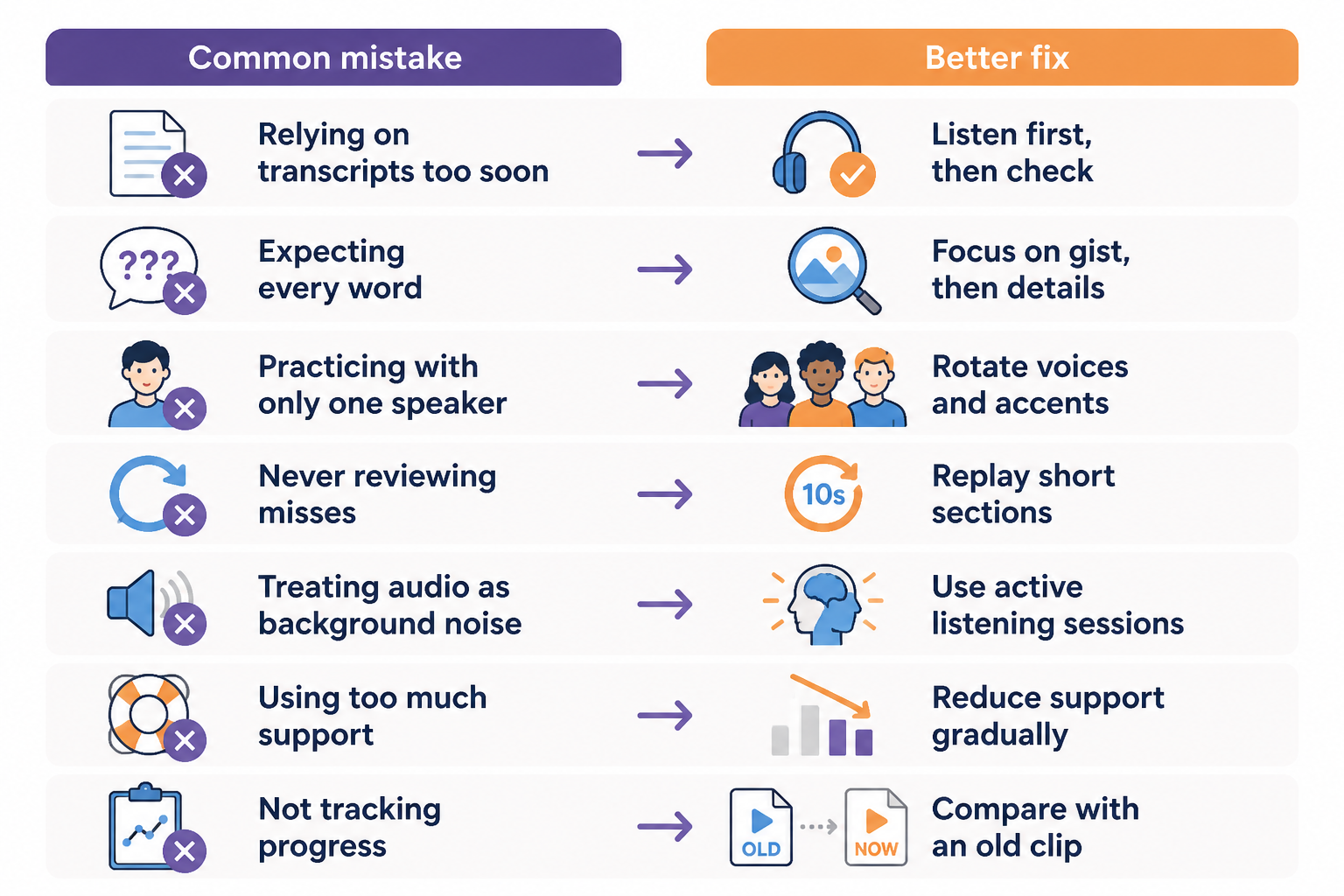
1. Using audio that is too hard
If you understand almost nothing, you are not practicing listening efficiently. You are mostly getting exposed to noise. That may still have some value, but it should not be your main strategy.
Fix: choose easier material and re-listen more often.
2. Changing material too often
If you always jump to something new, your brain never gets enough repetition to notice patterns.
Fix: stay with one clip long enough to hear real improvement.
3. Reading too early
If you immediately read subtitles every time, your listening muscles do less work.
Fix: listen first, support second.
4. Expecting every word
Even fluent listeners miss words sometimes. The goal is meaning, not microscopic perfection.
Fix: train for gist, then details.
5. Practicing only with one speaker
Hearing only one voice can create a false sense of competence.
Fix: rotate speakers, accents, and formats gradually.
6. Never reviewing what you missed
Listening becomes much more effective when you learn from your misses.
Fix: replay short sections and identify why you missed them.
7. Treating listening like passive background noise
Passive listening can help with exposure, but it is not enough on its own for most learners.
Fix: combine passive exposure with active sessions.
How to know if your listening is improving
Sometimes improvement is obvious. Other times it sneaks up on you. Watch for these signs:
- You recognize common words faster.
- You need fewer replays to understand a clip.
- You can follow the structure of conversations more easily.
- You catch more details without subtitles.
- Familiar speakers start to sound clearer and less “blurred.”
Improvement may feel slow day to day, but over a few weeks it can become surprisingly noticeable. What once sounded like fog starts sounding like language.
A simple progress check
Once every one or two weeks, revisit an old clip and compare:
- How much did you understand the first time?
- How many times did you need to replay it?
- Did you catch more words automatically?
- Did the audio feel slower or more familiar?
If the answer is yes to even one of those, you are moving forward.
What to do when listening feels stuck
Plateaus are normal. If listening suddenly feels flat, do not assume you have stopped improving. Often, you just need a small adjustment.
If everything sounds too fast
- Use shorter clips.
- Slow down the audio only if it still sounds natural enough to learn from.
- Choose speakers with clearer pronunciation.
- Repeat the same content more times.
If you understand with subtitles but not without them
- Try audio first, subtitles later.
- Listen to one sentence at a time without reading.
- Use transcripts to identify what your ears missed.
- Re-listen after removing the text.
If you know the words but cannot hear them
- Focus on recognition of common phrases.
- Shadow short lines.
- Listen for connected speech and reduced sounds.
- Work with the same speaker repeatedly.
If you get bored
- Pick more interesting topics.
- Use shorter sessions.
- Mix serious practice with enjoyable listening.
- Switch between podcasts, clips, songs, and learner audio as needed.
If you feel frustrated
That is usually a sign the material is slightly too hard or the session is too long. Frustration is not always bad, but if it becomes constant, scale the difficulty down.
Good listening practice is challenging enough to stretch you and easy enough that you can keep going tomorrow.
Passive listening vs active listening
Both have a place, but they do different jobs.
| Type | What it is | Best use |
|---|---|---|
| Passive listening | Hearing the language while doing something else | Building familiarity, rhythm, and exposure |
| Active listening | Focused listening with a goal | Building comprehension and accuracy |
Passive listening is helpful, especially when you are busy or when you want more exposure. But active listening is where most of the real skill-building happens. A good plan usually includes both.
For example, you might do one focused session with a transcript, then play the same audio again while cooking or walking. That way, your brain gets both attention and repetition.
How to listen without translating everything in your head
Many learners translate every word mentally. That is exhausting, slow, and usually not necessary.
Instead, try to attach meaning directly to the sound when possible. You do not need to eliminate translation overnight. You just want less of it over time.
How to reduce translation
- Use familiar topics so meaning is easier to guess.
- Repeat the same phrases often.
- Learn chunks, not just isolated words.
- Practice understanding the main idea first.
- Use images, context, or action to connect sound and meaning.
Think of this as building a shortcut. At first, the path goes through your native language. With enough exposure, more of the meaning can go straight from sound to idea.
A practical daily routine for better listening
If you want a routine you can start immediately, use this.
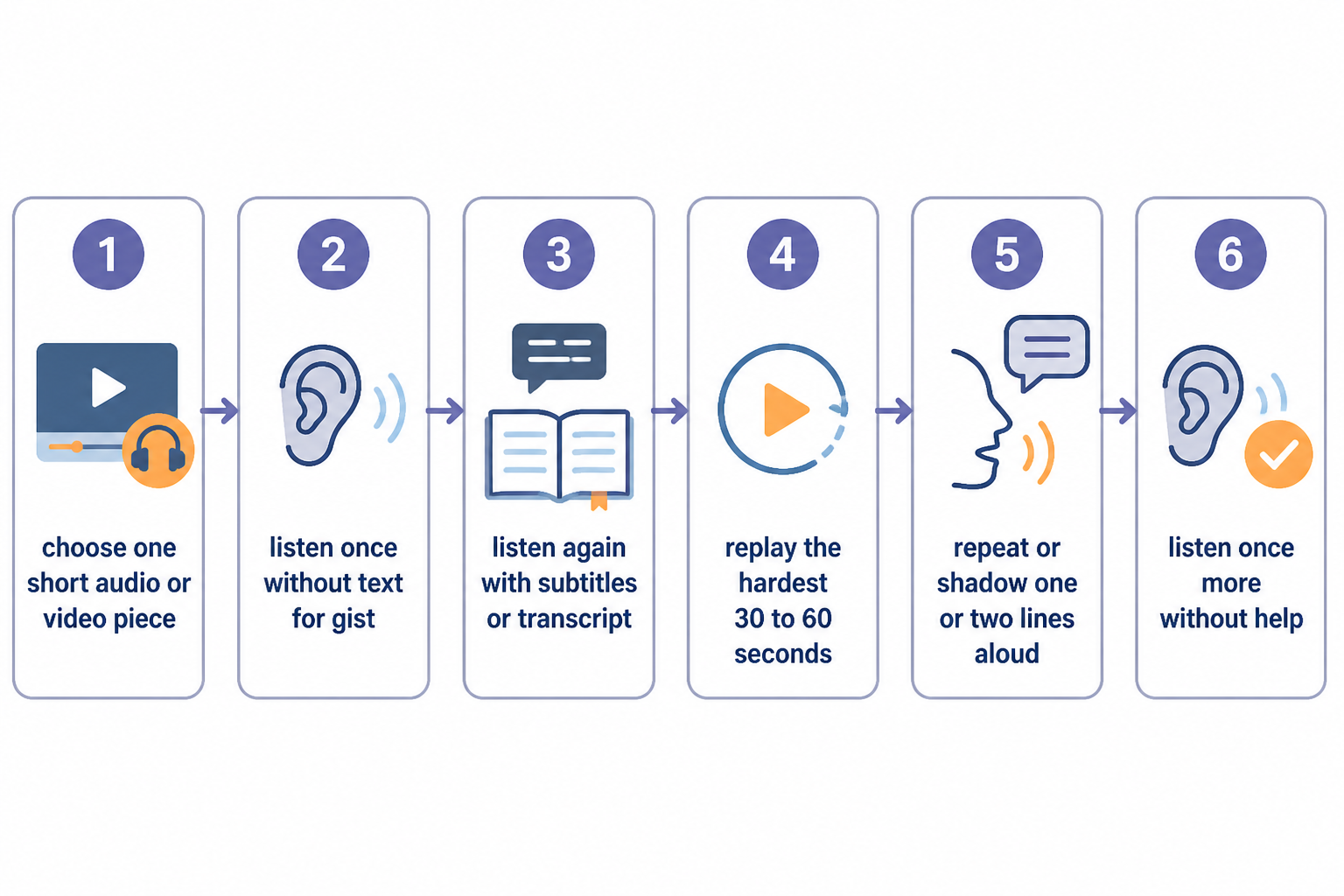
10 to 20 minute daily routine
- Choose one short audio/video piece.
- Listen once without text. Focus on gist.
- Listen again with subtitles or transcript. Notice what changed.
- Replay the hardest 30 to 60 seconds.
- Repeat or shadow one or two lines aloud.
- Listen once more without help.
If you can do this most days, you will build stronger listening faster than by cramming once a week. Small daily contact helps your brain stay tuned to the language.
How to make listening more effective with other skills
Listening improves faster when it is not isolated from the rest of language learning. The skills support each other.
Reading helps listening
Reading gives you vocabulary and grammar knowledge that later helps you recognize spoken language. If you know a word on paper, you are closer to hearing it in speech.
Speaking helps listening
When you practice saying phrases, you become more aware of how they sound. That makes them easier to notice in audio.
Vocabulary study helps listening
Listening is much easier when key words are already familiar. A little targeted vocabulary work can make audio suddenly become understandable.
Context helps everything
Knowing the topic before listening can make a huge difference. If you know you are about to hear a restaurant dialogue, your brain starts predicting the kinds of words it might hear.
Final troubleshooting checklist
If your listening still feels weak, use this checklist before changing your whole method:
- Am I using material that is too hard?
- Do I listen to the same audio more than once?
- Do I try to understand the gist before the details?
- Do I use transcripts or subtitles as support, not a substitute?
- Do I practice regularly instead of randomly?
- Do I spend time reviewing what I missed?
- Am I mixing active listening with some relaxed exposure?
If you answer “no” to several of these, that is usually the place to fix first.
What to do next
If you want stronger listening, the next move is not to hunt for the perfect resource. It is to start with one manageable piece of audio and use it well.
Pick something short. Listen once without help. Then listen again with support. Then listen again without it. Repeat this process across days, not just minutes. That is how listening stops being mysterious and starts becoming a skill you can trust.
If you want to build your listening practice around audio lessons, the next helpful step is learning how to use podcasts strategically. If you want more visual and contextual listening practice, movies and subtitles can be a powerful companion. And if you want the bigger learning principle behind all of this, comprehensible input is the foundation that makes listening growth much more manageable.
Most of all, remember this: you do not need to understand everything to improve. You need the right material, repeated exposure, and a method that helps your brain notice more each time. That is how to practice listening in a language without turning it into a weekly headache.