
If you want to improve a language without turning every study session into a heroic event, journaling is one of the best habits you can build. It is low-pressure, flexible, and surprisingly powerful. You do not need perfect grammar, fancy vocabulary, or a long block of free time. You just need a notebook, a few minutes, and a prompt that gives your brain something real to work with.
That is the beauty of Daily Language Journaling Prompts: they turn “I should practice more” into something you can actually do today. A good prompt helps you start, stay focused, and keep writing even when your mind goes blank halfway through sentence number two. Which, to be fair, happens to everyone.
This guide will show you how to use language journal prompts effectively, how to choose prompts that match your level, how to avoid the most common mistakes, and how to turn journaling into a habit that supports real language growth. You will also get a large set of prompt ideas you can use right away, plus practical ways to make the exercise more useful than “I ate breakfast. It was fine.”
What language journaling actually does for your learning
Language journaling is simple: you write in the language you are learning about your life, thoughts, plans, opinions, or experiences. The content can be tiny or long. The important part is that you are producing language yourself, not only recognizing it when you read or listen.
This matters because writing forces your brain to do several useful things at once:
- retrieve vocabulary from memory
- build sentences instead of only recognizing them
- notice grammar gaps
- practice expressing real ideas, not just textbook examples
- learn how to say something when you do not know the exact word
That last point is especially important. Journaling trains flexibility. In real conversations, you often do not have the perfect word ready. A journal is a safe place to practice working around that problem.
Think of journaling as a language gym for your writing muscles. You are not trying to become an author. You are training control, memory, and confidence.
The goal of language journaling is not “beautiful writing.” The goal is better language production, one small page at a time.
For many learners, journaling also reduces fear. A conversation can feel high-stakes because another person is waiting for you. A journal does not judge you, interrupt you, or look confused when you forget the past tense of a verb. It just sits there and lets you try again tomorrow.
Why prompts work better than writing “whatever comes to mind”
In theory, freewriting sounds great. In practice, many learners open the notebook and immediately lose the will to live because their mind goes blank. Prompts solve that problem by giving your brain a starting point.
A prompt does three things:
- It lowers the activation energy. You do not need to invent a topic.
- It narrows the task. Smaller tasks are easier to finish.
- It creates repetition. Repeated structures help you reuse and strengthen language.
For beginner and intermediate learners, prompts are especially useful because they reduce the “what do I even say?” problem. Instead of staring at a blank page, you respond to a question, a sentence starter, or a short task.
That said, not all prompts are equally useful. A good prompt should be clear, manageable, and tied to language you can realistically produce. A bad prompt is vague, too abstract, or so ambitious that you spend 20 minutes trying to translate one sentence about the meaning of existence.
How to use daily language journal prompts well
The best journaling habit is not the one that sounds impressive. It is the one you can repeat. Before you choose prompts, it helps to decide how you will use them.
Choose a realistic daily length
Most learners do better with a short, consistent session than with an ambitious journal marathon they abandon after three days. Start with one of these:
- 5 minutes for absolute beginners or very busy days
- 10 minutes for a steady daily habit
- 15 minutes if you want more depth and can maintain it
If you are writing slowly, that is not a problem. Slow writing is still writing. In language learning, a sentence that took effort often teaches more than five sentences you dashed off without thinking.
Keep the structure simple
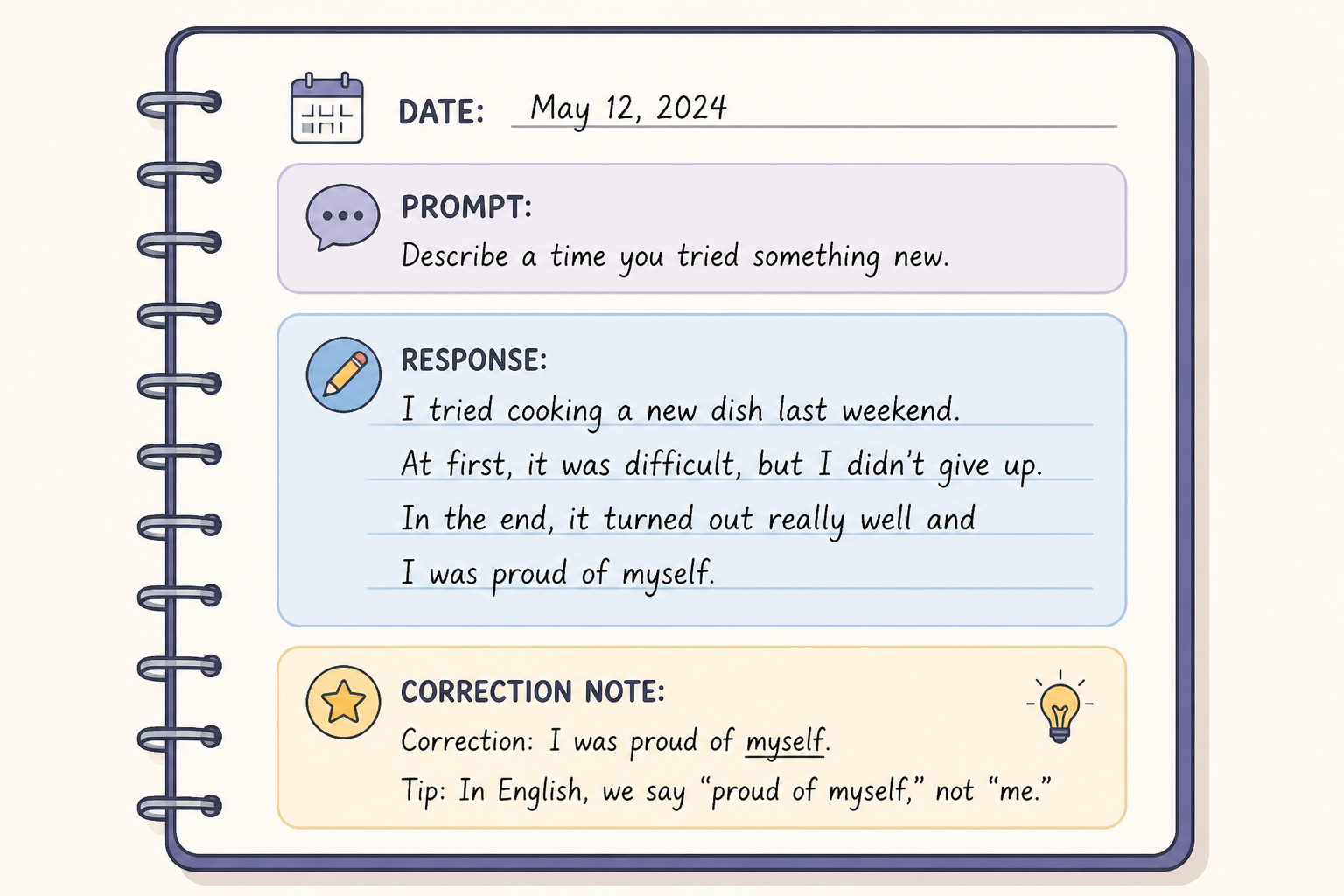
Use a repeatable format so the habit feels easy to start. For example:
- date
- prompt
- 3 to 8 sentences in the target language
- 1 quick correction or note
That “quick correction or note” matters. It is where journaling becomes learning instead of just output. You might underline an error, write the correct form beside it, or note a new phrase you want to reuse.
Write first, check later
Try not to stop every five seconds to look up words. If you do that, the activity turns into translation work, and your flow disappears. Instead:
- write with the words you already know
- leave blanks or use a placeholder word if needed
- circle uncertain phrases to review later
This keeps the session moving and helps you notice what you actually need to learn. If you look up every unknown word immediately, you may feel productive, but you often remember less because the sentence never fully belonged to you.
How to choose prompts that fit your level
The best prompt for a beginner is not the same as the best prompt for an intermediate learner. A good match keeps the task challenging without being discouraging.
Here is a simple way to think about it:
| Level | What to write about | Best prompt style | What to avoid |
|---|---|---|---|
| Beginner | daily routines, likes/dislikes, simple facts | sentence starters, yes/no questions, short descriptions | abstract opinions, long explanations, complex comparisons |
| Lower intermediate | past events, reasons, preferences, comparisons | “why” prompts, short reflections, mini stories | too many ideas in one prompt |
| Intermediate | opinions, habits, plans, hypothetical situations | open-ended prompts, argument-style prompts, reflection prompts | overly broad prompts with no structure |
The sweet spot is “just hard enough.” If a prompt is so easy that you can answer it in two seconds, it may not stretch you much. If it is so hard that you freeze, it is too much for daily use. You want friction, but not a wall.
Daily Language Journaling Prompts you can use right away
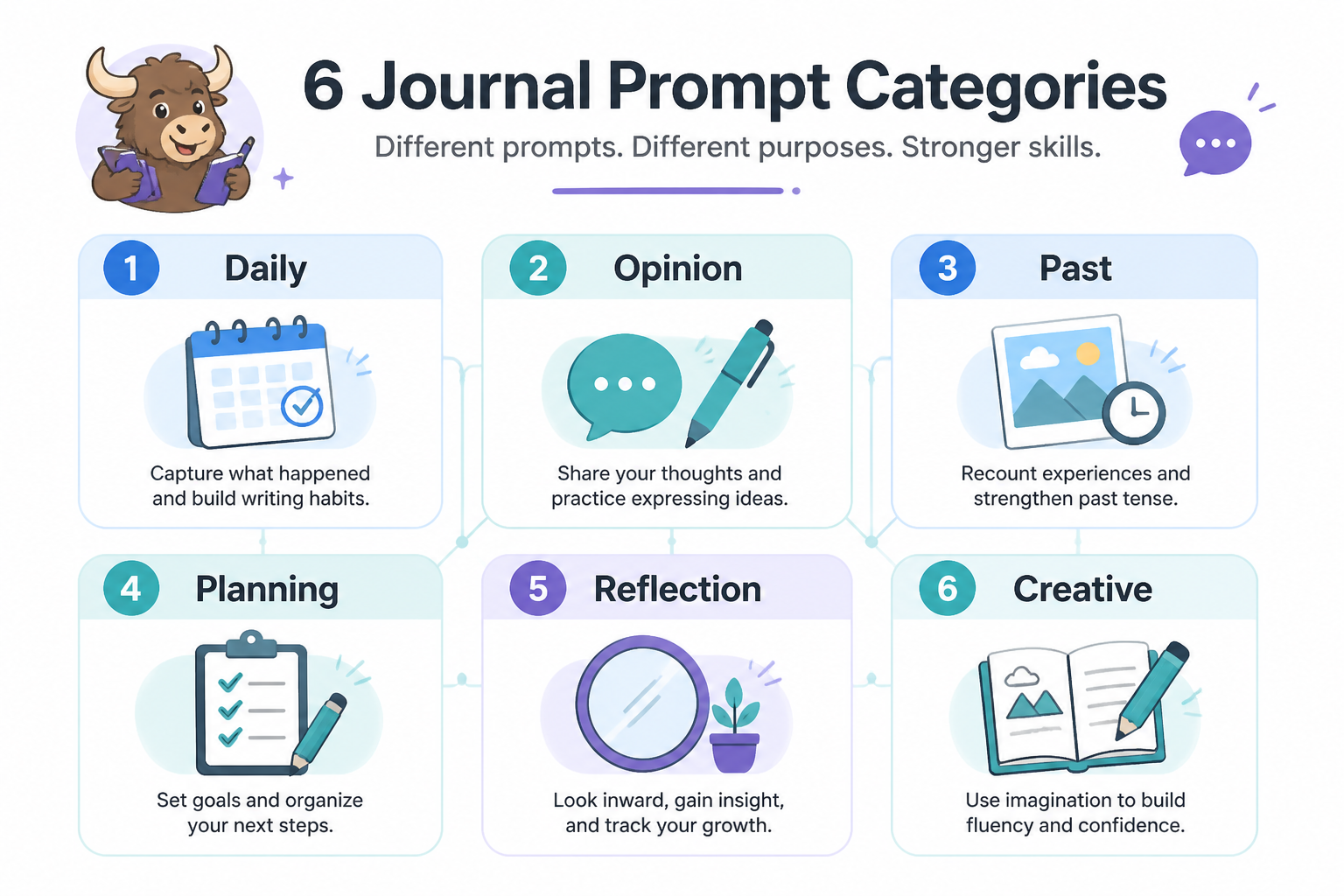
Below are prompt categories that work well for regular practice. You do not need to use all of them. Pick a few that fit your level and rotate through them.
1. Simple daily life prompts
These are great for beginners and for warm-up writing.
- What did I do this morning?
- What am I doing now?
- What will I do later today?
- What did I eat today?
- What is the weather like today?
- What time did I wake up?
- What was easy today?
- What was difficult today?
Why these work: they keep the language concrete. Concrete topics are easier to express because you can point to real actions, places, and objects.
2. Personal preference prompts
These help you practice opinions in a simple, natural way.
- What do I like to eat, and why?
- What kind of music do I enjoy?
- Do I prefer mornings or evenings?
- What is my favorite season?
- What kind of movies do I like?
- What kind of books or shows do I enjoy?
- What do I want more of in my life?
Tip: opinions become more useful when you add a reason. Compare:
- I like coffee.
- I like coffee because it helps me wake up.
The second version gives you practice with connectors like “because,” “so,” and “but,” which are incredibly useful in real communication.
3. Past event prompts
Once you can talk about simple daily life, start writing about what happened yesterday, last weekend, or earlier in the week.
- What did I do yesterday?
- What was the best part of my day?
- What did I learn recently?
- What problem did I solve today?
- What was one surprise from this week?
- Who did I talk to recently?
- What did I do differently today?
Past-tense writing is useful because it pushes you beyond present-tense routines. It also helps you build story-shaped language, which is essential for conversation.
4. Future and planning prompts
These are ideal for practicing intention, prediction, and basic future forms.
- What will I do tomorrow?
- What do I need to prepare this week?
- What is one goal I want to reach this month?
- What will I study next?
- What do I hope will happen soon?
- What should I remember to do today?
- What is one habit I want to build?
Planning prompts are especially helpful if you are trying to connect journaling to real life. You are not just practicing words; you are using the language to organize your day.
5. Reflection prompts
These work well for lower intermediate and intermediate learners who want more depth.
- What did I do well today?
- What could I improve tomorrow?
- What habit is helping me most right now?
- What is something I want to change?
- What made me feel proud this week?
- What drained my energy today?
- What helped me stay focused?
Reflection prompts are useful because they naturally produce longer answers and more complex sentence structures. They also help you practice expressing nuance, not just facts.
6. Comparison prompts
Comparisons are excellent for stretching your vocabulary without becoming too abstract.
- What is different between today and yesterday?
- What is better: studying in the morning or at night?
- How is my life now different from last year?
- What is easier: reading, listening, speaking, or writing?
- What is the difference between a good day and a bad day?
- Which is more difficult for me, grammar or vocabulary?
- How are my study habits improving?
Comparison prompts push you to use connectors such as “more than,” “less than,” “same as,” “however,” and “while.” Those are all very helpful in real conversations.
7. Creative and imagination prompts
These are good once you are comfortable with everyday writing and want to keep the practice interesting.
- If I had a free day, what would I do?
- If I could travel anywhere, where would I go?
- If I could meet anyone, who would it be?
- If I had more time, what would I learn?
- If today were a movie scene, what would happen?
- What would my ideal day look like?
- What would I do if I had no fear?
Use these when you want to stretch your expression, but do not make every journal entry imaginative. Balance matters. A mix of concrete and creative prompts is usually more sustainable.
A simple formula for turning any prompt into a useful journal entry
Sometimes the prompt is fine, but the answer becomes too short or too vague. A simple structure helps. Try this formula:
| Part | What it does | Example |
|---|---|---|
| Answer the prompt | gives the direct response | I prefer evenings. |
| Add a reason | practices connectors and opinions | I prefer evenings because I feel calmer after work. |
| Add an example | makes the language richer and more specific | For example, I read or take a walk at night. |
| Add one challenge or detail | pushes the language a little further | However, I still need more sleep when I stay up too late. |
You do not need all four parts every day. Even two or three is enough. But this structure helps you avoid one-line answers that do very little for learning.
Here is how the formula looks in practice:
Prompt: What did I do yesterday?
Entry: Yesterday I studied for 20 minutes and went to the store. I bought fruit because I wanted a healthy snack. It was a busy day, but I felt good at the end.
That is more useful than a single sentence because it includes a clear event, a reason, and a feeling. You are practicing sentence building instead of just naming nouns.
How to keep a journal entry from becoming a translation trap
One of the biggest mistakes learners make is trying to say too much too soon. They sit down with a prompt, want to express a complicated idea, and then spend the whole time searching for exact words. That can be frustrating and slow.
Instead, try these strategies:
- Use simple words you already know.
- Shorten the idea if needed.
- Write “something” or “a thing” if the exact word is missing, then review it later.
- Break long thoughts into smaller sentences.
- Choose prompts that match your current vocabulary.
For example, if you want to write “I was overwhelmed by my schedule,” but that feels too hard, you can simplify it to:
- My schedule was busy.
- I felt stressed.
- I had many things to do.
That is still valid language practice. In fact, simplifying often helps you notice the exact vocabulary you are missing. Once the basic thought is on the page, you can improve it later.
Common mistakes with daily journaling prompts and how to fix them
Journaling works best when it is sustainable and useful. Here are the most common traps and the quickest fixes.
| Mistake | What it looks like | Better approach |
|---|---|---|
| Using prompts that are too hard | You stare at the page and quit | Choose concrete, level-appropriate prompts |
| Writing only one sentence | The entry ends before it starts | Use a simple 3-part structure: answer, reason, detail |
| Translating every word | The process becomes slow and exhausting | Write first, check later |
| Skipping review | You repeat the same mistakes for weeks | Underline one or two errors and correct them |
| Changing format every day | The habit feels messy and inconsistent | Keep one basic routine and rotate prompts instead |
| Trying to sound advanced | The writing becomes unnatural and fragile | Use language you can control, then stretch slightly |
If you only remember one thing from this section, remember this: the purpose of the journal is not to impress anyone. It is to create repeated, manageable language output. Small wins count.
How to make prompts more useful with small variations
A single prompt can last for days if you change the angle. This keeps journaling from feeling repetitive and helps you practice the same language in new ways.
For example, with the prompt What did I do today?, you can vary your response like this:
- One day, focus on actions only.
- Another day, add feelings.
- Another day, add reasons.
- Another day, write a short timeline.
Here is another example with What do I want to improve?:
- Use one entry to name the problem.
- Use the next entry to explain why it matters.
- Use the next entry to describe one action step.
This kind of variation is helpful because learning sticks better when you revisit a structure in slightly different forms. You are not memorizing a single answer. You are training a pattern.
How to use journaling for both writing practice and habit building
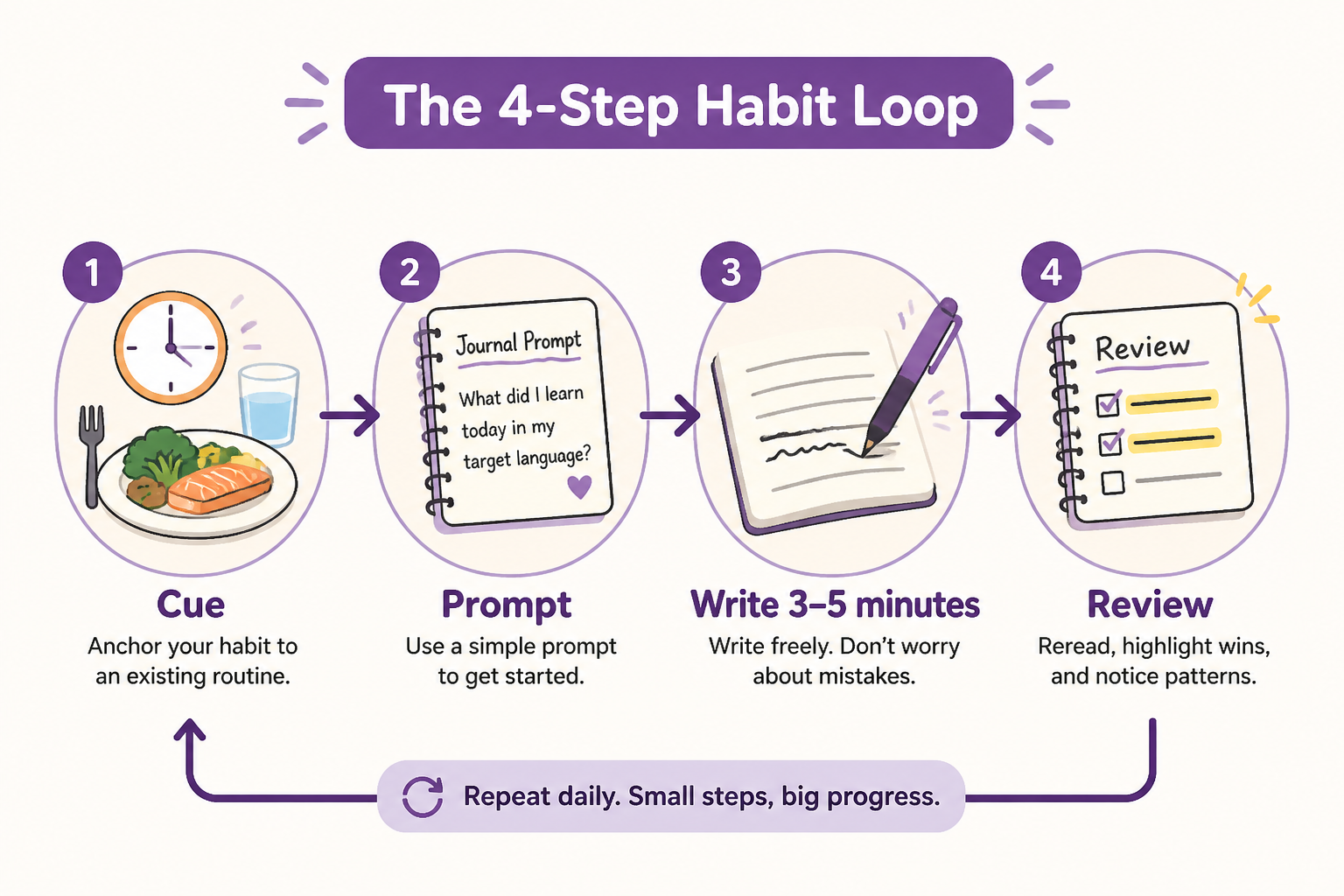
Journaling is strongest when it becomes part of a routine. If you are trying to build consistency, the journal should fit your day instead of fighting it.
Use the same trigger each day if possible. For example:
- after breakfast
- before bed
- after your main study session
- during a coffee break
- right before planning tomorrow
This kind of pairing is powerful because it reduces decision-making. You stop asking, “When should I journal?” and start thinking, “It is after dinner, so I write now.” That tiny change makes a habit much easier to keep.
If you want more help with consistency, the guide on how to build a language learning habit pairs naturally with journaling. It can help you create a routine that is realistic rather than heroic.
And if you want to connect journaling to a wider routine, the article on how to build a language study plan can help you decide where journaling belongs in the bigger picture.
How to review journal entries so they actually improve your language
Writing is valuable on its own, but a little review makes it much more effective. The review does not need to be long. In fact, a short review is often better than a perfectionist overhaul.
A simple 3-step review method
- Step 1: Circle or underline mistakes. Do not correct everything immediately.
- Step 2: Fix the highest-value errors. Start with repeated grammar problems or confusing vocabulary.
- Step 3: Save one useful phrase. Write down a sentence or expression you want to reuse.
This keeps review focused. You are not trying to turn every entry into a polished essay. You are looking for patterns that matter.
For example, if you repeatedly mix up verb forms, that is worth noting. If you are constantly missing the same connector word, that is worth noticing too. Over time, your journal becomes a record of what you are learning, not just what you wrote.
What to review first
- high-frequency words you want to remember
- grammar errors you repeat often
- phrases that feel useful in real life
- sentence patterns you want to copy
Do not review everything. Review what will actually help you write better tomorrow.
Prompt templates that make daily writing easier
Instead of starting from scratch every day, you can use a few prompt templates. These are flexible structures that you can fill with different topics.
| Template | How it works | Example prompt |
|---|---|---|
| Today I… | simple daily report | Today I did, felt, and learned… |
| I prefer… | practice opinions and reasons | I prefer X because… |
| Yesterday I… | practice past tense | Yesterday I went, saw, and did… |
| Tomorrow I… | practice future plans | Tomorrow I will, need to, and want to… |
| One thing I… | practice reflection | One thing I enjoyed, struggled with, or noticed… |
| If I could… | practice imagination | If I could change, travel, or learn… |
Templates are especially helpful when motivation is low. They save energy because you already know the shape of the answer. All you have to do is fill in the blanks with your own words.
Sample daily journal entries at different levels
Sometimes it helps to see what a good entry actually looks like. Here are some simple examples in English-style structure that show the kind of progression you want.
Beginner example
Prompt: What did I do today?
Today I went to work. I ate lunch with my coworker. After work, I rested at home. I was tired, but I had a good day.
Why this works: it is short, clear, and uses practical vocabulary. The learner is practicing actions, sequence, and a feeling.
Lower intermediate example
Prompt: What was difficult today?
Today was difficult because I had many tasks to finish. I started too late, so I felt stressed in the afternoon. Next time, I want to begin earlier and make a better plan.
Why this works: it includes cause, result, and a future action. That gives the writer more language practice in one small entry.
Intermediate example
Prompt: What habit is helping me most right now?
The habit helping me most right now is writing every morning. It keeps my language practice consistent, even on busy days. I also notice mistakes more clearly when I write early, before I feel distracted. Because of that, I want to keep this habit for at least another month.
Why this works: it builds a stronger argument and uses more precise language without becoming overly complicated.
A weekly structure for daily journal prompts
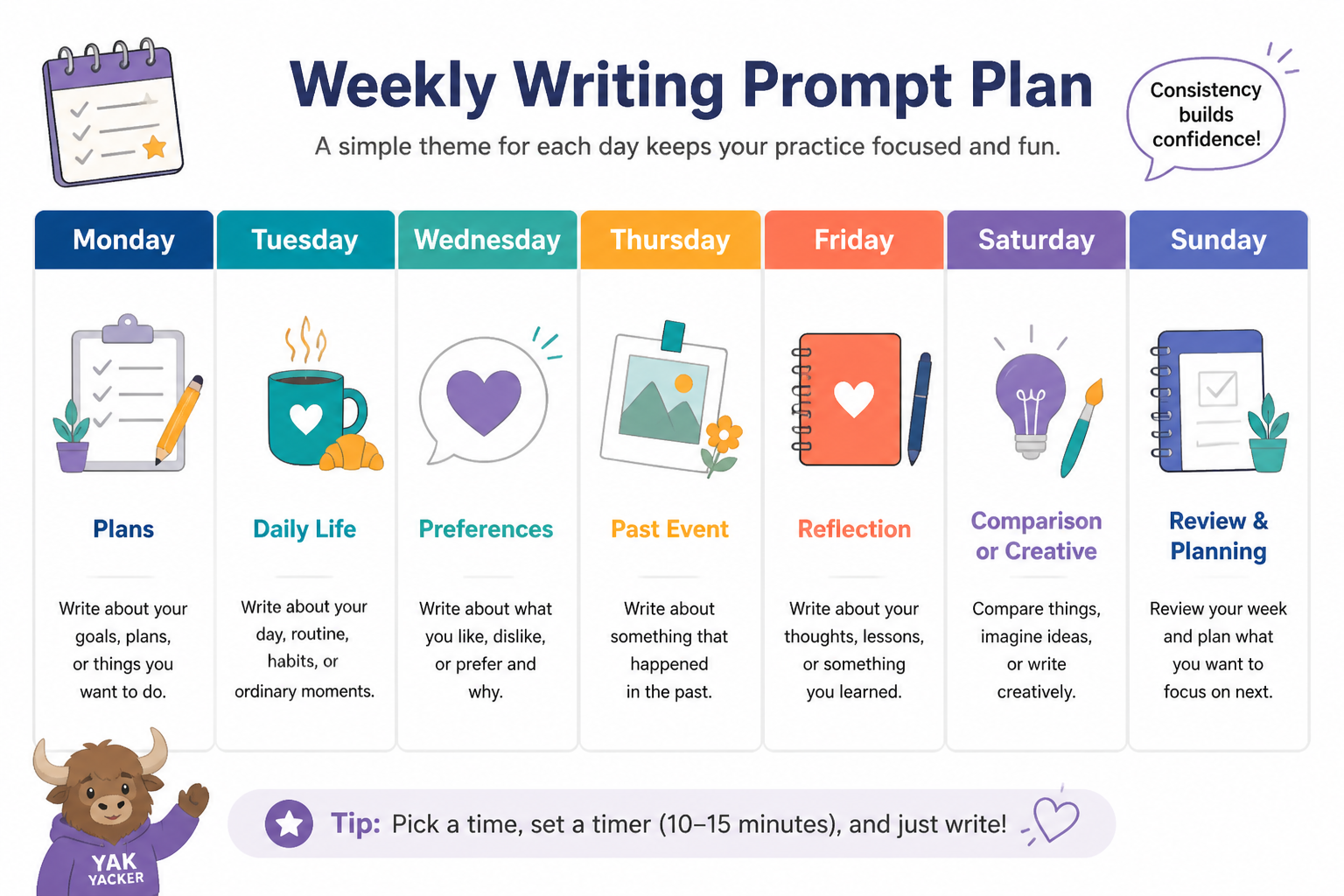
If you journal every day, it can help to give the week a loose shape. This keeps the practice from feeling random and gives you some variety without making decisions every morning.
| Day | Prompt type | Example focus |
|---|---|---|
| Monday | plans | What do I want to do this week? |
| Tuesday | daily life | What happened today? |
| Wednesday | preferences | What do I like or dislike about my routine? |
| Thursday | past event | What did I do recently? |
| Friday | reflection | What went well this week? |
| Saturday | comparison or creative | How is today different, or what would I do if I had free time? |
| Sunday | review and planning | What did I learn, and what will I focus on next week? |
This is not a rulebook. It is a way to reduce friction. If you already know the type of prompt for the day, you are more likely to sit down and write.
How journaling supports broader writing practice
Daily prompts are a great entry point, but they work even better when they support your overall writing progress. Journaling can help you move from controlled practice to more flexible writing over time.
For example, you might start with:
- single-sentence answers
- short daily descriptions
- simple opinions with reasons
- brief reflections
- slightly longer personal paragraphs
This progression matters because writing skill grows through repetition plus gradual challenge. If you want a deeper look at making writing practice more effective, the guide on how to practice writing in a foreign language is a useful companion read.
Troubleshooting: when journaling starts to feel hard
Even a good habit can stall. If journaling suddenly feels frustrating, one of these problems is usually the reason.
“I do not know what to write.”
Fix:
- use a smaller prompt
- write about the last hour instead of the whole day
- describe one object near you
- answer with three simple sentences
When in doubt, make the topic concrete. Concrete beats clever every time.
“I keep making the same mistakes.”
Fix:
- identify one repeated error pattern
- write a corrected version of one sentence
- reuse the corrected sentence in a new entry tomorrow
Repeating the correction is important. Awareness alone is nice, but practice is what changes your writing.
“It takes too long.”
Fix:
- set a 5-minute timer
- choose one prompt only
- limit yourself to 4 sentences
- leave advanced corrections for another time
A shorter entry done consistently is better than a perfect entry you never finish.
“My writing feels childish.”
Fix:
- add reasons and details
- use connectors like because, but, so, however
- combine two short sentences into one better sentence
- include a feeling or opinion instead of only facts
Simple language is not the problem. Empty language is the problem. Even basic words can express real thoughts when you connect them well.
“I keep skipping days.”
Fix:
- attach journaling to an existing habit
- keep the notebook somewhere visible
- use the same prompt style for a week
- make the first step tiny: one prompt, three sentences
Consistency usually improves when the task gets smaller, not when your self-talk gets louder.
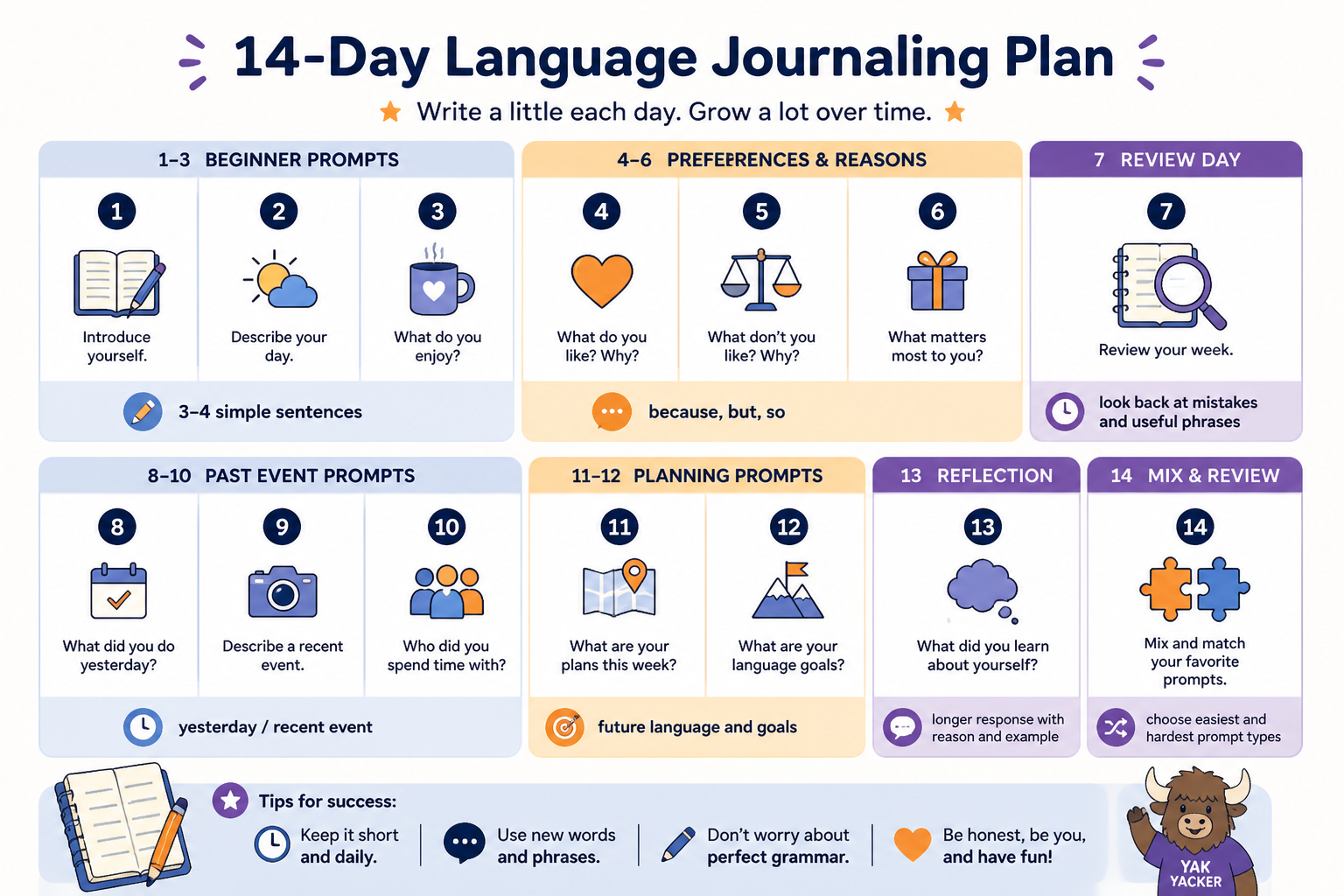
A practical 14-day journaling starter plan
If you want to begin now, use this simple two-week plan. It is designed to be manageable and to build confidence without overwhelming you.
| Days | Focus | Goal |
|---|---|---|
| 1–3 | daily life prompts | write 3–4 simple sentences each day |
| 4–6 | preferences and reasons | practice because, but, and so |
| 7 | review day | look back at common mistakes and useful phrases |
| 8–10 | past event prompts | write about yesterday or a recent event |
| 11–12 | planning prompts | practice future language and goals |
| 13 | reflection prompt | write a slightly longer response with a reason and example |
| 14 | mix-and-match review | choose your easiest and hardest prompt types |
By the end of two weeks, you should know which prompts feel easiest, which ones push you in a good way, and what kind of format you can keep using.
How to make daily prompts part of your larger language routine
Daily journaling works best when it does not have to do everything. It can sit beside listening, reading, speaking, and review. That makes it easier to sustain and more useful overall.
A balanced routine might look like this:
- listening for input
- reading for vocabulary and patterns
- journaling for output and recall
- review for correction and repetition
Journaling helps lock in what you learn from input. If you hear or read a useful phrase, try using it in your journal later that day. That is one of the fastest ways to move vocabulary from “I recognize it” to “I can use it.”
And if you are still building the overall structure of your study time, the pillar page at how to learn a language can help you see where journaling fits inside a larger approach.
Quick checklist for a strong daily journal session
Use this as a fast self-check before or after writing:
- I chose a prompt I can answer today.
- I wrote without stopping for every unknown word.
- I used at least a few complete sentences.
- I added a reason, detail, or example.
- I noticed at least one useful correction.
- I kept the session short enough to repeat tomorrow.
If you can check most of those boxes, your journaling session is doing its job.
What to do next if you want journaling to stick
The next step is not to find the perfect prompt list. The next step is to make one tiny decision and repeat it.
Here is the simplest way to begin:
- Choose one prompt type for this week.
- Decide on a time of day.
- Set a minimum length, like 3 sentences.
- Review one mistake or one useful phrase each day.
- Repeat for seven days before changing anything.
That is enough to start building momentum. Once the habit feels stable, you can add more variety, longer entries, or more review. But do not start by making it complicated. Complicated is where good intentions go to sit in a drawer.
Daily language journaling works because it is practical, personal, and repeatable. You are using the language for real thoughts, not just school exercises. You are building confidence by writing imperfectly and improving steadily. And you are creating a habit that gives you daily contact with the language, even on ordinary days.
If you keep the prompts simple, the sessions short, and the review focused, your journal becomes more than a notebook. It becomes a record of progress you can actually see.