
Why feedback matters more than “just practicing”
Learning a language without feedback is a bit like trying to improve your tennis swing by hitting balls in the dark. You may be active, you may be sweating, and you may even feel productive, but you won’t know what to fix. Useful corrections turn practice into progress.
That does not mean every mistake needs to be corrected, and it definitely does not mean you should ask people to turn into tiny grammar robots. The goal is simpler: get feedback that helps you notice patterns, fix the right things, and keep speaking or writing without freezing up.
If you want to learn a language efficiently, you need two things at the same time:
- input, so you can see and hear what good language looks like
- feedback, so you can notice where your own language goes off track
Feedback is especially valuable because beginners and intermediate learners often cannot reliably hear their own mistakes. You might think a sentence sounds fine, but a native speaker, teacher, or strong learner can hear issues with word order, tense, article use, pronunciation, or register that you simply have not built sensitivity to yet.
That is why correction is not just about being “right.” It is about building better awareness.
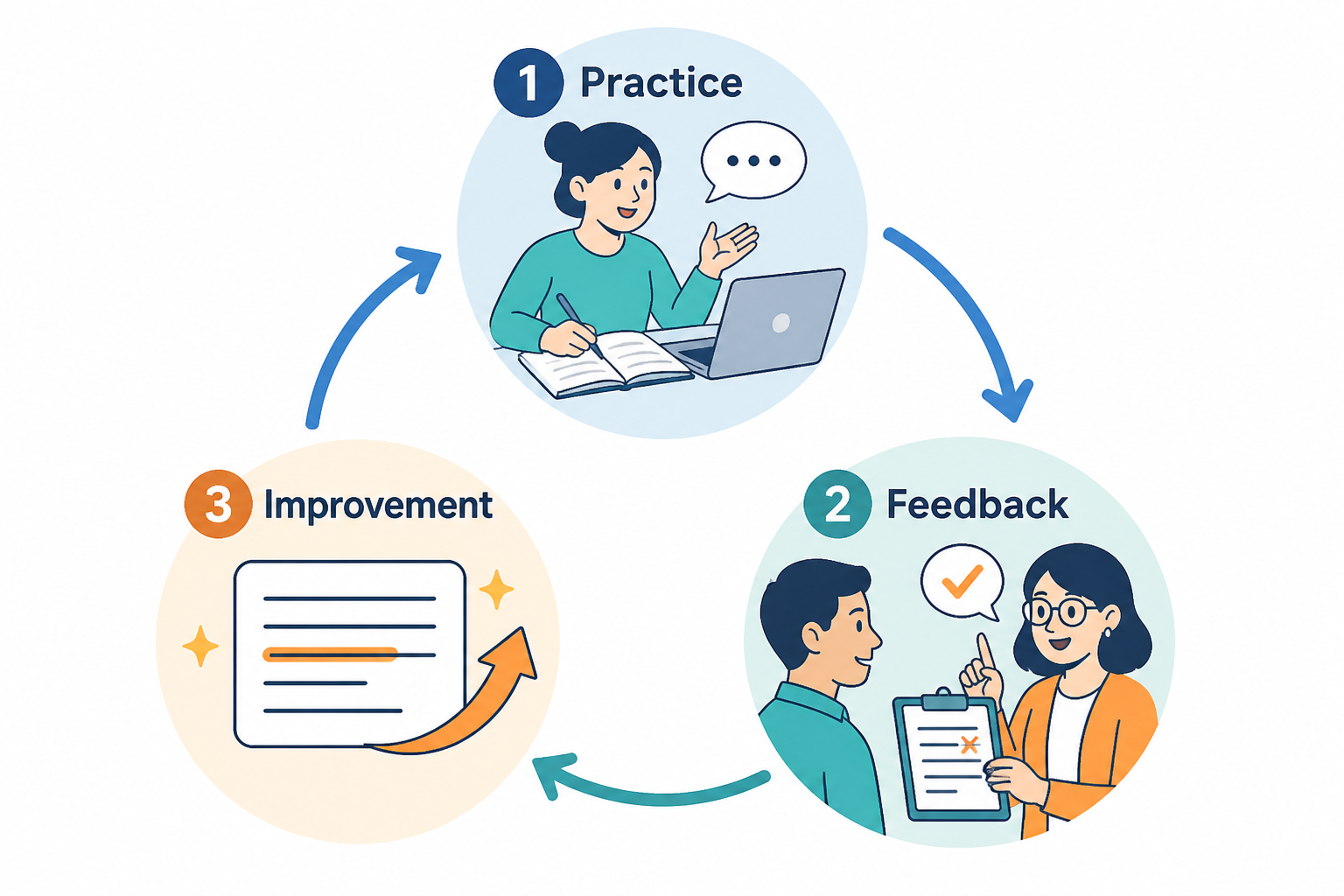
What useful feedback actually looks like
Not all corrections are equally useful. A great correction is not just “wrong” or “right.” It tells you what happened, what should have happened, and sometimes why. The best feedback helps you change behavior next time.
Useful language feedback usually falls into one of these types:
| Type of feedback | What it does | Best for |
|---|---|---|
| Direct correction | Gives the correct version | Quick fixes, beginners, important messages |
| Recast | Repeats your sentence in a better form | Natural conversation, low-pressure correction |
| Explanation | Explains why something is wrong | Patterns you keep repeating, grammar study |
| Prompt | Helps you notice and self-correct | Long-term learning, speaking practice |
| Focused feedback | Targets one skill only, like verb tense or pronunciation | Preventing overwhelm, measurable improvement |
Example:
- You say: “Yesterday I go to the store.”
- Direct correction: “Yesterday I went to the store.”
- Recast: “Oh, you went to the store yesterday?”
- Explanation: “Use the past tense after ‘yesterday.’”
- Prompt: “Try that sentence again in the past tense.”
Each version has a place. If you are exhausted, a quick recast may be enough. If you keep making the same mistake, you may need explanation and practice. If you are learning pronunciation, a prompt and a model can be more useful than a long grammar lecture.
The biggest mistake: asking for correction in the wrong way
Many learners say they want feedback, but they never specify what kind. Then they get corrections that feel random, overwhelming, or unhelpful. The problem is not always the person giving feedback. Often the request was too vague.
“Please correct me” sounds reasonable, but it leaves too much open:
- Do you want every mistake or only the serious ones?
- Do you want grammar, vocabulary, pronunciation, or all of it?
- Do you want interruption during speaking or notes after?
- Do you want explanations or just the correct version?
If you make the request clearer, the feedback gets better immediately.
Better ways to ask for corrections
- For conversation: “Please correct only mistakes that make my meaning unclear.”
- For accuracy practice: “Please correct my grammar and word choice as we go.”
- For fluency practice: “Let me speak first, then correct me after I finish.”
- For writing: “Can you mark my biggest mistakes and explain the top three?”
- For pronunciation: “Please tell me if anything sounds unnatural or hard to understand.”
That one sentence of guidance can save a lot of confusion. It also tells the other person what kind of help will actually be valuable.
How to choose the right kind of feedback for your stage
Different learners need different amounts and styles of correction. If you are a beginner, too much feedback can feel like being corrected by an overenthusiastic red pen. If you are intermediate, too little feedback may let bad habits harden.
Here is a simple way to think about it:
| Stage | Best feedback style | Main goal |
|---|---|---|
| Absolute beginner | High-frequency, simple, gentle corrections | Build confidence and basic sentence patterns |
| Lower intermediate | Selective correction with short explanations | Fix recurring grammar and vocabulary errors |
| Upper intermediate | Focused feedback on style, accuracy, nuance, pronunciation | Polish naturalness and reduce fossilized mistakes |
A beginner may need the correct phrase immediately so they can continue. An intermediate learner often benefits more from noticing patterns and trying again. If you are far enough along that you can already communicate fairly well, the best feedback is often the kind that improves precision, not just basic survival.
One useful rule: correct the mistakes that are blocking your progress, not every tiny thing that makes you feel imperfect. There will always be another tiny thing. Languages are generous that way.
How to ask for feedback in real life
Getting feedback is often a social skill, not just a language skill. People are usually willing to help, but they need a clear request and a little guidance on how to help you well.
When speaking with a tutor, teacher, or conversation partner
Start before the conversation begins. Say what kind of correction you want and when you want it.
Try one of these:
- “Please interrupt me if I make a major mistake.”
- “Can you take notes and correct me at the end?”
- “I want to practice speaking smoothly, so only correct repeated mistakes.”
- “Can you focus on verb tense today?”
This helps the other person avoid guessing. It also protects the mood of the conversation. Some speaking sessions should be more like free-flowing practice. Others should be more like training sessions. Both are useful, but they should not be mixed without a plan.
When talking to native speakers
Native speakers are not automatically good correction partners. Some are excellent; others are kind but not sure what to do; many are happy to help if you make it easy.
Make the request light and specific:
- “If I say something odd, can you rephrase it naturally?”
- “Please stop me only if I’m hard to understand.”
- “After I talk, can you tell me one thing to improve?”
Do not ask a casual chat partner to become your unpaid grammar coach for forty minutes unless that is clearly the arrangement. A small, polite request works much better.
When posting writing in language exchanges or communities
For writing, the best results usually come when you ask for a clear level of detail. If you want broad feedback, say so. If you want line-by-line correction, say that too.
Examples:
- “Please correct grammar and natural word choice.”
- “I’d like corrections in the text plus a short explanation.”
- “Please keep the original meaning, but make it sound natural.”
- “I’m practicing one structure, so only correct that structure.”
Writing is often easier to correct than speech because the feedback can be more precise and the learner can study it afterward. If you are trying to improve your writing, keep a record of recurring changes so you can spot patterns over time.
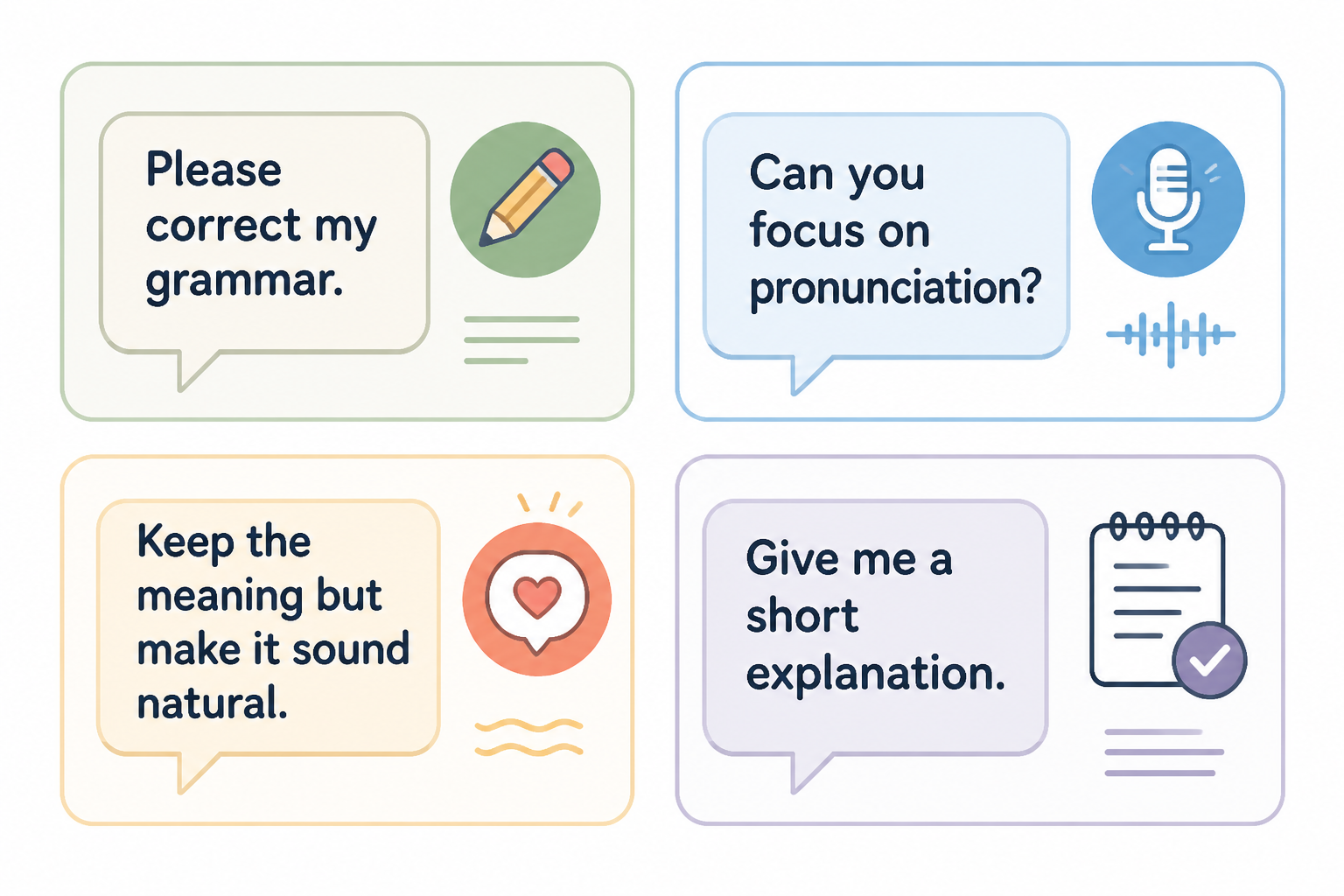
How to ask for feedback without sounding awkward
Many learners avoid asking for correction because they worry it sounds needy or intense. It does not have to. The request can be simple, normal, and even a little casual.
Useful phrasing usually includes three parts:
- what you want corrected
- when you want it corrected
- how much detail you want
For example:
- “Please correct my biggest mistakes as I speak, but don’t interrupt every sentence.”
- “Can you tell me if my pronunciation is clear, and then give me one or two examples to repeat?”
- “I’m trying to improve my past tense. Please focus on that, even if other mistakes happen.”
If you are very early in the learning process, you can even say:
- “I’m still learning, so please use simple corrections.”
- “I want feedback, but not too much at once.”
That usually helps people relax. You are not asking for perfection. You are asking for useful information.
How to get better feedback from teachers and tutors
A good teacher can be an excellent correction source, but even a good teacher benefits from guidance. If you want stronger results, help them help you.
Bring a correction goal to each lesson
Instead of saying, “Correct me,” choose one or two targets:
- verb tense
- sentence order
- pronunciation of specific sounds
- articles and prepositions
- more natural vocabulary
- hesitation and filler phrases
Focused feedback works because it reduces overload. If everything is wrong, nothing is memorable. If one thing is targeted, the brain has a better chance of noticing it.
Ask for examples, not just labels
Sometimes a teacher says, “That’s incorrect because of article use.” That may be true, but it may not help you if you still do not understand the pattern. A more useful response includes an example:
- Wrong: “I went to store.”
- Correct: “I went to the store.”
- Pattern: “Use the for a specific place we both know.”
Examples are sticky. Labels are not always sticky. Your brain remembers concrete language more easily than abstract terminology.
Ask for “one rule, one example, one repeat”
If you often leave lessons feeling corrected but not improved, use this pattern:
- One rule: What is the core issue?
- One example: Show me the correct version.
- One repeat: Let me say it again correctly.
That tiny loop can turn a vague correction into a real learning moment.
How to get useful feedback from language exchange partners
Language exchange can be great, but it is inconsistent by nature. Some partners love correcting. Some avoid correction because they want to keep the conversation friendly. Some correct too much. Some correct too little. A bit of structure solves most of this.
Set the format before the conversation starts
Try one of these formats:
- Conversation first, corrections later: best for fluency
- Interrupt me for major errors: best for accuracy and awareness
- Take notes and review at the end: best for flow plus reflection
- Correct only one category: best for focused study
A lot of frustration disappears when both people know the plan. Without a plan, one person may feel ignored and the other may feel constantly interrupted. Everyone loses, including the poor sentence that was just trying to be born.
Make your partner’s job easier
Helpful learners do not just ask for corrections. They also give their partner a clear target. For example:
- “I’m especially working on verb endings.”
- “I want to sound more natural in casual conversation.”
- “Please tell me if my sentence sounds translated from English.”
The more precise you are, the more useful the feedback becomes.
After the exchange, review the corrections
Do not let good feedback vanish into the fog of “I’ll remember that later.” Later is a liar.
After the conversation, write down:
- the corrected sentence
- the type of mistake
- what you should remember next time
Example:
- Original: “I am agree.”
- Correction: “I agree.”
- Type: verb pattern / collocation
- Note: Do not use “am” with “agree.”
This turns a one-time correction into reusable learning.
How to use writing tools and communities wisely
Writing is one of the easiest ways to get correction because the text is fixed. You can study it, compare versions, and rewrite it at your own pace. But writing feedback is only useful if you know what to do with it.
Decide what kind of correction you want
There are at least four options:
- Light correction: only the biggest mistakes
- Full correction: grammar, style, and naturalness
- Targeted correction: one skill only, like articles or verb tense
- Teacher-style correction: corrected text plus explanation
If you do not choose, you may get a mix of all four, which can be overwhelming.
Look for patterns, not isolated errors
One correction matters. A repeated correction matters more. When the same issue appears again and again, that is your real learning target.
For example, if your corrected writing keeps showing:
- missing articles
- awkward word order
- incorrect prepositions
then your job is not just to fix one sentence. Your job is to notice the pattern and practice it.
Rewrite the corrected version yourself
Do not just read the correction and nod politely at it. Rewrite it. Say it out loud. Compare the original and the correction.
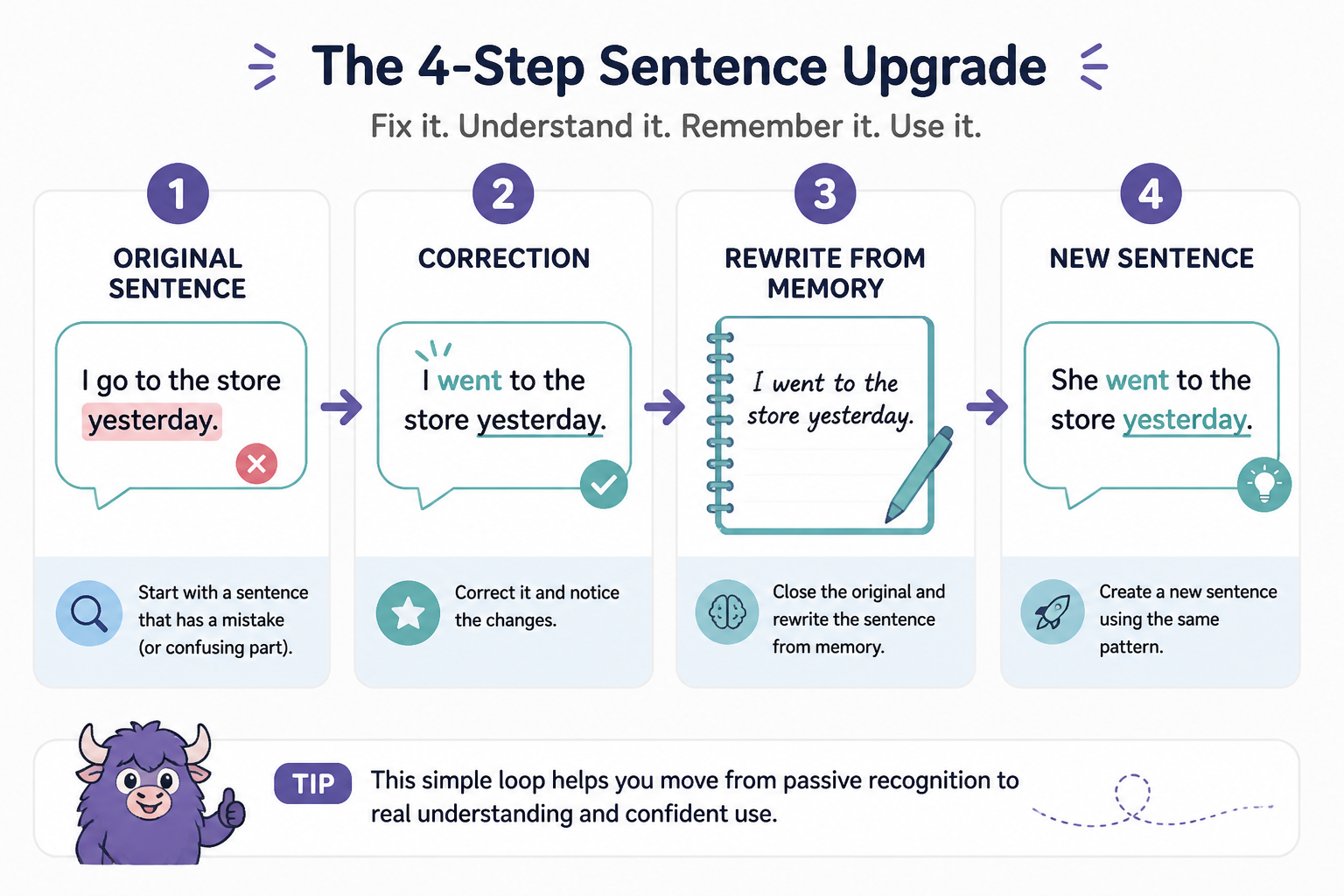
A simple workflow:
- Read the correction
- Identify the change
- Rewrite the sentence from memory
- Say why the correction was needed
- Create one new sentence using the same pattern
That final step is important. If you can only repeat the corrected sentence, you may have memorized the answer without learning the rule. A new sentence shows real understanding.
How to deal with corrections without feeling crushed
Some learners avoid feedback because correction feels personal. That reaction is normal. Language learning can be oddly vulnerable. You are trying to communicate as yourself, but your words are still under construction.
The trick is to separate your value from your current language accuracy.
A correction is not a verdict on your intelligence. It is information about a sentence.
That distinction matters. If you treat every correction like a judgment, you will start avoiding feedback. If you treat it as data, you can improve faster and with less emotional drama.
Three helpful mindset shifts
- From “I made a mistake” to “I found a pattern.”
- From “I’m bad at this” to “I need more examples.”
- From “They corrected me” to “They gave me a shortcut.”
Feedback is only painful when it is vague, repeated without explanation, or delivered in a rude way. Good correction should make the next attempt easier, not make you dread the conversation.
Common mistakes learners make with feedback
There are a few predictable traps. Avoiding them can dramatically improve how much you learn from each correction.
1. Wanting every mistake corrected
If you try to fix everything at once, you will remember almost nothing. Focus on the most useful mistakes first: errors that block meaning, repeat often, or relate to your current study goal.
2. Taking correction as the whole lesson
Correction is not the same as learning. A correction only helps if you review it, compare it, reuse it, and practice it again later.
3. Asking for feedback too late
If you ask for correction only after a week of chatting or writing, it is much harder to connect the feedback to the original sentence. The sooner the feedback arrives, the more useful it is.
4. Ignoring pronunciation feedback because it feels vague
Pronunciation feedback is often the least concrete and the most useful. If a listener says something sounds unclear, ask them to point to the exact word or sound and give you a model. Vague is fixable if you ask for a clearer demonstration.
5. Not recording recurring mistakes
If the same issue keeps appearing and you never track it, you are doing the same correction over and over like a tiny hamster on a wheel. Write it down. Notice it. Review it.
6. Correcting yourself only after you have already formed the habit
The sooner you receive feedback on a repeated mistake, the easier it is to stop it becoming automatic. Waiting too long makes it harder.
How to turn corrections into actual improvement
Feedback is valuable, but only if it changes what you do next. Here is a practical system you can use after any correction, whether it came from a teacher, exchange partner, or writing correction.
The 5-step correction routine
- Capture it. Write down the original sentence and the correction.
- Classify it. Is it grammar, vocabulary, pronunciation, word order, or style?
- Compare it. What exactly changed?
- Practice it. Say or write two to five new sentences using the corrected pattern.
- Review it later. Come back to the same mistake in a day or two.
This is simple, but it works because it moves feedback from passive recognition to active use.
Example of the routine in action
- Original: “I’m looking forward to meet you.”
- Correction: “I’m looking forward to meeting you.”
- Classification: verb form after a fixed phrase
- Compare: “to + verb-ing” after “looking forward to”
- Practice: “I’m looking forward to seeing the movie.”
- Review: use the phrase again tomorrow in a new sentence
That is the difference between being corrected and actually learning from correction.
How to use feedback to notice your weak spots
Good feedback is not just for fixing one sentence. It can reveal your learning priorities. If you keep seeing the same kind of correction, that is not random noise. That is your language profile waving a flag at you.
Ask yourself:
- Do I keep missing articles?
- Do I choose the wrong verb patterns?
- Do I use a literal translation from English too often?
- Do I hesitate on pronunciation for the same sounds?
- Do I sound correct but unnatural?
Once you know your weak spots, you can study with more precision. That is much more effective than just “studying more.” More is not always better. Better-targeted is better.
For a structured way to see whether your weak spots are improving, it helps to track language growth over time. If you want a clear system for that, see how to track language progress with CEFR and ACTFL.
How to tell whether a correction is actually correct
This is an underrated skill. Not every correction you receive will be perfect. Sometimes a partner gives you a natural-sounding alternative that is not the only correct version. Sometimes a correction is overgeneralized. Sometimes it reflects personal preference rather than a clear rule.
That does not mean you should distrust all feedback. It means you should learn how to evaluate it.
Ask these questions:
- Does this correction fit the meaning I wanted?
- Is it clearly more natural, or just different?
- Do I see the same pattern in other examples?
- Was the correction about grammar, style, or preference?
- Can I confirm it in other trusted materials or from another speaker?
If two different sources give the same correction, it is probably a real issue. If one person says it and no one else does, you may be looking at style, dialect, or preference. In those cases, keep the note, but do not panic.
What to do when feedback is too much
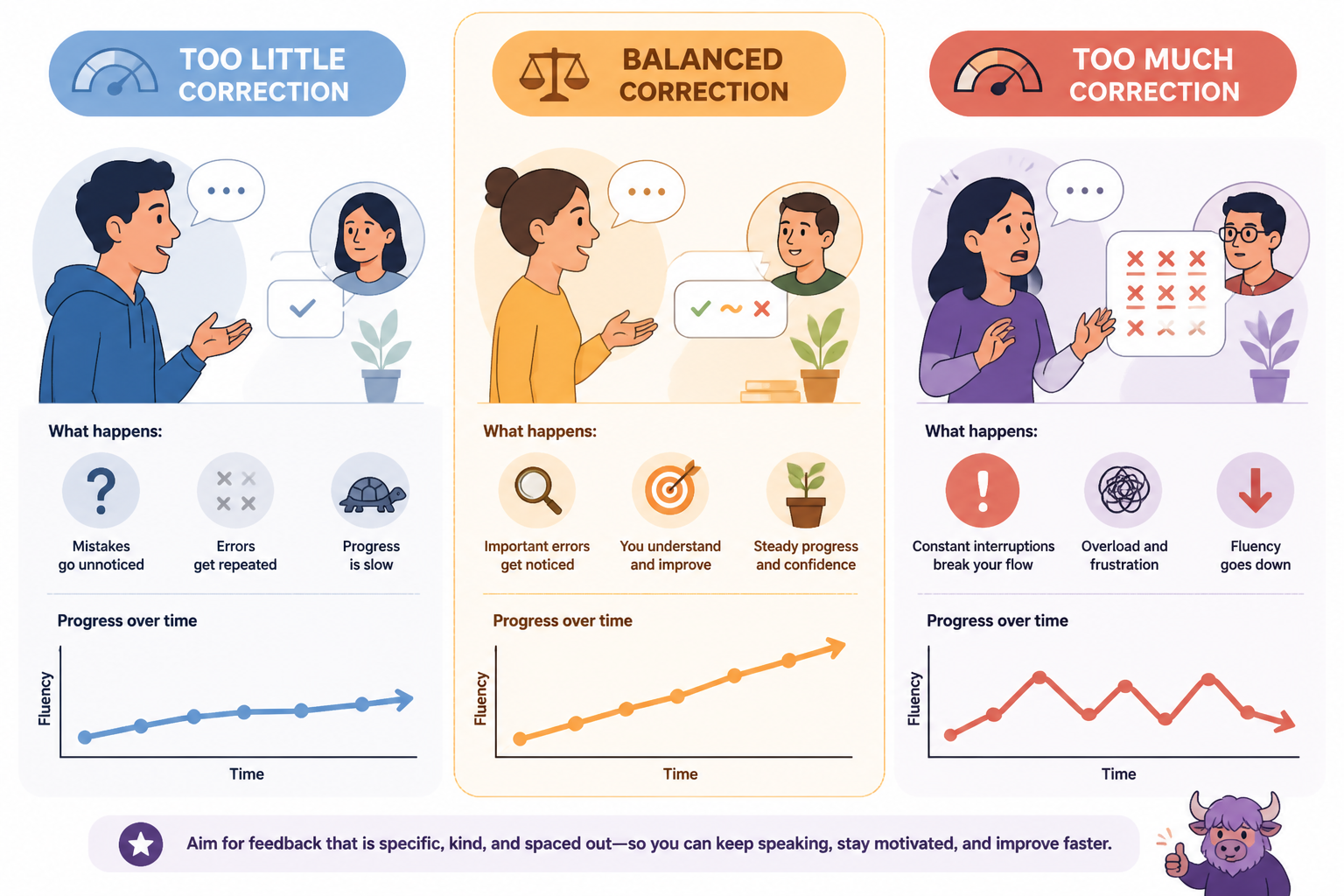
Too much correction can be counterproductive. If you are so overwhelmed that you stop speaking, the feedback has become too heavy. That is not a failure. It just means the format needs adjusting.
Signs the correction level is too high
- You stop speaking because you fear every sentence
- You cannot remember any of the corrections afterward
- The conversation becomes more about accuracy than communication
- You feel irritated or embarrassed instead of motivated
How to reduce the load
- Ask for correction only at the end
- Focus on one category per session
- Ask for only the top three mistakes
- Use simpler topics while building confidence
- Separate fluency practice from accuracy practice
This is not lowering your standards. It is making the training sustainable.
What to do when feedback is too little
On the other hand, some learners get lots of speaking practice and almost no correction. That can feel comfortable at first, but progress may slow down because mistakes get repeated without being noticed.
Signs the correction level is too low
- You keep repeating the same errors
- You leave sessions feeling good but unchanged
- You suspect you are making mistakes, but no one is saying anything
- Your accuracy improves much more slowly than your confidence
How to increase useful feedback
- Ask directly for more correction
- Bring written samples to review
- Choose one target area and request focus on it
- Use recordings so you can self-review
- Work with a teacher or tutor periodically, even if your main practice is casual
Sometimes learners think they need more speaking time when what they really need is more precision. The right amount of correction changes over time.
How to build a feedback habit you will actually keep
The best correction system is the one you can stick with. A fancy method that disappears after three days is less useful than a plain one you use every week.
A realistic weekly feedback routine
- During one speaking session: ask for correction on one target only
- After the session: record 3–5 useful corrections
- Next day: review them and make new sentences
- Once a week: look for the most repeated mistake
- Once a month: choose one pattern to focus on intentionally
You do not need to make this elaborate. The goal is to keep feedback in circulation long enough for it to become knowledge instead of fleeting information.
A simple feedback notebook structure
- Original sentence
- Corrected sentence
- Type of mistake
- Short explanation
- New example sentence
This works on paper, in notes on your phone, or in a simple document. The format matters less than the habit.
A practical script you can use today
If you are not sure how to begin, use this script and adapt it to your situation:
“I’m trying to improve my language accuracy. Could you please correct me when I make mistakes, but focus only on the most important ones? If possible, I’d like a short explanation or example when you correct me.”
If you want less interruption:
“Please let me speak first, then tell me the main corrections at the end.”
If you want focused practice:
“Today I’m focusing on verb tense and pronunciation. Please correct those more than anything else.”
If you want writing feedback:
“Could you correct my writing for grammar and natural phrasing, and maybe explain the biggest changes?”
That may sound small, but clear requests can transform the quality of the feedback you receive.
Quick checklist for getting better corrections
Before your next lesson, chat, or writing exchange, check these boxes:
- I know what I want corrected
- I know whether I want interruption or end-of-session feedback
- I have chosen one main focus area
- I know how I will record the corrections
- I will review the corrections afterward
- I will look for repeated patterns, not just isolated mistakes
That is enough to make feedback much more useful without turning your session into a bureaucratic meeting with adjectives.
When to ask for more self-correction instead of direct correction
Direct correction is useful, but it is not the only route. Sometimes the best feedback is a hint that makes you correct yourself. Self-correction helps the correction stick because your brain does more work to find the answer.
Use self-correction when:
- you already know the structure but sometimes slip
- you want to strengthen awareness
- you are practicing speaking and want less interruption
Example:
- You say: “He go to school every day.”
- Teacher says: “Check the verb.”
- You correct yourself: “He goes to school every day.”
This is a very small moment, but it can be powerful. You are not just receiving the answer; you are retrieving it.
Bringing it all together
Getting useful language feedback is not about collecting corrections like souvenirs. It is about creating a system that helps you notice, understand, and fix the kinds of mistakes that matter most.
The most helpful feedback usually has four qualities:
- it is specific
- it matches your current level
- it focuses on the right mistake at the right time
- it leads to a follow-up action
If you can ask for the kind of correction you need, record it well, and revisit it later, your mistakes stop being embarrassing dead ends and start becoming useful map markers. That is how feedback turns from awkward interruption into real progress.
If you want to go one step further, it also helps to understand the role of mistakes themselves in language growth. For that, see how to handle mistakes in language learning.
And if you want the broader learning framework that this article fits into, you can also visit the main guide at How to learn a language.