
Why mistakes feel bigger than they are
If you are learning a language, mistakes are not a sign that you are bad at it. They are the job. Every wrong verb, awkward sentence, or misheard word is useful data. The real skill is not “never making mistakes.” It is learning how to respond when someone corrects you so the correction actually sticks.
For the broader learning path, visit our parent guide.
For many learners, getting corrected can trigger one of three reactions: embarrassment, defensiveness, or total shutdown. None of those help much. The good news is that responding well to corrections is a learnable skill, just like vocabulary or pronunciation. If you can stay calm, extract the useful part, and turn the correction into practice, your progress gets much faster.
This guide shows you how to handle mistakes and get corrected in a way that helps you improve instead of spiraling. You will learn what to say in the moment, how to remember the correction afterward, how to ask for better feedback, and how to build the kind of mindset that makes correction feel less personal and more useful.
What correction is actually for
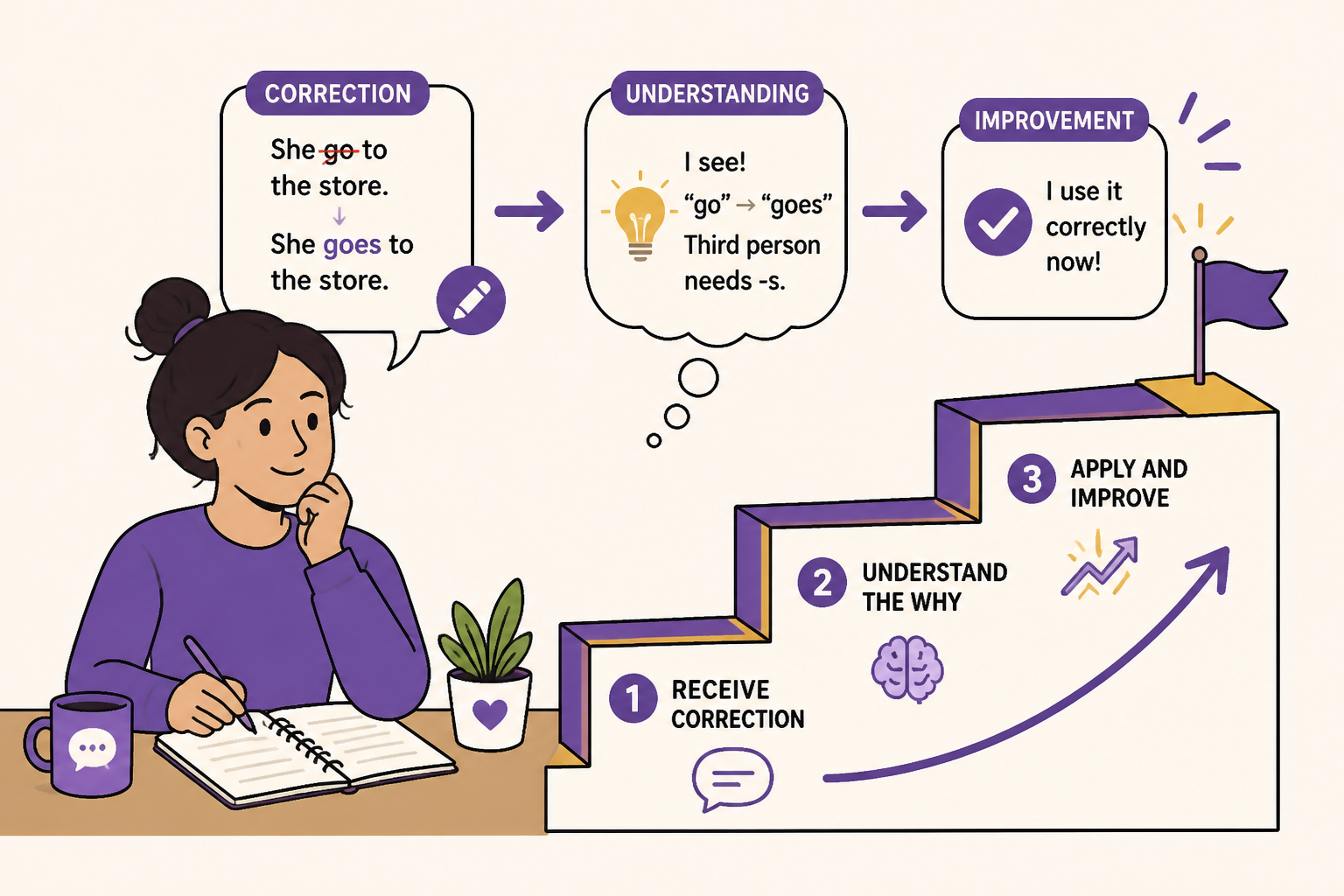
Correction is not a grade. It is information. Someone is helping you notice the gap between what you meant to say and what you actually said. That gap might be about grammar, pronunciation, word choice, or even politeness.
When learners hear “That’s wrong,” they often think the moment is about failure. In reality, the useful question is: What exactly should I change next time? If you can answer that, the correction has done its job.
Not every correction has the same purpose, either. Some corrections are meant to help you speak more accurately. Others are meant to prevent confusion. Some are tiny and cosmetic. Others change the meaning completely. Learning to tell the difference keeps you from overreacting to small errors and ignoring important ones.
The best response in the moment: calm, curious, brief
When someone corrects you, your first goal is not to produce a perfect reply. Your first goal is to stay open. A calm response keeps the conversation moving and makes the correction easier to remember.
A simple pattern works well:
- Acknowledge the correction.
- Repeat the corrected form if needed.
- Use it again right away if you can.
For example:
- Teacher: “Not I have 20 years. Say I am 20 years old.”
- You: “Right, I am 20 years old. Thanks.”
Or:
- Conversation partner: “You mean borrow, not lend.”
- You: “Ah, borrow. I want to borrow your book.”
This kind of reply does three things at once: it shows you understood, it gives your brain a second exposure, and it gives the other person a signal that correcting you is welcome.
A simple correction-response formula you can reuse
Here is a practical formula you can use in almost any language-learning situation:
Notice → Accept → Repeat → Reuse
- Notice: Realize that a correction is happening.
- Accept: Avoid arguing unless something is truly unclear.
- Repeat: Say the corrected phrase back if possible.
- Reuse: Put the corrected form into another sentence.
Why does this work? Because a correction is easiest to remember when you do something with it immediately. Passive hearing is weak. Active reuse is sticky.
Example:
- Correction: “Not much people. Say many people.”
- Your response: “Many people. Got it.”
- Reuse: “Many people like this restaurant.”
What to say when you do not understand the correction
Sometimes the correction is too fast, too vague, or full of unfamiliar words. That is normal. Do not pretend you understood if you did not. A useful correction that you misunderstand is not useful at all.
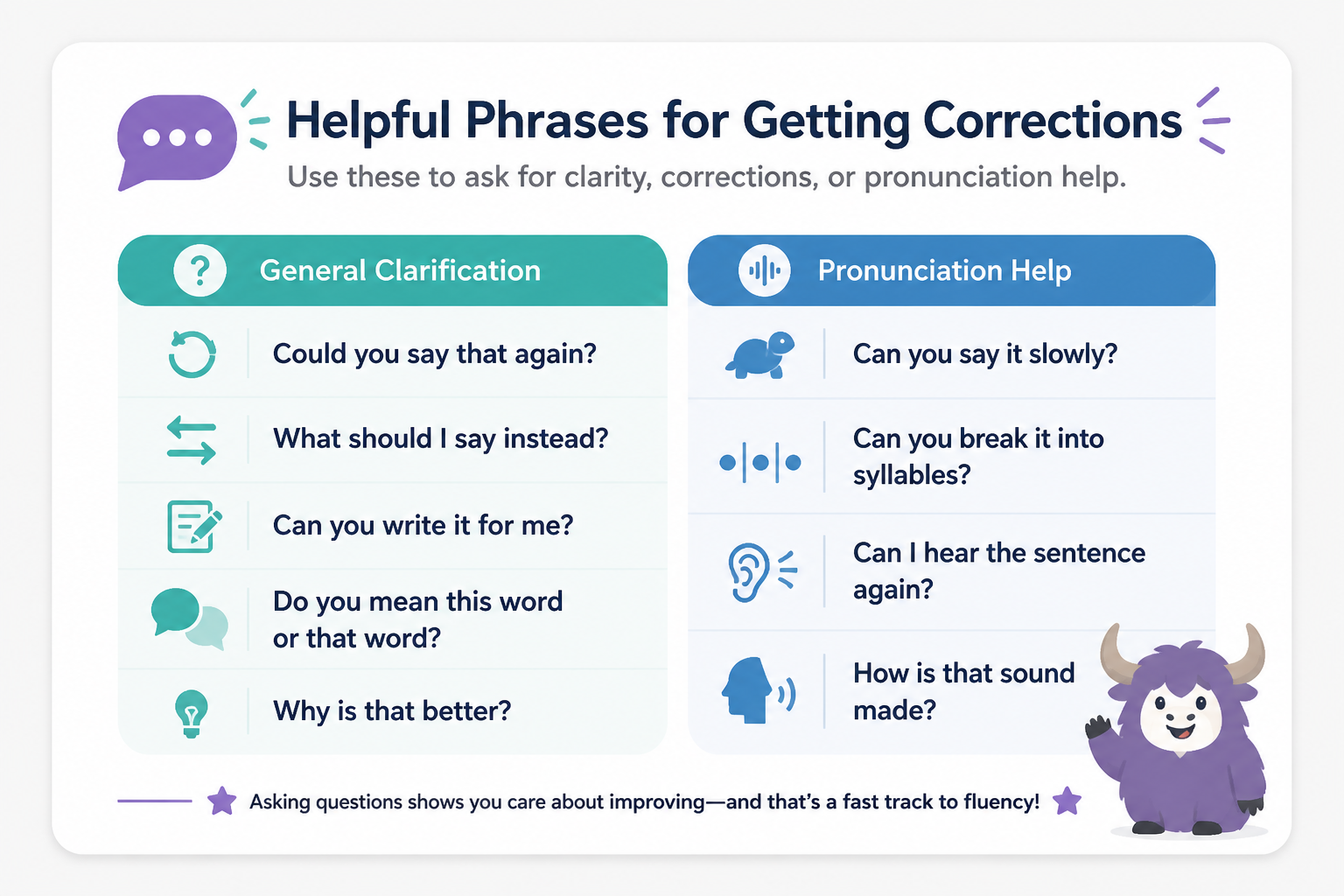
Good clarification phrases are short and direct. You do not need fancy language. You need precision.
- “Could you say that again?”
- “What should I say instead?”
- “Can you write it for me?”
- “Do you mean this word or that word?”
- “Why is that better?”
If the correction is about pronunciation, ask for a model you can imitate:
- “Can you say it slowly?”
- “Can you break it into syllables?”
- “Can I hear the sentence again?”
If it is about grammar or word choice, ask for the reason only if it helps you remember. You do not need a lecture every time. Sometimes one clear example is better than a long explanation.
How to avoid getting defensive when corrected
Defensiveness is usually a reflex, not a character flaw. Your brain hears correction as threat: “I sounded wrong in front of another person.” But language learning requires a lot of public imperfect moments, which can feel awkward even when nobody is judging you.
Here are a few ways to keep your cool:
- Assume helpful intent first. Most people correct to help, not to embarrass you.
- Separate your identity from the error. You are not “wrong.” You made a wrong sentence.
- Remember the purpose. The correction is evidence that someone is helping you improve.
- Use a neutral reply. A simple “Thanks, that helps” lowers the emotional temperature.
If a correction stings, that does not mean you are failing. It means you care. The trick is to let the sting pass through without turning it into a whole story about your ability.
A useful mental sentence is: This is not a verdict. This is a data point.
Different kinds of corrections and how to respond to each one
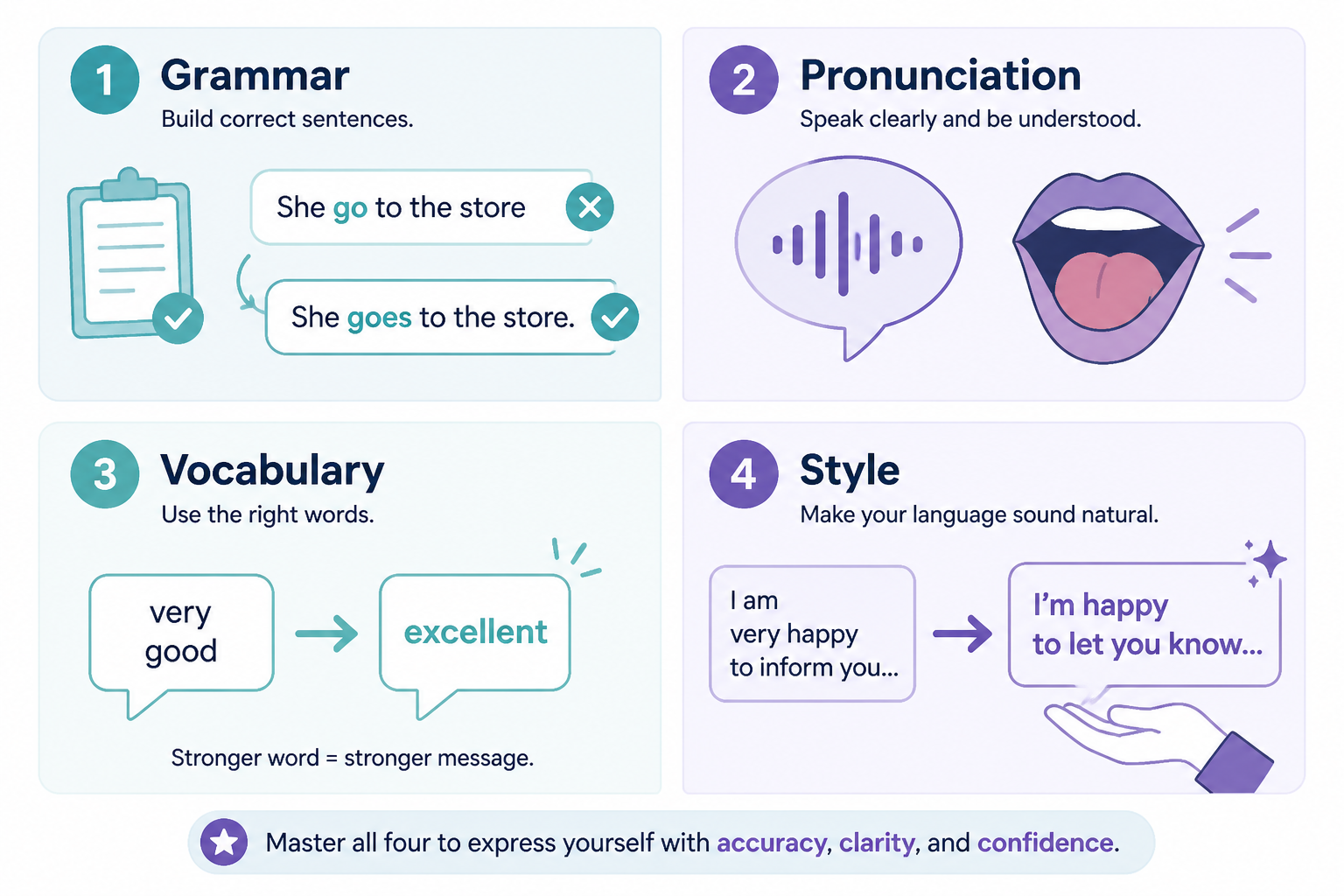
Not all corrections are equal. Some should be accepted immediately. Some are worth asking about. Some may be more about style than correctness. Knowing the difference helps you respond appropriately instead of overcorrecting everything.
| Type of correction | What it means | Good response |
|---|---|---|
| Grammar | The structure of the sentence needs adjustment | Repeat the corrected sentence and note the pattern |
| Vocabulary | The word choice is inaccurate, too weak, or unnatural | Use the new word in another sentence right away |
| Pronunciation | The sound, stress, or rhythm is unclear | Repeat slowly and compare your version to theirs |
| Meaning | Your sentence could be misunderstood | Confirm the intended meaning and rewrite the sentence |
| Style or politeness | The sentence is technically fine but sounds too direct, formal, or odd | Ask for a more natural option if you want one |
One common beginner mistake is treating every correction as equally important. It is not necessary to obsess over every tiny detail. Focus first on errors that block understanding, then on recurring errors, and finally on polish.
How to turn a correction into memory instead of a forgettable moment
Many learners hear a correction, nod politely, and then immediately forget it. That is frustrating, but fixable. The goal is to convert the correction into something your brain can retrieve later.
Use this three-step method:
- Write it down quickly. A tiny note beats a vague memory.
- Make one new example. Create a sentence using the corrected form.
- Review it later the same day. Short repeats matter more than one long review session.
Example note:
- Wrong: “I’m agree.”
- Correct: “I agree.”
- Example: “I agree with your plan.”
This kind of note is small enough to actually use. You do not need a giant grammar notebook with color-coded tabs and a desk lamp worthy of a detective movie. You need a system you will open again.
The best way to ask for corrections before they happen
One of the smartest things you can do is tell people what kind of correction you want. If you do this early, your feedback becomes more useful and less random.
For example, you can say:
- “Please correct my major mistakes.”
- “Can you stop me when my meaning is unclear?”
- “I want pronunciation feedback today.”
- “Please correct me only after I finish speaking.”
- “Can you write the correction down if possible?”
This matters because different learners need different kinds of correction. If you are nervous, too many interruptions can make speaking harder. If you are working on accuracy, silence is not very helpful. Ask for the type of help that matches your goal.
For more on getting useful feedback in the first place, see how to get corrections and feedback when learning a language.
How to learn from a correction without stopping the conversation
Real conversations move quickly. You cannot pause every sentence for a full lesson. The challenge is to learn from corrections while still keeping the conversation alive.
A good tactic is to do the minimum needed in the moment, then review later. In the conversation:
- repeat the correction once
- use it again if possible
- move on
Later, when you are not under pressure, you can look at the correction more carefully. Ask yourself:
- Was this a one-time slip or a pattern?
- Did I confuse two similar words?
- Do I need to practice the sound or the structure?
- Would I make the same mistake again tomorrow?
This two-stage approach keeps the conversation natural and the learning deep. You do not need to solve everything in real time.
Common mistakes learners make after being corrected
Sometimes the biggest problem is not the mistake itself, but what happens next. Here are the most common traps.
1. Saying “sorry” too much
A quick “sorry” is fine if you want it. But constant apologizing can make the correction feel heavier than it is. You do not need to act like you broke something expensive every time you use the wrong preposition.
Try: “Thanks, I’ll remember that.”
2. Ignoring the correction completely
Nodding politely and continuing with the old form is a missed opportunity. If you can, repeat the corrected version once. That simple act improves retention a lot.
3. Trying to fix every mistake at once
If someone gives you three corrections in one minute, do not try to master all three before speaking again. Pick the one that matters most for the current conversation, and review the rest later.
4. Taking corrections personally
A correction on your sentence is not a judgment on your intelligence, accent, or effort. It is a small adjustment in a skill that takes a long time to build.
5. Hiding from feedback
If corrections make you uncomfortable, it is tempting to avoid them by speaking less. That slows progress. A better solution is to make feedback smaller, clearer, and more manageable—not to eliminate it.
How to respond differently depending on the situation
The “right” response changes depending on who is correcting you and why. A classroom, a language exchange, and a family dinner are not the same thing.
In class
In class, you can usually ask for a little more detail. Teachers often expect questions like “Why?” or “Can you show me another example?”
- Repeat the corrected form.
- Ask for the rule or pattern if needed.
- Write it down immediately.
In conversation practice
In speaking practice, keep the correction short so the conversation stays natural. You can revisit it after the exchange.
- Say “Oh, I meant…”
- Repeat the corrected phrase.
- Keep talking.
With friends or language partners
With someone you know well, you can be honest about your preferences. Maybe you like immediate correction. Maybe you only want major mistakes corrected. Being clear prevents awkwardness.
With strangers
With strangers, keep it simple and polite. You usually want the interaction to stay smooth, not turn into a grammar workshop.
- “Thanks, that’s helpful.”
- “Could you say that one more time?”
- “Okay, I’ll use that form.”
A practical correction routine you can follow every time
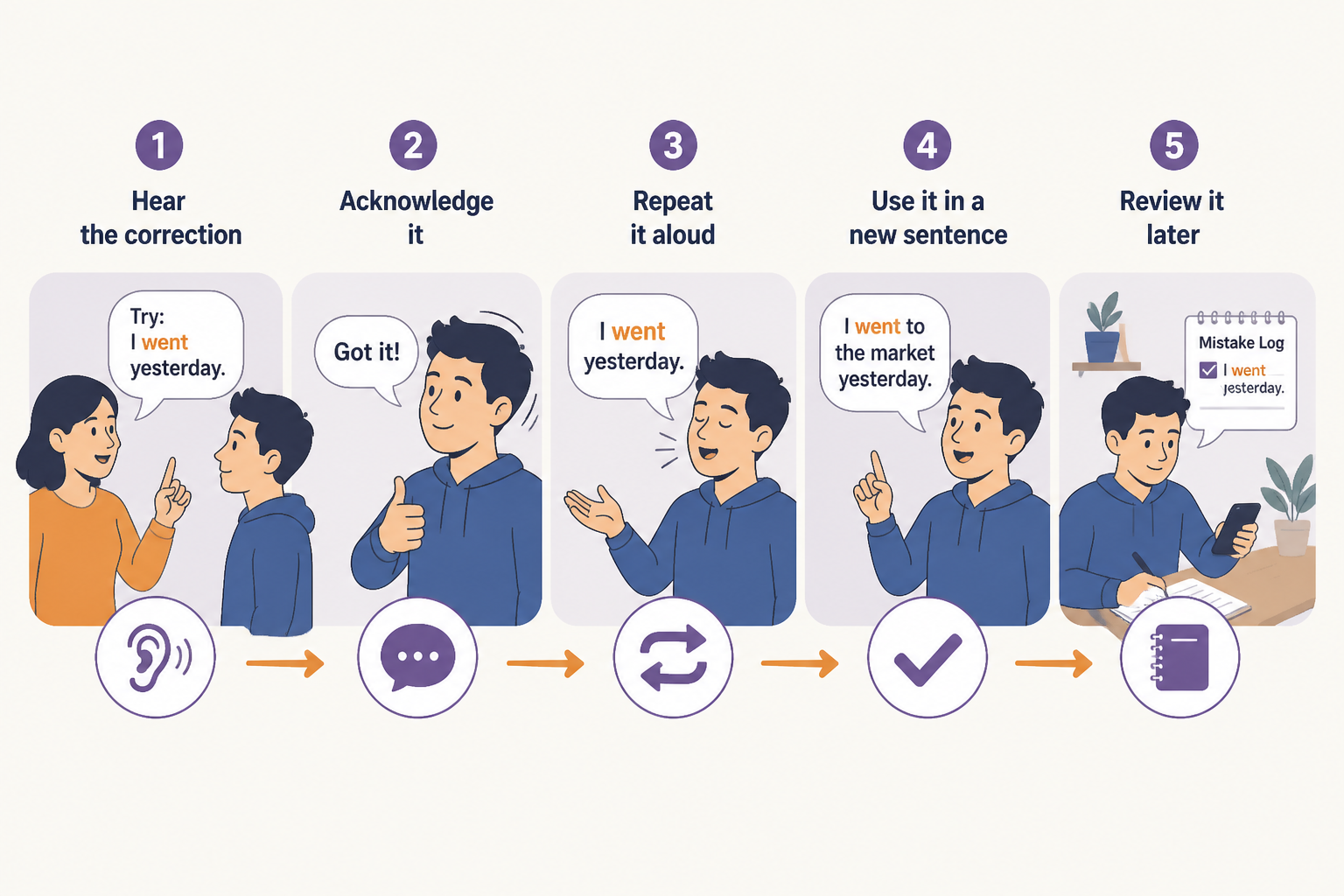
If you want a repeatable system, use this routine after every correction. It takes less than a minute in the moment and a few minutes later for review.
- 1. Hear the correction. Stay still for a second. Do not rush.
- 2. Acknowledge it. “Got it,” “Right,” or “Thanks.”
- 3. Repeat the fixed version. Say it out loud if possible.
- 4. Use it once more. Make a new sentence with the corrected form.
- 5. Capture it later. Add it to a notebook or review list.
- 6. Look for patterns. Notice whether this is a one-off or a repeated issue.
If you do this consistently, corrections stop being random embarrassment events and start becoming a structured part of learning. That shift matters a lot.
How to tell whether a correction is worth obsessing over
Some corrections deserve immediate attention. Others are useful but not urgent. A good learner knows where to focus.
Ask these questions:
- Did the mistake change the meaning?
- Will I probably make this mistake again?
- Is this a basic form I need often?
- Did the listener have to guess what I meant?
If the answer is yes to one or more of these, the correction is worth reviewing carefully. If not, note it and move on. Perfectionism is a sneaky time thief.
How to build a “mistake log” that actually helps
A mistake log is simply a place to collect corrections you want to remember. It can be a notebook, phone note, or study app. The key is to keep it short and organized enough that you will use it.
Use one line per correction:
- Wrong: I am agree
- Correct: I agree
- My example: I agree with you
You can also add a label:
- Grammar
- Pronunciation
- Word choice
- Politeness/style
That makes it easier to spot patterns. For example, you might realize you keep mixing up two verbs, or that a certain sound keeps disappearing in fast speech.
Do not turn the log into a museum of old mistakes. Keep it active. Review the items you actually still need.
What to do when a correction feels harsh or embarrassing
Not every correction is delivered kindly. Sometimes the tone is abrupt, impatient, or worse. In those moments, your goal is to protect your motivation without ignoring the useful part.
Try this filter:
- Keep the content. If the correction is correct, the information is still useful.
- Ignore the tone if you can. Easier said than done, but often worth it.
- Set boundaries if needed. You can ask for gentler or slower correction.
- Choose better practice partners. If someone consistently makes you feel small, that is not ideal practice.
Learning a language should stretch you, not humiliate you. A little discomfort is normal. Being repeatedly put down is not a productive learning method.
How to give yourself a better reaction after the conversation
The moment of correction is only part of the learning process. What you do afterward matters just as much. A five-minute review can turn one awkward moment into a durable improvement.
After the conversation, ask:
- What was the correction?
- What was I trying to say?
- What sentence will I use next time?
- Do I need to practice this aloud?
Then do one of these:
- Say the corrected sentence aloud three times.
- Write one original sentence using the corrected form.
- Teach it to yourself in plain English.
- Use it in your next speaking session.
This is how corrections become progress instead of memory noise.
What if you keep making the same mistake?
Recurring mistakes are normal. In fact, they are one of the most useful things to notice. If you keep getting the same correction, that usually means the issue is not random. It needs targeted practice.
When a mistake keeps coming back, ask which of these is true:
- I understand the rule but forget it in real time.
- I know the form but cannot produce it quickly.
- I am confusing two similar forms.
- I have never really practiced this enough.
Each problem needs a different fix:
- Forget in real time: practice with speaking prompts and slower repetition.
- Slow production: drill short sentence frames until they feel automatic.
- Confusing similar forms: compare them side by side and make contrast examples.
- Not enough practice: revisit the form in several short sessions, not one long session.
If a correction keeps appearing, that is not proof you are hopeless. It is proof the topic is important enough to deserve deliberate practice.
How to handle correction when you are nervous speaking
Nervous learners often worry that correction will interrupt their flow and make them freeze. That can happen, especially early on. The solution is not to avoid correction entirely. The solution is to lower the pressure.
Try these strategies:
- Ask for correction after you finish speaking.
- Use shorter speaking turns.
- Practice with one trusted partner first.
- Focus on one correction target at a time.
- Remind yourself that pauses are normal.
It also helps to prepare a few “recovery phrases” so you do not freeze after a mistake:
- “Let me say that again.”
- “What I meant was…”
- “Oh, the correct form is…”
- “Thanks, I’ll try that again.”
These phrases give you a bridge back into the conversation. They are small, but they reduce panic a lot.
How to know when to accept a correction and when to question it
Most of the time, accept the correction first and sort it out later. But sometimes people are inconsistent, oversimplify, or give a preference rather than a rule. It is okay to ask for clarification.
Question a correction when:
- the explanation is unclear
- you have heard a different version elsewhere
- the correction changes the meaning in a way you do not understand
- you want to know whether it is formal, casual, or regional
Useful follow-up questions include:
- “Is that always true, or just in this situation?”
- “Is this the more natural version?”
- “Is my sentence wrong, or just less common?”
- “Would people understand me if I said it my way?”
This is especially helpful when learning from different people, because not every correction reflects the same standard. Some are rules. Some are preferences. Some are both.
How correction helps you build confidence, not destroy it
It sounds backwards, but getting corrected often builds confidence over time. Why? Because you stop guessing. You learn what works. You also learn that mistakes do not end the conversation. That is huge.
Confidence in language learning is not “I never mess up.” It is more like:
- I can recover when I mess up.
- I can ask for help.
- I can improve from feedback.
- I do not need to be perfect to keep talking.
That kind of confidence is sturdier than perfectionism. Perfectionism collapses the first time a sentence goes sideways. Recovery skills keep you moving.
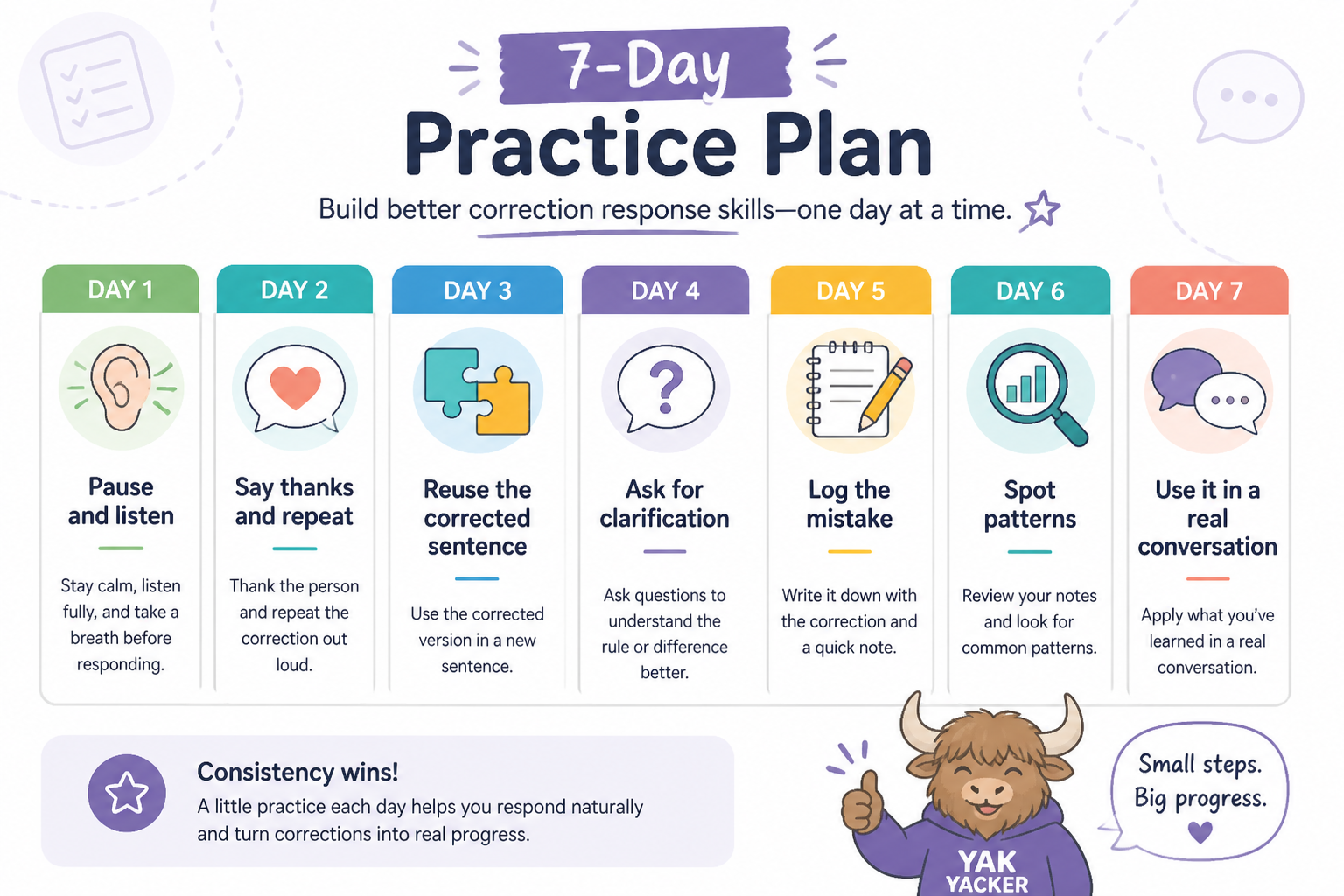
A 7-day practice plan for handling corrections better
If you want to make this skill more natural, practice it intentionally for one week. Keep the goal small and realistic.
| Day | Focus | What to do |
|---|---|---|
| 1 | Awareness | Notice how you feel when corrected. No fixing yet, just observe |
| 2 | Response phrases | Practice saying “Thanks,” “Right,” and “Could you say that again?” |
| 3 | Repeat and reuse | After one correction, repeat the corrected sentence and make a new one |
| 4 | Clarifying questions | Practice asking for a written correction or a slower explanation |
| 5 | Mistake log | Write down three recent corrections and make one example for each |
| 6 | Pattern spotting | Look for repeated errors and group them by type |
| 7 | Real use | Have a speaking session and consciously use your correction routine |
You do not need to complete every step perfectly. The point is to make correction feel normal, manageable, and useful.
Quick checklist: the next time someone corrects you
Keep this mental checklist handy. It is short enough to remember in real time.
- Pause for a second.
- Accept the correction calmly.
- Repeat the corrected form.
- Use it again if you can.
- Ask a question if you do not understand.
- Write it down later.
- Look for patterns, not perfection.
If you can do those seven things, you are already handling correction well.
Final thought: corrections are part of the path, not proof you are behind
Everyone learning a language gets corrected. The difference is what they do with it. Some people treat correction like a reminder that they are not ready. Others treat it like a shortcut to improvement.
Choose the second approach. Stay calm, ask for what you need, repeat the corrected form, and review it later. Over time, this turns mistakes into progress you can actually see.
If you want to strengthen the overall process, it also helps to build a routine you can stick with. A steady habit makes correction less stressful because learning happens more often and in smaller chunks. For that, see how to build a language learning habit, and if you want to improve the feedback you receive, revisit how to get corrections and feedback when learning a language.
And if you want the broader big-picture guide for the topic, start with the main language-learning guide and keep building from there.