

Why a language learning habit matters more than a “perfect” study session
If you want to get better at a language, the biggest win is not finding the perfect app, the perfect textbook, or the perfect study system. It is showing up often enough that language learning becomes normal.
For the broader learning path, visit our parent guide.
That is what a habit does. It lowers the drama. You stop asking, “Do I feel motivated today?” and start doing the small actions that move you forward anyway.
A consistent routine matters because languages are built on repetition. You need repeated exposure to words, sounds, sentence patterns, and meaning. A once-a-week marathon session feels productive, but it usually loses to small, regular practice over time.
Think of it like brushing your teeth. You do not wait for inspiration before brushing. You just do it because it is part of your day. The goal here is to make language learning feel that normal.
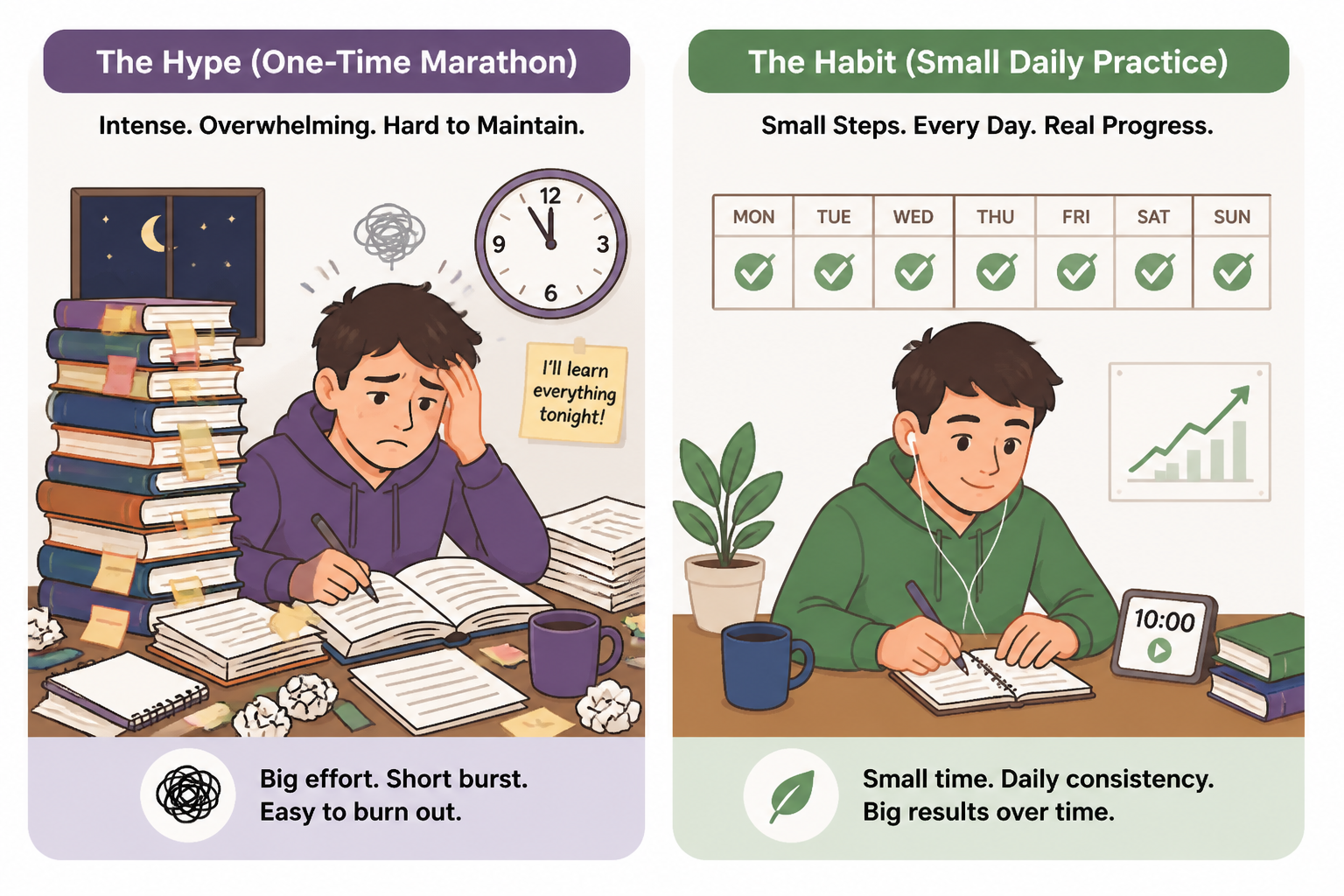
This guide will show you how to build a language learning habit that actually sticks, how to avoid the most common traps, and how to make your routine realistic enough that you can keep it going even on busy days.
What a good language learning routine actually looks like
A strong routine is not complicated. It is repeatable. It fits your life, your energy, and your goals.
At a minimum, a good routine has three parts:
- When you will study
- What you will do
- How long you will do it
That might sound almost too simple, but most routines fail because they are vague. “Study language more” is not a routine. “Do 10 minutes of review after breakfast” is a routine.
The best routine is usually small enough that it feels easy to start, but meaningful enough that it actually improves your skills.
Here is the sweet spot:
| Routine type | What it feels like | Typical result |
|---|---|---|
| Too big | “I need 90 minutes, a perfect desk setup, and a clear mind.” | You skip it a lot |
| Too small | “I’ll glance at one word when I remember.” | Easy to keep, but slow progress |
| Just right | “I can do this daily without bargaining with myself.” | Consistent progress and better follow-through |
The goal is not to create a routine that impresses people. It is to create one you can keep doing when life is ordinary, messy, and occasionally annoying.
Start by choosing the smallest useful habit
Most people make the mistake of starting with a routine that is too ambitious. They try to include speaking practice, grammar study, listening, reading, flashcards, writing, and a new motivational playlist all at once. That is not a habit. That is a renovation project.
Instead, start with one small habit that is easy to repeat and clearly tied to your language goal.
Good starter habits include:
- Review 10 flashcards after breakfast
- Listen to 5 minutes of the language during your commute
- Read one short paragraph before bed
- Do one lesson from your course at lunch
- Write three sentences about your day
The best starter habit is the one you can do even on a low-energy day. If the habit only works when you feel great, it is too big.
Ask yourself:
- What is the smallest action that still counts as practice?
- What can I do most days without needing special conditions?
- What would be easier to repeat than to debate?
If you want a routine that sticks, your first job is not to optimize. Your first job is to make starting feel almost boring.
Pick a routine shape that matches your real life
There is no single best schedule for everyone. The right routine depends on when you naturally have time and focus.
1. Morning routine
This works well if your mornings are predictable and your brain is freshest early in the day.
- Best for: people with busy evenings, parents, shift workers who have stable mornings, early risers
- Risk: if mornings are chaotic, the habit gets skipped fast
- Good format: 10 minutes right after coffee, breakfast, or brushing your teeth
2. Lunch break routine
This is useful if you need a small reset in the middle of the day.
- Best for: office workers, students, people with flexible breaks
- Risk: lunch plans change, or you feel too mentally tired
- Good format: one short lesson, a listening exercise, or flashcard review
3. Evening routine
This can be great if you want a calm, low-pressure study block after work or school.
- Best for: people who need more time than a morning routine allows
- Risk: tiredness, distractions, and the classic “I’ll do it later” trap
- Good format: 15 to 20 minutes at a fixed point, such as after dinner
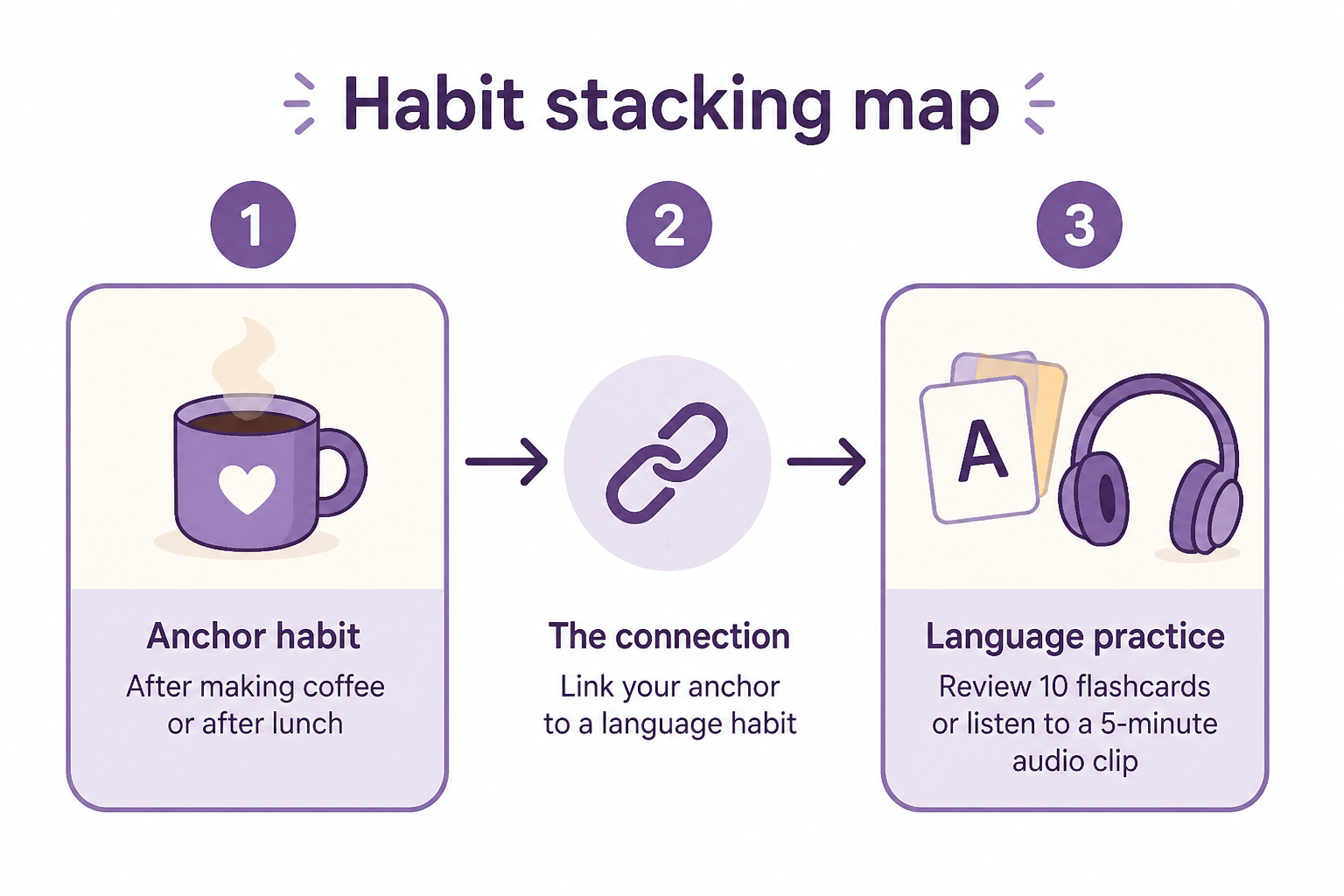
4. Habit stacking routine
This is one of the easiest ways to build consistency. You attach language learning to something you already do every day.
Examples:
- After making coffee, review vocabulary
- After lunch, listen to a short audio clip
- After getting into bed, read one short passage
- After opening your laptop, do one language lesson before checking messages
This works because your routine stops depending on motivation and starts riding on an existing habit.
If you are unsure which shape to choose, pick the one with the fewest moving parts. Simple beats clever.
Decide what kind of practice belongs in your routine
A balanced language routine usually needs more than one type of practice. But it does not need everything every day.
The main categories are:
- Input: listening and reading
- Output: speaking and writing
- Review: flashcards, notes, and spaced repetition
- Study: lessons, grammar, and structured practice
Here is the key idea: your habit should be built around what is easiest to repeat, not what is hardest to force.
For many beginners, that means starting with input and review:
- 5 minutes of listening
- 5 minutes of flashcards
As you become more comfortable, you can add output:
- Repeat phrases out loud
- Record yourself speaking
- Write a few simple sentences
- Join a short conversation practice
To keep the routine manageable, think in “one main thing plus one small thing.” For example:
- One lesson + one vocabulary review
- One listening clip + one short speaking drill
- One reading passage + one sentence summary
This keeps your habit from becoming a massive to-do list with a language label on it.
A simple formula for building your routine
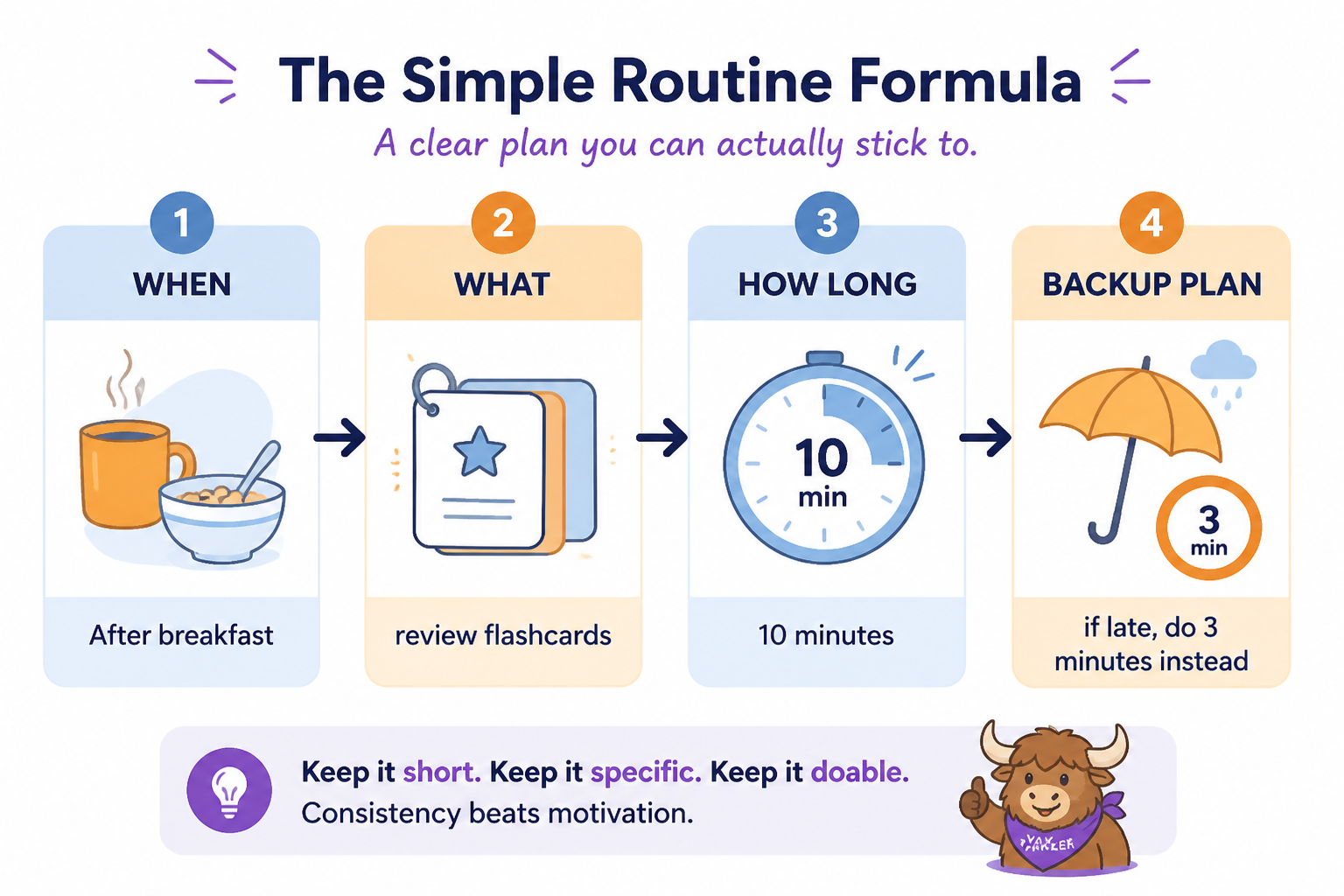
If you want a routine that is easy to remember, use this formula:
When + What + How long + Backup plan
For example:
- When: after breakfast
- What: flashcard review
- How long: 10 minutes
- Backup plan: if I am running late, I do 3 minutes instead of skipping
That last part matters more than people think. A backup plan protects the habit when life gets messy.
Here are a few complete examples:
| Routine example | Why it works |
|---|---|
| After breakfast, do 10 minutes of review cards. | Easy to attach to an existing habit and hard to forget. |
| After work, listen to one short audio lesson and repeat key phrases. | Low pressure, uses a fixed time, and blends input with speaking. |
| Before bed, read one short passage and write one sentence about it. | Small enough to do nightly, but still active enough to build skill. |
If your routine cannot be described in one or two sentences, it is probably too complicated for habit-building.
How to make the habit easier to start
The hardest part of a language habit is usually the beginning, not the work itself. Starting feels hard because your brain has to switch gears.
That is why good routines focus on reducing friction.
Make the materials visible
Put your language app, notebook, flashcards, or textbook where you will actually see them. Out of sight often becomes out of habit.
Reduce the number of decisions
Do not make yourself choose between ten study options every day. Decide in advance what you will do. Fewer choices mean less resistance.
Keep the first step tiny
“Study language for 30 minutes” can feel heavy. “Open the app and do one lesson” feels lighter. Once you start, you can continue if you want.
Use a trigger you already trust
Link the habit to something stable, like breakfast, a commute, or the moment you sit down at your desk.
Remove easy excuses
If you waste time looking for headphones, logging in, or finding the right notebook, your routine gets weaker. Set things up before you need them.
Here is a quick friction check:
- Can I start in under one minute?
- Do I know exactly what to do first?
- Are my materials ready?
- Is there a backup version for busy days?
If the answer to any of these is no, your routine probably needs to be simplified.
How to choose the right time of day
Choosing a time is less about theory and more about honesty. The best time is the time you are most likely to protect.
To choose well, think about these questions:
- When am I usually free?
- When do I have the most focus?
- When am I least likely to be interrupted?
- What time already has a repeated pattern in my day?
Some people have strong willpower in the morning. Others are much better after work. Neither is wrong.
The real goal is consistency, not proving that you are a heroic person before 8 a.m.
If you are not sure, test a routine for one week in each of two possible time slots. Then keep the one that felt easiest to repeat.
Set a realistic daily minimum
A daily minimum is the smallest version of your routine that still counts. This is one of the most useful habit tools you can have.
Why? Because your minimum gives you a way to stay consistent even when your ideal plan is not possible.
Example:
- Ideal routine: 20 minutes of study
- Minimum routine: 3 minutes of flashcards or one short audio clip
This matters because consistency is not built only on good days. It is built on bad days, busy days, and “I absolutely do not feel like it” days.
A good minimum should:
- Take less than 5 minutes
- Feel almost too easy
- Still count as meaningful contact with the language
- Be doable when tired
Some people worry that small minimums are “not enough.” But the real danger is not doing a perfect routine every day. The real danger is quitting because the routine is too demanding.
Better to do a tiny routine consistently than a big routine occasionally.
Build your routine around one clear goal
A routine works better when it serves a clear purpose. Otherwise, you end up doing random language tasks and hoping they magically combine into fluency.
Your routine should match your current goal.
| Your goal | Routine focus |
|---|---|
| Understand more when listening | Short audio, repeated listening, key phrase review |
| Remember vocabulary better | Spaced review, flashcards, example sentences |
| Speak more confidently | Shadowing, speaking prompts, short self-recordings |
| Read more easily | Graded reading, short articles, highlighting useful phrases |
| Write better sentences | Sentence practice, daily journaling, error correction |
If your goal is broad improvement, you can still keep the habit focused by rotating tasks across the week. For example, Monday and Wednesday could be listening, Tuesday and Thursday vocabulary review, and Friday speaking practice.
That way, the routine stays structured without becoming monotonous.
How to make the routine enjoyable enough to repeat
A habit does not have to be thrilling, but it should not feel like punishment.
If your routine is always unpleasant, your brain will start negotiating with you every day. That gets old fast.
Ways to make it more enjoyable:
- Use content you find genuinely interesting
- Mix easier and harder tasks
- Keep sessions short enough to feel manageable
- Track progress so you can see that the effort is working
- Allow occasional “fun-only” sessions with songs, stories, or videos in the language
The trick is not to make every session exciting. The trick is to make the routine pleasant enough that you do not dread it.
Also, some friction is fine. A habit does not need to be a treat. It just needs to be sustainable.
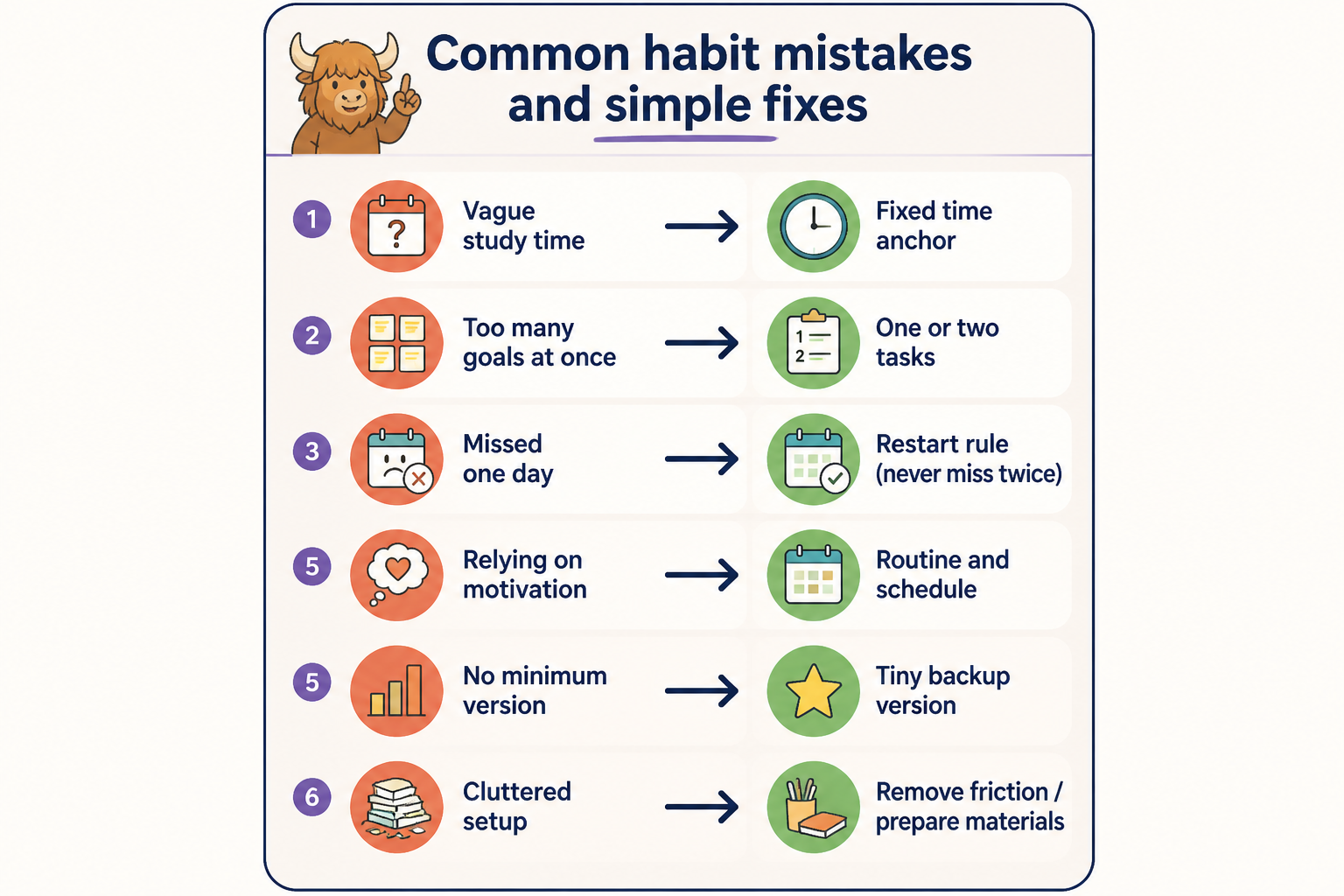
Common mistakes that break language habits
Most broken routines do not fail because the learner is lazy. They fail because the setup was unrealistic.
1. Starting too big
This is the most common problem. People build a routine that only works on their most organized day of the month.
Fix: Shrink the habit until it feels slightly too easy.
2. Having no clear trigger
If your routine is not attached to something specific, it becomes a decision you have to make every day.
Fix: Tie it to a stable event like breakfast, your commute, or bedtime.
3. Making the routine too flexible
“I’ll study sometime today” is basically a polite way of saying “I may not do it.”
Fix: Give the routine a fixed time or a fixed anchor.
4. Trying to do everything at once
Reading, listening, speaking, writing, grammar, and vocabulary all at once sounds impressive. It also makes the habit harder to repeat.
Fix: Pick one or two tasks per session and rotate the rest.
5. Skipping after one missed day
A missed day is not a failed habit. But some people treat it like the end of the world and never recover.
Fix: Use a restart rule. For example: “Never miss twice.”
6. Relying on motivation
Motivation is a great bonus. It is a terrible foundation.
Fix: Build a routine that works even when you are not excited.
A practical step-by-step process to build your routine
If you want a straightforward method, use this process.
Step 1: Choose one time anchor
Pick a moment that already happens daily.
Examples:
- After breakfast
- During your lunch break
- Right after work
- Before bed
Step 2: Choose one main task
Pick the task you are most likely to do consistently.
Examples:
- Flashcards
- Listening
- Reading
- One lesson from a course
Step 3: Set the time limit
Start with 5 to 15 minutes. You can always build later.
Step 4: Define your minimum version
Choose the smallest possible backup version. For example:
- Ideal: 15 minutes of study
- Minimum: 3 minutes of review
Step 5: Remove friction
Put the materials where they are easy to access and decide exactly what you will do first.
Step 6: Track the habit simply
Use a calendar, a notebook, or a habit tracker. Marking the day can help your brain take the habit more seriously.
Step 7: Review after one week
Ask:
- Did I actually do this on most days?
- Was it too long, too hard, or too vague?
- What made it easier?
- What got in the way?
Then adjust. Habits improve through small edits, not dramatic reinventions.
A few routine templates you can copy
If you are stuck, use one of these starting points and adapt it to your life.
Template 1: The 10-minute daily routine
- After breakfast
- 10 minutes of flashcards or review
- Optional: 2 minutes of speaking aloud
This is a great starter routine because it is simple and easy to keep.
Template 2: The input-first routine
- After lunch or during commute
- 5 to 10 minutes of listening
- Write down 1 useful phrase
This works well if you want more exposure to natural language.
Template 3: The study-plus-output routine
- After work
- 10 minutes of lesson or grammar review
- 5 minutes of speaking or writing practice
This is useful if you want both understanding and production in the same session.
Template 4: The low-energy routine
- Before bed
- 3 minutes of flashcards or passive listening
This is your backup on rough days. It keeps the streak alive without asking for much.
How to track progress without making it stressful
Tracking is helpful when it gives you clarity. It is unhelpful when it becomes another task you dread.
Keep it simple.
- Use a calendar and check off completed days
- Use a notebook to record what you did
- Use a basic habit tracker if you like visual streaks
You do not need to track every detail. In fact, too much tracking can make the routine feel bigger than it is.
Track things like:
- Did I do the habit today?
- What did I practice?
- What felt easy or hard?
That is enough to reveal patterns without turning your routine into a spreadsheet hobby.
What to do when you miss a day
Missing a day is normal. The danger is what you tell yourself after you miss one.
People often think:
- “I already broke the streak, so it does not matter.”
- “I failed, so I should restart next week.”
- “I need a better system before I try again.”
Those thoughts are habit killers.
Instead, use this response:
- Notice the missed day without drama
- Return to the routine at the next normal opportunity
- Do the minimum version if needed
- Do not negotiate with the habit for three days straight
A useful rule: never miss twice.
This rule does not mean you can never slip. It means you recover quickly. That recovery skill is part of consistency.
How to stay consistent when life gets busy
Busy seasons are where habits prove themselves. When your schedule gets crowded, you need a fallback version that survives.
Use these strategies:
- Shorten the session: reduce it to 3 to 5 minutes
- Keep one category only: just review, just listen, or just read
- Move the habit: shift it to a more reliable time temporarily
- Lower the standard: aim for contact, not perfection
If you are in a very busy period, consistency may look a little different. It may mean tiny daily contact instead of a full session. That still counts.
The habit is not broken just because the format changes. It is broken only if it disappears completely.
How to keep improving after the habit is established
Once your routine is stable, you can gradually make it more effective.
Do not add too much too quickly. Improve one thing at a time.
Examples of healthy upgrades:
- Increase time from 10 minutes to 15 minutes
- Add one speaking task per week
- Replace weak materials with more useful ones
- Shift from passive review to more active recall
Good routines evolve. They are not frozen forever. But they should not change every few days either.
A good sign that it is time to upgrade: your current routine feels too easy or no longer matches your goals.
A bad sign: you keep changing the routine because you are bored for one afternoon.
A quick decision guide for building your routine
If you are still unsure where to begin, use this simple decision path:
| If this is true… | Then do this… |
|---|---|
| You are inconsistent right now | Choose one small daily habit with a fixed trigger |
| You are busy and tired | Build a 3 to 5 minute minimum version |
| You forget to study | Attach the habit to an existing daily routine |
| You start but do not continue | Reduce the size and remove extra choices |
| You need more progress | Keep the habit but gradually add one new element |
This is the heart of how to build a language learning habit: start small, anchor it to real life, keep it easy to repeat, and improve it slowly.
How this connects to a broader learning system
A routine is the engine, but it works best when it fits into a larger plan. Once the habit exists, it becomes easier to build a study plan that actually makes sense and supports your goals.
If you want help turning a habit into a more structured system, it is worth reading how to build a language study plan. That gives your routine direction, so you are not just practicing randomly.
If you are looking for a compact way to get moving fast, the 14-day language learning routine can help you test a simple structure before committing to a long-term version.
And if you want a broader view of methods and tradeoffs, you may also want to compare approaches in the best way to learn a language.
These are useful next steps, but the routine itself remains the foundation. Without consistency, even the best plan gathers dust.
Final checklist for building a routine that sticks
Before you finish, use this checklist to pressure-test your plan:
- I have chosen one clear time to practice.
- I know exactly what I will do during the routine.
- The habit is small enough to repeat on busy days.
- I have a minimum version for low-energy days.
- I attached the habit to an existing part of my day.
- I removed unnecessary friction and decision-making.
- I know how I will track progress simply.
- I have a plan for missed days.
- I will review and adjust the routine after a week or two.
If most of these are true, you are in good shape.
Takeaway: consistency beats intensity
A language learning habit does not need to be flashy. It needs to be repeatable.
Start with one small action, attach it to a real moment in your day, make it easy to begin, and protect it with a backup version. That is how you build a consistent routine that can survive busy weeks, low energy, and the occasional brain protest.
Over time, those small sessions add up. That is the quiet magic of habit: the work feels modest, but the results compound.
So do not wait for the perfect plan. Pick a time, pick a task, make it tiny, and start tomorrow. Then keep showing up.