
Why speaking feels so hard at the beginning
If you can read a little, understand a few words, or even answer easy questions in your head but still freeze the moment you need to speak, you are extremely normal. That “blank mind” feeling is one of the most common problems language learners face. It does not mean you are bad at languages. It usually means your brain is trying to do too many things at once: find words, build grammar, pronounce them, and survive the pressure of being watched.
For the broader learning path, visit our parent guide.
The good news is that speaking confidence is not something you either have or do not have. It is built. Usually, the fix is not “study harder.” It is “make speaking smaller, safer, and more automatic.” Once speaking feels less like a performance and more like a repeatable skill, the freezing starts to fade.
This guide will show you how to begin speaking a new language confidently without freezing, even if you are a nervous beginner. You will learn what is actually happening in your brain, how to lower the pressure, what to practice first, and how to build real speaking momentum without waiting until you “feel ready.”
What freezing up really is
Freezing is often a mix of three things:
- Not enough automatic language yet — you know the words, but not fast enough to use them smoothly.
- Too much pressure — you feel judged, rushed, or put on the spot.
- No speaking routine — your brain has not practiced turning knowledge into speech often enough.
That means the problem is not just “speaking.” It is the combination of recall, speed, nerves, and habit. If you only study by reading or listening, you may recognize language but still struggle to produce it quickly. Speaking is its own skill.
Think of it like this: knowing how to swim and actually swimming are related, but one does not automatically make the other easy. Speaking works the same way.
The important shift: aim for “usable,” not “perfect”
Many learners freeze because they want their first sentence to be accurate, elegant, and complete. That is a very expensive expectation. Instead, your goal should be:
- get the message across
- use simple language
- stay in the conversation
- improve one step at a time
Confidence grows from successful repetitions, not from flawless performance.
The fastest way to stop freezing: make speaking smaller
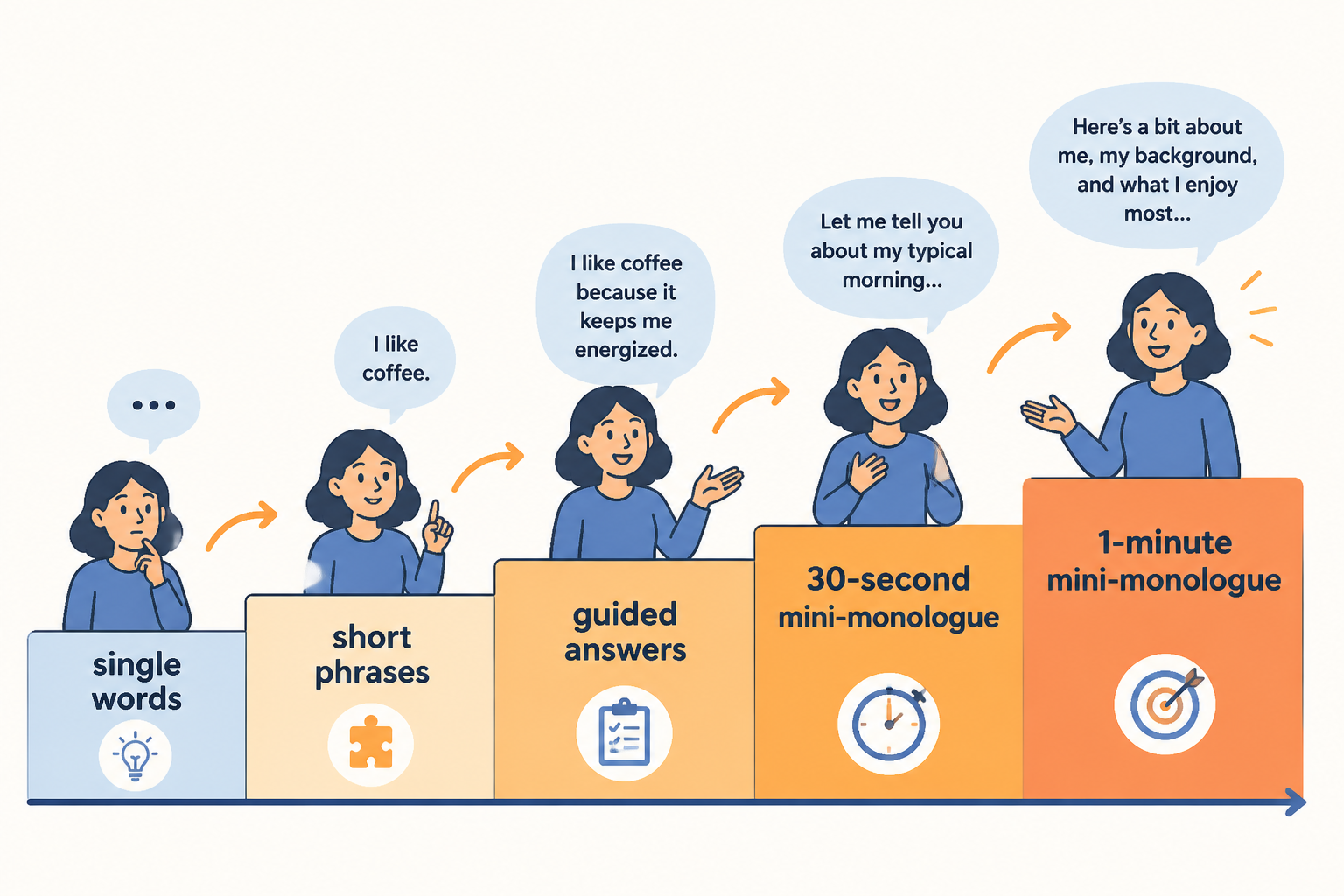
When speaking feels huge, the brain panics. So the first job is to shrink the task. Do not start by trying to hold a free-flowing, 20-minute conversation about your life goals. Start with tiny speaking tasks that your brain can actually complete.
Use this ladder:
- say one word aloud
- say a short phrase
- say a memorized sentence
- answer a simple question
- ask a simple question
- explain one tiny idea
- have a short conversation
Each step trains your brain to stay calm while speaking. The key is not to jump too fast.
A simple rule: reduce the decision load
Freezing happens when your brain has to make too many decisions at once. So, prepare language chunks you can reuse. Instead of building every sentence from scratch, keep a few ready-made patterns like:
- I think…
- I don’t understand.
- Can you repeat that?
- How do you say…?
- For me, it’s…
- I mean…
These are not “cheating.” They are scaffolding. Strong speakers use chunks all the time because chunks reduce pressure and keep speech moving.
What to practice first if you freeze when speaking
If you are anxious, do not start with random conversation topics. Start with the most useful building blocks. Your first speaking practice should be designed to produce success quickly.
1. Self-introduction scripts
Learn a short version of how to say your name, where you’re from, what you do, and a couple of basic preferences. This is useful because introductions come up often, and practicing them lowers the panic of first contact.
Example pattern:
- My name is…
- I’m from…
- I live in…
- I study/work…
- I like…
Make one simple version and repeat it until it feels natural. Then make a slightly longer version.
2. Survival phrases
These are phrases that help you stay calm during conversation. They buy you time, prevent panic, and keep you from disappearing mentally.
- One moment, please.
- How do you say that?
- Could you speak more slowly?
- Can you repeat that?
- I know this word, but I can’t remember it right now.
When learners freeze, they often think they must silently suffer through it. You do not. Repair phrases are part of speaking.
3. Tiny opinion statements
Eventually, you need more than “facts” and “introductions.” A very useful next step is expressing simple opinions.
- I like it.
- I don’t like it.
- I think it’s interesting.
- I agree.
- I’m not sure.
Opinions are powerful because they turn you from “answering only” to “participating.”
4. Question patterns
Asking questions is easier than giving long answers, and it keeps the conversation alive. Learn a few patterns:
- What does that mean?
- Where is…?
- How much is…?
- Do you like…?
- What do you think?
Conversation is easier when you can both answer and ask. That balance reduces pressure on you to do all the talking.
The speaking-confidence formula: repeat, reduce, reuse
If you want a simple way to remember the method, use this:
- Repeat the same language often.
- Reduce the size of the task.
- Reuse ready-made chunks.
This formula matters because confidence usually comes from familiarity. The more often you say the same patterns, the less effort they need. The less effort they need, the less likely you are to freeze.
That is also why consistent practice beats occasional heroic efforts. Ten small speaking moments are usually more useful than one stressful marathon.
Build speaking confidence before real conversations
A lot of learners try to jump straight into live conversation and then conclude they are “bad at speaking.” But there is a middle stage between silent study and real conversation. Use it. It is where confidence starts.
Speak out loud alone
This sounds too simple, but it works. Read sentences aloud. Answer fake questions aloud. Narrate simple actions in the room. Say what you are doing as you do it.
For example:
- I’m making tea.
- I’m looking for my keys.
- I need to finish this later.
- This is difficult, but it’s okay.
Speaking alone removes social pressure while training the exact muscle you need: producing language out loud.
Shadow short audio
Shadowing means repeating after a speaker, closely and quickly, so your mouth practices the rhythm and flow of the language. Keep it short and manageable. You do not need long recordings at first. A few seconds repeated many times is enough.
Focus on:
- the shape of the sentence
- the rhythm
- the speed
- the confidence of the voice
This is not about perfect accent imitation. It is about making speaking feel more automatic.
Use prepared mini-monologues
Pick one easy topic and talk about it for 30 seconds. Then one minute. Then a little more. This is a great bridge between practice and conversation because it teaches you to keep speaking without another person feeding you the words.
Good beginner topics include:
- your daily routine
- your food preferences
- your hometown
- a recent weekend activity
- something you want to do soon
How to prepare for conversation so you do not blank out
One of the easiest ways to freeze is to enter a conversation with no preparation and no target language ready to use. Preparation does not make you robotic. It makes you available.
Before a conversation, prepare three things
- Three topics you can talk about
- Five useful phrases for the situation
- One recovery phrase for when you get stuck
That is enough. You do not need a script for the entire conversation. You only need a few anchors.
Example for a casual chat:
- Topics: work, weekend, favorite food
- Useful phrases: I think…, I went to…, I usually…, That sounds…, What about you?
- Recovery phrase: Sorry, I lost the word.
Start with predictable situations
Early conversation practice should not be random. Use situations where the flow is easier to guess, such as:
- introductions
- ordering food
- talking about hobbies
- asking for directions
- describing your day
Predictable context means fewer surprises. Fewer surprises means less freezing.
Limit the difficulty on purpose
You do not need to understand every word. In fact, trying to understand everything can make you freeze harder. In early conversation, aim to understand the main idea and keep the exchange going.
If someone says something you missed, you can say:
- Could you say that again, please?
- Could you say that more slowly?
- Do you mean…?
These phrases are not signs of failure. They are signs that you are actively participating.
What to do in the exact moment you freeze
Freezing is not the end of the conversation. It is a moment to recover. The trick is to stop treating the freeze as a disaster. You need a simple emergency protocol.
Your 5-second recovery plan
- Pause.
- Breathe out slowly.
- Use a repair phrase.
- Say a simpler version.
- Keep going.
For example:
- “I… don’t know the word.”
- “Let me say it another way.”
- “It’s like… the place where you buy food.”
That is not failure. That is real communication.
Swap precision for approximation
If you cannot say the exact thing, say a close version. Use a simpler word, a gesture, a description, or an example.
Instead of waiting for the perfect sentence, try:
- a simpler synonym
- a general category word
- a description of what it does
- a quick example
Freezing often breaks when you stop demanding perfection from yourself.
Use filler phrases to keep moving
Native speakers use little bridge phrases all the time. Learners can use them too. Examples include:
- Well…
- Let me think…
- Actually…
- What I mean is…
- How can I say this…
These phrases give your brain a second to catch up.
Why listening and speaking should work together
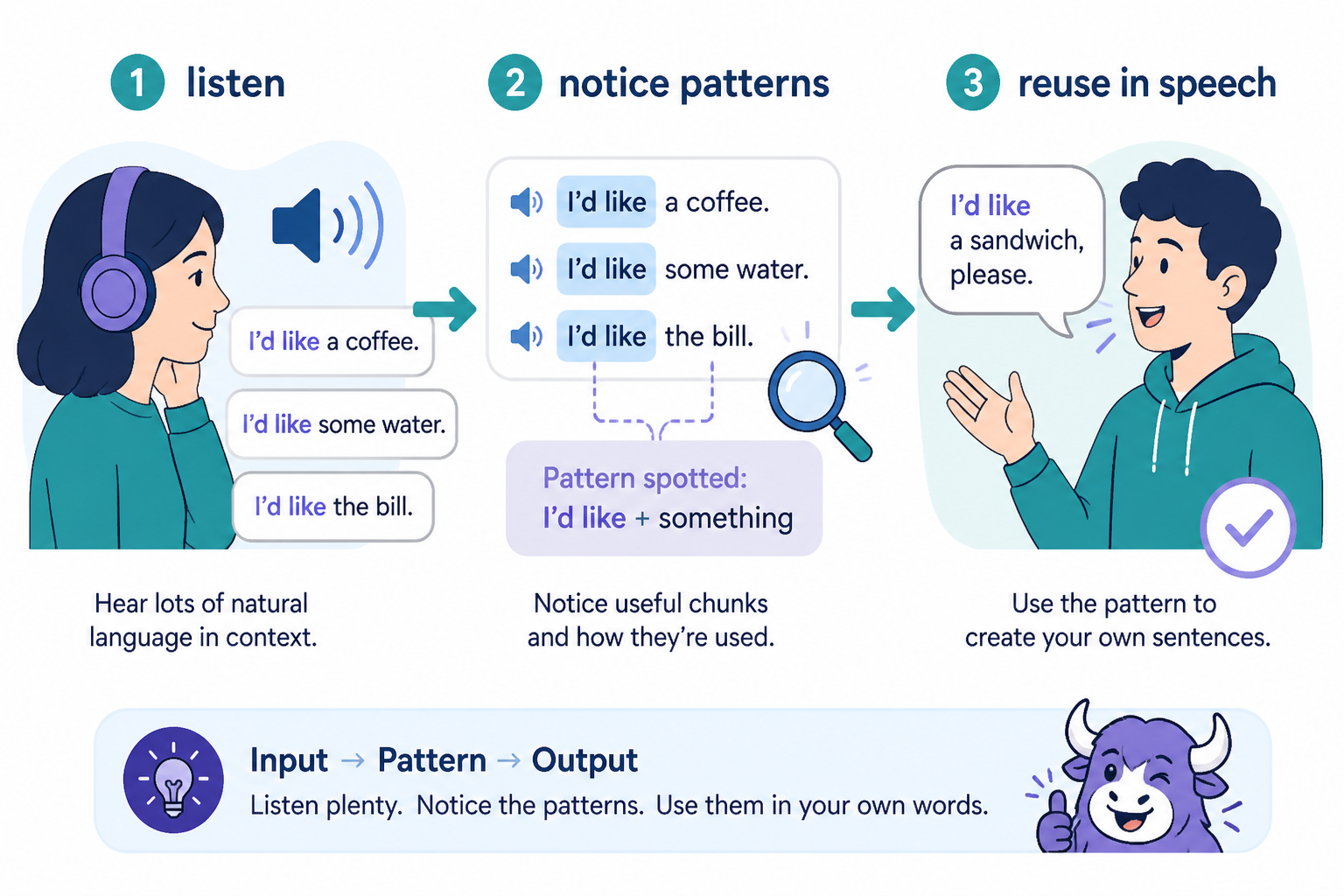
Speaking confidence gets much better when your brain has heard a lot of language before trying to produce it. That is because input gives your brain patterns to reuse. If you have never heard common sentence shapes many times, you are trying to build speech from scratch under pressure. That is hard.
One of the most effective supports for speaking is comprehensible input: language that you can mostly understand, with enough context that the meaning stays clear. This helps your brain notice patterns and reuse them later in conversation. If you want a deeper explanation, see comprehensible input explained.
The practical takeaway is simple: listen to language you can understand enough to follow, then reuse pieces of it in speaking practice. That makes speaking feel less random.
A beginner-friendly speaking routine that actually works
If you only “practice speaking” when you feel brave, your progress will be inconsistent. A routine makes speaking normal, and normal is where confidence grows.
Daily routine: 10 to 15 minutes
Here is a simple structure that does not require a huge time commitment:
- 2 minutes: review 5 to 10 useful phrases
- 3 minutes: speak them aloud from memory
- 3 minutes: answer 3 simple questions out loud
- 3 minutes: short monologue on one topic
- 2 minutes: repeat the hardest phrase until it feels easier
If you want a more structured approach to consistency, you may also find how to build a language learning habit useful. For a smaller daily commitment, how to learn a language 10 minutes a day fits nicely with this style of practice.
Weekly routine: one real speaking event
Once a week, try one of these:
- a short live conversation
- a language exchange
- a speaking message recorded out loud
- a practice call with a tutor or partner
The point is to get used to speaking with some pressure, but not so much pressure that you shut down.
How to choose the right difficulty level
Many learners freeze because their speaking tasks are too hard. The conversation is too fast, the topic is too abstract, or the other person talks far above your current level. Confidence does not come from repeated overwhelm. It comes from climbing the right slope.
Too easy, just right, too hard
| Level | What it feels like | What to do |
|---|---|---|
| Too easy | You never struggle, but you also do not stretch | Add one small challenge: a longer answer, a new phrase, or a new topic |
| Just right | You need effort, but you can recover | Keep going; this is where confidence grows |
| Too hard | You panic, go blank, or stop talking quickly | Lower the difficulty: simpler topic, slower pace, more preparation |
If you often freeze, your current speaking tasks may be too hard, not too few. That is a useful diagnosis, not a personal flaw.
Common mistakes that make freezing worse
Let’s save you some pain. These are common habits that keep learners stuck.
1. Waiting until you “feel ready”
Feeling ready is usually the result of practice, not the starting point. If you wait for confidence before speaking, confidence never gets a chance to grow.
2. Trying to speak with full grammar every time
Full grammar is great eventually, but in the beginning it can slow you down too much. Use simpler sentence shapes first. Accuracy can improve after you are speaking more freely.
3. Studying vocabulary without using it
If you only memorize words in isolation, they may not show up when you need them. Learn words in phrases and use them aloud quickly.
4. Taking every pause as failure
Pauses are normal. Even fluent speakers pause. The problem is not the pause itself. The problem is panic about the pause.
5. Practicing only mentally
Silent recall is helpful, but it is not enough. You need out-loud practice so your mouth, ears, and timing all get involved.
6. Chasing perfect pronunciation before speaking at all
Good pronunciation matters, but waiting until it is perfect can keep you silent for months. Aim for understandable first. Then refine it.
How to speak more confidently even if your vocabulary is small
You do not need a huge vocabulary to start speaking. You need the right vocabulary and a few ways to stretch it.
Use high-frequency words first
Start with the words and phrases that appear all the time in ordinary conversation. These give you the biggest return on effort.
- I want…
- I need…
- I like…
- I don’t know…
- I went…
- I’m going to…
- Can you help me?
Learn phrase families, not isolated words
Once you know a core phrase, learn related variations around it. For example:
- I like coffee.
- I really like coffee.
- I don’t like coffee.
- I like coffee in the morning.
This multiplies your usable speech without requiring a huge new vocabulary list.
Use “talk around it” strategies
If you do not know a word, describe it.
- It’s a thing you use to…
- It’s like…
- It means…
- You put it in…
This is an extremely normal part of real conversation. The ability to paraphrase is a confidence skill, not just a vocabulary skill.
How feedback helps you stop freezing faster
Many learners repeat the same speaking errors because nobody tells them what is actually happening. Feedback helps you notice patterns, remove confusion, and build better habits.
Getting corrections in a useful way is important. If corrections are too many or too harsh, they can increase anxiety. If they are too little, you may keep repeating the same problems. A balanced approach matters. For a practical guide on this, see get corrections and feedback when learning a language.
Ask for the kind of feedback you need
You can make correction less intimidating by being specific. For example:
- Can you correct only my biggest mistakes?
- Please stop me if I say something unnatural.
- Can you write down the useful phrases after we talk?
- Can you tell me one thing I did well and one thing to improve?
That turns feedback into a tool instead of a surprise attack from the grammar police.
Use feedback to make a speaking list
After each practice session, write down:
- one phrase you used well
- one mistake you want to fix
- one new phrase to reuse next time
This keeps feedback practical and prevents it from becoming vague self-criticism.
A simple 4-week plan to build speaking confidence
If you like structure, here is a short plan you can follow. It is designed to reduce fear and increase speaking reps without overwhelming you.
Week 1: speak alone every day
- memorize 10 survival phrases
- say them out loud daily
- practice a 30-second self-introduction
- answer 3 basic questions aloud each day
Week 2: add short controlled responses
- practice 5 common question-and-answer pairs
- talk about one daily topic for 1 minute
- repeat difficult phrases until they feel smoother
- listen to short, understandable audio and reuse phrases you hear
Week 3: start low-pressure conversation
- have one short conversation
- prepare 3 topics and 5 useful phrases beforehand
- use repair phrases when you get stuck
- focus on staying in the conversation, not being perfect
Week 4: increase realism slowly
- add a slightly harder topic
- talk for a little longer
- ask more questions
- review feedback and repeat useful phrases
If you need help making the process sustainable, how to build a language study plan can help you organize your time and keep speaking practice from getting squeezed out.
Troubleshooting: what to do when progress feels slow
Sometimes you will practice consistently and still feel awkward. That does not mean it is not working. Speaking confidence often improves in a messy, non-linear way. Here are a few common situations and what to do.
If you know the words but cannot say them fast enough
Use shorter sentences. Practice the same phrase in multiple speeds. Repeat a small set of answers until they become automatic. Speed usually follows familiarity.
If you panic when another person speaks quickly
Ask for slower speech. Focus on the main idea instead of every word. Train with easier audio and simple live conversations before moving up.
If you understand but can’t reply
Prepare response templates like “I think…,” “Yes, because…,” “No, but…,” and “For me…” This bridges the gap between understanding and producing.
If you keep forgetting basic words
That usually means the words have not been used enough in speech. Make them part of a daily speaking drill. Words become easier to remember when they live in phrases, not flashcards alone.
If you feel embarrassed speaking aloud alone
Start very small. Speak while walking, while cooking, or while reading one sentence at a time. The weirdness fades faster than you think. Your brain eventually stops acting like you are auditioning for a role called “Person Who Is Not Allowed to Practice.”
What confidence actually looks like
Confidence is not “I never feel nervous.” It is more like:
- I can start even if I feel nervous.
- I can recover when I forget a word.
- I do not need every sentence to be perfect.
- I know how to keep the conversation going.
- I have proof that speaking practice works.
That is the real goal. Not fearless perfection. Functional courage.
A quick pre-speaking checklist
Use this before a practice session or real conversation:
- Do I know my goal for this conversation?
- Have I prepared 3 easy topics?
- Do I have 3 to 5 useful phrases ready?
- Do I know my recovery phrase?
- Am I okay with making mistakes?
- Am I aiming to communicate, not perform?
If you can say yes to most of these, you are ready enough.
Final thoughts: speak before you feel ready
If you want to know how to begin speaking a new language confidently, without freezing, the answer is not a secret trick. It is a set of small habits that lower pressure and build automaticity. Speak a little every day. Use prepared language. Make conversations easier at first. Ask for feedback. Recover quickly when you freeze. Repeat the process often enough that speaking starts to feel normal.
That is how confidence is built: not by waiting for the fear to vanish, but by speaking in a way that makes fear smaller and competence bigger.
If you want the shortest possible version of the method, remember this:
- start with tiny speaking tasks
- use useful chunks and survival phrases
- practice out loud before live conversation
- prepare for conversation instead of improvising everything
- recover from freezes with a simple plan
- get feedback and reuse it
- keep the routine small enough to repeat
That is how speaking stops feeling like a cliff and starts feeling like a staircase.