Why movies and subtitles work so well for language learning
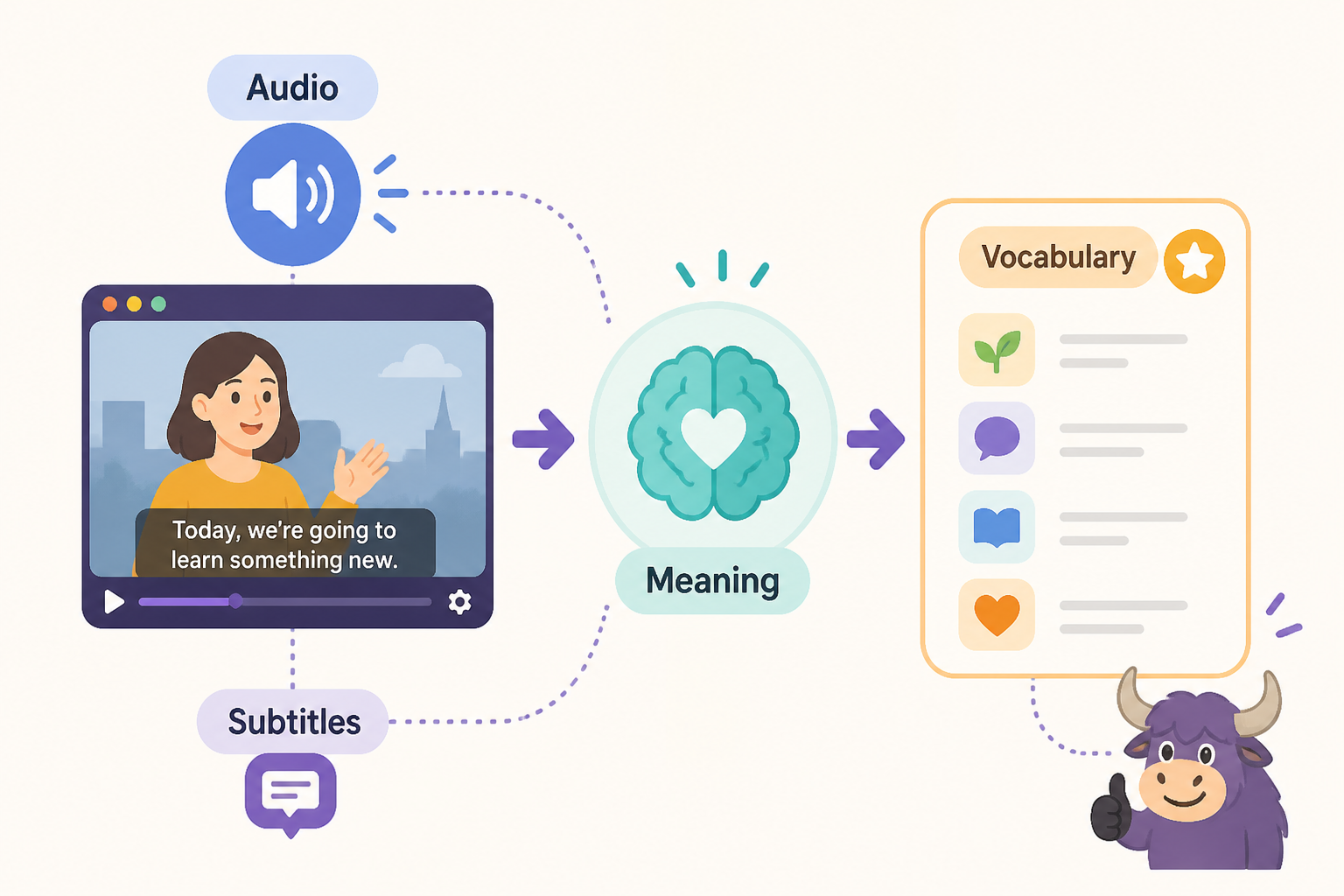
If you want a language-learning method that feels less like homework and more like having a reason to keep watching one more scene, movies with subtitles are hard to beat. They give you real speech, real pacing, real emotion, and real context all at once. That combination is powerful because your brain is not just hearing words; it is seeing meaning unfold.
Used well, movies can help you build listening skill, vocabulary, pronunciation awareness, and even a better feel for how a language sounds in everyday life. Subtitles act like training wheels. They can support you when the audio is too fast, too slangy, or too hard to follow. The trick is not to use them randomly. The trick is to use them with a plan.
That plan matters because many learners do one of two unhelpful things: they either watch passively and hope absorption does the job, or they stop every five seconds and turn a movie into a miserable transcript hunt. There is a middle path. It is practical, enjoyable, and much more effective.
What you are actually training when you watch movies
Before choosing subtitle settings or picking a film, it helps to know what skill you are building. Movies can train several things at once, but they do not train all of them equally well.
Listening comprehension
This is the main event. Movie dialogue exposes you to natural speed, connected speech, reductions, different accents, and background noise. Real conversations are not neat textbook recordings, so movies help you get used to the messiness of actual speech.
Vocabulary recognition
You will hear words in context instead of in isolated word lists. That makes them easier to remember. You may not learn every word, but repeated exposure helps important words stick.
Pronunciation awareness
Even if you cannot copy every sound perfectly yet, you start to notice how words are linked together. You hear stress, rhythm, intonation, and where one word ends and the next begins.
Reading support
Subtitles connect sound to text. That makes it easier to match what you hear with what you read. For many learners, this is the bridge that finally makes fast speech feel less mysterious.
Context skills
Movies teach you to infer meaning from tone, gestures, facial expressions, settings, and story context. That is a real language skill, not a cheat code. Native speakers use context constantly.
The point is not to treat movies as magic. The point is to use them as a rich input source that supports your listening and comprehension practice. If you want a deeper explanation of that idea, the guide on comprehensible input connects nicely here.
The subtitle strategy that works best
Not all subtitle use is equally helpful. The best setup depends on your level, your goal, and how hard the movie is. The goal is to keep the input understandable enough that you learn, but challenging enough that you are still stretching.
| Subtitle setup | Best for | Strength | Weakness |
|---|---|---|---|
| Target-language audio + target-language subtitles | Beginner to intermediate learners | Strong sound-text connection | Can become reading-only if overused |
| Target-language audio + English subtitles | Very early beginners or first viewing | Easy to follow the story | Less direct practice with target-language spelling and word forms |
| Target-language audio + no subtitles | Stronger intermediate learners | Best for pure listening practice | Can feel too hard if used too soon |
| English audio + target-language subtitles | Usually not ideal for language learning | Reading practice | Weak listening benefit because you are not training the target language audio |
For most learners, the sweet spot is target-language audio with target-language subtitles. That gives your ears and eyes the same message at the same time. You hear the word and see it spelled. Over time, that helps you notice words faster and understand speech more efficiently.
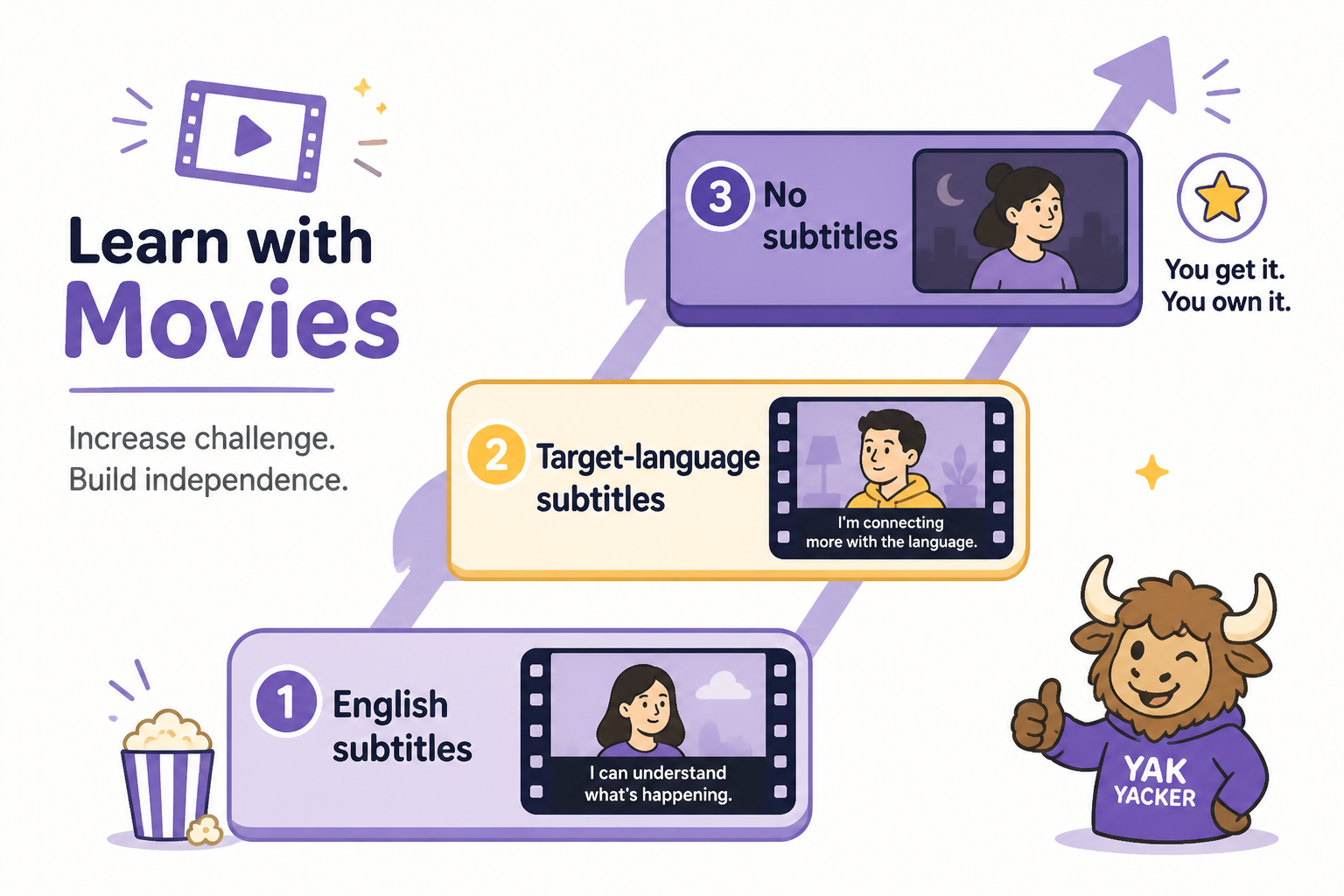
If you are a beginner, you may need English subtitles at first just to understand the story. That is fine. But do not stay there forever. English subtitles can help you get oriented, yet they do less to train your ability to hear the language itself.
A simple decision guide for choosing subtitle settings
Use this as a quick filter before you hit play:
| Your level | Recommended setup | What you should focus on |
|---|---|---|
| Absolute beginner | English subtitles first, then target-language subtitles for repeat viewing | Story, repeated words, basic sound recognition |
| Low intermediate | Target-language audio + target-language subtitles | Common phrases, pronunciation, high-frequency words |
| Mid intermediate | Start with subtitles, then try sections with no subtitles | Listening without support, catching familiar phrases |
| Upper intermediate | Mostly no subtitles, use subtitles for difficult scenes only | Speed, accents, slang, finer details |
The important idea is this: subtitles should support understanding, not replace listening. If you read every line faster than you hear it, you may be improving reading more than listening. That is not bad, but it is not the whole job.
How to learn with movies and subtitles: the practical method
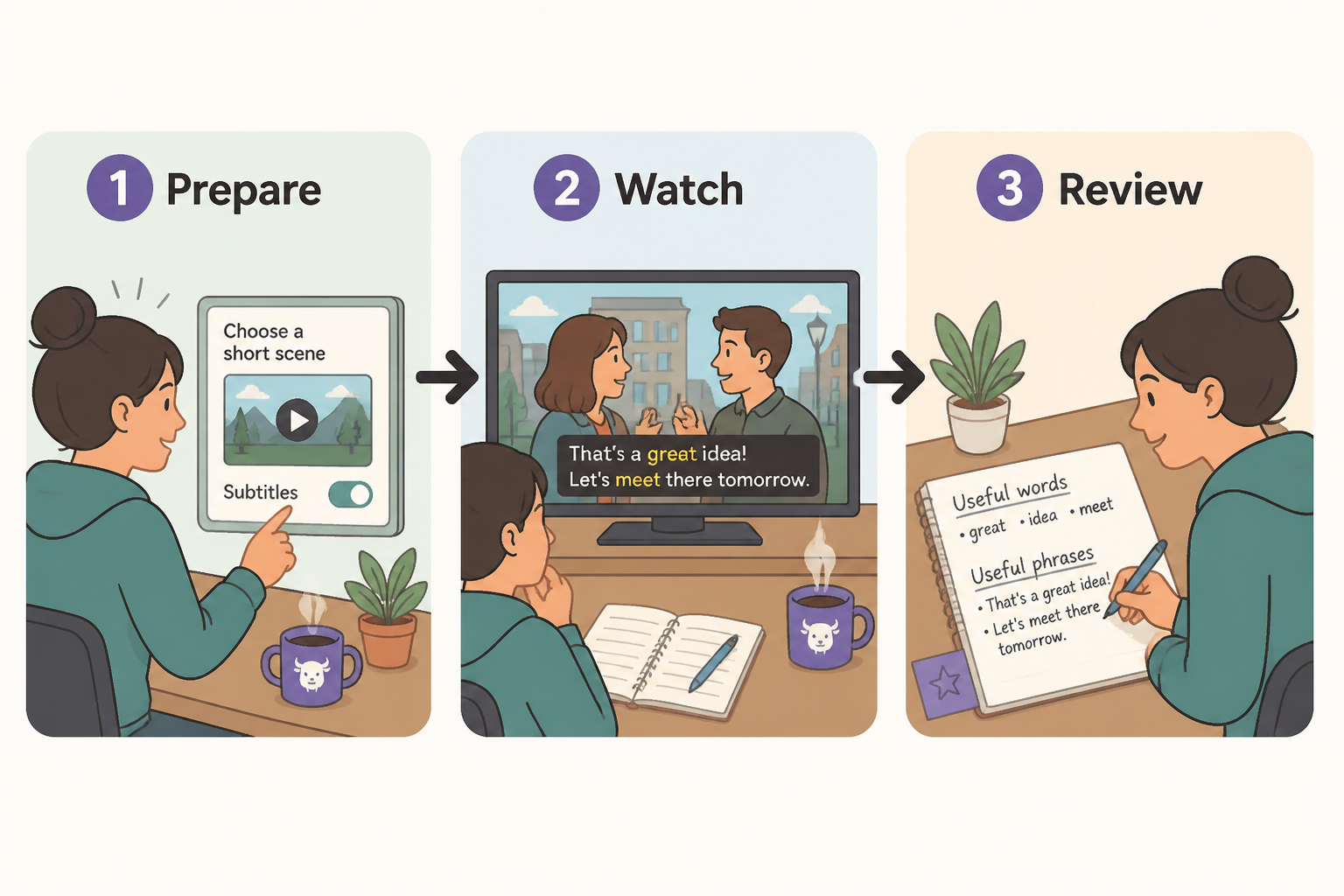
Here is the method that makes this approach work without turning it into a chore. It has three stages: prepare, watch actively, then review.
1) Prepare before you watch
Pick a movie that is just right for your level. Not easy enough to be boring, and not so hard that you spend the whole time lost. A familiar story is often better than a clever one. If you already know the plot, your brain has fewer unknowns to juggle.
Before watching, ask yourself three questions:
- Can I follow the story if I miss some words?
- Will the dialogue likely be too fast, too slangy, or too noisy?
- Do I want listening practice, vocabulary exposure, or just a first sense of the language?
If the movie is difficult, do not quit. Just lower the pressure. Watch in shorter chunks. Use subtitles. Rewatch key scenes. The goal is not to impress anyone with how much you can survive without help.
2) Watch actively, not passively
Active watching means you are paying attention to meaning, sound, and repeated patterns. You are not pausing every sentence, but you are not zoning out either.
A good active watching loop looks like this:
- Watch a short scene or one chapter segment.
- Notice the main idea without stopping too much.
- Replay one or two parts that sounded useful or confusing.
- Look for repeated words or phrases.
- Move on before fatigue kills your focus.
Short chunks are key. A full movie is a lot to process. One focused scene can teach you more than two hours of drifting attention.
3) Review what you noticed
After watching, spend a few minutes on review. This is where learning hardens into memory. You do not need to write a giant summary. Just capture useful pieces.
Ask:
- What words or phrases kept repeating?
- What scene did I understand best?
- What did I hear but not quite catch?
- Was there one expression I could use in real life?
Write down only a small number of items. If you collect 25 phrases, you will probably learn none of them well. If you collect 3 to 5 useful items, you are more likely to remember them and use them later.
A better way to use subtitles than reading everything
One common mistake is to treat subtitles like a book. You read them quickly, understand the scene, and call it practice. But if your eyes are glued to the text the whole time, your ears are not doing enough work.
Try this instead:
- Use subtitles to confirm what you heard.
- Listen first, then look.
- Replay short parts without reading if you can handle it.
- Notice where the audio and text match, and where they do not.
This is especially useful because subtitles are not always perfect transcripts. They may simplify dialogue, omit filler words, or compress timing. That is normal. It means you should treat subtitles as support, not as sacred text handed down from the subtitle gods.
How to choose the right movie
The best movie for language learning is not necessarily your favorite movie. It is the one that gives you enough comprehension to keep going.
Choose films with these traits when possible
- Clear dialogue
- Everyday settings and common situations
- Moderate pacing
- Strong visual context
- Repetitive or predictable story structure
Be cautious with films that have these traits
- Very dense slang or regional humor
- Heavy background noise or overlapping dialogue
- Fast argument scenes
- Highly poetic or abstract language
- Lots of proper names or fantasy jargon
That does not mean you should never watch difficult films. It just means difficult films are better for later practice, not for your first experience with this method.
A good rule of thumb
If you understand almost nothing, the movie is too hard for focused learning. If you understand almost everything without effort, the movie may be too easy to stretch your listening. Aim for the middle ground where you get the story and still notice gaps.
What to do during the first viewing
First viewing is about orientation. You are learning the story, the voices, the pace, and the sound of the language in this film. Do not try to catch everything.
Here is a useful first-viewing goal:
Understand the main story, notice recurring words, and identify one or two scenes worth rewatching.
During this stage, it helps to ignore the urge to translate every unknown word. If you stop for every new term, your brain gets stuck in microscope mode and stops following the scene.
Instead, ask whether the word matters. If a word appears multiple times, sounds emotionally important, or seems useful in daily speech, it is worth noticing. If it is a random obscure noun in a throwaway joke, you can probably let it go.
What to do on the second viewing
The second viewing is where the magic usually starts to happen. Now you know the plot, so your brain has room to listen more carefully.
Second-viewing goals
- Catch words you missed the first time
- Notice how pronunciation matches the subtitle text
- Repeat short phrases aloud after the characters
- Focus on scenes that were confusing before
This is also a good time to switch subtitle settings depending on your level. For example, if you used English subtitles first, try target-language subtitles on the second pass. If you already used target-language subtitles, try one short section with no subtitles at all.
The idea is not to prove you can suffer through the film. The idea is to move from support to independence in manageable steps.
How to build vocabulary from movies without overdoing it
Movies are great for vocabulary, but only if you are selective. If you try to learn every unknown word, you will create a giant list of half-learned items and very little actual progress.
A better method is to capture words and phrases that are:
- Repeated several times
- Clearly useful in conversation
- Tied to strong emotion or memorable scenes
- Easy to reuse in real life
Good examples of movie vocabulary
- greeting and farewell phrases
- agreement and disagreement expressions
- requests and offers
- basic reactions like surprise, doubt, or concern
- common filler phrases and conversational connectors
Less useful vocabulary to chase early on
- rare technical terms
- one-off joke words
- names of props or background objects you will never use
- very specialized cultural references unless they matter to your goals
When you note a phrase, write the full phrase and the scene where it appeared. Context helps memory. A word floating in space is easier to forget than a line attached to a character’s angry face.
How to improve listening while still using subtitles
This is the balancing act. Subtitles can help comprehension, but you still want your ears to improve. If you use subtitles badly, your eyes do all the work. If you use them well, they support listening instead of replacing it.
Try this pattern:
- Listen once without looking too hard at the text.
- Glance at subtitles only when needed.
- Replay a short section and try to hear the words before reading them.
- Check the subtitles to confirm what you heard.
This trains prediction. You begin guessing what is about to be said, then comparing your guess to the actual line. That small gap between expectation and reality is where listening skill grows.
If you want more listening-specific tactics, the guide on how to practice listening in a language pairs naturally with this method.
Common mistakes learners make with movies and subtitles
Movies can be incredibly useful, but only if you avoid a few predictable traps.
1) Using movies as passive background noise
Watching a movie while checking your phone, cleaning, and half-listening is entertaining, but it is weak practice. Your brain needs enough attention to connect sound, text, and meaning.
Fix: Watch in focused sessions, even if they are short. Ten attentive minutes can beat an hour of half-watching.
2) Staying with English subtitles forever
English subtitles make the story easy to follow, but they can become a comfort blanket. If you never move beyond them, you reduce the chance to connect sound directly to the target language.
Fix: Use English subtitles as a stepping stone, not a destination.
3) Stopping too often
If every unknown word triggers a pause, your progress slows to a crawl and the movie stops being watchable.
Fix: Pause only for repeated or especially useful phrases. Let minor unknowns pass.
4) Choosing content that is far too hard
Some films are basically advanced listening exams with explosions. That is not a good starting point if you need confidence and comprehension.
Fix: Pick clearer, more conversational movies first. Save the extra-hard stuff for later.
5) Treating subtitles as the goal
If you think “I understood the subtitles, so I’m done,” you may miss the listening benefit.
Fix: Ask what you heard before you looked. The audio is the skill you are trying to improve.
6) Learning random words with no review
You may notice many useful phrases, but without review they evaporate fast.
Fix: Revisit your notes or favorite scenes within a day or two.
A simple movie-study workflow you can repeat every week
Consistency matters more than intensity. A repeatable workflow makes the method sustainable.
| Step | What to do | Time |
|---|---|---|
| Choose | Select one movie or a small set of scenes that fits your level | 5 minutes |
| First watch | Watch for story and overall comprehension | 20 to 40 minutes |
| Review | Note useful phrases and tricky moments | 5 to 10 minutes |
| Second watch | Replay key scenes with better focus | 10 to 20 minutes |
| Recall | Say or write a few phrases from memory | 5 minutes |
If you can repeat this once or twice a week, you will likely get much more value than from occasional marathon sessions. Language learning likes steady effort. Annoying, yes, but true.
How to turn movie lines into speaking practice
One underrated benefit of movies is that they give you ready-made dialogue. You can borrow useful lines for shadowing, role-play, and pronunciation practice.
Shadowing
Shadowing means you play a short clip and repeat the line almost at the same time, trying to match rhythm and intonation. It is tough at first, so keep it short and realistic.
Best use:
- Short dialogue exchanges
- Clear, emotional lines
- Phrases you might actually use
Role-play
You can take a scene and practice one side of the conversation aloud. This helps you move a phrase from recognition to production.
For example, if a character says a polite refusal, you can pause and answer as the other character would. It sounds a bit silly. That is fine. Language practice is not a red-carpet event.
Mini sentence harvesting
Choose one line, then make two or three variations of it for your own life. This helps you avoid memorizing quotes that you never use.
For instance, if a character says a useful request pattern, adapt it to your own needs with different nouns or contexts. That way, you learn a structure, not just a line.
How to know whether the movie is helping you
You do not need a perfect scientific system, but you do need some way to notice progress. Otherwise you may feel busy without knowing whether anything is sticking.
Signs the method is helping:
- You recognize more phrases without reading them first
- Previously confusing scenes become easier
- You hear words you learned elsewhere in the wild
- You can follow dialogue longer before fatigue sets in
- Subtitles become a support, not a crutch
Sometimes progress is subtle. You may not suddenly understand an entire film. Instead, the film that once felt like static begins to sound like actual speech. That is real progress, even if it is not flashy.
If you want a more structured way to judge gains, the guide on how to track language progress with CEFR and ACTFL can help you make that progress more visible.
Mini learning plan: first 4 weeks with movies and subtitles
If you want a simple roadmap, use this:
Week 1: Get oriented
- Choose one movie that seems manageable
- Watch with subtitles that let you follow the story
- Do not worry about every unknown word
- Write down 5 useful or repeated phrases
Week 2: Rewatch and notice patterns
- Rewatch the same movie or key scenes
- Use target-language subtitles if possible
- Pause only for important lines
- Practice repeating short phrases aloud
Week 3: Reduce support a little
- Try short sections with fewer subtitle prompts
- Listen before reading
- Focus on hearing familiar words in faster speech
- Review your phrase list
Week 4: Check your progress
- Watch a scene you once found difficult
- Notice what is easier now
- Track a few concrete wins
- Decide whether to keep the same level or raise the challenge slightly
That month is enough to build a habit and learn how your brain responds to this kind of input. After that, you can adjust based on what feels productive.
Troubleshooting: when movies feel too hard or too easy
Most learners eventually hit one of two problems: the movie is overwhelming, or it is not stretching them enough. Both are fixable.
If the movie feels too hard
- Switch to a simpler film or a familiar genre
- Use subtitles for support
- Watch in shorter segments
- Rewatch key scenes instead of pushing through blindly
- Pick dialogue-heavy scenes with clearer speech
If the movie feels too easy
- Reduce subtitle support
- Choose a film with faster or less polished speech
- Focus on accents, humor, or emotion rather than just plot
- Try shadowing selected lines
- Listen for small details you used to miss
The right difficulty level changes over time. What feels perfect this month may feel dull next month. That is a good sign. It means you are growing.
What movies are best for beginners versus intermediates
You do not need a strict list of “good” movies to make this work, but it helps to know what features tend to suit different levels.
Beginner-friendly features
- Clear pronunciation
- Slow to moderate pace
- Repeated everyday phrases
- Strong visual action that helps explain the dialogue
- Simple emotional stakes
Intermediate-friendly features
- More natural conversation
- Some idioms and slang
- Faster exchanges
- Multiple speakers with distinct voices
- More subtle humor or social nuance
If a film has great sound quality and clear acting, it is usually easier to learn from than a brilliant but mumbled masterpiece. Your ears are already working hard. Do them the courtesy of decent audio.
A quick checklist before you press play
Use this as your pre-watch routine:
- I picked a movie that matches my level reasonably well.
- I know what I want from this session: story, listening, vocabulary, or all three.
- I have chosen subtitles intentionally, not by habit.
- I am ready to watch in focused chunks.
- I will note only a few useful phrases, not everything.
- I will review important scenes later.
That is enough structure to make the method work without turning it into a science fair project.
Putting it all together
Learning a language through movies and subtitles works best when you treat movies as guided input, not passive entertainment. You choose content you can mostly follow, use subtitles strategically, and rewatch enough to notice words and patterns. Over time, you move from understanding the story with support to understanding more of the language itself.
The big win is not memorizing every line. The big win is training your brain to hear, predict, and recognize language in real context. That makes listening less intimidating and more familiar. And familiar is where confidence starts to grow.
If you want to continue building this skill set, a good next step is to connect movie practice with broader listening work and a simple progress-tracking habit. That way, your movie time stays fun while still moving your language forward.
For a fuller foundation, you can also revisit the broader language-learning path at How to Learn a Language.