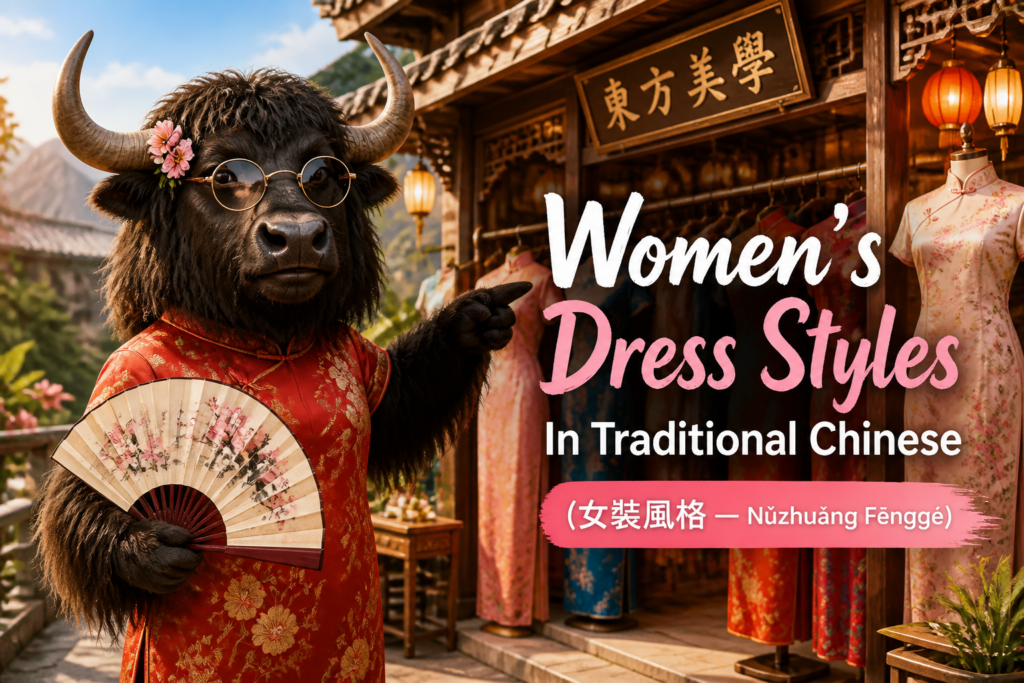
女裝風格(nǚzhuāng fēnggé)means “women’s clothing style” or “women’s dress style.” In everyday Mandarin, people often talk about 穿搭(chuāndā, outfit styling)more than sounding like a fashion textbook with opinions. That’s good news, because real Taiwanese Mandarin is practical, casual, and full of useful shopping phrases.
For the broader learning path, visit our parent guide.
This guide teaches the most common Traditional Chinese words and phrases for women’s clothing styles, with pinyin and real-life examples. By the end, you’ll be able to describe styles, talk about shopping, and understand the kind of language you might hear in Taiwan cafés, night markets, department stores, and online shops.
For a bigger language-learning challenge later, you can also try the Traditional Chinese Placement Test (TOCFL) or the Traditional Chinese Vocabulary Test. Fashion vocabulary shows up more often than you’d think. Yes, even language tests enjoy a little wardrobe drama.
Core Fashion Words You’ll Actually Use
Here are the basic words that help you talk about women’s dress styles in Traditional Chinese. These are the building blocks before you start describing sleeves, fabrics, colors, or the very important question of whether something is “too cute” or “not cute enough.”
| Traditional Chinese | Pinyin | Meaning | Example (ZH) | Example (Pinyin) | Translation (EN) |
|---|---|---|---|---|---|
| 女裝風格 | nǚzhuāng fēnggé | women’s dress style | 她很會搭配女裝風格。 | Tā hěn huì dāpèi nǚzhuāng fēnggé. | She is really good at styling women’s outfits. |
| 穿搭 | chuāndā | outfit styling; what someone wears | 你的穿搭很有特色。 | Nǐ de chuāndā hěn yǒu tèsè. | Your outfit style is very distinctive. |
| 服裝 | fúzhuāng | clothing; apparel | 這家店的服裝很適合上班穿。 | Zhè jiā diàn de fúzhuāng hěn shìhé shàngbān chuān. | The clothes in this shop are suitable for work. |
| 時尚 | shíshàng | fashionable; stylish | 她的穿著很時尚。 | Tā de chuānzhuó hěn shíshàng. | Her clothes are very stylish. |
| 打扮 | dǎbàn | to dress up; appearance; styling | 今天她打扮得很漂亮。 | Jīntiān tā dǎbàn de hěn piàoliang. | She dressed up beautifully today. |
| 風格 | fēnggé | style; vibe | 我喜歡簡單的風格。 | Wǒ xǐhuān jiǎndān de fēnggé. | I like a simple style. |
| 款式 | kuǎnshì | design; style of a product | 這件外套有很多款式。 | Zhè jiàn wàitào yǒu hěn duō kuǎnshì. | This jacket has many styles. |
| 穿著 | chuānzhuó | dress; attire | 她的穿著很得體。 | Tā de chuānzhuó hěn dětǐ. | Her attire is very appropriate. |
| 衣服 | yīfu | clothes | 我想買幾件衣服。 | Wǒ xiǎng mǎi jǐ jiàn yīfu. | I want to buy a few clothes. |
| 裙子 | qúnzi | skirt; dress | 這條裙子很適合夏天。 | Zhè tiáo qúnzi hěn shìhé xiàtiān. | This skirt is very suitable for summer. |
Common Women’s Style Words
Fashion words in Mandarin are often borrowed from everyday style talk. Some words describe a mood, some describe a silhouette, and some just say, “Yes, this outfit has a personality.” Here are the most useful style labels.
| Traditional Chinese | Pinyin | Meaning | Example (ZH) | Example (Pinyin) | Translation (EN) |
|---|---|---|---|---|---|
| 可愛風 | kě’ài fēng | cute style | 她今天走可愛風。 | Tā jīntiān zǒu kě’ài fēng. | She is going for a cute style today. |
| 簡約風 | jiǎnyuē fēng | simple, minimal style | 我喜歡簡約風的衣服。 | Wǒ xǐhuān jiǎnyuē fēng de yīfu. | I like simple, minimal-style clothes. |
| 甜美風 | tiánměi fēng | sweet, feminine style | 這種洋裝很有甜美風。 | Zhè zhǒng yángzhuāng hěn yǒu tiánměi fēng. | This kind of dress has a sweet style. |
| 休閒風 | xiūxián fēng | casual style | 週末我想穿休閒風。 | Zhōumò wǒ xiǎng chuān xiūxián fēng. | I want to wear a casual style on the weekend. |
| 正式風 | zhèngshì fēng | formal style | 這件洋裝很正式風。 | Zhè jiàn yángzhuāng hěn zhèngshì fēng. | This dress has a formal style. |
| 性感風 | xìnggǎn fēng | sexy style | 她的穿搭有一點性感風。 | Tā de chuāndā yǒu yìdiǎn xìnggǎn fēng. | Her outfit has a bit of a sexy style. |
| 韓系風 | Hánxì fēng | Korean-inspired style | 最近很流行韓系風。 | Zuìjìn hěn liúxíng Hánxì fēng. | Korean-inspired style is very trendy lately. |
| 日系風 | Rìxì fēng | Japanese-inspired style | 她喜歡日系風的裙子。 | Tā xǐhuān Rìxì fēng de qúnzi. | She likes Japanese-inspired skirts. |
| 復古風 | fùgǔ fēng | retro style | 那家店很多復古風衣服。 | Nà jiā diàn hěn duō fùgǔ fēng yīfu. | That shop has many retro-style clothes. |
| 優雅風 | yōuyǎ fēng | elegant style | 這套搭配很優雅風。 | Zhè tào dāpèi hěn yōuyǎ fēng. | This outfit pairing is very elegant. |
Useful Clothing Items For Women’s Styles
If you want to talk about a style clearly, you usually need the item names too. For example, “cute style” sounds nice, but “cute style with a skirt and cardigan” gives people the actual picture instead of a foggy fashion horoscope.
| Traditional Chinese | Pinyin | Meaning | Example (ZH) | Example (Pinyin) | Translation (EN) |
|---|---|---|---|---|---|
| 洋裝 | yángzhuāng | dress | 這件洋裝很漂亮。 | Zhè jiàn yángzhuāng hěn piàoliang. | This dress is very pretty. |
| 上衣 | shàngyī | top; blouse | 這件上衣很好搭配。 | Zhè jiàn shàngyī hěn hǎo dāpèi. | This top is easy to match. |
| 襯衫 | chènshān | shirt; blouse | 她穿白襯衫很好看。 | Tā chuān bái chènshān hěn hǎokàn. | She looks good in a white shirt. |
| 毛衣 | máoyī | sweater | 天冷的時候要穿毛衣。 | Tiān lěng de shíhou yào chuān máoyī. | When it is cold, you need to wear a sweater. |
| 外套 | wàitào | jacket; coat | 我想試穿這件外套。 | Wǒ xiǎng shìchuān zhè jiàn wàitào. | I want to try on this jacket. |
| 裙子 | qúnzi | skirt; dress | 這條裙子顏色很柔和。 | Zhè tiáo qúnzi yánsè hěn róuhé. | This skirt has a soft color. |
| 長褲 | chángkù | long pants | 這件上衣配長褲很好看。 | Zhè jiàn shàngyī pèi chángkù hěn hǎokàn. | This top goes well with long pants. |
| 短褲 | duǎnkù | shorts | 夏天很多人穿短褲。 | Xiàtiān hěn duō rén chuān duǎnkù. | Many people wear shorts in summer. |
| 連身裙 | liánshēn qún | one-piece dress | 這件連身裙很省事。 | Zhè jiàn liánshēn qún hěn shěngshì. | This one-piece dress is convenient. |
| 針織衫 | zhēnzhī shān | knit top; knitted sweater | 她買了一件米色針織衫。 | Tā mǎile yì jiàn mǐsè zhēnzhī shān. | She bought a beige knit top. |
10+ Real-Life Style Phrases
Now for the good stuff: phrases you can actually say while shopping, chatting, or describing someone’s outfit without sounding like a mannequin with a vocabulary list.
| Traditional Chinese | Pinyin | Meaning | Example (ZH) | Example (Pinyin) | Translation (EN) |
|---|---|---|---|---|---|
| 這件衣服很好看。 | Zhè jiàn yīfu hěn hǎokàn. | This piece of clothing looks great. | 這件衣服很好看,顏色也很適合你。 | Zhè jiàn yīfu hěn hǎokàn, yánsè yě hěn shìhé nǐ. | This piece looks great, and the color suits you too. |
| 這個風格很適合你。 | Zhège fēnggé hěn shìhé nǐ. | This style suits you. | 我覺得這個風格很適合你。 | Wǒ juéde zhège fēnggé hěn shìhé nǐ. | I think this style suits you very well. |
| 我喜歡簡單的穿搭。 | Wǒ xǐhuān jiǎndān de chuāndā. | I like simple outfits. | 我平常喜歡簡單的穿搭。 | Wǒ píngcháng xǐhuān jiǎndān de chuāndā. | I usually like simple outfits. |
| 這件太緊了。 | Zhè jiàn tài jǐn le. | This one is too tight. | 這件太緊了,我想換大一號。 | Zhè jiàn tài jǐn le, wǒ xiǎng huàn dà yí hào. | This one is too tight; I want a bigger size. |
| 這件太寬鬆了。 | Zhè jiàn tài kuānsōng le. | This one is too loose. | 這件太寬鬆了,不太適合我。 | Zhè jiàn tài kuānsōng le, bù tài shìhé wǒ. | This one is too loose, not really suitable for me. |
| 可以試穿嗎? | Kěyǐ shìchuān ma? | Can I try it on? | 這件可以試穿嗎? | Zhè jiàn kěyǐ shìchuān ma? | Can I try this one on? |
| 有別的顏色嗎? | Yǒu bié de yánsè ma? | Do you have other colors? | 這件有別的顏色嗎? | Zhè jiàn yǒu bié de yánsè ma? | Do you have this in other colors? |
| 這件很顯瘦。 | Zhè jiàn hěn xiǎnshòu. | This one is slimming. | 這件洋裝很顯瘦。 | Zhè jiàn yángzhuāng hěn xiǎnshòu. | This dress is very slimming. |
| 這件很顯氣質。 | Zhè jiàn hěn xiǎn qìzhì. | This one makes you look elegant. | 這件上衣很顯氣質。 | Zhè jiàn shàngyī hěn xiǎn qìzhì. | This top makes you look elegant. |
| 這樣搭配很自然。 | Zhèyàng dāpèi hěn zìrán. | This pairing looks natural. | 這樣搭配很自然,不會太誇張。 | Zhèyàng dāpèi hěn zìrán, bú huì tài kuāzhāng. | This pairing looks natural and not too exaggerated. |
| 我比較喜歡這一套。 | Wǒ bǐjiào xǐhuān zhè yí tào. | I prefer this set. | 我比較喜歡這一套,感覺比較舒服。 | Wǒ bǐjiào xǐhuān zhè yí tào, gǎnjué bǐjiào shūfu. | I prefer this set; it feels more comfortable. |
| 這件有點太花了。 | Zhè jiàn yǒudiǎn tài huā le. | This one is a little too busy/patterned. | 這件有點太花了,我想找簡單一點的。 | Zhè jiàn yǒudiǎn tài huā le, wǒ xiǎng zhǎo jiǎndān yìdiǎn de. | This one is a little too busy; I want something simpler. |
Style Descriptions With Nuance
Some style words overlap, but they are not always the same. A native speaker might say 時尚(shíshàng)to mean fashionable, while 優雅(yōuyǎ)focuses more on elegance. The difference matters, because one outfit can be fashionable without being elegant. Fashion is strange like that. It refuses to stay in one lane.
| Traditional Chinese | Pinyin | Meaning | Example (ZH) | Example (Pinyin) | Translation (EN) |
|---|---|---|---|---|---|
| 時尚 | shíshàng | fashionable | 她的穿搭很時尚。 | Tā de chuāndā hěn shíshàng. | Her outfit is very fashionable. |
| 優雅 | yōuyǎ | elegant | 這種風格很優雅。 | Zhè zhǒng fēnggé hěn yōuyǎ. | This style is very elegant. |
| 可愛 | kě’ài | cute | 她今天看起來很可愛。 | Tā jīntiān kàn qǐlái hěn kě’ài. | She looks very cute today. |
| 俏皮 | qiàopí | playful | 這套搭配很俏皮。 | Zhè tào dāpèi hěn qiàopí. | This outfit pairing is playful. |
| 得體 | dětǐ | appropriate; proper | 她的穿著很得體。 | Tā de chuānzhuó hěn dětǐ. | Her attire is very appropriate. |
| 大方 | dàfāng | generous; confident; decent-looking | 這種穿搭很大方。 | Zhè zhǒng chuāndā hěn dàfāng. | This kind of outfit looks classy and confident. |
Tone And Usage Notes
Chinese clothing vocabulary has a few little traps. Nothing dramatic, just the usual “why are there three ways to say almost the same thing?” sort of situation.
- 穿(chuān)means to wear.
- 穿搭(chuāndā)means outfit styling or a whole outfit.
- 打扮(dǎbàn)focuses on how someone dresses or gets dressed up.
- 穿著(chuānzhuó)sounds a bit more formal than 穿搭 or 打扮.
- 洋裝(yángzhuāng)is a dress, especially in Taiwan usage.
- 連身裙(liánshēn qún)also means a one-piece dress; it is a useful, clear term.
- 裙子(qúnzi)can mean skirt, and in some contexts can be used loosely for a dress-like item. Context does the heavy lifting, as usual.
If you want to check standard vocabulary choices, a boring but reliable place is the Taiwan Ministry of Education Dictionary. Not glamorous, but extremely useful. Like a good plain white shirt.
Yak wisdom: In Mandarin fashion talk, “simple” often means “good taste,” and “too much” often means “please no.” The clothes may be quiet, but the opinion is loud.
Shopping And Styling Sentences
Here are more natural sentences you may hear in Taiwan shops, online comments, or casual conversation. They are short, useful, and mercifully less dramatic than a reality show fitting room.
| Traditional Chinese | Pinyin | Meaning | Example (ZH) | Example (Pinyin) | Translation (EN) |
|---|---|---|---|---|---|
| 這件很百搭。 | Zhè jiàn hěn bǎidā. | This one matches many things. | 這件上衣很百搭。 | Zhè jiàn shàngyī hěn bǎidā. | This top matches many outfits. |
| 這件很有質感。 | Zhè jiàn hěn yǒu zhígǎn. | This one feels high quality. | 這件外套很有質感。 | Zhè jiàn wàitào hěn yǒu zhígǎn. | This jacket feels high quality. |
| 這件很適合約會。 | Zhè jiàn hěn shìhé yuēhuì. | This one is good for a date. | 這件裙子很適合約會。 | Zhè tiáo qúnzi hěn shìhé yuēhuì. | This skirt is good for a date. |
| 這件看起來很溫柔。 | Zhè jiàn kàn qǐlái hěn wēnróu. | This one looks gentle/soft. | 這件洋裝看起來很溫柔。 | Zhè jiàn yángzhuāng kàn qǐlái hěn wēnróu. | This dress looks soft and gentle. |
| 這件很有夏天的感覺。 | Zhè jiàn hěn yǒu xiàtiān de gǎnjué. | This one feels very summery. | 這件衣服很有夏天的感覺。 | Zhè jiàn yīfu hěn yǒu xiàtiān de gǎnjué. | This clothing feels very summery. |
| 這套很適合上班穿。 | Zhè tào hěn shìhé shàngbān chuān. | This set is suitable for work. | 這套很適合上班穿。 | Zhè tào hěn shìhé shàngbān chuān. | This outfit is suitable for work. |
| 這件不太顯眼。 | Zhè jiàn bù tài xiǎnyǎn. | This one is not too flashy. | 我想找不太顯眼的衣服。 | Wǒ xiǎng zhǎo bù tài xiǎnyǎn de yīfu. | I want to find clothes that are not too flashy. |
| 這件很有個性。 | Zhè jiàn hěn yǒu gèxìng. | This one has personality. | 這件外套很有個性。 | Zhè jiàn wàitào hěn yǒu gèxìng. | This jacket has a lot of personality. |
| 我想找比較成熟的風格。 | Wǒ xiǎng zhǎo bǐjiào chéngshú de fēnggé. | I want a more mature style. | 我想找比較成熟的風格。 | Wǒ xiǎng zhǎo bǐjiào chéngshú de fēnggé. | I want a more mature style. |
| 我不太喜歡太複雜的設計。 | Wǒ bú tài xǐhuān tài fùzá de shèjì. | I don’t really like designs that are too complicated. | 我不太喜歡太複雜的設計。 | Wǒ bú tài xǐhuān tài fùzá de shèjì. | I don’t really like designs that are too complicated. |
Mini Grammar Notes For Clothing Talk
Clothing descriptions in Mandarin often use the pattern 很 + adjective. It can mean “very,” but in casual speech it often just makes the sentence sound natural. Not every “very” is shouting. Sometimes it is just polite grammar in a nice top.
| Pattern | Meaning | Example (ZH) | Pinyin | English |
|---|---|---|---|---|
| 很 + adjective | natural description | 這件很漂亮。 | Zhè jiàn hěn piàoliang. | This one is pretty. |
| 太 + adjective + 了 | too much | 這件太花了。 | Zhè jiàn tài huā le. | This one is too busy. |
| 有點 + adjective | a little bit | 這件有點貴。 | Zhè jiàn yǒudiǎn guì. | This one is a little expensive. |
| 很適合 + person/situation | very suitable for | 這件很適合你。 | Zhè jiàn hěn shìhé nǐ. | This one suits you very well. |
| 看起來 + adjective | looks/sounds like | 這件看起來很舒服。 | Zhè jiàn kàn qǐlái hěn shūfu. | This one looks comfortable. |
Also note the adjective 舒服(shūfu, comfortable)is very common in Taiwan clothing talk. People do not only care about pretty. They care whether the outfit lets them move, sit, eat, and survive a whole day.
Practice Time
Try these quick drills. No pressure. Fashion judgment is optional; language practice is not.
- Translate: “This dress is very elegant.” → 這件洋裝很優雅。(Zhè jiàn yángzhuāng hěn yōuyǎ.)
- Translate: “Can I try this on?” → 這件可以試穿嗎?(Zhè jiàn kěyǐ shìchuān ma?)
- Translate: “I like a simple style.” → 我喜歡簡單的風格。(Wǒ xǐhuān jiǎndān de fēnggé.)
- Swap the word 漂亮(piàoliang, pretty)into this sentence: 這件很___。 → 這件很漂亮。
- Fill in the blank: 這件太___了。 Use 緊(jǐn, tight)→ 這件太緊了。
- Say it in Chinese: “Do you have another color?” → 有別的顏色嗎?(Yǒu bié de yánsè ma?)
- Say it in Chinese: “This one is suitable for work.” → 這套很適合上班穿。(Zhè tào hěn shìhé shàngbān chuān.)
Common Mistakes And Fixes
| Mistake | Why It’s Awkward | Better Version | Pinyin |
|---|---|---|---|
| 我喜歡這個衣服。 | 這個 does not fit as well with 衣服 here. | 我喜歡這件衣服。 | Wǒ xǐhuān zhè jiàn yīfu. |
| 這件很有時尚。 | 時尚 is usually used as an adjective, not with 有 here. | 這件很時尚。 | Zhè jiàn hěn shíshàng. |
| 這件太大一點。 | This sounds incomplete. | 這件有點太大。 | Zhè jiàn yǒudiǎn tài dà. |
| 我想穿搭這件。 | 穿搭 is usually about styling, not “wearing” a single piece. | 我想穿這件。 | Wǒ xiǎng chuān zhè jiàn. |
| 這件很漂亮的風格。 | The structure is clumsy. | 這件是漂亮的風格。 or 這件很漂亮。 | Zhè jiàn shì piàoliang de fēnggé. / Zhè jiàn hěn piàoliang. |
One more learner tip: in Taiwan, people often say 洋裝 for “dress.” If you use 連身裙, you will still be understood, but 洋裝 is very natural in shops, magazines, and everyday conversation. Small word, big usefulness. Annoyingly efficient.
Quick Reference Summary
- 女裝風格(nǚzhuāng fēnggé)= women’s dress style
- 穿搭(chuāndā)= outfit styling
- 打扮(dǎbàn)= to dress up; appearance
- 時尚(shíshàng)= fashionable
- 優雅(yōuyǎ)= elegant
- 可愛風(kě’ài fēng)= cute style
- 簡約風(jiǎnyuē fēng)= minimalist style
- 甜美風(tiánměi fēng)= sweet feminine style
- 休閒風(xiūxián fēng)= casual style
- 復古風(fùgǔ fēng)= retro style
- 洋裝(yángzhuāng)= dress
- 試穿(shìchuān)= to try on
If you want to keep building your Chinese vocabulary, try the basic words and phrases guide, then move into actions and gestures in Traditional Chinese and even Chinese food in Traditional Chinese. Fashion, body language, and food vocabulary together make conversation a lot less awkward. Which is nice, because nobody wants to mime an entire dinner order while wearing the wrong skirt.
Yak takeaway: In Traditional Chinese, women’s dress style talk is mostly about practical, natural phrases like 穿搭、風格、時尚、and 洋裝. Learn the simple patterns first, and suddenly shopping, compliments, and style descriptions become much easier. Your clothes may not speak Chinese, but you can.