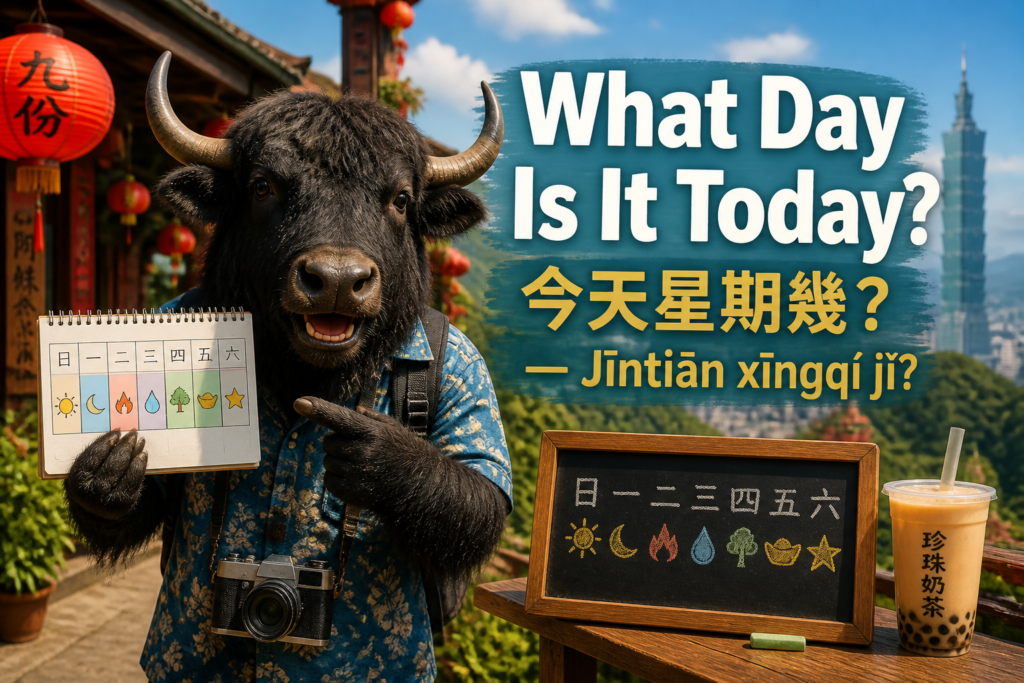
If you can ask 今天星期幾? jīntiān xīngqí jǐ? you can survive a surprising amount of real life in Mandarin. Schedules, class plans, MRT meetups, office chats, and the classic “Wait… is that today or tomorrow?” disaster all start here.
Today's Date in Traditional Chinese
See today's date in Traditional Chinese, then use the lesson below to ask and answer the question naturally.
Loading today's date...
- Chinese characters
- Numeric date
- Pinyin
Now you know today's date in Traditional Chinese. Keep reading to learn how to ask what day it is, answer with confidence, and talk about dates naturally.
In Taiwan, people often say 星期 xīngqī for the days of the week, and that is exactly what this lesson uses. Clean, practical, and very useful. No drama. Just the words you actually need when someone asks, “So, what day is it?”
By the end, you will know how to ask the question, answer it naturally, and use related phrases like “today,” “tomorrow,” and “this week” without sounding like you got lost in a calendar app.
The Main Question
| Traditional Chinese | Pinyin | Meaning | Example (ZH) | Example (Pinyin) | Translation (EN) |
|---|---|---|---|---|---|
| 今天星期幾? | jīntiān xīngqī jǐ? | What day is it today? | 今天星期幾?我忘了。 | Jīntiān xīngqī jǐ? Wǒ wàng le. | What day is it today? I forgot. |
| 今天禮拜幾? | jīntiān lǐbài jǐ? | What day is it today? (Taiwan casual usage) | 今天禮拜幾?我有課嗎? | Jīntiān lǐbài jǐ? Wǒ yǒu kè ma? | What day is it today? Do I have class? |
| 今天是星期幾? | jīntiān shì xīngqī jǐ? | What day is it today? / Today is what day? | 今天是星期幾? | Jīntiān shì xīngqī jǐ? | What day is it today? |
The shortest answer is usually easiest: 今天星期幾? jīntiān xīngqī jǐ?
And yes, 幾 jǐ is the “which / what number” word here. It is asking for a day number, not a deep philosophical calendar truth. Mandarin keeps it simple when it feels like it.
How To Answer
To answer, say 今天是星期一 jīntiān shì xīngqī yī or 今天是禮拜一 jīntiān shì lǐbài yī.
| Traditional Chinese | Pinyin | Meaning | Example (ZH) | Example (Pinyin) | Translation (EN) |
|---|---|---|---|---|---|
| 今天是星期一。 | jīntiān shì xīngqī yī. | Today is Monday. | 今天是星期一,我要上班。 | Jīntiān shì xīngqī yī, wǒ yào shàngbān. | Today is Monday, and I have to go to work. |
| 今天是星期二。 | jīntiān shì xīngqī èr. | Today is Tuesday. | 今天是星期二,沒有會議。 | Jīntiān shì xīngqī èr, méiyǒu huìyì. | Today is Tuesday, and there is no meeting. |
| 今天是星期三。 | jīntiān shì xīngqī sān. | Today is Wednesday. | 今天是星期三,作業很多。 | Jīntiān shì xīngqī sān, zuòyè hěn duō. | Today is Wednesday, and there is a lot of homework. |
| 今天是星期四。 | jīntiān shì xīngqī sì. | Today is Thursday. | 今天是星期四,我想喝咖啡。 | Jīntiān shì xīngqī sì, wǒ xiǎng hē kāfēi. | Today is Thursday, and I want coffee. |
| 今天是星期五。 | jīntiān shì xīngqī wǔ. | Today is Friday. | 今天是星期五,晚上去夜市。 | Jīntiān shì xīngqī wǔ, wǎnshàng qù yèshì. | Today is Friday, and we are going to the night market tonight. |
| 今天是星期六。 | jīntiān shì xīngqī liù. | Today is Saturday. | 今天是星期六,我想睡晚一點。 | Jīntiān shì xīngqī liù, wǒ xiǎng shuì wǎn yīdiǎn. | Today is Saturday, and I want to sleep a bit later. |
| 今天是星期日。 | jīntiān shì xīngqī rì. | Today is Sunday. | 今天是星期日,我要休息。 | Jīntiān shì xīngqī rì, wǒ yào xiūxi. | Today is Sunday, and I need to rest. |
You can also hear 星期天 xīngqītiān for Sunday in some places, but in Taiwan, 星期日 xīngqīrì is very common and often sounds a bit more standard. Language loves having two doors into the same room.
Taiwan-Friendly Weekly Words
| Traditional Chinese | Pinyin | Meaning | Example (ZH) | Example (Pinyin) | Translation (EN) |
|---|---|---|---|---|---|
| 星期 | xīngqī | week; used in weekday expressions | 今天是星期幾? | Jīntiān shì xīngqī jǐ? | What day is it today? |
| 禮拜 | lǐbài | week; casual Taiwan usage for weekday expressions | 你禮拜幾有空? | Nǐ lǐbài jǐ yǒu kòng? | What day are you free? |
| 週 | zhōu | week; often used in formal or written language | 這週很忙。 | Zhè zhōu hěn máng. | This week is busy. |
| 這週 | zhè zhōu | this week | 這週我有三個考試。 | Zhè zhōu wǒ yǒu sān gè kǎoshì. | This week I have three tests. |
| 下週 | xià zhōu | next week | 下週再見。 | Xià zhōu zàijiàn. | See you next week. |
| 上週 | shàng zhōu | last week | 上週我去台中。 | Shàng zhōu wǒ qù Táizhōng. | Last week I went to Taichung. |
| 今天 | jīntiān | today | 今天很熱。 | Jīntiān hěn rè. | Today is hot. |
| 明天 | míngtiān | tomorrow | 明天要上課。 | Míngtiān yào shàngkè. | Tomorrow we have class. |
| 後天 | hòutiān | the day after tomorrow | 後天我有約。 | Hòutiān wǒ yǒu yuē. | I have plans the day after tomorrow. |
| 昨天 | zuótiān | yesterday | 昨天下雨。 | Zuótiān xià yǔ. | It rained yesterday. |
If you want a bigger map of the weekdays, take a look at Days Of The Week In Trad Chinese. It is the same calendar family, just with a little more room to stretch out.
The Days Of The Week
| Traditional Chinese | Pinyin | Meaning | Example (ZH) | Example (Pinyin) | Translation (EN) |
|---|---|---|---|---|---|
| 星期一 | xīngqī yī | Monday | 星期一早上我很忙。 | Xīngqī yī zǎoshang wǒ hěn máng. | Monday morning I am very busy. |
| 星期二 | xīngqī èr | Tuesday | 星期二有中文課。 | Xīngqī èr yǒu Zhōngwén kè. | There is Chinese class on Tuesday. |
| 星期三 | xīngqī sān | Wednesday | 星期三晚上我去健身房。 | Xīngqī sān wǎnshàng wǒ qù jiànshēnfáng. | Wednesday night I go to the gym. |
| 星期四 | xīngqī sì | Thursday | 星期四要交報告。 | Xīngqī sì yào jiāo bàogào. | The report is due Thursday. |
| 星期五 | xīngqī wǔ | Friday | 星期五大家都很開心。 | Xīngqī wǔ dàjiā dōu hěn kāixīn. | Everyone is happy on Friday. |
| 星期六 | xīngqī liù | Saturday | 星期六我要去逛街。 | Xīngqī liù wǒ yào qù guàngjiē. | I am going shopping on Saturday. |
| 星期日 | xīngqī rì | Sunday | 星期日適合休息。 | Xīngqī rì shìhé xiūxi. | Sunday is good for resting. |
A small but useful note: in Mandarin, 星期一 xīngqī yī does not mean “week one” in a weird math way. It just means Monday. Your brain may protest at first. That is normal.
Useful Real-Life Phrases
| Traditional Chinese | Pinyin | Meaning | Example (ZH) | Example (Pinyin) | Translation (EN) |
|---|---|---|---|---|---|
| 今天幾號? | jīntiān jǐ hào? | What is the date today? | 今天幾號?我怕記錯。 | Jīntiān jǐ hào? Wǒ pà jì cuò. | What is the date today? I am afraid I remembered it wrong. |
| 禮拜幾有空? | lǐbài jǐ yǒu kòng? | Which day are you free? | 你禮拜幾有空?我們可以見面。 | Nǐ lǐbài jǐ yǒu kòng? Wǒmen kěyǐ jiànmiàn. | Which day are you free? We can meet. |
| 今天有課嗎? | jīntiān yǒu kè ma? | Do you have class today? | 你今天有課嗎? | Nǐ jīntiān yǒu kè ma? | Do you have class today? |
| 明天見。 | míngtiān jiàn. | See you tomorrow. | 好,明天見。 | Hǎo, míngtiān jiàn. | Okay, see you tomorrow. |
| 後天再說。 | hòutiān zài shuō. | Let’s talk about it the day after tomorrow. | 今天太忙了,後天再說。 | Jīntiān tài máng le, hòutiān zài shuō. | Today is too busy, let’s talk about it the day after tomorrow. |
| 這週末 | zhè zhōumò | this weekend | 這週末你要做什麼? | Zhè zhōumò nǐ yào zuò shénme? | What are you doing this weekend? |
| 下週末 | xià zhōumò | next weekend | 下週末我們去爬山。 | Xià zhōumò wǒmen qù páshān. | Next weekend we are going hiking. |
| 我忘記了。 | wǒ wàngjì le. | I forgot. | 抱歉,我忘記了今天是星期幾。 | Bàoqiàn, wǒ wàngjì le jīntiān shì xīngqī jǐ. | Sorry, I forgot what day it is today. |
| 再問一次。 | zài wèn yí cì. | Ask again. | 你可以再問一次嗎? | Nǐ kěyǐ zài wèn yí cì ma? | Can you ask again? |
| 時間過得好快。 | shíjiān guò de hǎo kuài. | Time passes so fast. | 怎麼又星期五了?時間過得好快。 | Zěnme yòu xīngqī wǔ le? Shíjiān guò de hǎo kuài. | How is it Friday again? Time passes so fast. |
Grammar Note: 是 In Day Questions
You may hear both 今天星期幾? jīntiān xīngqī jǐ? and 今天是星期幾? jīntiān shì xīngqī jǐ?
Both are correct. The version with 是 shì can feel a little more complete, like your sentence has put on its work shoes. The version without 是 is shorter and very common in casual speech.
| Pattern | Meaning | Example (ZH) | Pinyin | English |
|---|---|---|---|---|
| 今天星期幾? | Ask what day it is | 今天星期幾? | Jīntiān xīngqī jǐ? | What day is it today? |
| 今天是星期幾? | Ask what day it is, with 是 | 今天是星期幾? | Jīntiān shì xīngqī jǐ? | What day is it today? |
| 今天是星期五。 | Answer with 是 | 今天是星期五。 | Jīntiān shì xīngqī wǔ. | Today is Friday. |
| 今天星期五。 | Answer without 是 | 今天星期五。 | Jīntiān xīngqī wǔ. | Today is Friday. |
Yak wisdom: In Mandarin, sometimes the shortest sentence is the most natural one. English likes extra glue. Mandarin often says, “No thanks, I’m good.”
Useful Nuances And Common Confusions
- 星期 xīngqī and 禮拜 lǐbài both mean “week” in weekday expressions.
- In Taiwan, 禮拜幾? lǐbài jǐ? is very common in daily speech.
- 星期日 xīngqīrì is standard and common for Sunday.
- 星期天 xīngqītiān is also heard, but it is a bit more casual.
- 週 zhōu is often used for “this week,” “next week,” and “last week.”
- 幾 jǐ asks for a number, so it fits weekdays because each day has a number-like name.
- Do not confuse 今天星期幾? with 今天幾號? jīntiān jǐ hào? The first asks the day of the week. The second asks the date.
- If someone says 禮拜五 lǐbài wǔ, they mean Friday, not “five weeks.” Mandarin is doing its best.
Practice Time
Try these quick drills. Short, simple, and far less painful than looking at a calendar in panic.
| Task | Prompt | Suggested Answer |
|---|---|---|
| 1. Translate | What day is it today? | 今天星期幾? or 今天是星期幾? |
| 2. Translate | Today is Friday. | 今天是星期五。 |
| 3. Swap The Day | Today is Monday. | 今天是星期一。 |
| 4. Swap The Day | Today is Sunday. | 今天是星期日。 |
| 5. Fill In The Blank | 今天是星期___。 = Today is Wednesday. | 三 sān |
| 6. Fill In The Blank | 今天___星期幾? | 是 shì |
| 7. Make It Casual | Use Taiwan-style speech for “What day is it today?” | 今天禮拜幾? |
| 8. Choose The Right Question | You want the date, not the weekday. | 今天幾號? |
Mini challenge: say the whole week out loud once, then answer with your own schedule.
- 今天是星期一,我要上班。 Jīntiān shì xīngqī yī, wǒ yào shàngbān. Today is Monday, and I have to work.
- 今天是星期三,我有中文課。 Jīntiān shì xīngqī sān, wǒ yǒu Zhōngwén kè. Today is Wednesday, and I have Chinese class.
- 今天是星期五,晚上去夜市。 Jīntiān shì xīngqī wǔ, wǎnshàng qù yèshì. Today is Friday, and we are going to the night market tonight.
- 今天是星期日,我想休息。 Jīntiān shì xīngqī rì, wǒ xiǎng xiūxi. Today is Sunday, and I want to rest.
Common Mistakes And Fixes
| Mistake | Why It Feels Wrong | Better Version |
|---|---|---|
| 今天是星期幾? said as if 幾 were a day name | 幾 means “which number,” so it is the question word, not the answer. | 今天是星期五。 |
| 今天幾號? when asking for weekday | This asks for the date, not the weekday. | 今天星期幾? |
| 星期一號 | Mixing weekday and date language together like a confused spreadsheet. | 星期一 or 一號 |
| 今天是禮拜一號。 | Also mixing two systems. | 今天是禮拜一。 or 今天是一號。 |
| Using only “星期” in very casual Taiwan speech | Not wrong, just sometimes a bit more formal than the local casual vibe. | 禮拜幾 can sound more natural in daily conversation. |
| Forgetting the weekday number | Monday is 一, Tuesday is 二, and so on. Yes, the numbers matter. | Memorize 星期一 to 星期日 |
One more tiny note: 一 yī can change tone in some contexts, but in weekday names it is usually taught simply as yī with the first tone. Keep it steady and move on with your life.
Quick Reference Summary
- 今天星期幾? Jīntiān xīngqī jǐ? = What day is it today?
- 今天禮拜幾? Jīntiān lǐbài jǐ? = Taiwan-casual way to ask the same thing
- 今天是星期五。 Jīntiān shì xīngqī wǔ. = Today is Friday.
- 今天是禮拜五。 Jīntiān shì lǐbài wǔ. = Casual Taiwan-style Friday
- 今天幾號? Jīntiān jǐ hào? = What is the date today?
- 星期日 xīngqīrì = Sunday
- 禮拜 lǐbài = week; common in Taiwan daily speech
- 這週 zhè zhōu = this week
- 下週 xià zhōu = next week
- 上週 shàng zhōu = last week
If you want to check your wider Traditional Chinese skills, try the Traditional Chinese Vocabulary Test or the Traditional Chinese Placement Test TOCFL. Very official-looking. Almost suspiciously so.
For a bigger learning path, the learn-japanese pillar page is there too, because language learners tend to wander. Respectfully. Constantly.
Yak takeaway: If you remember only one thing, make it this: 今天星期幾? jīntiān xīngqī jǐ? asks the day, and 今天幾號? jīntiān jǐ hào? asks the date. Keep those two apart, and your calendar stops being rude.