
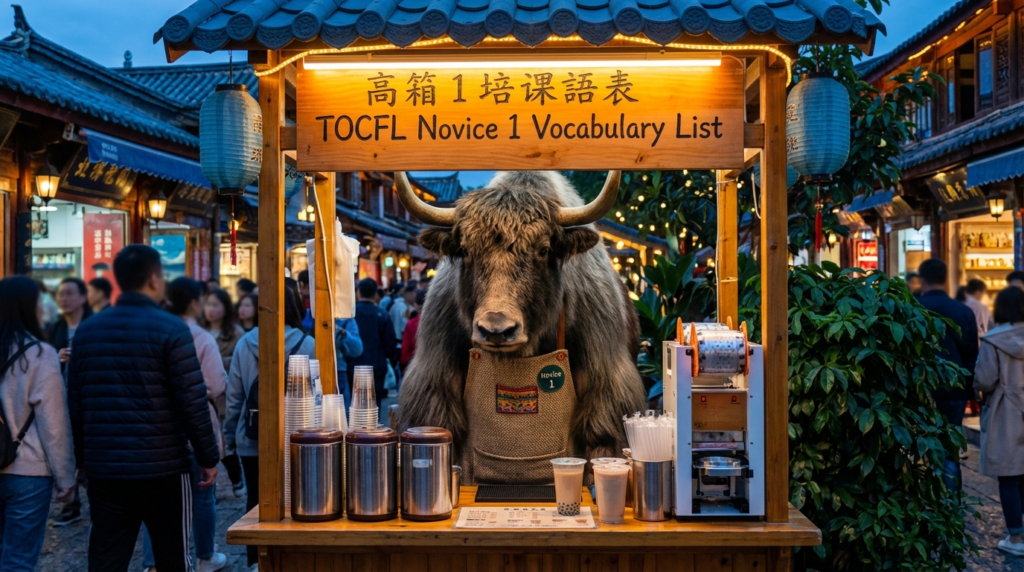
Need the TOCFL Novice 1 vocabulary list (traditional Chinese)? Good, good, you found it. And just a quick note before getting started, the TOCFL now has 8 levels, technically. Novice 1, Novice 2, Level 1, Level 2, Level 3, Level 4, Level 5, and lastly, Level 6.
This list is Novice 1 – so the words covered from 1 to 160.
If you’re looking for the other TOCFL word lists, we still got you covered:
Novice 2 • Level 1 • Level 2 • Level 3 • Level 4 • Level 5
And if you’re looking for Grammar or more info on TOCFL overall, there’s spots on Yak Yacker for that too, below.
TOCFL Novice 1 Vocabulary Quiz
Keep scrolling down if you want to see the full vocab list alongside pinyin and English meanings, or you can try your hand at seeing how many words you currently know! Start the quiz that cycles through 20 words, or enter in a higher number and have at it.
Good luck!
Helpful Links
More Traditional Chinese Posts: Learning Traditional Chinese Guide
Related Vocabulary Lists: Novice 2 • Level 1 • Level 2 • Level 3 • Level 4 • Level 5
Grammar Support: TOCFL Grammar List • TOCFL Vocabulary & Grammar Hub
Official TOCFL Resources: TOCFL Official Site • Official Downloads • Mock Tests • TOCFL Overview (Wikipedia)
Use these like flashcards: cover the English column, read the Hanzi + pinyin, then say the example sentence out loud.
Words 1–20 (People, Identity, Time Basics)
| Hanzi | Pinyin | Meaning | ZH | Pinyin Example | EN |
|---|---|---|---|---|---|
| 我 | wǒ | I / me | 我是學生。 | Wǒ shì xuéshēng. | I am a student. |
| 你/妳 | nǐ | you | 你是老師嗎? | Nǐ shì lǎoshī ma? | Are you a teacher? |
| 他/她 | tā | he / she | 他很忙。 | Tā hěn máng. | He is very busy. |
| 我們 | wǒmen | we / us | 我們去學校。 | Wǒmen qù xuéxiào. | We go to school. |
| 你們/妳們 | nǐmen | you (plural) | 你們好。 | Nǐmen hǎo. | Hello, everyone. |
| 他們/她們 | tāmen | they | 他們是同學。 | Tāmen shì tóngxué. | They are classmates. |
| 您 | nín | you (polite) | 您好。 | Nín hǎo. | Hello (polite). |
| 誰 | shéi | who | 誰是老師? | Shéi shì lǎoshī? | Who is the teacher? |
| 姓名 | xìngmíng | full name | 你的姓名是什麼? | Nǐ de xìngmíng shì shénme? | What is your full name? |
| 人 | rén | person / people | 我是台灣人。 | Wǒ shì Táiwān rén. | I’m Taiwanese. |
| 國 | guó | country | 日本是國家。 | Rìběn shì guójiā. | Japan is a country. |
| 中國 | Zhōngguó | China | 我住中國。 | Wǒ zhù Zhōngguó. | I live in China. |
| 美國 | Měiguó | USA | 他去美國。 | Tā qù Měiguó. | He goes to the USA. |
| 日本 | Rìběn | Japan | 你去日本嗎? | Nǐ qù Rìběn ma? | Are you going to Japan? |
| 台灣/臺灣 | Táiwān | Taiwan | 我們回台灣。 | Wǒmen huí Táiwān. | We return to Taiwan. |
| 名字 | míngzi | name | 你的名字呢? | Nǐ de míngzi ne? | And your name? |
| 家 | jiā | home / family | 我回家了。 | Wǒ huí jiā le. | I’m going home. |
| 電話 | diànhuà | telephone / phone number | 這是我的電話。 | Zhè shì wǒ de diànhuà. | This is my phone number. |
| 時間 | shíjiān | time | 我沒有時間。 | Wǒ méiyǒu shíjiān. | I don’t have time. |
| 小時 | xiǎoshí | hour | 我等一小時。 | Wǒ děng yī xiǎoshí. | I wait for one hour. |
Words 21–40 (Now, Days, And Numbers 1–10)
| Hanzi | Pinyin | Meaning | ZH | Pinyin Example | EN |
|---|---|---|---|---|---|
| 現在 | xiànzài | now | 現在幾點? | Xiànzài jǐ diǎn? | What time is it now? |
| 今年 | jīnnián | this year | 今年我很忙。 | Jīnnián wǒ hěn máng. | I’m very busy this year. |
| 今天 | jīntiān | today | 今天我們上課。 | Jīntiān wǒmen shàngkè. | We have class today. |
| 明天 | míngtiān | tomorrow | 明天你去嗎? | Míngtiān nǐ qù ma? | Are you going tomorrow? |
| 昨天 | zuótiān | yesterday | 昨天我看電影。 | Zuótiān wǒ kàn diànyǐng. | I watched a movie yesterday. |
| 早上 | zǎoshàng | morning | 早上我去學校。 | Zǎoshàng wǒ qù xuéxiào. | I go to school in the morning. |
| 上午 | shàngwǔ | AM / late morning | 上午我打電話。 | Shàngwǔ wǒ dǎ diànhuà. | I make a phone call in the morning. |
| 中午 | zhōngwǔ | noon | 中午吃飯。 | Zhōngwǔ chī fàn. | Eat lunch at noon. |
| 下午 | xiàwǔ | afternoon | 下午我買東西。 | Xiàwǔ wǒ mǎi dōngxi. | I buy things in the afternoon. |
| 晚上 | wǎnshàng | evening / night | 晚上我看電視。 | Wǎnshàng wǒ kàn diànshì. | I watch TV at night. |
| 一 | yī | one | 我有一個朋友。 | Wǒ yǒu yī gè péngyou. | I have one friend. |
| 二 | èr | two | 我有二個筆。 | Wǒ yǒu èr gè bǐ. | I have two pens. |
| 三 | sān | three | 我們三個人。 | Wǒmen sān gè rén. | There are three of us. |
| 四 | sì | four | 四點見。 | Sì diǎn jiàn. | See you at 4 o’clock. |
| 五 | wǔ | five | 五分。 | Wǔ fēn. | Five minutes. |
| 六 | liù | six | 他六歲。 | Tā liù suì. | He is six years old. |
| 七 | qī | seven | 七個人。 | Qī gè rén. | Seven people. |
| 八 | bā | eight | 八點半。 | Bā diǎn bàn. | 8:30. |
| 九 | jiǔ | nine | 九點。 | Jiǔ diǎn. | 9 o’clock. |
| 十 | shí | ten | 十點。 | Shí diǎn. | 10 o’clock. |
Words 41–60 (More Numbers, Family, And Measure Words)
| Hanzi | Pinyin | Meaning | ZH | Pinyin Example | EN |
|---|---|---|---|---|---|
| 兩 | liǎng | two (before measure words) | 兩個人。 | Liǎng gè rén. | Two people. |
| 時候 | shíhou | when / time | 你什麼時候來? | Nǐ shénme shíhou lái? | When are you coming? |
| 百 | bǎi | hundred | 一百塊。 | Yì bǎi kuài. | 100 dollars. |
| 半 | bàn | half | 現在兩點半。 | Xiànzài liǎng diǎn bàn. | It’s 2:30 now. |
| 千 | qiān | thousand | 一千塊。 | Yì qiān kuài. | 1,000 dollars. |
| 爸爸/爸 | bàba / bà | dad | 我爸爸很高。 | Wǒ bàba hěn gāo. | My dad is tall. |
| 媽媽/媽 | māma / mā | mom | 媽媽很忙。 | Māma hěn máng. | Mom is busy. |
| 哥哥/哥 | gēge / gē | older brother | 我哥哥是老師。 | Wǒ gēge shì lǎoshī. | My older brother is a teacher. |
| 弟弟/弟 | dìdi / dì | younger brother | 弟弟是學生。 | Dìdi shì xuéshēng. | My younger brother is a student. |
| 姊姊/姐姐/姊/姐 | jiějie / jiě | older sister | 我姐姐很漂亮。 | Wǒ jiějie hěn piàoliang. | My older sister is pretty. |
| 妹妹/妹 | mèimei / mèi | younger sister | 妹妹九歲。 | Mèimei jiǔ suì. | My younger sister is nine. |
| 小孩(子) | xiǎohái(zi) | child | 小孩也是人。 | Xiǎohái yě shì rén. | Children are people too. |
| 的 | de | possessive particle | 這是我的書。 | Zhè shì wǒ de shū. | This is my book. |
| 第 | dì | ordinal marker (No.) | 這是第十個。 | Zhè shì dì shí gè. | This is the tenth one. |
| 分 | fēn | minute / point | 現在兩點十分。 | Xiànzài liǎng diǎn shí fēn. | It’s 2:10 now. |
| 點 | diǎn | o’clock / dot | 現在三點。 | Xiànzài sān diǎn. | It’s 3 o’clock now. |
| 個 | gè | general measure word | 我們三個人。 | Wǒmen sān gè rén. | There are three of us. |
| 歲 | suì | years old | 你幾歲? | Nǐ jǐ suì? | How old are you? |
| 年 | nián | year | 今年是二千二十六年。 | Jīnnián shì èr qiān èr shí liù nián. | This year is 2026. |
| 住 | zhù | to live / stay | 我住台灣。 | Wǒ zhù Táiwān. | I live in Taiwan. |
Words 61–80 (Core Verbs, Descriptions, School Basics)
| Hanzi | Pinyin | Meaning | ZH | Pinyin Example | EN |
|---|---|---|---|---|---|
| 來 | lái | to come | 你來嗎? | Nǐ lái ma? | Are you coming? |
| 是 | shì | to be (is/are) | 她是老師。 | Tā shì lǎoshī. | վել? (She is a teacher.) |
| 姓 | xìng | surname | 你姓什麼? | Nǐ xìng shénme? | What’s your surname? |
| 覺得 | juéde | to feel / think | 我覺得很好。 | Wǒ juéde hěn hǎo. | I think it’s very good. |
| 喜歡 | xǐhuān | to like | 我喜歡中文。 | Wǒ xǐhuān Zhōngwén. | I like Chinese. |
| 打電話 | dǎ diànhuà | to make a phone call | 我再打電話。 | Wǒ zài dǎ diànhuà. | I’ll call again. |
| 漂亮 | piàoliang | pretty | 你很漂亮。 | Nǐ hěn piàoliang. | You’re very pretty. |
| 高 | gāo | tall / high | 我哥哥很高。 | Wǒ gēge hěn gāo. | My older brother is tall. |
| 老 | lǎo | old | 我爸爸不老。 | Wǒ bàba bù lǎo. | My dad isn’t old. |
| 好 | hǎo | good | 這很好。 | Zhè hěn hǎo. | This is very good. |
| 很 | hěn | very | 我很忙。 | Wǒ hěn máng. | I’m very busy. |
| 真 | zhēn | really | 你真好。 | Nǐ zhēn hǎo. | You’re really nice. |
| 電腦 | diànnǎo | computer | 這是電腦。 | Zhè shì diànnǎo. | This is a computer. |
| 老師 | lǎoshī | teacher | 老師好。 | Lǎoshī hǎo. | Hello, teacher. |
| 買 | mǎi | to buy | 我買書。 | Wǒ mǎi shū. | I buy books. |
| 忙 | máng | busy | 今天很忙。 | Jīntiān hěn máng. | Today is busy. |
| 學生 | xuéshēng | student | 我是學生。 | Wǒ shì xuéshēng. | I’m a student. |
| 大學 | dàxué | university | 我去大學上課。 | Wǒ qù dàxué shàngkè. | I go to university for class. |
| 學校 | xuéxiào | school | 我去學校。 | Wǒ qù xuéxiào. | I go to school. |
| 中文 | Zhōngwén | Chinese (language) | 中文很難。 | Zhōngwén hěn nán. | Chinese is difficult. |
Words 81–100 (Classroom Actions, Media, And Simple Feelings)
| Hanzi | Pinyin | Meaning | ZH | Pinyin Example | EN |
|---|---|---|---|---|---|
| 同學 | tóngxué | classmate | 他是我同學。 | Tā shì wǒ tóngxué. | He’s my classmate. |
| 字 | zì | character | 這個字很難。 | Zhè gè zì hěn nán. | This character is hard. |
| 筆 | bǐ | pen | 這是筆。 | Zhè shì bǐ. | This is a pen. |
| 學 | xué | to study | 我學中文。 | Wǒ xué Zhōngwén. | I study Chinese. |
| 問 | wèn | to ask | 我問老師。 | Wǒ wèn lǎoshī. | I ask the teacher. |
| 說 | shuō | to say / speak | 他說謝謝。 | Tā shuō xièxie. | He says thanks. |
| 寫 | xiě | to write | 我寫字。 | Wǒ xiě zì. | I write characters. |
| 聽 | tīng | to listen | 我聽老師。 | Wǒ tīng lǎoshī. | I listen to the teacher. |
| 對 | duì | correct / right | 你說對了。 | Nǐ shuō duì le. | You said it right. |
| 能 | néng | can / be able to | 我能去。 | Wǒ néng qù. | I can go. |
| 可以 | kěyǐ | may / can | 現在可以嗎? | Xiànzài kěyǐ ma? | Is it okay now? |
| 上課 | shàngkè | to attend class | 今天我們上課。 | Jīntiān wǒmen shàngkè. | We have class today. |
| 知道 | zhīdào | to know | 我不知道。 | Wǒ bù zhīdào. | I don’t know. |
| 電視(機) | diànshì(jī) | TV (set) | 我看電視。 | Wǒ kàn diànshì. | I watch TV. |
| 水 | shuǐ | water | 請給我水。 | Qǐng gěi wǒ shuǐ. | Please give me water. |
| 久 | jiǔ | (a) long time | 我等很久。 | Wǒ děng hěn jiǔ. | I’ve waited a long time. |
| 早 | zǎo | early | 早! | Zǎo! | Morning! |
| 再 | zài | again | 明天再見。 | Míngtiān zài jiàn. | See you tomorrow. |
| 書 | shū | book | 這是我的書。 | Zhè shì wǒ de shū. | This is my book. |
| 電影 | diànyǐng | movie | 我喜歡電影。 | Wǒ xǐhuān diànyǐng. | I like movies. |
Words 101–120 (Before/After, Daily Actions, Useful Particles)
| Hanzi | Pinyin | Meaning | ZH | Pinyin Example | EN |
|---|---|---|---|---|---|
| 以前 | yǐqián | before / previously | 以前我住中國。 | Yǐqián wǒ zhù Zhōngguó. | I lived in China before. |
| 以後 | yǐhòu | after / later | 以後我住台灣。 | Yǐhòu wǒ zhù Táiwān. | Later I’ll live in Taiwan. |
| 走 | zǒu | to walk / to go | 我們走吧。 | Wǒmen zǒu ba. | Let’s go. |
| 等 | děng | to wait | 我等你。 | Wǒ děng nǐ. | I’m waiting for you. |
| 看 | kàn | to look / watch / read | 我看書。 | Wǒ kàn shū. | I read a book. |
| 就 | jiù | then / right away | 我現在就去。 | Wǒ xiànzài jiù qù. | I’ll go right now. |
| 什麼/甚麼 | shénme | what | 這是什麼? | Zhè shì shénme? | What is this? |
| 朋友 | péngyou | friend | 他是我朋友。 | Tā shì wǒ péngyou. | He’s my friend. |
| 東西 | dōngxi | thing / stuff | 我買東西。 | Wǒ mǎi dōngxi. | I buy things. |
| 吧 | ba | sentence particle (suggestion) | 我們去吧。 | Wǒmen qù ba. | Let’s go. |
| 呢 | ne | sentence particle (“and…?”) | 你呢? | Nǐ ne? | How about you? |
| 嗎 | ma | question particle | 你是學生嗎? | Nǐ shì xuéshēng ma? | Are you a student? |
| 找 | zhǎo | to look for | 我找朋友。 | Wǒ zhǎo péngyou. | I’m looking for a friend. |
| 做 | zuò | to do / make | 你做什麼? | Nǐ zuò shénme? | What are you doing? |
| 再見 | zàijiàn | goodbye | 再見! | Zàijiàn! | Goodbye! |
| 怎麼樣 | zěnmeyàng | how is it / how about | 這怎麼樣? | Zhè zěnmeyàng? | How is this? |
| 叫 | jiào | to be called / to call | 我叫小王。 | Wǒ jiào Xiǎowáng. | My name is Xiao Wang. |
| 謝謝 | xièxie | thanks | 謝謝您。 | Xièxie nín. | Thank you (polite). |
| 對不起 | duìbuqǐ | sorry | 對不起,我來了。 | Duìbuqǐ, wǒ lái le. | Sorry, I’m here. |
| 請問 | qǐngwèn | excuse me / may I ask | 請問,你姓什麼? | Qǐngwèn, nǐ xìng shénme? | Excuse me, what’s your surname? |
Words 121–140 (This/That, Transport, Location, Money, Easy/Hard)
| Hanzi | Pinyin | Meaning | ZH | Pinyin Example | EN |
|---|---|---|---|---|---|
| 這 | zhè | this | 這是書。 | Zhè shì shū. | This is a book. |
| 那 | nà | that | 那是電腦。 | Nà shì diànnǎo. | That is a computer. |
| 公共汽車/公車 | gōnggòng qìchē / gōngchē | bus | 我坐公車去學校。 | Wǒ zuò gōngchē qù xuéxiào. | I take the bus to school. |
| 車(子) | chē(zi) | car / vehicle | 這是車。 | Zhè shì chē. | This is a car. |
| 到 | dào | to arrive / to reach | 你到家了嗎? | Nǐ dào jiā le ma? | Did you get home? |
| 去 | qù | to go | 我去台灣。 | Wǒ qù Táiwān. | I’m going to Taiwan. |
| 回 | huí | to return | 我回家。 | Wǒ huí jiā. | I go back home. |
| 坐 | zuò | to sit / to take (transport) | 我坐公共汽車。 | Wǒ zuò gōnggòng qìchē. | I take the bus. |
| 這裡/這裏/這兒 | zhèlǐ / zhèr | here | 我住這裡。 | Wǒ zhù zhèlǐ. | I live here. |
| 那裡/那裏/那兒 | nàlǐ / nàr | there | 他住那裡。 | Tā zhù nàlǐ. | He lives there. |
| 哪裡/哪裏/哪兒 | nǎlǐ / nǎr | where | 你住哪裡? | Nǐ zhù nǎlǐ? | Where do you live? |
| 開車 | kāichē | to drive | 他開車去學校。 | Tā kāichē qù xuéxiào. | He drives to school. |
| 錢 | qián | money | 我沒有錢。 | Wǒ méiyǒu qián. | I don’t have money. |
| 多少 | duōshǎo | how many / how much | 這多少錢? | Zhè duōshǎo qián? | How much is this? |
| 給 | gěi | to give | 請給我書。 | Qǐng gěi wǒ shū. | Please give me a book. |
| 貴 | guì | expensive | 這很貴。 | Zhè hěn guì. | This is expensive. |
| 便宜 | piányí | cheap | 那很便宜。 | Nà hěn piányí. | That is cheap. |
| 大 | dà | big | 這個學校很大。 | Zhè gè xuéxiào hěn dà. | This school is big. |
| 小 | xiǎo | small | 這個字很小。 | Zhè gè zì hěn xiǎo. | This character is small. |
| 難 | nán | difficult | 中文很難。 | Zhōngwén hěn nán. | Chinese is difficult. |
Words 141–160 (Have/Want, Food, Negation, And Core Particles)
| Hanzi | Pinyin | Meaning | ZH | Pinyin Example | EN |
|---|---|---|---|---|---|
| 容易 | róngyì | easy | 中文不容易。 | Zhōngwén bù róngyì. | Chinese isn’t easy. |
| 有 | yǒu | to have | 我有朋友。 | Wǒ yǒu péngyou. | I have friends. |
| 想 | xiǎng | to want / to think | 我想吃飯。 | Wǒ xiǎng chī fàn. | I want to eat. |
| 幾 | jǐ | how many / several | 你幾點來? | Nǐ jǐ diǎn lái? | What time are you coming? |
| 塊 | kuài | (money) dollar / piece | 一百塊。 | Yì bǎi kuài. | 100 dollars. |
| 位 | wèi | polite measure word (people) | 這位老師很忙。 | Zhè wèi lǎoshī hěn máng. | This teacher is busy. |
| 飯 | fàn | rice / meal | 中午吃飯。 | Zhōngwǔ chī fàn. | Eat lunch at noon. |
| 吃 | chī | to eat | 我吃飯。 | Wǒ chī fàn. | I eat a meal. |
| 請 | qǐng | please / to invite | 請坐。 | Qǐng zuò. | Please sit. |
| 也 | yě | also | 我也喜歡書。 | Wǒ yě xǐhuān shū. | I also like books. |
| 不 | bù | not (negation) | 我不去。 | Wǒ bù qù. | I’m not going. |
| 沒 | méi | not / without | 我沒時間。 | Wǒ méi shíjiān. | I don’t have time. |
| 都 | dōu | all | 我們都是學生。 | Wǒmen dōu shì xuéshēng. | We are all students. |
| 只 | zhǐ | only | 我只去學校。 | Wǒ zhǐ qù xuéxiào. | I only go to school. |
| 可是 | kěshì | but | 我想去,可是我很忙。 | Wǒ xiǎng qù, kěshì wǒ hěn máng. | I want to go, but I’m busy. |
| 還是 | háishi | still / better to | 你還是回家吧。 | Nǐ háishi huí jiā ba. | You’d better go home. |
| 了 | le | completed / changed state particle | 我回家了。 | Wǒ huí jiā le. | I went home / I’m home now. |
| 得 | děi | must / have to | 我得走。 | Wǒ děi zǒu. | I have to go. |
| 過 | guò | experience (have done) | 我去過日本。 | Wǒ qù guò Rìběn. | I’ve been to Japan. |
| 沒有 | méiyǒu | to not have | 我沒有錢。 | Wǒ méiyǒu qián. | I don’t have money. |
Variants And Polite Options
| Use Case | Option | Pinyin | Meaning | Mini Example (ZH) | Mini Example (EN) |
|---|---|---|---|---|---|
| “You” (standard) | 你 | nǐ | you | 你是學生嗎? | Are you a student? |
| “You” (female in writing) | 妳 | nǐ | you (female, written) | 妳好。 | Hello. |
| “You” (polite) | 您 | nín | you (polite) | 您好。 | Hello (polite). |
| Taiwan spelling | 台灣/臺灣 | Táiwān | Taiwan | 我住台灣/我住臺灣。 | I live in Taiwan. |
| “What” spelling | 什麼/甚麼 | shénme | what | 這是什麼? | What is this? |
Official TOCFL Resources
If you want to match your study to the real exam ecosystem, these are the “official-ish” places to start:
- TOCFL Official Site (SC-TOP) — test info, registration, and updates.
- TOCFL Practice & Mock Tests — official practice options.
- TOCFL Reference Vocabulary Links — official “reference word list” area.
- TOCFL Overview (Wikipedia) — quick context and level structure.
Final Yak Box
How To Use This List (No Drama Edition):
1) Pick 10 words. Read them out loud.
2) Say the example sentence.
3) Swap one part (我→你, 今天→明天, 去→回).
4) Repeat tomorrow. Yes, tomorrow. Not “someday.”
When you’re ready to level up: go to TOCFL Novice 2 Vocabulary List. Or jump straight into structure with the TOCFL Grammar List.
TOCFL Novice 1 Vocabulary List
| Word # | Vocabulary | Pinyin | Parts of Speech | English |
|---|---|---|---|---|
| 1 | 我 | wŏ | N | I |
| 2 | 你/妳 | nĭ | N | You/You |
| 3 | 他/她 | tā | N | He/She |
| 4 | 我們 | wŏmen | N | us |
| 5 | 你們/妳們 | nĭmen | N | You/You |
| 6 | 他們/她們 | tāmen | N | They/She |
| 7 | 您 | nín | N | you |
| 8 | 誰 | shéi | N | who |
| 9 | 姓名 | xìngmíng | N | Name |
| 10 | 人 | rén | N | people |
| 11 | 國 | guó | N | country |
| 12 | 中國 | zhōngguó | N | China |
| 13 | 美國 | měiguó | N | USA |
| 14 | 日本 | rìběn | N | Japan |
| 15 | 台灣/臺灣 | táiwān | N | Taiwan |
| 16 | 名字(˙ㄗ) | míngzi | N | Name (˙ㄗ) |
| 17 | 家 | jiā | N | Home |
| 18 | 電話 | diànhuà | N | Telephone |
| 19 | 時間 | shíjiān | N | time |
| 20 | 小時 | xiăoshí | N | Hour |
| 21 | 現在 | xiànzài | N | Now |
| 22 | 今年 | jīnnián | N | This year |
| 23 | 今天 | jīntiān | N | today |
| 24 | 明天 | míngtiān | N | tomorrow |
| 25 | 昨天 | zuótiān | N | yesterday |
| 26 | 早上 | zăoshàng | N | Morning |
| 27 | 上午 | shàngwŭ | N | morning |
| 28 | 中午 | zhōngwŭ | N | noon |
| 29 | 下午 | xiàwŭ | N | afternoon |
| 30 | 晚上 | wănshàng | N | night |
| 31 | 一 | yī | N | one |
| 32 | 二 | èr | N | two |
| 33 | 三 | sān | N | three |
| 34 | 四 | sì | N | Four |
| 35 | 五 | wŭ | N | five |
| 36 | 六 | liù | N | six |
| 37 | 七 | qī | N | seven |
| 38 | 八 | bā | N | eight |
| 39 | 九 | jiŭ | N | Nine |
| 40 | 十 | shí | N | ten |
| 41 | 兩 | liăng | N | two |
| 42 | 時候 | shíhòu | N | when |
| 43 | 百 | băi | N | Hundred |
| 44 | 半 | bàn | N | Half |
| 45 | 千 | qiān | N | thousand |
| 46 | 爸爸/爸 | bàba/bà | N | Dad/Dad |
| 47 | 媽媽/媽 | māma/mā | N | Mom/Mom |
| 48 | 哥哥/哥 | gēge/gē | N | Brother |
| 49 | 弟弟/弟 | dìdi/dì | N | younger brother |
| 50 | 姊姊/姐姐/姊/姐 | jiějie/jiě | N | Sister/older sister/older sister/older sister |
| 51 | 妹妹/妹 | mèimei/mèi | N | younger sister/sister |
| 52 | 小孩(子) | xiăohái(zi) | N | child) |
| 53 | 的 | de | Ptc | of |
| 54 | 第 | dì | Det | No. |
| 55 | 分 | fēn | M | point |
| 56 | 點 | diăn | M | point |
| 57 | 個 | ge | M | indivual |
| 58 | 歲 | suì | M | age |
| 59 | 年 | nián | M | Year |
| 60 | 住 | zhù | V | live |
| 61 | 來 | lái | V | Come |
| 62 | 是 | shì | Vst | yes |
| 63 | 姓 | xìng | Vst | surname |
| 64 | 覺得 | juéde | Vst | feel |
| 65 | 喜歡 | xĭhuān | Vst | like |
| 66 | 打電話 | dădiànhuà | Vi | Call up |
| 67 | 漂亮 | piàolìang | Vs | pretty |
| 68 | 高 | gāo | Vs | high |
| 69 | 老 | lăo | Vs | old |
| 70 | 好 | hăo | Adv | good |
| 71 | 很 | hěn | Adv | very |
| 72 | 真 | zhēn | Adv | real |
| 73 | 電腦 | diànnăo | N | computer |
| 74 | 老師 | lăoshī | N | teacher |
| 75 | 買 | măi | V | purchase |
| 76 | 忙 | máng | Vs | busy |
| 77 | 學生 | xuéshēng | N | student |
| 78 | 大學 | dàxué | N | University |
| 79 | 學校 | xuéxiào | N | School |
| 80 | 中文 | zhōngwén | N | Chinese |
| 81 | 同學 | tóngxué | N | classmate |
| 82 | 字 | zì | N | Character |
| 83 | 筆 | bĭ | N | Pen |
| 84 | 學 | xué | V | study |
| 85 | 問 | wèn | V | ask |
| 86 | 說 | shuō | V | explain |
| 87 | 寫 | xiě | V | Write |
| 88 | 聽 | tīng | V | listen |
| 89 | 對 | duì | Vs | right |
| 90 | 能 | néng | Vaux | able |
| 91 | 可以 | kěyĭ | Vaux | Can |
| 92 | 上課 | shàngkè | V-sep | Attend class |
| 93 | 知道 | zhīdào | Vst | Know |
| 94 | 電視(機) | diànshì(jī) | N | TV set) |
| 95 | 水 | shuĭ | N | water |
| 96 | 久 | jiŭ | Vs-pred | Long |
| 97 | 早 | zăo | Vs | morning |
| 98 | 再 | zài | Adv | Again |
| 99 | 書 | shū | N | Book |
| 100 | 電影 | diànyĭng | N | Movie |
| 101 | 以前 | yĭqián | N | before |
| 102 | 以後 | yĭhòu | N | after |
| 103 | 走 | zŏu | V | Walk |
| 104 | 等 | děng | V | wait |
| 105 | 看 | kàn | V | look |
| 106 | 就 | jiù | Adv | At once |
| 107 | 什麼/甚麼 | shénme | N | What/what |
| 108 | 朋友 | péngyŏu | N | friend |
| 109 | 東西 | dōngxi | N | thing |
| 110 | 吧 | ba | Ptc | Bar |
| 111 | 呢 | ne | Ptc | Woolen cloth |
| 112 | 嗎 | ma | Ptc | Ma |
| 113 | 找 | zhăo | V | try to find |
| 114 | 做 | zuò | V | Do |
| 115 | 再見 | zàijiàn | Vi | goodbye |
| 116 | 怎麼樣 | zěnmeyàng | Vs | How about it |
| 117 | 叫 | jiào | Vst / V | Call |
| 118 | 謝謝 | xièxie | Vst | Thanks |
| 119 | 對不起 | duìbùqĭ | sorry | |
| 120 | 請問 | qĭngwèn | Excuse me | |
| 121 | 這 | zhè | Det | this |
| 122 | 那 | nà | Det | That |
| 123 | 公共汽車/公車 | gōnggòngqìchē/gōngchē | N | Bus |
| 124 | 車(子) | chē(zi) | N | Car |
| 125 | 到 | dào | V | arrive |
| 126 | 去 | qù | V | go |
| 127 | 回 | huí | V | return |
| 128 | 坐 | zuò | Vi | sit |
| 129 | 這裡/這裏/這兒 | zhèlĭ/zhèr | N | Here/Here/Here |
| 130 | 那裡/那裏/那兒 | nàlĭ/nàr | N | There/There/There |
| 131 | 哪裡/哪裏/哪兒 | nălĭ/năr | N | Where/where/where |
| 132 | 開車 | kāichē | V-sep | drive |
| 133 | 錢 | qián | N | money |
| 134 | 多少 | duōshăo | N | How many |
| 135 | 給 | gěi | V | Give |
| 136 | 貴 | guì | Vs | expensive |
| 137 | 便宜 | piányí | Vs | Cheap |
| 138 | 大 | dà | Vs | big |
| 139 | 小 | xiăo | Vs | Small |
| 140 | 難 | nán | Vs | Disaster |
| 141 | 容易 | róngyì | Vs | easy |
| 142 | 有 | yŏu | Vst | have |
| 143 | 想 | xiăng | Vst | think |
| 144 | 幾 | jĭ | Det | Several |
| 145 | 塊 | kuài | M | piece |
| 146 | 位 | wèi | M | Bit |
| 147 | 飯 | fàn | N | meal |
| 148 | 吃 | chī | V | eat |
| 149 | 請 | qĭng | V | please |
| 150 | 也 | yě | Adv | also |
| 151 | 不 | bù | Adv | No |
| 152 | 沒 | méi | Adv | without |
| 153 | 都 | dōu | Adv | All |
| 154 | 只 | zhĭ | Adv | Only |
| 155 | 可是 | kěshì | Conj | But |
| 156 | 還是 | háishì | Conj | still |
| 157 | 了 | le | Ptc | Already |
| 158 | 得 | de | Ptc | have to |
| 159 | 過 | guò | Ptc | Pass |
| 160 | 沒有 | méiyŏu | Ptc | No |