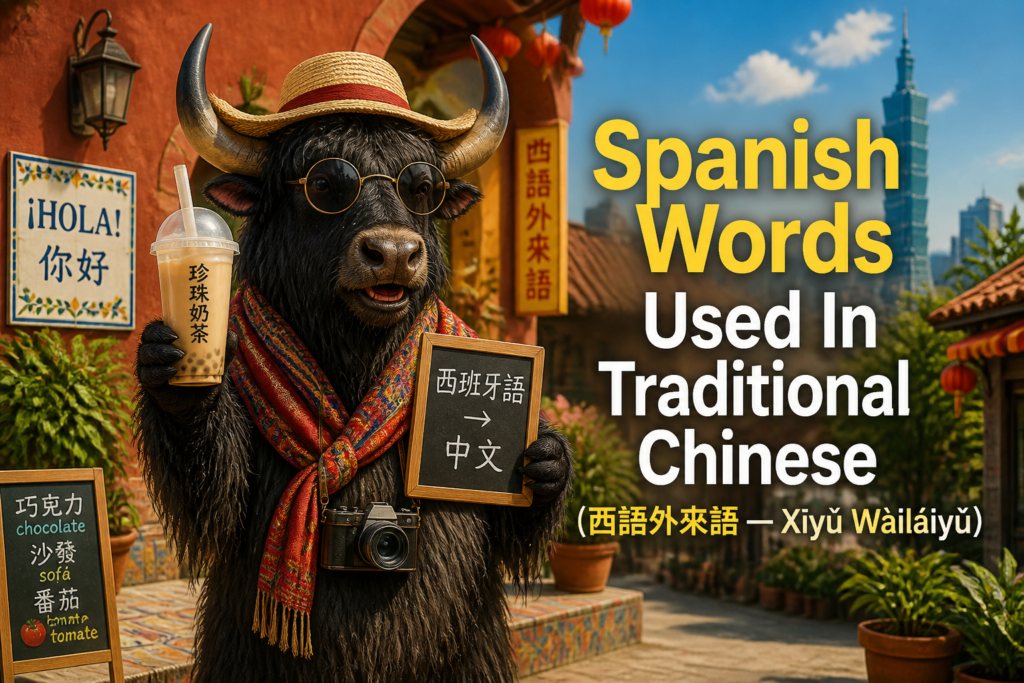
西語外來語(Xīyǔ wàiláiyǔ)are Spanish-origin words and names that have entered Traditional Chinese through food, culture, history, pop music, and travel. Some are obvious, like 巧克力(qiǎokèlì)and 咖啡(kāfēi)through older borrowing routes; others are newer and more direct, especially place names, foods, and cultural terms.
For the broader learning path, visit our parent guide.
Good news: you do not need to be a language detective with a tiny magnifying glass to spot them. Once you know a few patterns, Spanish loans in Traditional Chinese start looking less mysterious and more like normal vocabulary wearing a foreign hat.
In Taiwan, you will often see Spanish words in travel writing, food menus, geography, and conversations about Latin America or Spain. If you want a boring-but-useful reference point for learning vocabulary patterns, the Traditional Chinese vocabulary test can help you check what you already know and what still slips through your fingers.
Why Spanish Words Show Up In Traditional Chinese
Spanish entered Chinese mostly through contact with the Spanish-speaking world: trade, missionary history, food culture, migration, sports, and modern media. Some words stayed close to the original sound. Others were adapted to sound natural in Mandarin. That is normal. Languages are messy little creatures.
One useful habit: do not assume a borrowed word in Chinese will look anything like the original spelling. Chinese usually borrows sound, not letters. So the same Spanish idea can appear as a transliteration, a translated meaning, or a Chinese word that came through another language first. Fun, right? Slightly annoying, but fun.
Core Spanish Loanword Patterns
Here are the main patterns you will meet in Traditional Chinese. The examples below focus on words learners are actually likely to see, hear, or need.
| Traditional Chinese | Pinyin | Meaning | Example (ZH) | Example (Pinyin) | Translation (EN) |
|---|---|---|---|---|---|
| 墨西哥 | Mòxīgē | Mexico | 我想去墨西哥旅遊。 | Wǒ xiǎng qù Mòxīgē lǚyóu. | I want to travel to Mexico. |
| 西班牙 | Xībānyá | Spain | 我朋友在西班牙念書。 | Wǒ péngyǒu zài Xībānyá niànshū. | My friend studies in Spain. |
| 番茄 | fānqié | tomato | 這個義大利麵加了很多番茄。 | Zhège yìdàlì miàn jiā le hěn duō fānqié. | This pasta has lots of tomato. |
| 巧克力 | qiǎokèlì | chocolate | 她最喜歡巧克力蛋糕。 | Tā zuì xǐhuān qiǎokèlì dàngāo. | She likes chocolate cake the most. |
| 咖啡 | kāfēi | coffee | 我早上一定要喝一杯咖啡。 | Wǒ zǎoshang yīdìng yào hē yī bēi kāfēi. | I have to drink a cup of coffee in the morning. |
| 芒果 | mángguǒ | mango | 夏天我很愛吃芒果冰。 | Xiàtiān wǒ hěn ài chī mángguǒ bīng. | In summer, I really love mango shaved ice. |
| 香蕉 | xiāngjiāo | banana | 超市裡的香蕉很便宜。 | Chāoshì lǐ de xiāngjiāo hěn piányi. | The bananas in the supermarket are very cheap. |
| 玉米 | yùmǐ | corn | 我在夜市買了烤玉米。 | Wǒ zài yèshì mǎi le kǎo yùmǐ. | I bought grilled corn at the night market. |
| 可可 | kěkě | cocoa | 這杯熱可可是晚上喝的。 | Zhè bēi rè kěkě shì wǎnshang hē de. | This hot cocoa is for drinking at night. |
| 龍舌蘭 | lóngshélán | agave | 龍舌蘭是一種植物,也常和酒類文化一起出現。 | Lóngshélán shì yī zhǒng zhíwù, yě cháng hé jiǔlèi wénhuà yīqǐ chūxiàn. | Agave is a plant, and it often appears with alcohol culture too. |
Some of these are not direct Spanish borrowings in the strictest historical sense, but they are common in the Spanish-contact story of Traditional Chinese vocabulary. In other words: useful for learners, and that is what matters.
Everyday Food Words With Spanish Roots Or Spanish Connections
Food is where borrowed words love to hide. If you have ever ordered dessert in a café in Taipei, you have probably met a few already.
| Traditional Chinese | Pinyin | Meaning | Example (ZH) | Example (Pinyin) | Translation (EN) |
|---|---|---|---|---|---|
| 番茄 | fānqié | tomato | 番茄炒蛋是很常見的家常菜。 | Fānqié chǎo dàn shì hěn chángjiàn de jiācháng cài. | Tomato scrambled eggs are a very common home-style dish. |
| 玉米 | yùmǐ | corn | 這家店的玉米濃湯很受歡迎。 | Zhè jiā diàn de yùmǐ nóngtāng hěn shòu huānyíng. | This shop’s corn soup is very popular. |
| 芒果 | mángguǒ | mango | 芒果冰是夏天的救星。 | Mángguǒ bīng shì xiàtiān de jiùxīng. | Mango shaved ice is a summer lifesaver. |
| 巧克力 | qiǎokèlì | chocolate | 這盒巧克力看起來很高級。 | Zhè hé qiǎokèlì kàn qǐlái hěn gāojí. | This box of chocolate looks fancy. |
| 咖啡 | kāfēi | coffee | 你要黑咖啡還是拿鐵? | Nǐ yào hēi kāfēi háishì nátiě? | Do you want black coffee or latte? |
| 可可 | kěkě | cocoa | 我弟弟很喜歡可可牛奶。 | Wǒ dìdi hěn xǐhuān kěkě niúnǎi. | My younger brother likes cocoa milk a lot. |
| 香蕉 | xiāngjiāo | banana | 早餐我吃香蕉和優格。 | Zǎocān wǒ chī xiāngjiāo hé yōugé. | For breakfast, I eat a banana and yogurt. |
| 檸檬 | níngméng | lemon | 我喜歡檸檬紅茶。 | Wǒ xǐhuān níngméng hóngchá. | I like lemon black tea. |
Quick note: 番茄(fānqié)is a good example of how Chinese often borrowed a foreign crop name and made it feel native. If you only know one thing from this article, let it be this: borrowed words do not always look borrowed. Sneaky little things.
Place Names And Cultural Names You Will See Often
Spanish place names in Chinese are usually transliterations. Once you learn the pattern, you can guess a lot faster, even if you do not know Spanish yet. Not perfectly, but enough to stop feeling personally attacked by every unfamiliar city name.
| Traditional Chinese | Pinyin | Meaning | Example (ZH) | Example (Pinyin) | Translation (EN) |
|---|---|---|---|---|---|
| 墨西哥 | Mòxīgē | Mexico | 墨西哥的食物很有特色。 | Mòxīgē de shíwù hěn yǒu tèsè. | Mexican food has a lot of character. |
| 巴拿馬 | Bānámǎ | Panama | 巴拿馬運河很有名。 | Bānámǎ Yùnhé hěn yǒumíng. | The Panama Canal is very famous. |
| 古巴 | Gǔbā | Cuba | 我在新聞上看到古巴的消息。 | Wǒ zài xīnwén shàng kàn dào Gǔbā de xiāoxī. | I saw news about Cuba. |
| 阿根廷 | Āgēntíng | Argentina | 阿根廷足球很強。 | Āgēntíng zúqiú hěn qiáng. | Argentinian soccer is very strong. |
| 西班牙 | Xībānyá | Spain | 西班牙菜很適合慢慢吃。 | Xībānyá cài hěn shìhé mànman chī. | Spanish food is perfect for eating slowly. |
| 拉丁美洲 | Lādīng Měizhōu | Latin America | 拉丁美洲音樂很有節奏感。 | Lādīng Měizhōu yīnyuè hěn yǒu jiézòugǎn. | Latin American music has a strong rhythm. |
Useful Phrases For Talking About Spanish Words In Chinese
These phrases help when you want to describe where a word comes from, ask about pronunciation, or talk about food and culture.
| Traditional Chinese | Pinyin | Meaning | Example (ZH) | Example (Pinyin) | Translation (EN) |
|---|---|---|---|---|---|
| 外來語 | wàiláiyǔ | loanword | 這個字是外來語嗎? | Zhège zì shì wàiláiyǔ ma? | Is this word a loanword? |
| 音譯 | yīnyì | transliteration | 這個名字是音譯的。 | Zhège míngzi shì yīnyì de. | This name is transliterated. |
| 借詞 | jiècí | borrowed word | 中文裡有很多借詞。 | Zhōngwén lǐ yǒu hěn duō jiècí. | Chinese has many borrowed words. |
| 西班牙文 | Xībānyáwén | Spanish language | 我只會一點西班牙文。 | Wǒ zhǐ huì yīdiǎn Xībānyáwén. | I only know a little Spanish. |
| 西語 | Xīyǔ | Spanish language; Spanish-related | 這家餐廳有很多西語菜單。 | Zhè jiā cāntīng yǒu hěn duō Xīyǔ càidān. | This restaurant has many Spanish menus. |
| 發音 | fāyīn | pronunciation | 這個詞的發音不難。 | Zhège cí de fāyīn bù nán. | This word’s pronunciation is not hard. |
| 拼音 | pīnyīn | pinyin | 請看拼音再念一次。 | Qǐng kàn pīnyīn zài niàn yīcì. | Please look at the pinyin and say it again. |
| 意思 | yìsi | meaning | 這個字的意思是什麼? | Zhège zì de yìsi shì shénme? | What does this word mean? |
| 菜單 | càidān | menu | 菜單上有很多西語名字。 | Càidān shàng yǒu hěn duō Xīyǔ míngzi. | There are many Spanish names on the menu. |
| 口音 | kǒuyīn | accent | 他的西班牙口音很明顯。 | Tā de Xībānyá kǒuyīn hěn míngxiǎn. | His Spanish accent is very noticeable. |
If you want a structured way to review language topics like this, the Traditional Chinese placement test is a handy place to start. Yes, tests. The glamorous life of vocabulary learning continues.
How These Words Change When They Enter Chinese
Spanish words usually change in one of three ways when they enter Traditional Chinese:
- Sound-based borrowing: the Chinese form copies the sound of the original word as closely as possible.
- Meaning-based borrowing: Chinese uses a native word for the concept instead of copying the sound.
- Mixed borrowing: part sound, part meaning, part “good enough, let’s move on.”
Example of sound-based borrowing: 墨西哥(Mòxīgē)for Mexico. The spelling is Chinese, but the sound tries to match the original place name.
Example of meaning-based borrowing: 番茄(fānqié)for tomato in modern Chinese usage. The word is fully naturalized, so most learners do not think about its historical route.
Example of mixed borrowing: some food and cultural terms became fixed Chinese words after passing through other languages and different regions. That is why etymology can feel like assembling furniture with half the screws missing.
Pronunciation Notes That Actually Help
Spanish has a different sound system from Mandarin, so Chinese transliterations are approximate. Do not try to force a perfect Spanish pronunciation from the Chinese spelling. It will only make your eyebrows tired.
| Chinese Word | Pinyin | Helpful Note | Example |
|---|---|---|---|
| 西班牙 | Xībānyá | Three syllables; the yá is light and not stressed heavily. | 我在學西班牙文。 |
| 墨西哥 | Mòxīgē | Three syllables; keep all tones clear and even. | 墨西哥在北美洲。 |
| 巧克力 | qiǎokèlì | Common everyday word; say it smoothly, not like three separate robots. | 巧克力很好吃。 |
| 番茄 | fānqié | The first syllable is high and level, the second rises. | 番茄蛋花湯很好喝。 |
Taiwan Usage And Learner Traps
In Taiwan, many Spanish-connected words appear in travel, food, and education contexts. But there are also a few traps for learners:
- Do not confuse borrowed words with native Chinese words. For example, 番茄 means tomato, but it does not look obviously foreign anymore.
- Do not expect one-to-one spelling. A Spanish name in Chinese may look far from the original spelling.
- Do not overthink every syllable. Some transliterations are based on older pronunciation habits.
- Do not assume Mainland and Taiwan usage is always identical. In Taiwan, you may hear slightly different preferred terms in media or education, especially in names and transliterations.
For a broader comparison of how foreign words behave across languages, you can also check the related guide on English Words In Traditional Chinese or the companion article on French Words Used In Traditional Chinese.
Mini Practice: Spot The Borrowed Word
Try to identify the Spanish-linked or Spanish-origin word in each sentence. Then check the meaning. Small wins count. Vocabulary learning is basically a very patient treasure hunt.
| Traditional Chinese | Pinyin | English |
|---|---|---|
| 我早餐喝咖啡,午餐吃番茄炒蛋。 | Wǒ zǎocān hē kāfēi, wǔcān chī fānqié chǎo dàn. | I drink coffee for breakfast and eat tomato scrambled eggs for lunch. |
| 她在墨西哥工作過。 | Tā zài Mòxīgē gōngzuò guò. | She has worked in Mexico before. |
| 我們買了芒果和香蕉。 | Wǒmen mǎi le mángguǒ hé xiāngjiāo. | We bought mangoes and bananas. |
| 這杯熱可可很香。 | Zhè bēi rè kěkě hěn xiāng. | This cup of hot cocoa smells great. |
Challenge: say each sentence once naturally, then again with a little more speed. If your tongue trips, congratulations — it is learning.
Quick Reference Summary
- Spanish-related names in Chinese are often transliterations: 西班牙(Xībānyá), 墨西哥(Mòxīgē).
- Food words are where many learners meet loanwords first: 番茄(fānqié), 咖啡(kāfēi), 巧克力(qiǎokèlì), 芒果(mángguǒ).
- Borrowed words may not look “foreign” anymore after long use.
- Chinese spelling shows sound, not original spelling.
- Taiwan usage often keeps these words very natural in daily speech, menus, travel writing, and media.
For learners who like sorting vocabulary by level, the TOCFL-style placement test can help organize what you know into something less chaotic than a notebook full of random words and hope.
Yak Takeaway: Spanish words in Traditional Chinese are not just “foreign words.” They are living vocabulary pieces that show how Chinese adapts sound, meaning, and culture. Learn a few common ones, and suddenly menus, maps, and travel articles stop looking like they are written in secret code.