This B1 Intermediate retelling of Un perro andaluz keeps the plot clear for learners while still giving the story some atmosphere and momentum. Una noche de verano, un hombre llamado Luis soñó con una nube afilada que cortaba la luna. En la penumbra, vio a una mujer de pie junto a su cama.
This version teaches Spanish through English and includes clickable word help inside the story, full story audio, and lesson notes after the reading. It is free to use on Yak Yacker and is designed to feel natural, readable, and manageable for learners.
Una noche de verano, un hombre llamado Luis soñó con una que la luna.
Se despertó . En la , vio a una mujer de pie junto a su cama.
-No tengas miedo -dijo ella con una -. Soy un sueño, pero también soy real.
Luis se los ojos. -Si eres un sueño, ¿cómo es que puedo ?
-En este , los sueños y la realidad se -respondió ella-. Mira tu mano.
Luis bajó la mirada y vio saliendo de un en la palma de su mano.
-¡Qué ! -exclamó-. ¿Por qué hay hormigas?
-Porque -dijo la mujer-. y te mostraré más.
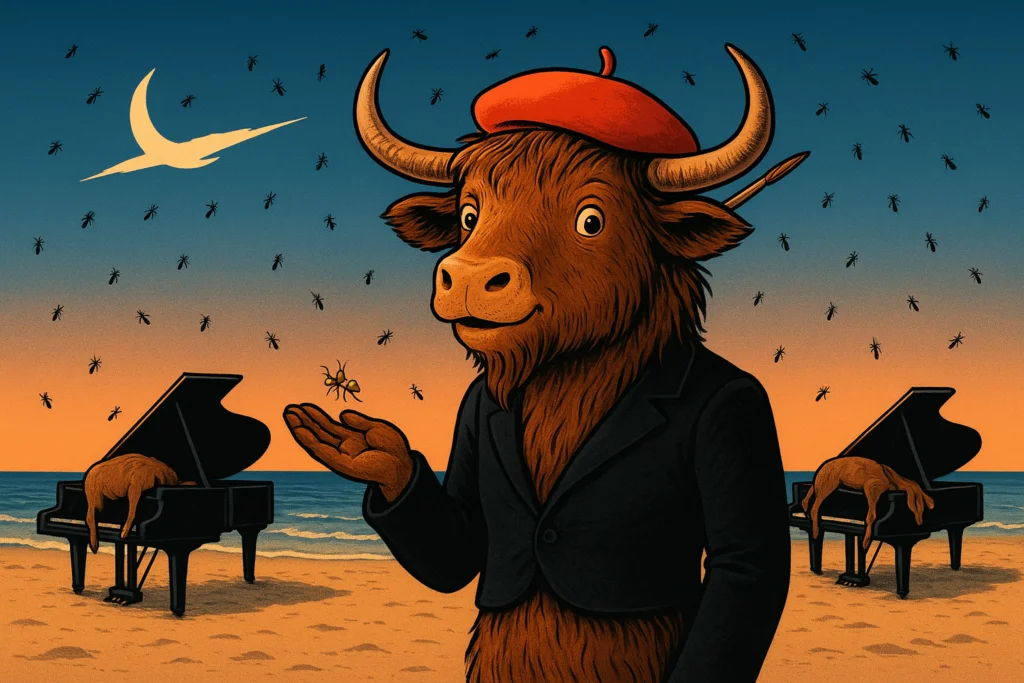
Lo llevó a una . Allí, dos estaban enterrados en la arena, con burros muertos encima.
-Esto es -dijo Luis-. Los pianos no están en la playa.
-Todo es en este mundo -sonrió ella-. Ahora dime, ¿qué es lo que más ?
Luis un momento. -Desearía que esto fuera real, que tú fueras real.
La mujer lo miró con . -Yo soy tan real como tú quieras que sea. Pero debes las cosas extrañas.
De repente, el cielo se y empezó a llover . Luis y la mujer rieron juntos bajo la lluvia.
Luego, Luis se despertó. Estaba solo en su cama, pero en su mano encontró una pequeña .
Sonrió. Tal vez los sueños no eran tan después de todo.
One summer night, a man named Luis dreamed of a sharp cloud cutting the moon.
He woke up startled. In the dim light, he saw a woman standing by his bed.
"Don't be afraid," she said in a soft voice. "I am a dream, but I am also real."
Luis rubbed his eyes. "If you're a dream, how can I talk to you?"
"In this place, dreams and reality blend together," she replied. "Look at your hand."
Luis looked down and saw ants coming out of a hole in his palm.
"How strange!" he exclaimed. "Why are there ants?"
"Because you keep secrets," the woman said. "Come with me and I'll show you more."
She took him to a deserted beach. There, two grand pianos were buried in the sand, with dead donkeys on top.
"This is absurd," Luis said. "Pianos aren't on the beach."
"Anything is possible in this world," she smiled. "Now tell me, what do you desire most?"
Luis thought for a moment. "I wish this were real, that you were real."
The woman looked at him tenderly. "I am as real as you want me to be. But you must accept strange things."
Suddenly, the sky darkened and it began to rain tiny ants. Luis and the woman laughed together under the rain.
Then Luis woke up. He was alone in his bed, but in his hand he found a small golden ant.
He smiled. Perhaps dreams weren't so unreal after all.
The story mixes ordinary words with surreal images. Let’s explore some key vocabulary so you can describe your own strange dreams. Pay attention to how these words appear in the narrative—they’ll help you build vivid scenes in Spanish.
Here are the essential terms, with their English equivalents and a bit of context from the story.
- el sueño / la realidad – dream / reality; central to the surrealist theme (-los sueños y la realidad se mezclan-).
- la nube afilada – sharp cloud; notice how -afilado/a- adds an unsettling edge to something normally soft.
- sobresaltado/a – startled, jolted awake; describes Luis’s sudden awakening (-se despertó sobresaltado-).
- la penumbra – dim light, half-darkness; sets the mysterious mood.
- las hormigas – ants; from the famous surrealist image, and later -llover hormigas diminutas- (to rain tiny ants).
- el agujero en la palma – hole in the palm; a creepy detail that reveals hidden secrets.
- los pianos de cola – grand pianos; surprising objects on the beach, -enterrados en la arena- (buried in the sand).
- absurdo/a – absurd; Luis exclaims -¡Esto es absurdo!-, perfectly capturing the dream logic.
- desear – to wish; used in the conditional/subjunctive pattern -desearía que… fuera real-.
- dorado/a – golden; the lingering trace of the dream, -una pequeña hormiga dorada-.
The story plays with the boundaries between reality and desire. Spanish uses the subjunctive and conditional to express exactly these shades of meaning. Notice two key moments: Luis’s wish (-Desearía que esto fuera real-) and the woman’s open-ended condition (-Yo soy tan real como tú quieras que sea-).
The pattern -desearía que + imperfect subjunctive- is a soft, polite way to express a wish about the present or future. You can use it for realistic or fanciful desires: -Desearía que no lloviera- (I wish it weren’t raining) or, as in the story, -Desearía que esto fuera real-. The imperfect subjunctive -fuera- (from ser) signals that the wish is contrary to current reality—exactly the dream logic!
- Conditional + que + imperfect subjunctive: -Desearía que tú fueras real- → I would want you to be real (but you’re not… yet).
- -Como tú quieras- uses the present subjunctive after -como- to mean -as you want / in whichever way you want-. It keeps the reality flexible: -soy real en la medida en que tú lo desees-.
- Try creating your own dream-wish sentences: -Soñé que volaba y deseé que nunca terminara el sueño.-
- Compare with a simple conditional: -Sería feliz si esto fuera real.- (I would be happy if this were real.)
The backbone of any Spanish narrative is the interplay between the preterite (for completed actions) and the imperfect (for descriptions, ongoing states, and setting the scene). In this surreal story, that contrast is especially effective: sudden, strange events punch through a hazy, dreamlike background.
Notice how the opening sets the scene with imperfect: -Era una noche de verano- (It was a summer night). Then the preterite kicks in for the action: -Un hombre… soñó- (dreamed), -se despertó- (woke up). Throughout the story, the preterite moves the plot forward, while the imperfect paints the atmosphere: -En la penumbra, vio a una mujer- (preterite: he saw) but the penumbra itself was already there.
- Imperfect for backdrop: -era-, -estaba-, -había- → -En la playa desierta había dos pianos enterrados.-
- Preterite for plot progression: -la llevó-, -dijo-, -sonrió- → -Luis y la mujer rieron juntos.-
- When describing dreams or surreal scenes, use imperfect to make the strange feel continuous and immersive: -Caían hormigas del cielo, era todo oscuro.-
- Practice: describe a dream where something normal slowly turns bizarre. Start with -Era un día normal…- and then let a preterite action disrupt it.
Surrealism thrives on unexpected combinations. Now that you have the vocabulary and grammar, try creating your own oneiric micro-story. Start with a familiar setting, then introduce an absurd element. Use the imperfect to establish the mood, and the preterite to make things happen. Throw in a wish or two with the subjunctive.
Reading and listening to more Spanish-language surrealism—like Cortázar’s short stories or Dalí’s interviews—will deepen your feel for this playful use of the language. And if you wake up with a golden ant in your hand… well, you’ll know what to say.
- Write three sentences about a dream using at least one vocabulary word from Section 1.
- Try a -desearía que…- wish based on your dream.
- Share your surreal scene with a friend or tutor and see if it makes them smile—or shiver.
Un perro andaluz comes from an older public-domain story tradition and is best known as a public_domain_story_retelling. This Yak Yacker article is an original learner retelling based on public-domain source material, so the wording here is simplified for modern learners rather than copied from one old edition.
Older printings, translations, and retellings of this story can vary quite a bit. This version is adapted for B1 Intermediate learners studying Spanish.
If you want to keep going, browse more in our Spanish section and review the DELE B1 Vocabulary List. After that, try Spanish Gender Rules for Nouns and Adjectives for another useful next step.