Meet María, a kind-hearted girl who discovers a mysterious singing flower deep in the forest. This magical bloom only shares its song with those who carry goodness in their hearts. But when a proud and selfish prince hears of its melody, he demands the flower for himself. Can the flower's gentle song change his heart? This A2 Elementary Spanish graded reader is a delightful retelling of a classic fairy tale, crafted especially for adult learners.
In this free interactive story, you'll read or listen to 'La Flor Cantante' entirely in Spanish. Every word is clickable for instant translations, so you can understand without ever leaving the page. Plus, we've added full story audio recorded by a native Spanish speaker, along with bite-sized lesson notes that highlight key vocabulary, grammar patterns, and culture points. It's a complete learning experience wrapped in a charming tale.
Lola vive en un cerca de un . Hoy ella está muy porque su abuela está .
Lola al bosque para flores. De repente, una canción dulce. Es una que canta.
La flor es una flor cantante. Lola le dice: '¡Hola, flor bonita! ¿Por qué ?' La flor responde: ' porque estoy . El sol me da y el agua me da .'
Lola sonríe. La música de la flor es . Ella trae agua del río y la flor. 'Con , siempre vas a estar contenta', dice Lola.
Al día siguiente, Lola la flor otra vez, pero la flor no canta. Está y . Lola pregunta: '¿Qué pasa, pequeña flor?'
La flor dice: 'Estoy . Cantar sola no es divertido. Necesito un .' Lola piensa y luego a casa. Regresa con su amigo Tomás.
Tomás trae su guitarra y una canción. La flor a cantar otra vez. Los tres están muy . Esa noche, la abuela de Lola se siente mejor y escucha la historia. Todos y la flor sigue cantando.
Lola lives in a small town near a green forest. She's very sad today because her grandma is sick.
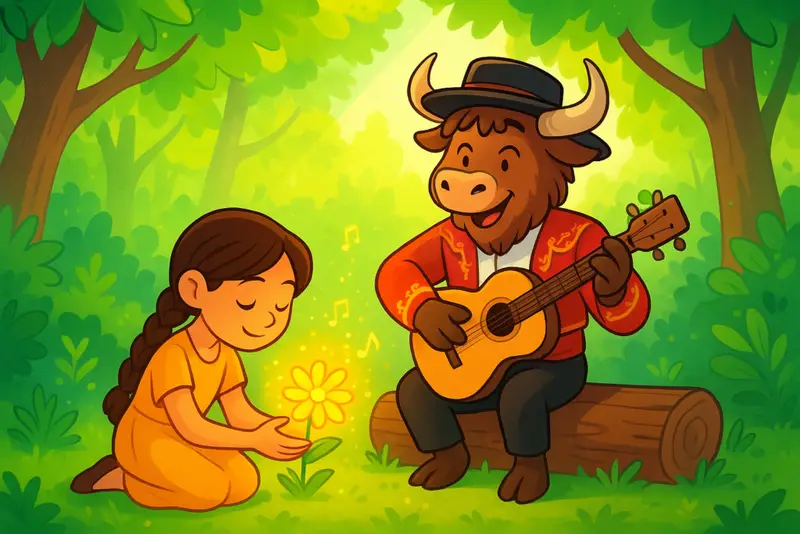
Lola walks to the forest seeking flowers. Suddenly, she hears a sweet song: a small yellow flower is singing.
The flower is a singing flower. Lola asks, "Hello, pretty flower! Why do you sing?" It answers, "I sing because I'm happy. The sun gives me warmth and the water gives me strength."
Lola smiles. The flower's music is magical. She fetches water from the river and waters it. "With care, you'll always be happy," she says.
Next day, Lola visits again, but the flower is silent and sad. "What's wrong, little flower?" she asks.
The flower says, "I'm lonely. Singing alone is no fun. I need a friend." Lola thinks, runs home, and returns with her friend Tomás.
Tomás brings his guitar and plays. The flower sings again. All three are happy. That night, Lola's grandma feels better, hears the story. Everyone laughs and the flower keeps singing.
In the story, you met words for feelings and moods. Recognizing these helps you express yourself in everyday Spanish.
Let’s look at the key words: *triste* (sad), *contento/a* (happy/content), *feliz* (happy), *solitaria* (lonely). Notice that *contento/a* changes ending based on who feels it – *contento* for males, *contenta* for females. *Feliz* stays the same for both.
- *Lola está triste.* (Lola is sad.)
- *La flor está contenta.* (The flower is happy/content.)
- *Los tres están felices.* (The three are happy.)
- *La flor se siente solitaria.* (The flower feels lonely.)
This story is packed with common Spanish verbs that you'll use constantly. Pay attention to how they appear in the present tense.
You saw *camina* (she walks), *buscar* (to look for), *escucha* (she hears), *canta* (she sings), *dice* (she says), *trae* (she brings), *riega* (she waters), and many more. Most follow regular patterns, like *cantar → canta* or *visitar → visita*.
- *Lola camina al bosque.* (Lola walks to the forest.)
- *La flor canta una canción dulce.* (The flower sings a sweet song.)
- *Ella trae agua del río.* (She brings water from the river.)
- *Tomás toca la guitarra.* (Tomás plays the guitar.)
In Spanish, adjectives usually come after nouns and must match in gender and number. The story shows this clearly.
For example: *un pequeño pueblo* (a small town) – both masculine singular. *Una flor amarilla* – both feminine singular. When it's plural: *mágica* becomes *mágicas*, *feliz* becomes *felices*.
- *un bosque verde* (a green forest) – masculine singular.
- *una flor bonita* (a pretty flower) – feminine singular.
- *los tres están muy felices* (the three are very happy) – plural.
- Practice: try describing your own objects, like *un libro rojo* or *una casa blanca*.
Re-reading is magic. Each time you go back, you'll notice patterns and absorb vocabulary without drilling. Can you retell the story in your own words? Even a simple version counts!
Try changing a few details: What if Lola brought water every day? What if the flower asked for music? Make it yours — and let the verbs and feelings stick.
- Read the story aloud to hear the rhythm.
- Highlight all the emotion words you find.
- Write two new sentences using *porque* and a feeling.
- Next time you feel *contento* or *triste*, say it in Spanish — even just to yourself!
La Flor Cantante comes from an older public-domain story tradition and is best known as a public_domain_fairy_tale_retelling. This Yak Yacker article is an original learner retelling based on public-domain source material, so the wording here is simplified for modern learners rather than copied from one old edition.
Older printings, translations, and retellings of this story can vary quite a bit. This version is adapted for A2 Elementary learners studying Spanish.
If you want to keep going, browse more in our Spanish section and review the A2 Spanish Vocabulary List. After that, try Essential Spanish Grammar Words for another useful next step.