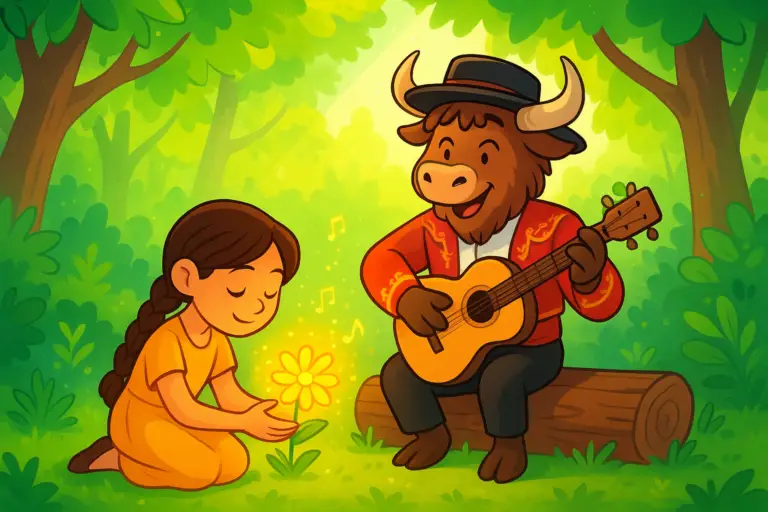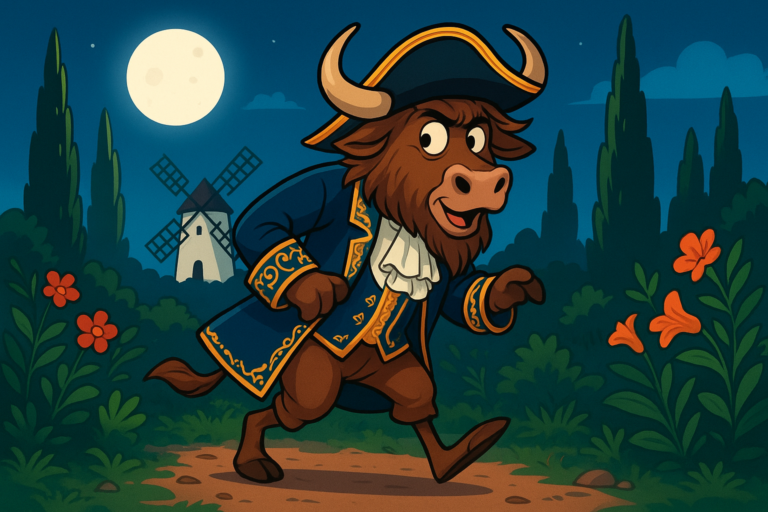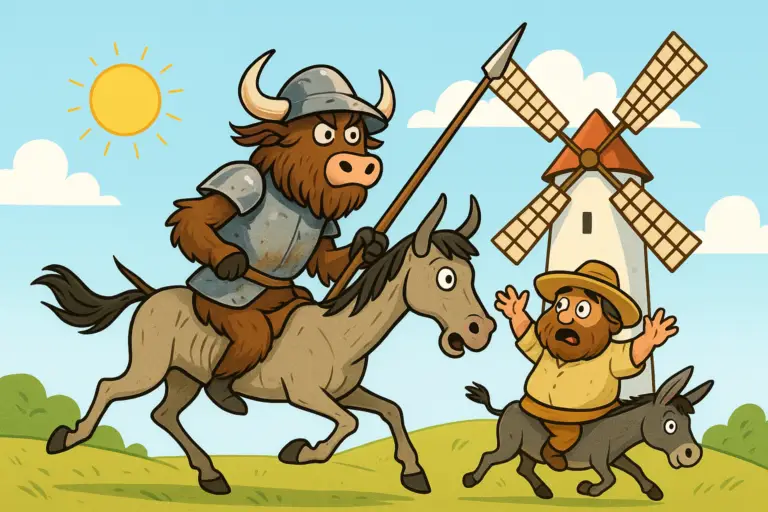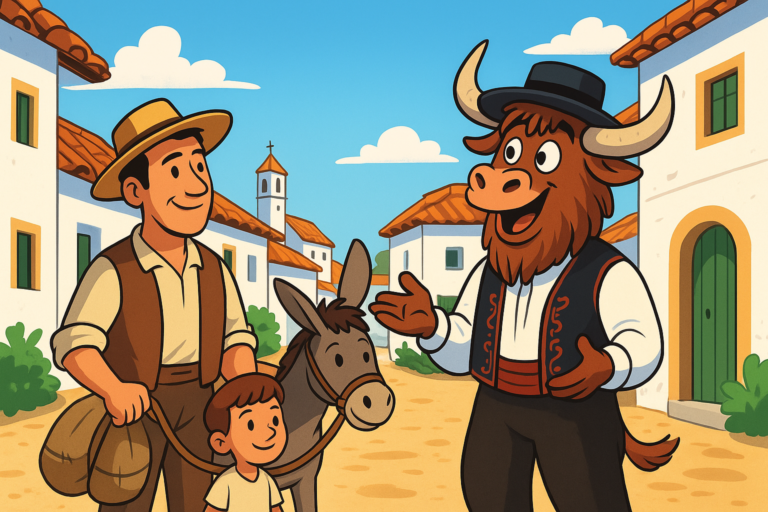
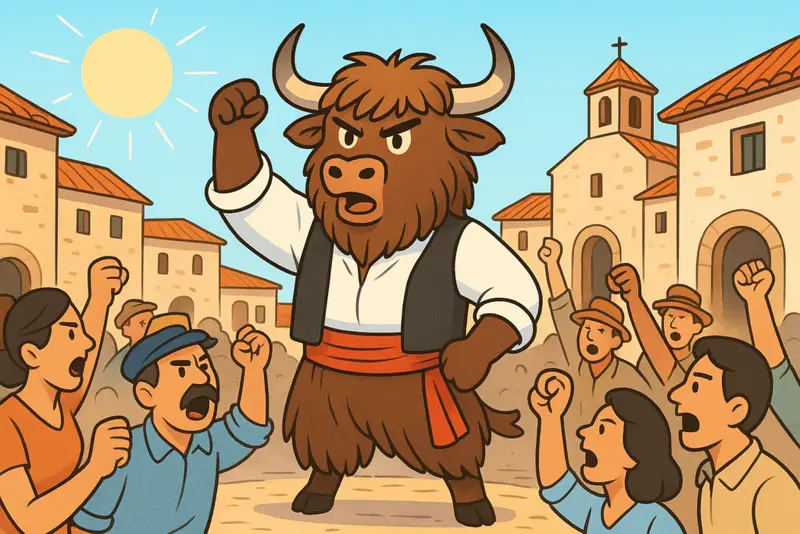
Step into the world of Fuenteovejuna, a timeless Spanish story about a village that rises against oppression. This B1 intermediate retelling lets you enjoy the drama of Lope de Vega's classic play in simpler Spanish, while improving your reading and listening skills. You can also listen to the full story audio on Yak Yacker.
You'll follow the villagers as they confront the cruel Commander, learning key vocabulary like "pueblo" (village), "justicia" (justice), and "libertad" (freedom) along the way. The story is fully narrated, so you can read and listen at the same time-perfect for building your Spanish confidence.
Every word is clickable for instant definitions, and the free lesson notes help you understand the grammar and context. Just relax, press play, and let the story teach you.
Fuenteovejuna era un y en las de Córdoba.
Sus habitantes vivían de la y la , y se unos a otros con alegría.
Todos al alcalde Esteban y a su hija Laurencia, una joven y .
Pero la paz del pueblo se con frecuencia por culpa del comendador Fernán Gómez.
Él era un noble poderoso que su autoridad sin ningún por los campesinos.
Entraba en el pueblo con sus soldados, se las y a los hombres.
Un día, mientras las mujeres lavaban en el río, el comendador a Laurencia.
-Eres la flor más bella de este lugar -le dijo con una -. .
Laurencia le respondió con : -Mi lugar está aquí, con mi gente.
El comendador se mucho y quiso , pero en ese momento llegó Frondoso.
Frondoso era un joven , Laurencia, y llevaba una .
-¡, señor! -gritó al comendador-. No le haga daño a ella.
Sorprendido, el comendador a Laurencia y se marchó riéndose, pero con una .
-Ya lo , pastor -dijo mientras se alejaba con sus hombres.
Frondoso y Laurencia se miraron con . Él le su amor y ella aceptó.
Pero la alegría duró poco. Esa noche, el comendador volvió al pueblo con más soldados.
Entró en la casa del alcalde, a Esteban y se llevó a Frondoso a .
-¡A ver quién te ahora! -se burló, y lo en la plaza delante de todos.
El pueblo entero sintió la . Los hombres , las mujeres lloraban.
Después de aquella noche terrible, los vecinos se en secreto en la casa del alcalde.
-Ya no podemos más -dijo Esteban-. Pero ¿qué podemos hacer contra sus armas?
-¡! -gritó una voz desde la puerta. Era Laurencia, con el rostro cubierto de lágrimas y rabia.
-¡Mirad lo que ha hecho con nuestro pueblo! ¿Sois hombres o qué? ¡Yo misma iré !
Sus palabras los corazones. Las mujeres tomaron palos y cuchillos, los hombres hoces y lanzas.
Todos juntos hacia el palacio del comendador. No había .
Gritaban: -¡Viva Fuenteovejuna! ¡Muerte al !
Los soldados, al ver aquella , huyeron. El comendador quedó solo.
-¡! -imploró-. ¡Os daré todo lo que pidáis!
Pero el pueblo recordaba cada insulto, cada golpe. No hubo .
Entre todos lo mataron. No fue uno solo, sino la entera.
Cuando al día siguiente llegó el enviado por los Reyes Católicos, el silencio lo cubría todo.
-¿Quién mató al comendador? -preguntaba una y otra vez a todos los vecinos.
-Fuenteovejuna, señor -respondían uno a uno, sin revelar un .
Los niños también decían: -Fuenteovejuna lo hizo.
El pesquisidor se . , pero todos mantenían la misma respuesta.
Finalmente, los Reyes Católicos, al conocer la historia de , al pueblo.
Fuenteovejuna volvió a ser un lugar tranquilo. Y desde entonces, cuando alguien preguntaba por algún , la respuesta era siempre la misma: -Fuenteovejuna lo hizo.
Y esa frase quedó para siempre como de la fuerza de la .
Fuenteovejuna was a small, peaceful village in the mountains of Córdoba.
Its inhabitants lived off farming and livestock, helping each other joyfully.
Everyone respected Mayor Esteban and his daughter Laurencia, a brave and determined young woman.
But the village's peace was often broken by Commander Fernán Gómez.
He was a powerful noble who abused his authority without any respect for the peasants.
He would enter the village with his soldiers, seize harvests, and humiliate the men.
One day, while women were washing at the river, the Commander approached Laurencia.
"You are the most beautiful flower in this place," he said with a fake smile. "You should accompany me."
Laurencia firmly replied, "My place is here, with my people."
The Commander became very angry and tried to grab her, but just then Frondoso arrived.
Frondoso was a young shepherd, in love with Laurencia, carrying a crossbow.
"Let her go, sir!" he shouted, aiming at the Commander. "Don't hurt her."
Surprised, the Commander released Laurencia and left laughing, but with a threat.
"You'll pay for this, shepherd," he said as he rode off with his men.
Frondoso and Laurencia looked at each other gratefully. He confessed his love, and she accepted.
But the joy was short-lived. That night, the Commander returned with more soldiers.
He entered the mayor's house, beat Esteban, and dragged Frondoso away.
"Now let's see who saves you!" he mocked, and whipped him in the square in front of everyone.
The whole village felt the humiliation. Men clenched their fists, women wept.
After that terrible night, the neighbors secretly gathered at the mayor's house.
"We can no longer endure these abuses," said Esteban. "But what can we do against his weapons?"
"Kill him!" cried a voice from the doorway. It was Laurencia, her face covered in tears and rage.
"Look what he has done to our village! Are you men or what? I myself will go against him!"
Her words ignited hearts. Women took up sticks and knives, men sickles and spears.
All together they marched to the Commander's palace. There was no turning back.
They shouted, "Long live Fuenteovejuna! Death to the tyrant!"
The soldiers, seeing that human tide, fled. The Commander was left alone.
"Mercy!" he begged. "I'll give you everything you ask!"
But the village remembered every insult, every blow. There was no forgiveness.
Together they killed him. It was not one person, but the whole community.
When the investigator sent by the Catholic Monarchs arrived the next day, silence covered everything.
"Who killed the Commander?" he asked again and again of all the residents.
"Fuenteovejuna, sir," they answered one by one, without revealing any individual name.
The children also said, "Fuenteovejuna did it."
The investigator despaired. He threatened torture, but everyone kept the same answer.
Finally, the Catholic Monarchs, upon learning the history of abuses, pardoned the village.
Fuenteovejuna became a peaceful place again. And from then on, whenever someone asked about a crime, the answer was always the same: "Fuenteovejuna did it."
And that phrase remained forever as a symbol of the strength of unity.
The story of Fuenteovejuna is full of expressive Spanish words. Let’s pull a few out of the tale so they become part of your active vocabulary. You don’t need to memorize them all, but noticing them in context will help them stick.
- comendador – a nobleman with command over a region, often abusing power like Fernán Gómez did.
- ballesta (crossbow) – Frondoso defended Laurencia with one; handy if you visit a medieval museum!
- humillar (to humiliate) – used in the imperfect (humillaba) to show repeated humiliation.
- unido/a (united) – the village became unida, a perfect adjective from the story’s theme.
Every great story moves through time, and Spanish has two past tenses that work together to paint scenes and drive the plot. In Fuenteovejuna, you saw them side by side. The imperfect (like era, vivían, humillaba) sets the background: what things were like, what people used to do, ongoing states. The preterite (like se acercó, gritó, mataron) pushes the action forward with completed events.
Compare: 'El comendador abusaba de su autoridad' (he habitually abused his authority) versus 'Se acercó a Laurencia' (he approached her in one specific moment). When you tell your own stories, use imperfect for the 'scenery' and preterite for the 'plot points'.
- Look for mientras (while) with imperfect, and then de repente (suddenly) with preterite in the story!
Beyond the language, the story carries a cultural gem. The phrase 'Fuenteovejuna lo hizo' means not one person, but the whole community, took action. It’s a powerful concept in Spanish-speaking cultures, where the name of a small town became a symbol of unity. When the pesquisidor interrogated everyone, their united reply became a linguistic milestone—a way to take shared responsibility and resist unjust authority. Even today, if a group accomplishes something together but no single person claims credit, you might hear: 'Ha sido obra de Fuenteovejuna.'
- The Spanish playwright Lope de Vega immortalized this event in his 1619 play, still studied across the Spanish-speaking world.
You’ve just traveled back in time, witnessed a rebellion, and encountered rich Spanish past tenses in context. The best way to make this language yours is to weave it into your own words. Try retelling a moment from Fuenteovejuna to a friend—describe the peaceful town (imperfect), then how the comendador’s arrival changed everything (preterite). Or think about a time your community came together, and tell that story mixing past tenses. Before you know it, you’ll be telling tales with the rhythm of a Spanish storyteller.
Fuenteovejuna comes from an older public-domain story tradition and is best known as a public_domain_story_retelling. This Yak Yacker article is an original learner retelling based on public-domain source material, so the wording here is simplified for modern learners rather than copied from one old edition.
Older printings, translations, and retellings of this story can vary quite a bit. This version is adapted for B1 Intermediate learners studying Spanish.
If you want to keep going, browse more in our Spanish section and review the B1 Spanish Vocabulary List. After that, try Spanish Subjunctive Phrases for another useful next step.