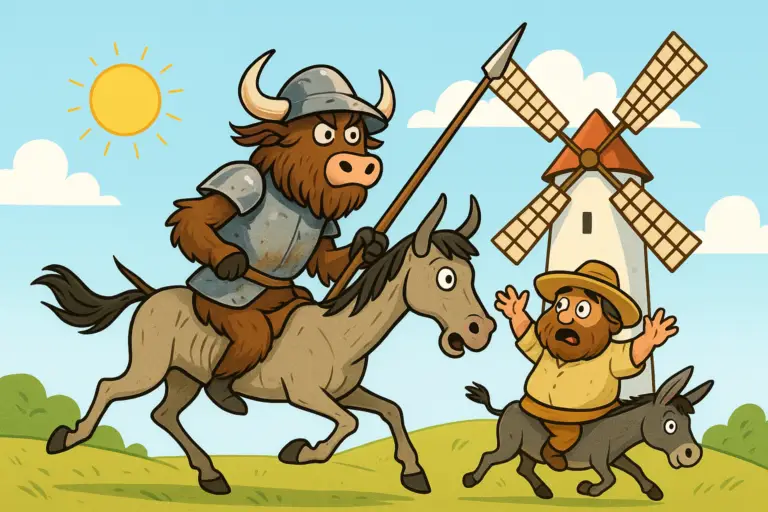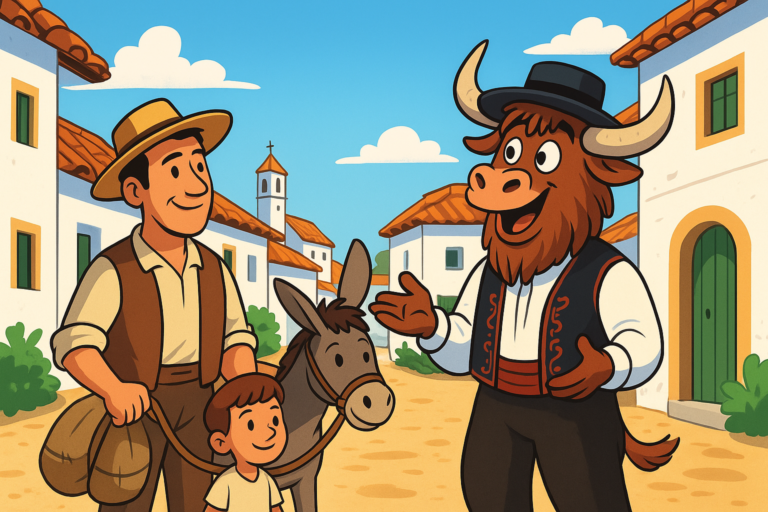
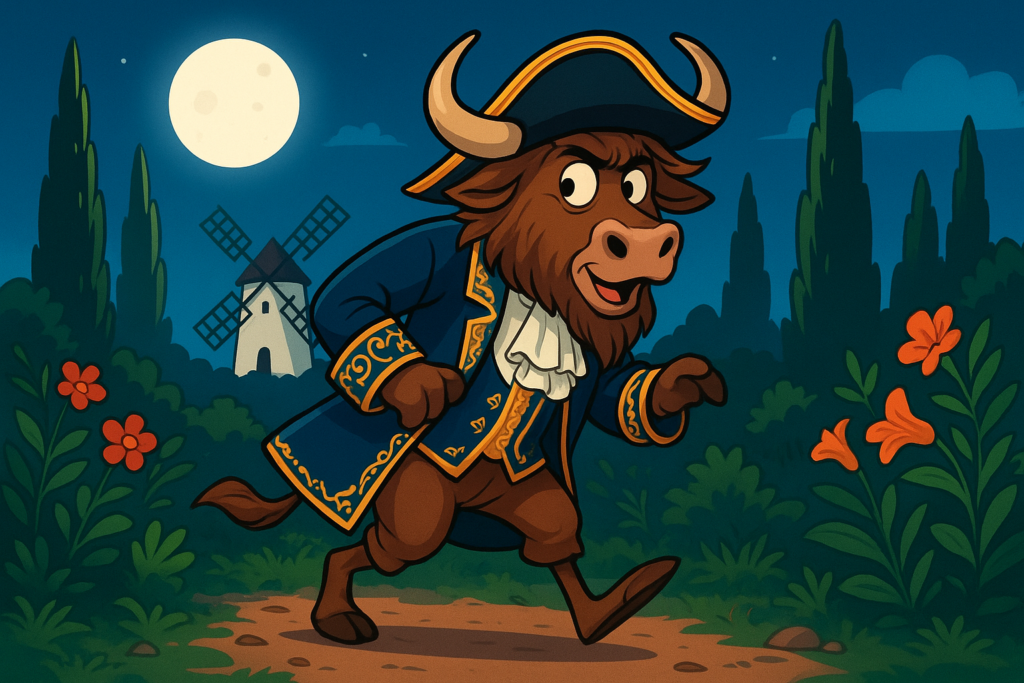
Welcome to this interactive Spanish graded reader featuring 'El sombrero de tres picos' (The Three-Cornered Hat), a classic tale from Spanish literature. At the heart of this humorous story are the clever miller's wife and the not-so-clever magistrate who gets his comeuppance. Set in a small mountain village, the plot twists around mistaken identity, a three-cornered hat, and a series of comic misunderstandings. It's a perfect story for Spanish learners who enjoy lively characters and a satisfying ending.
Throughout the text, you can click on any word to see its meaning instantly-no dictionaries needed. There's also story audio you can listen to while reading, plus free lesson notes that highlight key grammar and vocabulary. Everything is designed to help you read with confidence at the B1 intermediate level. Ready to dive in? Let the story begin!
En un pequeño pueblo de Andalucía, cerca de un río, había un molino viejo pero muy bonito. El molinero, Lucas, era un hombre feo pero simpático, y su esposa, Frasquita, era una mujer muy guapa y alegre.
Un día, el corregidor del pueblo, un señor mayor que siempre llevaba un , pasó por el molino. Cuando vio a Frasquita, se quedó .
-¡Qué mujer tan ! -pensó el corregidor-. Tengo que para hablar con ella.
A partir de ese momento, el corregidor visitaba el molino con . Le llevaba regalos a Frasquita y le decía cosas bonitas, pero ella no le hacía .
Frasquita le contó todo a su marido. Lucas se mucho, pero no dijo nada. Decidió y tratar al corregidor con respeto para evitar problemas.
Una noche, el corregidor mandó llamar a Lucas y le dijo: -Tienes que ir al pueblo vecino por un asunto . Sal ahora mismo y vuelve mañana.
Lucas obedeció, pero en el camino empezó a . "Esto es un engaño", pensó. Así que se detrás de unos árboles para ver qué pasaba.
Mientras tanto, el corregidor llegó al molino muy contento. Pero al un pequeño puente de madera, se y cayó al agua.
Frasquita escuchó el ruido y salió corriendo. Vio al corregidor en el río, y moviendo los brazos como un pato mojado. , ella escapó hacia el pueblo.
Lucas vio todo desde su escondite y decidió hacer algo muy . Entró en la casa del molino, cogió la ropa seca del corregidor y se la puso. También se puso el famoso sombrero de tres picos.
-Ahora voy a hacerle una visita a la señora corregidora -dijo Lucas riendo-. ¡Veremos qué pasa!
El corregidor, todo mojado y sin su ropa, encontró la ropa de Lucas y se la puso. Así, vestido de molinero, fue a .
Mientras tanto, Lucas llegó a la casa del corregidor. La señora corregidora lo recibió pensando que era su marido, porque llevaba el sombrero de tres picos.
-Querido, ¿ya has vuelto? -le dijo ella. -Sí, esposa, pero estoy muy -contestó Lucas, la voz del corregidor.
La señora corregidora le ofreció comida y lo trató muy bien. Lucas disfrutaba de la situación, pero por dentro se reía pensando en la .
Al final, el verdadero corregidor apareció, vestido de molinero. Cuando vio a Lucas con su ropa, todo. Se puso rojo de vergüenza.
-¡Me ha engañado! -gritó. -Usted también quiso a mí -respondió Lucas con calma-. Pero no lo consiguió.
Frasquita regresó al molino sana y salva. Lucas le contó lo sucedido y juntos rieron mucho. El corregidor aprendió a no molestar a la gente, y nunca más se puso su sombrero de tres picos en ese pueblo.
In a small Andalusian village near a river, there was an old but beautiful mill. The miller, Lucas, was an ugly yet friendly man, and his wife, Frasquita, was a very pretty and cheerful woman.
One day, the town magistrate, an older gentleman who always wore a three-cornered hat, passed by the mill. When he saw Frasquita, he was impressed.
"What a beautiful woman!" thought the magistrate. "I must come back to talk to her."
From then on, the magistrate visited the mill often. He brought gifts to Frasquita and said nice things, but she ignored him.
Frasquita told her husband everything. Lucas got very angry, but he said nothing. He decided to wait and treat the magistrate respectfully to avoid trouble.
One night, the magistrate sent for Lucas and told him: "You must go to the next village on an urgent matter. Leave now and come back tomorrow."
Lucas obeyed, but on the way he grew suspicious. "This is a trick," he thought. So he hid behind some trees to see what would happen.
Meanwhile, the magistrate arrived at the mill very pleased. But when crossing a small wooden bridge, he slipped and fell into the water.
Frasquita heard the noise and ran out. She saw the magistrate in the river, shouting and flapping his arms like a wet duck. Taking advantage of the confusion, she escaped toward the village.
Lucas saw everything from his hiding place and decided to do something mischievous. He went into the mill house, took the magistrate's dry clothes and put them on. He also put on the famous three-cornered hat.
"Now I'm going to visit the magistrate's wife," Lucas said, laughing. "Let's see what happens!"
The magistrate, soaked and without his clothes, found Lucas's clothes and put them on. Dressed as a miller, he went to look for help.
Meanwhile, Lucas arrived at the magistrate's house. The magistrate's wife received him, thinking he was her husband, because he was wearing the three-cornered hat.
"Darling, you're back already?" she said. "Yes, wife, but I'm very tired," Lucas answered, imitating the magistrate's voice.
The magistrate's wife offered him food and treated him very well. Lucas enjoyed the situation, but inside he laughed, thinking about the mix-up.
In the end, the real magistrate showed up, dressed as a miller. When he saw Lucas wearing his clothes, he understood everything. He turned red with shame.
"He tricked me!" he shouted. "You tried to trick me too," Lucas replied calmly. "But you didn't succeed."
Frasquita returned to the mill safe and sound. Lucas told her what had happened, and together they laughed a lot. The magistrate learned not to bother people, and he never wore his three-cornered hat in that town again.
Every good story needs colorful characters and vivid details, and -The Three-Cornered Hat- delivers plenty! Let’s pick out a few key words that bring the tale to life. You’ll see these again and again in Spanish stories, so they’re well worth learning.
Pay special attention to the word engañar – it’s the heart of the whole misadventure. When you recount a funny trick or misunderstanding, you’ll find it super handy.
- Un molinero / una molinera: the miller (Lucas’ job). Think of windmills and flour!
- El corregidor: in old Spain, a local official, often a bit full of himself. He’s the ‘villain’ here.
- Un sombrero de tres picos: a three-cornered hat. You can picture it – pointy and a little ridiculous.
- Engañar: to trick or deceive. The whole story is built on engaños – the corregidor tries to engañar Lucas, but Lucas turns the tables.
- Resbalarse: to slip. We see this when the corregidor falls into the river – ¡se resbaló! A great verb for describing clumsy moments.
- Como un pato mojado: like a wet duck. A playful image you can borrow for your own tales!
At B1, you’re already comfortable with both past tenses, but using them smoothly in a story takes practice. In this tale, the imperfecto (había, era, llevaba) sets the scene and describes ongoing states or habits, while the indefinido (vio, cayó, pensó) pushes the action forward with a sequence of completed events.
When you’re telling your own misadventure, think of the imperfecto as the camera that lingers on the background, and the indefinido as the video that captures the key actions. Try mixing them just like the story does: ‘Lucas era un hombre simpático, pero un día el corregidor vio a Frasquita y se quedó impresionado.’
- Imperfecto for descriptions: ‘En un pequeño pueblo había un molino.’ – sets the stage.
- Imperfecto for repeated actions: ‘El corregidor visitaba el molino con frecuencia.’ – establishes a habit.
- Indefinido for sudden events: ‘Se resbaló y cayó al agua.’ – the plot twists!
- Tip: When you want to interrupt a scene, use the indefinido. The imperfecto paints the picture; the indefinido breaks in with drama.
Object pronouns are little words that pack a big punch – they keep your storytelling smooth and natural. In this story, you’ll spot direct objects (lo, la, los, las) and indirect objects (le, les) popping up constantly. Notice how they often sneak in right before the verb: ‘Le llevaba regalos’ (He brought her gifts), ‘Frasquita le contó todo’ (Frasquita told him everything).
When you have two pronouns together, like le + lo, Spanish turns the first one into se for smoother pronunciation: ‘se la puso’ (he put it on himself). It might feel tricky at first, but with a little practice, you’ll be swapping them around with a grin, just like Lucas swapping clothes!
- Direct objects answer ‘what?’ or ‘whom?’: ‘cogió la ropa’ → ‘la cogió’ (he took it).
- Indirect objects tell ‘to/for whom’: ‘Le llevaba regalos’ → ‘le’ refers to Frasquita.
- Double pronouns: When you combine them, indirect goes first: ‘Me lo contó’ (He told it to me). And remember the se swap: ‘Se lo dijo’ (He said it to him/her).
- Placement: Before a conjugated verb (‘Lucas se la puso’) or after an infinitive/gerund (‘Quería engañarme’ / ‘Estaba escondiéndose’). Both are correct, so pick whichever feels natural.
The best way to make these tenses and pronouns stick is to tell your own mini-story. Think of a time you misjudged a situation, played a harmless prank, or witnessed a laughable mix-up. Keep it short – maybe a paragraph – and experiment with both past tenses as you set the scene and drive the action forward.
Don’t be afraid to sprinkle in object pronouns to avoid repeating nouns over and over. And if you want a challenge, try working in a ‘se lo’ construction just like Lucas’s clever trick. The goal isn’t perfection, but playfulness. ¡A reír y a contar!
- Start with a vivid imperfecto backdrop: ‘Era un día soleado y yo estaba en el parque…’
- Add a surprising indefinido twist: ‘De repente, vi a mi amigo haciendo algo muy extraño.’
- Use pronouns to keep the flow: ‘Le dije que no lo hiciera, pero él no me hizo caso.’
- Next time you’re on Yak Yacker, challenge a buddy to tell their own funny misadventure – you’ll both learn loads while laughing!
El sombrero de tres picos comes from an older public-domain story tradition and is best known as a public_domain_story_retelling. This Yak Yacker article is an original learner retelling based on public-domain source material, so the wording here is simplified for modern learners rather than copied from one old edition.
Older printings, translations, and retellings of this story can vary quite a bit. This version is adapted for B1 Intermediate learners studying Spanish.
If you want to keep going, browse more in our Spanish section and review the B1 Spanish Vocabulary List. After that, try Basic Questions in Spanish for another useful next step.