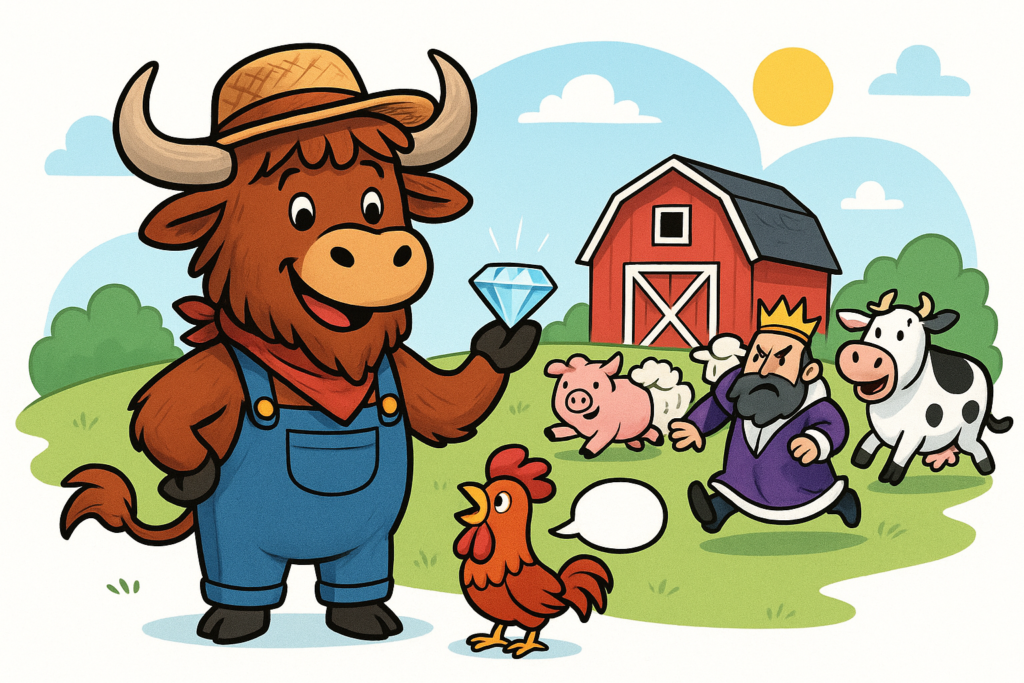
This A1 Beginner retelling of El Gallito y el Diamante keeps the plot clear for learners while still giving the story some atmosphere and momentum. Un día, el gallito encuentra un diamante brillante en el suelo. Un rey malo ve el diamante y grita: -¡Dame ese diamante!
This version teaches Spanish through English and includes clickable word help inside the story, full story audio, and lesson notes after the reading. It is free to use on Yak Yacker and is designed to feel natural, readable, and manageable for learners.
Hay un muy . Vive en una .
Un día, el gallito un en el suelo.
-¡Qué ! -dice el gallito.
Un ve el diamante y : -¡Dame ese diamante!
-¡No, es ! -dice el gallito.
El rey se y el gallito. El gallito : -¡Quiquiriquí! ¡Amigos, ayuda!
Vienen sus amigos, los animales del , y juntos al rey. El gallito su diamante.
A tiny rooster lives on a farm.
One day, the rooster finds a shiny diamond on the ground.
"How pretty!" says the rooster.
A wicked king sees the diamond and yells, "Give me that diamond!"
"No, it's mine!" says the rooster.
The king gets angry and runs at the rooster. The rooster crows, "Cock-a-doodle-doo! Friends, help!"
His barnyard friends come and together they scare off the king. The rooster keeps his diamond.
Let’s meet the words from the story! Many of them are easy to remember because they’re real things you can picture.
Here are the key nouns you saw. Try saying them out loud.
- el gallito – the little rooster (gallo + -ito makes it cute and small)
- la granja – the farm
- el diamante – the diamond
- el rey – the king
- los amigos – the friends
When the rooster says -¡No, es mío!-, he’s claiming the diamond as his. In Spanish, you can show ownership with words like mi and mío.
Notice the little word -ito in gallito. This ending makes something smaller or cuter—like saying -little rooster- instead of just -rooster-.
- mi diamante – my diamond (used before a noun)
- es mío – it’s mine (used after the verb, no noun needed)
- -ito / -ita – added to nouns to mean -little- or show affection (perro → perrito, casa → casita)
This story is full of strong feelings. When the rooster finds the diamond, he cries -¡Qué bonito!- — a very common way to say -How pretty!- or -How nice!-.
Other useful phrases help you react, ask for help, or say no. Try them with the same energy as the characters!
- ¡Qué bonito! – How pretty! (use for anything you like a lot)
- ¡No, es mío! – No, it’s mine! (a firm, clear way to say it)
- ¡Dame ese diamante! – Give me that diamond! (dame = give me, a command)
- ¡Quiquiriquí! – Cock‑a‑doodle‑doo! (the rooster’s crow, and here a call for help)
You’ve learned key words, a little grammar, and some useful phrases. Now make them yours! Try retelling -The Little Rooster- to a friend or just to yourself — using as much Spanish as you can.
If you’re not sure what to say, start with the nouns and the emotional phrases. The meaning will come through!
- Say each new word three times today to help it stick.
- Pretend you’re the rooster and act out the scene: -¡No, es mío!- with feeling!
- Look for -ito words around you — like calling a small dog perrito.
El Gallito y el Diamante comes from an older public-domain story tradition and is best known as a public_domain_folk_tale_retelling. This Yak Yacker article is an original learner retelling based on public-domain source material, so the wording here is simplified for modern learners rather than copied from one old edition.
Older printings, translations, and retellings of this story can vary quite a bit. This version is adapted for A1 Beginner learners studying Spanish.
If you want to keep going, browse more in our Spanish section and review the Geography and Location Vocabulary in Spanish. After that, try Basic Questions in Spanish for another useful next step.