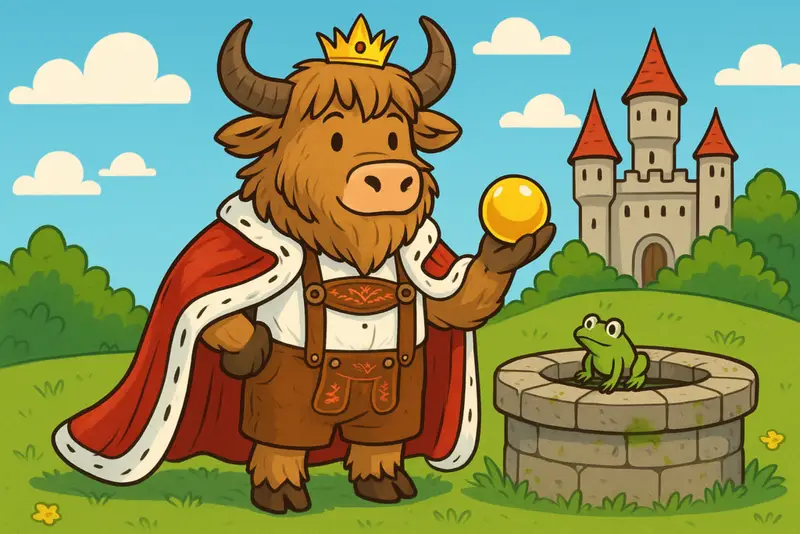
This A1 Beginner retelling of Der Froschkönig keeps the plot clear for learners while still giving the story some atmosphere and momentum. Die Prinzessin hat einen goldenen Ball. Der Ball fällt in den Brunnen.
This version teaches German through English and includes clickable word help inside the story, full story audio, and lesson notes after the reading. It is free to use on Yak Yacker and is designed to feel natural, readable, and manageable for learners.
Die Prinzessin hat einen . Sie im Garten.
Der Ball in den . Die Prinzessin .
Ein . "Warum du, Prinzessin?"
"Mein Ball ist im Brunnen!" "Ich ihn. Aber du musst mein sein."
"Ja, ich es!" Der Frosch den Ball. Die Prinzessin ins Schloss.
Am Abend es an der Tür. "Wer ist da?" "Ich bin der Frosch. Die Prinzessin hat es ." Der König sagt: "Du musst dein ."
Die Prinzessin die Tür. Der Frosch von ihrem Teller und in ihrem Bett. Am Morgen ist er ein .
The princess has a golden ball. She plays in the garden.
The ball falls into the well. The princess cries.
A frog comes. 'Why are you crying, princess?'
'My ball is in the well!' 'I'll fetch it. But you must be my friend.'
'Yes, I promise!' The frog fetches the ball. The princess runs quickly to the castle.
In the evening, there is a knock at the door. 'Who is there?' 'I am the frog. The princess promised.' The king says: 'You must keep your promise.'
The princess opens the door. The frog eats from her plate and sleeps in her bed. In the morning, he is a prince.
This classic fairy tale introduces many useful German nouns and verbs. Recognizing them will help you follow the story and talk about everyday objects and actions.
Take a look at some key words and their English meanings.
- der Ball – ball
- der Brunnen – well
- die Prinzessin – princess
- der Frosch – frog
- weinen – to cry
- holen – to fetch
- versprechen – to promise
- das Schloss – castle
When the king says "Du musst dein Versprechen halten," he uses the verb müssen (must). It's a common modal verb that expresses obligation or necessity. In A1 German, it's very handy for expressing rules or duties.
Notice how müssen is conjugated: ich muss, du musst, er/sie/es muss. The main verb (e.g., halten, holen) goes to the end of the clause in its infinitive form.
- Ich muss meinen Ball holen. (I must fetch my ball.)
- Du musst dein Versprechen halten. (You must keep your promise.)
- Der Frosch muss klopfen. (The frog must knock.)
The story uses simple question-and-answer patterns that are perfect for daily conversation in German. Phrases like 'Wer ist da?' or 'Ich bin der Frosch' are great for beginners.
Try using these expressions yourself. They will help you sound more natural in German.
- Warum weinst du? – Why are you crying?
- Wer ist da? – Who is there?
- Ich bin der Frosch. – I am the frog.
- Es ist versprochen! – It is promised!
Der Froschkönig comes from an older public-domain story tradition and is best known as a public_domain_fairy_tale_retelling. This Yak Yacker article is an original learner retelling based on public-domain source material, so the wording here is simplified for modern learners rather than copied from one old edition.
Older printings, translations, and retellings of this story can vary quite a bit. This version is adapted for A1 Beginner learners studying German.
If you want to keep going, browse more in our German section and review the A1 German Vocabulary List. After that, try Basic Questions in German for another useful next step.