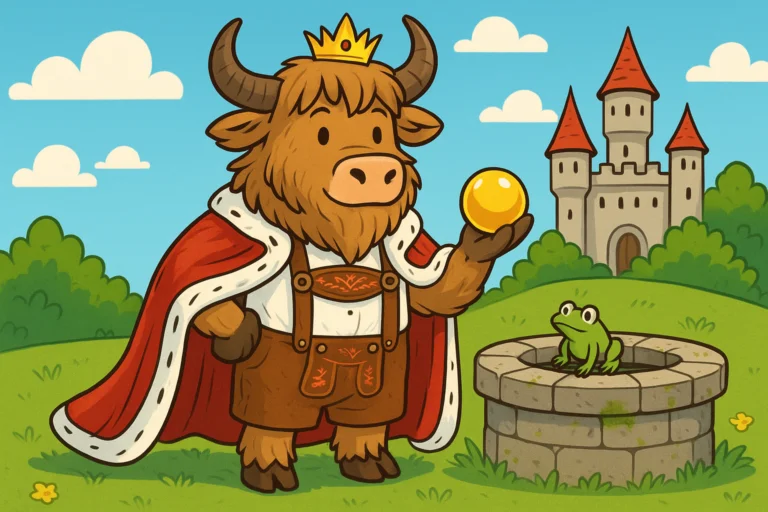
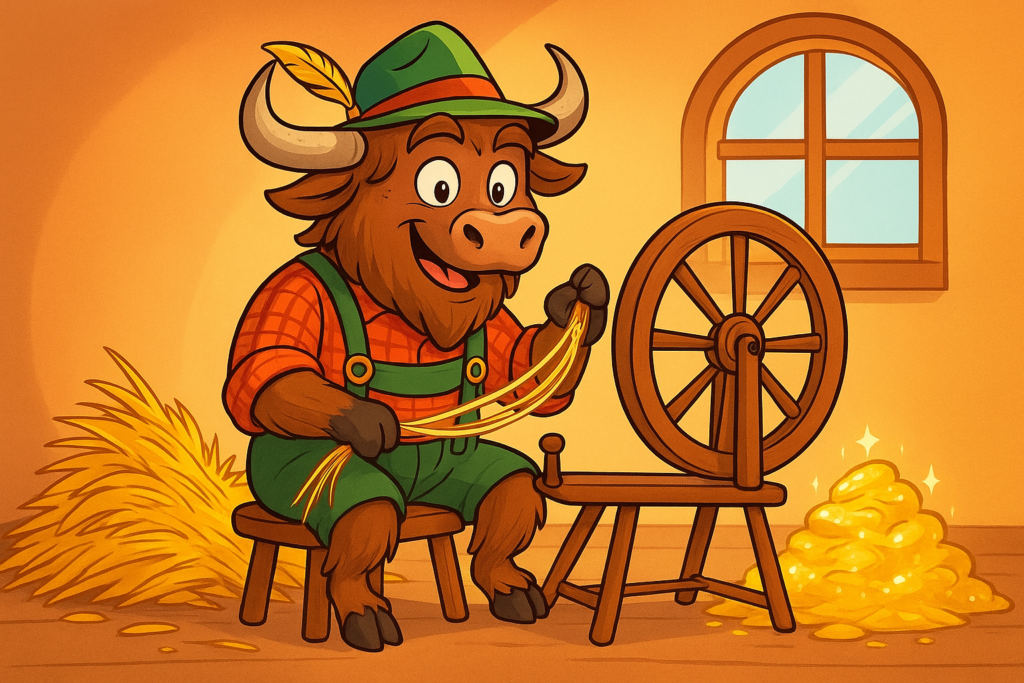
This A1 Beginner retelling of Rumpelstilzchen keeps the plot clear for learners while still giving the story some atmosphere and momentum. Ein Müller sagt: "Meine Tochter kann Stroh zu Gold spinnen. Ein kleiner Mann kommt und fragt: "Warum weinst du?
This version teaches German through English and includes clickable word help inside the story, full story audio, and lesson notes after the reading. It is free to use on Yak Yacker and is designed to feel natural, readable, and manageable for learners.
Ein Müller sagt: "Meine Tochter kann ." Der König bringt das Mädchen in ein mit viel . Das Mädchen .
Ein kommt und fragt: "Warum du?" Sie antwortet: "Ich soll Stroh zu Gold spinnen." Er sagt: "Ich . Gib mir deine ." Sie gibt die Kette. Er das Stroh zu Gold.
Am ist wieder Stroh da. Der Mann kommt . Sie gibt ihm ihren . Er spinnt wieder.
Am hat sie . Der Mann sagt: "Versprich mir dein ." Sie es. Er spinnt. Der König sie.
Ein Jahr später bekommt sie ein . Der Mann kommt und will das Kind. Er sagt: " meinen Namen. Du hast drei Tage."
Sie . Ein sagt: "Ich sah einen kleinen Mann. Er : 'Heute back ich, morgen brau ich, übermorgen hol ich der Königin ihr Kind. Ach wie gut, dass niemand weiß, dass ich heiß!'"
Am sagt die Königin: "Dein Name ist !" Der Mann und .
A miller says, "My daughter can spin straw into gold." The king brings the girl into a room full of straw. The girl cries.
A little man comes and asks, "Why are you crying?" She answers, "I am supposed to spin straw into gold." He says, "I'll help you. Give me your necklace." She gives the necklace. He spins the straw into gold.
The next day, there is straw again. The man comes again. She gives him her ring. He spins again.
On the third day, she has nothing. The man says, "Promise me your first child." She promises it. He spins. The king marries her.
A year later, she has a baby. The man comes and wants the child. He says, "Guess my name. You have three days."
She searches and searches. A messenger says, "I saw a little man. He sang: 'Today I bake, tomorrow I brew, the day after I'll fetch the queen's child. Oh, how good that nobody knows that my name is Rumpelstiltskin!'"
On the third day, the queen says, "Your name is Rumpelstiltskin!" The man screams and disappears.
Let’s look at some key German words you just met. These will help you talk about fairy tales and everyday situations.
- Stroh – straw
- Gold – gold
- spinnen – to spin
- der König – the king
- weinen – to cry
- helfen – to help
- das Kind – the child
- der Name – the name
In German, words like kann (can) and soll (should) are used with another verb to show ability or necessity. They give the main verb a special meaning.
"Meine Tochter kann Stroh zu Gold spinnen" means "My daughter can spin straw into gold." "Ich soll Stroh zu Gold spinnen" means "I am supposed to spin straw into gold."
- kann = can (ability)
- soll = should / is supposed to (obligation)
- In German, the main verb goes to the end: "Ich kann Gold spinnen."
- Try making your own sentences: "Ich kann singen." "Du sollst lernen."
You did great! You followed a classic tale in German and learned some useful words and grammar. Want to keep going?
- Try reading the story again and see how much you understand now.
- Practice saying new words out loud. It helps your memory!
- In the next story, you might meet these words again.
Rumpelstilzchen comes from an older public-domain story tradition and is best known as a public_domain_fairy_tale_retelling. This Yak Yacker article is an original learner retelling based on public-domain source material, so the wording here is simplified for modern learners rather than copied from one old edition.
Older printings, translations, and retellings of this story can vary quite a bit. This version is adapted for A1 Beginner learners studying German.
If you want to keep going, browse more in our German section and review the A1 German Vocabulary List. After that, try Essential German Grammar Words for another useful next step.