


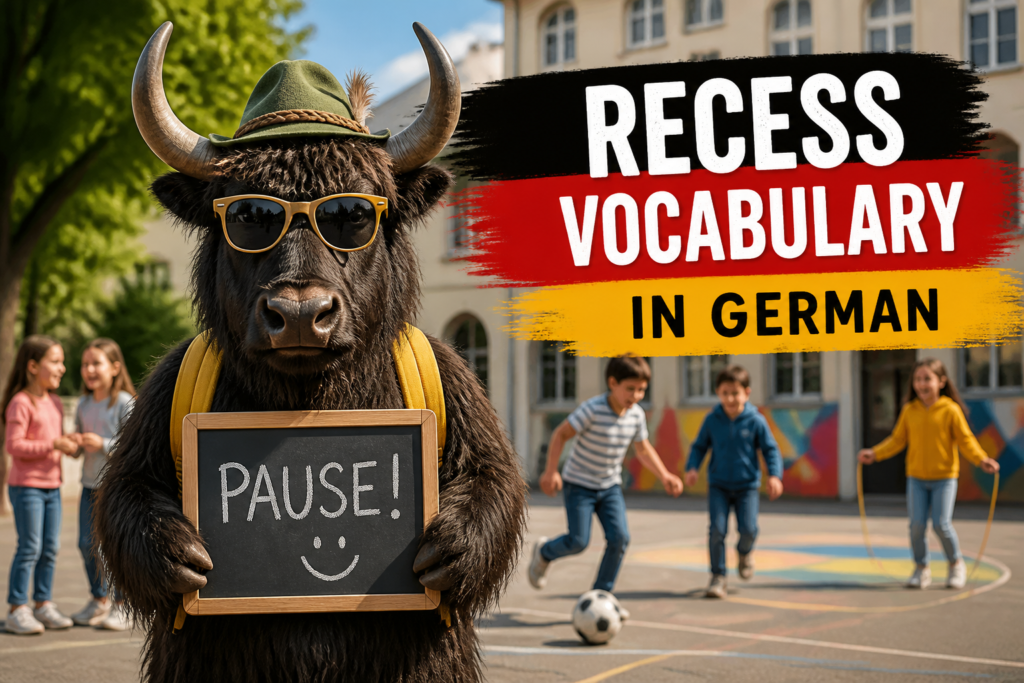
If you want to talk about recess in German, you’ll quickly run into a nice little mix of school words, playground words, and the occasional “please stop yelling indoors” phrase. Conveniently, German has plenty of useful everyday vocabulary for exactly that. Unluckily, some of it changes depending on whether you mean a break at school, a break at work, or just a moment to breathe before someone asks for homework.
This guide focuses on practical, modern German you’ll actually hear in Germany. By the end, you’ll be able to talk about recess, playground activities, school breaks, and what kids do when the bell finally saves everyone’s sanity.
A quick note: in German, “recess” at school is often called die Pause. Simple, common, and refreshingly boring in the best way.
For a helpful nearby topic, compare this guide with Chores Vocabulary in German and Health Vocabulary in German. School life, after all, includes both cleaning up and surviving small injuries.
Useful Recess Words And Phrases
Here are the core words you’ll need first. The examples use natural German and the kind of language that won’t make native speakers tilt their heads like confused pigeons.
| German | Pronunciation | Meaning | Example Sentence | Translation | Learner Note |
|---|---|---|---|---|---|
| die Pause | PYOW-zuh | break; recess | In der Pause gehen die Kinder auf den Hof. | During recess, the children go to the yard. | Very common for school breaks. |
| die Hofpause | HOHFP-ow-zuh | yard break; outdoor recess | Die Hofpause dauert zehn Minuten. | The recess in the yard lasts ten minutes. | More specific than die Pause. |
| der Schulhof | shool-hohf | schoolyard | Auf dem Schulhof spielen viele Kinder. | Many children play in the schoolyard. | der because Hof is masculine. |
| das Pausenbrot | POW-zen-broat | snack or packed lunch for recess | Mein Pausenbrot ist ein Käsebrot. | My recess snack is a cheese sandwich. | Literally “break bread.” Very common in school context. |
| die Brotdose | BROHT-doh-zuh | lunchbox | Ich packe mein Pausenbrot in die Brotdose. | I pack my snack into the lunchbox. | Super useful everyday word. |
| die Trinkflasche | TRINK-flah-shuh | water bottle | Hast du deine Trinkflasche dabei? | Do you have your water bottle with you? | Common with school and sports. |
| spielen | SHPee-len | to play | Die Kinder spielen Fangen. | The children are playing tag. | Usually a regular verb. Nice and obedient. |
| rennen | REN-nen | to run | Die Kinder rennen über den Hof. | The children run across the yard. | Often used during recess chaos. |
| schaukeln | SHOW-keln | to swing | Sie schaukelt auf dem Spielplatz. | She is swinging on the playground. | Also means “to sway,” depending on context. |
| rutschen | ROOT-shen | to slide | Die Kinder rutschen die Rutsche hinunter. | The children slide down the slide. | Common on playgrounds. |
| klettern | KLET-tern | to climb | Vorsicht, sie klettern auf den Baum. | Careful, they are climbing the tree. | Often used for climbing structures too. |
| fangen | FAHNG-en | to catch; to tag in a game | Wer fängt heute beim Spiel? | Who is it in the game of tag today? | Common in the game Fangen = tag. |
| das Fangenspiel | FAHNG-en-she-pool | tag game | Wir spielen im Hof ein Fangenspiel. | We are playing a tag game in the yard. | Useful if you want the exact game name. |
| die Rutsche | ROOT-shuh | slide | Die Rutsche ist heute nass. | The slide is wet today. | die noun; common playground item. |
| die Schaukel | SHOW-kel | swing | Die Schaukel ist besetzt. | The swing is occupied. | Useful for playground rules. |
| die Klettergerüst | KLET-ter-guh-roost | climbing frame | Das Klettergerüst ist groß. | The climbing frame is big. | Most often written as das Klettergerüst. |
| ballspielen | BAHL-she-peeln | to play ball games | Die Kinder ballspielen auf dem Hof. | The children play ball games in the yard. | Less common than simply Fußball spielen or mit dem Ball spielen. |
More Everyday Recess Words
These words help you describe the place, the actions, and the small social drama that happens between the bell and the next lesson.
| German | Pronunciation | Meaning | Example Sentence | Translation | Learner Note |
|---|---|---|---|---|---|
| die Klingel | KLIN-gel | bell | Die Klingel beendet die Pause. | The bell ends the break. | School bells are always bossy. |
| läuten | LOY-ten | to ring | Die Glocke läutet um zehn Uhr. | The bell rings at ten o’clock. | Also used for church bells. |
| die Aufsicht | OWF-zoorcht | supervision | Die Aufsicht ist auf dem Schulhof. | The supervision teacher is on the schoolyard. | Common at schools; a teacher watches the children. |
| aufpassen | OWF-pahs-sen | to watch out; to look after | Pass bitte auf die kleinen Kinder auf. | Please watch out for the little children. | Separable verb: auf … auf. |
| achtgeben | ACHT-gay-ben | to pay attention; to be careful | Gib auf dem Hof bitte acht. | Please be careful in the yard. | More formal or old-fashioned than aufpassen. |
| schubsen | SHOOB-sen | to shove | Man schubst niemanden in der Pause. | You don’t shove anyone during recess. | Useful for rules and behavior. |
| streiten | SHTRY-ten | to argue, fight | Die Kinder streiten um den Ball. | The children are arguing about the ball. | Can be mild arguing, not always a physical fight. |
| mitmachen | MIT-mah-khen | to join in | Ich mache beim Spiel mit. | I’m joining in the game. | Very useful and very natural. |
| mitspielen | MIT-shpee-len | to play along; to join the game | Darf ich mitspielen? | May I join in? | One of the most useful school phrases. |
| dran sein | dran zyne | to be next; it’s your turn | Jetzt bist du dran. | Now it’s your turn. | Very common in games and class activities. |
| wechseln | VEK-seln | to switch, change | Wir wechseln nach fünf Minuten. | We switch after five minutes. | Useful for games and activities. |
| trödeln | TROY-deln | to dawdle | Trödel nicht, sonst ist die Pause gleich vorbei. | Don’t dawdle, or the break will be over soon. | Friendly scolding word. Very German, somehow. |
| eilen | EYE-len | to hurry | Ich muss jetzt eilen. | I have to hurry now. | More neutral and a little formal. |
| die Ecke | ECK-uh | corner | Sie sitzen in der Ecke vom Hof. | They are sitting in the corner of the yard. | Useful for describing spots on the playground. |
| der Ball | bahl | ball | Der Ball rollt unter die Bank. | The ball rolls under the bench. | Easy one, but very common. |
| die Bank | bahngk | bench | Wir sitzen auf der Bank. | We are sitting on the bench. | Also means “bank” as in a financial bank. Context matters. |
| der Trinkbecher | TRINK-beh-kher | drinking cup | Ich habe meinen Trinkbecher vergessen. | I forgot my drinking cup. | Less common than Trinkflasche, but handy. |
Useful Recess Phrases You’ll Actually Hear
These are the kinds of lines kids, teachers, and parents actually say. Not poetry. Just practical German doing its job.
| German | Pronunciation | Meaning | Example Sentence | Translation | Learner Note |
|---|---|---|---|---|---|
| Die Pause hat begonnen. | dee POW-zuh haht be-gun-nen | The break has started. | Die Pause hat begonnen, also raus! | The break has started, so outside! | Often used by teachers or announcements. |
| Die Pause ist vorbei. | dee POW-zuh ist for-BY | The break is over. | Schade, die Pause ist schon vorbei. | Too bad, the break is already over. | Very useful and very common. |
| Wir gehen auf den Schulhof. | veer GAY-en owf den shool-hohf | We are going to the schoolyard. | Nach dem Unterricht gehen wir auf den Schulhof. | After class, we go to the schoolyard. | auf here means “onto” or “to.” |
| Darf ich mitspielen? | darf ikh MIT-shpee-len | May I join in? | Darf ich mitspielen, wenn ihr Fußball spielt? | May I join in when you play soccer? | One of the most important playground phrases. |
| Willst du tauschen? | vilst doo TOW-shen | Do you want to swap? | Willst du die Karte tauschen? | Do you want to swap the card? | Useful for games, snacks, and kid diplomacy. |
| Sei nicht so laut. | zy niht zoh LOWT | Don’t be so loud. | Sei nicht so laut, wir sind noch im Flur. | Don’t be so loud, we’re still in the hallway. | Common teacher language. |
| Pass auf! | pahs OWF | Watch out! | Pass auf, da kommt ein Fahrrad! | Watch out, a bicycle is coming! | Short, urgent, very common. |
| Das ist mein Platz. | dahs ist myne plahsts | That’s my spot. | Das ist mein Platz auf der Bank. | That’s my spot on the bench. | Handy in seating disputes, which apparently are universal. |
| Ich bin als Nächstes dran. | ikh bin als NEEK-stes dran | I’m next. | Ich bin als Nächstes dran beim Spiel. | I’m next in the game. | dran sein is a very common expression. |
| Jetzt du! | yets doo | Your turn now! | Jetzt du, dann bin ich wieder dran. | Your turn now, then it’s my turn again. | Short and natural in games. |
| Wir spielen Fangen. | veer SHPEE-len FAHNG-en | We are playing tag. | Auf dem Hof spielen wir Fangen. | We are playing tag in the yard. | Fangen is the game, not just the verb “to catch.” |
| Ich habe Durst. | ikh hah-buh doorsht | I’m thirsty. | Nach dem Rennen habe ich Durst. | After running, I’m thirsty. | Extremely useful school and playground phrase. |
| Ich brauche eine Pause. | ikh BROW-khuh EY-nuh POW-zuh | I need a break. | Ich brauche wirklich eine Pause. | I really need a break. | Works for school, work, and life. |
| Kann ich kurz rausgehen? | kan ikh koortz ROWS-gay-en | Can I go out for a moment? | Kann ich kurz rausgehen, bitte? | Can I go out for a moment, please? | Good for asking to leave the classroom. |
| Wir treffen uns auf dem Hof. | veer TREF-en oons owf dem hohf | We meet in the yard. | Wir treffen uns nach der Pause auf dem Hof. | We meet in the yard after the break. | sich treffen becomes wir treffen uns. |
Mini Grammar Notes That Help A Lot
German likes to hide useful grammar inside everyday phrases. Very on brand.
| Pattern | Meaning | German Example | English Translation | Learner Note |
|---|---|---|---|---|
| in der Pause | during the break | In der Pause essen die Kinder ihr Pausenbrot. | During the break, the children eat their snack. | in + dative here because it means “during.” |
| auf dem Schulhof | on the schoolyard | Auf dem Schulhof spielen viele Kinder. | Many children play on the schoolyard. | auf + dative because the location is fixed. |
| mitspielen | to join the game | Ich will mitspielen. | I want to join in. | Separable verb? No. It stays together: mitspielen. |
| aufpassen | to watch out | Pass bitte auf! | Please watch out! | Separable verb. In a sentence, auf can move away. |
| Ich bin dran. | It’s my turn. | Jetzt bin ich dran. | Now it’s my turn. | Very common in games, class, and queues. |
| kein + noun | no / not any | Ich habe kein Geld für den Kiosk. | I don’t have any money for the kiosk. | Use kein with nouns, not nicht. |
| nicht + adjective | not | Die Rutsche ist nicht nass. | The slide is not wet. | nicht often negates adjectives and verbs. |
| der Hof / dem Hof | yard; case change | Wir sind auf dem Hof. | We are in the yard. | der Hof becomes dem Hof after auf in this location meaning. |
German pronunciation tip: Pause starts with au, which sounds like English “ow” in now. So it’s closer to “POW-zuh” than “paws.” Tiny difference, big payoff.
Common Recess Actions
These verbs come up all the time in playground talk. Practice them in full sentences, because verbs alone are cute, but sentences do the real work.
| German | Pronunciation | Meaning | Example Sentence | Translation | Learner Note |
|---|---|---|---|---|---|
| springen | SHPRING-en | to jump | Die Kinder springen über die Linie. | The children jump over the line. | Useful for games and physical play. |
| werfen | VER-fen | to throw | Er wirft den Ball sehr weit. | He throws the ball very far. | Strong verb, common in sports and games. |
| holen | HOH-len | to get, fetch | Kannst du den Ball holen? | Can you get the ball? | Very common everyday verb. |
| teilen | TY-len | to share, divide | Wir teilen die Kekse. | We are sharing the cookies. | Very useful at snack time. |
| anstellen | AHN-shtel-len | to line up; to queue up | Die Kinder stellen sich an. | The children line up. | In school contexts, this often means “form a line.” |
| lachen | LAH-khen | to laugh | Auf dem Hof lachen alle. | Everyone laughs in the yard. | Easy verb, very cheerful. |
| rufen | ROO-fen | to call, shout | Die Kinder rufen sich gegenseitig zu. | The children call to each other. | rufen can be louder than you intended. |
| sitzen | SITS-en | to sit | Wir sitzen auf der Bank. | We are sitting on the bench. | Very common for calm recess moments. |
| liegen | LEE-gen | to lie, be lying | Der Ball liegt unter dem Tisch. | The ball is lying under the table. | Location verb; useful for finding lost stuff. |
| suchen | ZOO-khen | to search for | Wir suchen den Ball. | We are looking for the ball. | Handy when something rolls off somewhere mysterious. |
School Breaks, Snacks, And The Great Lunchbox Economy
German school recess often involves snacks from home. The classic word is das Pausenbrot, usually a sandwich or bread-based snack. Germans love a good bread compound noun almost as much as they love a well-organized school day.
- das Pausenbrot — snack for recess
- die Brotdose — lunchbox
- die Trinkflasche — water bottle
- der Apfel — apple
- das Brötchen — bread roll
- das Käsebrot — cheese sandwich
- das Marmeladenbrot — jam sandwich or jam bread
- der Kiosk — school kiosk, snack stand
- das Obst — fruit
- der Snack — snack
Example: In der Pause esse ich mein Pausenbrot. — During the break, I eat my snack.
Small learner note: Brot means bread, but Pausenbrot does not always mean an actual slice of bread. It can be any recess snack in school talk. German is practical like that. Not glamorous, just efficient.
For the word Pause, authoritative dictionary sources such as the Duden entry for Pause are a good reference if you want spelling, grammar, and meaning in one place. Dry? Yes. Useful? Also yes.
Quick Differences: Germany, Austria, And Switzerland
Most of the vocabulary here is standard German and works well in Germany, Austria, and Switzerland. Still, a few words may change depending on region or school culture.
| Expression | Germany | Austria | Switzerland | Learner Note |
|---|---|---|---|---|
| die Pause | Very common | Very common | Very common | Safe choice everywhere. |
| der Schulhof | Very common | Common | Common | Understood broadly. |
| Jause | Uncommon | Common | Common | In Austria and parts of Switzerland, Jause can mean snack/break. In Germany, it sounds regional. |
| Pause for recess | Standard | Standard | Standard | Best neutral word for learners. |
| Znüni / Zvieri | Not used | Not used | Common in Swiss German contexts | These are Swiss snack-break words. Good to recognize, not necessary for standard German. |
If you want to go deeper into general German learning patterns, the main Learn German page is the neat little starting point that keeps the chaos organized.
Pronunciation Notes Worth Knowing
Just a few sound notes can make your recess vocabulary sound much more natural.
- Pause — OW sound in au: “POW-zuh.”
- Schulhof — sch sounds like English “sh.”
- spielen — sp at the start sounds like “shp.”
- stehen — if you use it in related school talk, st at the start sounds like “sht.”
- Rutsche — the r is often softer in modern German, depending on accent.
- Fangen — final g in many regions sounds closer to a soft k-like or ch-like ending in speech, but standard spelling stays g.
- laut — the au is again “ow,” as in lout with a German sound.
- Pause vs Pause — yes, same word, but the first syllable carries the stress.
German recess vocabulary is mostly very friendly. The language is not trying to trick you here. It only looks serious because it puts all the nouns in capital letters and calls that a personality.
Practice: Make These Recess Sentences Your Own
Try swapping in your own words. The goal is not perfection. The goal is to get the sentence shapes into your brain so they stop feeling weird and start feeling normal.
- In der Pause … → In der Pause spiele ich mit meinen Freunden.
- Wir gehen auf den Schulhof. → Wir gehen nach der Pause auf den Schulhof.
- Darf ich mitspielen? → Darf ich auch mitspielen?
- Jetzt bin ich dran. → Jetzt ist mein Freund dran.
- Pass auf! → Pass auf den Ball auf!
- Ich brauche eine Pause. → Ich brauche jetzt wirklich eine Pause.
- Die Pause ist vorbei. → Leider ist die Pause schon vorbei.
- Die Kinder spielen Fangen. → Die Kinder spielen im Hof Fangen.
- Wir teilen das Pausenbrot. → Wir teilen die Kekse in der Pause.
- Ich habe Durst. → Nach dem Rennen habe ich großen Durst.
Now try the same idea with a few quick translations:
- “Can I join in?” → Darf ich mitspielen?
- “It’s my turn now.” → Jetzt bin ich dran.
- “The break is over.” → Die Pause ist vorbei.
- “We’re going to the schoolyard.” → Wir gehen auf den Schulhof.
- “Watch out!” → Pass auf!
Common Mistakes And Easy Fixes
| Wrong / Awkward | Better German | Why |
|---|---|---|
| In die Pause | In der Pause | You usually need the dative here when you mean “during the break.” |
| Ich spiele mit. | Ich mache mit. / Ich spiele mit. | Both can work, but mitspielen is often the most natural for joining a game. |
| Ich bin next. | Ich bin dran. | English “next” is a false friend-ish habit here. German uses dran. |
| Sei laut nicht. | Sei nicht so laut. | German word order matters. Adjective negation is usually nicht so + adjective. |
| Pause is over. | Die Pause ist vorbei. | German uses the article and the right verb phrase. |
| Ich habe Dursten. | Ich habe Durst. | Durst is a noun, not a verb. |
| auf den Schulhof sein | auf dem Schulhof sein | Use auf dem when talking about being located on the schoolyard. |
| Wir spielen Tag. | Wir spielen Fangen. | German usually says Fangen for tag. |
Quick Reference Summary
- die Pause = break, recess
- der Schulhof = schoolyard
- das Pausenbrot = recess snack or packed lunch
- die Brotdose = lunchbox
- mitspielen = to join in
- dran sein = to be next / it’s your turn
- Pass auf! = Watch out!
- Ich habe Durst. = I’m thirsty.
- Die Pause ist vorbei. = The break is over.
- Wir spielen Fangen. = We’re playing tag.
Recess vocabulary in German is nice because it’s practical, common, and easy to use right away. Learn the core words, practice a few full sentences, and suddenly the playground stops sounding like a mystery zone with stairs.
Yak Takeaway: die Pause, der Schulhof, mitspielen, and dran sein are your best friends here. Learn those first, and the rest of recess German will behave itself—mostly.