


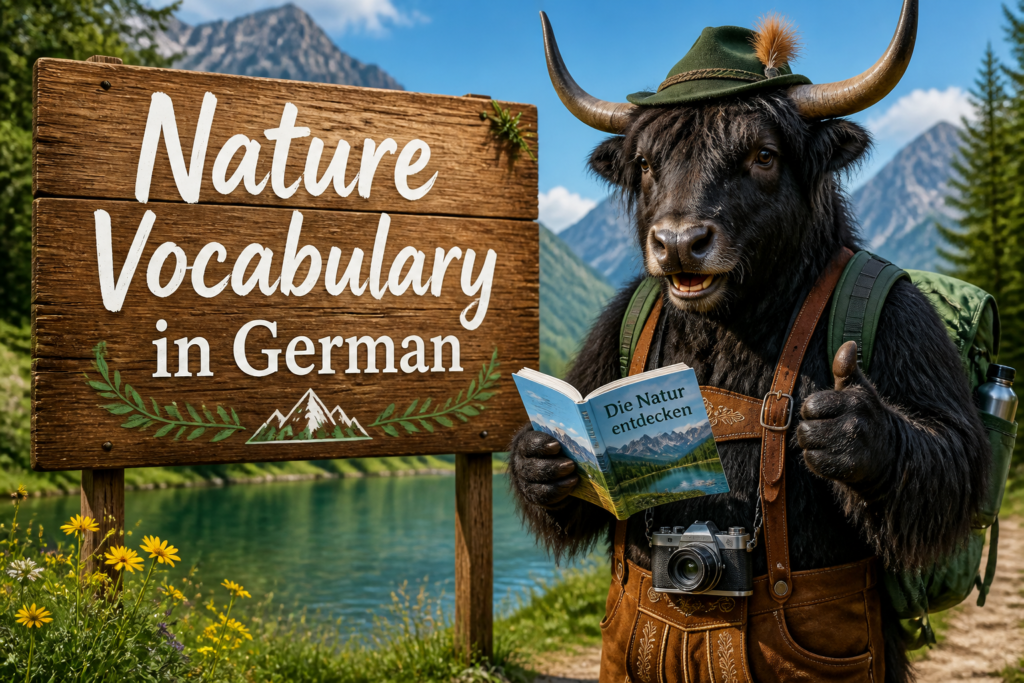
Germany has forests, hills, rivers, lakes, meadows, and enough weather to keep everyone humble. So yes, Nature Vocabulary in German is actually useful, not just pretty dictionary decoration.
For the broader learning path, visit our parent guide.
If you want to talk about a walk in the woods, a lake trip, a mountain hike, or the sudden emotional collapse caused by German weather, this guide gives you the words you need. You will learn practical nature nouns, useful phrases, simple pronunciation help, and a few easy grammar notes without turning the whole thing into a moss-covered grammar museum.
For a broader place-vocabulary refresher, you can also compare this with Geography Vocabulary in German. Same planet, slightly different emotional damage.
Yak note: In German, all nouns are capitalized. So yes, der Wald, die Blume, and das Wasser all get fancy little capital letters even when they are just minding their own business.
Nature words show up everywhere: on hikes, in travel talks, in weather conversations, in school lessons, and in those peaceful moments when somebody says, “Let’s just go outside for a while.” Germans do this too. Surprisingly often.
Core Nature Words
Here are the most useful nature words first, with simple pronunciation help and real example sentences.
| German | Pronunciation | Meaning | Example Sentence | Translation | Learner Note |
|---|---|---|---|---|---|
| die Natur | nah-TOOR | nature | Ich gehe gern in die Natur. | I like going out into nature. | Usually used in a general, broad sense. |
| der Wald | vahlt | forest, woods | Wir gehen heute durch den Wald. | We are walking through the forest today. | der Wald becomes den Wald after durch. |
| der Baum | bown | tree | Der Baum ist sehr alt. | The tree is very old. | Plural: die Bäume. |
| die Blume | BLOO-muh | flower | Die Blumen sind schön. | The flowers are beautiful. | Plural: die Blumen. |
| das Gras | grahs | grass | Das Gras ist nass. | The grass is wet. | Uncountable in many contexts, like English. |
| der See | zay | lake | Wir machen ein Picknick am See. | We are having a picnic at the lake. | Watch the pronunciation: long ee sound. |
| der Fluss | floos | river | Der Fluss fließt schnell. | The river flows quickly. | Verb fließen means “to flow.” |
| der Berg | behrk | mountain | Der Berg ist nicht sehr hoch. | The mountain is not very high. | Plural: die Berge. |
| der Hügel | HOO-guhl | hill | Auf dem Hügel ist es windig. | It is windy on the hill. | Small mountain-ish hill, not a dramatic alp. |
| die Wiese | meadow, grassy field | Die Kühe stehen auf der Wiese. | The cows are standing in the meadow. | Often a natural grass field, not a city park lawn. | |
| die Küste | KOO-stuh | coast | Wir fahren an die Küste. | We are driving to the coast. | Useful for sea trips and weather talk. |
| der Strand | shtraht | beach | Der Strand ist heute voll. | The beach is full today. | Strand is the beach itself, not just the coastline. |
Plants, Animals, And Outdoor Things
Nature vocabulary is not just about landscapes. If you want to describe what you see on a walk, these words are the practical ones.
| German | Pronunciation | Meaning | Example Sentence | Translation | Learner Note |
|---|---|---|---|---|---|
| der Baum | bown | tree | Der Baum wirft Schatten. | The tree casts shade. | Common in nature descriptions. |
| das Blatt | blaht | leaf | Ein Blatt fällt vom Baum. | A leaf falls from the tree. | Plural: die Blätter. |
| die Wurzel | VOOR-tsel | root | Die Wurzeln sind tief. | The roots are deep. | Plural: die Wurzeln. |
| der Ast | ahst | branch | Der Vogel sitzt auf dem Ast. | The bird is sitting on the branch. | Distinct from der Zweig, which is often a smaller branch/twig. |
| die Blüte | BLOO-tuh | blossom, bloom | Im Frühling beginnt die Blüte. | In spring, the blooming begins. | Related to flowering and springtime. |
| die Pflanze | PLAHN-tsuh | plant | Diese Pflanze braucht Licht. | This plant needs light. | Very useful for gardening and home vocabulary. |
| das Moos | mohs | moss | Das Moos wächst auf dem Stein. | The moss grows on the stone. | A lovely word if you enjoy being dramatic in forests. |
| der Stein | shtine | stone, rock | Auf dem Weg liegen viele Steine. | There are many stones on the path. | Plural: die Steine. |
| der Pilz | pilts | mushroom, fungus | Wir haben einen Pilz im Wald gefunden. | We found a mushroom in the forest. | Be careful: not all mushrooms are edible. Nature is rude like that. |
| der Vogel | FOH-guhl | bird | Der Vogel singt früh am Morgen. | The bird sings early in the morning. | Plural: die Vögel. |
| das Tier | teer | animal | Das Tier versteckt sich im Gebüsch. | The animal is hiding in the bushes. | General word for animal. |
| das Wild | vilt | wild animals, game | Im Wald lebt viel Wild. | Many wild animals live in the forest. | Often used in hunting or forest contexts. |
Weather, Light, And Landscape Words
Nature and weather are close friends in German. They gossip together constantly.
| German | Pronunciation | Meaning | Example Sentence | Translation | Learner Note |
|---|---|---|---|---|---|
| die Sonne | ZON-uh | sun | Heute scheint die Sonne. | The sun is shining today. | Common in weather talk. |
| der Himmel | HIM-uhl | sky, heaven | Der Himmel ist blau. | The sky is blue. | Can mean “heaven” in religious contexts too. |
| die Wolke | VOL-kuh | cloud | Eine Wolke verdeckt die Sonne. | A cloud covers the sun. | Plural: die Wolken. |
| der Regen | RAY-ghen | rain | Der Regen hört nicht auf. | The rain does not stop. | Noun, not the verb. |
| der Schnee | shnay | snow | Im Winter gibt es viel Schnee. | There is a lot of snow in winter. | Long ee sound again. |
| der Wind | vint | wind | Der Wind ist heute stark. | The wind is strong today. | Also used in compounds like Windmühle (windmill). |
| das Gewitter | guh-VIT-ter | thunderstorm | Ein Gewitter kommt näher. | A thunderstorm is getting closer. | Very common in weather forecasts. |
| der Blitz | blits | lightning, flash | Der Blitz war sehr hell. | The lightning was very bright. | Can also mean “flash” or “speedy.” |
| der Donner | DON-er | thunder | Der Donner ist laut. | The thunder is loud. | Classic storm word. |
| das Tal | tahl | valley | Das Dorf liegt im Tal. | The village lies in the valley. | Useful for geography and hiking. |
| die Ebene | AY-buh-nuh | plain, flat land | Die Ebene ist sehr weit. | The plain is very wide. | More common in geography or formal descriptions. |
| der Hügel | HOO-guhl | hill | Hinter dem Hügel beginnt der Wald. | The forest begins behind the hill. | Handy for describing landscapes. |
Useful Phrases For Real Life
These are the phrases that actually show up in daily life, travel, walking, and small talk. German likes compact expressions, so these will help you sound natural fast.
| German | Pronunciation | Meaning | Example Sentence | Translation | Learner Note |
|---|---|---|---|---|---|
| Ich gehe spazieren. | ikh GAY-uh shpa-TSEER-en | I am going for a walk. | Am Nachmittag gehe ich spazieren. | In the afternoon, I go for a walk. | Very common and very useful. |
| Wir machen einen Spaziergang. | veer MAH-khen EYE-nen shpa-TSYEER-gahng | We are taking a walk. | Wir machen am See einen Spaziergang. | We are taking a walk by the lake. | Spaziergang = a walk, a stroll. |
| Die Luft ist frisch. | dee loft ist frish | The air is fresh. | Hier oben ist die Luft frisch. | The air is fresh up here. | Great for mountains, forests, and mornings. |
| Es ist sehr ruhig hier. | es ist zayr ROO-hikh heer | It is very quiet here. | Im Wald ist es sehr ruhig. | It is very quiet in the forest. | Useful in nature and travel descriptions. |
| Die Aussicht ist toll. | dee AUSS-sicht ist toll | The view is great. | Von hier ist die Aussicht toll. | The view from here is great. | Aussicht = view, outlook. |
| Der Weg ist steil. | dehr vayk ist shtile | The path is steep. | Der Weg zum Gipfel ist steil. | The path to the summit is steep. | steil = steep. |
| Wir sind in der Nähe des Sees. | veer zint in dehr NAY-uh des zays | We are near the lake. | Das Hotel liegt in der Nähe des Sees. | The hotel is near the lake. | in der Nähe often takes the genitive in writing, but everyday speech varies. |
| Im Wald verliert man leicht die Orientierung. | im valt fer-LEERT man light dee o-ree-en-tee-ROONK | In the forest, it is easy to lose your sense of direction. | Im Wald verliert man leicht die Orientierung. | In the forest, you easily lose your sense of direction. | Nice survival phrase. Also a subtle warning. |
| Es riecht nach Regen. | es reekt nahkh ray-ghen | It smells like rain. | Draußen riecht es nach Regen. | Outside, it smells like rain. | riechen nach = to smell like. |
| Die Blätter fallen. | dee BLET-ter fal-en | The leaves are falling. | Im Herbst fallen die Blätter. | In autumn, the leaves fall. | Very typical autumn sentence. |
| Die Sonne geht unter. | dee ZON-uh gayt oon-ter | The sun is setting. | Abends geht die Sonne unter. | In the evening, the sun sets. | Separable verb: untergehen. |
| Die Sonne geht auf. | dee ZON-uh gayt owf | The sun is rising. | Früh am Morgen geht die Sonne auf. | Early in the morning, the sun rises. | Useful opposite of untergehen. |
Nature Activities You Will Hear In Real Conversations
These expressions are great for weekend plans, travel chats, and “I need fresh air before I turn into a desk-shaped person” moments.
| German | Pronunciation | Meaning | Example Sentence | Translation | Learner Note |
|---|---|---|---|---|---|
| wandern | VAHN-dern | to hike | Wir wandern am Samstag. | We are hiking on Saturday. | Very common in Germany, Austria, and Switzerland. |
| eine Wanderung | EH-nuh VAHN-der-oong | a hike | Die Wanderung dauert drei Stunden. | The hike takes three hours. | Noun form of wandern. |
| campen | KAHM-pen | to camp | Wir campen am See. | We are camping at the lake. | Very direct and modern. |
| ein Picknick machen | ine PIK-nik MAH-khen | to have a picnic | Wir machen ein Picknick im Park. | We are having a picnic in the park. | Used exactly like English, basically. |
| schwimmen | SHVIM-men | to swim | Im Sommer schwimmen wir im See. | In summer, we swim in the lake. | Watch the schw sound. |
| angeln | AHNG-eln | to fish | Mein Großvater angelt gern. | My grandfather likes fishing. | Common in lake and river contexts. |
| beobachten | be-OH-bakh-ten | to observe, watch carefully | Wir beobachten die Vögel. | We are observing the birds. | Great for wildlife and birdwatching. |
| pflücken | PLIK-ken | to pick, pluck | Sie pflückt Blumen. | She picks flowers. | Be careful where you use this; some wild plants are protected. |
| sammeln | ZAM-meln | to collect | Wir sammeln Pilze im Wald. | We are collecting mushrooms in the forest. | Very common with mushrooms, leaves, shells, and stones. |
| spazieren gehen | shpa-TSYEER-en gay-en | to go for a walk | Am Abend gehen wir spazieren. | In the evening, we go for a walk. | Often used instead of just spazieren. |
Handy Nature Adjectives
Adjectives help you describe the mood of a place, which is important if you want to say more than “tree good, sky blue.”
| German | Pronunciation | Meaning | Example Sentence | Translation | Learner Note |
|---|---|---|---|---|---|
| grün | gryn | green | Im Frühling ist alles grün. | Everything is green in spring. | Umlaut ü is rounded lips, front tongue. |
| kalt | kahlt | cold | Der Morgen ist kalt. | The morning is cold. | Common in weather and outdoor talk. |
| warm | vahrm | warm | Das Wasser ist warm. | The water is warm. | Useful for lakes, pools, and weather. |
| hell | hel | bright, light | Der Himmel ist hell. | The sky is bright. | Often used for light and color descriptions. |
| dunkel | DOON-kuhl | dark | Es wird langsam dunkel. | It is slowly getting dark. | Es wird… is a handy pattern. |
| nass | nahss | wet | Der Boden ist nass. | The ground is wet. | Very common after rain. |
| trocken | TROK-en | dry | Der Sommer war sehr trocken. | The summer was very dry. | Important for weather and nature topics. |
| ruhig | ROO-hikh | quiet, peaceful | Hier ist es ruhig. | It is quiet here. | Very common in nature descriptions. |
| steil | shtile | steep | Der Weg ist steil. | The path is steep. | Useful on hikes and maps. |
| flach | flakh | flat | Das Land ist flach. | The land is flat. | Opposite of steil in many contexts. |
| wild | vilt | wild | Die Landschaft ist wild und schön. | The landscape is wild and beautiful. | Great for dramatic scenery. |
| idyllisch | ee-DIL-ish | picturesque, idyllic | Das Dorf liegt idyllisch am See. | The village is beautifully located by the lake. | Slightly fancy, but very common in travel descriptions. |
Mini Grammar Notes: Nature Words In Sentences
Nature vocabulary becomes a lot easier when you notice a few patterns. Good news: German does have patterns. It does not always behave like a random forest goblin.
| Pattern | Meaning | German Example | English Translation | Learner Note |
|---|---|---|---|---|
| im + dative | in the | im Wald | in the forest | im = in dem. Very common. |
| am + dative | at the / on the | am See | at the lake | am = an dem. |
| auf + dative | on | auf der Wiese | on the meadow | auf changes meaning with case; here it is location. |
| durch + accusative | through | durch den Wald | through the forest | durch always takes accusative. |
| nach + dative | after / toward | nach dem Regen | after the rain | Also used in place names for “to” some countries/cities, but not here. |
| von + dative | from | von den Bergen | from the mountains | von is very common in describing views and movement. |
| es gibt + accusative | there is / there are | Es gibt viele Seen. | There are many lakes. | Very useful for describing places. |
| werden + adjective | to become | Es wird dunkel. | It is getting dark. | Natural everyday German. |
| sein + adjective | to be | Der See ist ruhig. | The lake is calm. | Simple description pattern. |
| separable verbs | verb splits in sentence | Die Sonne geht auf. | The sun rises. | Prefix often moves to the end in main clauses. |
Common Confusions
These are the little nature-word traps that catch learners when they are otherwise feeling quite confident. Naturally.
| German | Meaning | Common Confusion | Clear Difference |
|---|---|---|---|
| der See | lake | Looks like “sea” | der See = lake. The sea is das Meer. |
| das Meer | sea, ocean | Not the same as lake | Use Meer for sea/ocean, See for lake. |
| der Wald | forest | Can mean forest or woods | Often translates naturally as “forest” or “woods.” |
| die Wiese | meadow | Not just any field | Usually grassy open land, often natural. |
| das Gebirge | mountain range | Not a single mountain | Use Berg for a mountain, Gebirge for a mountain range. |
| der Fluss | river | Different from stream | A small stream is often der Bach. |
| der Bach | stream, brook | Smaller than a river | Nice word for small watercourses in nature descriptions. |
| die Landschaft | landscape | Very broad meaning | Use it for scenery, terrain, and the overall visual feel of a place. |
| die Natur | nature | Can mean the natural world generally | Use it for nature in a broad sense, not one single place. |
For a boring but reliable spelling check, Duden is the kind of source that never tries to be exciting, which is exactly why it works.
Quick Practice
Try these without peeking too much. Your brain likes short repetition better than heroic suffering.
- Say “We are hiking through the forest.” in German.
- Translate: “The leaves are falling.”
- Complete the sentence: Im _____ ist es ruhig.
- Choose the right word: See = lake or sea?
- Say: “The air is fresh.” in German.
- Translate: “A thunderstorm is coming.”
- Complete the sentence: Die Sonne geht _____.
- Say: “There are many trees here.” in German.
- Translate: “The path is steep.”
- Say: “It smells like rain.” in German.
Answers
1. Wir gehen durch den Wald wandern. or Wir wandern durch den Wald.
2. Die Blätter fallen.
3. Wald
4. See = lake
5. Die Luft ist frisch.
6. Ein Gewitter kommt.
7. unter
8. Hier gibt es viele Bäume.
9. Der Weg ist steil.
10. Es riecht nach Regen.
Common Mistakes And Fixes
- Wrong: die See → Correct: der See
Lake is masculine. - Wrong: im der Wald → Correct: im Wald
im already includes the article idea. - Wrong: die Natur ist schöns → Correct: die Natur ist schön
Adjectives do not get random extra endings in predicative position. - Wrong: der Blume → Correct: die Blume
Gender matters. Annoying, yes. Still real. - Wrong: durch dem Wald → Correct: durch den Wald
durch takes accusative, not dative. - Wrong: die Sonne geht auf used for sunrise only
It can also be used naturally as “the sun is rising.” - Wrong: ein Fluss klein → Correct: ein kleiner Fluss
German adjective order matters.
Useful Variants And Related Words
Nature vocabulary often has useful near-synonyms or related words. These help you sound less repetitive and more natural.
| German | Pronunciation | Meaning | Example Sentence | Translation | Learner Note |
|---|---|---|---|---|---|
| der Wald / der Forst | valt / forst | forest / woodland, forest area | Der Forst wird gepflegt. | The forest area is maintained. | Forst is more formal or forestry-related. |
| der See / das Meer | zay / mayr | lake / sea | Das Meer ist heute ruhig. | The sea is calm today. | Don’t mix these up unless you enjoy confusion. |
| der Bach / der Fluss | bakh / floos | stream / river | Der Bach fließt durch den Wald. | The stream flows through the forest. | Bach is smaller and more rural. |
| die Wiese / die Weide | VEE-zuh / VY-duh | meadow / pasture | Die Kühe stehen auf der Weide. | The cows are standing in the pasture. | Weide often means a grazing area. |
| der Berg / der Gipfel | behrk / gip-fel | mountain / summit | Der Gipfel ist schneebedeckt. | The summit is covered with snow. | Gipfel = the top, not the whole mountain. |
| die Landschaft / die Gegend | LAHND-shaft / GAY-gent | landscape / area, region | Die Gegend ist sehr schön. | The area is very beautiful. | Gegend is broader and more everyday. |
If you want a second solid reference for meanings and usage, Cambridge Dictionary is one of those delightfully plain sources that does the job without wearing a cape.
Regional Notes: Germany, Austria, And Switzerland
Standard German works almost everywhere, but a few nature words can vary by region.
- der See = lake in standard German in Germany, Austria, and Switzerland.
- der Berg, wandern, Tal, and Wald are broadly standard and useful across German-speaking regions.
- In Austria and Switzerland, you may hear more local vocabulary for hiking trails, mountain areas, and regional landscape terms, but standard German still works well for learners.
- die Alpe / Alm can appear in alpine areas for mountain pasture, especially in Austria and southern German regions.
Quick Reference Summary
- Nature: die Natur
- Forest: der Wald
- Lake: der See
- Sea: das Meer
- River: der Fluss
- Mountain: der Berg
- Hill: der Hügel
- Meadow: die Wiese
- Sun: die Sonne
- Cloud: die Wolke
- Rain: der Regen
- Wind: der Wind
- Thunderstorm: das Gewitter
- Hike: wandern, eine Wanderung
- Walk: spazieren gehen
If you remember nothing else, remember this: der Wald, der See, die Sonne, and es riecht nach Regen will already carry you through a lot of real conversations. Nature German is one of the friendlier corners of the language, which is nice because the weather often is not.
Yak takeaway: Learn the big landscape nouns first, add a few nature phrases, and German suddenly becomes much better at letting you talk about peaceful walks, dramatic skies, and suspiciously wet grass.