


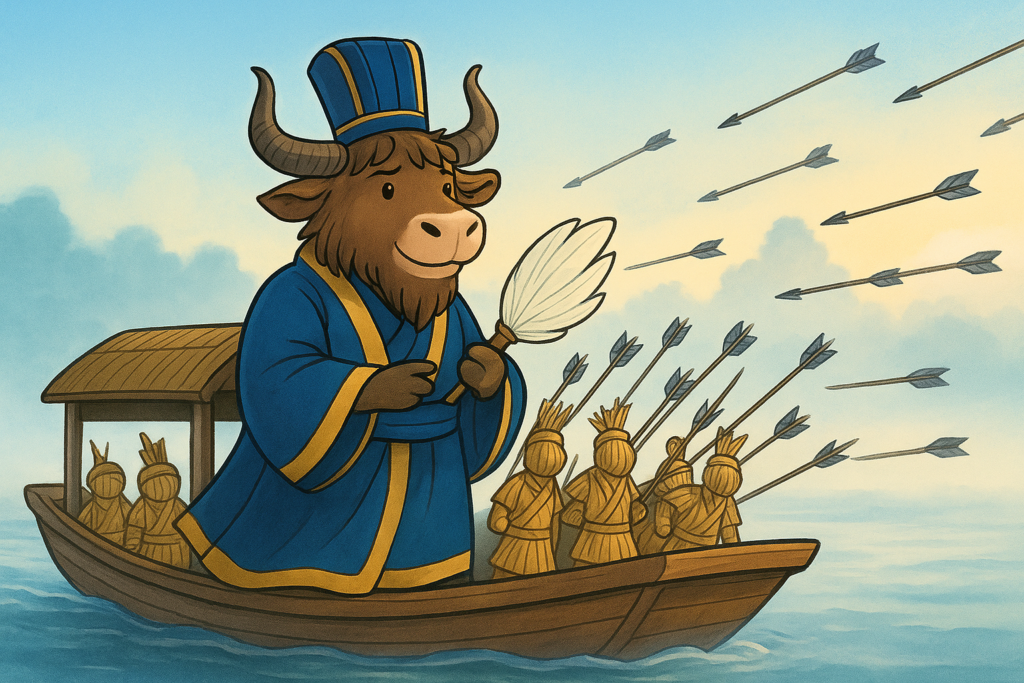
This B1 Intermediate retelling of 草船借箭 keeps the plot clear for learners while still giving the story some atmosphere and momentum.
This version teaches Simplified Chinese through English and includes clickable word help inside the story, full story audio, and lesson notes after the reading. It is free to use on Yak Yacker and is designed to feel natural, readable, and manageable for learners.
三国时期,吴国的周瑜想和曹操,但缺少。
有一天,周瑜对诸葛亮说:"诸葛亮先生,请你。"
诸葛亮,说:"十天太长了。给我,我一定给你。"
周瑜很,心里想:"这。"但他还是了,并让诸葛亮。
诸葛亮请鲁肃,说:"请你我二十条船,每条船上要有三十个士兵,还要用穿上军装,立在船的两边。"
鲁肃很,问:"你要这些东西做什么?"
诸葛亮说:"到时候你就知道了。"
第三天夜里,天还没亮,江上起了,几十米外就看不清了。诸葛亮带着,向曹操的军营。
等到船队曹营时,诸葛亮士兵们敲鼓、大喊。
"咚咚咚–"响彻江面。曹操的士兵被了,他们看不清江面上的情况,以为吴军。
曹操急忙:"放箭!"于是,几千名向江中射箭。
箭像飞来,都了船上的草人和草捆上。
过了一会儿,诸葛亮让船队,让草人的另一面也对着曹营。鼓声又响了起来,曹军放箭。
天快亮的时候,雾散了。草捆上已经扎满了的箭。诸葛亮笑着说:"够了,我们回去吧。"
船队回到吴营后,士兵们把箭从草人上,数了数,竟然有!
鲁肃说:"诸葛亮先生,您真是啊!您怎么知道今天会有大雾呢?"
诸葛亮摇着,说:"打仗不能只靠,还要呀!"
周瑜知道以后,也很,不过心里还是有点儿。
During the Three Kingdoms period, Zhou Yu, the Grand Commander of Wu, wanted to fight Cao Cao but lacked arrows.
One day, Zhou Yu said to Zhuge Liang, "Mr. Zhuge Liang, please produce 100,000 arrows within ten days."
Zhuge Liang smiled and said, "Ten days is too long. Give me three days, and I will definitely give you 100,000 arrows."
Zhou Yu was surprised and thought, "This is impossible." But he still agreed and made Zhuge Liang sign a military pledge.
Zhuge Liang asked Lu Su for help, saying, "Please lend me twenty boats, each with thirty soldiers, and place straw men dressed in military uniforms on both sides of the boats."
Lu Su was puzzled and asked, "What do you need these things for?"
Zhuge Liang said mysteriously, "You'll know when the time comes."
On the third night, before dawn, a thick fog rose over the river, making it impossible to see beyond a few dozen meters. Zhuge Liang led the fleet silently towards Cao Cao's camp.
When the fleet approached Cao's camp, Zhuge Liang ordered the soldiers to beat drums and shout loudly.
"Boom, boom, boom-" The drumbeats echoed across the river. Cao Cao's soldiers were awakened; unable to see clearly on the river, they thought Wu's army was attacking.
Cao Cao hastily ordered, "Fire arrows!" So thousands of archers shot arrows into the river.
The arrows flew like raindrops and all stuck into the straw men and straw bundles on the boats.
After a while, Zhuge Liang had the fleet turn around so the other side of the straw men faced Cao's camp. The drums sounded again, and Cao's army continued shooting arrows.
As dawn approached, the fog gradually dispersed. The straw bundles were densely packed with arrows. Zhuge Liang laughed and said, "That's enough, let's go back."
After the fleet returned to Wu's camp, the soldiers pulled the arrows off the straw men and counted them-there were actually over 100,000!
Lu Su said admiringly, "Mr. Zhuge Liang, you are truly divine! How did you know there would be a heavy fog today?"
Zhuge Liang waved his feather fan and said, "In war, one cannot rely only on bravery; one must also understand astronomy and geography!"
After Zhou Yu learned of this, he also admired Zhuge Liang, but deep down he still felt a bit unwilling to concede.
Let's grab the juiciest words from Zhuge Liang's clever plan. These terms will pop up again and again in Chinese historical tales, so they're well worth your time.
Pay attention to the characters and how they combine to form vivid images-like "arrow rain" or "straw men in uniform." We'll give you the pinyin and an example for each.
- 草船借箭 (cǎo chuán jiè jiàn) - "borrow arrows with straw boats." The whole story in a phrase! Example: 他用了草船借箭的计策,轻松解决了问题。(He used a straw-boat strategy to solve the problem effortlessly.)
- 军令状 (jūn lìng zhuàng) - a military pledge or written bond with serious consequences. Zhuge Liang had to sign one. Example: 既然你立了军令状,就要按时完成任务。(Since you signed a military pledge, you must finish the task on time.)
- 密密麻麻 (mì mì má má) - dense, closely packed. Describes the arrows sticking in the straw. Example: 纸上的字密密麻麻的,很难看清。(The words on the paper were so dense that it was hard to read them.)
- 上知天文,下知地理 (shàng zhī tiān wén, xià zhī dì lǐ) - "know astronomy above, know geography below." A compliment for someone broadly knowledgeable. Example: 他是个上知天文、下知地理的学者。(He's a scholar who knows everything from the stars to the earth.)
Zhuge Liang's soldiers 把箭从草人上拔下来 (bǎ jiàn cóng cǎo rén shàng bá xià lái) - "pulled the arrows off the straw men." This little word 把 is a superstar for handling objects.
The 把 structure emphasizes what happens to an object, often a change of location or state. The pattern is: Subject + 把 + Object + Verb + Other information. Think of it as "take the object and do something to it."
- Story example: 他们把箭拔下来。(They pulled the arrows off.) - Here, 箭 (arrows) is the object, 拔下来 tells what happened to it.
- Compare without 把: 他们拔下来箭。This is grammatically fine, but 把 shines when the verb has a complement (like 下来) and you want to keep the object clear.
- Create your own: Try saying "I finished reading that book" with 把 → 我把那本书看完了。(Wǒ bǎ nà běn shū kàn wán le.) Notice the object is definite (那本书, that book).
- Common pitfall: The verb after 把 must be something you do to the object (an action verb), and the sentence can't end with just the verb-it usually needs a result or direction. Don't say *我把书看. Instead, add a complement like 完, 懂, or 一下.
草船借箭 isn't just a cool story-it's a classic metaphor in Chinese for using the enemy's resources to achieve your goal. Zhuge Liang's genius was turning fog and panic into free arrows.
The phrase is still used today to describe any clever leveraging of third-party resources. For example, a startup might "借箭" from a competitor's technology to build a better product. It's all about working smarter, not harder.
- Zhuge Liang relied on practical knowledge: predicting weather (上知天文) and using the river currents (下知地理). The story celebrates wisdom over brute force.
- In a work context, you might hear: 我们可以来个草船借箭,用对手的广告让更多人知道我们的品牌。(We can "borrow arrows" by using the competitor's ads to make our brand better known.)
You've met the characters, read the ruse, and unpacked the language. Now it's time to make the story your own. Try retelling the key events in Chinese, using at least three of the new words or structures from this lesson.
Don't worry about perfection-focus on getting the flow and having fun with it. You can even add a twist: what if the fog lifted early? How would Zhuge Liang talk his way out? Record yourself or write it down, then come back and share it with a tutor or friend.
草船借箭 comes from the Chinese / Romance of Three Kingdoms tradition and is best known as a historical novel episode. This Yak Yacker article is an original learner retelling based on Romance of the Three Kingdoms; public domain, so the wording here is simplified for modern learners rather than copied from one old edition.
Older printings, translations, and retellings of this story can vary quite a bit. The original audience was usually general, but this version is adapted for B1 Intermediate learners studying Simplified Chinese. Good strategy story; simplify factions.
If you want to look into the source tradition, start with Project Gutenberg.
If you want to keep going, browse more in our Simplified Chinese section and review the HSK Level 1 Chinese Vocabulary. After that, try Essential Chinese Grammar Words for another useful next step.