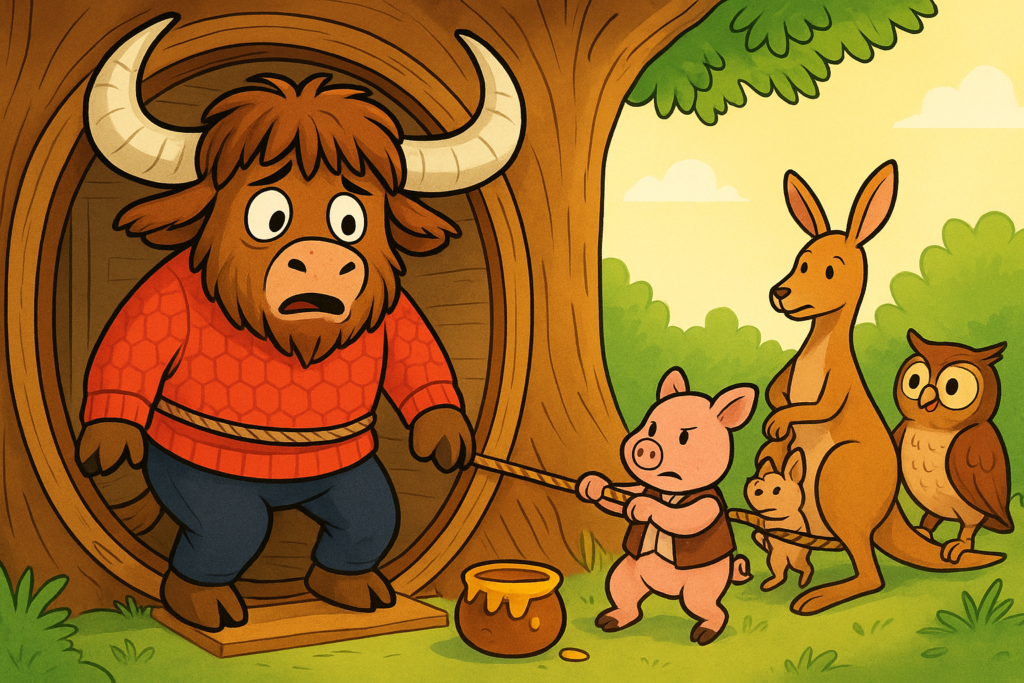
Welcome to Yak Yacker's interactive A2 English story! Today, we're heading to the Hundred Acre Wood to meet a very special bear. Winnie-the-Pooh loves honey more than anything, and his latest adventure is full of fun, friends, and a little problem. When Pooh visits Rabbit and eats too much, he gets stuck in the door! Can his friends help him get free?
This retelling of the beloved classic is written in simple English so you can read and enjoy it even at the elementary level. As you read, you'll find clickable words that give you instant definitions-no need to stop to look in a dictionary. There's also a full audio version so you can listen along and improve your pronunciation. Whether you read, listen, or do both, this story helps you build vocabulary and confidence in English.
A friendly lesson note at the end explains a few useful language points from the story. So, sit back, click play on the audio if you like, and let's join Pooh on his sticky adventure!
One morning, Winnie-the-Pooh felt very hungry. He thought about . So he went to Rabbit's house. Rabbit always had a of honey.
Pooh . Rabbit . "Hello, Pooh! Come in," said Rabbit. Pooh went inside happily.
Rabbit some bread and a jar of honey on the table. Pooh ate a lot of bread with honey. "Mmm, this honey is so !" he said.
Pooh ate and ate. Soon, he was very . His tummy got . "I must go now," he said. He got up to leave.
He went to the door, but he got ! He could not . "Oh, no! I am stuck!" cried Pooh. Rabbit looked worried. "I will call Piglet," he said. Rabbit called, "Piglet, come and !"
Piglet came . He pulled Pooh's arms. Rabbit pulled too. But Pooh did not move. "He is too full!" said Piglet.
"We must ," said Piglet. They called more friends. All the animals came to pull: Kanga, Roo, and Owl.
They pulled together. "One, two, three, !" shouted Rabbit. With a , Pooh came out. Everyone fell down and laughed.
Pooh laughed too. "Thank you, friends. I think I ate too much honey," he said. They all had a little bread (without too much honey) and were happy together.
One morning, Pooh was very hungry. He wanted honey. So he went to Rabbit's house, because Rabbit always had a big jar of honey.
Pooh knocked on the door. Rabbit opened it and said, "Hello, Pooh! Come in." Pooh went inside happily.
Rabbit put bread and a jar of honey on the table. Pooh ate a lot of bread with honey and said, "Mmm, this honey is so good!"
Pooh ate a lot. Soon, his tummy was big and round. He said, "I must go now," and got up to leave.
He went to the door, but he got stuck! He could not move. "Oh, no! I am stuck!" cried Pooh. Rabbit said, "I will call Piglet." Rabbit called, "Piglet, come and pull!"
Piglet came quickly. He and Rabbit pulled Pooh's arms, but Pooh did not move. Piglet said, "He is too full!"
Piglet said, "We must help each other." They called more friends: Kanga, Roo, and Owl. All the animals came to pull.
They pulled together. Rabbit shouted, "One, two, three, PULL!" With a loud POP, Pooh came out. Everyone fell down and laughed.
Pooh laughed too. He said, "Thank you, friends. I think I ate too much honey." They all had a little bread without too much honey and were happy.
This story uses a few very useful words for talking about how we feel. Pooh is hungry at the start, then full after eating, and finally stuck when he cannot move through the door.
These words are simple, but they help you tell a clear story. You can use them in everyday life too: "I'm hungry," "I'm full," and "I'm stuck."
- hungry = wanting food
- full = having eaten enough
- stuck = unable to move
- Use these words to describe a problem quickly
When Pooh gets stuck, the other characters do not just watch. They call for help, come quickly, and work together. This is a nice example of teamwork.
In stories and in real life, friends help by doing small jobs together. One person may call, another may pull, and everyone can encourage the group.
- call for help
- come quickly
- work together
- encourage each other
The story repeats simple action words: went, opened, ate, got up, pulled, and laughed. These are great for telling events in order.
Notice the short sentences too. They make the story easy to follow. In English, short sentences are often a good choice when you want your meaning to be clear and friendly.
- Use action verbs to show what happens
- Put events in order: first, then, soon, after that
- Short sentences can make a story easier to understand
Pooh's problem is funny, but the message is serious in a kind way: too much of a good thing can cause trouble. A little patience and a little teamwork can solve a sticky situation.
Next time you read a story like this, look for the problem, the helpers, and the ending. That will help you understand the story and remember the new words more easily.
- Too much honey caused the problem
- Friends solved it together
- Look for problem, help, and ending
- Stories can teach us how to be kind and patient
Winnie-the-Pooh and the Honey Adventure comes from the English / A. A. Milne tradition and is best known as a children's story collection. This Yak Yacker article is an original learner retelling based on A. A. Milne, 1926; public domain in U.S., so the wording here is simplified for modern learners rather than copied from one old edition.
Older printings, translations, and retellings of this story can vary quite a bit. The original audience was usually kids, but this version is adapted for A2 Elementary learners studying English. Only original 1926 book version; Disney/trademarks and later designs still caution.
If you want to look into the source tradition, start with Project Gutenberg.
If you want to keep going, browse more in our English section and review the A2 English Vocabulary List. After that, try 1,200 English Phrases and Expressions for another useful next step.