


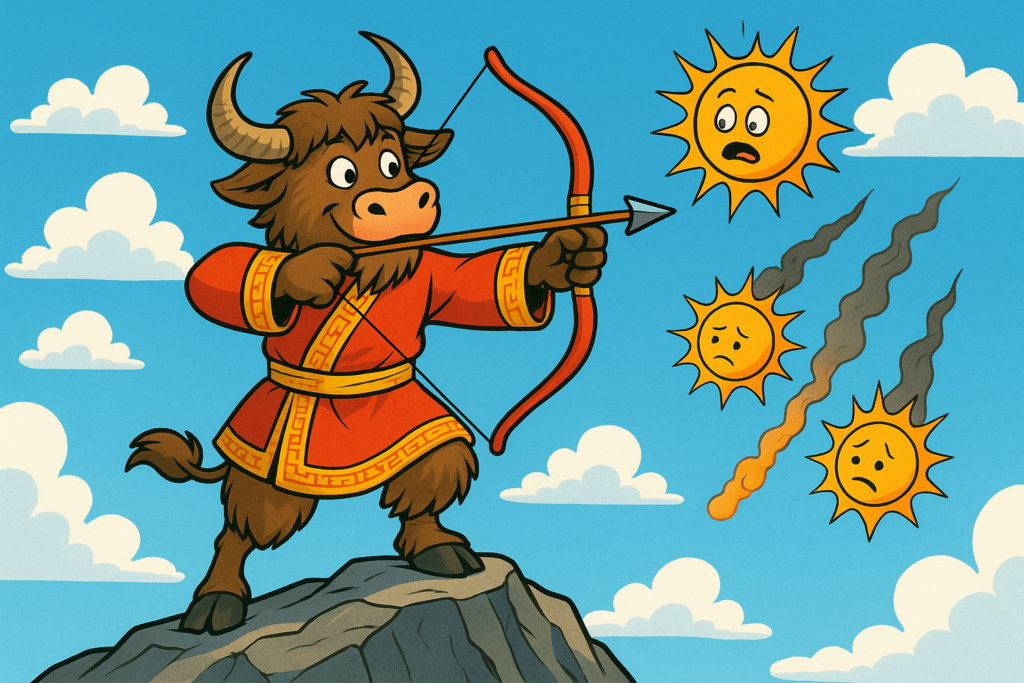
This A2 Elementary retelling of 后羿射日 keeps the plot clear for learners while still giving the story some atmosphere and momentum.
This version teaches Simplified Chinese through English and includes clickable word help inside the story, full story audio, and lesson notes after the reading. It is free to use on Yak Yacker and is designed to feel natural, readable, and manageable for learners.
很久很久以前,天上有十个太阳。他们每天一个出来,给世界光和热。可是有一天,一起出来了。
天太热了!地上的人们、动物和植物都受不了。河流干了,土地裂开了。皇帝说:"这可怎么办呢?"
有一个叫后羿的神箭手。他有一把红弓和白箭。皇帝请他帮忙。后羿说:"我去射太阳!"
后羿爬上了一座高山。他拿起弓,搭上箭,瞄准一个太阳。嗖!一个太阳掉下来了。
他不停地射。嗖!嗖!嗖!八个太阳掉了下来。天上只有一个太阳了。
最后一个太阳很害怕,他说:"请不要射我!没有我,世界就没有光和热了。"后羿想了想,说:"好吧,你留下来。但你要按时升起和落下,不能太热。"
太阳答应了。从那以后,太阳每天早上升起,晚上落下。世界不热不冷,人们非常高兴。
A long time ago, there were ten suns in the sky. Each day, one came out to give light and heat to the world. But one day, all ten suns came out together.
It was too hot! The people, animals, and plants on earth couldn't bear it. Rivers dried up, and the land cracked. The emperor said, "What can be done?"
There was an archer named Hou Yi. He had a red bow and white arrows. The emperor asked for his help. Hou Yi said, "I'll shoot down the suns!"
Hou Yi climbed a high mountain. He took his bow, nocked an arrow, and aimed at a sun. Whoosh! A sun fell down.
He kept shooting. Whoosh! Whoosh! Whoosh! Eight suns fell. Only one sun remained in the sky.
The last sun was very scared and said, "Please don't shoot me! Without me, the world will have no light or heat." Hou Yi thought for a moment and said, "Alright, you stay. But you must rise and set on time, and not be too hot."
The sun agreed. From then on, the sun rises in the morning and sets in the evening. The world is neither too hot nor too cold, and people are very happy.
Here are some useful words and phrases from the story of Hou Yi. Try to remember them-you'll see many of these in other Chinese tales and everyday conversations!
- 太阳 (tàiyáng) - sun. E.g., 天上有一个太阳。 (There is one sun in the sky.)
- 热 (rè) - hot. E.g., 今天很热。 (Today is very hot.)
- 冷 (lěng) - cold. E.g., 冬天很冷。 (Winter is very cold.)
- 高兴 (gāoxìng) - happy. E.g., 我们很高兴。 (We are very happy.)
In Chinese, the particle 了 (le) often shows that an action is completed or a situation has changed. In the story, you saw it many times, like in 掉下来了 (fell down) and 人们非常高兴了 (people were very happy).
For A2 learners, a simple rule is: when you want to say something happened, add 了 right after the verb. For example, 我吃了 (I ate), 他走了 (he left). But remember, in negative sentences you use 没 (méi) and drop the 了: 我没吃 (I didn't eat).
- 天太热了!(Tiān tài rè le!) - It got too hot! (highlighting a change)
- 后羿射了一个太阳。(Hòu yì shè le yī gè tàiyáng.) - Hou Yi shot a sun. (completed action)
Now that you know the story, try retelling it in your own words. Use the new vocabulary and the 了 grammar to say what happened. You can also write a short summary or draw a comic strip with captions in Chinese!
- Review the key words again tomorrow-a little daily practice goes a long way.
- Look for 了 in your next Chinese reading and notice how it shows completed actions.
后羿射日 comes from the Chinese / myth tradition and is best known as a myth. This Yak Yacker article is an original learner retelling based on Ancient Chinese myth; public domain, so the wording here is simplified for modern learners rather than copied from one old edition.
Older printings, translations, and retellings of this story can vary quite a bit. The original audience was usually kids/general, but this version is adapted for A2 Elementary learners studying Simplified Chinese. Good for numbers/weather/hero vocabulary.
If you want to look into the source tradition, start with Wikipedia.
If you want to keep going, browse more in our Simplified Chinese section and review the HSK Level 1 Chinese Vocabulary. After that, try Essential Chinese Grammar Words for another useful next step.