This A2 Elementary retelling of El Cid y el León keeps the plot clear for learners while still giving the story some atmosphere and momentum. El Cid es un caballero valiente. Vive en un castillo con sus soldados.
This version teaches Spanish through English and includes clickable word help inside the story, full story audio, and lesson notes after the reading. It is free to use on Yak Yacker and is designed to feel natural, readable, and manageable for learners.
El Cid es un . Vive en un con sus soldados. Tiene un .
Un día, el león se de su . ¡Qué miedo! Los soldados y gritan.
Pero El Cid no tiene miedo. el león . El león lo mira.
El león : ¡Grrr! El Cid dice: 'Tranquilo, amigo. No quiero .'
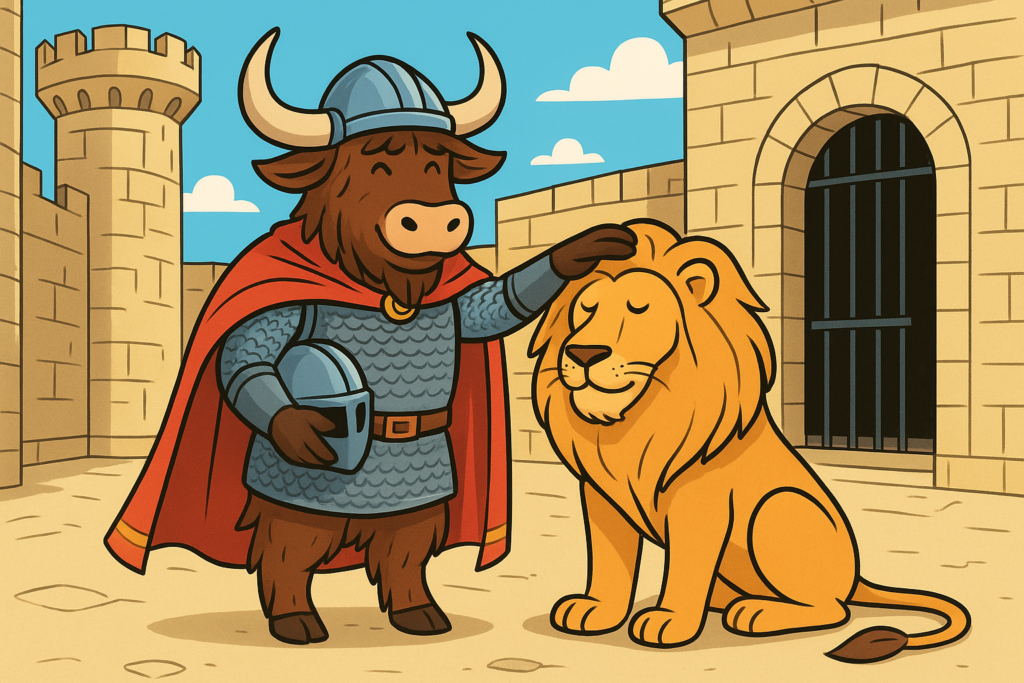
El Cid su mano en la cabeza del león. El león se . Juntos a la jaula.
Los soldados están . Gritan: '¡Viva El Cid! ¡Es el más !'
El Cid y dice: 'El león solo un amigo.'
El Cid is a brave knight. He lives in a castle with his soldiers. He has a big, strong lion.
One day, the lion escapes from its cage. How scary! The soldiers run and shout.
But El Cid is not afraid. He walks slowly toward the lion. The lion looks at him.
The lion roars: Grrr! El Cid says: 'Easy, friend. I don't want to hurt you.'
El Cid puts his hand on the lion's head. The lion calms down. Together they walk to the cage.
The soldiers are amazed. They shout: 'Long live El Cid! He is the bravest!'
El Cid smiles and says: 'The lion just needs a friend.'
Let’s pick out some useful words you met in the tale. Learning these will help you talk about knights, animals, and big feelings in Spanish.
- caballero (knight) and valiente (brave) – El Cid es un caballero valiente.
- león (lion), jaula (cage), and fuerte (strong) – Un león grande y fuerte se escapa de su jaula.
- miedo (fear) – ¡Qué miedo! Los soldados tienen miedo, pero El Cid no tiene miedo.
- tranquilo (calm) and amigo (friend) – El Cid dice: 'Tranquilo, amigo.' He speaks gently to the lion.
The whole story is told in the present tense, which makes it feel immediate and exciting. In Spanish, the present tense is straightforward but watch out for a few irregular forms.
- Regular verbs: vive (he lives), corre (he runs), camina (he walks), gritan (they shout).
- Irregular yo forms: tengo (I have) from tener, but here we see tiene (he has) – El Cid tiene un león.
- Stem changers: ruge (it roars) from rugir (o → ue), sonríe (he smiles) from sonreír (e → í).
- Reflexive verbs: se escapa (escapes), se calma (calms down). Notice the 'se' before the verb.
The story shows us two ways to talk about fear and bravery in Spanish. You can use tener miedo (to be afraid) and valiente (brave). Also, notice how El Cid calms the lion with a simple word.
- Tener miedo means 'to have fear.' Los soldados tienen miedo. (The soldiers are afraid.)
- No tener miedo means 'not to be afraid.' El Cid no tiene miedo. (El Cid is not afraid.)
- Valiente is an adjective that describes a brave person or act. El Cid es valiente. ¡Es el más valiente!
- To ask if someone is afraid: ¿Tienes miedo? (Are you afraid?)
Now it’s your turn! Imagine you meet a wild animal in a calm, brave way. What would you say? Use some of the words and phrases you’ve just learned.
- Start with a present–tense sentence: Un perro grande viene hacia mí. (A big dog comes toward me.)
- Describe your reaction: No tengo miedo. (I’m not afraid.)
- Talk to the animal like El Cid: 'Tranquilo, amigo. No quiero hacerte daño.'
- End with a smile and a new friend: El perro se calma y juntos caminamos.
El Cid y el León comes from an older public-domain story tradition and is best known as a public_domain_legend_retelling. This Yak Yacker article is an original learner retelling based on public-domain source material, so the wording here is simplified for modern learners rather than copied from one old edition.
Older printings, translations, and retellings of this story can vary quite a bit. This version is adapted for A2 Elementary learners studying Spanish.
If you want to keep going, browse more in our Spanish section and review the A2 Vocabulary List. After that, try Spanish Gender Rules for Nouns and Adjectives for another useful next step.