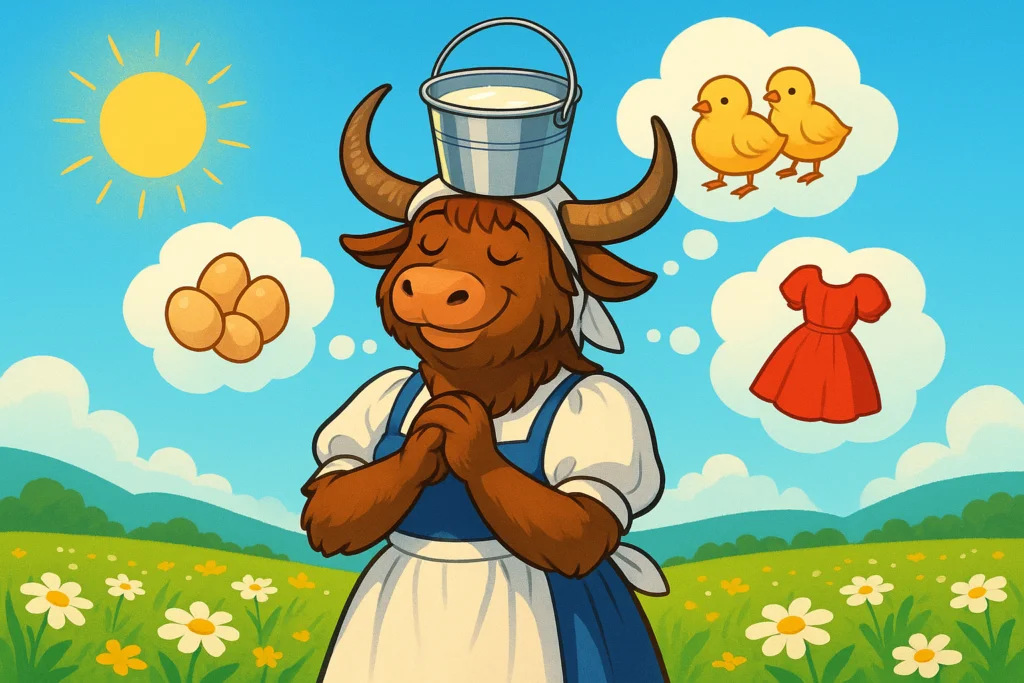
Welcome to our free A1 Spanish story, a gentle retelling of the classic fable 'The Milkmaid.' Meet a young girl carrying a pail of milk to market, dreaming of all the wonderful things she'll buy-until one moment of distraction teaches her a valuable lesson. This well-loved tale is perfect for beginners, with simple vocabulary and a clear, easy-to-follow narrative.
On this page, you can read and listen to the entire story in Spanish, with full audio to help you master pronunciation and rhythm. Every word is clickable for instant translations, so you'll never feel lost. After the story, check out our bite-sized lesson notes that explain key grammar and vocabulary, making your learning smooth and enjoyable. It's a complete, self-contained reading experience-no textbook required.
Una lechera al mercado. Lleva una en la cabeza.
Piensa: «Voy a la leche y con el dinero voy a huevos».
«De los huevos voy a tener . Luego voy a los pollos y voy a comprar un vestido ».
La lechera : «Voy a ser la más del pueblo. Todos me van a ».
Mueve la cabeza con y la jarra . La leche se por el suelo.
No hay huevos, no hay pollos, no hay vestido. ¡No !
A milkmaid walks to the market. She carries a jug of fresh milk on her head.
She thinks: "I'm going to sell the milk and with the money I'll buy eggs."
"From the eggs I'll have chicks. Then I'll sell the chicks and buy an elegant dress."
The milkmaid imagines: "I'll be the prettiest in the village. Everyone will look at me."
She moves her head with joy and the jug falls. The milk spills on the ground.
There are no eggs, no chicks, no dress. Don't count your chickens before they hatch!
Let’s pick out the most important words from the story. These food-related terms are the building blocks of the milkmaid’s dream.
Notice how the story uses simple, everyday nouns. Recognizing them will help you follow along and build your own sentences.
- la leche – milk
- los huevos – eggs
- los pollos – chickens
The milkmaid’s plans all use a handy structure: ir a + infinitive. It’s the most common way to say what you’re going to do in Spanish.
Just conjugate the verb ir (to go), add a, and then your action word (the infinitive). Even at A1 level, this opens up a world of conversation!
- voy a vender – I’m going to sell
- vas a comprar – you’re going to buy
- va a mirar – he/she is going to look
- vamos a tener – we’re going to have
The story ends with a classic saying: «No cuentes los pollos antes de nacer». It’s the Spanish equivalent of -Don’t count your chickens before they hatch.-
It’s a gentle reminder not to depend on future events that may never happen. The milkmaid learned it the hard way!
- no cuentes – don’t count
- los pollos – the chickens
- antes de nacer – before being born / before they hatch
Now it’s your turn! Using ir a + infinitive, share a few of your own plans. What are you going to do later today or this week?
You could even retell the story from the milkmaid’s point of view. Keep dreaming—just hold onto your jar!
- Write three things you are going to do tomorrow.
- Say them out loud to practice pronunciation.
La Lechera comes from an older public-domain story tradition and is best known as a public_domain_fable_retelling. This Yak Yacker article is an original learner retelling based on public-domain source material, so the wording here is simplified for modern learners rather than copied from one old edition.
Older printings, translations, and retellings of this story can vary quite a bit. This version is adapted for A1 Beginner learners studying Spanish.
If you want to keep going, browse more in our Spanish section and review the A1 Spanish Vocabulary List. After that, try Essential Spanish Grammar Words for another useful next step.