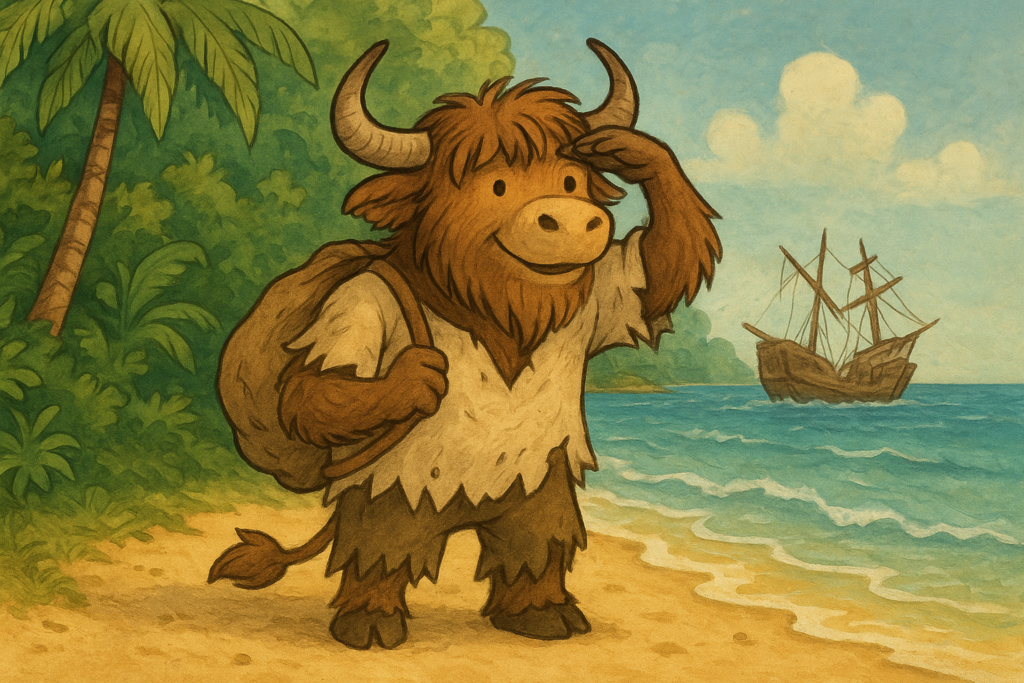
Robinson Crusoe is a classic adventure story about a man who survives a shipwreck and lives alone on a tropical island. He builds a home, finds food, and learns to survive. Later, he meets Friday, a man he rescues from cannibals, and they become friends. It is a story of survival, hope, and friendship.
In this special A2 elementary version, you can read and listen to the story for free. Every word is clickable, so you can see its meaning right away. The story audio helps you practice listening and pronunciation. At the end, you will find lesson notes to help you learn new words and grammar.
Robinson Crusoe loved the sea. He wanted to and see new places. But one day, a hit his ship. The ship broke, and the water pulled him under.
He opened his eyes. He was on a beach. 'Where is everybody?' he cried. He walked and called, but no one answered. He felt very .
He went back to the broken ship. He made a and took food, tools, and clothes. Then he found a cave and made a small home. He felt a little .
Every day, he with a spear and found fruit and nuts. He planted seeds and waited. Little plants grew. 'I will not ,' he said.
One day, he saw a on the sand. He felt afraid. Was there someone else on the island? He waited and watched. Then he saw a man . Other men chased him. Robinson helped the man. 'Thank you! You saved me!' said the man. Robinson smiled and called him Friday.
Friday was happy and friendly. He learned English words from Robinson. 'Friend,' Friday said. 'Yes, friend,' Robinson answered. They built a small boat. Robinson felt and not anymore.
One morning, a big ship came near the island. 'A ship!' Friday shouted. Robinson ran to the beach and his arms. The sailors saw them. 'We are going home!' Robinson cried.
They sailed back to England. Robinson looked at the sea and remembered his long . He walked on the busy streets and smiled. He was home.
Robinson Crusoe loved the sea and wanted to travel. One day, his ship was hit by a big storm. The ship broke, and he was pulled underwater.
He woke up on a beach. He called out, but no one answered. He felt very alone.
He went to the broken ship, made a raft, and took supplies. He found a cave and made a small home. He felt safer.
Every day, he hunted and gathered fruit and nuts. He planted seeds and saw plants grow. He said he would not give up.
One day, he saw a footprint and became afraid. He saw a man being chased and helped him. The man thanked him, and Robinson named him Friday.
Friday was friendly and learned English. They became friends and built a boat. Robinson felt hopeful and no longer alone.
One morning, a ship came. Friday shouted, and Robinson waved. The sailors saw them, and Robinson said they were going home.
They sailed to England. Robinson thought of his adventure. He walked the busy streets, smiled, and felt he was home.
Robinson used many things to live on the island. Learning these survival words will help you describe basic needs and nature in English.
- raft: a simple flat boat
- cave: a natural rock shelter
- spear: a pointed hunting tool
- footprint: a mark left by a foot
This adventure is told in the past simple tense. We use it for finished actions. Regular verbs add -ed (walk → walked), but many common verbs are irregular, so you need to remember their forms.
To make negatives, use didn't + base verb. For questions, put did before the subject.
- Robinson walked on the beach. / He felt very lonely.
- He didn't see anyone for a long time.
- Did he find food? Yes, he hunted and picked fruit.
In the story, Robinson's emotions change a lot. These words help you express how someone feels inside-very useful for storytelling!
- lonely: unhappy because you are alone → "He felt very lonely."
- afraid: feeling fear → "He felt afraid of the footprint."
- hopeful: believing good things will come → "He felt hopeful with Friday."
- friendly: kind and nice to others → "Friday was happy and friendly."
Now it's your turn! Imagine you are on a deserted island like Robinson. What three things would you do first? Use the past simple to write or tell your own mini-adventure. Start with: "I arrived on the island. I…"
Try adding words like first, then, after that to show the order of events. You can do it!
Robinson Crusoe comes from an older public-domain story tradition and is best known as a public_domain_story_retelling. This Yak Yacker article is an original learner retelling based on public-domain source material, so the wording here is simplified for modern learners rather than copied from one old edition.
Older printings, translations, and retellings of this story can vary quite a bit. This version is adapted for A2 Elementary learners studying English.
If you want to keep going, browse more in our English section and review the A2 English Vocabulary List. After that, try English Question Words for another useful next step.