


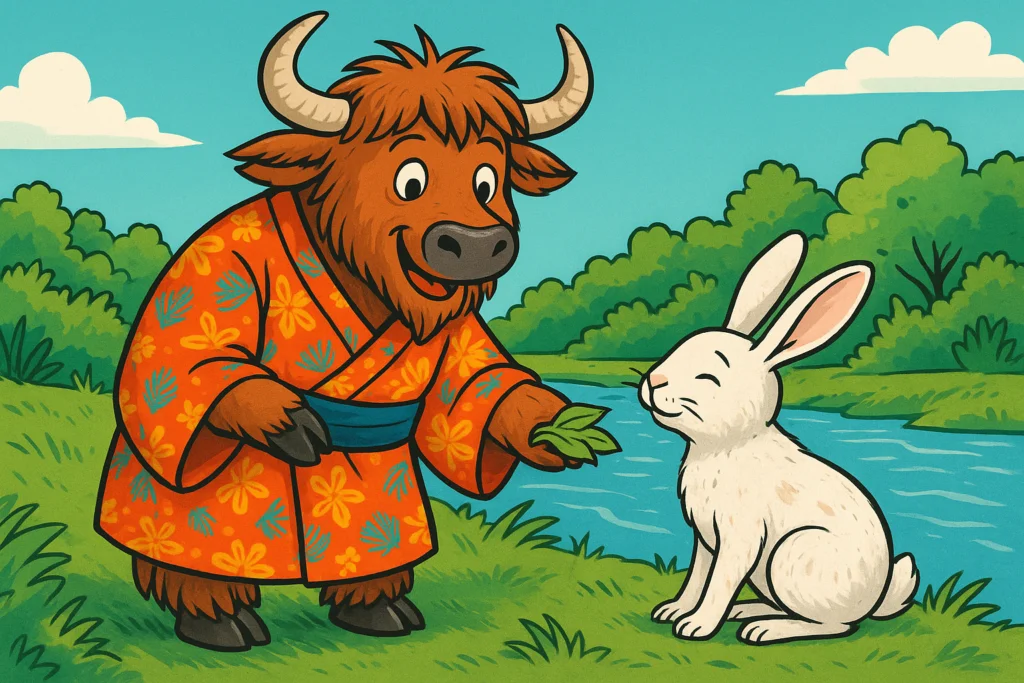
In this beginner-friendly retelling of a beloved Japanese legend, a clever white hare wants to cross from the island of Oki to the mainland of Inaba. His trick works at first, but the plan goes badly wrong, and the hare finds himself hurt and alone on the shore.
Everything changes when a large group of gods comes walking along the beach. Eighty brothers travel together, all hoping to win the hand of Princess Yakami, and they give the hare some very cruel advice. But the last god to pass by is kind, honest, and different from all the rest.
Along the way, you'll pick up useful everyday words for animals, body parts, kindness, and simple actions. Every word in the story is tappable for instant translations, and the whole text comes with native story audio, clear lesson notes, and free interactive exercises.
This is a gentle A2 elementary (upper-beginner) read, so if you know hiragana and some basic grammar, you're ready to hop right in.
むかしむかし、 しろい うさぎが いました。うさぎは を わたりたくて、「わたしは みずの なかを 。どうしましょう?」と いいました。
その とき、わにが およんで きました。うさぎは ちょっと 、いい を おもいつきました。
「わにさん、わたしたちと あなたたちは、どちらが いますか? みましょう」と うさぎは いいました。
わにたちは うみの うえに ならびました。うさぎは わの うえを ぴょん、ぴょん、ぴょんと 、かずを かぞえました。
「いち、に、さん……」でも、うさぎは おわりに 「! わたしは あなたたちを つかったのです!」と いいました。わにたちは とても 。うみの なかに しまいました。
うさぎは かわを わたりました。でも、わにたちは うさぎの かわを 。「いたい!」うさぎは すなの うえに 。かわが とても いたかったです。
そこに が とおりました。彼らは しんせつでは ありませんでした。「うみの みずで あらいなさい。かぜに あたりなさい」と いいました。うさぎは その とおりに しました。でも、もっと いたくなりました。うさぎは ないて しまいました。
つぎに、おおきな かばんを もった おとこが きました。なまえは オオクニヌシでした。「どうしたの?」と 。
うさぎは すべてを はなししました。オオクニヌシは やさしく いいました。「かわの みずで あらいなさい。この を つけなさい。あたらしい かわが でますよ」。
うさぎは がまの はなを からだに つけました。すると、かわは よくなりました。「ありがとう!」うさぎは とても うれしくなりました。
「しんせつな ひとを たすけた から、あなたは 」と うさぎは いいました。そして、その とおりに なりました。オオクニヌシは やさしさで、さいごに しあわせに なったのです。
Long, long ago, a white rabbit lived in the land of Inaba. The rabbit wanted to cross the water, so he said, "I can't swim. What should I do?"
Just then, a crocodile came swimming by. The rabbit thought for a moment and came up with a good idea.
"Mr. Crocodile, which of us is greater in number-us rabbits or you crocodiles? Let's count," said the rabbit.
The crocodiles lined up in a row across the sea. The rabbit hopped along their backs-hop, hop, hop-counting them as he went.
"One, two, three..." But at the very end, the rabbit said, "You fools! I was just using you!" The crocodiles were furious and disappeared into the sea.
The rabbit crossed the water. But the crocodiles tore off his fur. "Ouch!" The rabbit collapsed on the sand, crying. His skin hurt terribly.
Then the eighty gods came passing by. They were not kind. "Wash yourself in seawater and let the wind dry you," they said. The rabbit did as he was told, but it hurt even more, and he began to cry.
Next, a kind man carrying a large bag came along. His name was Okuninushi. "What happened?" he asked.
The rabbit told him everything. Okuninushi gently said, "Wash yourself in fresh water, then cover yourself with the pollen of cattail flowers. Your skin will grow back nicely."
The rabbit covered his body with the cattail pollen, and his skin quickly got better. "Thank you!" The rabbit was so happy.
"Because you helped someone in need, you will find happiness," said the rabbit. And that is exactly what happened. In the end, Okuninushi found happiness through his kindness.
Japanese past-tense narration usually appears in plain form: いました (was/existed), いいました (said), とんで (jumped), たおれました (fell down). In stories you will often see a mix of ~ました endings and plain forms like いた or ないた - both point to the past.
When you retell a story, stick to ~ました endings to keep it simple. For example: うさぎは かわを わたりました (The hare crossed the river). うさぎは ないて しまいました (The hare ended up crying).
- いました / ~ました = past tense, polite
- いた / ないた = past tense, plain (common in stories)
- たずねました = asked; はなししました = told (something)
This story is full of feeling and injury words. いたい means "it hurts," so かわが とても いたかったです means "the skin hurt a lot" - notice how いたい becomes いたかった in the past tense.
うれしくなりました means "became happy," and おこりました means "got angry." Adding ~なりました after an adjective is a natural way to show a change of feeling.
- いたい → いたかったです = it hurt
- かなしい / うれしい = sad / happy
- ~は ~く なりました = became ~ (うれしく なりました = became happy)
- おこりました = got angry
オオクニヌシ asks どうしたの? (What's wrong?) - a soft, caring question you can use with friends. Compare the unkind advice of the eighty gods: あらいなさい (wash it!) with the kind man's gentle instructions.
The pattern ~なさい gives a direct instruction, like あらいなさい (wash!) or つけなさい (put on!). It's gentler than a command, but stronger than a suggestion. The polite way to ask for help is たすけて (help me).
- どうしたの? = What's wrong? (friendly)
- ~なさい = do ~ (あらいなさい = wash it)
- たすけて = help!
- ありがとう ございます / ありがとう = thank you (casual)
Try retelling the story in five or six past-tense sentences: the hare wanted to cross, tricked the crocodiles, got hurt, met kind オオクニヌシ, and became happy again. Using sequence words like つぎに (next) and そして (then) will hold your story together.
A little each day goes a long way - one sentence tonight, one tomorrow. The hare recovered step by step, and so will your Japanese!
- Use そして / つぎに to link events
- Start each sentence with the subject: うさぎは…, オオクニヌシは…
- Aim for five past-tense sentences about the story
The White Hare of Inaba comes from the Japanese / Kojiki myth tradition and is best known as a myth/fable. This Yak Yacker article is an original learner retelling based on Ancient Japanese myth; public domain, so the wording here is simplified for modern learners rather than copied from one old edition.
Older printings, translations, and retellings of this story can vary quite a bit. The original audience was usually kids/general, but this version is adapted for A2 Elementary learners studying Japanese. Good animal/moral story.
If you want to look into the source tradition, start with Wikipedia.
If you want to keep going, browse more in our Japanese section and review the Geography Vocabulary in Japanese. After that, try Japanese Question Words for another useful next step.