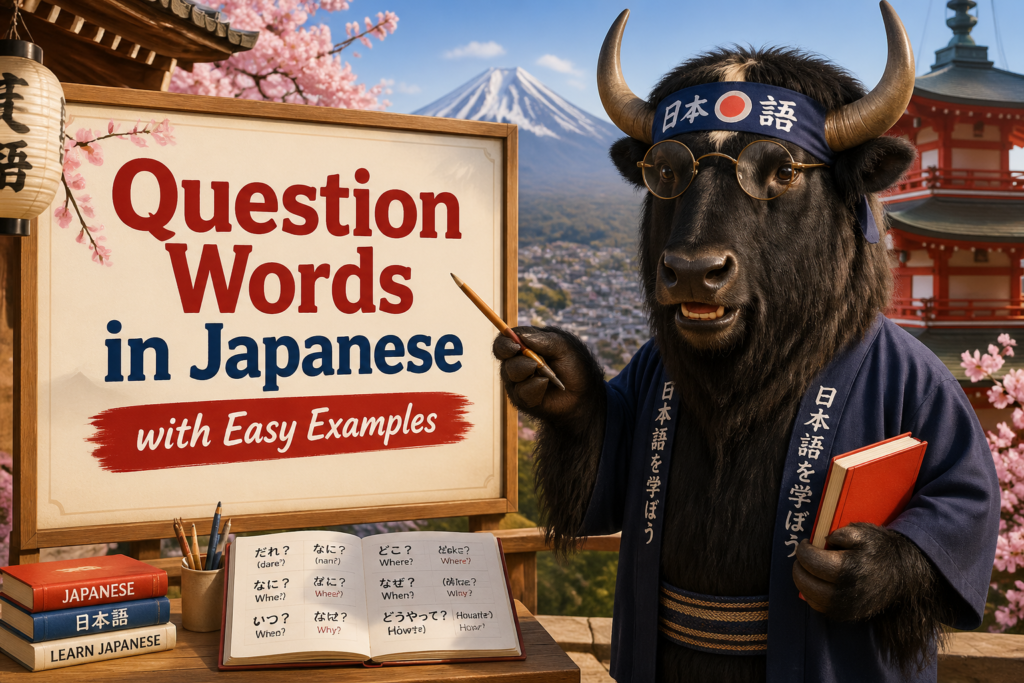
Japanese question words look small, but they do a lot of heavy lifting. The good news? Once you know the basic set, you can ask about people, things, places, reasons, time, and choices without sounding like you are wrestling the sentence from the inside out.
If you have ever stared at なに / nan and wondered why it sometimes becomes なん / nan, welcome to the club. Japanese likes a little sound change drama. Very polite, very tidy, mildly annoying.
This chart gives you the most useful Japanese question words, their meanings, and real example sentences so you can start using them fast. For a broader learning path, you can also check the main guide at Learn Japanese.
The Most Useful Japanese Question Words
| Kanji / Japanese | Rōmaji | English Meaning | Example Sentence | Rōmaji | Translation |
|---|---|---|---|---|---|
| 何 | nani / nan | what | 何を食べますか。 | Nani o tabemasu ka. | What will you eat? |
| 誰 | dare | who | 誰が来ますか。 | Dare ga kimasu ka. | Who is coming? |
| どこ | doko | where | 駅はどこですか。 | Eki wa doko desu ka. | Where is the station? |
| いつ | itsu | when | いつ帰りますか。 | Itsu kaerimasu ka. | When are you going home? |
| なぜ | naze | why | なぜ日本語を勉強しますか。 | Naze Nihongo o benkyō shimasu ka. | Why do you study Japanese? |
| どうして | dōshite | why / how come | どうして遅れましたか。 | Dōshite okuremashita ka. | Why were you late? |
| どの | dono | which | どの本が好きですか。 | Dono hon ga suki desu ka. | Which book do you like? |
| どれ | dore | which one | どれが一番安いですか。 | Dore ga ichiban yasui desu ka. | Which one is the cheapest? |
| いくら | ikura | how much | これはいくらですか。 | Kore wa ikura desu ka. | How much is this? |
| いくつ | ikutsu | how many / how old | お子さんはいくつですか。 | Okosan wa ikutsu desu ka. | How old is your child? |
| どちら | dochira | which way / which one / who (polite) | 駅はどちらですか。 | Eki wa dochira desu ka. | Which way is the station? |
| どのくらい | dono kurai | how much / how long | ここまでどのくらいかかりますか。 | Koko made dono kurai kakarimasu ka. | How long does it take to get here? |
These are the core words. If you learn only these, you can already ask a surprising number of questions. Small words, big results. Very efficient. Japanese approves this kind of practical behavior.
Useful Question Words With Real-Life Examples
| Kanji / Japanese | Rōmaji | Meaning | Example Sentence | Rōmaji | Translation |
|---|---|---|---|---|---|
| 何ですか | Nani desu ka | What is it? | これは何ですか。 | Kore wa nan desu ka. | What is this? |
| 誰ですか | Dare desu ka | Who is it? | あの人は誰ですか。 | Ano hito wa dare desu ka. | Who is that person? |
| どこですか | Doko desu ka | Where is it? | トイレはどこですか。 | Toire wa doko desu ka. | Where is the bathroom? |
| いつですか | Itsu desu ka | When is it? | 会議はいつですか。 | Kaigi wa itsu desu ka. | When is the meeting? |
| なぜですか | Naze desu ka | Why is it? | なぜ高いですか。 | Naze takai desu ka. | Why is it expensive? |
| どうしてですか | Dōshite desu ka | How come? | どうして笑うのですか。 | Dōshite warau no desu ka. | Why are you laughing? |
| どれですか | Dore desu ka | Which one is it? | あなたのかばんはどれですか。 | Anata no kaban wa dore desu ka. | Which bag is yours? |
| どの人ですか | Dono hito desu ka | Which person is it? | どの人が先生ですか。 | Dono hito ga sensei desu ka. | Which person is the teacher? |
| いくらですか | Ikura desu ka | How much is it? | このケーキはいくらですか。 | Kono kēki wa ikura desu ka. | How much is this cake? |
| いくつですか | Ikutsu desu ka | How many? / How old? | りんごはいくつありますか。 | Ringo wa ikutsu arimasu ka. | How many apples are there? |
| どちらですか | Dochira desu ka | Which way is it? | 銀行はどちらですか。 | Ginkō wa dochira desu ka. | Which way is the bank? |
| どのくらいですか | Dono kurai desu ka | How long / how much? | 準備はどのくらいですか。 | Junbi wa dono kurai desu ka. | How long is the preparation? |
How To Use Japanese Question Words
Japanese question words usually stay near the word they ask about. That sounds simple, and for once, it mostly is.
The basic question shape is often:
| Pattern | Meaning | Example | Rōmaji | Translation |
|---|---|---|---|---|
| Question word + sentence + か | make a question | どこに行きますか。 | Doko ni ikimasu ka. | Where are you going? |
| Question word + は | topic with a question word | これは何ですか。 | Kore wa nan desu ka. | What is this? |
| Question word + が | often used for subject focus | 誰が来ますか。 | Dare ga kimasu ka. | Who is coming? |
Here is the useful part: Japanese does not always force the question word to sit at the very front. In English we say “Where are you going?” but in Japanese you can often place the question word in a more natural spot in the sentence. The sentence still works, and your ears slowly stop panicking.
Question Words That Sound Similar
Some Japanese question words are easy to mix up. A quick comparison helps a lot.
| Word | Rōmaji | Meaning | When To Use |
|---|---|---|---|
| なに | nani | what | Before a particle like を or as a standalone question |
| なん | nan | what | Before certain counters or sounds that make nani easier to say |
| どこ | doko | where | Ask for a place or location |
| どちら | dochira | which way / which one | More polite; also used for directions |
| どれ | dore | which one | Choose one item from a group |
A very common beginner question is why 何 becomes なん. The short answer: Japanese pronunciation prefers smoother sound combinations in some cases. So 何時 is なんじ / nanji (what time), not なにじ. Language loves shortcuts. Even when it pretends to be neat, it still cuts corners.
Quick Grammar Notes
- か at the end of a sentence usually makes it a question.
- は marks the topic, even when the topic is a question word like これは何ですか。
- が often points to the subject, especially in questions like 誰が / dare ga.
- どこ, いつ, and なぜ are simple and very common.
- どの needs a noun after it, like どの本 / dono hon (“which book”).
- どれ stands alone when you choose from a set of items.
Japanese question words are not about memorizing a giant chart once and being done. They are about noticing patterns again and again until your brain stops treating them like mysterious little goblins.
Practice: Swap The Question Word
Try replacing the missing word with the correct question word.
| Sentence | Missing Word | Answer | Translation |
|---|---|---|---|
| ___ が来ますか。 | who | 誰 / dare | Who is coming? |
| 駅は___ですか。 | where | どこ / doko | Where is the station? |
| これは___ですか。 | what | 何 / nan | What is this? |
| 会議は___ですか。 | when | いつ / itsu | When is the meeting? |
| この店は___ですか。 | how much | いくら / ikura | How much is this store’s item? |
| ___ 本が好きですか。 | which | どの / dono | Which book do you like? |
| ___ が一番いいですか。 | which one | どれ / dore | Which one is best? |
| ___ 帰りますか。 | when | いつ / itsu | When are you going home? |
Common Mistakes And Fixes
- Mistake: Using どれ before a noun.
Fix: Use どの before a noun. Example: どの本 / dono hon. - Mistake: Saying なにじ for “what time.”
Fix: Say なんじ / nanji. - Mistake: Forgetting か at the end of a direct question.
Fix: Add か when needed: どこですか。 - Mistake: Thinking どちら only means “which one.”
Fix: It can also mean “which way” and sounds more polite. - Mistake: Using なぜ in every situation.
Fix: In conversation, どうして often sounds more natural and softer.
Question Words In A Single Glance
| Japanese | Rōmaji | Meaning | Simple Example |
|---|---|---|---|
| 何 | nani / nan | what | 何ですか。 / Nan desu ka. / What is it? |
| 誰 | dare | who | 誰ですか。 / Dare desu ka. / Who is it? |
| どこ | doko | where | どこですか。 / Doko desu ka. / Where is it? |
| いつ | itsu | when | いつですか。 / Itsu desu ka. / When is it? |
| なぜ | naze | why | なぜですか。 / Naze desu ka. / Why is it? |
| どうして | dōshite | why / how come | どうしてですか。 / Dōshite desu ka. / How come? |
| どの | dono | which + noun | どの車ですか。 / Dono kuruma desu ka. / Which car is it? |
| どれ | dore | which one | どれですか。 / Dore desu ka. / Which one is it? |
| いくら | ikura | how much | いくらですか。 / Ikura desu ka. / How much is it? |
| いくつ | ikutsu | how many / how old | いくつですか。 / Ikutsu desu ka. / How old / how many? |
| どちら | dochira | which way / which one | どちらですか。 / Dochira desu ka. / Which way is it? |
| どのくらい | dono kurai | how long / how much | どのくらいですか。 / Dono kurai desu ka. / How long is it? |
If you want to keep building your Japanese, this chart is a great base for reading, listening, and daily conversation. Start with the big ones like 何, 誰, どこ, and いつ, then add the rest as you need them. That is the pleasant secret: you do not need to know everything today. Just enough to ask the next useful question.
For more Japanese learning practice, visit this Japanese lesson and keep moving forward one small sentence at a time. Small steps, less chaos, better Japanese.