Japanese names can look simple at first. Then you meet the name order, the family name, the given name, and suddenly your brain is doing unpaid overtime. Classic.
This guide breaks down How Japanese Names Work: Family Names, Given Names, and Name Order in clear English, with the Japanese words you’ll actually see in real life. If you want the very basic “What is your name?” side first, there’s a helpful companion lesson here: What Is Your Name? and My Name Is in Japanese.
One small detail causes big confusion: in Japanese, the family name usually comes first. So if you see a name written in Japanese style, it may look “backwards” to English readers, but it is not backwards at all. English just got there later and started making a fuss.
If you like the bigger language picture, the main learning hub is here: Learn Japanese.
The Big Picture
A Japanese full name usually has two main parts:
- Family name = surname / last name
- Given name = personal name / first name
- Name order = family name first, then given name
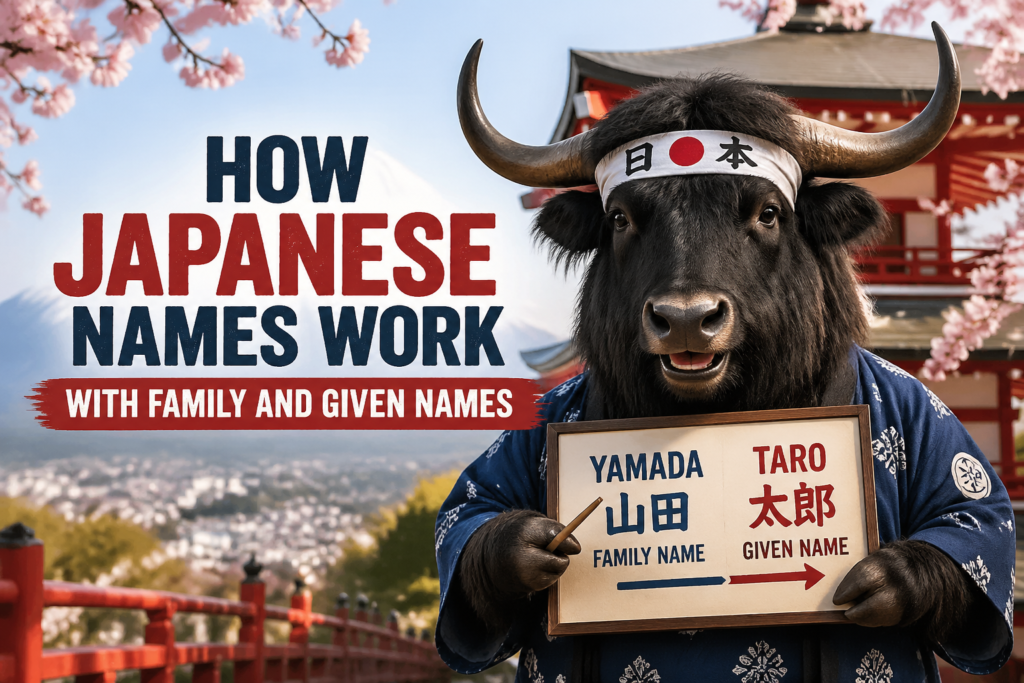
So if someone is called 山田 太郎 (Yamada Tarō), then 山田 (Yamada) is the family name and 太郎 (Tarō) is the given name.
That is the core rule. Simple. Useful. Sneakily easy to forget when you are staring at a name badge and trying to act like you know what is happening.
Key Words For Japanese Names
| Japanese | Rōmaji | English Meaning |
|---|---|---|
| 名字 | Myōji | Family name / surname |
| 苗字 | Myōji | Family name / surname |
| 姓 | Sei | Family name / surname |
| 名前 | Namae | Name |
| 下の名前 | Shita no namae | Given name / first name |
| フルネーム | Furū nēmu | Full name |
| 姓・名 | Sei / mei | Family name / given name |
| 順番 | Junban | Order / sequence |
| 日本式 | Nihonshiki | Japanese style |
| 西洋式 | Seiyōshiki | Western style |
One quick note: 名字 (myōji) and 苗字 (myōji) both mean “family name.” You will see both spellings, and yes, Japanese happily lets two versions exist because apparently one was not enough drama.
How Name Order Works
In Japanese, the normal order is:
Family name + Given name
Example:
田中 みどり (Tanaka Midori)
- 田中 (Tanaka) = family name
- みどり (Midori) = given name
In many English contexts, especially older ones, Japanese names were often written in Western order:
Midori Tanaka
That does not change the actual structure of the name. It only changes the writing order for the reader’s convenience. The person still has the same family name and given name.
Modern Japanese writing in English increasingly keeps the Japanese order, especially in books, news, academic writing, and official style. That is why you may see both orders depending on the situation.
Japanese order: family name first, given name second. Western order: given name first, family name second.
Useful Real-Life Name Phrases
| Japanese | Rōmaji | English Meaning | Example Sentence | Rōmaji | English Translation |
|---|---|---|---|---|---|
| お名前 | Onamae | Your name / polite name word | お名前は何ですか。 | Onamae wa nan desu ka. | What is your name? |
| 苗字 | Myōji | Family name | 苗字は田中です。 | Myōji wa Tanaka desu. | My family name is Tanaka. |
| 下の名前 | Shita no namae | Given name | 下の名前は花です。 | Shita no namae wa Hana desu. | My given name is Hana. |
| フルネーム | Furū nēmu | Full name | フルネームを書いてください。 | Furū nēmu o kaite kudasai. | Please write your full name. |
| 名字 | Myōji | Family name / surname | 名字はどれですか。 | Myōji wa dore desu ka. | Which one is the family name? |
| 姓 | Sei | Surname / family name | 姓と名を分けて書きます。 | Sei to mei o wakete kakimasu. | We write the surname and given name separately. |
| 名 | Mei | Given name | 名は太郎です。 | Mei wa Tarō desu. | The given name is Tarō. |
| 名前の順番 | Namae no junban | Name order | 名前の順番に気をつけてください。 | Namae no junban ni ki o tsukete kudasai. | Please pay attention to the name order. |
| 日本式 | Nihonshiki | Japanese style | 日本式では山田太郎です。 | Nihonshiki de wa Yamada Tarō desu. | In Japanese style, it is Yamada Tarō. |
| 西洋式 | Seiyōshiki | Western style | 西洋式では太郎山田ではありません。 | Seiyōshiki de wa Tarō Yamada de wa arimasen. | In Western style, it is not Tarō Yamada. |
| 敬称 | Keishō | Honorific title / respectful title | 敬称をつけます。 | Keishō o tsukemasu. | We add an honorific title. |
| さん | San | Mr. / Ms. / polite title | 田中さんは先生です。 | Tanaka-san wa sensei desu. | Mr./Ms. Tanaka is a teacher. |
Common Name Examples
Here are some simple examples of Japanese-style name order.
| Kanji | Rōmaji | Meaning |
|---|---|---|
| 佐藤 花子 | Satō Hanako | Family name Sato, given name Hanako |
| 鈴木 一郎 | Suzuki Ichirō | Family name Suzuki, given name Ichirō |
| 高橋 美咲 | Takahashi Misaki | Family name Takahashi, given name Misaki |
| 小林 健 | Kobayashi Ken | Family name Kobayashi, given name Ken |
| 山本 直子 | Yamamoto Naoko | Family name Yamamoto, given name Naoko |
These are just sample names, but the pattern is the same every time: family name first, then given name.
Reading Japanese Names In Text
In Japanese writing, names may appear in kanji, hiragana, katakana, or a mix. Foreign names are usually written in katakana, while Japanese names often use kanji with possible furigana for reading help.
Example:
山田 (やまだ / Yamada)
太郎 (たろう / Tarō)
If you can read the kanji, great. If not, the reading helps. Japanese is kind enough to say, “Here, let me help,” which is a nice change from some writing systems that simply stare at you.
For the basics of asking and answering names, this lesson pairs well with the phrase guide here: What Is Your Name? and My Name Is in Japanese.
Family Name Versus Given Name
The family name connects a person to their family line. The given name identifies the individual. In daily use, Japanese people often use both, but the given name alone may be used among close friends and family.
Important detail: if you are not sure which part is the family name, do not guess too confidently. That is how awkward mistakes are born and then invited to dinner.
| Part | Japanese Term | Role |
|---|---|---|
| Family name | 姓 / 苗字 / 名字 | Shared family identifier |
| Given name | 名 / 下の名前 | Personal name |
| Full name | フルネーム | Family name + given name |
Honorifics And Names
Japanese names are often followed by an honorific, especially さん (san). This is polite and very common.
Examples:
- 田中さん (Tanaka-san) = Mr./Ms. Tanaka
- 山本さん (Yamamoto-san) = Mr./Ms. Yamamoto
- 佐藤先生 (Satō sensei) = Teacher/Doctor Sato
Honorifics are not part of the name itself. They are added to show respect. The name structure stays the same: family name first, given name second.
Common Confusions
Here are the mix-ups that happen most often.
| Confusion | Simple Fix |
|---|---|
| “Is the first part always the given name?” | No. In Japanese order, the first part is usually the family name. |
| “Why do English books sometimes flip the order?” | To match Western reading habits. The actual name parts do not change. |
| “Does さん mean part of the name?” | No. It is an honorific title. |
| “Are 苗字 and 名前 the same?” | No. 苗字 means family name, while 名前 means name in general. |
| “Can I use only the given name?” | Sometimes, but usually only with close friends, family, or in casual situations. |
Practice: Spot The Name Order
Look at each name and decide which part is the family name and which part is the given name.
- 中村 結衣 (Nakamura Yui) → family name: 中村, given name: 結衣
- 木村 拓也 (Kimura Takuya) → family name: 木村, given name: 拓也
- 石川 里奈 (Ishikawa Rina) → family name: 石川, given name: 里奈
- 岡田 翔 (Okada Shō) → family name: 岡田, given name: 翔
Now try switching them into Western order:
- Yui Nakamura
- Takuya Kimura
- Rina Ishikawa
- Shō Okada
Same people. Same names. Just different order on the page.
Quick Reference Summary
- Japanese name order is usually family name + given name.
- 姓 (sei), 苗字 (myōji), and 名字 (myōji) can refer to the family name.
- 名 (mei) and 下の名前 (shita no namae) refer to the given name.
- さん (san) is a polite title, not part of the actual name.
- English sources may flip the order, but the name parts stay the same.
- When in doubt, check the full name carefully before assuming which word is which.
If you want to dig deeper into related name and introduction phrases, the next stop is the lesson on asking and answering names, which works nicely with this topic: What Is Your Name? and My Name Is in Japanese.
Yak Takeaway
Japanese names are not mysterious once you know the pattern. Family name first, given name second, and honorifics like さん are added for politeness. That’s the whole machine, really. Small machine, big importance.
Once you get used to the order, Japanese names become much easier to read, write, and say. And yes, your brain may still try to flip them at first. That is normal. Just gently correct it and move on like a language-learning pro who has seen this movie before.