Japanese Introductions • 名前(なまえ / namae)
Learn natural ways to ask and answer with polite, casual, and formal Japanese, plus the name words people actually use in real life.
The first time I introduced myself in Japanese, I used 私の名前は…です (watashi no namae wa … desu) with the seriousness of a courtroom confession. The other person smiled and answered with a breezy ケンです (Ken desu). That was it. Tiny sentence. Zero drama. My overprepared speech went straight into the emotional recycling bin.
That is the trick with names in Japanese: the textbook version is correct, but real conversation often trims the fat. Here you will learn how to ask “What is your name?” and say “My name is” in ways that fit actual situations, from chatting with a new friend to sounding properly polite at a front desk or interview.
A Tiny Native-Sounding Trick
Textbooks love 私の名前は〜です (watashi no namae wa … desu). It is correct. It is also longer than everyday conversation often needs. Once the context is clear, Japanese usually drops the obvious parts, so 〜です (… desu) often sounds more natural than a full “my name is” speech. Efficient? Yes. Slightly rude to your memorization efforts? Also yes.
The Fastest Real-Life Version
If your brain freezes, use one safe question and one safe answer. These four lines cover most beginner situations without sounding stiff.
| Phrase | Rōmaji | Meaning | Example (Japanese) | Example (Rōmaji) | Translation |
|---|---|---|---|---|---|
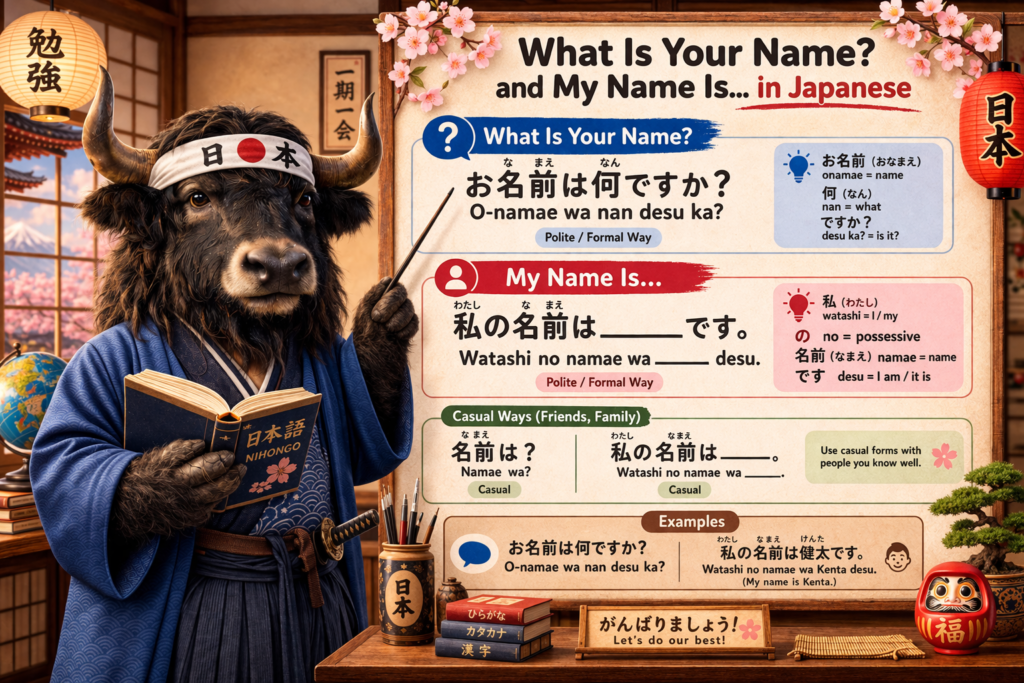
| お名前は何ですか。 | onamae wa nan desu ka | What is your name? (polite) | すみません、お名前は何ですか。 | Sumimasen, onamae wa nan desu ka. | Excuse me, what is your name? |
| 名前は? | namae wa? | What’s your name? (casual) | ねえ、名前は? | Nee, namae wa? | Hey, what’s your name? |
| ルカです。 | Ruka desu. | I’m Luka. | 初めまして、ルカです。 | Hajimemashite, Ruka desu. | Nice to meet you, I’m Luka. |
| ルカと申します。 | Ruka to moushimasu. | My name is Luka. (formal) | 初めまして、ルカと申します。 | Hajimemashite, Ruka to moushimasu. | Nice to meet you. My name is Luka. |
How To Ask Someone’s Name
English leans hard on the word “your.” Japanese often does not. That is why お名前は何ですか (onamae wa nan desu ka) usually sounds softer and more natural than a heavier direct-you sentence. Use the short forms with friends, the fuller forms in polite situations, and the very polite one when you are being extra careful.
| Phrase | Rōmaji | Meaning | Example (Japanese) | Example (Rōmaji) | Translation |
|---|---|---|---|---|---|
| お名前は何ですか。 | onamae wa nan desu ka | What is your name? (polite and safe) | 失礼ですが、お名前は何ですか。 | Shitsurei desu ga, onamae wa nan desu ka. | Excuse me, what is your name? |
| お名前は? | onamae wa? | Your name? (short polite) | 受付で、お名前は? | Uketsuke de, onamae wa? | At reception: your name? |
| 名前は? | namae wa? | What’s your name? (casual) | ねえ、名前は? | Nee, namae wa? | Hey, what’s your name? |
| お名前を伺ってもよろしいですか。 | onamae o ukagatte mo yoroshii desu ka | May I ask your name? (very polite) | ご予約の確認です。お名前を伺ってもよろしいですか。 | Goyoyaku no kakunin desu. Onamae o ukagatte mo yoroshii desu ka. | I’m checking your reservation. May I ask your name? |
| 名字は何ですか。 | myouji wa nan desu ka | What is your family name? | 名簿に書くので、名字は何ですか。 | Meibo ni kaku no de, myouji wa nan desu ka. | I’m writing it on the list, so what is your family name? |
| 下の名前は何ですか。 | shita no namae wa nan desu ka | What is your first name? | 名札を作るので、下の名前は何ですか。 | Nafuda o tsukuru no de, shita no namae wa nan desu ka. | We’re making name tags, so what is your first name? |
| 何とお呼びすればいいですか。 | nan to oyobi sureba ii desu ka | What should I call you? | 初めてなので、何とお呼びすればいいですか。 | Hajimete nanode, nan to oyobi sureba ii desu ka. | Since we’re meeting for the first time, what should I call you? |
How To Say “My Name Is”
You have four main lanes here: very short, standard polite, textbook-clear, and formal. All of them work. The trick is picking the shortest line that still fits the moment instead of swinging a grammar hammer at every introduction.
| Phrase | Rōmaji | Meaning | Example (Japanese) | Example (Rōmaji) | Translation |
|---|---|---|---|---|---|
| 〜です。 | … desu | I’m … | 初めまして、ノアです。 | Hajimemashite, Noa desu. | Nice to meet you, I’m Noah. |
| 私は〜です。 | watashi wa … desu | I am … | 私はノアです。 | Watashi wa Noa desu. | I am Noah. |
| 私の名前は〜です。 | watashi no namae wa … desu | My name is … | 私の名前はノアです。 | Watashi no namae wa Noa desu. | My name is Noah. |
| 〜と言います。 | … to iimasu | I’m called … | ノアと言います。 | Noa to iimasu. | I’m called Noah. |
| 〜と申します。 | … to moushimasu | My name is … (formal / humble) | 田中真理と申します。 | Tanaka Mari to moushimasu. | My name is Mari Tanaka. |
| 〜と呼んでください。 | … to yonde kudasai | Please call me … | アレクサンドラですが、アレックスと呼んでください。 | Arekusandora desu ga, Arekkusu to yonde kudasai. | My name is Alexandra, but please call me Alex. |
| フルネームは〜です。 | furunēmu wa … desu | My full name is … | フルネームはノア・スミスです。 | Furunēmu wa Noa Sumisu desu. | My full name is Noah Smith. |
| 愛称は〜です。 | aishou wa … desu | My nickname is … | 愛称はユッキーです。 | Aishou wa Yukkī desu. | My nickname is Yuki. |
| 初めまして。 | hajimemashite | Nice to meet you. | 初めまして、ミカです。 | Hajimemashite, Mika desu. | Nice to meet you, I’m Mika. |
| どうぞよろしくお願いします。 | douzo yoroshiku onegaishimasu | Please be kind to me / Nice to meet you | ミカです。どうぞよろしくお願いします。 | Mika desu. Douzo yoroshiku onegaishimasu. | I’m Mika. Nice to meet you. |
Name Words You Actually Need
These are the building blocks around names that show up all the time. Learn them once and a lot of beginner introductions suddenly stop looking like soup.
名前(なまえ)
Rōmaji: namae
Meaning: name
In A Sentence:
私の名前はレイです。
Watashi no namae wa Rei desu.
My name is Rei.
お名前(おなまえ)
Rōmaji: onamae
Meaning: name (polite)
In A Sentence:
お名前は何ですか。
Onamae wa nan desu ka.
What is your name?
名字(みょうじ)
Rōmaji: myouji
Meaning: family name
In A Sentence:
私の名字は木村です。
Watashi no myouji wa Kimura desu.
My family name is Kimura.
下の名前(したのなまえ)
Rōmaji: shita no namae
Meaning: first name
In A Sentence:
下の名前はゆいです。
Shita no namae wa Yui desu.
My first name is Yui.
呼ぶ(よぶ)
Rōmaji: yobu
Meaning: to call
In A Sentence:
ケンと呼んでください。
Ken to yonde kudasai.
Please call me Ken.
申す(もうす)
Rōmaji: mousu
Meaning: to say; to be called (humble)
In A Sentence:
佐藤と申します。
Satou to moushimasu.
My name is Sato.
愛称(あいしょう)
Rōmaji: aishou
Meaning: nickname
In A Sentence:
愛称はケンです。
Aishou wa Ken desu.
My nickname is Ken.
片仮名(かたかな)
Rōmaji: katakana
Meaning: katakana script
In A Sentence:
外国の名前は片仮名で書くことが多いです。
Gaikoku no namae wa katakana de kaku koto ga ooi desu.
Foreign names are often written in katakana.
Mini Dialogues You Can Actually Use
Casual
A: ねえ、名前は?
Nee, namae wa?
Hey, what’s your name?
B: エマです。エムと呼んでください。
Ema desu. Emu to yonde kudasai.
I’m Emma. Please call me Em.
Polite
A: 初めまして。お名前は何ですか。
Hajimemashite. Onamae wa nan desu ka.
Nice to meet you. What is your name?
B: アンナと言います。どうぞよろしくお願いします。
Anna to iimasu. Douzo yoroshiku onegaishimasu.
I’m Anna. Nice to meet you.
Formal
A: 失礼ですが、お名前を伺ってもよろしいですか。
Shitsurei desu ga, onamae o ukagatte mo yoroshii desu ka.
Excuse me, may I ask your name?
B: 株式会社みどりの田中一郎と申します。
Kabushikigaisha Midori no Tanaka Ichirou to moushimasu.
My name is Ichiro Tanaka from Midori Co., Ltd.
Cultural Notes That Save Awkward Moments
Foreign names usually go in katakana. If your name is Claire, it will usually be written as クレア (Kurea), not with dramatic mystery kanji you found on a random corner of the internet. The goal is sound, not letter-by-letter spelling.
Family name often comes first in Japanese order. So 田中花子 is Tanaka Hanako, with the family name first. In formal settings, this order matters more. In English-speaking environments, people may still switch to the local order, so stay flexible.
Do not honorify yourself. Skip さん, ちゃん, and くん when saying your own name. Also skip the polite お in your own 名前. You can ask about their お名前, but your own is just 名前.
You can often drop 私は. Once it is obvious you are talking about yourself, Japanese prefers not repeating the same subject over and over. That is why エマです (Ema desu) can sound better than a full sentence every single time.
Common Mistakes And Fixes
- Textbook-heavy: あなたの名前は何ですか。
Anata no namae wa nan desu ka.
Meaning: What is your name?
Better: お名前は何ですか。
Onamae wa nan desu ka.
In A Sentence: 受付では、お名前は何ですか。のほうが自然です。
Uketsuke de wa, onamae wa nan desu ka. no hou ga shizen desu.
At a reception desk, “Onamae wa nan desu ka?” sounds more natural. - Too polite about yourself: 私のお名前はノアです。
Watashi no onamae wa Noa desu.
Meaning: My honorable name is Noah. Nope. That is not the vibe.
Better: 私の名前はノアです。
Watashi no namae wa Noa desu.
In A Sentence: 自分のことなら、私の名前はノアです。と言います。
Jibun no koto nara, watashi no namae wa Noa desu. to iimasu.
When talking about yourself, say “Watashi no namae wa Noa desu.” - Adding さん to your own name: 田中さんです。
Tanaka-san desu.
Meaning: I am Mr./Ms. Tanaka. A little self-congratulatory, honestly.
Better: 田中です。 / 田中と申します。
Tanaka desu. / Tanaka to moushimasu.
In A Sentence: 初めまして、田中です。
Hajimemashite, Tanaka desu.
Nice to meet you, I’m Tanaka. - Using the full long version every time: 私は〜です。私の名前は〜です。
Watashi wa … desu. Watashi no namae wa … desu.
Meaning: I am … My name is …
Better: Often just use 〜です。
In A Sentence: 初めまして、エマです。
Hajimemashite, Ema desu.
Nice to meet you, I’m Emma.
Practice Time
Try these before peeking at the answers.
- Make this polite: 名前は?
- Make this shorter and more natural: 私の名前はリアムです。
- Add a nickname line to this: 私はアレクサンドラです。
- Pick the best line for a job interview: レオです。 / レオと申します。 / 名前はレオです。
- Translate this into natural Japanese: “Nice to meet you. My name is Mei. Please call me Mei-chan.”
Answer Key
- お名前は何ですか。
Onamae wa nan desu ka.
What is your name? - リアムです。
Riamu desu.
I’m Liam. - 私はアレクサンドラです。アレックスと呼んでください。
Watashi wa Arekusandora desu. Arekkusu to yonde kudasai.
I’m Alexandra. Please call me Alex. - レオと申します。
Reo to moushimasu.
My name is Leo. (formal) - 初めまして。メイと申します。メイちゃんと呼んでください。
Hajimemashite. Mei to moushimasu. Mei-chan to yonde kudasai.
Nice to meet you. My name is Mei. Please call me Mei-chan.
Quick Reference Summary
- Safe polite question: お名前は何ですか。 / onamae wa nan desu ka
- Casual question: 名前は? / namae wa?
- Easiest answer: 〜です。 / … desu
- Standard answer: 私は〜です。 / watashi wa … desu
- Textbook-clear answer: 私の名前は〜です。 / watashi no namae wa … desu
- Formal answer: 〜と申します。 / … to moushimasu
- Nickname line: 〜と呼んでください。 / … to yonde kudasai
- Do not overuse: あなた, self-honorifics, and giant unnecessary sentences
Your Emergency Three-Line Intro
初めまして。
Hajimemashite.
Nice to meet you.
エマです。
Ema desu.
I’m Emma.
どうぞよろしくお願いします。
Douzo yoroshiku onegaishimasu.
Nice to meet you / Please be kind to me.
That is enough. Really. You do not need a full autobiography and a laser pointer. Three calm lines will carry you surprisingly far.