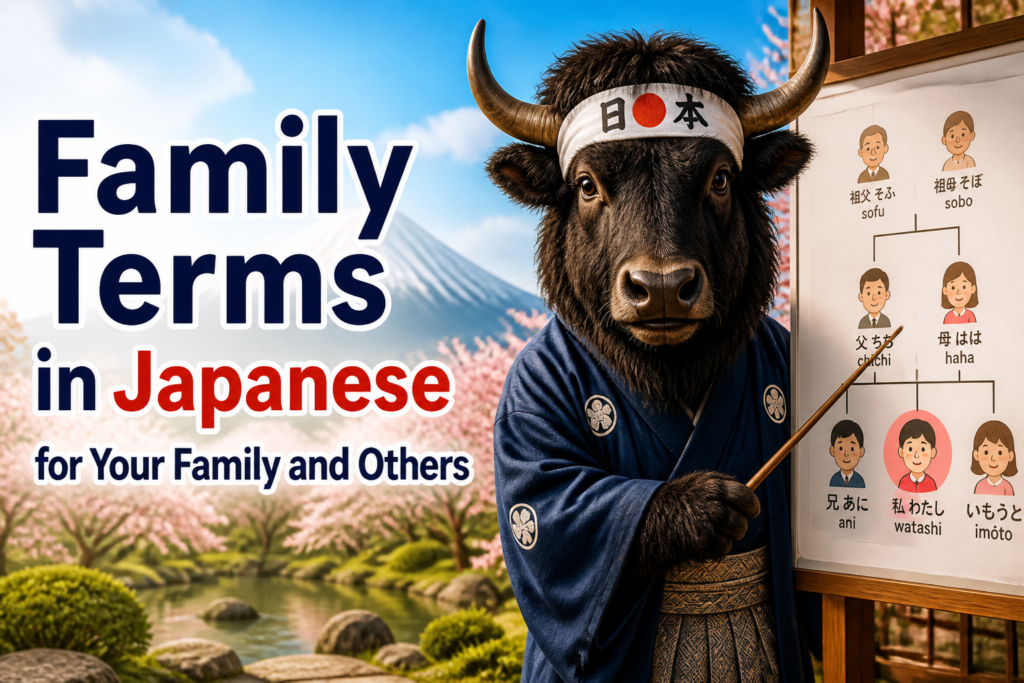
Japanese family words are one of those topics that look simple until they suddenly are not. Of course there is a word for “mother.” Then Japanese politely says, “Yes, but which mother, whose mother, and are we talking about her or to her?” Charming, really.
This chart will help you talk about your own family and other people’s family members without mixing them up. That distinction matters a lot in Japanese, and it shows up everywhere in daily speech, from introductions to emails to casual conversation. For a broader overview of Japanese basics, you can also visit the learn Japanese page.
One useful pattern to remember: Japanese often uses different words for your family and someone else’s family. So the “same” person can have two common labels depending on the situation. It is not a trap. It is just Japanese being very Japanese.
Core Family Terms
| Kanji | Rōmaji | Meaning | Example |
|---|---|---|---|
| 家族 | kazoku | family | 私の家族は五人です。 Watashi no kazoku wa go-nin desu. My family has five people. |
| 両親 | ryōshin | parents | 両親は大阪にいます。 Ryōshin wa Ōsaka ni imasu. My parents are in Osaka. |
| 父 | chichi | my father | 父は会社員です。 Chichi wa kaishain desu. My father is an office worker. |
| 母 | haha | my mother | 母は料理が上手です。 Haha wa ryōri ga jōzu desu. My mother is good at cooking. |
| 兄 | ani | my older brother | 兄は東京に住んでいます。 Ani wa Tōkyō ni sunde imasu. My older brother lives in Tokyo. |
| 姉 | ane | my older sister | 姉は英語を教えています。 Ane wa eigo o oshiete imasu. My older sister teaches English. |
| 弟 | otōto | my younger brother | 弟はまだ学生です。 Otōto wa mada gakusei desu. My younger brother is still a student. |
| 妹 | imōto | my younger sister | 妹は絵が好きです。 Imōto wa e ga suki desu. My younger sister likes drawing. |
| 祖父 | sofu | grandfather | 祖父は九十歳です。 Sofu wa kyūjussai desu. My grandfather is ninety years old. |
| 祖母 | sofu | grandmother | 祖母は花が好きです。 Sobo wa hana ga suki desu. My grandmother likes flowers. |
Talking About Other People’s Family
| Kanji | Rōmaji | Meaning | Example |
|---|---|---|---|
| お父さん | otōsan | someone else’s father; also polite “dad” | 田中さんのお父さんは医者です。 Tanaka-san no otōsan wa isha desu. Mr. Tanaka’s father is a doctor. |
| お母さん | okāsan | someone else’s mother; also polite “mom” | 友達のお母さんに会いました。 Tomodachi no okāsan ni aimashita. I met my friend’s mother. |
| お兄さん | onīsan | someone else’s older brother | 彼のお兄さんは背が高いです。 Kare no onīsan wa se ga takai desu. His older brother is tall. |
| お姉さん | onēsan | someone else’s older sister | 山田さんのお姉さんは大学生です。 Yamada-san no onēsan wa daigakusei desu. Ms. Yamada’s older sister is a university student. |
| 弟さん | otōtosan | someone else’s younger brother | 弟さんはサッカーが好きです。 Otōtosan wa sakkā ga suki desu. His younger brother likes soccer. |
| 妹さん | imōtosan | someone else’s younger sister | 妹さんはピアノを習っています。 Imōtosan wa piano o naratte imasu. Her younger sister is learning piano. |
| お祖父さん | ojīsan | someone else’s grandfather; also polite “grandpa” | お祖父さんは毎朝散歩します。 Ojīsan wa maiasa sampo shimasu. Her grandfather takes a walk every morning. |
| お祖母さん | obāsan | someone else’s grandmother; also polite “grandma” | お祖母さんの料理はおいしいです。 Obāsan no ryōri wa oishii desu. Her grandmother’s cooking is delicious. |
Here is the big idea: family words change depending on whose family you are talking about. In polite conversation, your own family is often expressed with the plain forms like 父 (chichi) and 母 (haha), while someone else’s family usually gets the respectful forms like お父さん (otōsan) and お母さん (okāsan).
Japanese family words are less about biology and more about social perspective. In other words: the grammar has manners. Very efficient, very opinionated.
Useful Phrases For Real Life
| Kanji | Rōmaji | Meaning | Example |
|---|---|---|---|
| 私の家族 | watashi no kazoku | my family | 私の家族は四人です。 Watashi no kazoku wa yon-nin desu. My family has four people. |
| うちの母 | uchi no haha | my mother; my mom | うちの母は忙しいです。 Uchi no haha wa isogashii desu. My mom is busy. |
| うちの父 | uchi no chichi | my father; my dad | うちの父は運転が好きです。 Uchi no chichi wa unten ga suki desu. My dad likes driving. |
| ご家族 | gokazoku | your family; polite family term | ご家族は元気ですか。 Gokazoku wa genki desu ka. Is your family well? |
| ご両親 | goryōshin | your parents; polite | ご両親によろしくお伝えください。 Goryōshin ni yoroshiku otsutae kudasai. Please give my regards to your parents. |
| 兄弟 | kyōdai | siblings; brothers | 兄弟は何人いますか。 Kyōdai wa nan-nin imasu ka. How many siblings do you have? |
| 姉妹 | shimai | sisters | 姉妹で買い物に行きました。 Shimai de kaimono ni ikimashita. The sisters went shopping together. |
| 一人っ子 | hitorikko | only child | 私は一人っ子です。 Watashi wa hitorikko desu. I am an only child. |
| 親戚 | shinseki | relatives | 親戚がたくさんいます。 Shinseki ga takusan imasu. I have many relatives. |
| 祖父母 | sofubo | grandparents | 祖父母と住んでいました。 Sofubo to sunde imashita. I used to live with my grandparents. |
| 義理の母 | giri no haha | mother-in-law; stepmother depending on context | 義理の母は親切です。 Giri no haha wa shinsetsu desu. My mother-in-law is kind. |
| 義理の父 | giri no chichi | father-in-law; stepfather depending on context | 義理の父に会いました。 Giri no chichi ni aimashita. I met my father-in-law. |
If you want to learn how Japanese labels family members in broader social life, a simple reference like Japanese language can be helpful for the big picture. Still, the real trick is not memorizing a giant pile of words. It is remembering whose family the word is about.
Common Patterns To Remember
| Pattern | Meaning | Example |
|---|---|---|
| 私の + plain family word | used for your own family | 私の母は教師です。 Watashi no haha wa kyōshi desu. My mother is a teacher. |
| お + family word + さん | polite way to talk about someone else’s family member | お母さんはお元気ですか。 Okāsan wa ogenki desu ka. Is your mother well? |
| ご + 家族 / 両親 | polite “your family” or “your parents” | ご家族は何人ですか。 Gokazoku wa nan-nin desu ka. How many people are in your family? |
| うちの + family word | casual “my” family member | うちの兄は歌が上手です。 Uchi no ani wa uta ga jōzu desu. My older brother sings well. |
| 〜さん | respectful for someone else’s family member | お兄さんは学生ですか。 Onīsan wa gakusei desu ka. Is your older brother a student? |
Notice how the polite forms often add お or ご. That little prefix does a lot of heavy lifting. Japanese loves a good shortcut that still sounds respectful. Efficient and fancy. Rude? Never.
Common Mistakes And Easy Fixes
| Common Mistake | Better Form | Why |
|---|---|---|
| 私のお母さん | 私の母 | For your own mother, plain form is usually better in neutral speech. |
| 彼の母 in casual talk about someone else’s mom | 彼のお母さん | Someone else’s family usually takes the respectful form. |
| 私の父さん | 私の父 or お父さん if speaking directly | 父さん is not the normal standard form for your own father. |
| 姉 when you mean “my older sister” in every situation | 姉 for your family, お姉さん for someone else’s | The perspective matters. |
| 兄 and 弟 mixed up | 兄 = older brother, 弟 = younger brother | Age order matters more than English “brother” does. |
Quick Practice
- Change “my mother” into Japanese: 母 / haha / mother
- Change “your mother” into Japanese: お母さん / okāsan / your mother
- Change “my older brother” into Japanese: 兄 / ani / my older brother
- Change “his older brother” into Japanese: お兄さん / onīsan / his older brother
- Change “my family” into Japanese: 家族 / kazoku / family
- Change “your parents” into polite Japanese: ご両親 / goryōshin / your parents
Try saying these out loud with the example sentence after each word. That extra step matters. Japanese pronunciation gets easier when the word is attached to a real sentence instead of floating around like an anxious vocabulary ghost.
Quick Reference Summary
- Self family: usually plain forms like 父 (chichi), 母 (haha), 兄 (ani)
- Other people’s family: often polite forms like お父さん (otōsan), お母さん (okāsan), お兄さん (onīsan)
- Parents: 両親 (ryōshin) or polite ご両親 (goryōshin)
- Siblings: 兄弟 (kyōdai) for brothers or siblings in general, 姉妹 (shimai) for sisters
- Grandparents: 祖父母 (sofubo)
- Relatives: 親戚 (shinseki)
For more structured practice, it helps to review family words alongside basic introductions and polite expressions on the related lesson page. The more you pair words with real contexts, the less likely you are to say something polite in the wrong direction. Which, yes, Japanese absolutely notices.
The yak takeaway: Japanese family terms are not just vocabulary. They are a social map. Learn the plain forms for your own family, the polite forms for other people’s families, and you will already sound much more natural. That is a very useful win for such a small set of words.