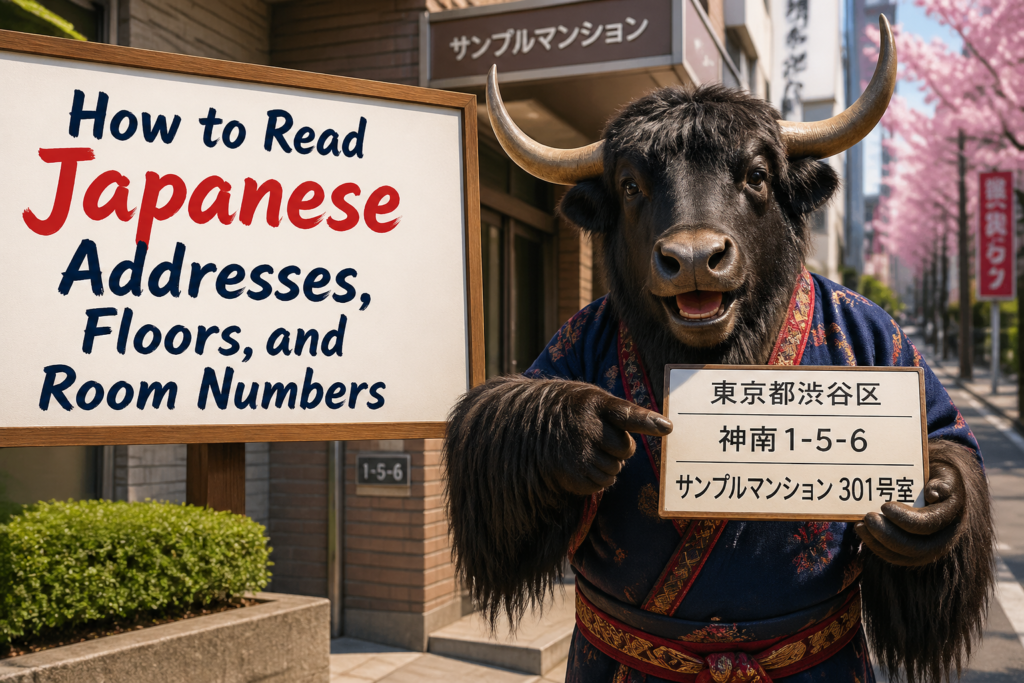
Japanese addresses can look like a puzzle box at first. The numbers seem to be “in the wrong order,” room numbers sometimes feel weirdly compact, and buildings love to hide behind a name that sounds simple until you have to find them in real life. Charming, really.
The good news: once you learn the pattern, Japanese addresses become very readable. In this guide, you’ll learn how to read address parts, floors, room numbers, and building names in simple Japanese. If you want a broader place vocabulary refresher, the article on places and buildings in Japanese is a nice companion.
By the end, you should be able to read a sign, say the address out loud, and not panic when a Japanese apartment building decides to be “Room 503” on the “5th floor” but somehow not where you expected. Japan enjoys a little suspense.
The Big Idea: Japanese Addresses Go From Large To Small
In English, people often say an address from the smallest detail to the largest: room, floor, building, street, city. In Japanese, the order usually goes from large area to small location. So you move from prefecture to city to ward to district to block and building.
This is why a Japanese address can feel upside down at first. It is not wrong. It is just Japan being logically unhelpful for English speakers, which is basically a tradition at this point.
| Kanji | Rōmaji | Meaning | Example | Rōmaji Example | English Translation |
|---|---|---|---|---|---|
| 住所 | jūsho | address | 住所を教えてください。 | Jūsho o oshiete kudasai. | Please tell me your address. |
| 番地 | banchi | block number / lot number | 番地を確認します。 | Banchi o kakunin shimasu. | I will check the block number. |
| 建物 | tatemono | building | 建物の名前は何ですか。 | Tatemono no namae wa nan desu ka. | What is the building’s name? |
| 部屋 | heya | room | 部屋は五百三です。 | Heya wa gohyaku-san desu. | The room is 503. |
Useful Address Words You Will See All The Time
| Kanji | Rōmaji | Meaning | Example | Rōmaji Example | English Translation |
|---|---|---|---|---|---|
| 都 | to | metropolis; Tokyo-to | 東京都に住んでいます。 | Tōkyō-to ni sunde imasu. | I live in Tokyo Metropolis. |
| 道 | dō | prefecture-level area; Hokkaidō | 北海道は広いです。 | Hokkaidō wa hiroi desu. | Hokkaido is large. |
| 府 | fu | prefecture-level area; Osaka/Kyoto | 大阪府へ行きます。 | Ōsaka-fu e ikimasu. | I’m going to Osaka Prefecture. |
| 県 | ken | prefecture | 神奈川県にあります。 | Kanagawa-ken ni arimasu. | It is in Kanagawa Prefecture. |
| 市 | shi | city | 福岡市に行きます。 | Fukuoka-shi ni ikimasu. | I’m going to Fukuoka City. |
| 区 | ku | ward | 渋谷区はにぎやかです。 | Shibuya-ku wa nigiyaka desu. | Shibuya Ward is lively. |
| 町 | machi / chō | town / district | この町は静かです。 | Kono machi wa shizuka desu. | This town is quiet. |
| 丁目 | chōme | district block | 三丁目です。 | San-chōme desu. | It is 3-chōme. |
| 番地 | banchi | block / lot number | 二番地を見てください。 | Ni-banchi o mite kudasai. | Please look for block 2. |
| 号 | gō | number | 十号の建物です。 | Jū-gō no tatemono desu. | It is building number 10. |
How Japanese Addresses Are Usually Read
A typical Japanese address may include a prefecture, city or ward, neighborhood, block, building, floor, and room number. The exact order can vary a little, but the pattern stays familiar once you know the parts.
| Part | Common Reading | What It Means | Example | Rōmaji Example | English |
|---|---|---|---|---|---|
| Prefecture | Tokyo-to / Osaka-fu / Kanagawa-ken | large region | 東京都 | Tōkyō-to | Tokyo Metropolis |
| City / Ward | shi / ku | city or ward | 渋谷区 | Shibuya-ku | Shibuya Ward |
| Chōme | 1-chōme, 2-chōme, 3-chōme | district block | 三丁目 | san-chōme | 3-chōme |
| Banchi | 1-banchi, 2-banchi | lot / block number | 二番地 | ni-banchi | block 2 |
| Gō | 1-gō, 10-gō | number | 十号 | jū-gō | number 10 |
A simple example might look like this:
東京都渋谷区神南一丁目1番地1号
Tokyō-to Shibuya-ku Jinnan 1-chōme 1-banchi 1-gō
Tokyo Metropolis, Shibuya Ward, Jinnan 1-chōme, block 1, number 1
That looks intense, but it is just the address broken into neat pieces. The trick is not to stare at the whole thing like it owes you money. Read it piece by piece.
Floor Numbers In Japanese
Floor numbers are usually very straightforward. The common word is 階 (kai), meaning floor. So 1階 is the first floor, 2階 is the second floor, and so on.
| Kanji | Rōmaji | Meaning | Example | Rōmaji Example | English Translation |
|---|---|---|---|---|---|
| 一階 | ikkai | 1st floor | 一階です。 | Ikkai desu. | It is the first floor. |
| 二階 | nikai | 2nd floor | 二階にあります。 | Nikai ni arimasu. | It is on the second floor. |
| 三階 | sankai | 3rd floor | 三階へ行きます。 | Sankai e ikimasu. | I’m going to the third floor. |
| 四階 | yonkai | 4th floor | 四階の部屋です。 | Yonkai no heya desu. | It is a room on the 4th floor. |
| 五階 | gokai | 5th floor | 五階まで上がります。 | Gokai made agari masu. | I will go up to the 5th floor. |
One useful detail: in buildings, Japanese people often say 2階 for the second floor, not “2nd level” or anything fancy. If you see 地下1階 (chika ikkai), that means basement level 1.
| Kanji | Rōmaji | Meaning | Example | Rōmaji Example | English Translation |
|---|---|---|---|---|---|
| 地下 | chika | basement / underground | 地下にあります。 | Chika ni arimasu. | It is underground. |
| 地下一階 | chika ikkai | B1 | 地下一階です。 | Chika ikkai desu. | It is B1. |
Room Numbers In Japanese
Room numbers usually combine the floor and the room. For example, 503号室 means room 503. The 号室 (gōshitsu) part means “room number.”
| Kanji | Rōmaji | Meaning | Example | Rōmaji Example | English Translation |
|---|---|---|---|---|---|
| 号室 | gōshitsu | room number | 号室は何ですか。 | Gōshitsu wa nan desu ka. | What is the room number? |
| 三階五〇三号室 | sankai gohyaku-san gōshitsu | room 503 on the 3rd floor? Actually depends on building style | 三階五〇三号室です。 | Sankai gohyaku-san gōshitsu desu. | It is room 503 on the 3rd floor. |
| 五〇三号室 | gohyaku-san gōshitsu | room 503 | 五〇三号室に行ってください。 | Gohyaku-san gōshitsu ni itte kudasai. | Please go to room 503. |
Here is the most common pattern in apartment buildings and hotels:
- 101号室 = room 101
- 205号室 = room 205
- 503号室 = room 503
- 1002号室 = room 1002
Sometimes the room number matches the floor. For example, 503 often means the room is on the 5th floor. But not always. Buildings can be creative in the same way a cat is creative about ignoring you.
Building Names And Helpful Words
Building names often include words like ビル (biru, building), マンション (manshon, apartment building), or アパート (apāto, apartment). Some signs use kanji, and some use katakana, so keep your eyes open.
| Kanji / Writing | Rōmaji | Meaning | Example | Rōmaji Example | English Translation |
|---|---|---|---|---|---|
| ビル | biru | building | ビルの前で待ってください。 | Biru no mae de matte kudasai. | Please wait in front of the building. |
| マンション | manshon | apartment building | マンションに住んでいます。 | Manshon ni sunde imasu. | I live in an apartment building. |
| アパート | apāto | apartment | アパートはあそこです。 | Apāto wa asoko desu. | The apartment is over there. |
| 入口 | iriguchi | entrance | 入口は右です。 | Iriguchi wa migi desu. | The entrance is on the right. |
| 出口 | deguchi | exit | 出口から出ます。 | Deguchi kara demasu. | I will go out from the exit. |
| 階段 | kaidan | stairs | 階段で上がります。 | Kaidan de agarimasu. | I will go up the stairs. |
| エレベーター | erebētā | elevator | エレベーターを使います。 | Erebētā o tsukaimasu. | I will use the elevator. |
How To Say “Please Go To…”
This is one of the most useful travel phrases. You can use it when giving directions, checking into a hotel, or helping someone find a room.
| Kanji | Rōmaji | Meaning | Example | Rōmaji Example | English Translation |
|---|---|---|---|---|---|
| 〜へ行ってください | ~ e itte kudasai | Please go to ~ | 三階へ行ってください。 | Sankai e itte kudasai. | Please go to the third floor. |
| 〜にあります | ~ ni arimasu | It is at / in ~ | 二階にあります。 | Nikai ni arimasu. | It is on the second floor. |
| 〜です | ~ desu | It is ~ | 五〇三号室です。 | Gohyaku-san gōshitsu desu. | It is room 503. |
| 〜を探しています | ~ o sagashite imasu | I am looking for ~ | 受付を探しています。 | Uketsuke o sagashite imasu. | I am looking for the reception desk. |
Common Address Patterns To Recognize
These patterns show up again and again. Learn the shape, and the rest becomes much less scary.
- 東京都渋谷区神南一丁目2番3号 = Tokyo Metropolis, Shibuya Ward, Jinnan 1-chōme, block 2, number 3
- 大阪府大阪市北区梅田3丁目1-1 = Osaka Prefecture, Osaka City, Kita Ward, Umeda 3-chōme, 1-1
- 神奈川県横浜市西区みなとみらい2-2-1 = Kanagawa Prefecture, Yokohama City, Nishi Ward, Minato Mirai 2-2-1
- 北海道札幌市中央区南1条西2丁目 = Hokkaido, Sapporo City, Chuo Ward, South 1 West 2-chōme
Notice how some addresses use kanji for the area and numbers for the block, while others mix in hiragana or even regular digits. Japanese addresses are practical, not precious. They just want the mail to arrive.
Practice: Read These Out Loud
| Japanese | Rōmaji | English Meaning |
|---|---|---|
| 三階 | sankai | third floor |
| 五〇二号室 | gohyaku-ni gōshitsu | room 502 |
| 二丁目 | ni-chōme | 2-chōme |
| 東京都 | Tōkyō-to | Tokyo Metropolis |
| 大阪府 | Ōsaka-fu | Osaka Prefecture |
| 地下一階 | chika ikkai | basement level 1 |
Now try turning these into full sentences:
- 五階です。 — Gokai desu. — It is the 5th floor.
- 三階にあります。 — Sankai ni arimasu. — It is on the 3rd floor.
- 二〇五号室です。 — Nihyaku-go gōshitsu desu. — It is room 205.
- 入口は右です。 — Iriguchi wa migi desu. — The entrance is on the right.
Common Mistakes And Easy Fixes
| Common Mistake | Better Way | Why |
|---|---|---|
| Reading 二階 as “2nd storey” in a weird literal way | nikai = second floor | Just use the normal floor word 階. |
| Assuming room 503 is always on the 5th floor | Check the building sign first | Room numbering patterns can vary. |
| Forgetting 号室 | Say 503号室 or 五〇三号室 | It clearly shows “room number.” |
| Reading addresses from smallest to largest | Read large to small | That is the usual Japanese style. |
| Not recognizing ward names like 区 | Learn the common place markers | They help you split the address fast. |
Quick Reference Summary
- 住所 (jūsho) = address
- 階 (kai) = floor
- 号室 (gōshitsu) = room number
- 建物 (tatemono) = building
- 番地 (banchi) = block / lot number
- 丁目 (chōme) = district block
- 区 (ku) = ward
- 市 (shi) = city
- 県 (ken) = prefecture
- マンション (manshon) = apartment building
- ビル (biru) = building
- 地下 (chika) = basement / underground
If you remember only one thing, remember this: Japanese addresses are read in pieces, from big to small. Once the pattern clicks, the rest is just number practice and a little sign-reading detective work.
For more place vocabulary, keep exploring the main Japanese learning hub, and if you want a quick vocabulary boost for locations, buildings, and everyday places, the guide on places and buildings in Japanese is a good next stop. Japanese addresses may look scary, but honestly, they are just organized chaos with better manners.